

Budget Tanzania Safari 2026: Cost Glossary & Fee Breakdown
TL;DR
A budget Tanzania safari costs $180 to $250 per person per day for camping, or $250 to $350 per day on a group-joining basis. The biggest cost lever is choosing a shared vehicle over a private one, which cuts costs 30 to 50%. Park fees are fixed and non-negotiable, but timing your trip during green season (March through May) can save 30 to 40% on accommodation. This glossary defines every term you’ll encounter in a safari quote so you can compare operators accurately.
Safari quotes are confusing on purpose. One operator lists “conservation fees included,” another says “park fees extra,” and a third bundles everything into a single per-person rate without explaining what’s inside. If you’re planning a budget Tanzania safari, you need to decode the vocabulary before you can compare prices.
This glossary defines every term that shows up in safari quotes, grouped by category, with the actual 2026 numbers behind each one. The goal is simple: once you understand these terms, no operator can surprise you with hidden costs.
For a broader look at pricing across the region, see our East Africa safari cost guide.
Quick Answer: What Does a Budget Tanzania Safari Cost in 2026? If you're planning a budget Tanzania safari in 2026, expect to pay:
|
Safari Type |
Average Cost |
|---|---|
|
Group camping safari |
$180–$250 per person per day |
|
Private camping safari |
$250–$400 per person per day |
|
Mid-range private safari |
$400–$700 per person per day |
|
Luxury safari |
$700–$2,500+ per person per day |
Most budget travelers spend $1,300 to $2,000 for a 7-day Northern Circuit safari including accommodation, meals, guide, transportation, and park fees.
The biggest factors affecting price are: - Shared vs private vehicle - Number of safari days - Time of year - Accommodation style - Whether Ngorongoro Crater is included
Understanding safari pricing terminology makes it much easier to compare quotes and avoid hidden costs.
How Tanzania Safari Prices Are Calculated
Most safari operators calculate prices using five major components:
-
Government park fees
-
Accommodation costs
-
Vehicle and guide costs
-
Meals and camping services
-
Operator overhead and profit
The largest variable is the vehicle. A private Land Cruiser costs nearly the same whether two people or six people occupy it. That's why joining a group safari dramatically reduces the price per traveler.
A typical budget safari cost breakdown looks like this:
|
Cost Component |
Approximate Share |
|---|---|
|
Accommodation |
35–40% |
|
Park fees |
20–30% |
|
Vehicle and guide |
20% |
|
Meals |
10% |
|
Administration |
5% |
|
Tips |
Not included |
Fee and Cost Terms
These are the line items that make up the largest fixed portion of any Tanzania safari budget. Unlike accommodation and vehicle costs, most fees are set by the government and cannot be negotiated.
Conservation Fee
The per-person, per-24-hour entry fee charged by TANAPA (Tanzania National Parks Authority) for entering a national park. Every visitor pays this regardless of accommodation type. Serengeti charges $60 per adult per day before VAT. Tarangire, Lake Manyara, and Arusha National Park charge $45 per adult per day before VAT.
Budget impact: This is a fixed cost. A 4-day safari visiting Serengeti and Tarangire will rack up roughly $210 to $330 in conservation fees alone per person, depending on how many days you spend in each park.
Concession Fee
An additional per-person, per-night charge applied when you sleep inside a national park. Every lodge and tented camp operating within the Serengeti pays a concession fee to TANAPA, currently $70.80 per person per 24-hour period (VAT included). This fee exists on top of the standard conservation fee.
Budget impact: Sleeping outside the park eliminates this charge entirely. Budget camping safaris often use campsites just outside park boundaries for exactly this reason, saving $50 to $71 per night per person. When comparing quotes, ask whether the accommodation is inside or outside the park.
Crater Service Fee
A per-vehicle charge for descending into the Ngorongoro Crater floor, levied by the Ngorongoro Conservation Area Authority (NCAA). The 2026 rate is approximately $295 per vehicle per trip.
Budget impact: On a group-joining safari with six passengers, this splits to about $49 per person. On a private safari for two, it’s $147.50 each. This single fee is one reason group safaris cost so much less at Ngorongoro.
18% VAT
Tanzania’s value-added tax applies on top of base park fees. When a source says Serengeti entry is “$60 per day,” the actual amount after VAT is closer to $70.80. When another source quotes “$82.60,” they may be including VAT plus the concession fee.
Budget impact: Always ask your operator whether quoted park fees are VAT-inclusive. This single clarification can reveal $10 to $20 per day in costs that seemed included but weren’t. Our guide to common safari booking mistakes covers this and other quote-reading pitfalls.
Park Fee Tiers
TANAPA groups parks into pricing bands. Serengeti and Nyerere (formerly Selous) sit in the highest tier. Tarangire, Lake Manyara, and Arusha National Park are in a lower tier. Ngorongoro has its own separate fee structure because it’s managed by the NCAA, not TANAPA.
Budget impact: Building an itinerary around lower-tier parks saves $15 to $20 per person per day in entry fees. A three-day Tarangire-focused safari costs meaningfully less in fees than three days in the Serengeti.
GePG (Government e-Payment Gateway)
Tanzania’s cashless payment system for all national park transactions. All payments require a government “Control Number” generated by the park authority. Self-drivers must pay via Visa or Mastercard at the gate. Cash is not accepted anywhere in the park system.
Budget impact: If you’re considering a self-drive safari, this is a genuine gotcha. Practitioners on travel forums report confusion and delays at gates when cards are declined or the system is slow. Most budget travelers avoid this headache entirely by booking through an operator who handles GePG payments in advance. You’ll also want to sort out your Tanzania visa and e-visa before worrying about park payments.
Single Supplement
The extra charge applied when one person occupies a room or tent designed for two. Standard across the hotel and safari industry worldwide, but particularly painful on safari because rates are already high.
Budget impact: Can add $50 to $150 per night. Solo travelers on a budget Tanzania safari should strongly consider group-joining departures, which typically eliminate the single supplement by pairing you with the group’s shared accommodation arrangement.
All-Inclusive Rate
A quote covering accommodation, meals, vehicle, driver-guide, and park fees in a single per-person-per-day figure. This is the standard quoting format among reputable Tanzania operators.
Budget impact: Always confirm what’s excluded. Tipping, international flights, travel insurance, and sometimes drinks are almost never included. On a 7-day safari at $250 per day, tips alone can add $105 to $175 per person on top of the quoted price.
Accommodation Terms
The type of accommodation you choose determines roughly 40% of your total safari cost. Here’s what each option actually means.
Budget Camping Safari
A tent-based safari using public or special campsites, with all camping gear, a professional guide, and a dedicated cook provided by the operator. You sleep in dome tents (typically two-person), on thin mattresses or sleeping pads, in sleeping bags. Bathrooms are shared. Meals are prepared at camp by your cook.
Practitioners on safari forums describe the experience as basic but functional. One operator, Mawenzi Adventures, puts it plainly: you’ll sleep in a dome tent at a public campsite, on a very thin mattress, in a sleeping bag, with shared bathrooms and your own cook.
Budget impact: Budget camping safaris run $180 to $250 per person per day all-inclusive, making them the most affordable way to do a Tanzania safari. Packing is different for camping trips, so check our safari packing list if you go this route.
Public Campsite
TANAPA-managed camping areas within national parks. Familiar names include Simba Camp and Seronera in the Serengeti. Facilities are basic: pit latrines or simple flush toilets, sometimes cold-water showers, no electricity.
Budget impact: Camping permits at public campsites run $30 to $50 per person per night. Campsites outside the national parks are much cheaper, sometimes just $5 to $15 per tent, and they eliminate the concession fee.
Special Campsite
Designated private-use sites inside national parks. Only one group can use the site at a time, giving you more privacy and a wilder setting. No permanent facilities.
Budget impact: $50 to $100 per person per night, roughly double the public campsite cost. Worth considering for small groups who want a more exclusive bush experience without jumping to lodge pricing.
Tented Camp (Permanent or Semi-Permanent)
Canvas structures built on raised platforms with en-suite bathrooms, proper beds, and sometimes running hot water. These are not “tents” in the way most people imagine. They range from comfortable to genuinely luxurious.
Budget impact: Falls in the mid-range tier at $280 to $490 per person per day all-inclusive. A big step up in comfort from camping, but double the cost.
Lodge
A fixed-structure hotel inside or adjacent to a national park. Think concrete walls, glass windows, swimming pools. Sopa, Serena, and similar chains operate lodges across the Northern Circuit.
Budget impact: Similar pricing to mid-range tented camps ($280 to $490 per day), though some lodges outside parks can be cheaper. Lodges lack the immersive bush atmosphere but offer reliable comfort and amenities.
Fly Camp
A temporary mobile camp set up in remote areas, often used on walking safaris or in less-visited sections of large parks. The operator’s crew carries everything in and sets up before you arrive.
Budget impact: Usually a luxury or specialist product. Rarely relevant for budget Tanzania safari planning, but you may see the term in operator brochures.
Safari Format Terms
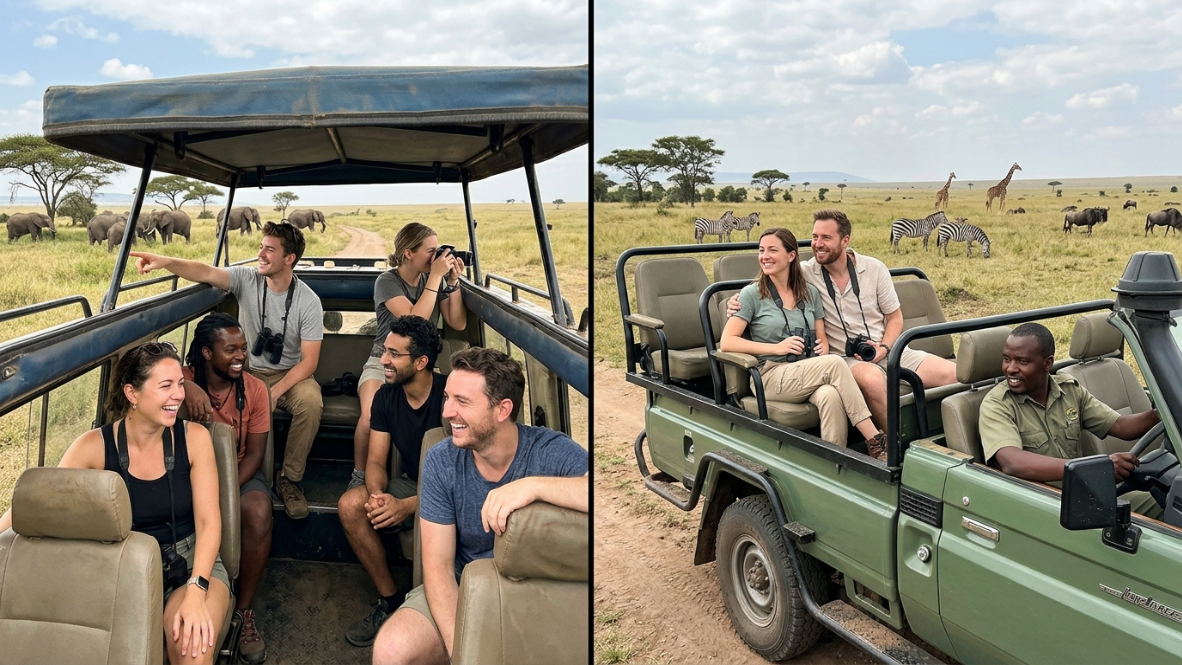
The format of your safari, meaning how you travel and who you travel with, is the single biggest cost lever. Not the lodge, not the park. The vehicle.
Group-Joining Safari (Shared Safari)
A pre-scheduled departure that you join alongside other travelers, sharing a vehicle and guide. Departures typically run on fixed dates with set itineraries. Vehicle capacity is usually 6 to 9 passengers in a modified Land Cruiser or safari truck.
Group safari departures reduce per-person costs 30 to 50% compared to private safaris by splitting vehicle and guide expenses. A safari vehicle with a driver-guide can cost $250 to $350 per day; dividing that across six people instead of two changes the math dramatically.
Budget impact: Shared group camping safaris start from around $250 per person per day. This is the single most effective way to bring costs down. For a detailed comparison, see our shared vs. private safari guide.
Operators themselves confirm this. As one Tanzania-based outfitter notes, they run thin margins on 5-day itineraries for just two passengers. They make up the difference on groups of six or more. That margin math is why group safaris are so much cheaper.
Private Safari
Your own vehicle, your own driver-guide, your own schedule. You choose when to leave camp, how long to stay at a sighting, and whether to skip a park or linger.
Budget impact: Private budget safaris start at approximately $350 per person per day. A 7-day private budget safari runs $1,750 to $2,800 per person. Mid-range private safaris jump to $2,800 to $4,900. If you’re considering this route, our private Tanzania safari guide breaks down what to expect.
Overland Safari
A multi-day road trip, often in a larger converted truck or 4x4, covering long distances between parks. Common on routes that connect multiple countries or cross from Tanzania into Kenya.
Budget impact: Can be very affordable ($100 to $200 per day in some cases) but involves more driving time and less game-viewing time per day.
Fly-In Safari
Travel between parks via light aircraft (Cessna Caravan or similar). Saves hours of driving, particularly between Arusha and the Serengeti or between the Northern and Southern Circuits.
Budget impact: Each flight leg costs $200 to $500 per person. Fly-in safaris are typically mid-range to luxury. Not a budget option, but worth knowing about if you have limited time and slightly more money.
Self-Drive Safari
Renting a 4x4 and driving yourself through Tanzania’s parks. Technically possible but challenging. Roads in parks are unpaved, signage is minimal, and the GePG payment system adds logistical friction at gates.
Budget impact: Can be cheaper on paper if you’re a group of four or more splitting vehicle rental, but most experienced travelers on forums advise against it in Tanzania specifically. The road conditions, navigation challenges, and lack of a guide’s wildlife-spotting expertise make this a false economy for most first-timers.
Budget Safari Types Compared
|
Feature |
Group Safari |
Private Safari |
Self-Drive |
|---|---|---|---|
|
Lowest Cost |
✅ |
❌ |
⚠ |
|
Flexible Schedule |
❌ |
✅ |
✅ |
|
Wildlife Spotting |
Excellent |
Excellent |
Depends on experience |
|
Guide Included |
Yes |
Yes |
No |
|
Best for First-Time Visitors |
✅ |
✅ |
❌ |
|
Average Daily Cost |
$180–250 |
$300–700 |
Variable |
Season and Timing Terms
When you travel can save (or cost) you more than where you stay. Accommodation, which accounts for the largest share of your safari budget, fluctuates dramatically by season.
Peak Season (June to October, Late December)
Dry season. The grass is short, animals cluster around water sources, and game viewing is at its easiest. This is also when the Great Migration crosses the Mara River in the northern Serengeti. Prices are at their highest.
Budget impact: Full-price rates with no discounts. If you must travel peak season, a group-joining camping safari is your main cost-reduction strategy.
Green Season / Low Season (March to May)
The long rains. Some roads become muddy, short afternoon downpours are common, and a few remote camps close. But the landscape turns vivid green, migratory birds arrive, and crowds thin dramatically.
Budget impact: Expect savings of 30 to 40% below peak-season rates, primarily on accommodation. Green season advantages include spectacular photography, outstanding birdwatching, and significantly fewer vehicles at sightings. For a budget Tanzania safari, this is the sweet spot if you can handle occasional rain. Our best time to visit East Africa guide has month-by-month detail.
Shoulder Season (November, Early June, January to February)
The transition months between peak and low seasons. Weather is generally good, prices are 12 to 20% below peak, and parks aren’t as crowded.
Budget impact: Travelers on Fodor’s forums report planning 9 to 10 day safaris with budgets of $4,500 to $5,500 per person (inclusive of fees and taxes) during late February shoulder season, and finding mid-range options achievable at that price point. Shoulder season offers arguably the best value-to-experience ratio.
Calving Season (January to March, Southern Serengeti / Ndutu)
Roughly 1.5 million wildebeest give birth on the short-grass plains of the southern Serengeti and Ndutu area. Predator activity spikes as lions, cheetahs, and hyenas follow the herds. It’s one of Africa’s greatest wildlife spectacles, and it overlaps with lower-priced shoulder and green season months.
Budget impact: You get world-class wildlife viewing at below-peak prices. This is a secret hiding in plain sight for budget-conscious travelers. Learn more about when and where to see the Migration.
Migration Timing
The wildebeest move seasonally in a roughly clockwise loop through the Serengeti ecosystem. Where they are determines where you need to be, which affects which camps are available and at what price.
Budget impact: Following the migration to specific areas can limit your accommodation choices to fewer (and sometimes pricier) options. Flexibility on exact timing gives you more budget-friendly alternatives.
How to Save Money on a Tanzania Safari
The easiest ways to reduce safari costs without sacrificing wildlife viewing include:
Join a Group Safari
Sharing vehicle costs can reduce prices by 30–50%.
Travel During Green Season
Accommodation discounts often reach 40%.
Stay Outside National Parks
Avoid concession fees while still accessing the parks each morning.
Limit Ngorongoro Days
The Crater Service Fee makes Ngorongoro one of the most expensive days of any itinerary.
Book Directly With a Licensed Tanzanian Operator
Booking directly often removes international agency markups.
Compare Fully Itemized Quotes
Always verify whether VAT, park fees, drinks, and tips are included.
Parks and Route Terms
Tanzania’s parks are grouped into circuits. Understanding which circuit you’re on helps you predict costs.
Northern Circuit
The most popular safari route: Tarangire, Lake Manyara, Ngorongoro Crater, and Serengeti. All parks are accessible from Arusha, the main safari gateway city. The Northern Circuit has the widest range of operators, the most accommodation options, and the strongest competition, which helps keep budget options available.
Budget impact: The Northern Circuit is where most budget Tanzania safari packages operate because the infrastructure exists to support them. Competition among operators keeps prices lower than in less-visited areas. For itinerary ideas across the circuit, see our East Africa safari itineraries guide.
Southern Circuit
Ruaha National Park, Mikumi National Park, and Nyerere (formerly Selous Game Reserve). Less visited, more remote, and sometimes cheaper on a per-day basis, but getting there often requires a domestic flight, which adds cost.
Budget impact: Mixed. Daily rates can be lower, but the fly-in access requirement ($200 to $500 per leg) can negate the savings. Best for repeat visitors or those specifically seeking solitude over savings.
Ngorongoro Conservation Area (NCA)
A UNESCO World Heritage Site managed by the NCAA, not TANAPA. The NCA has its own separate fee structure, including the infamous Crater Service Fee. Maasai communities live within the NCA alongside wildlife, making it a conservation area rather than a national park.
Budget impact: Ngorongoro is expensive relative to other parks. Between the conservation fee ($60 per day), the Crater Service Fee ($295 per vehicle), and accommodation costs inside the crater rim, a single day at Ngorongoro can be the most expensive day on your entire safari.
TANAPA (Tanzania National Parks Authority)
The government body that manages Tanzania’s 22 national parks, sets entry fees, and operates the GePG payment system.
NCAA (Ngorongoro Conservation Area Authority)
The separate government body managing the Ngorongoro Conservation Area with its own pricing, rules, and payment systems. Understanding that Ngorongoro operates under NCAA rather than TANAPA explains why its fee structure looks different from every other park.
Budgeting and Booking Terms
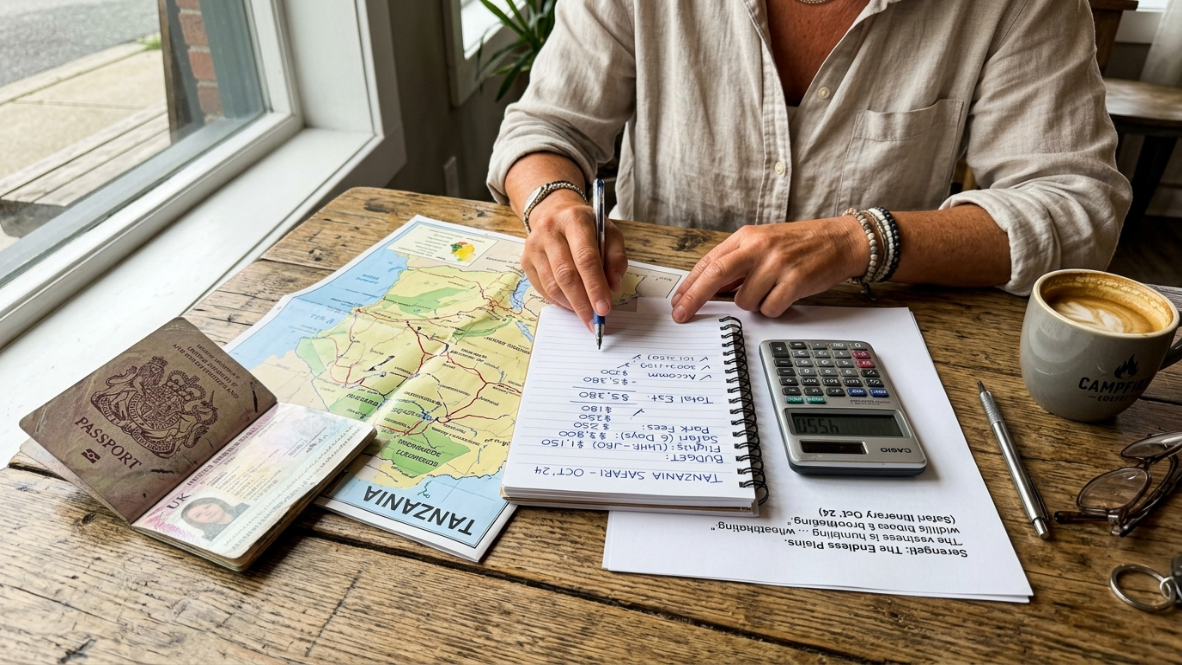
These terms show up in the fine print of quotes and contracts. Understanding them prevents surprise costs.
Per-Person-Per-Day (PPPD) Rate
The standard quoting unit for Tanzania safaris. A “$250 PPPD” quote means the total cost, divided by the number of travelers, divided by the number of safari days. This is how you compare operators apples-to-apples.
Budget impact: Always convert quotes to PPPD before comparing. Some operators quote total trip cost, others quote per-day, and a few quote per-group. Get everything into the same unit.
Tipping
Not included in any reputable operator’s quote, but a real and expected expense. Industry standards for 2026: tip your guide $20 to $25 per person per day, lodge or camp staff $10 to $15 per person per day, and your cook on a camping safari $10 to $15 per day per group.
Budget impact: On a 7-day safari, tipping adds $105 to $175 per person at a minimum. For a couple on a budget camping safari, that’s $210 to $350 in tips alone. This is the most commonly forgotten line item in budget calculations. For more on cultural etiquette including tipping norms, we have a separate guide.
Deposit
Typically 25 to 30% of the total trip cost, due at booking to confirm your dates and accommodation. The remaining balance is usually due 60 to 90 days before travel.
Budget impact: Cash flow consideration. Make sure your travel budget accounts for the deposit timeline, especially if booking 6 to 12 months in advance.
DMC (Destination Management Company)
A locally based operator in Tanzania that handles ground logistics: vehicles, guides, camp bookings, park fee payments, and airport transfers. Most international travel agents subcontract to a DMC for on-the-ground execution.
Budget impact: Booking directly with a licensed, Tanzania-based DMC instead of through international travel agents avoids a 15 to 30% markup, according to multiple operator comparison sites. The wildlife viewing experience is identical because the same local guides drive the same vehicles on the same roads.
International Agent Markup
The premium added when you book through a travel agency in the US, UK, or elsewhere outside Tanzania. Agents provide convenience and sometimes financial protection (ATOL bonding in the UK, for example), but at a cost.
Budget impact: 15 to 30% or more above the price you’d get booking with a local DMC directly. For a $5,000 safari, that markup could be $750 to $1,500. On a budget Tanzania safari, that’s the difference between camping and a mid-range tented camp.
Quick-Reference Budget Cheat Sheet
What a 7-Day Northern Circuit Safari Costs in 2026 (Per Person)
|
Tier |
PPPD Rate |
7-Day Total |
Accommodation |
Vehicle |
|---|---|---|---|---|
|
Budget camping (group) |
$180–$250 |
$1,260–$1,750 |
Dome tents, public campsites |
Shared, 6–9 passengers |
|
Budget camping (private) |
$250–$400 |
$1,750–$2,800 |
Dome tents, public campsites |
Private 4x4, your guide |
|
Mid-range (private) |
$400–$700 |
$2,800–$4,900 |
Tented camps or lodges |
Private 4x4, your guide |
|
Luxury (private) |
$700–$2,500 |
$4,900–$17,500+ |
Premium tented camps |
Private 4x4, top-tier guide |
Where Your Money Actually Goes (Budget Camping Safari)
|
Category |
Approximate Share |
|---|---|
|
Accommodation and camping fees |
~35–40% |
|
Park and conservation fees |
~25% |
|
Vehicle and driver-guide |
~20% |
|
Meals and cook |
~10% |
|
Tips (not in your quote) |
~5% |
The critical insight repeated by operators and travelers alike: whether camping or in a lodge, you see the same animals. The real trade-offs at the budget level are comfort, schedule flexibility, and how many other people share your vehicle. The lions, elephants, and wildebeest don’t know what you paid.
Frequently Asked Questions
What does a budget Tanzania safari actually cost per day?
For a group-joining camping safari, expect $180 to $250 per person per day all-inclusive (accommodation, meals, vehicle, guide, park fees). A private budget camping safari starts around $250 to $350 per person per day. These rates reflect 2026 pricing on the Northern Circuit.
What is a concession fee, and can I avoid it?
A concession fee is an additional per-person, per-night charge (currently $70.80 including VAT in the Serengeti) for sleeping inside a national park. You avoid it by choosing accommodation outside the park boundaries, which is exactly what most budget camping safaris do.
What is green season, and is it worth visiting then?
Green season runs from March through May, when Tanzania experiences its heaviest rains. Prices drop 30 to 40% below peak rates. The landscape is lush and green, birdwatching is excellent, and parks are far less crowded. Short afternoon showers are common, but most mornings are clear. For budget travelers who don’t mind occasional rain, it’s the best value window.
How much should I tip on a Tanzania safari?
Plan for $20 to $25 per person per day for your guide, $10 to $15 per person per day for camp or lodge staff, and $10 to $15 per day per group for a camping safari cook. On a 7-day trip, this adds $105 to $175 per person. Tips are always excluded from safari quotes.
Is a group-joining safari worth it to save money?
Yes. Sharing a vehicle and guide across six to nine passengers is the single most effective way to lower costs, reducing per-person rates by 30 to 50% compared to a private safari. The trade-offs are less schedule flexibility and sharing your vehicle with strangers. The wildlife viewing is the same.
Should I book with a local operator or an international agent?
Booking directly with a licensed Tanzanian operator typically saves 15 to 30% compared to booking through an international agent. The agents add convenience and sometimes financial protection, but the local operator provides the same guides, vehicles, and camps either way.
What hidden costs should I watch for in safari quotes?
The most common surprises: tipping (always excluded), single supplements for solo travelers, drinks at lodges, VAT added on top of quoted park fees, and the Ngorongoro Crater Service Fee ($295 per vehicle) that some operators list separately. Always ask for a fully itemized quote showing what is and isn’t included.
Can I do a self-drive safari in Tanzania on a budget?
Technically yes, but practically it’s difficult. Tanzania’s parks use the cashless GePG payment system (Visa/Mastercard only at gates), park roads are rough and poorly marked, and you’ll miss the wildlife-spotting expertise of a trained guide. Most budget travelers find that a group-joining safari with a professional guide delivers a better experience for similar or less money once you factor in vehicle rental, fuel, and camping gear.
Planning a budget Tanzania safari takes more homework than a luxury trip, but the payoff is real. The wildlife doesn’t change based on your price tier. What changes is the thread count of your sheets and whether you share your Land Cruiser with strangers.
If you’re ready to start building an itinerary, our complete Tanzania safari planning guide walks through routes, timing, and what to expect at every budget level.