East Africa Packing List: 2026 Guide to Rules & Gear
TL;DR
An East Africa packing list covers four distinct activities (safari, Kilimanjaro, gorilla trekking, and beach), each with specific gear rules and legal requirements. Bush planes enforce a strict 15 kg luggage limit and require soft-sided duffel bags. Tanzania, Kenya, Rwanda, and Uganda all ban single-use plastic bags, and camouflage clothing is illegal in several countries. This glossary defines the 40+ terms and rules you’ll encounter while building your packing list, so you understand the reasoning behind every item.
Quick Answer: What Should Be on an East Africa Packing List in 2026? An East Africa packing list in 2026 must account for four activity types—safari, gorilla trekking, Kilimanjaro climbing, and beach travel—each with different gear requirements and strict logistics rules. The most important constraints are a 15 kg bush plane luggage limit, a ban on single-use plastic bags, and camouflage clothing restrictions in several countries. Most travelers should pack lightweight, neutral-colored, moisture-wicking clothing, a soft-sided duffel bag, trekking gear (boots, gloves, rain protection), and activity-specific items like headlamps, binoculars, and reef-safe sunscreen.
Most East Africa trips aren’t single-activity vacations. You might spend five days on a game drive in the Serengeti, fly to Uganda for gorilla trekking, climb Kilimanjaro, then decompress on a Zanzibar beach. Each leg of that trip comes with its own packing vocabulary, weight restrictions, and legal rules that standard packing checklists mention but rarely explain.
This glossary exists to fill that gap. Instead of another list telling you what to pack, it defines the terms and explains why each item, rule, or concept matters. Think of it as the decoder ring you read alongside any East Africa packing list.
Terms are grouped by category rather than alphabetically, so you can scan by activity.
If you’re planning a multi-activity East Africa trip, this glossary will make every other packing resource you read more useful.
Luggage and Weight Rules
Soft-Sided Duffel Bag
A flexible canvas or nylon bag (typically 80 to 90 liters) with no rigid internal frame. This is the single most important item on your East Africa packing list, and the one people most often get wrong.
Safari guides consistently report that guests arrive with hard-shell suitcases, only to discover the pilot can’t fit them into the cargo hold of a bush plane. The luggage compartments on Cessna Caravans and similar light aircraft are small, oddly shaped, and require bags that can be squeezed and folded. A rigid suitcase simply won’t go in.
Beyond flights, soft duffels fit more easily into the back of safari vehicles, where space is shared among multiple guests.
Bush Plane Weight Limit (The 15 kg Rule)
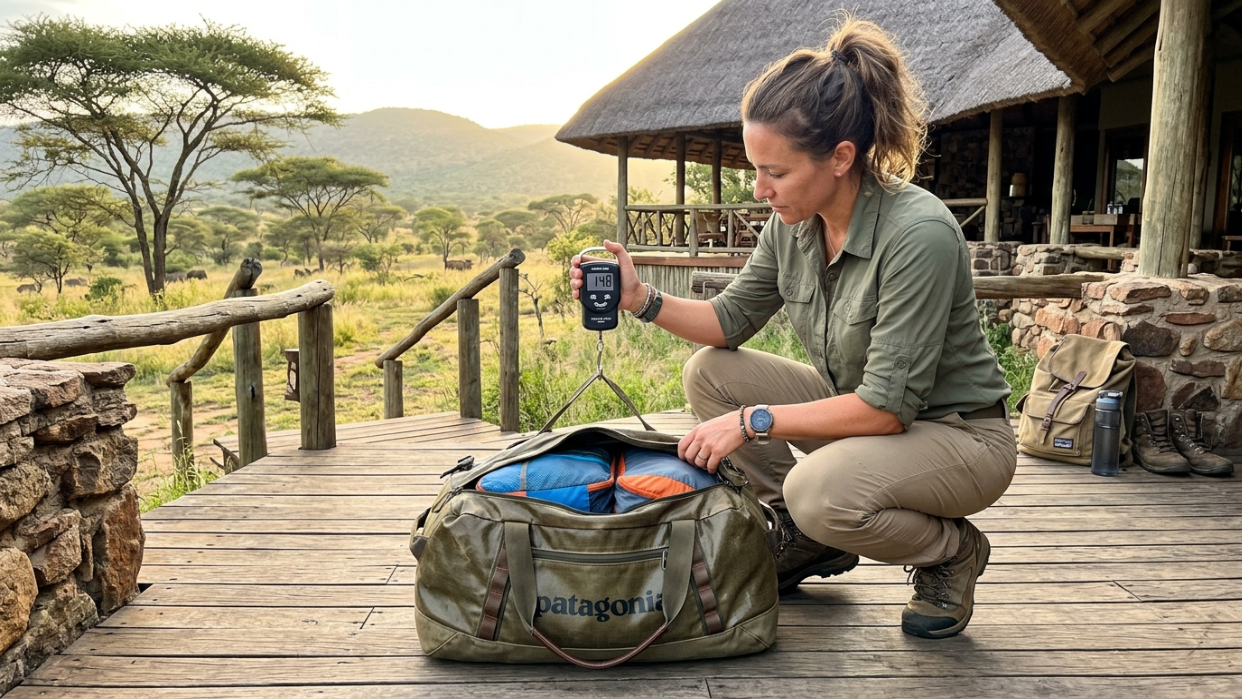
Light aircraft flights within Kenya, Tanzania, Uganda, and Rwanda enforce a combined luggage weight of 15 kg (33 lbs). That includes your main duffel and your daypack. Southern Africa is more generous at 20 kg, but East Africa holds firm at 15.
This is the constraint that forces every other packing decision. It’s why cotton gets replaced by moisture-wicking synthetics (lighter), why you bring three shirts instead of seven (camp laundry), and why hard-shell suitcases are out.
Weigh your packed duffel at home before departure. Airlines and charter operators do weigh bags at check-in, and overage fees apply.
Packing Cubes
Reusable fabric organizers that compartmentalize clothing inside your duffel. They serve two purposes in East Africa. First, they keep a soft bag organized when there’s no rigid structure. Second, they replace plastic zip-lock bags for organization in countries where single-use plastics are banned.
Good packing cubes compress clothing, which helps you stay under the 15 kg limit. They’re not optional here; they’re a practical necessity.
Daypack
A small backpack (20 to 30 liters) carried on your person during activities. You’ll use it on gorilla treks, walking safaris, Kilimanjaro summit night, and beach day trips. It carries water, snacks, camera gear, rain layers, and sunscreen.
For gorilla trekking, aim to keep your loaded daypack under 3 kg. You’ll be grabbing vegetation on steep slopes and scrambling through dense forest, so every extra kilogram matters. Many trekkers hire a porter on-site to carry it for them.
Luggage Storage
Most operators in Arusha and Nairobi will store excess luggage while you’re on safari or climbing Kilimanjaro. If your East Africa trip combines multiple activities, pack a separate bag with beach clothes or city wear and leave it at the hotel or operator’s office. This lets you travel with just the duffel and daypack during the bush and mountain phases.
Dry Bag
A waterproof roll-top bag (typically 5 to 15 liters) used to protect electronics, passports, and documents. Essential during gorilla trekking in Bwindi or Volcanoes National Park, where rain can arrive without warning. Also useful on dhow trips in Zanzibar and during river crossings on walking safaris.
Clothing Rules and Color Science
Neutral Earth Tones
Colors like khaki, tan, olive, sage, and light brown. These are the foundation of any East Africa packing list wardrobe, and the reasons go beyond aesthetics.
Tsetse flies have color vision. Research shows they’re most attracted to blue and black, followed by red, green, and yellow. Neutral earth tones sit outside their preference range. The CDC recommends neutral-colored clothing in tsetse-prone areas for exactly this reason.
Neutral tones also make you less conspicuous to wildlife on walking safaris and game drives. And they satisfy modesty norms in Muslim-majority areas like Zanzibar, where khaki and olive fit Stone Town’s relaxed aesthetic. One wardrobe, three functions.
Tsetse Fly
A biting fly found across much of sub-Saharan Africa, particularly in woodland and savanna habitats. Tsetse bites are painful and can transmit trypanosomiasis (sleeping sickness), though the risk to tourists is low.
The color advice matters, but practitioners on travel forums add important nuance. One traveler on Fodor’s reported that tsetse flies followed their vehicle regardless of the colors anyone was wearing, noting the flies seemed to track movement and dust clouds more than clothing. This matches the science: color is one attractant among several, including movement, heat, and carbon dioxide. Wearing neutral tones reduces your attractiveness to tsetse flies, but it doesn’t make you invisible to them. Combine clothing choices with DEET-based repellent for the best protection.
Camouflage Clothing Ban
Wearing camouflage-patterned clothing is illegal in Tanzania and restricted in several other East African countries. Unless you’re military personnel on official business, camo patterns can get you stopped by authorities. This applies to jackets, pants, hats, bags, and even backpack straps with camo accents.
The rule is strictly enforced. Leave anything resembling military wear at home. This includes “hunting camo” patterns that are popular in outdoor retailers.
Layering System (Safari)
A method of dressing in multiple thin layers rather than one heavy garment. East African temperatures can swing 20°C (36°F) in a single day. Early morning game drives start in near-darkness at 6:00 AM, when temperatures in Tanzania’s highlands can sit below 10°C (50°F). By noon, you’re at 30°C (86°F) or higher.
A typical safari layering outfit: a lightweight base t-shirt, a long-sleeved button-up shirt, and a fleece or softshell jacket. You peel off layers as the day warms and add them back at sunset.
That said, layering advice can be overdone. Practitioners on the Rick Steves forum point out that they packed fleeces for a safari in Ruaha and never wore them, finding long-sleeve cotton shirts perfectly comfortable in the cool mornings. The right layers depend on your specific parks and travel dates, so check conditions for your itinerary rather than defaulting to heavy warmth.
Moisture-Wicking Fabric
Synthetic materials (polyester, nylon, merino wool blends) that pull sweat away from your skin and dry quickly. On active days like gorilla treks or walking safaris, cotton absorbs moisture, gets heavy, and stays wet. Synthetics dry in hours, weigh less, and reduce chafing.
For a 15 kg weight limit, every gram matters. Three synthetic shirts weigh roughly the same as two cotton ones and can be washed and dried overnight at camp.
Modest Dress Code (Zanzibar and Muslim-Majority Areas)
Clothing that covers shoulders and knees when you’re away from the beach. Zanzibar’s culture is rooted in Islam, and showing too much skin in Stone Town, local markets, or villages is considered disrespectful.
For women, this means maxi dresses, knee-length shorts, or modest skirts paired with tops that cover the shoulders. For men, long pants (even lightweight ones) and shirts with sleeves. Swimwear is fine at beach resorts but not appropriate even a block inland.
Here’s a useful packing strategy most East Africa packing lists miss: if you’re arriving from a Tanzania safari, your safari wardrobe does double duty. The neutral-toned long-sleeved shirts and lightweight trousers you wore on game drives work perfectly as modest town clothing in Zanzibar. No need to pack a separate city wardrobe.
For deeper context on Zanzibar cultural etiquette, including dress norms at specific sites, the full guide covers what to expect.
Kanga / Sarong
A traditional East African cloth, roughly 1.5 by 1 meter, often printed with Swahili proverbs. A kanga is one of the most versatile items you can pack. It works as a modesty wrap for entering mosques or villages, a sun cover on boats, a beach towel, a picnic blanket, a pillow cover on long drives, and an emergency headscarf.
You can buy one locally (they’re inexpensive and sold everywhere in Zanzibar and mainland Tanzania), but having one from day one saves scrambling. It weighs almost nothing, which matters under the 15 kg rule.
Safari-Specific Gear Terms
Buff / Neck Gaiter
A seamless tube of stretchy fabric worn around the neck. When your safari vehicle hits a dusty stretch of road, you pull it up over your nose and mouth. Many experienced safari travelers call this the single most underrated item on any East Africa packing list.
Dust on unpaved park roads can be intense, especially during dry season. A buff also provides sun protection for your neck during long drives and doubles as a sleep mask or headband. It weighs under 50 grams and packs flat.
Binoculars
Optics for spotting wildlife at distance. Many animals are first spotted by your guide at 200 to 500 meters, and even in closer encounters, binoculars reveal behavior details, plumage patterns, and facial expressions you’d miss with the naked eye.
Some lodges lend binoculars to guests, but quality varies. If birding or photography matters to you, bring your own. A compact 8x42 or 10x42 pair balances magnification with weight. Check whether your pair fits inside your daypack rather than hanging from a neck strap all day.
Safari Hat (Wide-Brimmed)
A hat with at least a 7 cm (3-inch) brim and a chin/wind strap. Pop-up safari vehicles have no roof shade, and equatorial sun is intense even through clouds. Look for UPF 50+ rated fabric. The wind strap matters because open vehicles at speed will send an unstrapped hat into the bush immediately.
Headlamp
A hands-free light worn on the forehead. Headlamps beat flashlights in camp because you need both hands free to navigate tent zippers, uneven paths, and dining areas after dark. Many safari camps cut generator power by 10:00 PM, and walking paths between tents are unlit.
A headlamp with a red-light mode is ideal. Red light preserves your night vision and is less disruptive to wildlife.
Polarized Sunglasses
Sunglasses with polarized lenses reduce glare from dusty roads, water surfaces, and open plains. Standard tinted lenses dim everything; polarized lenses specifically cut reflected light, which makes spotting animals in bright conditions much easier. They’re also essential for driving comfort on all-day game drives.
Camera with Telephoto/Zoom Lens
A camera with at least 200mm focal length (300mm or more is better). Phone cameras have improved dramatically, but they can’t resolve a leopard in a tree at 100 meters. If photography is a priority, a mirrorless or DSLR body with a 100-400mm zoom is the standard safari setup.
Weight matters here. A full professional rig with multiple lenses can eat half your 15 kg allowance. Many photographers compromise with a single superzoom lens (like an 18-400mm or 100-400mm) and leave the rest at home. For gorilla trekking photography specifically, our gorilla photography gear guide covers settings and rules in detail.
Laundry Service (Camp/Lodge)
Most safari camps and lodges offer same-day or next-day laundry service, which is why experienced travelers pack fewer clothes than they think they need. Items are typically hand-washed and line-dried. One important caveat from safari insiders: don’t bring your favorite clothing items. Camp laundry staff wash everything the same way, and you have no control over drying methods. If a garment needs specific care, leave it at home.
There’s also a cultural note that catches many travelers off guard. Most camps will not launder men’s or women’s underwear. Pack enough pairs for your trip or plan to hand-wash your own.
Planning a Tanzania safari? Our private safari guide covers routes, costs, and what’s typically included.
Kilimanjaro-Specific Gear Terms
Layering System (Alpine Version)
The safari layering concept taken to extremes. On Kilimanjaro, you pass through five climate zones, from tropical rainforest at the base to arctic conditions at the summit. The alpine layering system has three components:
Base layer: Moisture-wicking thermal underwear (merino wool or synthetic). Keeps sweat off your skin.
Insulating layer: Fleece jacket or down puffy. Traps body heat. Down is lighter but useless when wet; synthetic insulation works in rain.
Shell layer: Waterproof, windproof jacket and pants. Blocks rain, sleet, and summit-night wind.
You’ll wear all three on summit night and strip down to a base layer by midday in the lower zones. For a route-by-route breakdown of what to expect, see the Kilimanjaro route comparison.
Summit-Night Gear
The specific items needed for the midnight-to-dawn push from high camp (around 4,600 m) to Uhuru Peak (5,895 m). Temperatures can drop below minus 20°C with wind chill. Your East Africa packing list suddenly looks more like a polar expedition checklist: thermal base layers, insulated pants, down jacket, balaclava, ski gloves or heavy mittens, hand warmers, and a headlamp with fresh batteries (cold drains them fast).
Trekking Poles
Adjustable poles (usually aluminum or carbon fiber) that redistribute weight from your legs to your arms. On Kilimanjaro, they matter most during two phases: the steep descent from the summit (where they save your knees from thousands of meters of downhill pounding) and scree sections where footing is unstable.
Poles can usually be rented in Arusha or from your operator, but rental quality varies. If you already own a pair, bring them.
Sleeping Bag Rating
The temperature at which a sleeping bag keeps you warm. Kilimanjaro camps sit between 2,700 m and 4,600 m, where overnight temperatures routinely reach minus 10°C to minus 15°C. A sleeping bag rated to minus 15°C or minus 20°C is the standard recommendation. Four-season bags are minimum; anything rated only to 0°C will leave you miserable.
Some operators rent sleeping bags. Ask about the specific temperature rating before relying on a rental.
Gaiters (Kilimanjaro)
Fabric sleeves that wrap around your lower leg from ankle to just below the knee. On Kilimanjaro, they serve two purposes: keeping volcanic scree out of your boots during summit approach and blocking snow/slush on the descent. They’re most useful on the Machame and Lemosho routes where scree fields are extensive.
Porter Weight Limit (KINAPA 20 kg Rule)
Kilimanjaro National Park Authority (KINAPA) limits each porter to carrying 20 kg, including the porter’s own gear. This means your personal bag carried by porters should stay around 13 to 15 kg. Everything you need for six to nine days on the mountain (sleeping bag, warm layers, toiletries, extra clothes) has to fit within that limit.
Check out the full Kilimanjaro packing list for a detailed gear checklist organized by weight priority.
Gorilla Trekking Gear Terms
Gardening Gloves
Standard thick gardening gloves with rubber-coated palms, available at any hardware store. This is the sleeper item on the gorilla trekking packing list, and experienced trekkers on Reddit consistently call them one of the most underrated things they packed.
Here’s why: gorilla trekking involves grabbing branches and vines to pull yourself up steep, slippery slopes through dense vegetation. Many of those plants have thorns, stinging nettles, or rough bark. Gardening gloves are designed for exactly this kind of hand protection. Bring cheap ones you don’t mind getting muddy or torn.
Gaiters (Gorilla Trekking)
Leg coverings that protect against mud, thorns, and biting ants. The gorilla trekking version is lighter than Kilimanjaro gaiters, focused on keeping debris out of your boots rather than blocking snow.
The necessity is debated among trekkers. On TripAdvisor forums, some trekkers report never putting theirs on, while others say they were essential on muddy treks from Buhoma in Bwindi. The terrain varies by starting point, season, and gorilla group location. Some lodges lend gaiters. The safest bet: bring lightweight ones and decide on the trailhead.
For Bwindi-specific conditions, the Bwindi gorilla trekking guide covers what to expect from different starting points.
Waterproof Hiking Boots (Broken-In)
High-ankle waterproof boots with aggressive tread. The “broken-in” part is critical. Gorilla trekking terrain can be steep, muddy, and slippery, with treks lasting anywhere from two to eight hours over rough ground. New boots cause blisters. Boots you’ve worn for at least 30 to 50 km before departure won’t.
High-ankle support matters because the terrain is uneven and you’ll be stepping over roots, rocks, and mud channels where ankle rolls are common. TripAdvisor forum users who trekked from Buhoma specifically recommend boots over trail shoes, noting the steep, rugged off-trail sections.
Face Mask (Gorilla Trekking Rule)
A surgical or cloth face mask worn during the one-hour viewing period near the gorillas. Mountain gorillas are susceptible to human respiratory diseases. Even a common cold can be fatal to them. Both the Uganda Wildlife Authority and Rwanda Development Board require masks during close encounters.
Bring your own. Don’t assume they’ll be provided at the trailhead.
Flash Photography Ban
The use of camera flash is explicitly banned during gorilla encounters. It startles the animals and can provoke defensive behavior. The Uganda Wildlife Authority and Rwanda enforce this strictly.
Turn off your flash before you leave the trailhead. Check your phone settings too, because many phones have auto-flash enabled by default and will fire in the dim forest canopy. This applies to video lights as well.
Gorilla Trekking Porter
A local guide hired at the trailhead (typically $15 to $20 per day) to carry your daypack and help you navigate difficult terrain. Porters are not mandatory, but they are strongly recommended. They stabilize you on steep descents, carry your bag so your hands are free for grabbing vegetation, and their income supports local communities directly.
Daypack Weight Target (Under 3 kg)
The recommended loaded weight for your gorilla trekking daypack. Contents should include water (1 to 1.5 liters), rain jacket, snacks, camera, and gardening gloves. Anything heavier, and you’ll fatigue faster on steep terrain. If your pack exceeds this, hand it to your porter.
Beach and Zanzibar Packing Terms
Reef-Safe Sunscreen
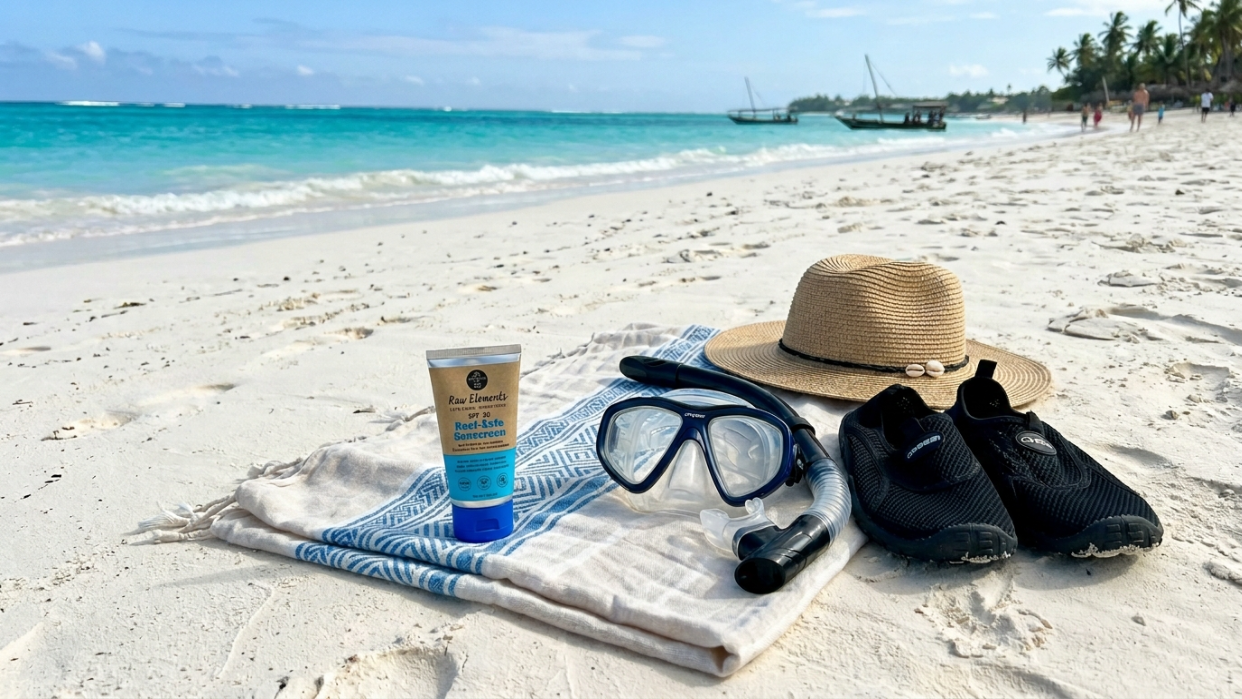
Sunscreen formulated without oxybenzone or octinoxate, two chemicals that damage coral reefs. Zanzibar’s reefs are among the most accessible in East Africa, and snorkeling is a major draw. Look for SPF 50+ mineral-based formulas using zinc oxide or titanium dioxide as the active ingredient.
This matters beyond personal virtue. Coral bleaching is visible in heavily snorkeled areas, and chemical sunscreens accelerate the damage. Some marine parks are beginning to restrict non-reef-safe products.
Water Shoes
Lightweight shoes with hard rubber soles, worn in the water. Zanzibar’s coastline includes coral rock, sea urchins, and sharp shells in tidal areas. Walking barefoot from your beach towel to the water’s edge can mean a painful cut. Water shoes with drainage holes work for wading, tide pools, and rocky beach entries.
Cover-Up / Kaftan
A loose, flowing garment worn over swimwear for the transition from beach to town. In Zanzibar, the boundary between resort and village can be just a few meters. A cover-up lets you walk from the beach to a restaurant or taxi without needing to fully change, while respecting local modesty expectations.
Rash Guard
A fitted UV-protective swim shirt, typically SPF/UPF 50+. Useful for snorkeling, kayaking, and long beach days. It reduces sunscreen consumption (relevant when you’re packing reef-safe formula, which tends to come in smaller bottles) and prevents the sunburn-while-snorkeling problem where your back gets scorched while you’re face-down watching fish.
For a complete breakdown, the Zanzibar packing list covers beach essentials and town clothing in detail.
Environmental Rules and Documents
Plastic Bag Ban
Tanzania, Kenya, Rwanda, and Uganda all ban single-use plastic bags. Tanzania’s ban took effect on June 1, 2019, and covers all plastic bags regardless of thickness, including cling film and plastic wrap. Rwanda’s ban is even stricter: plastic shopping bags can be confiscated at the airport during entry inspection.
Exemptions exist for medicine packaging, items in sealed plastic preserving their quality, and zip-lock bags for personal hygiene kits or documents (in Tanzania, on the condition they are not discarded in the country). But the safest approach: leave plastic bags at home and use packing cubes, reusable silicone bags, and cloth pouches instead.
This is one of the most under-discussed rules on any East Africa packing list, and getting caught with a bag of plastic bags at Kigali airport is an unpleasant way to start a trip.
Yellow Fever Vaccination Certificate
An International Certificate of Vaccination (the “yellow card”) proving you’ve received the yellow fever vaccine. Required for entry into Tanzania and several other East African countries if you’re arriving from or transiting through a yellow fever endemic country. Some travelers flying from the US or Europe through Nairobi or Addis Ababa have been asked for the certificate at Tanzanian immigration.
Get vaccinated at least 10 days before travel. The vaccine is valid for life under current WHO guidance.
Passport Validity Rule
Your passport must be valid for at least six months beyond your planned travel dates and have at least two blank pages for stamps. This is standard across Tanzania, Kenya, Uganda, and Rwanda. Airlines check this at the departure gate, and immigration officers check again on arrival. An expired-too-soon passport means you don’t board the plane.
US Dollar Bill Date Rule
US dollar bills must be from the 2009 series or later. Older bills are routinely rejected by banks, exchange bureaus, and businesses across East Africa due to concerns about counterfeiting. This catches many travelers off guard.
Request newer bills from your bank before departure. Bring small denominations ($1, $5, $10) for tipping and larger bills ($50, $100) for better exchange rates. Larger denominations typically receive more favorable rates at exchange bureaus.
For more practical rules like these, the East Africa travel tips glossary covers visa processes, money, and logistics.
Travel Insurance
Mandatory for entry to Zanzibar and strongly recommended for all East Africa travel. Your policy should cover medical evacuation (helicopter extraction from Kilimanjaro or remote safari areas), trip cancellation, lost luggage, and adventure activities. Standard travel insurance often excludes altitudes above 4,000 m or trekking, so read the fine print.
Tanzania E-Visa
Tanzania’s electronic visa system, applied for online before travel. Processing takes up to 10 business days, though most approvals come faster. Apply at least three weeks before departure. You’ll need a passport scan, passport photo, return flight itinerary, and accommodation details.
Health and Safety Packing Terms
Malaria Prophylaxis
Prescription medication taken before, during, and after travel to prevent malaria infection. Uganda, Rwanda, and low-altitude areas of Tanzania and Kenya are high-risk zones. The two most commonly prescribed options are Malarone (atovaquone-proguarone) and doxycycline.
Consult a travel clinic or GP at least four to six weeks before departure. Each medication has different side effects, dosing schedules, and costs. Your doctor can recommend the best option based on your health history and itinerary.
DEET / Picaridin
The two most effective active ingredients in insect repellent. DEET (concentration of 25 to 50%) has decades of proven efficacy. Picaridin (20%) is a newer alternative that’s less oily and doesn’t damage synthetic fabrics or plastics like DEET can.
Apply repellent to exposed skin during dawn and dusk, when mosquitoes are most active. On safari, apply before the afternoon game drive. Reapply after swimming.
Permethrin-Treated Clothing
Clothing pre-treated with permethrin, an insecticide that kills or repels mosquitoes, ticks, and other insects on contact. You can buy pre-treated clothing or apply permethrin spray to your own garments before the trip. Treatment lasts through roughly six washes.
This is passive protection. You wear the clothing and it works without reapplication, unlike DEET or picaridin. Combining permethrin-treated clothing with DEET on exposed skin is the most effective mosquito defense strategy available.
Basic First-Aid Kit
A small personal medical kit supplementing what lodges and guides carry. Contents should include: blister plasters (moleskin), antiseptic wipes, adhesive bandages, anti-diarrheal medication (loperamide), oral rehydration salts, basic painkillers (ibuprofen, paracetamol), antihistamine tablets, and any personal prescriptions.
Most safari camps have basic first-aid supplies. Kilimanjaro guides carry more comprehensive kits. But having your own means you’re not dependent on someone else’s supply for minor issues.
Electrolyte Packets
Single-serving powder packets mixed with water to replace sodium, potassium, and other minerals lost through sweat. Essential for two East Africa scenarios: high-altitude trekking on Kilimanjaro (where dehydration accelerates altitude sickness) and hot safari days where you’re sweating for hours in an open vehicle.
Plain water alone doesn’t replace electrolytes. Two to three packets per day during active phases keeps hydration balanced.
The Safari-to-Beach Crossover Strategy
This concept doesn’t appear on other East Africa packing lists, but it’s one of the most practical packing strategies for multi-activity trips.
Your safari wardrobe of neutral-toned long-sleeved shirts and lightweight trousers works directly as modest town clothing in Zanzibar. Olive, khaki, and tan all fit Stone Town’s aesthetic, and the shoulder and knee coverage satisfies local modesty expectations. You don’t need to pack a separate “city” wardrobe.
The only additions for the beach leg are a swimsuit, reef-safe sunscreen, water shoes, and a cover-up or sarong. Everything else you already have. This crossover thinking is how experienced multi-activity travelers stay under 15 kg while covering a three-week trip spanning savanna, rainforest, and coastline.
Once you know what to pack, the next step is building your itinerary. Our East Africa safari itinerary guide covers routes, costs, and timing.
What to Leave Behind
A quick reference of items that waste space, break rules, or cause problems:
-
Hard-shell suitcases (won’t fit in bush planes or safari vehicles)
-
Camouflage clothing (illegal in Tanzania)
-
Plastic bags (banned in Tanzania, Kenya, Rwanda, Uganda)
-
Blue or black clothing (attracts tsetse flies)
-
White clothing (shows every speck of red African dust within hours)
-
Favorite or delicate garments (camp laundry is rough on clothes)
-
Cotton-heavy wardrobes (heavy when wet, slow to dry)
-
Full-size toiletries (transfer into travel bottles, save weight)
-
Jewelry or valuables (unnecessary risk, no practical purpose)
-
More than two pairs of shoes (boots plus sandals covers everything)
Frequently Asked Questions
How strict is the 15 kg luggage limit on bush planes in East Africa?
Very strict. Pilots weigh your bags at check-in, and overweight luggage can be left behind for the next available flight. Some charter companies allow 20 kg on larger aircraft, but the standard across Kenya, Tanzania, Uganda, and Rwanda is 15 kg total (main bag plus daypack). Plan your East Africa packing list around this number from the start.
Can I bring zip-lock bags to Tanzania despite the plastic ban?
Tanzania’s ban exempts zip-lock bags used for personal hygiene kits or documents, provided they are not discarded in the country. However, enforcement at airports can be inconsistent, and a bag full of zip-lock bags might draw unwanted attention. The practical advice: bring a few small zip-locks for essential purposes and replace the rest with reusable silicone bags or packing cubes.
Do I really need gardening gloves for gorilla trekking?
Experienced trekkers overwhelmingly say yes. You’ll grab thorny branches and stinging nettles to steady yourself on steep slopes. Leather or rubber-coated gardening gloves cost a few dollars, weigh almost nothing, and prevent painful stings and scratches that can affect the rest of your trip. Bring a cheap pair you’re happy to discard afterward.
How many outfits should I pack for a two-week East Africa trip?
Three to four complete outfits is the standard recommendation for safari and trekking phases. Camp laundry services wash and return clothes within 24 hours, so you’re always cycling through clean clothes. Add one swimsuit and one cover-up for the beach. This keeps you well under 15 kg.
Are tsetse fly bites dangerous?
The bite itself is painful but not usually dangerous. Tsetse flies can transmit trypanosomiasis (sleeping sickness), but the risk to short-term tourists is very low. Wearing neutral colors, applying DEET repellent, and using permethrin-treated clothing all reduce bite frequency, though no method eliminates bites entirely in tsetse-heavy areas.
Should I buy safari clothing before the trip or in East Africa?
Buy technical items (moisture-wicking shirts, hiking boots, rain shells) at home where you can test fit and quality. Kangas, sarongs, and casual cotton clothing are cheaper and better quality when purchased locally in Tanzania or Zanzibar. Gardening gloves and basic supplies are also easily found at markets in Arusha or Kampala.
Do I need gaiters for both Kilimanjaro and gorilla trekking?
They serve different purposes. Kilimanjaro gaiters block volcanic scree and snow on summit day. Gorilla trekking gaiters protect against mud, thorns, and biting ants. If your trip includes both, lightweight gaiters that cover both use cases work fine. If you’re only doing one activity, they’re more essential for Kilimanjaro summit day and optional (but recommended) for gorilla trekking.
What’s the best way to organize a multi-activity East Africa packing list?
Start with the 15 kg bush plane limit as your ceiling. Pack your safari wardrobe first (it doubles as Zanzibar town wear). Add gorilla trekking specifics (gloves, gaiters, long sleeves). Then add Kilimanjaro layers if climbing. Use packing cubes to separate activity-specific items. Store non-essential items in luggage storage in Arusha or Nairobi between trip phases.
Ready to start planning? Explore Uganda gorilla safari trips or browse East Africa safari costs to match your packing list to your itinerary.