

Kid Friendly Serengeti Camps: 2026 Parents' Guide Checklist
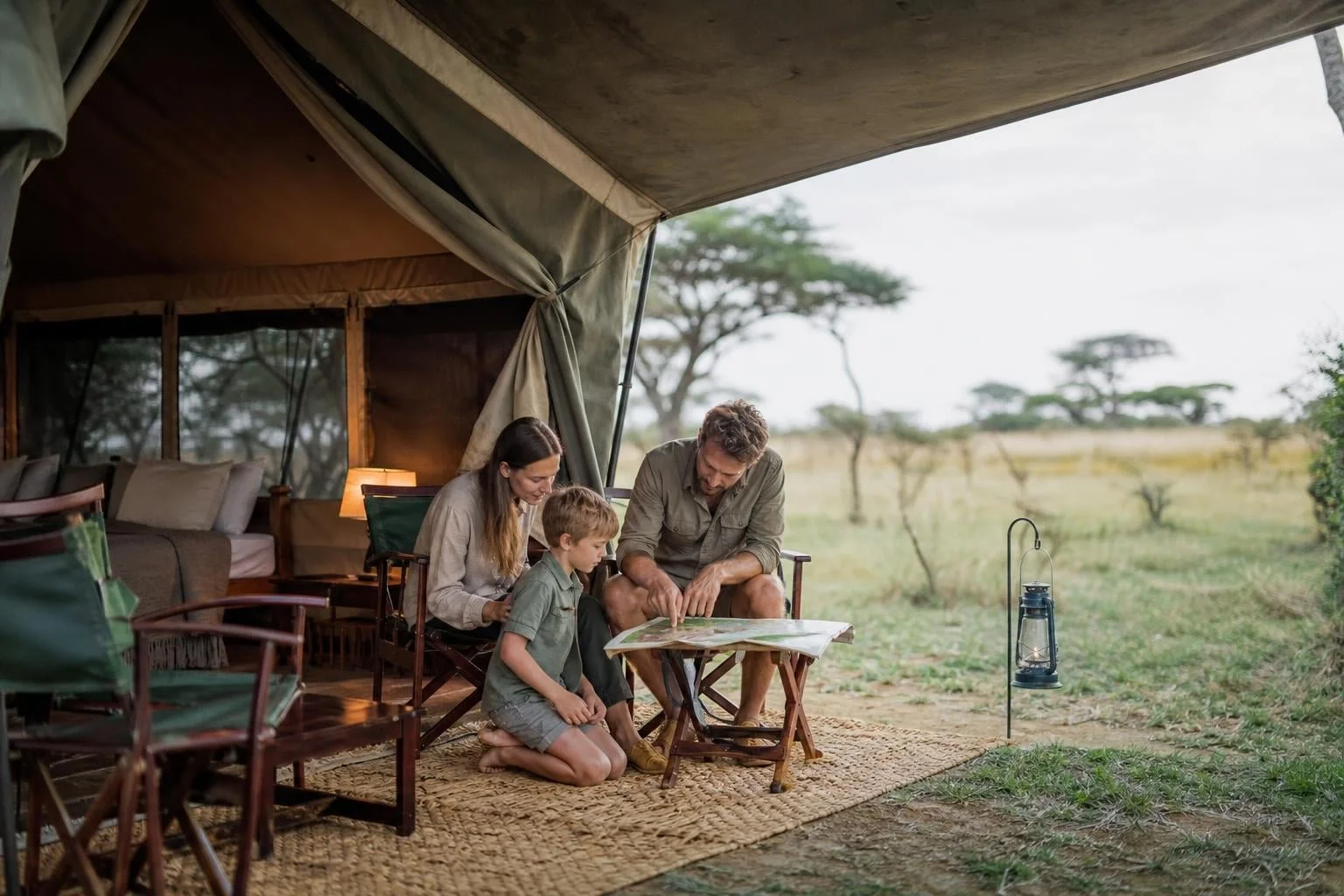
A kid-friendly Serengeti camp is one whose room layout, safety procedures, guiding style, and location work for your children’s specific ages, not just one that “allows children.” The most important factors are family tent configuration (connected vs. adjacent), private vehicle access, camp fencing and after-dark escort rules, flexible meals, and choosing the right Serengeti region for your travel month. For younger children, permanent camps with family suites and pools work best. For teens, more adventurous mobile or migration camps can be excellent. Start booking 9 to 12 months ahead for peak season family tents.
A kid-friendly Serengeti camp is not simply a camp that permits children to stay. It is a camp whose room layout, safety rules, guiding approach, meal flexibility, drive schedule, and location genuinely work for your children’s ages. For younger children, that often means a family tent or interconnecting rooms, a private vehicle, a pool or downtime space, flexible meals, and clear after-dark escort policies. For older children and teenagers, it may mean a more adventurous tented camp, photography-friendly guiding, migration access, or walking safari eligibility. The best choice depends less on star rating and more on child age, camp layout, vehicle privacy, and how much time your family can realistically spend in a safari vehicle each day.
Quick answer: The best kid-friendly Serengeti camps are those that match your children's ages, accommodation needs, and preferred safari pace. Before booking, check the camp's minimum age policy, family tent or interconnecting-room layout, private vehicle availability, after-dark safety procedures, meal flexibility, and proximity to wildlife areas relevant to your travel dates. Lodges and permanent camps with family accommodation and downtime facilities often suit younger children, while older children and teenagers may enjoy more remote tented camps. Always confirm current age restrictions and family room availability directly with the camp.
Quick Answer: What Makes a Serengeti Camp Kid-Friendly?
|
Feature |
What Parents Should Check |
Why It Matters |
|---|---|---|
|
Minimum age policy |
Minimum age to stay and join each activity |
Prevents booking restrictions and unexpected exclusions |
|
Family accommodation |
Family tent, connected rooms, or separate tents |
Keeps children close to parents, especially at night |
|
Private safari vehicle |
Whether it is included or costs extra |
Allows flexible drives, snack stops, and early returns |
|
Camp safety |
Fencing, wildlife movement, and after-dark escorts |
Helps families understand how children can move around camp |
|
Meals |
Early dinners, children's meals, and packed lunches |
Makes long safari days easier for younger travelers |
|
Downtime |
Pool, lounge, books, or other facilities |
Gives children time to rest between game drives |
|
Guide experience |
Experience guiding families and children |
Makes wildlife viewing engaging at different ages |
|
Seasonal location |
Distance to wildlife areas during your travel dates |
Reduces unnecessary transfers and excessive driving |
|
Health and emergency planning |
First aid, evacuation arrangements, and medical access |
Helps parents assess the practical risks of a remote safari |
Best Kid-Friendly Serengeti Camps: How to Compare Your Options
The best Serengeti camp for families depends on your children's ages, preferred comfort level, and travel dates. Some properties offer extensive family facilities, while others focus on an immersive tented safari experience. Use the comparison below as a starting point, then confirm the current child policy and accommodation setup with each property.
|
Camp or Lodge |
Best Fit to Investigate |
What to Verify Before Booking |
|---|---|---|
|
Four Seasons Safari Lodge Serengeti |
Families seeking lodge facilities and structured children's activities |
Current family room options, children's program availability, activity age limits, and vehicle arrangements |
|
Sayari Camp |
Families seeking a tented safari in the northern Serengeti |
Current minimum age, family tent configuration, and seasonal wildlife access |
|
&Beyond Serengeti Under Canvas |
Families seeking a mobile, canvas-based safari experience |
Minimum age, connected family accommodation, and supervision requirements |
|
Singita's Serengeti properties |
Families comparing luxury accommodation options |
Policies for the specific property, family suite availability, and child activity restrictions |
|
Olakira Migration Camp |
Families prioritizing seasonal migration viewing |
Current age policy, family tent availability, camp location during your dates, and transfer logistics |
How to Choose Between These Camps
-
For younger children: Start by investigating lodge facilities, connected family accommodation, meal flexibility, and private vehicle options.
-
For school-age children: Look for camps with engaging guides, comfortable family tents, manageable drive times, and activities appropriate for their ages.
-
For teenagers: Consider seasonal migration locations, wildlife photography opportunities, and more adventurous tented camps, subject to the camp's policies.
-
For multi-generational families: Prioritize room configuration, private vehicles, flexible schedules, and accommodation that can comfortably fit everyone.
Booking tip: Ask each camp to confirm its current minimum age, exact family room layout, private vehicle cost, and any activity restrictions in writing. Policies and availability can change, so do not rely on a property's name or general reputation alone.
What Does “Kid-Friendly Serengeti Camp” Actually Mean?
There is a meaningful difference between four descriptions that camps and operators use interchangeably, and understanding them prevents expensive booking mistakes.
Children allowed means the camp does not forbid children above a certain age. It says nothing about whether the camp is set up for them.
Children welcomed means the camp is open to families and may have some family-oriented features, but the primary experience is still designed for adults.
Children actively catered for means the camp has a kids’ program, child-specific meals, babysitting, or structured activities for different age groups.
Children safely accommodated means the room layout, camp design, and operational rules make it genuinely practical for children to stay, sleep, and move around.
A camp can allow children and still be a poor fit for a four-year-old. Camp policies vary substantially across Serengeti properties. Sayari Camp in northern Serengeti welcomes children aged five and older and offers family tents alongside private-use Retreats. &Beyond Serengeti Under Canvas states it cannot accommodate children under six because of the nature of the camp, and its family tent connects two sleeping areas with an enclosed walkway. Singita’s properties have different child policies depending on the specific lodge: children of all ages are welcome at some, while others require children to be 10 or older. Four Seasons Safari Lodge Serengeti runs a Kids For All Seasons program for ages 2 to 17.
The takeaway: never assume. Always ask the specific camp for its current age policy, shared-drive rules, and family room configuration.
If you are weighing camps across multiple parks, Duma Explorer’s guide covers the broader picture:
Plan a private family safari in Tanzania
The 6-Part Serengeti Family Camp Fit Test
Rather than relying on a camp’s marketing description, use these six questions to evaluate whether any Serengeti camp genuinely fits your family. This framework works for kid-friendly Serengeti camps across every price range and camp style.
|
Fit Factor |
What Parents Should Ask |
Why It Matters |
|---|---|---|
|
Age policy |
What is the minimum age to stay? To join shared drives? To walk? To balloon? |
Policies vary by camp and activity, sometimes within the same property. |
|
Room layout |
Is it a true family tent, connected tents, adjacent tents, or separate rooms? |
Night safety and sleep logistics matter in unfenced camps. |
|
Vehicle setup |
Is a private vehicle included, optional, or unavailable? |
Families need flexible timing, bathroom stops, and early returns. |
|
Camp safety |
Is the camp fenced? Are escorts required after dark? |
Children need clear movement rules, especially at night. |
|
Downtime |
Is there a pool, lounge, games, books, or child-friendly space? |
Children cannot game-drive all day. |
|
Location |
Does the camp match your travel month and transfer tolerance? |
Wrong location creates long, exhausting travel days. |
This test is more useful than any “Top 10” list because it forces the right questions before you commit.
Family Tent, Connected Tent, Adjacent Tent: What Is the Difference?
This is one of the most important and most overlooked details when selecting Serengeti camps for kids.
Family tent: A single tent designed for families, typically with two sleeping areas, two bathrooms, and a shared sitting space, all under one structure. Children can reach parents without going outside.
Interconnecting tent: Two separate tents physically connected by an enclosed walkway or canvas corridor. Similar safety benefit to a family tent, though the specific layout varies by camp.
Adjacent tent: Two tents placed near each other but not connected. Getting from one to the other requires stepping outside, which matters significantly in unfenced camps where wildlife may pass through at night.
Separate tents: Standard booking where family members are in different tents, potentially across camp. Usually unsuitable for younger children.
Family suite or retreat: A private-use unit (sometimes an entire small camp) designed for families or groups. Maximum flexibility and privacy, at a higher cost.
Practitioners on Tripadvisor forums repeatedly focus on this issue. One detailed Serengeti thread recommends family tents with two bedrooms, two ensuite bathrooms, hot and cold running water, and a sitting area. Another discussion warns that if families do not book a connected setup, parents may have to split between tents or worry about children leaving tents after dark.
The key question to ask any camp: “If my child wakes up at night, can they reach us without stepping outside?”
Many camps have only one or two family tents. Tripadvisor reviews for Nomad Serengeti Safari Camp, for example, mention just two family tents and recommend booking early. For families needing multiple connected units or traveling with extended family, the logistics get more complex.
See the guide for planning safaris with larger families
Private Safari Vehicle vs. Shared Game Drive
For families with younger children, this may be the single most important decision, more important than upgrading the room.
A private safari vehicle is reserved for your family alone, with a guide who can adapt everything: drive length, stop timing, bathroom breaks, sighting priorities, snack stops, and return time.
A shared game drive puts guests from different bookings into one vehicle. Fine for patient teenagers or adults, but risky with younger children who cannot control when the group returns, how long to wait at a sighting, or when to stop for a bathroom break.
Experienced safari operators make this point consistently. Practitioners on Reddit report that children under five typically need a fully private setup with shorter drives and guides who understand family travel. One r/FATFamilyTravel discussion emphasized that children do not run on fixed schedules and shared vehicles create pressure for everyone. Safari planners on LinkedIn reinforce this: multi-generational families have different energy levels, and private safaris work because the rhythm of each day can be adapted to the group.
For families with children under about 10, a private vehicle is not a luxury upgrade. It is the practical foundation of a successful Serengeti safari. Understanding how safari vehicle types affect comfort helps families make better choices here.
Best Serengeti Camp Style by Child Age
There are no universal rules, because children’s temperaments vary as much as camp designs. But these age bands reflect what most families and safari planners report working well.
|
Child Age |
Best Camp Style |
Use Caution With |
Planning Note |
|---|---|---|---|
|
Under 5 |
Lodge or permanent camp with family suite, pool, private vehicle, flexible meals |
Remote mobile camps, shared drives, separate tents |
Consider whether Serengeti should be a shorter stay paired with an easier destination. |
|
5 to 7 |
Permanent tented camp or lodge with family tent, pool, guide good with kids |
Long full-day drives, frequent camp moves |
Build in short morning and afternoon drives with downtime between. |
|
8 to 12 |
Family tented camp, central or migration-region camp, private vehicle |
Camps with strict shared-drive age rules |
Strong age for wildlife learning, photography, and animal tracking games. |
|
13 to 17 |
Mobile camps, migration camps, photography-focused camps, more remote areas |
Overly resort-like stays if teens want adventure |
Consider walking safaris where camp and park rules allow (12+ for TANAPA). |
Reddit discussions show wide variation within these bands. Several travelers noted that ages six to ten can be a “sweet spot” for safari if children love nature, while others reported five-year-olds doing beautifully and six-year-olds struggling with attention spans on game drives. The answer is always child-specific and camp-specific.
For a deeper look at how age affects the whole trip, the guide on best safari age for kids is worth reading.
Which Serengeti Camp Is Best for Your Child's Age?
The youngest child in your group is often the best starting point when choosing a Serengeti camp. A teenager may be happy with long game drives and a remote tented camp, but a preschooler may need more downtime, shorter drives, and easier access to family facilities.
|
Your Family's Situation |
What to Prioritize |
What to Avoid |
|---|---|---|
|
Traveling with a child under 5 |
Confirmed age eligibility, family accommodation, private vehicle, flexible meals, and downtime |
Assuming all camps accept preschoolers or allow them on shared drives |
|
Traveling with children aged 5–7 |
Shorter game drives, engaging guides, connected family tents, and predictable routines |
Frequent camp changes and long transfer days |
|
Traveling with children aged 8–12 |
Wildlife education, photography, comfortable accommodation, and flexible drive lengths |
Booking activities without checking minimum ages |
|
Traveling with teenagers |
Wildlife-focused camps, seasonal migration access, photography, and eligible walking activities |
Choosing a remote camp without checking transfers and activity restrictions |
|
Traveling with several generations |
Private vehicle, suitable room configurations, flexible schedules, and easy logistics |
Assuming one accommodation or activity plan suits every age |
These are planning guidelines, not universal age rules. The camp's actual policy, your child's temperament, and your itinerary should determine the final choice.
Lodge, Permanent Tented Camp, Mobile Camp, or Private-Use Retreat?
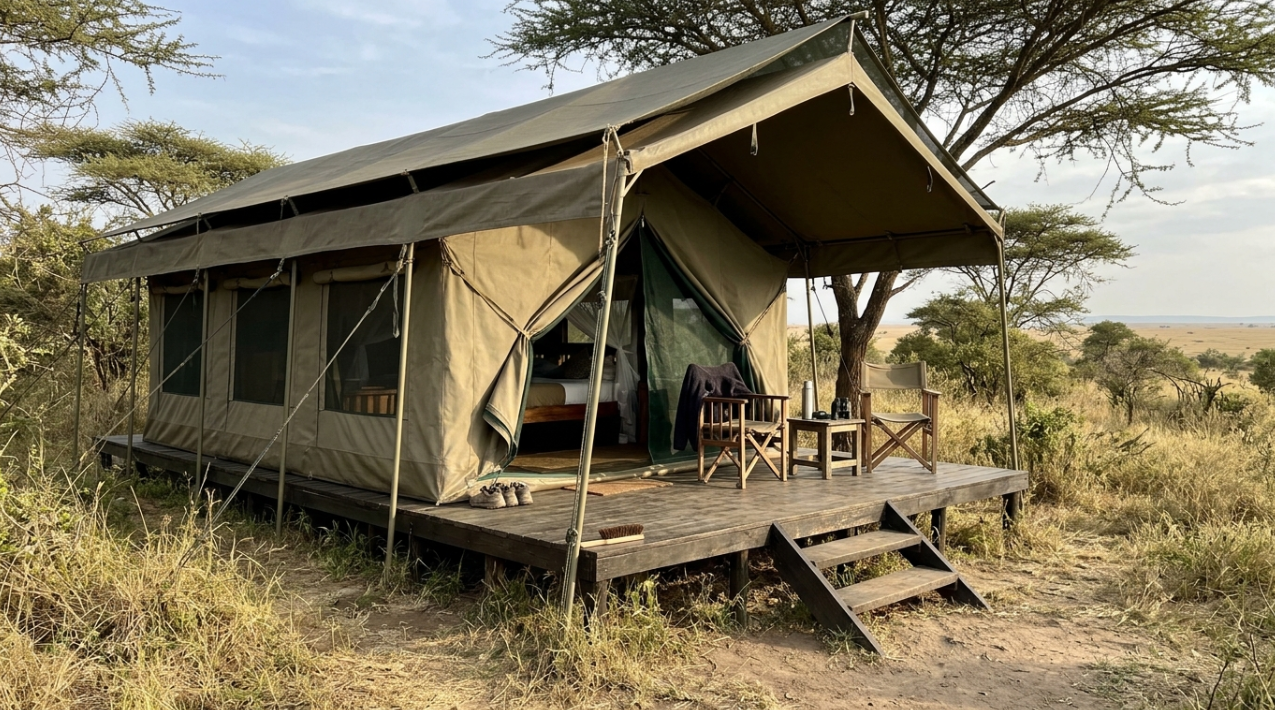
Each camp type creates a different experience for children, and families should match the style to their youngest traveler.
|
Camp Type |
Best For |
Pros |
Watch-Outs |
|---|---|---|---|
|
Large lodge |
Younger children, first safari, families wanting pool and services |
More facilities, easier downtime, often reassuring for nervous parents |
Less intimate; may feel less “wild” |
|
Permanent tented camp |
School-age children wanting real safari feel with comfort |
Good balance of wilderness and infrastructure |
Often unfenced; check family layout and escort rules |
|
Mobile migration camp |
Older children, teens, wildlife-focused families |
Excellent wildlife positioning in season |
Fewer child amenities; may have higher minimum ages |
|
Private-use camp or retreat |
Multi-generational families, large groups, special occasions |
Full flexibility on schedule, meals, and guides |
Higher cost; needs early booking |
For many families, a permanent tented camp is the middle ground: wilder than a hotel-style lodge but more comfortable and predictable than a simple mobile camp. A lodge like Four Seasons Safari Lodge Serengeti represents one end of the spectrum, with a structured kids’ program, raised protected walkways, and hot-air balloon safaris available for children aged seven and older. A mobile migration camp like Olakira, which welcomes children as young as five and has a family-sized tent, represents the other end. Neither is automatically “better.” The right choice depends on your children.
How Much Does a Family Serengeti Safari Cost?
The cost of a family safari in the Serengeti depends on accommodation, children's ages, travel season, park fees, flights, and whether you book a private vehicle. The lowest advertised per-person rate is not necessarily the least expensive option for a family once room configurations and required extras are included.
|
Cost Factor |
What to Check Before Booking |
|---|---|
|
Accommodation |
Whether the quoted rate covers a family suite, family tent, or multiple rooms |
|
Child rates |
How accommodation and children's discounts are calculated |
|
Private vehicle |
Whether the vehicle and guide are included or charged separately |
|
Park and conservation fees |
Current rates for each traveler and applicable age category |
|
Domestic flights |
Child fares, baggage limits, and the cost of reaching the camp's nearest airstrip |
|
Meals and drinks |
Whether meals, packed lunches, snacks, and drinks are included |
|
Activities |
Age restrictions and additional charges for eligible activities |
|
Transfers |
Road transfers, airstrip pickups, and any extra overnight stays |
|
Insurance and contingency |
Medical cover, evacuation provisions, and disruption costs |
How to Compare Family Safari Quotes
Request an itemized quote showing the total price for all travelers, each child's age, accommodation arrangements, private vehicle costs, park fees, flights, and included activities.
Compare the final trip total rather than relying only on a per-person headline rate. Before paying a deposit, confirm cancellation terms, seasonal surcharges, and whether the proposed family accommodation is actually available for your dates.
Which Serengeti Region Works Best for Families?
Serengeti National Park covers about 14,763 square kilometers, with air access via airstrips at Seronera, Kusini, Lobo, Kirawira, Kogatende, and Lamai. Choosing the wrong region can mean exhausting transfers that eat into safari time and children’s patience.
|
Region |
Family Use Case |
General Timing |
Family Notes |
|---|---|---|---|
|
Central Serengeti (Seronera) |
First Serengeti safari, shorter stay, reliable resident wildlife |
Year-round |
Reduces pressure to chase sightings. Good for shorter drives. |
|
Southern Serengeti (Ndutu) |
Calving season, baby animals, predator action |
Roughly Dec to Mar |
Great for children interested in baby animals. Confirm drive distances. |
|
Western Corridor |
Transitional migration, fewer crowds |
Often May to Jul |
Can work for families wanting space. Routing needs care. |
|
Northern Serengeti (Kogatende/Lamai) |
Mara River crossings, older children and teens |
Usually Jul to Oct |
Great drama but longer transfers, higher demand, fewer family units. |
For a first family safari, do not chase the migration at all costs. A camp with reliable resident wildlife, shorter drives, and good guiding may produce a better experience for children than a dramatic but exhausting migration itinerary.
How to Choose the Right Serengeti Region for Your Family
Choose your Serengeti region based on your travel dates, your children's tolerance for transfers, and the wildlife experience you want most.
-
Central Serengeti: A practical starting point for first-time family safaris because resident wildlife makes it possible to enjoy game viewing without planning the entire trip around a seasonal migration event.
-
Southern Serengeti and Ndutu: Worth considering during the calving season, generally from December through March, for families interested in young wildebeest and predator activity. Confirm seasonal camp operations and access for your dates.
-
Western Corridor: Consider this region when the migration's seasonal movement and your itinerary make it a sensible fit. Check the actual camp location rather than relying on a broad regional label.
-
Northern Serengeti: A strong option for families hoping to see the migration near the Mara River, particularly during the usual July-to-October window. River crossings are unpredictable, however, and are never guaranteed.
Before choosing a camp, ask for the estimated transfer time from the arrival airstrip, the expected driving time to wildlife-viewing areas, and whether a domestic flight can reduce long road transfers.
For younger children, one well-positioned camp with good guiding can be a better choice than moving between several regions in pursuit of a specific sighting. Build your itinerary around a realistic daily pace rather than assuming every game drive needs to be a full day.
Duma Explorer’s first-party traveler feedback has praised Nyumbani in Central Serengeti for its food quality and 24-hour hot water, and described Elwai Camp as feeling like being invited into someone’s home. These are comfort details, not child-policy endorsements, but they are exactly the kind of practical signals that matter when families are comparing camps.
Matching your travel month to the right region is critical. The guide on best time for a Tanzania safari explains seasonal wildlife movement in detail.
Camp Features Parents Should Ask About
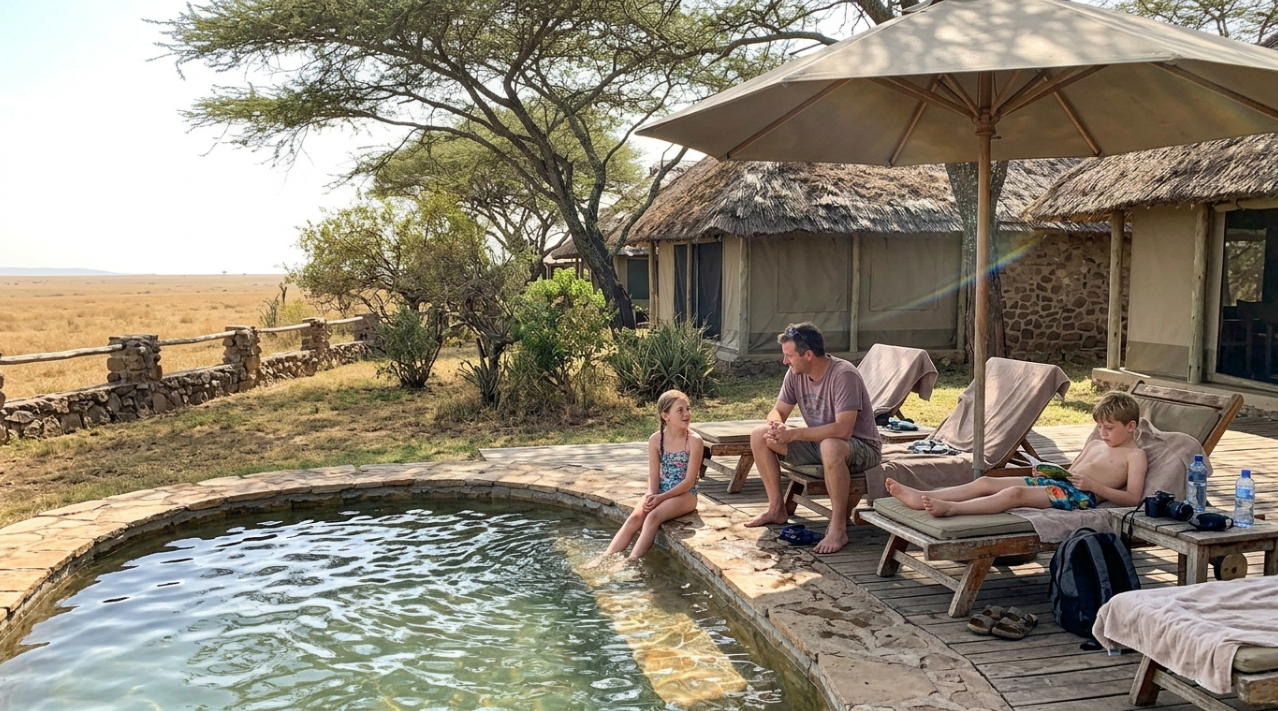
Beyond tent layout and vehicle arrangements, these details separate a good family experience from a frustrating one.
Pool or safe downtime area. Children cannot game-drive all day every day. A pool, a deck with board games, or a shaded common area gives families breathing room between drives.
Flexible meal times. Some camps serve dinner at 8 p.m. or later. Tired children need earlier options or the ability to eat in their tent.
Packed breakfasts and lunches. These allow families to skip formal dining and eat on the move or whenever hunger hits. Duma’s traveler feedback highlights that camps like Nyumbani and Elwai provided very good packed meals, a small but meaningful comfort detail for families.
Hot water and reliable bathrooms. This matters more with children than most parents expect. Cold showers and temperamental plumbing are manageable for adults but unpleasant for young kids after a dusty game drive.
Guide quality. The guide often determines whether a child loves safari or merely tolerates it. Guides who work well with children keep drives engaging by slowing down, focusing on small details, switching to animal tracking games when attention dips, and giving children tools like binoculars or cameras. First-hand family accounts from the Serengeti show children staying engaged through photography and memorable wildlife moments when the guide adjusts the pace.
Airstrip proximity. Families with young children often benefit from flying into the Serengeti rather than driving for hours. Proximity to an airstrip reduces road transfer time significantly.
Safety and Health Checklist for Serengeti Camps with Kids
Before booking a Serengeti camp with children, distinguish between three types of safety information: the camp's own operating procedures, Tanzania National Parks (TANAPA) regulations, and medical advice for your destination and travel dates. These are not interchangeable. A camp may have its own minimum ages or supervision requirements even when a particular activity is permitted under park rules.
Ask the camp or safari operator to explain its emergency communication arrangements, nearest practical medical support, evacuation procedures, and what happens if a child becomes unwell during a remote stay. Confirm the answers for your specific itinerary rather than assuming every property has the same facilities.
Camp Safety
Most Serengeti tented camps are unfenced, meaning wildlife can move through or near the property. &Beyond Serengeti Under Canvas explicitly notes that because the lodge is not fenced, children must be accompanied by an adult at all times. This kind of policy is common across unfenced Serengeti properties.
Parents should confirm before booking:
-
Whether the camp is fenced or unfenced
-
Whether after-dark escorts are required and how they work
-
Whether children can reach parents’ sleeping area without going outside
Park Rules Children Need to Know
TANAPA park rules include a 50 kph speed limit, no night driving from 7 p.m. to 6 a.m., staying on designated roads, not feeding wildlife, and not getting out of or standing on vehicles near animals. Prepare children before arrival: stay seated, keep voices down near animals, never leave the vehicle without the guide’s permission.
Walking Safaris
TANAPA’s walking safari guidelines restrict walking safaris to people above age 12, conducted on designated trails with armed park rangers and professional guides. Walking safaris are an older-child or teen activity, not a general family option.
Health Planning
The CDC recommends prescription malaria medicine for travelers visiting certain areas of Tanzania. CDC guidance for children specifies that kids traveling to malaria areas should take prevention medicine and use EPA-registered insect repellents. Consult a travel doctor or pediatrician well before departure.
Additional considerations include motion sickness on bumpy roads, dust protection (a bandana or buff works well for children), sun exposure, hydration in the vehicle, and travel insurance with emergency evacuation coverage. Families should review Tanzania travel insurance options before finalizing plans.
Car Seats
Do not assume car seats or booster seats will be available. Ask your operator in advance and specify the child’s age and weight requirements.
Questions to Ask Before Booking a Kid-Friendly Serengeti Camp
This checklist covers the details most parents only think about after booking.
-
What is the minimum age to stay at this camp?
-
What is the minimum age for shared game drives?
-
Is a private vehicle included, optional at extra cost, or required for children?
-
Is the family unit truly connected, or are tents only placed nearby?
-
Is the camp fenced or unfenced?
-
Are staff escorts required after dark?
-
Can children reach their parents without stepping outside?
-
How many family tents does the camp have?
-
Are flexible meals or early dinners possible?
-
Is there a pool or safe downtime area?
-
Can the guide shorten drives based on children’s energy?
-
What is the nearest airstrip and estimated transfer time?
-
Are walking safaris, balloon rides, or cultural visits age-restricted?
-
Are mosquito nets, screens, or fans provided?
-
What happens if one parent wants to skip a drive with a tired child?
-
Are child rates itemized separately for park fees and accommodation?
On that last point, TANAPA’s current tariff states that children under 5 enter Serengeti free of charge and child rates apply to ages 5 to 15. Practitioners on Reddit note that child discounts can be hidden inside bundled per-person rates, so always ask for an itemized breakdown in writing.
Common Mistakes Families Make When Choosing Serengeti Camps
Choosing the camp before choosing the right region
A beautiful camp in the wrong part of the Serengeti can mean long, empty drives to reach wildlife or exhausting transfers that waste a full day. Match the region to your travel month first, then find the right camp within that region. The Serengeti safari guide explains regional wildlife patterns in detail.
Treating “children allowed” as “kid-friendly”
A camp that accepts children aged eight and older is not the same as a camp designed for families. Always check the specific policies, room configurations, and activity restrictions before assuming a camp works for your kids.
Skipping the private vehicle to save money
For families with children under 10, this is often a false economy. A shared game drive that runs too long, cannot stop for bathroom breaks, or forces the family to follow another group’s pace can undermine the entire safari experience.
Booking separate tents without understanding after-dark rules
In unfenced camps, this creates real stress. Children in separate tents must follow strict rules about not leaving after dark, and parents may need to request staff escorts for basic needs. A connected family tent or suite avoids this entirely.
Moving camps every two nights
Safari operators who work with families consistently recommend fewer camp moves and longer stays. Children settle in, build a relationship with the guide, and accumulate less travel fatigue. A LinkedIn practitioner planning a 21-person family safari emphasized that back-to-back long days in a vehicle are simply not ideal for many families. Consider two to three nights at each camp rather than one.
How Duma Explorer Helps Families Choose Kid-Friendly Serengeti Camps
Duma Explorer (operating locally as Alika Africa in Tanzania) designs private, custom safaris with family pacing, private guides and vehicles, camp selection, in-country transfers, domestic flights, and park logistics handled from start to finish.
Owner-led trip design by Stacy Readal, who has spent 15 years based in Tanzania and speaks fluent Swahili, means families work with someone who knows the camps, regions, and guides from direct experience. Duma’s safari guides hold advanced training, including EcoTraining and an FGASA Level 1 certification rollout, which translates to stronger wildlife interpretation and safety awareness when guiding children.
Duma does not claim every camp is kid-friendly. The team compares comfort signals, family layouts, and regional timing to find the camp that fits each family’s youngest child, travel month, and tolerance for vehicle time. Small details like reliable hot water, good packed lunches, and a camp team that feels genuinely welcoming matter more than glossy marketing descriptions.
If you already know your children’s ages and travel month, Duma Explorer can compare Serengeti camps by family layout, drive time, private vehicle options, and the wildlife region that makes sense for your dates.
Build your family safari itinerary
FAQs
Are Serengeti tented camps safe for children?
Yes, when the camp layout, age policy, guide, vehicle arrangement, and after-dark escort rules match the child’s age. Many tented camps are unfenced, so parents should confirm whether children sleep in a connected family tent and whether escorts are required after dark. &Beyond Serengeti Under Canvas, for example, requires that children be accompanied by an adult at all times because the camp is unfenced.
What age is best for a Serengeti safari with kids?
There is no universal answer. Children under five can have a wonderful experience with a fully private setup, flexible meals, and patient guiding, but it requires more planning. Ages six to twelve are often strong for wildlife learning and engagement. Teenagers can handle more remote camps and longer drives. Personality matters as much as age: some five-year-olds thrive while some eight-year-olds struggle sitting still during game drives.
Do families need a private safari vehicle in the Serengeti?
Not always, but it is strongly recommended for younger children. A private vehicle lets the family shorten drives, return early, stop for snacks, and avoid putting pressure on other guests. For children under about 10, it is often the most important investment of the entire trip.
Are walking safaris allowed for children in the Serengeti?
TANAPA walking safari guidelines restrict walking safaris to people above age 12. Walks are conducted on designated trails with armed park rangers and professional guides. Families should treat walking safaris as an older-child or teen activity only.
Should families stay in Central or Northern Serengeti?
Central Serengeti (around Seronera) is often easier for first-time families because it has reliable resident wildlife, simpler logistics, and shorter transfer times. Northern Serengeti is excellent for older children and during migration season (roughly July to October), but families should plan around longer transfers, high demand, and limited family tent availability.
How early should families book Serengeti family tents?
For peak school holidays (June to August), migration season, and festive dates (December to January), start planning 9 to 12 months ahead. Large or multi-generational families should begin even earlier. Many camps have only one or two family tents, and these fill quickly. Get the specific tent layout confirmed in writing when you book.
Do children pay Serengeti park fees?
TANAPA’s current tariff states that children under 5 enter free and child rates apply to ages 5 to 15. Conservation fees are valid for 24 hours from entry. Fees can change, so confirm current rates through your operator or directly with TANAPA before travel.