

5 Best Kilimanjaro Day Hike Routes (2026, All Levels)
TL;DR
You don’t need a week and thousands of dollars to set foot on Africa’s highest mountain. Kilimanjaro day hikes range from a gentle rainforest walk to Mandara Hut (great for beginners and families) to a high-altitude trek across the Shira Plateau with summit views the entire way. Costs run $80 to $400 per person depending on the route. This guide compares all five viable options so you can pick the right one for your fitness, schedule, and travel style.
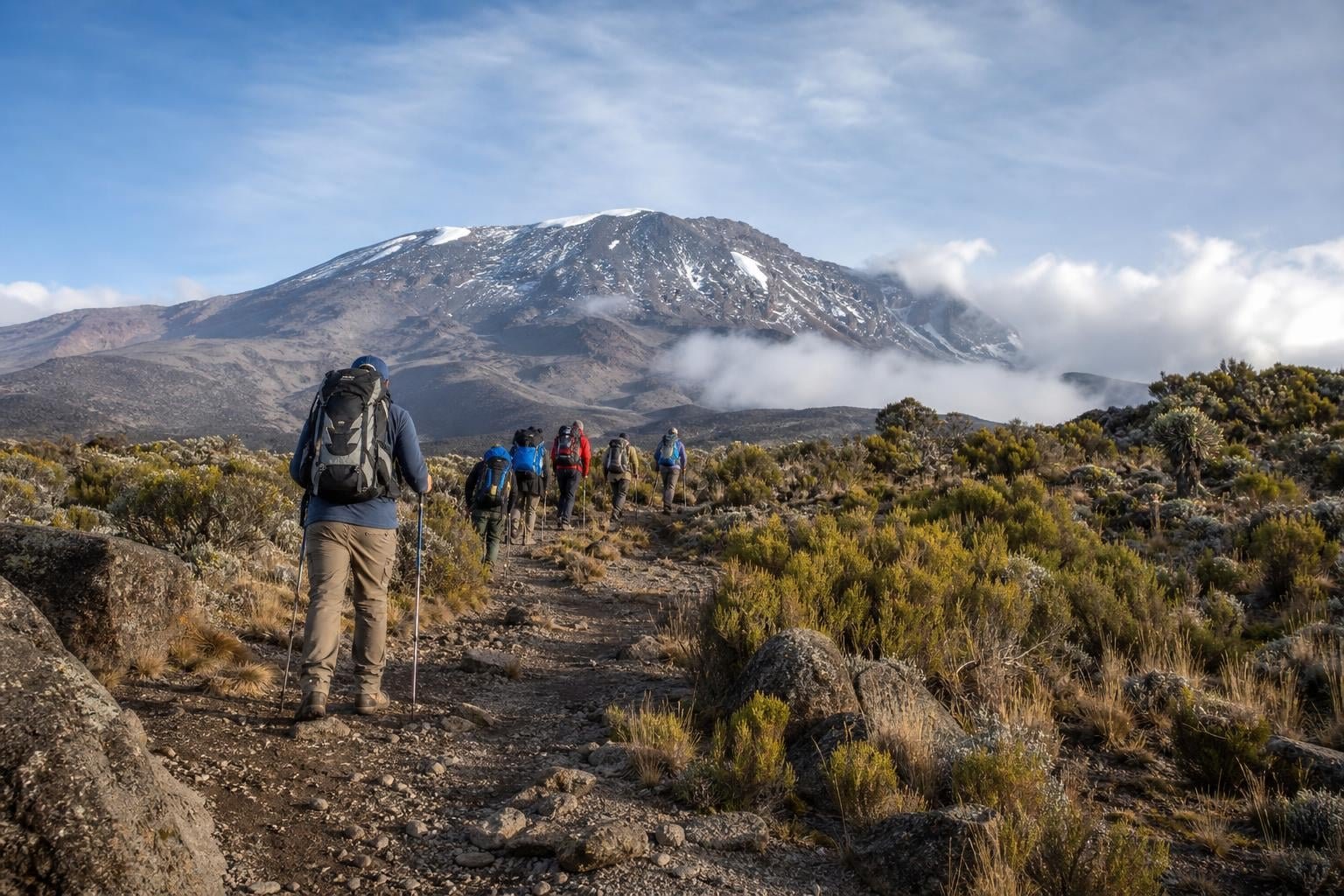
Can You Do a Day Hike on Kilimanjaro? A Kilimanjaro day hike is possible and is one of the best ways to experience Africa's highest mountain without committing to a 5–9 day summit climb. Visitors can hike through the rainforest to Mandara Hut, explore Maundi Crater, trek the Machame Forest, cross the Shira Plateau, or visit Materuni Waterfall in a single day.
Most hikes: - take 3–8 hours - require a licensed guide - cost $80–$400 per person - begin from Moshi - are suitable for reasonably fit travelers
The Marangu Route is the best choice for first-time visitors, while the Shira Plateau offers the best mountain views.
Why a Kilimanjaro Day Hike Belongs on Your Tanzania Itinerary
Most people assume Kilimanjaro requires a week-long expedition, 50 pounds of gear, and a small fortune. It doesn’t. A Kilimanjaro day hike puts you on the slopes of the world’s tallest freestanding mountain in a single morning, and you’re back at your hotel in Moshi or Arusha by dinner.
The appeal is broad. Safari travelers with a spare day between game drives. Families testing whether their kids are ready for something bigger. Partners of Kilimanjaro climbers who want their own mountain experience without the multi-day commitment. Practitioners on Reddit’s r/kilimanjaro community regularly recommend day hikes for exactly this last group, with one popular thread specifically asking about options for a “non-hiking partner” on a honeymoon trip.
There are five distinct day hike options on and around Kilimanjaro, each with a different character, difficulty level, and price point. No other guide covers all of them side by side. This one does.
Considering a full summit climb instead? Compare all Kilimanjaro routes to find your best fit.
At-a-Glance Comparison Table
|
Hike Option |
Max Altitude |
Duration |
Difficulty |
Best For |
Approx. Cost |
|---|---|---|---|---|---|
|
Marangu → Mandara Hut |
2,700m (8,858 ft) |
6–8 hrs |
Easy to Moderate |
Beginners, families |
$200–$350 pp |
|
Marangu → Maundi Crater |
2,720m (8,924 ft) |
6–8 hrs |
Easy to Moderate |
Views + rainforest combo |
$200–$350 pp |
|
Machame Forest Hike |
~3,000m (9,843 ft) |
5–7 hrs |
Moderate to Hard |
Experienced hikers |
$250–$400 pp |
|
Shira Plateau Hike |
3,500m+ (11,483 ft) |
5–8 hrs (+ drive) |
Moderate (altitude) |
Photographers, alpine scenery |
$250–$400 pp |
|
Materuni Waterfall + Coffee Tour |
~1,500m (4,921 ft) |
3–4 hrs |
Easy |
Culture seekers, young families |
$80–$150 pp |
Which Kilimanjaro Day Hike Is Right for You?
|
If you want... |
Choose |
|---|---|
|
First Kilimanjaro experience |
Marangu to Mandara Hut |
|
Best summit views |
Shira Plateau |
|
Most challenging hike |
Machame Forest |
|
Family-friendly option |
Marangu to Maundi Crater |
|
Lowest price |
Materuni Waterfall |
|
Cultural experience |
Materuni Coffee Tour |
|
Preview of a summit climb |
Shira Plateau |
|
Rainforest wildlife |
Marangu or Machame |
Prices typically include park fees, guide, transport from Moshi, and a packed lunch. Tips ($20–$50) and gear rental (~$20) are extra.
1. Marangu Route to Mandara Hut
Best for: First-time visitors, families with children, anyone wanting the most accessible Kilimanjaro experience.
This is the classic Kilimanjaro day hike, and the one most operators recommend to beginners. The trail follows the well-known Marangu route from the gate at 1,860m through dense montane rainforest to Mandara Hut at 2,700m.
Key details:
-
8 km (5 miles) each way, 16 km round trip
-
Elevation gain: ~840m / 2,756 ft
-
Duration: 6 to 8 hours total, including a packed lunch stop at Mandara Hut
-
Trail surface: smooth, well-maintained, the most “path-like” of any Kilimanjaro route
What you’ll see:
The trail passes through Kilimanjaro’s lush rainforest zone, one of the most biodiverse environments in East Africa. Black-and-white colobus monkeys swing through the canopy. Blue monkeys are common. Tropical birds, giant ferns, and massive fig trees line the route. A family travel blogger who hiked this trail with her kids described walking through corridors of “massive moss-covered trees” that felt like stepping into another world.
Pricing: $200 to $350 per person on most booking platforms, including the $70 conservation fee, guide, transport, and lunch. Children aged 5 to 15 pay half the park entry fee. Under 5 is free.
Tradeoffs:
-
The most popular route, so expect other hikers on the trail
-
Views are almost entirely forest canopy, not sweeping mountain panoramas
-
The turnaround at Mandara Hut, while satisfying, doesn’t offer the dramatic visual payoff of higher-altitude options
Who it suits perfectly: The r/kilimanjaro subreddit is full of threads recommending this exact hike for non-hiking partners and families. The altitude (2,700m) sits safely below the threshold where acute mountain sickness typically develops, making it appropriate for children aged 8 and up.
2. Marangu Route to Maundi Crater
Best for: Hikers who want everything the Mandara Hut day hike offers, plus panoramic views from a volcanic crater rim.
This is the same route as option one, with a worthwhile 15-minute extension that transforms the experience. After reaching Mandara Hut, your guide takes you on a short side trail to Maundi Crater, a small volcanic depression on Kilimanjaro’s southeastern slope at 2,720m.
Key details:
-
Same distance and elevation profile as the Mandara Hut hike
-
Duration: still 6 to 8 hours total (the crater detour adds roughly 30 minutes round trip)
-
The crater rim offers panoramic views of Mount Kilimanjaro’s upper slopes, northern Tanzania, and on clear days, Kenya
Why this extension matters:
The Mandara Hut hike is almost entirely within dense forest. Beautiful, but enclosed. The crater rim breaks you out above the canopy for the first time, delivering a visual reward that’s disproportionate to the extra effort. If the weather cooperates, you’ll see the mountain’s snow-capped peak towering above.
Pricing: Same as the standard Mandara Hut hike, $200 to $350 per person. The crater detour doesn’t change the cost.
Tradeoffs:
-
Views are weather-dependent, and clouds often roll in by midday
-
The crater itself is modest in size; this isn’t a dramatic volcanic landscape
-
Still primarily a rainforest experience
The honest recommendation: If you’re doing the Marangu day hike at all, there’s no reason to skip Maundi Crater. Ask your guide to include it. Most will do so without prompting, but confirm when booking.
3. Machame Route Forest Hike
Best for: Experienced hikers who want a real physical challenge, fewer crowds, and deeper rainforest immersion.
The Machame route is Kilimanjaro’s most popular multi-day climbing route for good reason: the scenery is extraordinary and the terrain is genuinely engaging. The day hike version starts at Machame Gate (1,800m) and follows the trail upward through dense montane rainforest toward Machame Camp at roughly 3,000m.
Key details:
-
10 to 12 km round trip
-
Elevation gain: ~1,200m / 3,937 ft (significantly more than Marangu)
-
Duration: 5 to 7 hours
-
Terrain: steep in places, often muddy, trekking poles strongly recommended
What makes it different:
The lower slopes of the Machame route receive heavy precipitation, creating a wetter, wilder rainforest than Marangu. The undergrowth is thicker. The trail is rougher. You’re far more likely to have stretches of trail to yourself. This route also passes through habitat for the Impatiens kilimanjaro, the only flower endemic to Mount Kilimanjaro.
Pricing: $250 to $400 per person. The higher cost reflects the more remote gate location and the need for experienced guides comfortable with steeper terrain.
Tradeoffs:
-
Considerably more demanding than the Marangu options
-
The trail can be slippery after rain (which is frequent on these lower slopes)
-
No hut facilities at the turnaround point, so lunch is on the trail
-
Not suitable for young children or people with mobility concerns
Who should choose this: If you’ve hiked in mountains before and find the Marangu route too tame on paper, this is your day hike. It gives a genuine taste of what a full Machame route climb involves without the multi-day commitment.
4. Shira Plateau Hike
Best for: Photographers chasing summit views, hikers who want above-treeline alpine scenery, and anyone scouting Kilimanjaro before a full climb.
This is the most unique Kilimanjaro day hike and the one that feels least like a consolation prize. Instead of hiking up through forest, you drive to the Shira Plateau at around 3,500m and hike across a vast, 500,000-year-old volcanic caldera that sits above the treeline entirely.
Key details:
-
The day starts with a 2 to 3 hour drive from Moshi to Londorossi Gate, then continues by 4x4 to the Shira Plateau
-
Hiking time: 5 to 8 hours on the plateau itself
-
Altitude: 3,400m to 3,600m throughout the hike
-
Trail character: gentle and rolling, with hardy moorland vegetation and rock formations
What makes it special:
Kilimanjaro’s snow-capped Kibo Peak serves as the backdrop for the entire hike. The Shira Plateau is a UNESCO World Heritage Site, and the landscape feels almost lunar compared to the forest routes below. You may spot elands, buffalo, and a variety of bird species on the open moorland. For photographers, this is by far the best day hike option.
The Shira Plateau also sits on the approach used by the Lemosho route, one of Kilimanjaro’s most scenic multi-day climbing routes. A day hike here gives a preview of what that full experience involves.
Pricing: $250 to $400 per person. The higher end reflects the long drive from Moshi and the fuel costs for the 4x4 transfer to the plateau.
Altitude warning (important):
This is where honesty matters. The Shira Plateau starts at 3,400 to 3,600m, which is firmly in the altitude zone where acute mountain sickness can develop. Most medical guidance puts the risk threshold at around 2,500m, and AMS commonly develops when you reach above 2,800m within two days. You’re driving straight to 3,500m.
For most healthy adults, a few hours at this altitude is manageable. But if you’re prone to altitude sensitivity, have heart or lung conditions, or are traveling with children, this matters. Kilimanjaro National Park does not permit children under 10 above 3,700m for safety reasons. The Shira Plateau sits just below that limit, but the combination of altitude and young lungs deserves careful consideration.
Tradeoffs:
-
The drive from Moshi is long (2 to 3 hours each way), eating into your day
-
No rainforest experience whatsoever
-
Views of Kibo Peak depend entirely on weather; cloud cover can obscure the summit
-
Altitude effects are a real risk, not a theoretical one
-
Not ideal for children under 10 or people with altitude sensitivity
Explore Duma Explorer’s Kilimanjaro day hike options, which include both the Machame Forest and Shira Plateau routes with experienced local guides.
5. Materuni Waterfall and Chagga Coffee Tour
Best for: Culture seekers, families with young children, coffee enthusiasts, and anyone wanting a lighter activity before or after a safari.
This isn’t technically on Kilimanjaro’s slopes. Materuni Village sits about 37 km from Moshi in the mountain’s foothills, and the experience is more cultural than athletic. But it’s the most commonly booked “day hike” activity in the Kilimanjaro region, and it belongs on any honest comparison list.
Key details:
-
A moderate 3.1-mile (5 km) hike with about 800 feet of elevation gain
-
Duration: 3 to 4 hours for the full experience (hike + coffee tour + village visit)
-
The trail winds through banana and coffee plantations to an 80-meter waterfall with a natural swimming pool at the base
-
After the waterfall, guides take you through an authentic Chagga coffee-making experience, from roasting to brewing
What makes it worth including:
AllTrails reviewers consistently note the waterfall is impressive and the cultural element is genuine. One reviewer described it as a “warmup for our Kilimanjaro attempt,” which captures how many travelers use it: a gentle shakeout hike before or after something bigger. The trail can get muddy after rain, and some visitors mention that the hiking boots available for rent at the village are helpful.
For travelers building a broader Tanzania itinerary, the Materuni visit pairs naturally with a safari day or serves as a recovery activity after summiting Kilimanjaro. It’s also one of the best cultural safari experiences in the region.
Pricing: $80 to $150 per person, making it the most affordable option by a wide margin. This typically includes transport from Moshi, a local guide, the coffee tour, and a simple lunch.
Tradeoffs:
-
Not on Kilimanjaro itself, so no park entry or mountain trail experience
-
The hike is short and easy, which may disappoint athletic travelers
-
Mountain views from the village depend on clear weather (often cloudy by midday)
-
The experience is heavily touristic in peak season
Bonus: Two-Day Marangu Hike with Mandara Hut Overnight
For readers who started this article looking for a day hike but now want more, there’s a middle ground. The two-day Marangu option includes an overnight stay at Mandara Hut, followed by a morning hike toward Horombo Hut Camp at 3,720m before descending.
This bridges the gap between a casual day hike and a full summit climb. You sleep in the mountain huts, eat meals prepared by a cook, and push higher into the moorland zone above the rainforest. It’s the shortest possible multi-day Kilimanjaro experience.
If this interests you, it’s worth comparing Kilimanjaro success rates across routes and durations to see whether a full climb might actually be feasible for your group.
What to Know Before You Book
Park Fees Explained
Every Kilimanjaro day hike (except Materuni, which isn’t in the national park) requires paying Kilimanjaro National Park entry fees. The current conservation fee is $70 per person per day for foreign non-residents. An additional 18% VAT applies to all fees. These rates are valid from January 1, 2025 through June 30, 2026, with proposed 15% annual increases starting in 2026/2027.
Children under 5 enter free. Children aged 5 to 15 pay 50% of the standard fee.
Most operator prices include park fees, but confirm this before booking. If the quoted price seems suspiciously low, fees may be separate.
Altitude Considerations by Route
This is the section most day hike guides skip, and it matters.
-
Marangu to Mandara/Maundi (2,700m): Safely below the altitude where most people experience symptoms. Very low risk for healthy adults and children.
-
Machame Forest (~3,000m): Approaching the early altitude sickness threshold, but you’re only at this elevation briefly before descending. Risk is minimal for most people.
-
Shira Plateau (3,400–3,600m): This is squarely in the zone where AMS develops. You’re driving directly to high altitude without acclimatization. Stay hydrated, ascend slowly on foot once you start hiking, and be honest about any symptoms (headache, nausea, dizziness). If you feel unwell, descend immediately.
For anyone wanting to understand altitude preparation better, this Kilimanjaro training guide covers the fundamentals.
Family and Children Guidance
A Kilimanjaro day hike can work well for families. The Marangu route to Mandara Hut is suitable for children aged 8 and up, with a well-maintained trail and guides experienced in pacing for younger hikers.
The critical rule: Kilimanjaro National Park does not allow children under 10 above 3,700m. This effectively rules out the Shira Plateau for younger kids, since the entire hike sits between 3,400m and 3,600m. While technically below the cutoff, the altitude exposure is significant for small bodies.
One commenter on the 14ers.com hiking forum put it well: “99% of children are either not up for it, or could do it, but wouldn’t really enjoy it. Children are pretty impatient and what’s fun one day becomes miserable after 4 tedious, tiring days.” That quote is about full summit climbs, but the underlying point applies: keep it short, keep it fun, and pick the route that matches your kids’ actual enthusiasm, not your own.
Gear Essentials
You don’t need expedition gear for a day hike, but you do need the basics:
-
Sturdy hiking boots (broken in, not new)
-
Rain jacket (rainfall is common on the forest routes, especially Machame)
-
2 liters of water minimum
-
Daypack
-
Sunscreen and hat
-
Layers for the Shira Plateau (temperatures can drop significantly at 3,500m)
-
Trekking poles for the Machame route (strongly recommended)
For a more complete breakdown, see this Kilimanjaro packing checklist.
Best Time of Year
The dry seasons offer the clearest conditions and driest trails: June through October and December through February. The Marangu and Machame forest trails can be extremely muddy during the rainy seasons (March through May, November).
For the Shira Plateau, clear weather is essential for the summit views that make the hike worthwhile. Booking during the best months for Kilimanjaro dramatically improves your experience.
Kilimanjaro Day Hike Conditions by Month
|
Month |
Weather |
Crowds |
Recommendation |
|---|---|---|---|
|
January |
Excellent |
Moderate |
★★★★★ |
|
February |
Excellent |
Moderate |
★★★★★ |
|
March |
Rain begins |
Low |
★★★☆☆ |
|
April |
Heavy rain |
Very low |
★★☆☆☆ |
|
May |
Wettest |
Very low |
★☆☆☆☆ |
|
June |
Dry |
Moderate |
★★★★★ |
|
July |
Excellent |
High |
★★★★★ |
|
August |
Excellent |
High |
★★★★★ |
|
September |
Excellent |
Moderate |
★★★★★ |
|
October |
Very good |
Moderate |
★★★★★ |
|
November |
Short rains |
Low |
★★★☆☆ |
|
December |
Dry |
High |
★★★★★ |
Where Are the Kilimanjaro Day Hike Routes?
Use bullets.
-
Marangu Gate — eastern side of Kilimanjaro
-
Machame Gate — southern slopes
-
Londorossi Gate — western approach to Shira Plateau
-
Materuni Village — foothills near Moshi
How a Kilimanjaro Day Hike Fits Into a Bigger Tanzania Trip
A day hike works as a standalone activity, but it’s most powerful as one piece of a larger itinerary. Common combinations:
Before a safari: Use a Marangu or Materuni day hike as a warm-up the day before heading to the Serengeti or Ngorongoro Crater. It stretches the legs after a long flight and gives you a mountain experience before the game drives begin.
Instead of a summit climb: One partner climbs Kilimanjaro for 7 days while the other does a safari. The non-climbing partner adds a Kilimanjaro day hike on arrival or departure day, so both people have a mountain story to share.
As part of the classic triangle: Kilimanjaro day hike, then a northern circuit safari, then a few days on Zanzibar. This combination covers mountain, wildlife, and beach in a single trip.
Post-climb recovery: The Materuni waterfall and coffee tour is a perfect low-key activity for the day after descending from a full Kilimanjaro summit attempt.
Which Kilimanjaro Day Hike Should You Choose?
The right choice depends on who you are:
-
First timer or nervous about hiking? Marangu to Mandara Hut. Smooth trail, gentle grade, rich forest.
-
Want the best photos? Shira Plateau. Nothing else puts you face-to-face with Kibo Peak for an entire day.
-
Traveling with kids under 12? Marangu to Maundi Crater. Safe altitude, manageable distance, the crater rim adds excitement.
-
Experienced hiker wanting a real workout? Machame Forest. The 1,200m elevation gain and muddy, steep terrain will satisfy.
-
More interested in culture than athletics? Materuni Waterfall and coffee tour. The Chagga village experience is unlike anything on the mountain trails.
Ready to book? Explore Duma Explorer’s Kilimanjaro day hike options, including guided Machame Forest and Shira Plateau routes with local guides who know these trails inside out.
Frequently Asked Questions
Can you do a day hike on Kilimanjaro without a guide?
No. Kilimanjaro National Park requires all hikers to be accompanied by a registered guide, even on day hikes. This rule applies to every route within the park boundaries. The Materuni waterfall hike, which is outside the park, also uses local village guides as standard practice.
How much does a Kilimanjaro day hike cost?
Expect $200 to $400 per person for hikes within the national park (Marangu, Machame, Shira), which typically includes the $70 conservation fee, 18% VAT, guide, transport from Moshi, and a packed lunch. The Materuni waterfall and coffee tour runs $80 to $150 per person. Tips for your guide ($20 to $50) are customary and separate.
Is a Kilimanjaro day hike safe for children?
The Marangu route to Mandara Hut is suitable for children aged 8 and up, according to most operators. The trail is well-maintained and stays below 2,700m, far under the altitude threshold where mountain sickness typically develops. Children under 10 are not permitted above 3,700m in Kilimanjaro National Park, which effectively makes the Shira Plateau hike unsuitable for younger kids.
Do I need special gear for a Kilimanjaro day hike?
Not expedition-level gear, but proper hiking boots, a rain jacket, and at least 2 liters of water are essential. Trekking poles are strongly recommended for the Machame route. If you’re hiking the Shira Plateau, bring warm layers since temperatures at 3,500m can be significantly cooler than in Moshi. Some operators provide gear rental for around $20.
Will I get altitude sickness on a Kilimanjaro day hike?
On the Marangu route (2,700m), altitude sickness is extremely unlikely. The Machame route reaches about 3,000m, which is borderline but brief. The Shira Plateau (3,400 to 3,600m) is the only day hike option with a real altitude risk, since you drive directly to high elevation without acclimatizing. Stay hydrated, move slowly, and descend if you develop headache, nausea, or dizziness.
What’s the best time of year for a Kilimanjaro day hike?
The dry seasons (June through October, December through February) offer the best conditions. Trails are less muddy, skies are clearer for summit views from the Shira Plateau, and rainfall is minimal. The long rainy season from March through May makes the Machame route particularly slippery and can obscure views on all routes.
Can I do a Kilimanjaro day hike as part of a safari trip?
Absolutely. This is one of the most common ways travelers experience the mountain. Most operators in Moshi and Arusha can arrange a Kilimanjaro day hike with one day’s notice. It fits naturally before or after a northern Tanzania safari circuit, making it easy to add to a broader East Africa itinerary.
How do Kilimanjaro day hikes compare to a full summit climb?
A day hike gives you the mountain’s rainforest zone, wildlife, and (on the Shira Plateau) alpine scenery, but you won’t reach the glaciers, the arctic zone, or the summit. Think of it as a concentrated sample rather than the full experience. Many travelers use a day hike to decide whether they want to commit to a 5 to 9 day summit attempt later.