Kilimanjaro Training: Why Marathon Fitness Won't Save You at 19,341 Feet
TLDR
Kilimanjaro training is about becoming durable enough to hike uphill and downhill for hours over consecutive days while your body adjusts to altitude. Fitness helps you enjoy the climb and recover each night, but it does not prevent altitude sickness. Most active people need 8 to 12 weeks of specific preparation, while beginners and older travelers should plan for 3 to 6 months. This glossary explains every term you keep seeing in Kilimanjaro training advice, tells you what actually matters, and helps you separate smart preparation from overhyped shortcuts.
Search “how to train for Kilimanjaro” and you will drown in contradictions. One page says eight weeks is enough. Another says six months. One recommends altitude masks. Another calls them useless. Someone says running is the best preparation. An expedition company says running is exactly the wrong approach.
The problem is not that the advice is wrong. It is that nobody explains the vocabulary. Terms like “Zone 2,” “vertical gain,” “eccentric strength,” “acclimatization,” and “pole pole” get thrown around as if everyone already knows what they mean and why they matter for a 5,895-meter mountain.
This glossary fixes that. Each entry gives a plain definition, explains why the term matters specifically on Kilimanjaro, and tells you what to do with it. No generic workout plan. No hype. Just the decoder you need to build a training approach that actually matches the mountain.
The core truth, before anything else: train for endurance and durability, but respect altitude. They are different problems, and confusing them is the most common mistake climbers make.
Does Fitness Prevent Altitude Sickness on Kilimanjaro? No. Physical fitness does not prevent altitude sickness, Acute Mountain Sickness (AMS), HAPE, or HACE. Altitude sickness is determined by genetics, your rate of ascent, and how well your body acclimatizes to low oxygen levels. Kilimanjaro training improves your endurance to hike 4 to 8 hours daily for consecutive days and helps your muscles recover each night, but even elite marathon runners can experience severe altitude sickness if they ascend too quickly.
The 4-Part Kilimanjaro Training Stack
Before the glossary entries, here is a framework that organizes everything. Think of Kilimanjaro preparation as four layers, each doing a different job.
1. The Engine: Aerobic Endurance
Your ability to move slowly for hours without burning out. This is built through steady hiking, incline walking, stairs, cycling, running, or swimming. Most Kilimanjaro training plans recommend 3 to 5 or more days per week of aerobic work, with longer hikes added as the trip approaches.
2. The Chassis: Legs, Core, Hips, and Joints
What keeps your knees, hips, ankles, lower back, and shoulders functioning after multiple days on the mountain. The descent deserves special attention. Going downhill loads your quads and knee stabilizers harder than most people expect.
3. The Rehearsal: Pack-Loaded Uphill and Downhill Time
The most Kilimanjaro-specific layer. Stairmaster, hills, stadium stairs, parking ramps, and incline treadmills all help if local terrain is flat. The key is not speed. It is time on feet, vertical gain, pack comfort, and controlled descending.
4. The Mountain Variable: Acclimatization and Safety Response
The part training cannot fully control. The CDC states plainly that training and physical fitness do not affect altitude-illness risk. Risk depends on individual susceptibility, altitude, and ascent rate. This is why route length, gradual ascent, pacing, hydration, symptom honesty, and guide monitoring matter as much as your squat numbers.
Understanding these four layers makes every glossary term below click into place.
What Training Can and Cannot Do
This distinction is worth a table, because it prevents the single most dangerous misconception in Kilimanjaro preparation.
|
Training can improve |
Training cannot guarantee |
|---|---|
|
Endurance for long trekking days |
Freedom from altitude sickness |
|
Leg strength for steep ascents |
A safe outcome on a too-fast itinerary |
|
Knee durability for descents |
Immunity from AMS, HACE, or HAPE |
|
Confidence with boots, poles, and pack |
Summit success |
|
Recovery between consecutive hiking days |
Permission to ignore symptoms |
The International Society of Travel Medicine shared expert commentary on LinkedIn emphasizing that fitness does not protect people from altitude illness and may actually lead some fit climbers to move too fast or push through warning signs. Being strong helps you handle the workload. It does not give you permission to ignore headache, nausea, dizziness, breathlessness at rest, or guide instructions.
Fitness and Workout Terms
Aerobic Base
What it means: Your ability to keep moving at an easy-to-moderate effort for a long time without redlining.
Why it matters on Kilimanjaro: The mountain involves repeated long trekking days, typically 4 to 8 hours of walking. A better aerobic base means you recover faster overnight and actually enjoy the scenery instead of staring at your boots. Kilimanjaro training plans typically build from 30 to 45 minute cardio sessions up to longer 75 to 90 minute sessions and eventually full-day hikes.
Common mistake: Training only with high-intensity intervals. Kilimanjaro is mostly slow, steady work. Sprinting does not transfer well to 7 hours of uphill plodding.
Zone 2 Training
What it means: Easy aerobic work where your breathing stays controlled and you can hold a conversation. In heart-rate terms, roughly 60 to 70 percent of your maximum, though the exact number varies by individual.
Why it matters on Kilimanjaro: Experienced trekking coaches argue that building training around Zone 2 (moving gradually into Zone 3 over time) produces the endurance foundation that summit day demands. Speed is irrelevant. Duration is everything.
Common mistake: Turning every workout into a hard effort and arriving overtrained or injured.
Time on Feet
What it means: The total duration your body spends walking, hiking, or climbing stairs, measured in hours rather than miles or kilometers.
Why it matters on Kilimanjaro: Fatigue accumulates over days. Alpine Ascents recommends climbers be comfortable walking 4 to 8 hours per day on successive days. A 5-mile flat walk that takes 90 minutes does not prepare you for a 5-mile rocky ascent that takes 5 hours.
Common mistake: Counting only mileage. On steep, slow Kilimanjaro terrain, hours and elevation gain matter far more than pace.
Vertical Gain (Elevation Gain)
What it means: The total amount of uphill climbing you accumulate, measured in feet or meters.
Why it matters on Kilimanjaro: A flat 10-mile walk and a hilly 6-mile hike with 2,000 feet of climbing are completely different efforts. Distance matters less on Kilimanjaro than daily elevation gain and hours spent ascending.
Common mistake: Walking flat routes and assuming the mileage alone will transfer. Practitioners on Reddit report that climbers who trained mostly on flat ground struggled significantly more than those who incorporated regular hill or stair work.
Pack-Loaded Hiking
What it means: Training while carrying a daypack similar to what you will carry on the mountain.
Why it matters on Kilimanjaro: Expedition companies reference a 15 to 25 pound daypack as a realistic training target, though actual loads vary depending on water, layers, snacks, and personal gear. Your shoulders, hips, and back need to be used to the weight before day one.
How to train it: Start with a light pack (8 to 10 pounds) and add weight gradually over weeks. Practice on uphills and downhills.
Common mistake: Starting too heavy too soon, especially on descents, which is a fast path to knee pain.
Progressive Overload
What it means: Gradually increasing the duration, elevation, distance, or pack weight of your training sessions over time.
Why it matters on Kilimanjaro: Bodies adapt to stress, but only when the increase is gradual. A widely cited guideline is increasing training load by roughly 10 percent per week: a little more elevation, a few more minutes, a slightly heavier pack.
Common mistake: Cramming. Jumping from 2-hour flat walks to 6-hour loaded hill hikes in a single week invites injury.
Stairmaster Training
What it means: Using a stair-climbing machine to simulate sustained uphill movement.
Why it matters on Kilimanjaro: The Stairmaster is one of the best substitutes for hills if you live somewhere flat. Coaches recommend Stairmaster and incline treadmill work with a backpack when real hills are not available.
Common mistake: Going too fast. The goal is slow, sustained climbing for 30 to 60 or more minutes, not crushing a quick HIIT session.
Incline Treadmill
What it means: A treadmill set to a steep uphill grade.
Why it matters on Kilimanjaro: Practical for flat-city training. Set the incline to 10 to 15 percent and walk at a comfortable pace to build hiking-specific strength.
Common mistake: Thinking incline treadmill perfectly replicates Kilimanjaro terrain. Real trails involve uneven ground, loose scree, rock steps, dust, and descents. The treadmill is a useful tool, not a complete simulation.
Downhill Conditioning
What it means: Training your quads, knees, hips, ankles, and core to handle controlled descending.
Why it matters on Kilimanjaro: The descent is where many climbers break down. Tusker Trail notes that going downhill is especially taxing on knees, hips, and thighs. After summit night, you descend thousands of vertical feet on tired legs. If you have not trained for this, it will hurt.
How to train it: Walk downhill with a loaded pack. Do slow step-downs off a bench. Use eccentric squats and lunges. If terrain allows, find trails with real descents and practice controlled, knee-friendly technique.
Common mistake: Training uphill only and treating the descent as an afterthought.
Eccentric Strength
What it means: Muscle control while the muscle is lengthening, the opposite of a contraction. Think of the lowering phase of a squat or the controlled braking action of walking downhill.
Why it matters on Kilimanjaro: Every downhill step loads your quads and knees eccentrically. Weak eccentric control equals sore, wobbly legs and potential knee flare-ups on descent days. If you have ever stumbled down a mountain with quads that feel like jelly, you have felt eccentric failure.
How to train it: Slow step-downs, walking lunges with deliberate lowering, and trail descents. Take 3 to 4 seconds on each lowering phase.
Core Stability
What it means: Trunk control that keeps you balanced on uneven terrain, helps support a daypack, and protects the lower back.
Why it matters on Kilimanjaro: Wobbly footing over roots, rocks, and scree is constant. A strong core keeps your upper body centered over your feet and reduces the strain of carrying a loaded pack for hours.
How to train it: Planks, dead bugs, farmer’s carries, single-leg balance work, and hiking on uneven terrain.
Step-Ups
What it means: Repeatedly stepping onto a bench, box, or stair with a controlled, full range of motion.
Why it matters on Kilimanjaro: Step-ups closely mimic the motion of uphill hiking and are one of the best exercises for flat-land Kilimanjaro training. Add a daypack for specificity.
Back-to-Back Hikes
What it means: Training on consecutive days to simulate the cumulative fatigue of a multi-day trek.
Why it matters on Kilimanjaro: The mountain does not give rest days on most routes. Hiking Saturday and Sunday with a loaded pack teaches your body to recover overnight and perform again the next morning.
Common mistake: Doing back-to-back hikes every weekend from the start. Build into them gradually to avoid overuse injuries.
Taper
What it means: Reducing training volume in the days before your climb so your body arrives rested and recovered.
Why it matters on Kilimanjaro: Training programs recommend ending hard training at least 4 to 7 days before the summit attempt. Your last week before flying should involve light movement, stretching, and gear organization, not desperate last-minute training.
Common mistake: Cramming hard workouts in the final week. You cannot build meaningful fitness in the last few days, but you can absolutely arrive tired or injured.
Gear Shakedown
What it means: Practicing with the exact boots, socks, daypack, rain gear, layers, hydration system, gloves, trekking poles, and headlamp you plan to use on the mountain.
Why it matters on Kilimanjaro: Gear problems become training problems if they cause blisters, chafing, cold hands, or dehydration. Break in boots over weeks, not days. Test your hydration setup while walking. Adjust your pack straps until the weight sits on your hips, not your shoulders. For a full breakdown of what to bring, check this Kilimanjaro packing list and gear checklist.
Common mistake: Buying new boots two weeks before departure and assuming they will be fine.
Mobility
What it means: The range of motion in your ankles, hips, calves, hamstrings, and thoracic spine.
Why it matters on Kilimanjaro: Tight ankles limit your ability to navigate uneven terrain. Stiff hips make long uphill stretches painful. Restricted hamstrings affect stride on descents. Even 10 minutes of daily mobility work, ankle circles, hip openers, calf stretches, hamstring slides, pays real dividends on a multi-day trek.
Altitude and Safety Terms
A note: this section is educational, not medical advice. Anyone with a medical condition, concerns about altitude, or questions about medication should consult a travel-medicine clinician before climbing.
Acclimatization
What it means: The body’s gradual process of adapting to lower oxygen availability at higher altitude. Your breathing rate, heart rate, and blood chemistry shift over hours and days to compensate.
Why it matters on Kilimanjaro: Acclimatization is the single biggest factor in Kilimanjaro safety and comfort. The Wilderness Medical Society recommends gradual ascent and emphasizes that sleeping altitude is more important than the highest point reached during the day. Training cannot replace acclimatization. It buys your body time.
Common mistake: Thinking that being fit means you acclimatize faster. You don’t. This is worth understanding deeply, because it changes how you approach route choice. Longer routes with gradual altitude profiles give your body more time to adjust, which is why many experienced operators recommend 7 to 9 day itineraries. A Kilimanjaro route comparison can help you see the difference.
AMS (Acute Mountain Sickness)
What it means: The most common altitude illness, typically causing headache plus some combination of nausea, dizziness, fatigue, appetite loss, or disturbed sleep. Symptoms often appear 2 to 12 hours after arriving at a higher altitude.
Why it matters on Kilimanjaro: AMS is extremely common on the mountain. CDC guidance reports that AMS prevalence reached 75 to 77 percent in studies of 4- and 5-day Kilimanjaro ascents, and even among climbers using acetazolamide on 5-day ascents, 40 percent or more still reported symptoms. A 2022 prospective study found severe altitude illness in 8.6 percent of recreational hikers, with 1.1 percent requiring hospitalization.
Common mistake: Hiding symptoms because you do not want to be “the weak one.” This is dangerous. Mild AMS that goes unreported can escalate.
HACE (High-Altitude Cerebral Edema)
What it means: A severe altitude illness involving swelling in the brain. Symptoms include confusion, loss of coordination, altered mental state, and inability to walk straight.
Why it matters on Kilimanjaro: HACE is a medical emergency. It requires immediate descent and medical intervention. This is not something you push through.
HAPE (High-Altitude Pulmonary Edema)
What it means: A severe altitude illness involving fluid in the lungs. Symptoms include breathlessness at rest, persistent cough, gurgling breathing, and extreme fatigue.
Why it matters on Kilimanjaro: HAPE can occur with or without AMS and requires urgent treatment and descent. The Wilderness Medical Society states that HAPE treatment should include oxygen and descent when possible.
Sleeping Altitude
What it means: The altitude at which you sleep each night, as opposed to the highest point you touch during the day.
Why it matters on Kilimanjaro: This is the altitude number that matters most for acclimatization. CDC recommends limiting sleeping-altitude gain to roughly 500 meters (about 1,600 feet) per day once above 3,000 meters and adding an acclimatization day for each additional 1,000 meters of sleeping-altitude gain.
Climb High, Sleep Low
What it means: A trekking pattern where you hike to a higher altitude during the day, then descend to a lower camp to sleep.
Why it matters on Kilimanjaro: Some routes build this into the itinerary. It exposes your body to higher altitude during the day while letting you sleep at a more comfortable elevation. This supports acclimatization because sleeping altitude matters more than the high point touched while awake.
Pole Pole
What it means: Swahili for “slowly, slowly.” You will hear this constantly from guides and porters.
Why it matters on Kilimanjaro: It is not a cute phrase or cultural decoration. It is a safety principle. Rushing uphill burns energy, raises your heart rate unnecessarily at altitude, and can accelerate AMS symptoms. Guides say “pole pole” because they know that the slowest sustainable pace is usually the right pace. The ego-killing truth of Kilimanjaro: the person shuffling along at the back of the group is often doing it right.
Diamox (Acetazolamide)
What it means: A prescription medication used to help prevent or treat AMS. A common adult prevention dose cited in the Wilderness Medical Society guidelines is 125 mg every 12 hours.
Why it matters on Kilimanjaro: The guidelines say acetazolamide should be strongly considered for moderate- or high-risk travelers ascending to high altitude. However, it is a medical decision, not a training shortcut. Side effects can include tingling in hands and feet, increased urination, and altered taste of carbonated drinks.
What to do: Talk to a travel-medicine clinician before your trip. Do not self-prescribe, borrow from a friend, or rely on it as a guarantee.
Hypoxic Tent
What it means: A tent or sleeping system that reduces oxygen concentration to simulate sleeping at altitude.
Why it matters on Kilimanjaro: Many climbers ask about these, but the evidence is thin. The Wilderness Medical Society notes that hypoxic tents may help only when sufficiently long exposures are done regularly over weeks, but there are no data showing increased summit success or improved physical performance. Short or infrequent exposures are likely of no benefit.
The blunt version: For most travelers, the money is better spent on a longer route, good gear, medical consultation, and consistent hiking-specific Kilimanjaro training.
Altitude Mask
What it means: A mask marketed to make breathing harder during exercise, sometimes confused with real altitude simulation.
Why it matters on Kilimanjaro: These masks restrict airflow; they do not meaningfully reduce oxygen concentration the way actual altitude does. They should not be confused with acclimatization. Short exercise exposures to restricted breathing are likely of no benefit for altitude adaptation.
Practitioners on Reddit reflect the same skepticism. Threads about altitude gyms and masks show mixed expectations: some users see psychological value, but others point out that plenty of normally fit people summit without simulated altitude. The consensus leans toward spending money on training time, gear, and itinerary length instead.
Symptom Honesty
What it means: Telling your guide, immediately and truthfully, when you have a headache, nausea, dizziness, unusual fatigue, breathlessness at rest, confusion, or any other concerning symptom.
Why it matters on Kilimanjaro: CDC prevention advice includes knowing early symptoms, not ascending to sleep higher when symptoms are present, and descending if symptoms worsen. Your guide cannot help you if you hide what you are feeling. This is not weakness. It is how safe climbs work.
Pulse Oximeter
What it means: A small clip-on device that measures blood oxygen saturation (SpO2) and heart rate from your fingertip.
Why it matters on Kilimanjaro: Guides often use pulse oximeters to monitor climbers during morning and evening health checks. Lower readings at altitude are expected, but significant drops or readings paired with symptoms can inform descent decisions.
Descent Decision
What it means: The choice, made by you and your guide, to turn around and go down if altitude symptoms are worsening.
Why it matters on Kilimanjaro: This is one of the hardest decisions on the mountain, and it can save your life. A good guide will make the call even when you do not want to hear it. The right response is to listen.
How Route Choice Impacts Your Acclimatization Success
Because physical fitness cannot prevent altitude sickness, your choice of itinerary is the most critical safety factor. Shorter routes force a rapid ascent, drastically increasing the risk of AMS.
|
Kilimanjaro Route |
Standard Duration |
Acclimatization Profile |
Estimated Success Rate |
|
Lemosho Route |
7 to 8 Days |
Excellent (Excellent "Climb High, Sleep Low" options) |
High (85%+) |
|
Machame Route |
6 to 7 Days |
Good (Steep, but allows decent acclimatization) |
Moderate to High (75%+) |
|
Rongai Route |
6 to 7 Days |
Moderate (Gradual ascent, lower peak-and-valley variation) |
Moderate (70%+) |
|
Marangu Route |
5 to 6 Days |
Poor (Fastest route, hut accommodation but rapid ascent) |
Low (Under 50%) |
Route and Mountain Terms
Summit Night
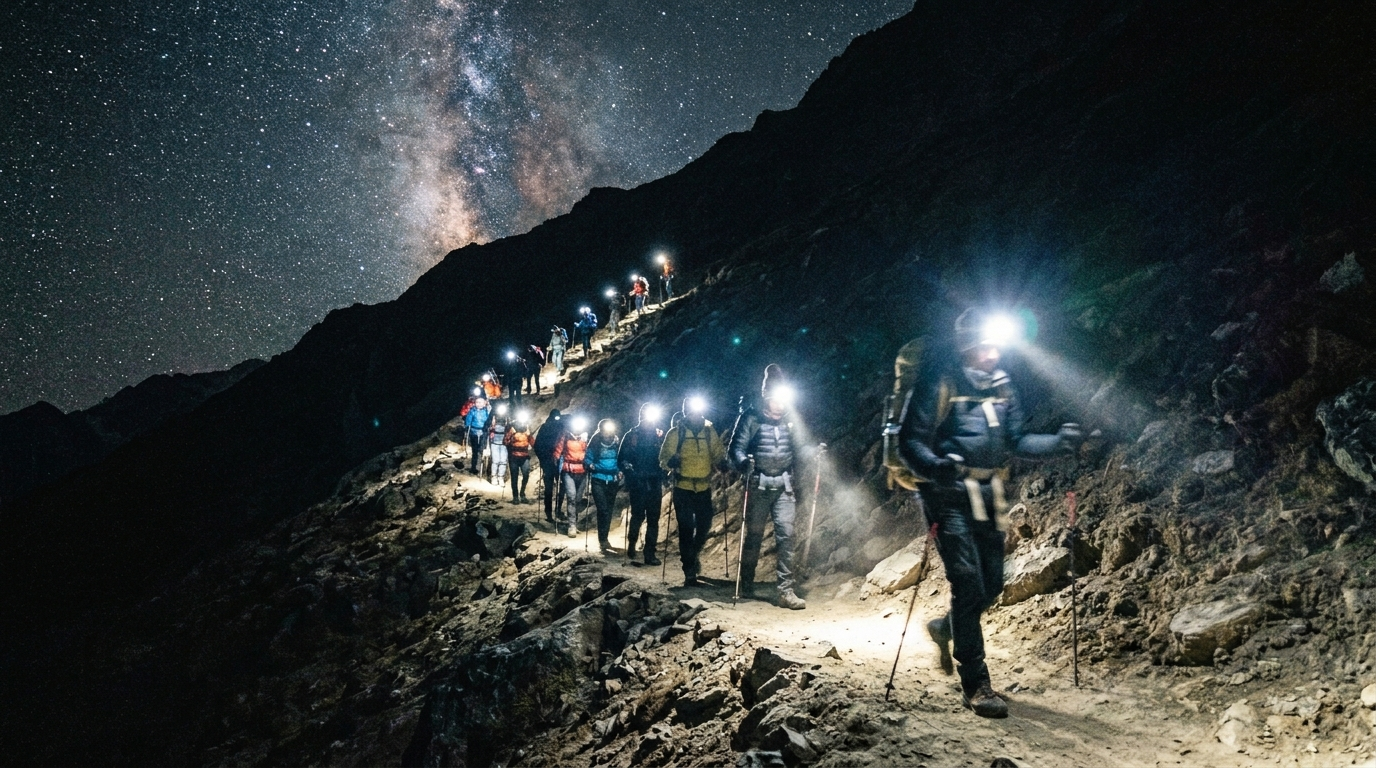
What it means: The final push to Uhuru Peak, usually starting between midnight and 2 a.m. depending on the route and camp.
Why it matters on Kilimanjaro: Summit night combines extreme cold, darkness, steep terrain, the thinnest air of the entire trek, sleep disruption, and a very long day. Community comments on Reddit repeatedly frame summit night as far harder than the earlier trekking days. One post described summit day as often 12 to 15 hours total, with 7 to 9 hours ascending and 5 to 7 hours descending.
Training implication: Practice long, slow endurance sessions. Wear your headlamp. Test your layering system. Eat snacks while moving. Do at least one early-morning or pre-dawn hike if safely possible. Summit night is where mental toughness matters as much as physical preparation.
Uhuru Peak
What it means: The true summit of Kilimanjaro at approximately 5,895 meters (19,341 feet), the highest point in Africa.
Stella Point and Gilman’s Point
What it means: Two significant points on the crater rim reached before Uhuru Peak. Stella Point sits at about 5,756 meters on the southern rim; Gilman’s Point at about 5,681 meters on the eastern rim. Both come with certificates.
Why they matter: If altitude symptoms become severe near the top, these points represent meaningful achievements. Reaching either one without continuing to Uhuru is not failure. It is a reasonable decision.
Barranco Wall
What it means: A steep rock face on routes approaching from the south (Lemosho, Machame, Umbwe). It involves scrambling, using hands for balance, but no technical climbing.
Why it matters on Kilimanjaro: It intimidates first-timers, but the reality is that slow movement, balance, and guide support matter more than climbing skill. Good core stability, comfortable boots, and confidence with hand-over-hand movement on rock are sufficient. For a breakdown of how this fits into different routes, see the guide to the Lemosho route.
Daypack
What it means: The pack you carry yourself containing water, snacks, rain gear, warm layers, sunscreen, medications, and personal items. Everything else goes in a porter duffel.
Why it matters: You will train and climb better if your shoulders, back, and hips are used to the load. Expedition references commonly cite 15 to 25 pounds, but actual weight depends on what you carry. Train with a realistic version.
Trekking Poles
What it means: Adjustable poles used for balance, rhythm, and reducing strain on knees, especially during descents.
Why they matter on Kilimanjaro: Poles redistribute some of the load off your legs and provide stability on loose or uneven ground. They are particularly helpful on descents, where they reduce impact on knees. Practice using them before the trip so they feel natural.
Route Duration
What it means: The total number of days your route spends on the mountain, including ascent, acclimatization, summit, and descent days.
Why it matters on Kilimanjaro: CDC advises adding 1 to 2 days to a planned Kilimanjaro ascent because additional time facilitates acclimatization, especially for routes normally promoted as 4 to 6 day trips. Choosing a longer itinerary is one of the most impactful things you can do, arguably more impactful than any single training technique.
This is where training and route planning intersect. The Marangu route is often chosen for its shorter duration and hut accommodation, but that shorter timeline reduces acclimatization opportunity. The Rongai route approaches from the north and offers a different terrain profile. Understanding what each route demands helps you tailor your Kilimanjaro training plan.
Acclimatization Day (Rest Day)
What it means: A day built into the itinerary specifically to slow your sleeping-altitude gain and allow your body to adapt. It often involves a short “climb high, sleep low” hike.
Why it matters: These days are not wasted time. They are built into longer routes for a reason. CDC specifically recommends extra acclimatization time and says it benefits climbers regardless of route.
Micro-Goals
What it means: Breaking the climb, especially summit night, into small mental targets: the next rest stop, the next switchback, the next hour, the next water break.
Why it matters on Kilimanjaro: A LinkedIn post from a Kilimanjaro climber advised trusting guides and setting micro-goals rather than fixating on the distant summit during hours of cold, dark hiking. This is practical psychology, not motivational fluff. When you are 8 hours into summit night, “reach Uhuru Peak” is overwhelming. “Make it to that rock 50 meters ahead” is manageable.
How Long Should You Train for Kilimanjaro?
The honest answer: it depends on where you are starting. Here is a decision table that synthesizes the range of recommendations across expedition companies and training programs.
|
Your current situation |
Suggested training window |
Main focus |
|---|---|---|
|
Already hikes hills regularly, comfortable with 4 to 6 hour hikes |
8 to 12 weeks |
Pack weight, stairs, downhill, back-to-back sessions, taper |
|
Exercises 3 to 5 times per week but rarely hikes |
12 to 16 weeks |
Convert general fitness to hiking-specific endurance |
|
Runs or cycles regularly but has not carried a pack or descended trails |
3 to 4 months |
Uphill hiking, step-ups, eccentric quad work, poles |
|
Sedentary or returning after a long break |
4 to 6+ months |
Build base safely, get medical clearance, progress slowly |
|
Over 50 or has knee, hip, or back concerns |
3 to 6+ months |
Strength, mobility, recovery, descent tolerance, long hikes |
|
Short on time but already healthy and active |
Minimum 8 weeks |
Consistency, injury avoidance, route and operator support |
The range across top-ranking pages spans from 8-week programs to 6-month plans. None of them are wrong. They are just written for different starting points. Pick the row that fits you, and give yourself at least that much time.
Sample Kilimanjaro Training Week (The 12-Week Sweet Spot)
If you are starting your training 3 months before your departure date, a balanced weekly structure should balance aerobic conditioning, strength, and active recovery.
-
Monday: Rest and Full-Body Mobility Work (20 mins)
-
Tuesday: Zone 2 Aerobic Training (45-60 mins running, cycling, or rowing)
-
Wednesday: Leg & Core Strength Training (Squats, Step-ups, Lunges, Planks)
-
Thursday: Incline Treadmill or Stairmaster Session (45 mins with a light 10 lb pack)
-
Friday: Rest Day
-
Saturday: Long Backpacking Hike / Time on Feet (3 to 5 hours on hilly terrain with a 15-20 lb pack)
-
Sunday: Active Recovery (30-45 min easy flat walk or swim)
How to Train for Kilimanjaro If You Live Somewhere Flat
Living in Miami, Dallas, or Amsterdam does not disqualify you. It just means you need to be more creative. Here is a practical substitution ladder, ordered from simplest to most specific.
-
Walk more daily. Build a habit of 45 to 60 minute walks at a brisk pace.
-
Add a weighted daypack. Start with 8 to 10 pounds and build toward 15 to 20.
-
Use stairs. Office stairwells, stadium steps, parking garages. Climb for 20 to 40 minutes at a steady pace.
-
Use a Stairmaster or incline treadmill. Set inclines high (10 to 15 percent on a treadmill) and walk. Add your daypack once it feels comfortable.
-
Do step-ups, lunges, split squats, and calf raises. These build the muscles that stairs and hills target.
-
Schedule monthly long hikes with elevation if possible. Drive to the nearest hilly trail, state park, or mountain for a 4 to 6 hour loaded hike.
-
Practice downhill. If terrain exists, descend slowly and deliberately. If not, train eccentric control with slow step-downs off a bench or box.
One Reddit trip-analysis post described how climbers who trained only on flat ground often struggled compared to those who incorporated sustained uphill and downhill movement, even through makeshift solutions like stairs and parking ramps. Flat-land training is better than no training, but adding vertical movement is what makes it transfer to Kilimanjaro.
Kilimanjaro Training Readiness Checklist
These are not guarantees. They are useful indicators that your preparation is on track.
Signs you are ready:
-
Walk or hike 4 to 6 hours at an easy pace without being wrecked the next day
-
Climb stairs or hills steadily with a loaded daypack for 30 to 60 minutes
-
Descend for an hour or more without significant knee pain
-
Do back-to-back training days (Saturday and Sunday) without unusual soreness
-
Carry your expected daypack comfortably for several hours
-
Eat, drink, adjust layers, and manage poles while moving
-
Maintain a genuinely slow pace without chasing faster hikers
-
Stop training hard several days before departure
Signs you are not ready yet:
-
Cannot walk 60 to 90 minutes without unusual pain or exhaustion
-
Relying entirely on flat walking with no stairs or incline work
-
Have not tested boots, socks, daypack, or poles on a real hike
-
Get knee pain on descents with no plan to address it
-
Starting from sedentary with only a few weeks remaining
-
Believe being fit means altitude symptoms will not happen
-
Planning a short route to save money despite altitude concerns
Common Kilimanjaro Training Mistakes
“I’m a runner, so I’m ready”
Running builds cardiovascular fitness, which helps. But Kilimanjaro requires hiking-specific endurance: loaded packs, steep terrain, uneven ground, trekking poles, slow movement at altitude, and punishing descents. Alpine Ascents states directly that many marathon-fit people struggle on high-altitude peaks because cardiovascular fitness alone is not enough.
Training flat only
Flat walking builds base fitness. It does not fully prepare calves, quads, glutes, and knee stabilizers for sustained climbing and descending. If hills are not available, use the flat-land substitution ladder above.
Ignoring the descent
After you summit, you still have to come down. The descent after summit night can be brutal on tired legs. Train downhill specifically, not just uphill.
Cramming fitness at the last minute
Training adaptations take weeks and months, not days. Rushed progression increases injury risk. Start earlier than you think you need to. A gradual ramp of roughly 10 percent more load per week is a well-supported approach.
Believing altitude sickness means you are weak
This might be the most dangerous misconception. The CDC is unambiguous: fitness does not affect altitude-illness risk. Very fit climbers get AMS. Average-fit climbers sometimes feel fine. Altitude susceptibility is partly genetic and depends on ascent rate, not squat strength.
A 2026 LinkedIn trip report from experienced Boulder hikers described feeling strong early on an 8-day Lemosho climb, then experiencing altitude problems above 15,000 feet near Lava Tower. Training gave them the endurance to manage the situation, but it did not prevent it.
Buying altitude gadgets instead of choosing a better itinerary
If budget is limited, spend on extra route days, medical consultation, quality gear, and consistent training. Altitude masks and short hypoxic sessions have no evidence showing improved summit success. A longer route with proper acclimatization days does have evidence behind it.
Hiding symptoms from your guide
CDC prevention advice: know early altitude symptoms, do not ascend to sleep higher when symptoms are present, and descend if symptoms worsen. Hiding a headache or nausea because you do not want to slow the group down is how mild AMS turns into an emergency. A good guide will ask. Tell the truth.
Real-World Rehearsal: The Training Detail Nobody Mentions
One r/kilimanjaro commenter shared that they practiced hiking in the dark and using outdoor bathroom facilities before their trip because those were genuine anxiety points. This is the kind of preparation that most training plans ignore.
Kilimanjaro is not just a physical challenge. It is a logistics challenge. You need to eat and drink while walking. You need to layer and de-layer as temperatures swing from freezing to warm within hours. You need to use a headlamp efficiently during summit night. You need to be comfortable with basic camp hygiene.
Consider working these into your training:
-
Wear your actual boots, poles, gloves, and daypack on training hikes
-
Practice eating snacks and drinking water without stopping
-
Do one pre-dawn or after-dark hike safely with a headlamp
-
Test your rain gear in actual rain if possible
-
Practice trekking-pole technique on uphills and downhills
These small rehearsals reduce anxiety and build the kind of competence that makes summit night less overwhelming.
When to Talk to a Doctor
Schedule a visit with a travel-medicine clinician before your Kilimanjaro climb if any of the following apply:
-
Heart, lung, or metabolic condition (including diabetes)
-
Prior severe altitude illness
-
Sleep apnea
-
Pregnancy
-
Questions about acetazolamide (Diamox) or other medications
-
Major injury or surgery history
-
Any medication that could interact with altitude or exertion
-
Sickle cell disease or trait
CDC discusses medical conditions, acclimatization, and medication considerations for high-altitude travelers in detail. Even healthy travelers benefit from a travel-medicine consultation to discuss Diamox, vaccinations, water safety, and emergency planning.
Match Your Training to the Right Route and Support
Kilimanjaro training and route selection are two halves of the same decision. Your fitness level, available preparation time, and altitude tolerance should all influence which route and itinerary length you choose. A well-matched route gives your body the time it needs, regardless of how fit you are.
If you are choosing between routes and wondering how training demands differ, a detailed Kilimanjaro route comparison can help you weigh acclimatization profiles, terrain, duration, and daily effort.
Training matters, but so does the team watching you on the mountain. Duma Explorer’s Kilimanjaro guides have 15+ years of experience and Wilderness First Responder certification, and the company provides a 1:1 guide-to-climber ratio on summit day. They offer multiple routes, including Lemosho, Machame, Northern Circuit, Rongai, and Marangu, with both private custom climbs and fixed-date small-group departures.
If you are comparing operators, consider porter welfare and sustainability in the decision. Duma Explorer is a KPAP founding partner and Travelife Certified.
And if you are planning to combine your Kilimanjaro climb with a safari or beach time afterward, this guide to fitting multiple experiences into one East Africa trip covers how recovery days, safari extensions, and Zanzibar or coastal add-ons can be built around your climb.
FAQs About Kilimanjaro Training
How fit do you need to be to climb Kilimanjaro?
You do not need elite athletic fitness. You should be able to hike for several hours on consecutive days, carry a daypack, climb steadily, descend comfortably, and recover overnight. Alpine Ascents emphasizes that regular exercise alone does not guarantee the conditioning needed; climbers need pack-loaded uphill hiking and the ability to ascend over successive days.
Is running enough training for Kilimanjaro?
No. Running builds cardiovascular fitness, which helps, but it does not train uphill hiking, downhill control, uneven terrain navigation, pack carrying, trekking-pole use, or the slow movement pattern altitude requires. Add loaded hikes, stairs, and descent work to your running routine.
Can I train for Kilimanjaro if I live somewhere flat?
Yes. Use stairs, stadium steps, parking ramps, a Stairmaster, incline treadmill, step-ups, lunges, and weighted walking. Many successful summit climbers trained primarily in flat cities. The key is incorporating vertical movement and pack weight into your routine.
Can fitness prevent altitude sickness?
No. The CDC states that training and physical fitness do not affect altitude-illness risk. Fitness helps you manage the physical workload, but altitude illness depends on individual susceptibility, altitude reached, and rate of ascent. Gradual ascent, route choice, pacing, and medical preparation are what reduce altitude risk.
Should I use an altitude mask or hypoxic tent?
For most climbers, these should not be the first priority. The Wilderness Medical Society notes that hypoxic systems may help only with long, repeated exposures over weeks, but there is no data showing improved summit success. Short or infrequent exposures are likely not useful. Money is usually better spent on a longer route, quality gear, and consistent hiking-specific training.
How long should I train for Kilimanjaro?
A practical range is 8 to 12 weeks for already active hikers and 3 to 6 months for beginners, sedentary travelers, older climbers, or anyone managing injuries. The variation across training programs (8 weeks to 6 months) reflects different starting fitness levels, not disagreement about what works.
How heavy should my training pack be?
Build gradually toward the daypack weight you expect to carry. Expedition references commonly cite 15 to 25 pounds, though actual weight depends on water, layers, snacks, camera gear, and personal items. Start light and add a pound or two each week.
Is a longer Kilimanjaro route worth the extra cost?
For acclimatization, often yes. CDC recommends adding 1 to 2 days to a planned Kilimanjaro ascent because additional time helps the body adapt, especially on routes normally promoted as 4 to 6 day trips. Training prepares the body; itinerary design gives the body time.