

Family Safari Cost Tanzania: 2026 Budget & Price Guide
At a Glance
A family of four on a private Tanzania safari typically spends between USD 7,000 and USD 20,000+ for five to seven days before international flights. The final number depends on children’s ages, room configuration, season, route, whether you fly or drive between parks, and what the quote excludes. This guide breaks down every term you will see in a safari proposal so you can compare quotes accurately and spend where it actually matters for your family.
A family safari in Tanzania can cost anywhere from about USD 200 to USD 1,500+ per person per day, but that range is so wide it barely helps a parent trying to budget. What families actually need is total trip math: what will this cost for four people, for five days, with two kids under ten?
A family of four on a 5-day private safari might see market quotes from roughly USD 4,000 to USD 12,000+ before international flights, while a well-paced 7-day private safari with stronger camps, a dedicated guide, and real Serengeti time can move considerably higher. The final price depends on children’s ages, room setup, season, park fees, private vehicle costs, internal flights, and what is excluded from the quote.
The problem is that most families receive two or three proposals that look completely different, and the pricing language can be confusing. “Per person sharing,” “land cost,” “crater service fee,” “single supplement,” “exclusions.” If you have never booked a safari before, these terms make it hard to know whether a cheaper quote is genuinely better value or just missing important line items.
This glossary exists to fix that. It explains every cost term families encounter when planning a private family safari in Tanzania, gives realistic budget ranges by travel style, and shows where spending more actually improves the experience for your kids.
Tanzania Family Safari Cost by Budget Level
The cost of a Tanzania family safari depends on the level of comfort, itinerary, accommodation, and transport. The following ranges are illustrative planning estimates for a family of four, not guaranteed operator prices.
|
Safari style |
Illustrative cost per person per day |
Estimated 5-day total for 4 |
Typical experience |
|---|---|---|---|
|
Budget |
USD 200–350 |
USD 4,000–7,000 |
Simpler accommodation, fewer upgrades, and possible shared transport |
|
Mid-range private safari |
USD 350–700 |
USD 7,000–14,000 |
Private vehicle, comfortable lodges or camps, and a flexible itinerary |
|
Premium private safari |
USD 700–1,200 |
USD 14,000–24,000 |
Higher-end camps, better locations, and more convenient transfers |
|
Luxury fly-in safari |
USD 1,200+ |
USD 24,000+ |
Luxury camps, premium guiding, and flights between safari areas where applicable |
Planning assumptions: four travelers, five safari days, and comparable daily rates for all four family members. These are simplified estimates; actual child rates, accommodation arrangements, park fees, and inclusions can change the total. Confirm whether the quoted trip price includes VAT and all required park and conservation charges. International flights are excluded unless specifically stated.
These are market benchmarks, not fixed prices. Actual quotes depend on dates, camp availability, children’s ages, room configuration, and route.
How Much Does a Tanzania Family Safari Cost in 2026? A Tanzania family safari typically costs around USD 7,000–20,000+ for a family of four on a 5- to 7-day private safari, excluding international flights. Budget trips may cost less, while luxury lodges, peak-season travel, internal flights, and longer itineraries can increase the total substantially.
The main factors affecting your family safari cost are:
-
Accommodation: Budget camps, comfortable lodges, and luxury tented camps have different rates and family-room availability.
-
Children's ages: Park authorities and accommodation providers use different child pricing rules.
-
Safari vehicle: A private vehicle costs more than joining a shared safari but gives your family greater flexibility.
-
Travel season: Peak demand and school holidays can increase prices and limit room availability.
-
Itinerary: More park days, internal flights, and premium activities increase the total cost.
-
What's included: Park fees, meals, transfers, tips, visas, and international flights may be treated differently in each quote.
For an accurate comparison, request a total price for your entire family, with the children's ages, room configuration, itinerary, inclusions, and exclusions clearly stated.
Why Family Safari Pricing Works Differently Than Couple Pricing
Safari pricing is not simply “per person times number of travelers.” Families change the math in ways that can work both for and against you.
The vehicle advantage. A safari vehicle, fuel, guide, and daily operating costs are partly fixed. A family of four sharing one private vehicle pays less per person than a couple in the same vehicle, because the cost is spread across more seats. Industry data suggests that two travelers sharing a private vehicle pay roughly USD 120 to USD 200 more per person per day than four travelers sharing the same vehicle. For families, this is good news: your per-person rate can actually be lower than a couple’s.
The room complication. Children need beds. A family of four rarely fits into one standard double room, so you may need a family room, a family tent, interconnecting rooms, or a second room entirely. Family rooms are limited at most camps, and during school holidays they book early. An odd-numbered family (three or five travelers) can trigger a single supplement on the extra room.
The park-fee savings. Children under five enter TANAPA national parks free, and child rates apply for ages 5 to 15. But park fees are only one part of the total cost. A child still needs transport, a bed, meals, a guide, and logistics. Reduced park fees help, but they will not cut your total quote in half.
The private vehicle question. This is the single biggest cost and quality decision for families. Practitioners on Reddit consistently recommend private vehicles for families with children because they allow later starts, earlier returns, bathroom stops, snack breaks, and a pace set by your kids rather than strangers. One commenter in a thread about game drives with kids ages 9 to 11 called a private vehicle and family-experienced guide “highly recommended,” noting it let the family leave after breakfast and adapt the entire day around their rhythm.
For families, a private vehicle is often the first upgrade worth paying for. It changes the trip more than a nicer room because it controls the pace of every day. Learn more about safari vehicle types and features to understand what you are comparing.
Private vs. Shared Tanzania Safari: Which Is Better for Families?
Choosing between a private and shared safari affects both your total budget and your family's flexibility. A shared safari can reduce the cost per traveler, while a private safari gives your family more control over daily timing and activities.
|
Factor |
Private family safari |
Shared or group safari |
|---|---|---|
|
Vehicle |
Reserved for your family |
Shared with other travelers |
|
Daily schedule |
More flexible, within park rules and the agreed itinerary |
Usually follows a fixed schedule |
|
Bathroom and snack breaks |
Easier to arrange around your children's needs |
Must be coordinated with the group |
|
Game-drive duration |
Can often be shortened or adjusted |
Usually follows the group itinerary |
|
Cost structure |
Family shares the cost of a dedicated vehicle and guide |
Vehicle costs are distributed among travelers |
|
Accommodation |
Can be selected around your family’s room needs |
May follow a fixed package |
|
Best suited to |
Families who value flexibility and privacy |
Families prioritizing price and comfortable sharing arrangements |
Which option offers better value?
A shared safari may be worth considering for families with older children who are comfortable following a fixed schedule. A private safari is often a better fit when traveling with younger children, when family members have different energy levels, or when you want greater control over the pace.
Compare the total cost for all family members rather than comparing only the advertised per-person rate. Also check whether both options include the same park fees, accommodation level, meals, and transport.
The best option is the one that fits your budget without compromising the travel experience your family wants.
Tanzania Family Safari Cost Glossary: Quote and Pricing Terms
When you receive a family safari proposal, these are the terms you will see. Understanding them is the difference between comparing apples to apples and accidentally booking a trip that costs thousands more than you expected.
Land Cost
The safari price once you are in Tanzania. This usually excludes international flights and often excludes visas, tips, insurance, medical costs, and some optional activities. When a quote says “land cost,” ask what is and is not included.
Per Person Sharing
A price based on two adults sharing a room or tent. This is the standard pricing unit in the safari industry, but it does not translate cleanly to families. If your children share your room, the per-person-sharing rate may not apply to them. If you need a second room, you need to know whether the same rate applies or whether a single supplement kicks in.
Child Rate
A reduced price for a child, often based on age and room-sharing arrangements. Child rates vary by park authority, lodge, camp, and airline. TANAPA uses one age band (5 to 15 for reduced fees). Ngorongoro uses another (5 to below 17). Lodges set their own policies. Do not assume one child discount applies to the whole trip.
Single Supplement
An added cost when one traveler occupies a room alone. This matters for odd-numbered families, grandparents traveling with the group, solo parents, or families needing multiple rooms. It can add USD 50 to USD 300+ per night depending on the camp.
Private Vehicle
A safari vehicle reserved exclusively for your family, with your own driver-guide. It costs more than a shared vehicle but gives you control over timing, stops, and game-drive pace.
Shared Safari (Group Joining Safari)
A safari where unrelated travelers share a vehicle, guide, schedule, and often a fixed itinerary. It can lower the family safari cost in Tanzania significantly, but it is usually less flexible. Your kids’ bathroom stops become everyone’s bathroom stops. Your early return becomes a negotiation.
Full Board
Accommodation including breakfast, lunch, and dinner. Ask whether children’s meals, packed lunches, drinks, and snacks are included or extra.
All-Inclusive
This term means different things in different quotes. In safari proposals, it may include accommodation, meals, guide, vehicle, and park fees but still exclude tips, visas, insurance, premium drinks, laundry, balloon rides, and international flights. Always read the exclusions list.
Exclusions
Costs not included in the quote. For families, exclusions can add thousands of dollars. The most common: international flights, visas, tips, travel insurance, medical preparation, optional activities, premium drinks, laundry, and sometimes internal flights.
Park Fee and Government Fee Terms
Park fees are a significant line item in any Tanzania family safari cost breakdown, and the terminology trips up many parents. Different authorities charge different fees with different age bands.
Conservation Fee (Park Fee)
A per-person fee charged by TANAPA for entering national parks. According to official TANAPA guidance, conservation fees are valid for 24 hours from entry, not per calendar day. This matters when your route enters a park in the afternoon and exits the next day.
Are Tanzania Safari Park Fees Up to Date for 2026?
Park and conservation fees can change, and different authorities manage different areas of a Tanzania safari. TANAPA manages Tanzania's national parks, while the Ngorongoro Conservation Area has a separate fee structure.
Before booking, ask your safari operator to confirm the applicable fees for your travel dates, including adult and child rates, concession charges, crater service fees, and any applicable taxes. Check whether the figures in your quote are VAT-inclusive and whether the listed fees cover every planned park entry and overnight stay.
Do not rely on an older tariff table alone when calculating your 2026 family safari budget. Request an itemized quote with the applicable fees confirmed in writing.
Ngorongoro Conservation Area Entry Fee
Ngorongoro is managed separately from TANAPA national parks. The Ngorongoro tariff lists non-East African entry at USD 70.80 for ages 17+, USD 23.60 for children ages 5 to below 17, and free for children under 5. For a deeper look at what this destination involves, see the Ngorongoro Crater safari planning guide.
Crater Service Fee
A per-vehicle fee for descending into Ngorongoro Crater, currently listed at USD 295 per non-EAC vehicle. This fee is the same whether you have two people or six in the vehicle, which makes it another area where larger families get slightly better per-person economics. It also explains why a Ngorongoro day can look expensive even when your children receive lower entry rates.
Concession Fee / Camping Fee
A fee associated with staying in certain accommodations inside protected areas or on special campsites. The exact amount depends on the authority, camp, and itinerary. Always ask whether concession or camping fees are included in your quote.
24-Hour Fee Validity
Many park and conservation fees are charged on a 24-hour basis rather than per calendar day. An operator who routes your family efficiently can sometimes save a day of park fees by timing entries and exits carefully.
Family Rooming Terms That Affect Your Budget
Room configuration is where family safari costs in Tanzania can surprise you. Two adults in one room is straightforward. Two adults and two children is not.
Family Room / Family Tent
A room or tent designed for parents and children together. These are limited in number at most safari camps, so they should be confirmed (not just “requested”) early, especially during school holidays. If the camp has only two family tents and they are booked, you may need to switch camps or dates.
Interconnecting Rooms
Two rooms with an internal connecting door. Useful for older children and multigenerational travel. Often more expensive than one family room because you are paying for two full rooms, but it gives everyone more space and privacy.
Child Sharing with Parents
A child sleeps in the same room or tent as one or two adults. This may reduce accommodation cost, but policies vary by lodge and child age. Some camps allow one child sharing, not two. Some charge a supplementary bed fee.
Unfenced Camp
A safari camp without a perimeter fence. These can be wonderful, but they require close supervision of children. Some camps restrict younger children for safety reasons. For example, &Beyond Serengeti Under Canvas does not accept children under six because the camp is unfenced and children must be accompanied by an adult at all times.
For families with specific lodging needs, the guide to family safari lodges in Tanzania covers age policies and room options in more detail.
Transport and Timing Terms
How you move between parks is one of the biggest cost variables, and for families it is also one of the biggest comfort variables.
Road Safari
A safari that travels by vehicle between parks. Usually better value than flying, but drive days can be long. The drive from Ngorongoro to central Serengeti, for example, can take most of a day. For adults, that is manageable. For a six-year-old, it can be miserable.
In a Reddit thread about Tanzania with kids, commenters pushed back on itineraries that pack in Tarangire, Ngorongoro, Ndutu, Serengeti, and Zanzibar without enough rest days. One noted the challenge of Christmas-week dust, crowds, and full-day transfers with children, recommending that families get exclusions in writing before committing.
Fly-In Safari
A safari using light aircraft to reach or leave safari areas. It adds cost but can save a full day of driving. Families should consider flying when the route includes northern Serengeti, when vacation time is limited, when traveling with younger children or grandparents, or when combining safari with a Zanzibar extension.
The tradeoff: higher cost, strict soft-bag luggage limits (usually 15 kg per person), but significantly less fatigue. A YouTube cost breakdown video highlights how much Tanzania pricing shifts depending on whether you drive or fly between destinations.
Internal Flight
A domestic or regional flight within East Africa, such as Arusha to Serengeti or Serengeti to Zanzibar. For a family of four, internal flights can add USD 1,000 to USD 3,000+ to the total trip cost depending on route and season. Confirm luggage rules before packing.
High Season
The most expensive safari period, driven by demand, favorable wildlife conditions, and school holidays. Family rooms book early.
Green Season
Lower-demand months with greener scenery and potential savings. Rain is possible, and some roads can be challenging, but wildlife patterns can be excellent (calving season in the southern Serengeti runs through green season months). For more on timing, see best time for a Tanzania safari.
School-Holiday Premium
Higher demand and less availability during Christmas/New Year, summer holidays, and spring break. Tanzania’s tourism earnings grew to USD 4.41 billion in 2025, with arrivals rising year over year. That growing demand means popular family rooms and preferred guides can sell out months ahead during school breaks.
When Is the Cheapest Time for a Tanzania Family Safari?
The cost of a Tanzania family safari depends partly on when you travel. Accommodation availability, seasonal rates, route conditions, and school holidays can all affect the final quote. The least expensive dates are not necessarily the best choice for every family, so compare both price and the wildlife experience you want.
|
Travel period |
Potential budget advantage |
What families should consider |
|---|---|---|
|
Peak demand periods |
Limited savings, with greater demand for popular camps |
Book family rooms early and compare alternative dates |
|
Shoulder periods |
Some camps may offer more competitive rates |
Check wildlife priorities and seasonal availability |
|
Green season |
Selected lodges may offer lower rates or special packages |
Rain can affect road conditions and travel times |
|
School holidays |
More convenient for families tied to school calendars |
Popular accommodation may sell out early, and prices can be higher |
How families can save by choosing travel dates
-
Ask for quotes for two alternative date ranges if your schedule is flexible.
-
Compare the same itinerary across different accommodation options.
-
Confirm whether seasonal discounts apply to children as well as adults.
-
Prioritize the wildlife experiences your family wants rather than choosing dates based on price alone.
-
Check the location of wildlife sightings before deciding whether a long transfer or internal flight is worthwhile.
For a more detailed breakdown of seasonal conditions, wildlife viewing, and travel timing, read our guide to the best time for a Tanzania safari.
The best-value dates are those that balance the total trip price, accommodation availability, and your family's wildlife priorities.
How Your Children's Ages Affect Tanzania Safari Costs
Children's ages affect a family safari budget in several ways, including park entry fees, accommodation rates, room-sharing rules, and eligibility for certain activities. There is no single child discount that applies to the entire trip.
|
Children's age |
What to check when budgeting |
Planning considerations |
|---|---|---|
|
Under 5 |
Park entry eligibility, lodge rates, extra beds, and transport costs |
Confirm camp age policies, sleeping arrangements, and whether long drives suit your family |
|
5–8 |
Child park fees, child-sharing rates, and family-room availability |
Prioritize flexible game drives, rest time, and shorter transfers |
|
9–12 |
Child rates for each park and accommodation provider |
Consider wildlife-focused activities and a balanced mix of game drives and downtime |
|
13–16 |
Whether the park, camp, or activity provider classifies your child as a child or adult |
Verify age cutoffs separately for every component of the quote |
|
17 and older |
Adult rates and room-sharing arrangements |
Budget for adult park fees and check whether a separate room affects the total |
Why age-based discounts do not apply to every cost
A child may qualify for reduced park entry fees but still incur substantial accommodation, meal, transport, and flight costs. A lodge might charge by room, by person, or according to a child-sharing policy.
Before booking, provide the exact ages of every child on the travel dates. Ask the operator to show how each age affects the quote and whether any age restrictions apply to the proposed camps or activities.
In a Reddit thread about taking two kids on safari, several travelers recommended waiting until the youngest is at least five and booking a private vehicle. Another emphasized that a guide experienced with families is as important as the itinerary itself.
All Tanzanian parks permit children, according to SafariBookings, but lodges may have age restrictions, and activities like walking safaris or night drives often have minimum age requirements. Families should not assume every camp works for every age.
For age-specific guidance, the article on the best age for safari in Tanzania covers this in much more depth.
Sample Tanzania Family Safari Budgets
These are planning ranges based on market data, not fixed quotes. Use them to set realistic expectations before requesting proposals.
5-Day Private Northern Circuit Family Safari
A focused route, often Tarangire, Lake Manyara, and Ngorongoro, sometimes with a short Serengeti stop. Good for families with limited time.
Market planning range for a family of four: roughly USD 7,000 to USD 14,000 for a comfortable private safari. Budget options can go lower; peak-season luxury can go higher.
[FACT CHECK REQUIRED: Confirm whether the supplied 5-day Northern Circuit starting price of about USD 2,000 per person is still current and whether child pricing differs.]
7-Day Private Family Safari
Better value for families who want real Serengeti time because travel days are spread over more wildlife days. Practitioners on Reddit note that stretching to six or seven days can transform the trip because families get meaningful time in the Serengeti rather than simply passing through.
Market planning range for a family of four: roughly USD 10,000 to USD 20,000+ for a comfortable private safari. Luxury and fly-in options push higher.
10–12 Day Safari Plus Zanzibar
Best for families wanting safari plus beach recovery time. Higher total cost but better pacing, and the beach days give children (and parents) a reset after early mornings and long game drives.
Internal flights between the Serengeti and Zanzibar are common on these longer itineraries and should be budgeted separately unless confirmed as included.
Example: How to Build a 7-Day Tanzania Family Safari Budget
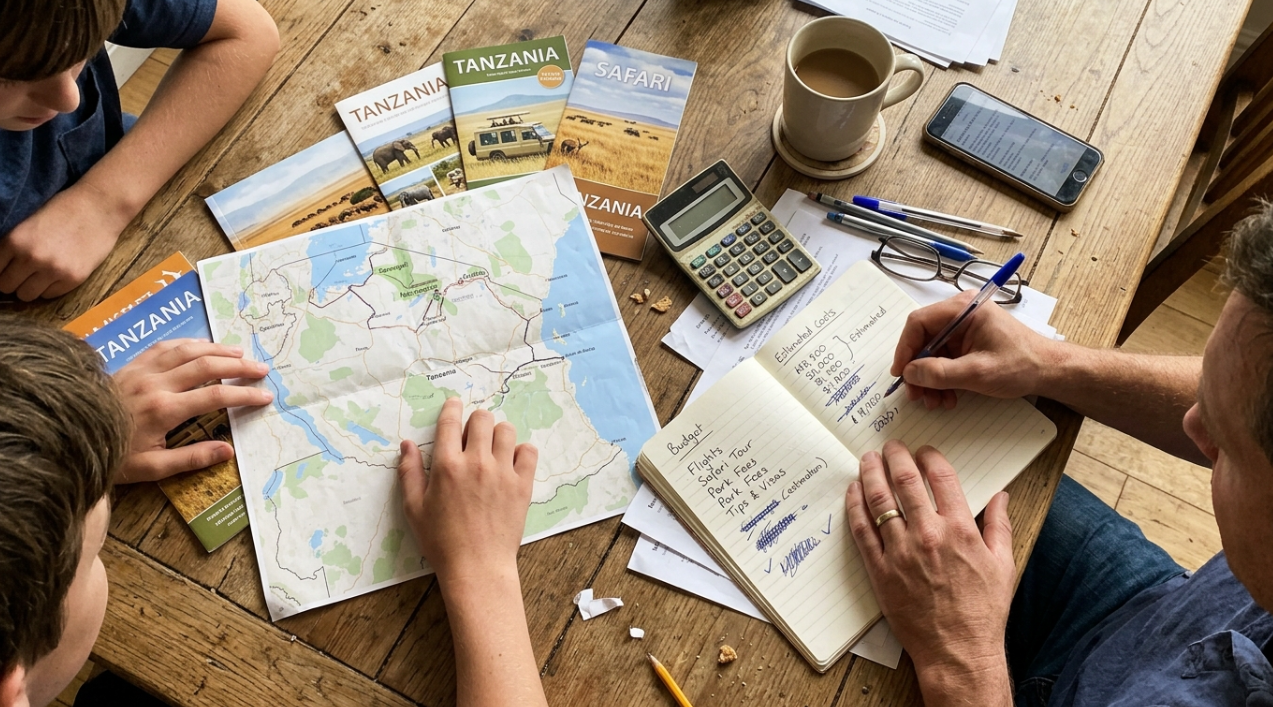
A seven-day Tanzania safari budget should account for more than accommodation. Families need to consider park entry and conservation charges, vehicle and guide costs, meals, transfers, and any flights between destinations.
The following table shows the main cost categories to request in a family safari quote.
|
Cost category |
What to include in your estimate |
|---|---|
|
Accommodation |
Seven nights, including the confirmed family room, family tent, or interconnecting rooms |
|
Safari vehicle and guide |
Private 4x4, driver-guide, fuel, and agreed itinerary |
|
Park and conservation fees |
Applicable adult and child fees for each park and conservation area |
|
Ngorongoro charges |
Applicable entry, crater service, and other required charges |
|
Meals and drinking water |
Confirmed meal plan, packed lunches, and drinking water |
|
Internal flights |
Flights required by the itinerary, including applicable baggage restrictions |
|
Transfers |
Airport pickups, drop-offs, and transfers between accommodation or destinations |
|
Tips and gratuities |
A separate allowance for guides and camp staff |
|
Visas and insurance |
Costs based on each traveler's nationality and chosen coverage |
|
Optional activities |
Balloon safaris, cultural visits, or other activities selected by the family |
|
Contingency |
A reserve for unexpected expenses and changes |
How to calculate your family safari total
Add the confirmed costs for accommodation, transport, park fees, meals, and transfers. Then add the expenses excluded from the operator's proposal, such as international flights, visas, tips, insurance, and optional activities.
Estimated family trip total = safari package + excluded travel costs + optional activities + contingency.
For an accurate estimate, ask the operator to provide separate totals for adults and children, explain the room configuration, and identify any taxes or fees that are not included.
This approach helps you compare proposals on a like-for-like basis instead of choosing a safari simply because its headline price is lower.
What Is Usually Included in a Family Safari Quote
A well-structured private family safari quote typically covers:
-
Accommodation (lodges, tented camps, or a mix)
-
Meals on a full-board basis
-
Private 4x4 vehicle and driver-guide
-
Park and conservation fees
-
Airport transfers and in-country logistics
Some operators also include select activities, drinking water, and a domestic flight or two on longer routes. The key is reading the inclusions list carefully, because what is included in one quote may be excluded in another.
What Is Usually Not Included
This is where the family safari cost in Tanzania can grow well beyond the initial quote. Common exclusions:
-
International flights. Often the single largest excluded cost. A family of four flying from the U.S. to Kilimanjaro International Airport can spend USD 4,000 to USD 10,000+ on airfare alone.
-
Visas. The official Tanzania eVisa guidance states that U.S. passport holders must apply for a Multiple Visa at USD 100 per person. For a U.S. family of four, that is USD 400 before you land. Most other nationalities pay USD 50 for an ordinary visa.
-
Tips. Guides, camp staff, and drivers expect gratuities. Budget several hundred dollars total for a week-long safari.
-
Travel insurance. The CDC recommends travel health and medical evacuation insurance for Tanzania travelers. Medical evacuation from remote safari areas is expensive without coverage. For more, see Tanzania travel insurance considerations.
-
Medical preparation. Travel clinic visits, vaccines, boosters, and children’s malaria medication are real costs. The CDC recommends malaria prescription medicine for travelers visiting certain areas of Tanzania and advises consulting a clinician at least a month before travel.
-
Optional activities. Hot-air balloon rides over the Serengeti (often USD 500+ per person), cultural visits, walking safaris, and night drives.
-
Premium drinks and laundry. Some camps include house wines and beer; many do not.
-
Internal flights if not listed in the inclusions.
-
Extra hotel nights before or after the safari due to flight schedules.
Family Safari Quote Comparison Checklist
Before choosing a Tanzania safari package, check that every operator has priced the same basic requirements. Two quotes may appear to offer similar trips while including different accommodation, park fees, transport arrangements, and exclusions.
|
What to compare |
Questions to ask the operator |
|---|---|
|
Total family price |
What is the complete price for all travelers, not just the per-person rate? |
|
Children's rates |
Were the exact ages of all children used to calculate the quote? |
|
Accommodation |
Are the family room or interconnecting rooms confirmed? |
|
Transport |
Is the vehicle private, and are all transfers included? |
|
Park and conservation fees |
Are all applicable charges and taxes included? |
|
Ngorongoro |
Are the entry and crater service fees clearly itemized? |
|
Meals |
Which meals, drinks, and packed lunches are included? |
|
Internal flights |
Are flights included, and what are the baggage restrictions? |
|
Itinerary |
How many hours of driving are expected each day? |
|
Exclusions |
Are visas, tips, insurance, optional activities, and extra hotel nights excluded? |
|
Flexibility |
Can the family return to camp early or skip an afternoon game drive? |
|
Payment terms |
What are the deposit, cancellation, and amendment policies? |
Compare the final totals, not the advertised prices
Ask each operator to provide a written breakdown of the same itinerary, with the same travel dates, accommodation level, room configuration, and child ages.
If one proposal is substantially cheaper, identify exactly which items explain the difference before making a decision. A lower headline price is not necessarily better value if essential fees, transfers, or accommodation costs are missing.
In a Reddit thread about planning a Tanzania safari and Zanzibar trip, travelers expressed confusion about what was included, specifically around Ngorongoro Crater service fees, concession fees, park fees, and guide-entry costs. Getting these line items clarified in writing before booking prevents the worst surprises.
Families who want to avoid hidden fee surprises can ask Duma Explorer to price the same route at two or three comfort levels, with child ages, room configuration, park fees, and optional flights clearly separated. Build a custom family safari that matches your budget and your children’s ages.
Where Spending More Matters for Families
Not every upgrade improves a family safari equally. Here is where additional spending genuinely changes the experience.
|
Spend more here |
Why it matters for families |
|---|---|
|
Private vehicle and guide |
Controls pace, bathroom breaks, meals, stops, and game-drive length |
|
Family-friendly camp selection |
Prevents age-policy surprises and awkward room setups |
|
Better itinerary pacing (fewer moves) |
Reduces meltdowns and transfer fatigue |
|
One strategic internal flight |
Can save a full day of driving on longer routes |
|
Inside-park or well-located nights |
Less commuting, more time viewing wildlife |
|
Travel insurance with medical evacuation |
Protects against the most expensive what-ifs of family travel |
Where to Spend More and Where to Save on a Family Safari
A successful family safari is not necessarily the most expensive one. The goal is to spend on the parts of the trip that improve comfort, flexibility, and wildlife viewing while avoiding upgrades that add little value for your family.
|
Budget decision |
Worth prioritizing? |
Why |
|---|---|---|
|
Private vehicle and experienced family guide |
Often yes |
Makes it easier to adjust game drives, stops, and daily timing |
|
Suitable family accommodation |
Yes |
Reduces rooming problems and helps everyone rest comfortably |
|
Better itinerary pacing |
Yes |
Fewer unnecessary transfers leave more time for wildlife viewing |
|
Well-located camps |
Often yes |
Can reduce commuting time and make game drives more convenient |
|
One strategic internal flight |
Depends on the route |
May save substantial driving time, but increases transport costs |
|
Ultra-luxury accommodation |
Depends on your priorities |
Extra amenities may not be worth the premium for every family |
|
Multiple optional activities |
Not always |
Choose activities that suit your children's ages and interests |
|
The cheapest quote with unclear exclusions |
No |
Missing fees and extra costs can erase the apparent savings |
Practical ways to reduce the total cost
-
Travel outside peak-demand periods if your school schedule allows.
-
Ask about child-sharing rates and family accommodation options.
-
Compare a shorter, focused itinerary with a longer route covering more parks.
-
Avoid unnecessary one-night stays and long transfers.
-
Request a detailed list of inclusions and exclusions before paying a deposit.
The most effective savings usually come from choosing the right itinerary and accommodation, rather than cutting essential services or accepting a schedule that does not suit your family.
Where Families Can Save Without Hurting the Safari
|
You might not need to pay more for |
Better approach |
|---|---|
|
Ultra-luxury rooms if kids just need comfort and a pool |
Choose well-located, family-friendly camps instead |
|
Too many one-night stays |
Use fewer bases and spend two nights at each |
|
Multiple expensive activities for young kids |
Pick one or two high-value experiences; skip the rest |
|
A second Ngorongoro Crater descent |
One well-planned crater visit is usually enough |
|
The cheapest quote with unclear inclusions |
Compare quotes line by line before assuming one is better value |
Travel in shoulder or green season if school schedules allow. Choose comfortable, well-located camps over the most expensive name-brand lodges. Ask about child-sharing rates and family rooms early, when there is still availability. And consider whether planning a safari for a larger family or traveling with another family could improve per-person economics, as long as group pace is compatible.
The Cost Mistake Most Families Make
The most common family safari cost mistake is not overspending. It is saving money by adding drive time.
A cheaper quote that routes your family through five parks in five days, with long transfers between each one, will feel like a road trip, not a safari. Children lose patience. Parents lose patience. Everyone arrives at each camp tired, and the first game drive the next morning starts before anyone has recovered.
A slightly more expensive quote with fewer moves, two-night stays at each camp, and one or two well-chosen parks can deliver a better wildlife experience and a more enjoyable family trip. As one contributor in a safari cost discussion on Reddit put it, stretching to six or seven days gives families real Serengeti time rather than simply passing through.
The cheapest route is not always the best family route. A child-friendly safari is usually designed around pacing before price.
Family Safari Quote Red Flags
If you spot several of these in a single proposal, ask more questions before booking.
-
The quote does not say whether the vehicle is private
-
Child ages were not requested before pricing
-
“All-inclusive” is used but exclusions are vague or missing
-
Ngorongoro Crater service fee is not clearly included or excluded
-
Park fees are not listed or described
-
Family room is “requested” but not confirmed
-
Long transfers are hidden behind short daily descriptions
-
The route has too many one-night stays
-
No plan for early returns, rest time, snacks, or downtime
-
Optional activities are bundled without checking child age restrictions
-
No mention of travel insurance, medical preparation, or luggage limits
When to Ask for a Custom Family Safari Quote
Some families can plan a straightforward safari with minimal help. Others are dealing with variables that make custom planning genuinely worthwhile:
-
Traveling with children under 10
-
Traveling during school holidays when family rooms book early
-
Needing family rooms or interconnecting rooms confirmed (not just requested)
-
Combining Serengeti, Ngorongoro, and Zanzibar in one trip
-
Traveling with grandparents who need different pacing or comfort levels
-
Comparing fly-in versus drive-based options
-
Planning around a special occasion
-
Working with a defined total family budget
If any of these apply, a conversation with an operator who plans private family safaris in Tanzania regularly, one who asks your children’s ages before quoting a price, will save time and prevent expensive surprises.
Build My Family Safari
Frequently Asked Questions
How much does a Tanzania family safari cost for a family of four?
A comfortable private 5- to 7-day family safari typically falls between USD 7,000 and USD 20,000+ before international flights, depending on route, season, accommodation level, child ages, and inclusions. Short basic options can start lower, while luxury and fly-in safaris run higher. Industry sources commonly use USD 200 to USD 600 per person per day as a family planning range, though broader Tanzania pricing extends well beyond that for premium trips.
Do children pay less on a Tanzania safari?
Often, but not consistently across the whole trip. Official TANAPA park fees are reduced for children ages 5 to 15, and children under 5 enter national parks free. Ngorongoro lists reduced fees for children 5 to below 17. However, lodges, camps, flights, and rooming policies each set their own child rates. A child who enters parks for free still needs a bed, meals, and transport.
Is a private safari vehicle worth the cost for families?
Yes, for most families. A private vehicle lets you control start times, stop for bathroom breaks, carry snacks, shorten game drives when kids are tired, and return to camp early without affecting other travelers. Community discussions from family travelers repeatedly recommend private vehicles as the single most important family comfort upgrade.
What is the best age for a Tanzania family safari?
There is no single perfect age, but children around six and older tend to handle safari routines, including early mornings, vehicle time, and patience during wildlife sightings, more comfortably than toddlers. All Tanzanian parks permit children, but individual camps and activities set their own age restrictions. Some unfenced camps do not accept children under six.
What hidden costs should families budget for beyond the safari quote?
The most commonly excluded costs are international flights, Tanzania visas (currently USD 100 per person for U.S. passport holders), tips, travel insurance, medical preparation and malaria medication, optional activities like balloon rides, premium drinks, laundry, and sometimes internal flights and extra hotel nights.
Is five days enough for a Tanzania family safari?
Five days works for a focused Northern Circuit safari (Tarangire, Lake Manyara, Ngorongoro), but it can feel rushed if the Serengeti is included. Six to eight days is generally more comfortable for families, especially with younger children. The extra days reduce the ratio of travel time to wildlife time, which matters more for kids than adults.
Should we add Zanzibar after a family safari?
A safari followed by beach days works well for families because it adds downtime after early mornings and long game drives. Budget for domestic flights or transfers, beach accommodation, extra meals, and activity costs. The combination changes the total trip budget significantly but can make the overall experience much more balanced for children.