

Gorilla Trekking Malaria: Risks, Prevention & Tips 2026
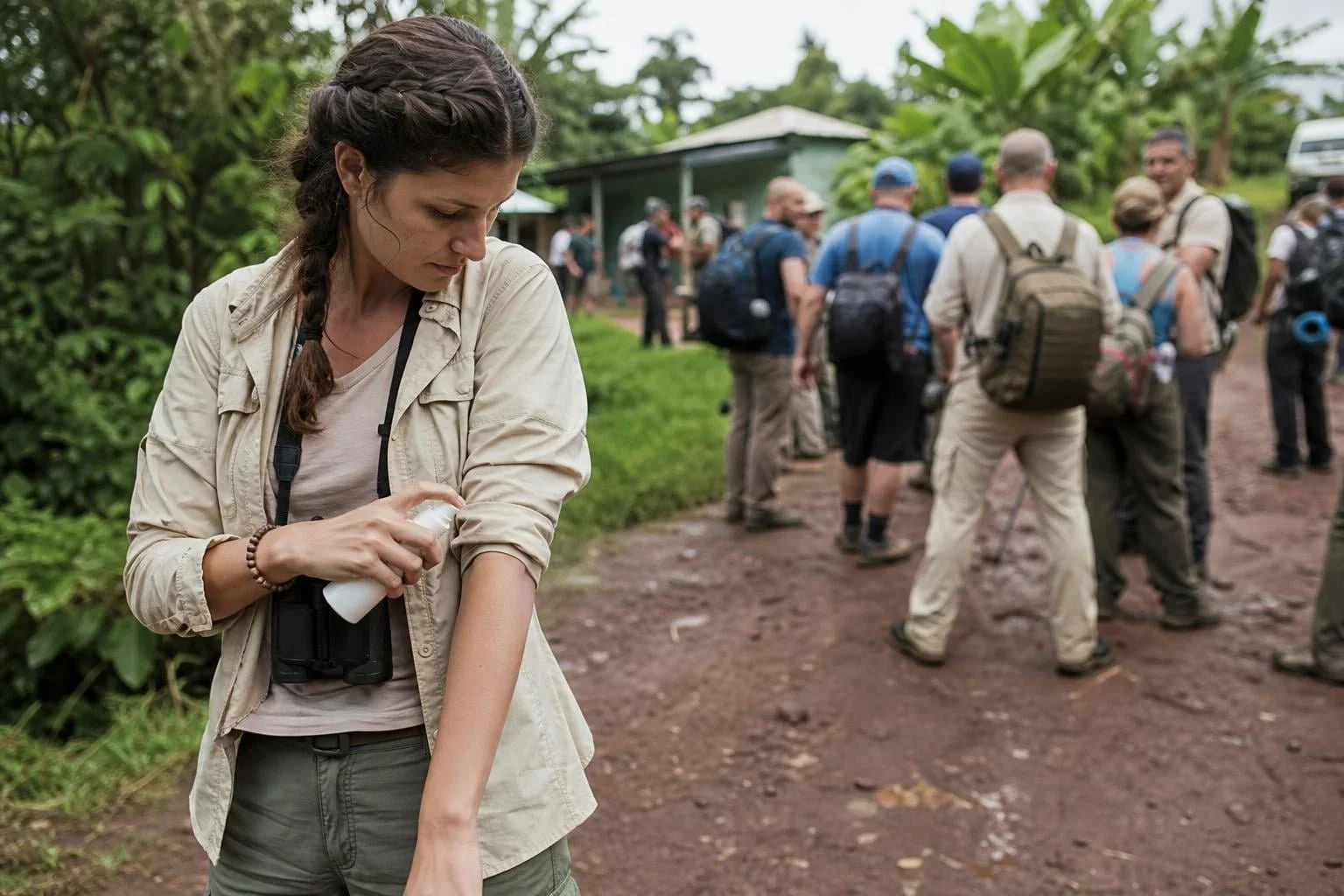
TL;DR
Malaria is the single most important health concern for gorilla trekking in Uganda and Rwanda. Although the high-altitude parks themselves carry lower mosquito risk, every itinerary passes through lowland transit zones where transmission is year-round. The CDC recommends antimalarial prophylaxis for all travelers to both countries, with no altitude exceptions. Take your pills, use repellent, sleep under a net, and understand that malaria prevention protects both your health and your $700+ gorilla permit.
Gorilla trekking malaria risk confuses people for one simple reason: the parks sit at high elevations where mosquitoes are scarce, but the journey to those parks passes through some of the most malaria-dense areas on Earth. That contradiction trips up nearly every traveler who researches this topic.
This guide defines the key malaria terms gorilla trekkers encounter during trip planning, explains what each one means in the specific context of trekking in Uganda and Rwanda, and connects the health dots to the financial and logistical realities of a gorilla permit that costs $700 to $1,500.
Medical disclaimer: This article is for educational purposes. Consult a travel medicine specialist 6 to 8 weeks before departure. No blog post replaces a doctor’s assessment of your individual health profile.
📌 Considering a gorilla trek? Start with our Uganda gorilla safari guide for pricing, itineraries, and logistics.
Quick Answer: Do You Need Malaria Pills for Gorilla Trekking? If you're gorilla trekking in Uganda or Rwanda, yes—official health authorities recommend taking antimalarial medication.
Although gorilla trekking parks like Bwindi Impenetrable National Park and Volcanoes National Park sit at higher elevations where mosquito activity is lower, nearly every itinerary includes time in lower-altitude cities and transit routes where malaria transmission occurs year-round.
For most travelers, malaria prevention includes: - Taking prescribed antimalarial medication before, during, and after travel - Applying 30–50% DEET insect repellent every evening - Wearing permethrin-treated clothing - Sleeping under insecticide-treated bed nets - Seeking medical advice 6–8 weeks before departure
The actual gorilla trek is usually not the highest malaria risk. Overnight stays and road transfers through lower elevations account for most traveler exposure.
Gorilla Trekking Malaria Risk at a Glance
|
Question |
Short Answer |
|---|---|
|
Is malaria present in Uganda? |
Yes |
|
Is malaria present in Rwanda? |
Yes |
|
Is malaria common inside gorilla parks? |
Lower risk because of altitude |
|
Is malaria common during travel to the parks? |
Yes |
|
Should travelers take malaria medication? |
Yes, according to CDC guidance |
|
Is mosquito repellent still necessary? |
Yes |
|
Is dry season safer? |
Generally yes |
|
Can malaria affect your trekking permit? |
Yes, illness may prevent trekking |
Core Malaria Terms for Gorilla Trekkers
Malaria
An infectious disease caused by Plasmodium parasites, transmitted to humans through the bite of infected female Anopheles mosquitoes. It is not spread through casual contact, food, or water. Symptoms include fever, chills, headache, muscle aches, and fatigue.
Why it matters for gorilla trekking: Malaria is endemic across both Uganda and Rwanda. As of 2023, Uganda had the third-highest global burden of malaria cases (4.8% of all cases worldwide). Rwanda has made dramatic progress, reducing its caseload by 85% between 2019 and 2023, from 4.9 million cases to 749,000. But the CDC still recommends prophylaxis for travelers to both countries.
Plasmodium falciparum
The most dangerous of the five Plasmodium species that infect humans. It causes the most severe form of malaria and is responsible for the vast majority of malaria deaths globally.
Why it matters for gorilla trekking: P. falciparum accounts for roughly 97% of malaria infections in Uganda and dominates in Rwanda as well. It is chloroquine-resistant throughout sub-Saharan Africa, which means older, cheaper antimalarials won’t work. Travelers need one of the currently recommended alternatives (more on those below).
Anopheles Mosquito
The specific mosquito genus responsible for transmitting malaria parasites. Unlike the Aedes mosquitoes that carry dengue and Zika (which bite during the day), Anopheles mosquitoes are most active between dusk and dawn.
Why it matters for gorilla trekking: This timing is critical. Multi-day gorilla trekking itineraries often require overnight stays at lodges near the forest edge. Practitioners in online travel forums note that exposure to mosquitoes at dusk and dawn around these lodges, particularly in lower-elevation areas surrounding the parks and in nearby towns like Buhoma and Ruhija, is where the real bite risk occurs. The trek itself, which happens during daylight hours in dense forest canopy, is actually the lowest-risk part of the day.
Malaria Transmission
The process by which Plasmodium parasites move from an infected mosquito to a human host through a bite. Transmission intensity depends on mosquito density, temperature, humidity, altitude, and season.
Why it matters for gorilla trekking: Transmission in Uganda is year-round and perennial across roughly 90% of the country, including urban areas like Kampala. In Rwanda, transmission is more seasonal, peaking during the rainy months. The gorilla trekking malaria risk is not limited to the park itself. It follows the entire route of your itinerary.
Malaria Symptoms
The classic presentation includes fever, chills, sweating, headache, nausea, vomiting, body aches, and general fatigue. Symptoms typically appear 7 to 30 days after an infected bite, though they can emerge weeks or even months later with certain Plasmodium species.
Why it matters for gorilla trekking: Here’s where gorilla trekking creates a unique financial risk beyond the health risk. If fever, chills, or respiratory symptoms develop before your scheduled trek, you will be flagged during the mandatory morning health briefing. Rangers can and do turn away visibly ill trekkers, because gorillas share approximately 98% of human DNA and are vulnerable to human diseases. Losing a permit that cost $700 or more because of preventable illness is a scenario worth avoiding. For a full breakdown of permit pricing and booking rules, see our gorilla trekking permits guide.
Prevention and Prophylaxis Terms
Chemoprophylaxis
The practice of taking antimalarial medication before, during, and after travel to a malaria-endemic area. The drugs don’t prevent mosquito bites. They kill the malaria parasites at various stages of their life cycle inside your body, preventing infection from developing into disease.
Why it matters for gorilla trekking: The CDC recommends chemoprophylaxis for all travelers to Uganda and Rwanda. No exceptions are made based on altitude, trip length, or time of year. As one experienced traveler put it on TripAdvisor’s Uganda forum: “Whether 1 night or 8, it only takes one bite from an infected mosquito.” That’s not fearmongering. It’s biology.
Malarone (Atovaquone-Proguanil)
A daily antimalarial pill that is started 1 to 2 days before entering a malaria zone and continued for only 7 days after leaving. It is generally the best-tolerated option, with the most common side effects being mild gastrointestinal upset and headache.
Why it matters for gorilla trekking: Malarone is the preferred drug among many Africa travel professionals. One industry professional on TripAdvisor shared: “I personally take Malarone. For me it seems to have had the fewest side effects, and anecdotally this seems common with other people who are in the industry.” Its short post-trip tail (7 days versus 4 weeks for doxycycline) makes it especially practical for typical 7 to 14 day gorilla trekking trips. It also doesn’t cause photosensitivity, which matters if your itinerary combines gorilla trekking with a Zanzibar beach extension or open-vehicle safari days. The downside is cost: Malarone is the most expensive option.
Doxycycline
A daily antibiotic that doubles as an antimalarial. Taken 1 to 2 days before travel and continued for 4 weeks after leaving the malaria zone. It is the most affordable antimalarial option and also provides protection against some bacterial infections.
Why it matters for gorilla trekking: The main drawback is photosensitivity, meaning your skin burns more easily in the sun. Inside the dense canopy of Bwindi Impenetrable Forest, this is less of a concern. But if your trip includes open savannah game drives in Queen Elizabeth National Park or beach time afterward, it becomes a real issue. The 4-week post-trip tail is also a nuisance, since many travelers forget to complete the course once they’re home.
Mefloquine (Lariam)
A weekly antimalarial pill started 2 weeks before travel and continued for 4 weeks after departure. The weekly dosing is convenient for longer trips.
Why it matters for gorilla trekking: Mefloquine carries a risk of neuropsychiatric side effects, including anxiety, vivid dreams, and in rare cases, more serious reactions. Some travelers report that the vivid dream side effect is unsettling when combined with the excitement and physical exhaustion of a gorilla trek. This drug requires a conversation with your doctor well in advance, since you need to start it 2 weeks before departure to check for side effects. Those with age-related concerns about drug options should also review our guide to gorilla trekking age limits.
Tafenoquine (Arakoda)
A newer weekly antimalarial option started 3 days before travel and continued for only 1 week after return. It requires a G6PD blood test before prescribing, since people with G6PD deficiency (a genetic enzyme condition) cannot take it safely due to the risk of hemolytic anemia.
Why it matters for gorilla trekking: Tafenoquine’s weekly dosing and short post-trip tail make it appealing for longer East Africa itineraries. However, it is not approved for travelers under 18 or for pregnant women, and the mandatory G6PD screening adds a step to pre-trip planning. Discuss it with your travel medicine specialist if the other options don’t suit you.
Chloroquine Resistance
Chloroquine was once the go-to antimalarial drug worldwide. Plasmodium falciparum has developed widespread resistance to it across sub-Saharan Africa, rendering it ineffective in Uganda and Rwanda.
Why it matters for gorilla trekking: If anyone suggests chloroquine for a gorilla trekking trip, find a different doctor. It simply does not work against the dominant malaria parasite in East Africa.
Drug Comparison at a Glance
|
Drug |
Dosing |
Start Before Trip |
Continue After |
Key Concern |
Relative Cost |
|---|---|---|---|---|---|
|
Malarone |
Daily |
1-2 days |
7 days |
GI upset |
Higher |
|
Doxycycline |
Daily |
1-2 days |
4 weeks |
Sun sensitivity |
Lower |
|
Mefloquine |
Weekly |
2 weeks |
4 weeks |
Neuropsychiatric effects |
Mid |
|
Tafenoquine |
Weekly |
3 days |
1 week |
Requires G6PD test |
Mid-high |
Which Malaria Medication Is Best for Gorilla Trekking?
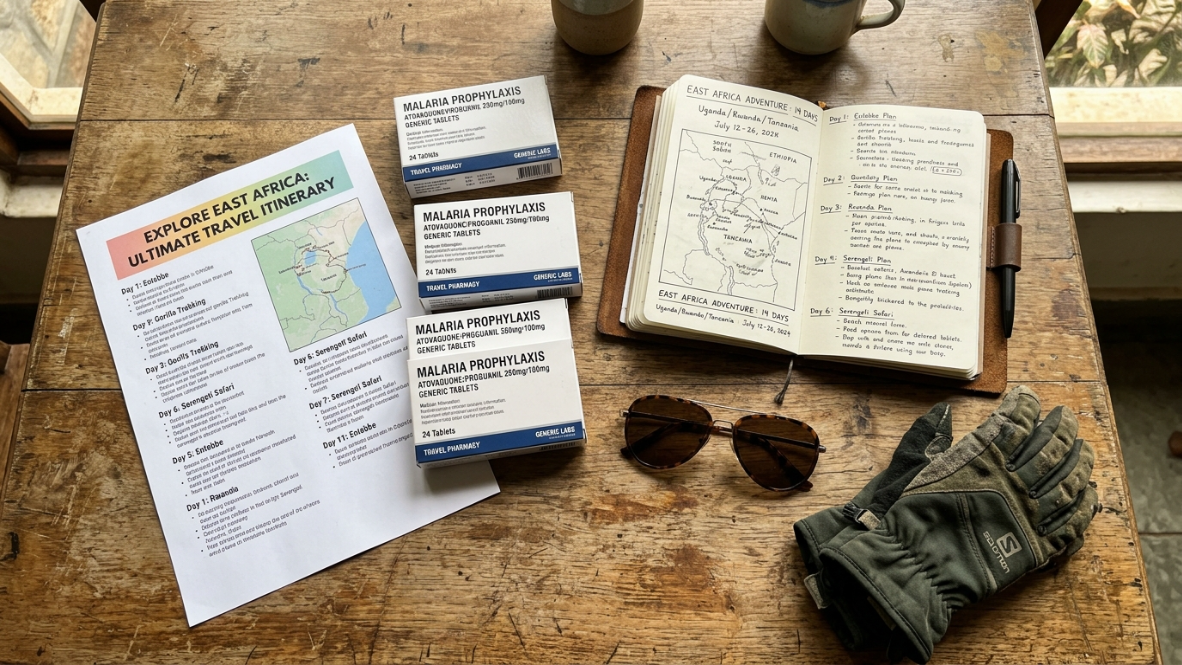
Choosing the right antimalarial depends on your health, itinerary, and personal preferences.
|
Medication |
Best For |
Possible Drawback |
|---|---|---|
|
Malarone |
Most vacation travelers |
Higher cost |
|
Doxycycline |
Budget travelers |
Sun sensitivity |
|
Mefloquine |
Long trips |
Neuropsychiatric side effects |
|
Tafenoquine |
Weekly dosing |
Requires G6PD testing |
No medication is universally best. A travel medicine physician should recommend the option that fits your medical history.
DEET
The active ingredient in the most effective insect repellents. Look for concentrations between 30% and 50% for tropical use. Applied directly to exposed skin.
Why it matters for gorilla trekking: Humid forest conditions mean you’ll sweat, which reduces DEET’s effectiveness. Reapply after heavy sweating. Use it on any exposed skin during the evening hours at your lodge, which is the highest-risk window for Anopheles bites. For a full list of what to bring, check our gorilla trekking packing list.
Permethrin
An insecticide applied to clothing, gear, and mosquito nets. It is not applied directly to skin. Permethrin-treated clothing repels and kills mosquitoes on contact.
Why it matters for gorilla trekking: Treating your trekking pants, long-sleeved shirts, and socks with permethrin before departure adds a layer of protection. Many gorilla trekking lodges already provide permethrin-treated bed nets, but bringing your own treated clothing ensures coverage during the dusk hours when you’re outside.
Insecticide-Treated Net (ITN)
A bed net treated with insecticide (usually permethrin or a related compound) that kills or repels mosquitoes that land on it. The CDC Yellow Book specifically recommends sleeping under permethrin-impregnated netting for all safari and trekking travelers.
Why it matters for gorilla trekking: Most reputable lodges near Bwindi and Volcanoes National Park provide ITNs. Use them every single night, even at altitude. Tuck the net under your mattress before dark, and check for holes. This is not optional.
Geographic and Environmental Terms
Altitude Effect
The relationship between elevation and malaria transmission intensity. Anopheles mosquitoes breed less successfully at higher, cooler elevations. Research published in PubMed has documented a greater than 1,000-fold reduction in transmission intensity between lowland and highland areas in East Africa.
Why it matters for gorilla trekking: This is the single most misunderstood aspect of gorilla trekking malaria risk. Volcanoes National Park in Rwanda sits at 2,400 to 4,500 meters above sea level. Bwindi Impenetrable National Park in Uganda ranges from 1,160 to 2,607 meters. At these elevations, mosquito density drops significantly. But every gorilla trekking itinerary transits through lowland areas where malaria is fully active. The CDC makes no altitude-based exceptions for Uganda. A blog post from Asilia Africa, a prominent East Africa operator, makes the critical point: “Most East Africa itineraries move between altitudes, and the benefits of anti-malarial medication apply to the entire trip rather than individual sections. Don’t assume that a night at high altitude means you can skip your meds.”
Lower risk does not mean no risk.
Bwindi Impenetrable National Park
Uganda’s primary gorilla trekking destination, home to roughly half of the world’s remaining mountain gorillas. Located in southwestern Uganda, it spans altitudes from approximately 1,160 to 2,607 meters.
Why it matters for gorilla trekking malaria planning: Bwindi’s risk level varies by sector. The lower sectors around Buhoma (roughly 1,500 meters) see more mosquito activity than the higher Ruhija sector (roughly 2,300 meters). Overnight stays at forest-edge lodges expose trekkers to bites at dusk and dawn. The risk is moderate rather than high, but it exists.
Volcanoes National Park
Rwanda’s gorilla trekking destination in the Virunga Mountains. Its altitude ranges from 2,400 to 4,500 meters, making it one of the highest gorilla trekking locations.
Why it matters for gorilla trekking malaria planning: The park itself carries low malaria risk due to its high elevation. But travelers fly into Kigali (approximately 1,500 meters) and drive through lower-elevation areas to reach the park. Rwanda’s impressive 85% reduction in malaria cases since 2019 offers additional reassurance, but does not eliminate the need for prophylaxis. To compare the two countries’ gorilla trekking options in detail, read our Rwanda vs. Uganda comparison.
Transit Risk
The malaria exposure acquired not at the gorilla park itself, but during travel to and from it. This is the most underappreciated aspect of gorilla trekking malaria prevention.
Why it matters for gorilla trekking: Flying into Entebbe, overnighting in Kampala, driving through lowland Uganda on the way to Bwindi, or combining gorilla trekking with a savannah safari in Queen Elizabeth National Park or Akagera creates exposure to high-transmission zones. Many travelers focus their malaria anxiety on the forest itself when the real risk points are the cities and lowland roads they pass through before and after the trek.
Rainy Season
March to May (long rains) and September to November (short rains) in both Uganda and Rwanda. Standing water from rainfall creates breeding grounds for mosquitoes, spiking transmission.
Why it matters for gorilla trekking: Rainy season means more mosquitoes, muddier trails, and more physically demanding treks. The gorilla trekking malaria risk is highest during these months, making dry season travel doubly attractive.
Dry Season
June to September and mid-December to early February. Lower rainfall reduces mosquito breeding habitat and decreases transmission intensity.
Why it matters for gorilla trekking: Dry season offers both the easiest hiking conditions and the lowest malaria risk. This double benefit makes it the recommended window for gorilla trekking. For month-by-month planning across the region, see our East Africa seasonal guide.
Malaria Risk by Park: Quick Comparison
|
Factor |
Bwindi (Uganda) |
Volcanoes NP (Rwanda) |
Transit Cities |
|---|---|---|---|
|
Altitude |
1,160–2,607m |
2,400–4,500m |
1,100–1,500m |
|
Malaria risk at park |
Moderate |
Low |
High |
|
CDC prophylaxis recommended |
Yes |
Yes |
Yes |
|
Peak mosquito season |
Mar–May, Sep–Nov |
Mar–May, Sep–Nov |
Year-round |
Health Screening and Permit Terms
Morning Health Briefing
A mandatory pre-trek assembly at park headquarters where rangers review trekking rules, assign groups, and screen participants for signs of illness. This happens every morning before gorilla trekking begins in both Uganda and Rwanda.
Why it matters: Rangers look for fever, persistent coughing, sneezing, and other symptoms that could indicate a contagious illness. If you present with malaria-like symptoms (fever, chills, visible distress), you will be turned away. This screening exists to protect the gorillas, which are highly susceptible to human respiratory viruses and other pathogens.
Illness Exclusion Policy
Both the Uganda Wildlife Authority (UWA) and the Rwanda Development Board (RDB) enforce strict rules barring visibly ill trekkers from visiting habituated gorilla families. If you have a cold, flu, fever, or any contagious illness, you must not visit the gorillas.
Why it matters: This policy creates a direct financial link between malaria prevention and your gorilla permit investment. Getting malaria during your trip doesn’t just make you sick. It can cost you the entire experience you traveled thousands of miles for. For full details on what rules apply during the trek, read our gorilla trekking safety rules guide.
UWA “Safety Net” Refund
In 2026, the Uganda Wildlife Authority clarified its refund policy for illness. If a Park Warden certifies that you are too ill to trek, you are eligible for a 50% permit refund. The policy is designed to encourage honest self-reporting rather than having sick trekkers attempt to hide symptoms.
Why it matters: A 50% refund on a $700 Uganda permit means you lose $350. On a $1,500 Rwanda permit, you’d lose $750. That’s real money on top of the misery of being sick in a remote location.
CFAR Travel Insurance
“Cancel for Any Reason” insurance policies that provide coverage when standard travel insurance doesn’t apply. Standard policies typically cover illness but may not cover the specific scenario of being turned away at a gorilla trekking briefing.
Why it matters: CFAR policies can help recover the remaining 50% of a forfeited permit that the UWA Safety Net doesn’t cover. Given that gorilla trekking malaria risk creates a real possibility of illness-related exclusion, CFAR insurance is worth investigating for any traveler who can’t afford to lose their permit fee. For a deeper look at insurance options, see our gorilla trekking insurance glossary.
Disease Transmission to Gorillas
Mountain gorillas are vulnerable to human diseases because of our close genetic relationship. Human respiratory viruses, gastrointestinal pathogens, and other infections can be fatal to gorilla families that have been habituated to human presence.
Why it matters: This is why the health screening exists. Face masks (surgical type) are required during gorilla encounters. Minimum distance rules (7 meters in Rwanda, 10 meters in Uganda) add another layer of protection. The illness exclusion policy is not bureaucratic caution. It is conservation necessity.
Emerging Concerns
Artemisinin Partial Resistance
The WHO has confirmed partial resistance to artemisinin, the frontline treatment drug for malaria, in four East African countries: Eritrea, Rwanda, Uganda, and the United Republic of Tanzania. This resistance affects treatment drugs (what doctors use after you’re infected), not the prophylactic drugs travelers take to prevent infection.
Why it matters for gorilla trekking: If treatment drugs are becoming less reliable in the very countries where gorilla trekking happens, prevention becomes even more important. Taking prophylaxis seriously, using DEET, wearing treated clothing, and sleeping under nets is no longer just recommended practice. It is the primary defense when treatment certainty is eroding. The WHO has stated that vigorous measures are needed to protect drug efficacy in this region.
Practical Quick Reference
When to See a Travel Doctor
Book your appointment 6 to 8 weeks before departure. This gives enough time to start mefloquine (which requires a 2-week lead), get a G6PD test if considering tafenoquine, and receive any needed vaccinations (yellow fever is required for Uganda entry).
Seasonal Malaria Risk Calendar
|
Month |
Risk Level |
Trekking Conditions |
|---|---|---|
|
January |
Lower |
Dry, good trails |
|
February |
Lower |
Dry, good trails |
|
March |
Rising |
Rains begin |
|
April |
High |
Heavy rain, muddy |
|
May |
High |
Heavy rain, muddy |
|
June |
Lower |
Dry season starts |
|
July |
Lower |
Peak dry season |
|
August |
Lower |
Peak dry season |
|
September |
Rising |
Short rains begin |
|
October |
Moderate-High |
Rainy, muddy |
|
November |
Moderate-High |
Rainy, muddy |
|
December |
Lower (mid-month on) |
Short dry season |
The Prevention Stack
Gorilla trekking malaria prevention is not about choosing one measure. It’s about layering them:
-
Chemoprophylaxis: Take antimalarial medication as prescribed, including the full post-trip course.
-
DEET repellent: Apply 30-50% concentration to exposed skin, especially from late afternoon onward.
-
Permethrin-treated clothing: Treat long sleeves, pants, and socks before departure.
-
Insecticide-treated bed net: Use every night at your lodge, tucked under the mattress.
-
Behavioral avoidance: Minimize exposed skin at dusk and dawn. Stay inside screened areas when possible during peak mosquito hours.
No single measure is 100% effective. Together, they reduce risk to a very manageable level.
📌 Ready to plan your gorilla trek? Explore our detailed gorilla trekking cost guide to understand what’s included and how to budget for permits, transport, and accommodation.
Step-by-Step Malaria Prevention Timeline
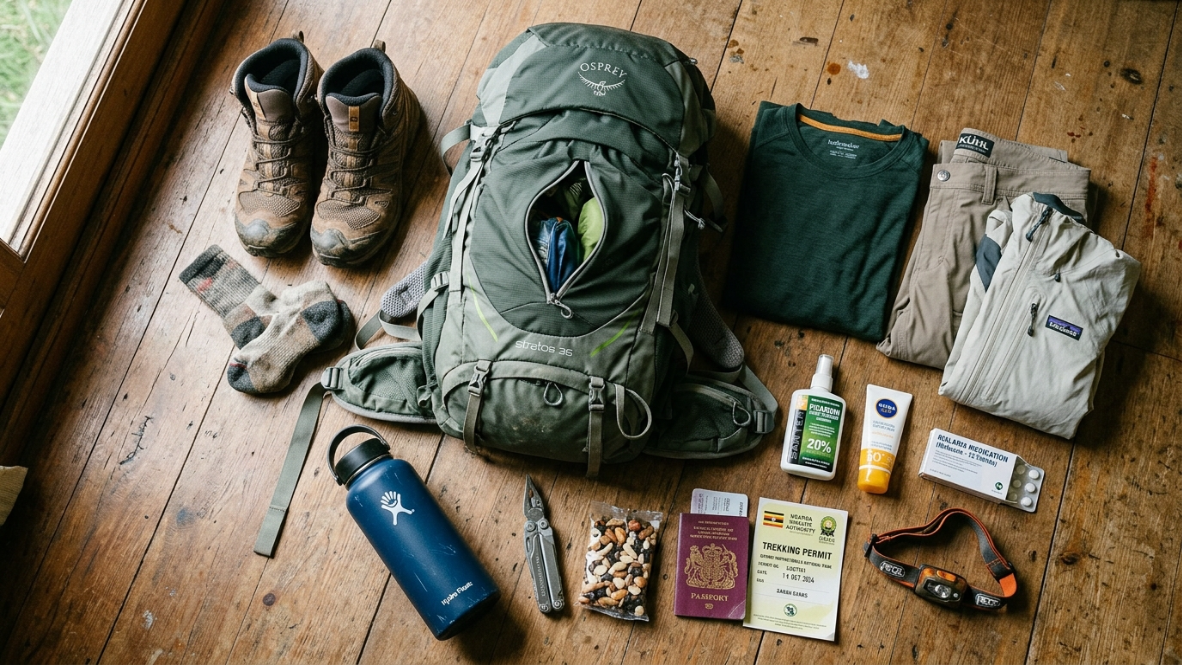
One of the easiest ways to reduce malaria risk is to prepare before you leave home instead of waiting until you arrive in East Africa.
6–8 Weeks Before Departure
-
Visit a travel medicine clinic
-
Discuss antimalarial medication options
-
Receive recommended vaccinations
-
Purchase travel insurance
-
Buy insect repellent and permethrin spray
1 Week Before Departure
-
Begin medication if required
-
Treat clothing with permethrin
-
Pack long sleeves and lightweight pants
During the Trip
-
Take medication every day (or weekly as prescribed)
-
Apply DEET every evening
-
Sleep under mosquito nets
-
Wear long sleeves after sunset
After Returning Home
Continue your medication for the prescribed period.
If fever develops within several weeks after returning, tell your doctor that you recently traveled to Uganda or Rwanda.
Frequently Asked Questions
Do I need malaria pills for gorilla trekking in Bwindi or Volcanoes National Park?
Yes. The CDC recommends antimalarial chemoprophylaxis for all travelers to both Uganda and Rwanda. While the parks themselves sit at high altitudes with reduced mosquito activity, your itinerary will include transit through lowland areas where malaria transmission is active year-round. No altitude-based exceptions exist in official guidance.
Which antimalarial drug is best for gorilla trekking?
There is no single “best” drug. It depends on your medical history, trip length, and itinerary. Malarone is the most commonly preferred by safari industry professionals due to its short post-trip course (7 days) and lack of photosensitivity. Doxycycline is the most affordable option. Mefloquine offers convenient weekly dosing. Discuss the options with a travel medicine specialist.
Is the malaria risk lower in Rwanda than Uganda for gorilla trekking?
Rwanda has made remarkable progress, cutting malaria cases by 85% since 2019, and Volcanoes National Park sits at higher elevation (2,400m+) than most of Bwindi. So yes, the on-the-ground risk at the Rwanda park is generally lower. But travelers still transit through Kigali and other areas where malaria is present, and the CDC recommends prophylaxis for both countries.
Can malaria symptoms cause me to lose my gorilla trekking permit?
Yes. If you develop fever, chills, or other malaria-like symptoms before your trek, rangers can turn you away during the mandatory morning health briefing. Uganda offers a 50% permit refund through its Safety Net policy if a Park Warden certifies your illness. The remaining cost is lost unless you carry CFAR travel insurance.
When is gorilla trekking malaria risk lowest?
During the dry seasons: June to September and mid-December to early February. Lower rainfall means fewer mosquito breeding sites, which translates to reduced transmission. These periods also offer the best trail conditions, making them ideal for gorilla trekking on every front.
Should I still use a bed net at high-altitude lodges?
Absolutely. Most lodges provide insecticide-treated nets, and you should use them every night regardless of altitude. Malaria-carrying mosquitoes can be present at elevations below 2,500 meters, and many Bwindi lodges sit in that range. It takes one bite from one infected mosquito.
What about artemisinin resistance in Uganda and Rwanda?
The WHO has confirmed partial artemisinin resistance in both countries. Artemisinin-based drugs are used for treatment (after infection), not prevention. This development doesn’t change which prophylactic drugs travelers should take, but it reinforces why preventing infection in the first place is critical. If treatment becomes less reliable, avoiding malaria altogether matters more than ever.
How far in advance should I see a travel doctor before gorilla trekking?
Six to eight weeks before departure. This allows time to start any antimalarial with a longer lead time (mefloquine needs 2 weeks), complete required blood tests (G6PD for tafenoquine), and receive vaccinations like yellow fever, which is required for Uganda entry and takes time to become effective.
Gorilla trekking malaria risk is real, but it is thoroughly manageable. The combination of antimalarial medication, bite prevention measures, and smart trip timing makes gorilla trekking one of the safest high-end wildlife experiences in Africa. The key is taking preparation seriously rather than gambling on altitude or luck.
📌 Planning a gorilla trek in Uganda or Rwanda? Our team designs custom gorilla trekking itineraries that account for health logistics, permits, and seasonal timing across both countries.