Gorilla Trekking Rwanda vs Uganda (2026): Which Is Best?
TL;DR
Uganda and Rwanda both offer life-changing mountain gorilla encounters with roughly 98% sighting success, but they serve different travelers. Uganda charges $800 per permit ($600 in low season) and offers more gorilla families, tougher jungle terrain, and the only 4-hour habituation experience in the world. Rwanda charges $1,500 with no discounts but provides easier treks, shorter transfers from Kigali, and a polished luxury experience. For solo travelers on short trips, Rwanda can actually work out cheaper when you factor in total logistics costs.
Direct Answer: Rwanda vs Uganda Gorilla Trekking If you're deciding between gorilla trekking in Rwanda or Uganda, the best choice depends on your budget, available time, and preferred travel style.
|
Traveler Type |
Best Choice |
|---|---|
|
Budget travelers |
Uganda |
|
Luxury travelers |
Rwanda |
|
Short trips (2–3 days) |
Rwanda |
|
Adventure seekers |
Uganda |
|
Photography-focused travelers |
Rwanda |
|
Longer East Africa itineraries |
Uganda |
|
Gorilla habituation experience |
Uganda |
|
Easier trekking conditions |
Rwanda |
|
Solo travelers |
Rwanda or Uganda via Kigali |
|
Best overall value |
Uganda |
For most travelers, Uganda offers the strongest value thanks to permits costing nearly half the price of Rwanda's while providing equally high gorilla sighting success rates. Rwanda becomes attractive when minimizing travel time is more important than minimizing costs.
Only about 1,063 mountain gorillas remain on Earth. They live in two places: the Virunga Massif (a volcanic range spanning Rwanda, Uganda, and the DRC) and Uganda’s Bwindi Impenetrable National Park. Both Rwanda and Uganda grant visitors a one-hour audience with habituated gorilla families, and both deliver near-identical sighting rates. The gorillas don’t care which country you’ve paid. Your job is to figure out which country fits your budget, your timeline, and the kind of experience you want.
This guide breaks down every term, cost, and logistical detail you need to make that decision. No sales pitch, just the real numbers and the practical nuances that operator marketing pages tend to skip.
Planning a gorilla trek as part of a broader East Africa trip? Our Uganda gorilla safari guide covers packages and pricing in detail.
Quick Comparison Table: Rwanda vs Uganda at a Glance
|
Factor |
Uganda (Bwindi / Mgahinga) |
Rwanda (Volcanoes NP) |
|---|---|---|
|
Permit price (foreign non-resident) |
$800 ($600 in low season) |
$1,500 (no discounts) |
|
Habituated gorilla families |
19+ (16 in Bwindi, 1+ in Mgahinga) |
12 |
|
Daily permits available |
~128 |
96 |
|
Trek duration |
2 to 8 hours |
30 minutes to 4 hours |
|
Terrain |
Dense, steep rainforest |
Open bamboo and volcanic hills |
|
Time with gorillas |
1 hour (or 4 hours with habituation permit) |
1 hour |
|
Drive from nearest international airport |
9-10 hrs from Entebbe (or 4-5 hrs from Kigali) |
2.5 hrs from Kigali |
|
Permit authority |
Uganda Wildlife Authority (UWA) |
Rwanda Development Board (RDB) |
|
Low-season discount |
Yes: $600 in April, May, November |
None |
|
Accommodation range |
Budget to ultra-luxury |
Skews four-star and five-star |
|
Habituation experience |
Yes ($1,500, 4 hours) |
Not available |
Rwanda vs Uganda: The 30-Second Verdict
Choose Uganda if your goal is maximizing value. You'll spend less on permits, have access to more gorilla families, and can participate in the Gorilla Habituation Experience.
Choose Rwanda if convenience matters most. Volcanoes National Park is just 2.5 hours from Kigali International Airport, making it possible to complete a gorilla trek on a short East Africa itinerary.
The gorilla encounter itself is nearly identical in both countries. The biggest differences are cost, logistics, terrain, and accommodation style.
The Parks and Where the Gorillas Live
Virunga Massif
The Virunga Massif is the volcanic mountain chain that straddles three countries: Rwanda, Uganda, and the Democratic Republic of Congo. It holds roughly 604 mountain gorillas. This is where Volcanoes National Park (Rwanda) and Mgahinga Gorilla National Park (Uganda) sit. The peaks here rise above 4,000 meters, draped in bamboo forest and afro-alpine moorland.
Bwindi Impenetrable National Park (Uganda)
Bwindi is a UNESCO World Heritage Site in southwestern Uganda, home to roughly 459 mountain gorillas, the other major population outside the Virunga Massif. The park lives up to its name. The vegetation is thick, tangled, and genuinely difficult to move through. Treks here range from 2 to 8 hours depending on where the gorillas have wandered.
Bwindi is divided into four trekking sectors, each with its own character and gorilla families: Buhoma, Ruhija, Rushaga, and Nkuringo. Your assigned sector determines your meeting point, your border crossing if coming from Rwanda, and the difficulty of your hike. For a deep look at sector-by-sector logistics, see our Bwindi gorilla trekking guide.
Volcanoes National Park (Rwanda)
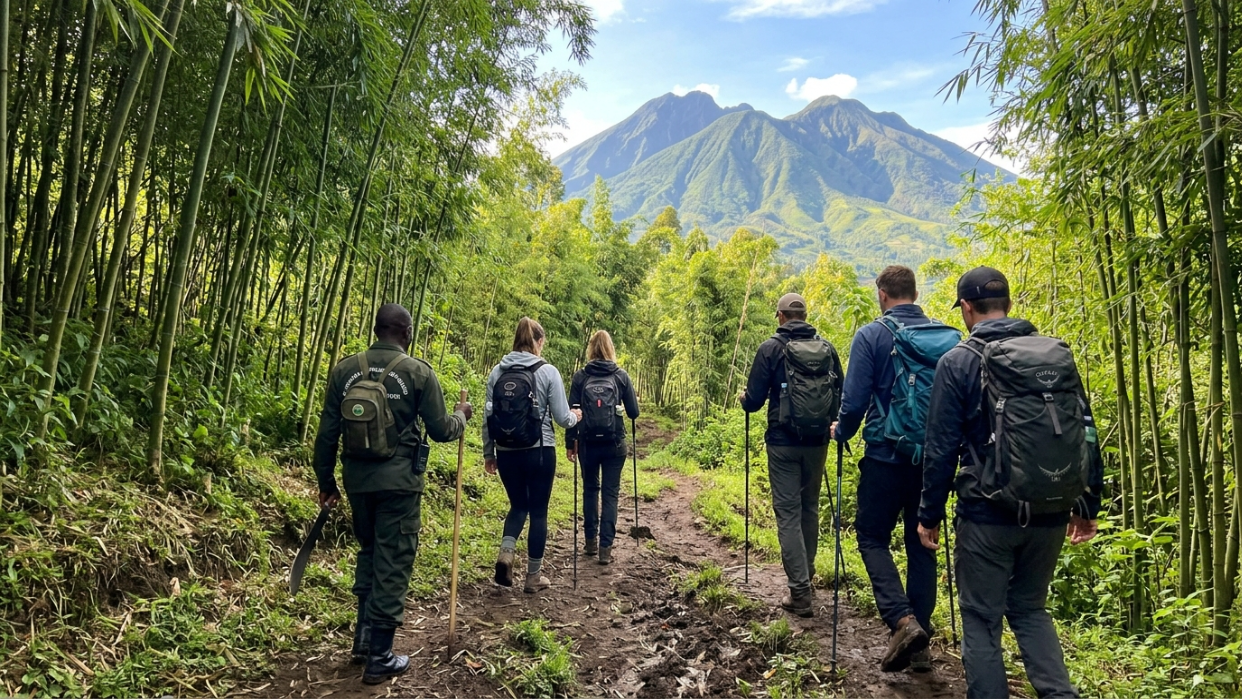
Rwanda’s sole gorilla trekking destination covers about 160 square kilometers of volcanic terrain in the northwest. Unlike Bwindi’s dense jungle, Volcanoes features rolling hills, open meadows, and bamboo forests that make for more straightforward hiking. Treks typically run 30 minutes to 4 hours. The park is home to 12 habituated gorilla families.
Mgahinga Gorilla National Park (Uganda)
Uganda’s smaller, lesser-known gorilla park sits on the Ugandan side of the Virunga Massif. It has just one habituated gorilla family (the Nyakagezi group), which occasionally crosses into Rwanda or the DRC. Mgahinga offers a quieter experience with far fewer tourists, though permit availability is limited.
Silverback
The silverback is the dominant adult male gorilla in each family group, named for the distinctive silver-gray hair that develops on his back with maturity. He’s the leader, the protector, and usually the most photographed member of the group. Every habituated family has at least one silverback, and encountering him up close is the emotional centerpiece of most treks.
Permits and Booking: The 2026 Numbers
Gorilla Trekking Permit
This is the legal document you need to visit a habituated gorilla family. One permit, one trek, one hour with the gorillas. Prices vary by country and residency status.
|
Category |
Uganda |
Rwanda |
|---|---|---|
|
Foreign non-resident |
$800 |
$1,500 |
|
Low-season (Apr, May, Nov) |
$600 |
No discount |
|
Foreign resident |
$700 |
$500 |
|
East African citizen |
~$80 (UGX 300,000) |
$200 |
The price gap is the first thing everyone notices when comparing gorilla trekking Rwanda vs Uganda. Rwanda’s $1,500 price tag is nearly double Uganda’s standard rate and more than double the low-season price. That said, as you’ll see in the logistics section, permit price alone doesn’t tell the full cost story.
For a detailed breakdown of Uganda permit costs and the booking process, read our gorilla trekking permits guide.
Uganda Wildlife Authority (UWA)
The UWA manages all gorilla permits in Uganda. An important policy change took effect in March 2026: the previous 7-day reservation window has been eliminated. All permits must now be paid in full at the time of booking. No more holding permits without confirmed payment. This means you can’t tentatively reserve a spot and decide later. If you want the date, you pay for the date.
Most travelers book Uganda permits through a licensed tour operator rather than directly with UWA, which simplifies the process considerably.
Rwanda Development Board (RDB)
The RDB handles gorilla permits in Rwanda, with online booking available through the Irembo platform. The process is more streamlined than Uganda’s, partly because Rwanda has built a slick digital infrastructure around its tourism industry. Permits can sell out months in advance during peak season (June through September), so early booking matters for both countries.
Gorilla Habituation Experience (GHEX)
This is Uganda’s ace card and a term worth understanding. A standard gorilla trek gives you one hour with a fully habituated family. The Gorilla Habituation Experience, available only in Bwindi, lets you spend four hours with a semi-habituated group for $1,500.
Here’s the math that most comparison articles miss: Uganda’s habituation permit costs the same as a standard Rwanda permit, but gives you four times the contact. You’re essentially joining the ongoing process of teaching wild gorillas to tolerate human presence. It’s more unpredictable, more physically demanding, and far more intimate than a standard trek.
If you have the fitness for it, the GHEX is arguably the best value proposition in gorilla tourism. Only a handful of permits are issued per day.
Gorilla Trekking Success Rates: Rwanda vs Uganda
One of the most common misconceptions is that one country offers better gorilla sightings than the other.
In reality, both Uganda and Rwanda report sighting success rates close to 98%.
Several factors contribute to this exceptionally high success rate:
-
Gorilla families are monitored daily by trackers
-
Rangers locate groups before visitors begin trekking
-
Habituated families stay within known territories
-
Trekking groups receive real-time updates from trackers
Gorilla Sighting Comparison
|
Metric |
Uganda |
Rwanda |
|---|---|---|
|
Sighting success rate |
~98% |
~98% |
|
Habituated families |
19+ |
12 |
|
Advance trackers used |
Yes |
Yes |
|
Daily monitoring |
Yes |
Yes |
For travelers concerned about missing the gorillas, neither destination has a meaningful advantage.
The Trek Experience: What Each Country Feels Like
Habituated Gorilla Group
A habituated group is a gorilla family that has been gradually conditioned over several years to accept the close presence of humans without stress. Only habituated groups are open to tourist visits. This process takes two to three years of daily approach by park rangers.
Uganda has more of them (19+) than Rwanda (12), which translates to more daily permits: roughly 128 in Bwindi versus 96 in Volcanoes. More availability generally means easier permit access, especially during peak season.
The Eight-Person Rule
No more than eight visitors per day are allowed to see each habituated gorilla family. This is standard in both countries. It exists to minimize stress on the gorillas and maintain the quality of the encounter. Combined with the one-hour viewing limit, these rules mean your gorilla time is exclusive but brief, so preparation matters.
The One-Hour Rule
Once your group reaches the gorillas, your clock starts. You get exactly 60 minutes. Rangers enforce this strictly. It sounds short, but most trekkers report it feels longer than expected because the encounters are so absorbing. For a full rundown of what these rules look like in practice, our gorilla trekking safety guide covers the details.
Trekking Sector (Bwindi)
Bwindi’s four sectors matter more than most people realize before they book:
-
Buhoma (northwest): The original trekking sector. Moderate terrain, well-established trails.
-
Ruhija (east): Higher elevation, more challenging terrain. Good birding.
-
Rushaga (south): The most gorilla families, relatively gentle slopes.
-
Nkuringo (south): Known for steep descents and ascents. Physically the most demanding.
Your assigned sector determines your starting point, your accommodation options, and (if you’re coming from Kigali) which border crossing you’ll use.
Terrain Comparison
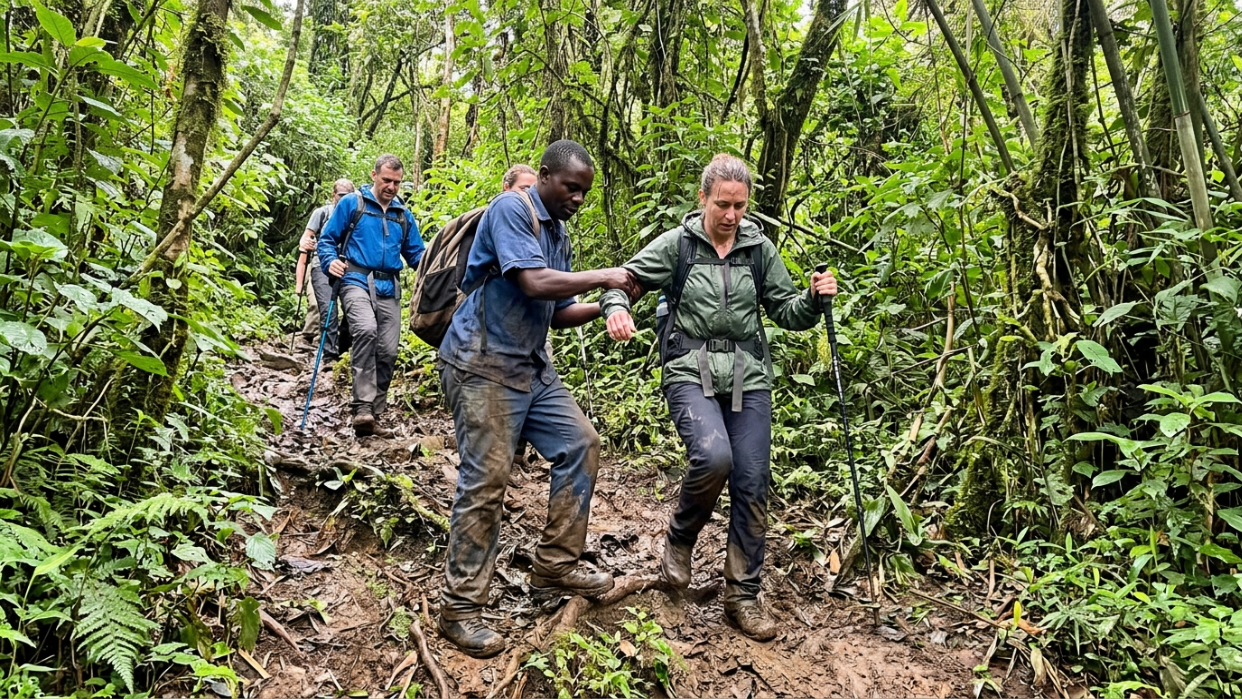
This is where the gorilla trekking Rwanda vs Uganda difference gets visceral.
Bwindi is a thick tropical rainforest with dense undergrowth. The park genuinely earns the word “impenetrable.” You may spend hours pushing through vegetation on narrow trails, climbing steep ridges, and navigating muddy slopes. Treks last anywhere from 2 to 8 hours depending on where the gorillas are that morning.
Volcanoes National Park offers more open terrain: bamboo forests, volcanic meadows, clearer sightlines. Most treks finish within 4 hours, and many take under 2. The hiking is still real exercise (you’re on a volcano) but it’s less grueling than Bwindi.
Wondering if you’re fit enough? Our gorilla trekking fitness guide gives honest benchmarks.
Trek Difficulty Comparison
Not all gorilla treks are equally challenging.
The location of the gorilla family on a particular day largely determines difficulty, but general trends exist.
|
Difficulty Level |
Uganda |
Rwanda |
|---|---|---|
|
Easy |
Some Rushaga groups |
Several Volcanoes groups |
|
Moderate |
Buhoma, Ruhija |
Most treks |
|
Difficult |
Nkuringo sectors |
High-elevation volcano slopes |
|
Typical trek duration |
2–8 hours |
30 mins–4 hours |
For first-time hikers or older travelers, Rwanda generally provides a more accessible trekking experience.
Photography Differences
The terrain gap directly affects your photos. Practitioners note that Volcanoes’ more open canopy means better natural light and easier shooting conditions. Bwindi’s dense forest creates challenging light but potentially more dramatic, atmospheric images. One safari guide noted that a professional photographer he recently led through Bwindi said the dense forest required more technical skill but produced images with a mood you simply can’t replicate in Volcanoes.
For gear recommendations and camera settings specific to gorilla encounters, see our gorilla trekking photography guide.
Porter
In both countries, you can hire a porter at the trailhead to carry your daypack and help you on steep sections. Porters are not included in your permit fee; they’re an additional cost (typically $15-20). Hiring one is strongly recommended, especially in Bwindi. Beyond the practical benefit, porter fees go directly to local community members, making this one of the most immediate ways your trip supports conservation economies.
Advance Tracker
Before your trekking group even sets out, rangers called advance trackers head into the forest at dawn to locate the gorilla family you’ve been assigned. By the time you start walking, they’ve radioed back the gorillas’ position. This system dramatically reduces search time and is used in both countries.
Logistics and Access: Getting There
The Rwanda Advantage
Volcanoes National Park is about a 2.5-hour drive from Kigali International Airport. You can land in the morning and be at your lodge before lunch. For travelers on tight schedules, or those adding gorilla trekking to a Kenya or Tanzania safari, this convenience is hard to beat.
The Uganda Challenge
Bwindi Impenetrable National Park is in Uganda’s far southwest. From Entebbe International Airport, you’re looking at a 9 to 10 hour drive, or a 1-hour domestic flight to Kihihi or Kisoro airstrip. Either way, you need an extra travel day compared to Rwanda.
The Kigali Shortcut
This is the logistics hack that experienced East Africa travelers swear by. Instead of driving 9 hours from Entebbe, you fly into Kigali and drive to Bwindi. The road takes 4 to 5 hours depending on your trekking sector. You get Uganda’s $800 permit with Rwanda’s easy airport access.
Practitioners on travel forums confirm the math works. Forum users on TripAdvisor have noted that RwandAir from London to Kigali is often cheaper than most carriers to Entebbe, and from Kigali it’s about 3 hours to the southern gorilla sites near Kisoro, or roughly 4.5 hours to Buhoma.
Your border crossing depends on your assigned Bwindi sector:
-
Cyanika Border: Preferred for Rushaga and Nkuringo sectors. Quieter, more scenic, routes through Kisoro town.
-
Katuna (Gatuna) Border: The busiest crossing, best for Buhoma and Ruhija sectors.
The Time Zone Trap
One of the most common mistakes on the Kigali-to-Bwindi route: forgetting the time difference. Rwanda runs on Central Africa Time (CAT). Uganda runs on East Africa Time (EAT). Uganda is one hour ahead. If your trekking briefing is at 7:30 AM Uganda time and you’ve set your alarm on Rwanda time, you’re showing up an hour late. Set your phone to update automatically when you cross the border.
East African Tourist Visa (EATV)
For $100, this 90-day multiple-entry visa covers Uganda, Rwanda, and Kenya. It’s the key that makes the Kigali Shortcut and multi-country itineraries seamless. Apply through any of the three countries’ immigration portals before departure. If you’re combining gorilla trekking with a Serengeti safari or Maasai Mara visit, the EATV saves both money and paperwork.
Sample Trip Costs: Rwanda vs Uganda
Permit prices tell only part of the story.
The total cost of a gorilla trekking trip depends on transportation, accommodation, and trip length.
Example Cost Comparison (Solo Traveler)
|
Expense |
Uganda |
Rwanda |
|---|---|---|
|
Permit |
$800 |
$1,500 |
|
Transfers |
$250–500 |
$50–150 |
|
Accommodation (2 nights) |
$150–500 |
$250–800 |
|
Estimated Total |
$1,200–1,800 |
$1,800–2,500 |
Example Cost Comparison (Couple)
|
Expense |
Uganda |
Rwanda |
|---|---|---|
|
Permit Cost (2 people) |
$1,600 |
$3,000 |
|
Shared Transport |
Lower per person |
Lower per person |
|
Estimated Savings Choosing Uganda |
$1,000+ |
— |
For a broader look at connecting multiple countries, our guide on fitting multiple experiences into one East Africa trip walks through the planning.
Seasonality: When to Go
Peak Season
June through September is the primary dry season across both Bwindi and Volcanoes. Weather is best, trails are driest, and permits sell out fastest. The short dry season from December to February also offers good conditions with slightly fewer crowds.
Low Season (Green Season)
April, May, and November bring heavier rain. Trails get muddier, especially in Bwindi. But Uganda drops permit prices to $600 during these months, saving $200 per person. Rwanda offers no seasonal discounts.
The gorillas don’t migrate. They’re there year-round. Rain makes the trek harder, not the sighting less likely. Budget-conscious travelers who don’t mind wet boots will find the low season rewarding.
Best Time for Gorilla Trekking
While gorilla trekking operates year-round, certain months offer better hiking conditions.
Gorilla Trekking Seasons
|
Season |
Months |
Conditions |
|---|---|---|
|
Peak Dry Season |
June–September |
Best weather |
|
Short Dry Season |
December–February |
Excellent conditions |
|
Green Season |
March–May |
Wet but quieter |
|
Short Rainy Season |
October–November |
Moderate rainfall |
The gorillas remain in the parks throughout the year, so weather affects trail conditions far more than viewing opportunities.
Culture and Conservation
Kwita Izina
Rwanda’s annual gorilla naming ceremony, Kwita Izina, is one of Africa’s most meaningful conservation events. At the 2025 ceremony, 40 baby mountain gorillas received official names. Since the tradition began over two decades ago, 397 gorillas have been named. The event draws global attention to gorilla conservation and has become a cornerstone of Rwanda’s national identity.
The Conservation Success Story
In the early 1980s, fewer than 254 mountain gorillas survived. Poaching, habitat loss, and regional conflict had pushed the species to the edge. As of 2024, the population has grown to approximately 1,063 individuals, a recovery that ranks among conservation’s greatest achievements.
Tourism revenue drives much of this progress. In Uganda, 75% of each $800 permit goes directly to gorilla conservation, 15% to the government, and 10% to local communities surrounding the parks. This revenue-sharing model gives communities a direct financial stake in protecting gorillas rather than poaching them.
A new census is underway: researchers are currently conducting the 2025 Bwindi-Sarambwe mountain gorilla census, with two sweeps planned (the second scheduled for October) to ensure no gorillas are missed.
Two Different Tourism Philosophies
Rwanda and Uganda have made deliberate, different strategic choices. Rwanda pursues a high-value, low-volume model. The $1,500 permit price is intentional: fewer visitors, higher spending per head, luxury-tier accommodations. Rwanda’s safari lodges skew four and five stars. Uganda markets itself as the more accessible, adventure-forward option. Budget lodges exist alongside luxury camps, and the lower permit prices attract a wider range of travelers.
Neither approach is better. They reflect different visions for conservation tourism, and they produce genuinely different travel experiences.
The Total-Cost Question Most Articles Get Wrong
Here’s a nuance almost every gorilla trekking Rwanda vs Uganda comparison misses. The standard advice says Uganda is always cheaper because the permit costs less. That’s true if you’re looking only at the permit. But total trip cost depends on your circumstances.
Practitioners on TripAdvisor forums have flagged this repeatedly. One experienced traveler put it plainly: a friend planning a quick solo gorilla trek found that once he factored in the logistics and transfer costs of getting to Bwindi from Entebbe, it was cheaper to go to Rwanda and pay the higher permit fee. Solo travelers absorb 100% of vehicle and driver costs that couples and groups split. Rwanda’s shorter transfer from Kigali means fewer hotel nights and cheaper ground transport.
The takeaway: for solo travelers on 2-3 day trips, Rwanda can match or beat Uganda on total cost. For couples, groups, or anyone building a longer East Africa itinerary, Uganda’s lower permit price compounds into significant savings. For a broader breakdown of what East Africa trips actually cost, our safari cost guide has detailed numbers.
Decision Framework: Which Country Fits You?
Choose Uganda if:
-
Budget is a priority ($800 standard, $600 low season)
-
You want the Gorilla Habituation Experience (4 hours for $1,500)
-
You prefer a rugged, jungle-immersion trek
-
You’re combining gorilla trekking with Queen Elizabeth National Park, Kibale chimpanzee tracking, or other Uganda wildlife experiences
-
You’re traveling as a couple or group (transfer costs spread across multiple people)
-
Peak-season permit availability matters (128 daily vs 96)
Choose Rwanda if:
-
You have limited time (2.5 hours from Kigali airport to the park)
-
You prefer easier terrain and shorter treks
-
Luxury accommodation is important
-
You’re adding gorilla trekking onto a Kenya or Tanzania safari
-
You’re traveling solo on a short trip (total cost may be comparable to Uganda)
-
You want a streamlined, polished experience from airport to gorilla
Consider Both if:
-
You want to use the Kigali Shortcut: fly into Kigali, drive to Bwindi for Uganda’s $800 trek, then loop back for a second trek in Volcanoes National Park
-
You have the East African Tourist Visa, which makes cross-border movement seamless
-
You want to compare the dense rainforest experience with the open volcanic terrain in a single trip
Ready to start planning? Explore Uganda gorilla trek options or get in touch to design a trip that covers both countries.
Frequently Asked Questions
Is gorilla trekking better in Rwanda or Uganda?
Neither is objectively better. Rwanda offers easier access, shorter treks, and a luxury-leaning experience. Uganda offers lower permit costs, tougher jungle terrain, more gorilla families, and the exclusive Gorilla Habituation Experience. The best choice depends on your budget, physical fitness, available time, and travel style.
How much does a gorilla trekking permit cost in 2026?
Uganda charges $800 per person for foreign non-residents, dropping to $600 during the low season (April, May, November). Rwanda charges $1,500 year-round with no seasonal discounts. Uganda’s Gorilla Habituation Experience costs $1,500 for a 4-hour visit.
Can I fly into Kigali and trek in Uganda?
Yes, and many experienced travelers recommend this route. Flying into Kigali and driving to Bwindi takes 4-5 hours, compared to 9-10 hours from Entebbe. You’ll need to cross the Uganda-Rwanda border (Cyanika for southern Bwindi sectors, Katuna for northern ones) and remember that Uganda is one hour ahead of Rwanda.
How far in advance should I book gorilla trekking permits?
For peak season (June through September and December through February), book at least 3-6 months ahead. Uganda’s new March 2026 policy requires full payment at time of booking, so you can no longer hold a reservation without paying. Rwanda permits also sell out months in advance during busy periods.
What is the Gorilla Habituation Experience?
Available only in Bwindi Impenetrable National Park, Uganda, the Gorilla Habituation Experience lets you spend 4 hours with a semi-habituated gorilla group for $1,500. You participate in the ongoing process of acclimating wild gorillas to human presence. It’s more physically demanding and less predictable than a standard trek, but the extended time with the gorillas is unmatched.
Do I need a visa to trek gorillas in both countries?
The East African Tourist Visa ($100) covers Uganda, Rwanda, and Kenya with 90-day multiple-entry access. It’s the simplest option for anyone visiting more than one of these countries. Apply online before departure through any of the three countries’ immigration websites.
How fit do I need to be for gorilla trekking?
In Rwanda, moderate fitness is sufficient for most treks (30 minutes to 4 hours on volcanic terrain). In Uganda, particularly in Bwindi’s Nkuringo sector, expect steep climbs through dense undergrowth for up to 8 hours. A porter is available in both countries to carry your gear and assist on difficult sections. Our gorilla trekking fitness guide provides honest physical benchmarks for each park.
Is there an age limit for gorilla trekking?
Yes. Both Uganda and Rwanda require trekkers to be at least 15 years old. There are no upper age limits, but physical fitness matters, particularly in Bwindi. Our gorilla trekking age limit guide covers family planning considerations in detail.
Is gorilla trekking safe in Rwanda and Uganda?
Yes. Gorilla trekking is conducted under strict supervision by armed park rangers and trained guides. Both countries have operated regulated gorilla tourism programs for decades with strong safety records.
Why is Rwanda gorilla trekking more expensive?
Rwanda intentionally follows a high-value, low-volume tourism model. The higher permit fee helps limit visitor numbers while generating conservation revenue.
Can seniors do gorilla trekking?
Many travelers in their 60s and 70s successfully complete gorilla treks each year. Rwanda is generally easier for seniors due to shorter access times and less demanding terrain.
Is Uganda or Rwanda better for first-time visitors?
Rwanda is often easier for first-time visitors because of shorter transfers, more straightforward logistics, and generally easier trekking conditions.