

Safari Travel Insurance 2026: Coverage & Evacuation Guide
TL;DR
Safari travel insurance is specialized travel coverage designed for the unique risks of African wildlife trips and high-altitude treks, including remote medical evacuations, activity exclusions, and high cancellation costs. Standard travel insurance often falls short because it may exclude safari activities, cap altitude coverage too low for Kilimanjaro, and carry inadequate evacuation limits. Most travelers need two layers of protection: a rapid-response air evacuation membership like AMREF Flying Doctors plus a comprehensive travel insurance policy. Buy your policy within 14 to 21 days of your first trip deposit to unlock time-sensitive benefits like Cancel for Any Reason and pre-existing condition waivers.
We’ll flag the coverage Duma requires (evac plus Kilimanjaro altitude if you climb) when we send your itinerary.
See Tanzania safari itineraries →
A safari in East Africa is one of the most rewarding trips you can take. It’s also one of the most expensive. The average Africa trip costs around $11,000 per person, and Tanzania ranks among the world’s ten most expensive travel destinations, with average trip costs near $19,000 per person. When you’re investing that kind of money in non-refundable deposits, park fees, permits, and flights, the right insurance policy isn’t a nice-to-have. It’s essential.
The problem is that “travel insurance” and “safari travel insurance” are not the same thing. Standard policies routinely exclude the activities, altitudes, and remote locations that define an East Africa trip. This glossary breaks down every term you’ll encounter when shopping for coverage, explains why each one matters, and gives you a practical framework for choosing the right policy.
Duma Explorer does not sell insurance. But as an operator that designs private Tanzania safaris and Kilimanjaro climbs, we consider adequate insurance coverage a non-negotiable part of trip planning.
Safari Travel Insurance at a Glance
For most travelers visiting Tanzania, Kenya, Uganda, or Rwanda, the best safari travel insurance includes:
Coverage
Recommended Minimum
Emergency Medical
$100,000+
Emergency Medical Evacuation
$250,000–$500,000+
Trip Cancellation
100% of prepaid trip cost
Trip Interruption
150% of trip cost
High-Altitude Trekking
Required for Kilimanjaro (6,000 meters)
Adventure Activity Coverage
Walking safaris, game drives, gorilla trekking
Pre-existing Condition Waiver
Buy within 14–21 days
Cancel For Any Reason (CFAR)
Recommended for expensive safaris
AMREF Flying Doctors Membership
Strongly recommended
Takeaway
The safest approach for an African safari is combining comprehensive travel insurance with a regional air evacuation membership such as AMREF Flying Doctors. Buy coverage within 14–21 days of your first trip deposit to unlock valuable benefits such as CFAR and pre-existing condition waivers.
Standard Travel Insurance vs Safari Travel Insurance
Feature
Standard Travel Insurance
Safari Travel Insurance
Medical Coverage Abroad
Yes
Yes
Medical Evacuation
Limited
Higher Limits
Remote Bush Evacuation
Often Limited
Yes
Walking Safari Coverage
Sometimes Excluded
Included
Gorilla Trekking
May Require Upgrade
Often Covered
Kilimanjaro Coverage
Usually Excluded Above 3,000m
Available to 6,000m
Adventure Activities
Limited
Designed for Safari Activities
Emergency Assistance
Basic
Specialized Providers
Who Needs Safari Travel Insurance?
Safari travel insurance is recommended for:
Travelers visiting Tanzania, Kenya, Botswana, Namibia, South Africa, Uganda, Rwanda, or Zambia
Anyone climbing Kilimanjaro or Mount Kenya
Gorilla trekking visitors
Luxury safari travelers with high prepaid costs
Family safaris
Photography safaris carrying expensive equipment
Multi-country East Africa itineraries
Travelers flying on bush aircraft
If your trip includes remote camps, charter flights, or trekking above 3,000 meters, specialized safari insurance becomes even more important.
Core Coverage Types
These are the building blocks of any safari travel insurance policy. Understanding them is the difference between being protected and being exposed.
Safari Travel Insurance
Safari travel insurance is a type of travel insurance that explicitly includes safari activities, game drives, walking safaris, and related adventures as covered activities. Many standard travel insurance policies treat these as exclusions or don’t mention them at all.
Why it matters: if your policy doesn’t specifically list an activity like a walking safari or gorilla trek, it may be excluded from coverage. Practitioners on Reddit and travel forums frequently report discovering exclusions only after filing a claim. The fine print is everything.
Safari-specific policies also tend to carry higher limits for medical costs and medical evacuations, reflecting the reality that safaris happen in places far from hospitals.
Emergency Medical Coverage
Emergency medical insurance reimburses you for medical costs incurred during your trip: doctor fees, ambulance transport, hospital stays, prescription medications, and treatment for conditions like malaria or injuries from a vehicle accident.
This coverage is critical because U.S. health insurance typically does not apply abroad, and Medicare never covers foreign medical care. The CDC Yellow Book explicitly recommends that travelers to Africa carry dedicated medical coverage.
Recommended minimums: At least $100,000 for medical expenses, though many operators and insurance experts recommend higher. Many safari destinations are hours from the nearest clinic, which means treatments that would be routine at home become expensive, logistically complex emergencies in the bush.
Medical Evacuation Coverage
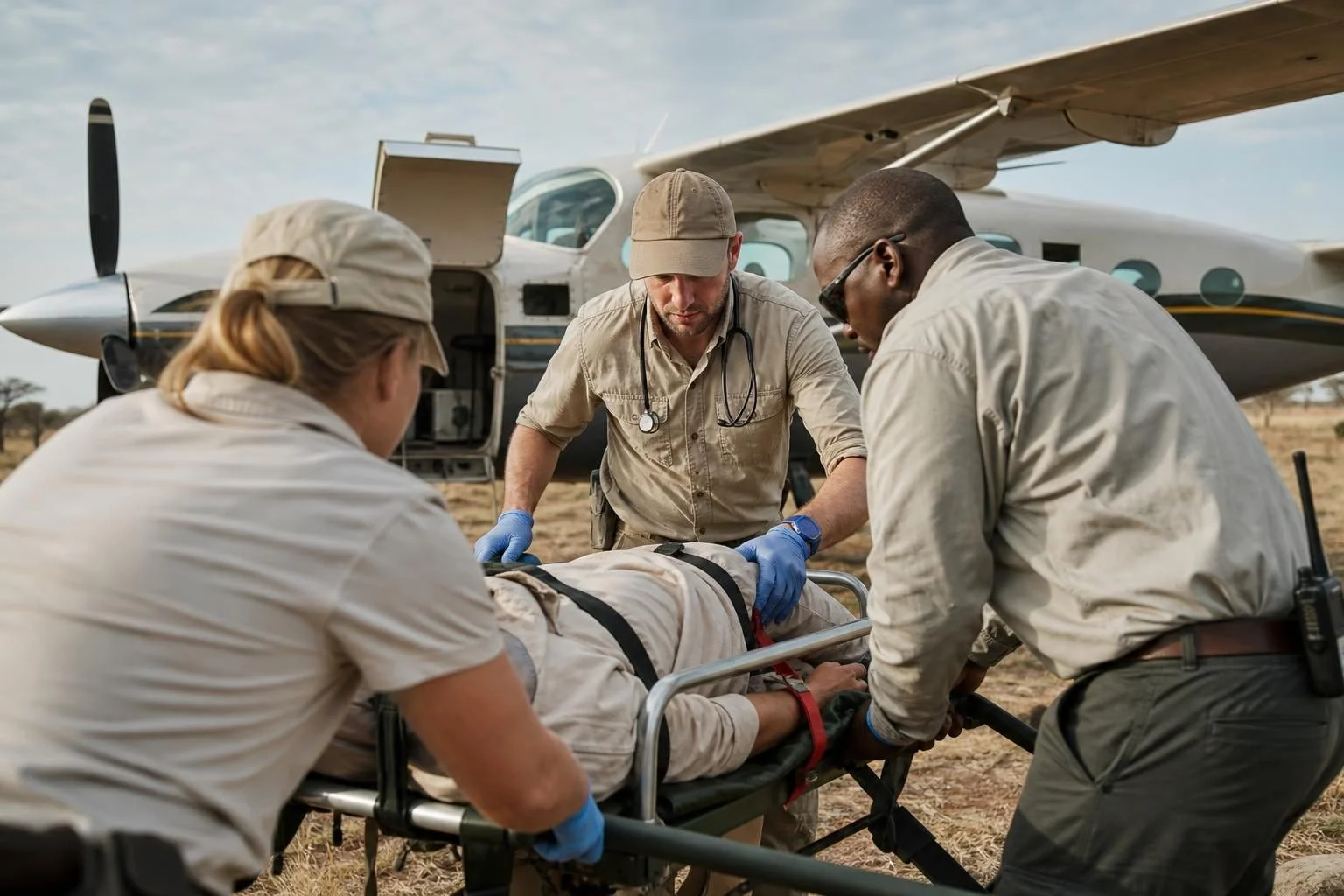
If you need to be airlifted from a remote bush camp to a hospital in Nairobi or Dar es Salaam, medical evacuation coverage pays for it. This is arguably the most important coverage category for safari travelers.
The real-world costs are staggering. An emergency air evacuation from a remote camp runs $10,000 to $50,000. Hospital treatment in Nairobi involving surgery and ICU can cost $15,000 to $80,000. Aeromedical repatriation back to your home country adds another $50,000 to $100,000. Total uninsured exposure for a serious medical emergency can reach $75,000 to $230,000.
Recommended minimums: $250,000 to $500,000 in emergency medical evacuation coverage is standard for African safari travel. Some operators, including Yellow Zebra Safaris, recommend coverage between $350,000 and $1 million per person.
Trip Cancellation Insurance
Trip cancellation insurance reimburses up to 100% of your unused, non-refundable, prepaid trip costs if you need to cancel before departure for a covered reason. Covered reasons typically include illness or injury of the traveler, a travel companion, or a family member, as well as specific events like jury duty, job loss, or natural disasters at your destination.
For safari travelers, the stakes are high. Between flights, lodge deposits, park fees, and permits, you could be looking at thousands of dollars in non-refundable costs. A broken leg six weeks before departure, without cancellation coverage, means losing all of it.
Understanding the full breakdown of what goes into safari costs and fees helps you calculate exactly how much trip cancellation coverage you need.
Trip Interruption Insurance
If you need to cut your trip short and head home early for a covered reason, trip interruption insurance pays up to 150% of your prepaid, nonrefundable trip expenses. The extra 50% above your trip cost helps cover last-minute return flights, which are almost always more expensive than planned departures.
This matters more than most people realize. Imagine you’re on day three of a ten-day safari when you get a call that a parent has been hospitalized. You need to fly home immediately. Without interruption coverage, you lose the remaining seven days of prepaid safari costs and eat the price of a walk-up international flight.
Baggage and Personal Effects Coverage
This reimburses you for lost, stolen, or damaged luggage and personal items. For safari travelers carrying expensive camera equipment, binoculars, or specialty gear, the standard coverage limits on basic policies (often $500 to $1,000) may not be enough. Check the per-item sublimits in any policy you’re considering, as some cap individual items at $250 regardless of their actual value.
Travel Delay and Missed Connection Coverage
Safaris often involve domestic flights on small regional carriers, bush transfers, and tight connections. If a delay causes you to miss a safari departure, a pre-booked domestic flight, or a lodge check-in, this coverage reimburses additional expenses like hotel stays, meals, and rebooking fees.
Advanced and Optional Coverage
Beyond the basics, several optional coverages address risks that are particularly relevant to East Africa travel.
Cancel for Any Reason (CFAR)
CFAR is an optional upgrade that lets you cancel your trip for any reason not covered by standard trip cancellation, including personal concerns about safety, changes of heart, or a travel companion backing out.
Key facts about CFAR:
You can typically recover 50% to 75% of your nonrefundable trip costs if you cancel at least 48 hours before departure.
CFAR adds roughly 40% to 50% to the cost of your base travel insurance policy.
To qualify, you must purchase CFAR within 14 to 21 days of your first trip payment and insure 100% of your prepaid, nonrefundable trip costs.
CFAR is not available in all states, including New York and Washington.
For safari travelers, CFAR is almost always worth it. At an added cost of roughly $270 to $340 on a $678 base premium, you’re protecting an $11,000+ investment against any cancellation scenario, including political instability, elevated travel advisories, or simply changed plans. Given that several of Africa’s most popular safari destinations carry active U.S. State Department travel advisories, this kind of flexibility has real value.
Non-Medical Evacuation
Political unrest, civil disturbances, or natural disasters can necessitate evacuation even when no one is sick or injured. Non-medical evacuation coverage pays for relocation to safety in these situations. This is distinct from medical evacuation and carries its own coverage limits.
For more context on destination-specific safety considerations, our East Africa safety guide covers what travelers should know about each country.
Financial Default Coverage
If your safari operator, airline, or lodge declares bankruptcy before your trip, financial default coverage reimburses your prepaid costs. These riders are generally time-sensitive and require purchasing the plan within a couple of weeks of your initial deposit.
This coverage is worth considering for any trip booked far in advance, especially when working with operators you haven’t vetted thoroughly.
Pre-Existing Condition Waiver
Travel insurance typically excludes pre-existing medical conditions treated within a “lookback period” (usually 60 to 180 days before you purchased the policy). However, many policies offer pre-existing condition waivers if you purchase the policy within 14 to 21 days of your first trip deposit.
This matters more than most travelers expect. According to the CDC Yellow Book, insurance companies fully pay only about two-thirds of international travel health insurance claims. The main reasons for denial are pre-existing illness and poor documentation. If you take blood pressure medication or have a history of any chronic condition, securing this waiver is critical.
Interrupt for Any Reason (IFAR)
The trip interruption equivalent of CFAR. If you need to leave your trip early for any reason (not just covered reasons), IFAR reimburses a portion of your remaining prepaid costs. Like CFAR, it’s an optional upgrade with time-sensitive purchase requirements.
Safari-Specific and Kilimanjaro Terms
These terms address risks unique to East Africa’s most popular activities. If you’re combining a safari with a Kilimanjaro climb or gorilla trek, this section is especially important.
High-Altitude Trekking Coverage
Most standard travel insurance policies quietly cap hiking or trekking coverage at around 2,500 to 3,000 meters. Kilimanjaro’s summit sits at 5,895 meters. Without explicit high-altitude trekking coverage up to at least 6,000 meters, your policy is useless on the mountain.
This isn’t just about claims. Kili MedAir, the private company that provides helicopter search and rescue on Kilimanjaro, requires verified travel insurance with coverage up to 6,000 meters before initiating a rescue operation. Without it, they will not dispatch.
If you’re planning a climb, understanding Kilimanjaro success rates by route helps you assess risk and choose the right coverage level.
The Trekking vs. Mountaineering Classification Trap
This distinction trips up Kilimanjaro climbers constantly. “Mountaineering” or “mountain climbing” implies technical climbing with ropes, ice axes, and fixed lines. Most insurance policies exclude it. Kilimanjaro, despite its altitude, is a non-technical trek. You walk up. No ropes, no technical gear, no ice climbing (on standard routes).
When purchasing a policy or speaking with your insurer, specify that you are doing high-altitude trekking up to 6,000 meters, not technical mountaineering. One Kilimanjaro guide author on ClimbKilimanjaroGuide specifically warns: if a route includes anything technical, check how the insurer classifies it. For standard Kilimanjaro routes like the Lemosho or Machame, this classification should be straightforward, but you need to confirm it explicitly with your provider.
Adventure Activities Coverage
A basic travel insurance policy might not cover activities like game drives, walking safaris, gorilla trekking, or horseback safaris. If a plan doesn’t explicitly mention a specific activity, it may be excluded.
Before purchasing, get a written list of covered activities from your insurer. Compare it against your actual itinerary. If you’re doing a walking safari in a remote area of Tanzania, a canoe safari, or a gorilla trek through dense forest, each of these needs to be specifically listed.
AMREF Flying Doctors
AMREF Flying Doctors is the air ambulance division of Amref Health Africa, founded in 1957 by three surgeons operating out of a Piper Tri-Pacer in Kenya. For over 65 years, AMREF has been the primary air evacuation service in East Africa, covering Tanzania, Kenya, Uganda, Burundi, and Rwanda.
Their tourist membership (the Maisha plan) costs roughly $35 to $55 per person for 30 days and covers emergency air evacuation from remote areas to a hospital.
Critical limitation: AMREF is not medical insurance. Their core product covers transport only, getting you from the bush to a hospital. The standard plan explicitly states that AMREF does not accept responsibility for hospital payments. At $40 to $100 per person, there’s no reason not to have it. But treat it as one layer of protection, not the whole thing.
Kili MedAir
Kili MedAir provides helicopter search and rescue operations specifically on Mount Kilimanjaro. Many climbing operators work directly with Kili MedAir for emergency evacuations during climbs.
The critical point: Kili MedAir requires verified travel insurance covering altitude up to 6,000 meters before initiating a rescue. This is a hard requirement, not a suggestion. Evacuation costs on Kilimanjaro run $5,000 to $10,000 or more.
Repatriation Coverage
If you die abroad or are too seriously injured to travel commercially, repatriation coverage pays to transport you (or your remains) home. This is often bundled with medical evacuation but carries separate limits. Aeromedical repatriation from East Africa to the United States can cost $50,000 to $100,000. Verify that your policy covers this explicitly and at adequate limits.
Insurance Considerations by Safari Destination
Country
Special Considerations
Tanzania
Kilimanjaro, remote parks, possible mandatory insurance
Kenya
AMREF network, flying safaris
Uganda
Gorilla trekking permits
Rwanda
Gorilla permits and luxury lodges
Botswana
Remote Okavango Delta camps
Namibia
Long driving distances
South Africa
Rental car coverage may be important
Why We Recommend Buying Insurance Early
As a safari operator planning private Tanzania safaris and Kilimanjaro climbs, we've seen travelers face canceled flights, medical emergencies, delayed baggage, and weather-related itinerary changes. While we don't sell insurance, we've learned that travelers who purchase coverage immediately after making their first deposit generally have access to the widest range of protections and experience fewer financial surprises when plans change.
Safari Insurance by the Numbers
Statistic
Value
Average Safari Cost
$11,000+
Tanzania Average Trip
~$19,000
Average Insurance Cost
$45/day
Typical Policy Cost
$678
Medical Evacuation
$10,000–$50,000
Repatriation
$50,000–$100,000
Hospital Treatment
$15,000–$80,000
Recommended Medical Coverage
$100,000+
Recommended Evacuation Coverage
$250,000–$500,000+
Buying and Timing Terms
When you buy safari travel insurance matters almost as much as what you buy. Several of the most valuable benefits are only available during narrow purchase windows.
Lookback Period
The window (typically 60 to 180 days) during which insurers review your medical history for pre-existing conditions. Any condition treated, diagnosed, or adjusted within this period may be excluded from coverage unless you secure a waiver. The length of the lookback period varies by insurer and plan.
Time-Sensitive Benefits Window
Several of the most important safari insurance benefits, including CFAR, pre-existing condition waivers, and financial default coverage, are only available if you purchase your policy within 14 to 21 days of your first trip deposit.
Here’s the real-world consequence: imagine you book your safari in January for August travel. You decide to wait until July to buy insurance. Then in July, you break your leg and your doctor says you can’t fly. Without insurance already in place, you lose your flights, safari deposits, permits, and accommodation payments. Buy early.
If you’re still in the planning stage, reviewing common safari booking mistakes can help you avoid this and other costly errors.
Insured Trip Cost
Your insured trip cost must match your total non-refundable, prepaid expenses. Underinsuring (listing $5,000 when your actual costs are $11,000) means you’ll only be reimbursed proportionally if you file a claim. Include everything: flights, safari costs, lodge deposits, permits, internal transfers, and any pre-booked excursions.
Covered vs. Non-Covered Reasons
Standard trip cancellation policies only pay out for specific “covered reasons” listed in the policy. Common covered reasons include illness, injury, death of a family member, jury duty, job termination, and natural disasters at your destination. Anything not on the list, such as general anxiety about travel, a friend canceling, or vague safety concerns, is not covered unless you have CFAR.
Primary vs. Secondary Coverage
Primary coverage pays claims first, regardless of other insurance you carry. Secondary coverage only kicks in after your other insurance (health insurance, homeowner’s policy, credit card benefits) has paid its share. For safari travel, primary coverage is preferable because it simplifies claims and avoids delays from coordinating between multiple insurers.
The Two-Layer Insurance Model for East Africa
No single product covers every risk of an East Africa safari. The smartest approach is two layers of protection working together.
Layer 1: AMREF Flying Doctors (or similar rapid-response evacuation)
Cost: $35 to $55 per person for 30 days. This handles the immediate emergency, getting you from a remote bush camp or mountain slope to a hospital via air ambulance. AMREF has the aircraft, the landing strips, and 65+ years of operational history in East Africa.
Layer 2: Comprehensive travel insurance
Cost: $200 to $500+ per person for a two-week safari. This handles everything else: hospital bills, trip cancellation, trip interruption, baggage loss, repatriation, and liability.
With both layers in place, your out-of-pocket exposure for a major medical emergency drops to near zero. Without them, you’re looking at potential costs of $75,000 to $230,000.
This two-layer model is the approach most experienced safari travelers and operators recommend, yet it’s rarely explained clearly in insurance guides.
What Coverage You Actually Need: A Decision Framework
Coverage needs vary depending on your itinerary. Here’s how to think about it by trip type.
Coverage TypeSafari OnlySafari + KilimanjaroMulti-Country + Gorilla TrekkingEmergency Medical$100,000+$100,000+$100,000+Medical Evacuation$250,000+$500,000+$500,000+High-Altitude Trekking (6,000m)Not neededRequiredSituationalAMREF Flying DoctorsStrongly recommendedStrongly recommendedStrongly recommendedTrip Cancellation100% of trip cost100% of trip cost100% of trip costCFARRecommendedRecommendedHighly recommendedNon-Medical EvacuationRecommendedRecommendedHighly recommendedAdventure ActivitiesVerify game drives, walking safarisVerify trekking classificationVerify gorilla trekking, game drives
For multi-country trips that include gorilla trekking permits in Uganda or Rwanda, the cancellation stakes rise further. A single gorilla permit costs $700 to $1,500 and is non-refundable. Losing that permit because of a last-minute illness, without cancellation coverage, is an expensive and avoidable loss.
Cost Benchmarks
According to 2026 sales data from Squaremouth, the average safari travel insurance premium runs about $45 per day, or roughly $678 total for a 15-day Africa trip. Tanzania-specific policies average $49 per day, or about $782 for a 16-day trip. Insurance typically runs 4% to 10% of your total trip cost.
Planning a trip and want to understand the full cost picture? Our East Africa safari cost guide explains what drives pricing across destinations.
Common Safari Insurance Pitfalls
These mistakes cost travelers thousands of dollars every year. Avoid all of them.
Buying too late. Missing the 14-to-21-day purchase window after your first deposit locks you out of CFAR, pre-existing condition waivers, and financial default coverage. There’s no workaround once the window closes.
Assuming credit card coverage is enough. The CDC explicitly warns that travelers should not consider credit card benefits as a substitute for travel health insurance, travel disruption insurance, or medical evacuation coverage. Credit card travel benefits are supplemental at best, with low limits and significant exclusions.
Not verifying altitude limits. If you’re climbing Kilimanjaro and your policy caps trekking at 3,000 meters, you have no coverage above base camp. Kili MedAir won’t rescue you, and your insurer won’t pay your hospital bills. Confirm the 6,000-meter threshold in writing.
Failing to declare pre-existing conditions. Undisclosed conditions are the leading cause of denied claims. If you take any regular medication or have been treated for anything within your policy’s lookback period, disclose it and secure the waiver.
Confusing AMREF with comprehensive insurance. AMREF gets you to a hospital. It does not pay the hospital bill. This confusion is widespread and potentially devastating.
Not carrying proof of insurance. Both digital and printed copies. Some operators require proof of coverage at check-in, and Kili MedAir needs verified insurance before dispatching a helicopter. Keep your policy number, emergency contact number, and coverage summary accessible at all times. When building your East Africa packing list, add printed insurance documents to the essentials.
Overlooking Tanzania’s emerging mandatory insurance requirement. As of early 2026, U.S. travelers are not legally required to purchase travel insurance for Tanzania. However, Tanzania is currently rolling out legislation that would require all foreign visitors to purchase mandatory, government-approved travel insurance before entry. This is worth monitoring as you plan.
Ignoring operator insurance requirements. Many safari operators and lodges now require proof of travel insurance with medical evacuation coverage before confirming your trip. This is an industry-wide trend, not an exception.
Frequently Asked Questions
Is safari travel insurance required for Tanzania?
As of early 2026, it is not legally required. However, Tanzania is developing mandatory insurance legislation for foreign visitors, and many safari operators already require proof of coverage as a booking condition. Regardless of legal requirements, carrying adequate coverage for a trip of this cost and remoteness is strongly advisable.
How much does safari travel insurance cost?
Based on 2026 marketplace data, the average cost is about $45 per day, or roughly $678 for a typical 15-day Africa trip. Tanzania-specific policies average around $782 for 16 days. Adding CFAR increases the cost by 40% to 50%. Total insurance cost typically runs 4% to 10% of your trip investment.
Do I need separate insurance for climbing Kilimanjaro?
Not necessarily separate insurance, but you need a policy that explicitly covers high-altitude trekking up to 6,000 meters. Most standard travel insurance caps coverage at 2,500 to 3,000 meters, which leaves you uninsured above Kilimanjaro base camp. Kili MedAir will not initiate helicopter rescue without verified 6,000-meter coverage.
Is AMREF Flying Doctors enough on its own?
No. AMREF covers emergency air transport from remote locations to a hospital. It does not cover hospital bills, trip cancellation, baggage, or repatriation. Think of AMREF as the rapid-response layer and comprehensive travel insurance as the financial protection layer. You need both.
What happens if I buy safari insurance too late?
You lose access to time-sensitive benefits including CFAR eligibility, pre-existing condition waivers, and financial default protection. These benefits typically require purchasing within 14 to 21 days of your first trip deposit. You can still buy a basic policy later, but the most valuable protections will be unavailable.
Does travel insurance cover gorilla trekking permits?
Gorilla trekking permits ($700 to $1,500 per person in Uganda and Rwanda) are non-refundable prepaid trip costs. If you include them in your insured trip cost and cancel for a covered reason (or have CFAR), they should be reimbursable. Confirm that your policy covers adventure activities including gorilla trekking.
Should I get Cancel for Any Reason coverage for a safari?
For most safari travelers, yes. CFAR adds roughly $270 to $340 to a typical safari insurance premium, protecting an investment that averages $11,000 or more per person. Given the long planning horizons (often 6 to 12 months), the non-refundable nature of most safari costs, and the possibility of travel advisory changes in East Africa, CFAR provides meaningful financial protection that standard cancellation coverage cannot match.
What documentation should I carry on safari?
Carry both digital and printed copies of your insurance policy, including the policy number, coverage summary, emergency assistance phone number, and any relevant membership cards (such as AMREF). Store digital copies in your phone, in cloud storage, and as an email you can access offline. Include printed copies in your carry-on bag.
Ready to start planning your East Africa trip with the right preparation? Explore our East Africa safari itineraries to see what’s possible, then lock in your insurance the moment you make your first deposit.