


In short
Organizing a group safari involves more than dividing the tour price by the number of travelers. You also need to coordinate deposits, balance deadlines, shared vehicle costs, individual permits, cancellation penalties, and payments from every group member.
For groups traveling to Tanzania, Kenya, Uganda, or Rwanda, a clear payment plan helps prevent missed deadlines, unexpected expenses, and disputes when someone changes their plans. The key is to agree on how costs will be divided, document every payment, and establish a written dropout policy before making a booking.
How Does Group Safari Payment Planning Work? Group safari payment planning is the process of collecting, allocating, tracking, and paying the costs of a safari for multiple travelers. It involves setting an internal payment deadline, collecting the required deposit, scheduling balance payments, separating shared expenses from individual costs, and agreeing on how cancellations will be handled. Many safari operators require an initial deposit followed by one or more balance payments before departure, but the exact percentages and deadlines depend on the operator, itinerary, accommodation providers, and permits involved. The group organizer should confirm these terms in writing before collecting money.
The simplest approach is to divide shared costs equally, allocate accommodation and optional activities according to individual use, and maintain a payment tracker that records what each traveler owes and has paid.
This guide explains the payment terminology, cost-splitting methods, cancellation risks, and practical systems you can use to manage your group's safari budget.
For a broader look at destinations, group sizes, vehicles, and trip budgets, see our friends safari trip to Tanzania guide.
Group Safari Payment Planning at a Glance
Use this table as a starting point when organizing a group safari. The figures are planning examples, not universal industry requirements. Your operator's written quotation and payment terms take precedence.
|
Payment Item |
Typical Planning Consideration |
What the Organizer Should Do |
|---|---|---|
|
Initial deposit |
Often a percentage of the total booking cost |
Confirm the required amount, refund terms, and payment deadline before collecting money. |
|
Balance payment |
May be due in one installment or several stages before departure |
Record every due date and set an earlier internal collection deadline. |
|
Shared expenses |
May include the safari vehicle, guide, fuel, and transfers |
Agree on how these costs will be divided among travelers. |
|
Individual expenses |
May include park fees, permits, accommodation supplements, and personal activities |
Confirm which items are already included in each person's quote. |
|
Payment fees |
May include card processing, foreign transaction, and bank transfer fees |
Compare the actual total cost of available payment methods. |
|
Cancellation costs |
Depend on the operator's policy and supplier commitments |
Share the written cancellation terms before anyone pays. |
|
Emergency reserve |
An optional amount set aside for unexpected expenses |
Agree on who can authorize spending and how unused funds will be returned. |
|
Final reconciliation |
The review of actual expenses against collected funds |
Settle outstanding balances and document any refunds after the trip. |
Planning rule: Never collect money based solely on an estimated percentage or verbal promise. Confirm the operator's invoice, payment schedule, inclusions, exclusions, and cancellation policy first.
Group Safari Payment Timeline: From Booking to Departure
A group safari payment schedule should work backward from the operator's actual deadlines. The organizer should collect each payment early enough to resolve missing payments before the operator's deadline arrives.
The following timeline is an example for a safari booked several months in advance. Adjust it to match the operator's contract, permit requirements, and accommodation payment terms.
|
Stage |
Suggested Timing |
Organizer's Action |
|---|---|---|
|
Agree on the trip |
Before requesting a formal booking |
Confirm dates, budget, accommodation preferences, group size, and cost-splitting rules. |
|
Confirm the quotation |
Before collecting deposits |
Review inclusions, exclusions, cancellation terms, payment methods, and any additional fees. |
|
Collect initial deposits |
By an agreed internal deadline |
Collect each traveler's share before the operator's deposit deadline. |
|
Confirm the booking |
After the operator receives the required payment |
Obtain written confirmation of the itinerary, accommodation, and services secured. |
|
Review outstanding balances |
Approximately 90 days before departure, if relevant to the contract |
Confirm the final group size, revised invoice, and remaining payment obligations. |
|
Collect balance payments |
Before the operator's balance deadline |
Reconcile individual contributions and pay the operator on time. |
|
Verify permits and flights |
According to supplier deadlines |
Confirm which bookings are paid, issued, confirmed, or still awaiting payment. |
|
Prepare spending money |
Before departure |
Agree on tipping arrangements, optional expenses, and the handling of shared cash. |
|
Reconcile expenses |
During and after the trip |
Record shared spending, settle outstanding amounts, and return any unused group funds. |
How Far in Advance Should You Collect Safari Payments?
Start collecting money according to the operator's contractual deadlines rather than relying on a universal schedule. A booking requiring an early permit purchase may need a different payment arrangement from a standard lodge safari.
As a practical rule, establish an internal deadline at least several days to two weeks before each major operator payment, provided the booking timeline allows it. This creates time to follow up with travelers and resolve payment issues.
Before confirming the trip, every traveler should know the amount they owe, when each payment is due, whether payments are refundable, and what happens if they withdraw.
How Safari Payments Work: Core Terms Defined
Deposit
The upfront payment that secures your booking. Most safari operators require a deposit of 20% to 30% of the total trip cost, paid at the time of booking. This deposit is typically non-refundable, meaning you won’t get it back if you cancel, regardless of the reason.
Some operators scale deposits by trip length or complexity. A short two to three day safari might require 20%, while a seven to twelve day itinerary could require 30% to 40%. Trips involving gorilla permits or Kilimanjaro climbs often require a 50% deposit (or full payment) because the operator must prepay permits and park fees that are themselves non-refundable.
For group organizers, the deposit stage is the first real test of commitment. Collecting deposits from eight people who said “I’m in!” at dinner is harder than it sounds. Set a firm deadline. Anyone who hasn’t paid by that date isn’t on the trip.
Balance Payment
The remaining amount owed after the deposit, typically due 60 to 90 days before departure. Some operators structure this differently. One common model breaks it into stages: 20% deposit to hold your spot, 40% due 90 days before departure, and the remaining balance due 15 days before departure.
Why so far in advance? Popular safari lodges and tented camps hold a limited number of rooms per date. Once your operator confirms an itinerary, they need full payment to guarantee those rooms. Without it, the lodge releases your allocation and sells it to someone else.
For groups, the balance deadline is the second major stress point. Build in a buffer. If the operator’s deadline is 60 days out, tell your group the deadline is 75 days out. That gives you two weeks to chase stragglers before you’re actually at risk.
Per-Person-Per-Day (PPPD) Pricing
The standard pricing format for East African safaris. A quote of “$350 PPPD” means each person pays $350 for each day of the trip, typically covering accommodation, meals, a private vehicle with driver-guide, fuel, and park fees. What’s included varies by operator and accommodation tier.
PPPD pricing is important for group safari payment planning because it makes the math of group savings immediately visible. A couple paying $450 PPPD on a seven-day safari spends $6,300 per person. The same itinerary with six friends might cost $300 PPPD, or $2,100 per person. That difference comes almost entirely from splitting fixed costs like the vehicle and guide across more people.
If you’re coordinating a large group safari, understanding PPPD pricing helps you show everyone exactly how adding participants reduces individual costs.
Invoice and Booking Confirmation
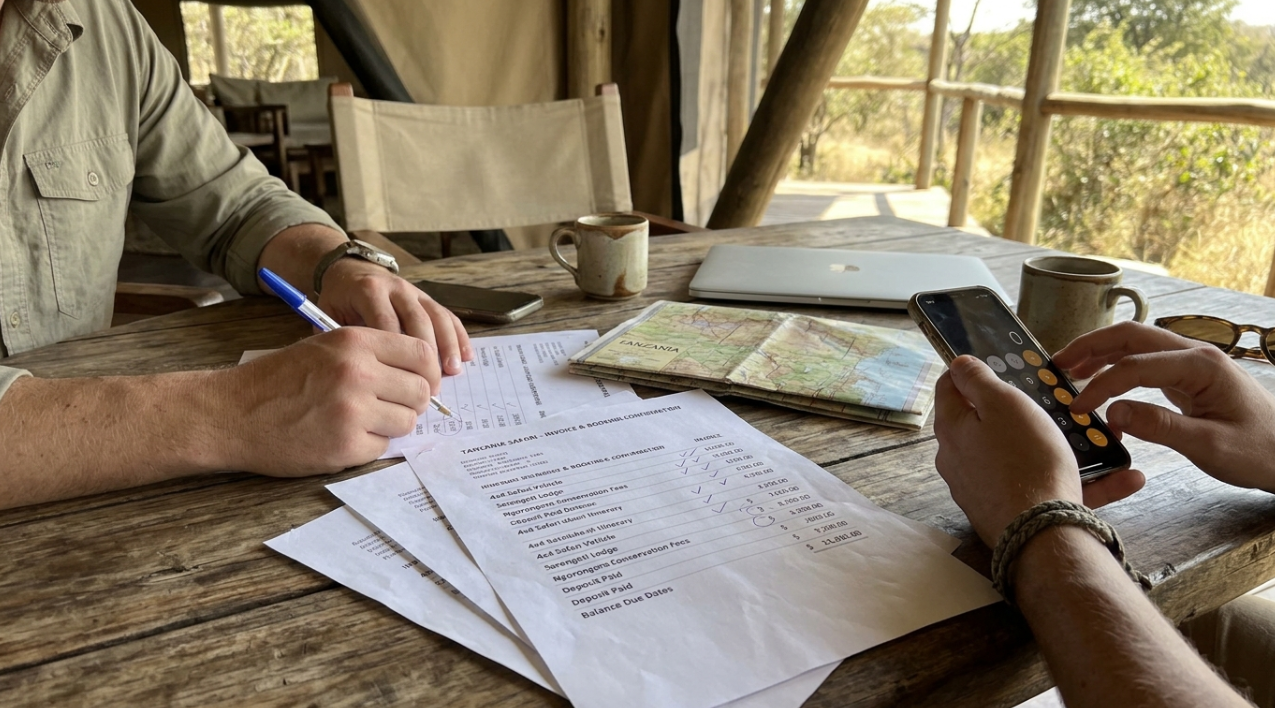
The invoice is the itemized document your operator sends showing the total cost, deposit amount, balance due dates, and what’s included. The booking confirmation is the document (often a separate email or PDF) confirming that your deposit has been received and your dates, lodges, and activities are secured.
Keep both. Share both with every member of your group. These documents are your proof of what was agreed, and they’ll matter if there’s a dispute about what was or wasn’t included.
Credit Card Surcharge
A fee the operator adds when you pay by credit card, typically 3.5% to 5% of the transaction amount. Safari operators in East Africa pay merchant processing fees on card transactions, and most pass that cost directly to the traveler rather than absorbing it.
On a $10,000 group booking, a 4% surcharge adds $400. That’s real money. But credit cards offer something a bank wire doesn’t: chargeback protection. If the operator fails to deliver the agreed services, your card network gives you a dispute path. Many experienced travelers put at least the deposit on a credit card for this reason, even if they pay the balance by wire.
Foreign Transaction Fee
A separate fee charged by your own bank or card issuer for purchases in a foreign currency, typically 1% to 3%. This is not the same as the operator’s surcharge. You could pay both. Some travel-focused credit cards waive foreign transaction fees entirely, which makes them useful for the deposit payment even if you switch to a wire for the balance.
Wire Transfer (Bank Transfer)
The payment method most safari operators prefer. An international bank wire typically costs $25 to $50 to send, plus a possible receiving fee and intermediary bank deductions that can eat another $15 to $30. The total transfer cost is usually far less than a credit card surcharge on a large booking.
The trade-off: wire transfers offer almost no buyer protection. Once the money leaves your account, getting it back requires the operator’s cooperation or a lengthy legal process. This is why verifying your operator’s legitimacy before sending a wire matters enormously.
Practitioners on Reddit and TripAdvisor forums report that services like Wise (formerly TransferWise) can reduce wire fees and provide better exchange rates than traditional banks. Worth investigating if your group is sending multiple payments.
Best Payment Methods for Group Safari Bookings
The best payment method depends on the operator's accepted payment options, transaction fees, exchange rates, payment deadlines, and the level of protection available to the traveler.
|
Payment Method |
Potential Advantages |
Potential Drawbacks |
What to Check |
|---|---|---|---|
|
Credit card |
Convenient and may provide access to dispute procedures or card benefits |
Operator surcharges and issuer fees may apply |
Total surcharge, applicable dispute rights, and card terms |
|
International bank transfer |
May be economical for large payments when fees are low |
Recovery can be difficult if money is sent to the wrong recipient or a dispute occurs |
Beneficiary details, sending and receiving fees, intermediary deductions, and transfer timing |
|
Online international transfer service |
May offer competitive exchange rates and transparent fees |
Availability, limits, recipient support, and protections vary by service |
Total cost, delivery time, currency conversion, and transaction terms |
|
Debit card |
Convenient and may avoid some credit-related costs |
Foreign transaction fees and dispute protections vary |
Issuer fees, card terms, and applicable protections |
|
Cash on arrival |
May be useful for certain local expenses or agreed payments |
Carrying large sums creates security risks and may not satisfy advance-payment requirements |
Operator acceptance, local payment rules, and safe handling |
How to Compare the Real Cost of a Payment
Compare the amount the operator must receive, not just the advertised transfer fee.
Include:
-
Any surcharge charged by the operator.
-
The sending bank's fee.
-
Intermediary and receiving bank deductions.
-
Currency conversion costs.
-
Any foreign transaction fee charged by the card issuer.
-
The time required for the funds to arrive.
For example, a payment method advertising a low transfer fee may still be more expensive if its exchange rate is less favorable or intermediary banks deduct additional charges.
Important: Do not assume that every international card payment provides the same chargeback rights or that a bank transfer has no possible recovery options. Protections depend on the payment method, provider, jurisdiction, and circumstances of the transaction. Confirm the terms before sending a large payment.
Safari Cost Categories for Groups
Before collecting money, classify every expense according to who benefits from it and how the operator charges for it. Some costs are shared by the group, some are charged individually, and others depend on personal choices.
|
Cost Category |
Examples |
Recommended Allocation |
|---|---|---|
|
Shared trip costs |
Private vehicle, guide, fuel, airport transfers, and other group transport |
Divide according to the group's agreed cost-sharing rules. |
|
Individual trip costs |
Park entry fees, per-person permits, individual activities, and personal insurance |
Charge each traveler for their own applicable costs. |
|
Accommodation |
Double or twin rooms, single rooms, family rooms, and room upgrades |
Allocate according to room occupancy and the agreed accommodation arrangement. |
|
Optional expenses |
Additional activities, spa treatments, personal shopping, and excluded drinks |
Charge only the travelers who choose or incur the expense. |
|
Group administration |
Payment transfer fees, agreed shared supplies, or other approved common expenses |
Divide according to the written group agreement. |
|
Contingency expenses |
Unplanned transfers, approved itinerary changes, or other unexpected costs |
Use an agreed reserve or collect additional contributions with the group's approval. |
Important: Do not assume that every expense listed as a shared cost is automatically included in the safari operator's quote. Ask for an itemized invoice and confirm whether each amount is included, excluded, or payable separately.
Shared Costs
These are costs that benefit the whole group equally. If everyone travels in the same vehicle and follows the same itinerary, splitting these equally is usually fair and straightforward. Shared costs commonly include the private safari vehicle hire, driver-guide fees, fuel, airport transfers, and road tolls where applicable.
For groups needing two vehicles (typically seven or more people), the vehicle cost still splits evenly across all participants unless the group agrees otherwise.
Per-Person Costs
Park entry fees in Tanzania, Kenya, Uganda, and Rwanda are charged per person per day. Accommodation at most lodges is quoted per person (or per room, which then divides by occupancy). These aren’t shareable, and they form the bulk of each person’s total cost.
The one exception: room arrangements. If your group includes couples sharing double rooms and solo travelers in single rooms, the solo travelers will pay a single supplement, often $50 to $150 per night extra. Decide upfront whether solo travelers absorb this themselves or the group subsidizes it.
Optional and Excluded Costs
International flights, travel insurance, alcoholic beverages, laundry, spa treatments, and tips are almost always excluded from the safari price. For gorilla trekking groups, the permit ($800 per person in Uganda, for example) is a per-person cost paid individually, even though the group treks together. Our gorilla trekking permits and costs guide covers the booking mechanics in detail.
If you’re sorting shared versus per-person costs across your group and finding it complicated, Duma Explorer can send an itemized quote that breaks down exactly what’s shared and what’s individual, before anyone commits a deposit.
Cost-Splitting Methods That Actually Work
Equal Split
Everyone pays the same amount. Simple, fast, and appropriate when everyone is staying in the same accommodation tier, doing the same activities, and occupying rooms in similar configurations.
This is the default for most friend groups and works well for groups of four to six traveling together. It falls apart when someone insists on a luxury suite while others are fine with standard rooms, or when half the group skips an optional activity the other half wants.
Proportional Split
Costs are divided based on what each person actually uses. Couples sharing a room pay less per person than solo travelers. Members who opt out of an expensive add-on don’t subsidize those who participate.
More fair, but more math. This is where expense-tracking tools earn their keep.
Hybrid Split
The most practical approach for most groups. Shared costs (vehicle, guide, fuel) split equally. Accommodation splits by room configuration. Optional activities and permits are paid individually.
This mirrors how most safari operators already structure their quotes, making it the easiest method to reconcile against the actual invoice.
How to Split a Group Safari Bill: Worked Example
Imagine six friends book a safari with a total package cost of $12,000. The operator's invoice includes shared vehicle and guide costs, accommodation, park fees, and other agreed services.
For this example, assume the invoice breaks down as follows:
|
Expense |
Total Cost |
Allocation Method |
|---|---|---|
|
Private vehicle and guide |
$3,000 |
Split equally among six travelers |
|
Accommodation |
$4,800 |
Allocated according to each person's room arrangement |
|
Park fees and included permits |
$2,400 |
Allocated according to individual charges |
|
Included transfers and other services |
$1,800 |
Split according to the invoice and group agreement |
|
Total |
$12,000 |
If the six travelers have identical accommodation arrangements and all included costs are allocated equally, each person pays $2,000.
However, the result changes when the group has different room arrangements or optional activities.
Example: Splitting the Shared Vehicle Cost
The vehicle and guide portion of the invoice is $3,000.
|
Number of Travelers Sharing the Cost |
Shared Cost Per Person |
|---|---|
|
4 |
$750 |
|
5 |
$600 |
|
6 |
$500 |
The calculation is:
Shared cost per person = Total shared cost ÷ Number of people sharing the cost
For example:
$3,000 ÷ 6 = $500 per person.
If one traveler withdraws and the vehicle cost remains unchanged, the remaining five travelers would each pay $600 toward that cost unless the operator revises the booking or the group has another agreed arrangement.
How to Handle Different Room Costs
Suppose four friends share two double rooms while two other travelers book single rooms. Do not automatically divide the entire accommodation bill equally.
Instead:
-
Identify the cost of each room or the applicable per-person accommodation rate.
-
Allocate each room's cost to the people using it.
-
Apply any single supplement or room upgrade charge to the appropriate traveler.
-
Divide genuinely shared expenses according to the group agreement.
-
Compare the final allocations against the operator's invoice before collecting the balance.
This hybrid approach is often easier to explain and audit than dividing the full booking cost equally when travelers have different accommodation arrangements.
Before collecting money: Confirm that the allocation method matches the operator's actual quotation. A worked example is a planning aid, not a substitute for an itemized invoice.
Single-Payer Model vs. Individual Payments
Most operators prefer working with a single point of contact who collects payments from the group and sends them in one transaction. This simplifies the operator’s accounting, reduces wire fees, and makes communication cleaner.
Some operators accept individual payments from each group member, but this is less common and creates more administrative overhead. Ask your operator early which model they use. If they require a single payer, the organizer needs a clear system for collecting from everyone on time.
For groups organizing a corporate retreat safari or incentive trip, the company typically handles the single-payer role, which eliminates most coordination friction.
The Group Organizer's Financial Role
The group safari organizer coordinates payments between travelers and the operator. This includes collecting contributions, tracking outstanding balances, communicating deadlines, documenting shared expenses, and ensuring the group understands the financial consequences of changing its plans.
The organizer should not have to rely on personal savings to cover other travelers' unpaid shares. Establish clear payment deadlines, keep transparent records, and avoid committing the group to non-refundable expenses until the required contributions have been collected or another arrangement has been agreed upon.
What the Organizer Actually Does
Communicates with the operator. Confirm the itinerary, accommodation, inclusions, payment deadlines, cancellation rules, and any costs that could change if the group size changes.
Collects and forwards deposits. Set internal deadlines before the operator's actual due dates. Tell travelers exactly how much they owe, how to pay, and what happens if they miss the deadline.
Manages the budget conversation. Agree on accommodation standards, room allocations, shared expenses, optional activities, and dropout rules before accepting deposits.
Tracks payments. Maintain a shared record showing each traveler's agreed contribution, payments received, outstanding balance, and any approved adjustments.
Reconciles the final invoice. Before departure, compare the operator's latest invoice with the amount collected. Document any changes, additional charges, refunds, and outstanding amounts.
Protects personal funds. Avoid fronting substantial group expenses without a written repayment agreement. If the organizer must pay the operator before everyone has contributed, the group should explicitly agree on the arrangement and repayment deadlines.
If you’re planning a multi-household family trip and the coordination feels overwhelming, our family reunion safari planning guide covers the dynamics of organizing across multiple families with different budgets.
Cancellation Windows, Dropouts, and Financial Protection
This is where group safari payment planning gets serious. Cancellations are the biggest financial risk in group travel, and most groups don’t plan for them.
Cancellation Window Tiers
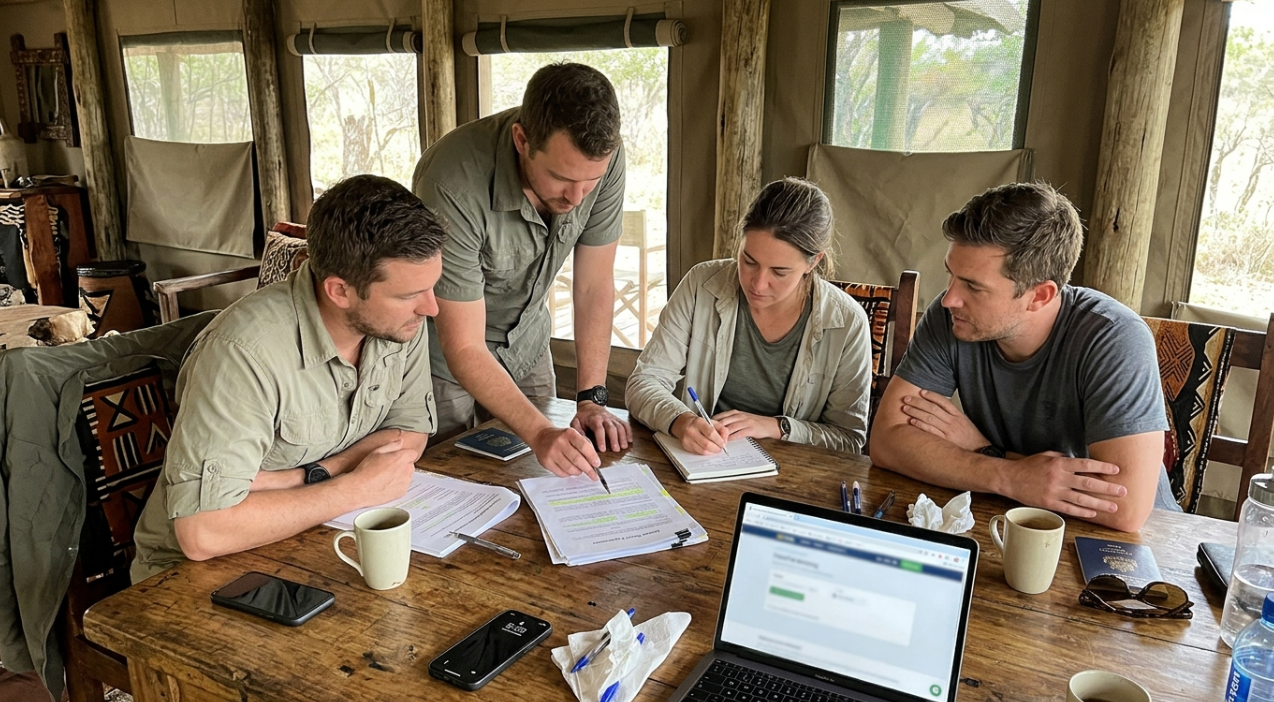
Most safari operators use a tiered cancellation policy. A common structure looks like this:
|
Cancellation Timing |
Typical Consequence |
|---|---|
|
More than 90 days before departure |
Deposit forfeited; balance refunded |
|
60 to 90 days before departure |
50% of total cost forfeited |
|
30 to 60 days before departure |
75% of total cost forfeited |
|
Less than 30 days before departure |
No refund |
The exact tiers vary by operator. Some start the penalty clock at 60 days rather than 90. Always read the cancellation policy before paying the deposit, and share it with every group member.
Group Safari Cancellation Policies: What to Check Before Paying
Safari cancellation policies determine how much money your group can recover if someone withdraws or the trip is canceled. The amount depends on the operator's written terms, how far in advance the cancellation occurs, and whether suppliers have already charged non-refundable fees.
There is no single cancellation schedule that applies to every safari operator. Instead of assuming that a particular percentage will be refunded, review the actual policy and identify the financial consequences at each stage of the booking.
|
Cancellation Scenario |
What May Happen |
What the Organizer Should Confirm |
|---|---|---|
|
Cancellation shortly after booking |
The deposit may be forfeited, subject to the contract |
Whether any cooling-off or cancellation provision applies |
|
Cancellation well before departure |
Some payments may be refundable, less applicable penalties |
The refund schedule and any supplier-specific deductions |
|
Cancellation closer to departure |
Penalties may increase as suppliers commit resources |
The exact cancellation deadline and amount at risk |
|
Cancellation shortly before departure |
A substantial portion or all prepaid costs may be non-refundable |
Whether any unused services or recoverable taxes can be refunded |
|
One traveler withdraws |
Individual charges may be lost and shared costs may need to be recalculated |
Whether the operator will revise the booking or accept a replacement |
|
The operator cancels |
The available remedies depend on the contract and applicable law |
Refund, rebooking, and other contractual options |
|
A covered emergency occurs |
Eligible insurance may reimburse certain non-refundable expenses |
Coverage limits, exclusions, documentation, and claim deadlines |
Before Paying a Non-Refundable Deposit
Ask the operator to explain:
-
Which payments are refundable and which are non-refundable.
-
When cancellation penalties increase.
-
Whether permits, domestic flights, and accommodation have separate terms.
-
Whether a replacement traveler can take over a booking.
-
Whether reducing the group size changes the remaining travelers' prices.
-
How refunds are calculated when only part of the group cancels.
Give every traveler a copy of the applicable terms before collecting money. A written agreement between friends is useful, but it does not override the operator's contract or the rights available under applicable law.
Non-Refundable Deposit
This term means exactly what it says. If you cancel, the deposit doesn’t come back. For groups, the question is: whose money is it? If the organizer collected deposits from eight people and paid the operator in one lump sum, and one person cancels, the operator still keeps that person’s share of the deposit. The group needs a pre-agreed rule about this.
Dropout Reallocation
When someone drops out, the group’s per-person cost increases because fixed costs (vehicle, guide) now split among fewer people. A group of six splitting a $3,000 vehicle cost pays $500 each. If one person drops out, the remaining five pay $600 each.
Decide before booking: does the dropout owe the group the cost increase, or does the group absorb it? Can the dropout’s spot be filled by a replacement? Will the dropout forfeit their deposit to the group or claim it back? Put the agreement in writing.
One financial planning expert quoted in Yahoo Finance recommended that one person manage the group’s finances, but with an explicit agreement about when the coordinator gets repaid. This applies directly to safari group planning where the organizer often fronts large sums before collecting from others.
Group Safari Payment Agreement: Rules to Set Before Booking
Before the organizer collects money, every traveler should agree on how the group's finances will be managed. A short written agreement can reduce misunderstandings and clarify what happens when plans change.
The agreement should cover the following points.
1. Total Budget and Individual Contributions
Record the estimated total trip cost, each person's expected share, and which expenses are excluded. State whether the group will divide shared costs equally or use a hybrid arrangement.
2. Payment Deadlines
List the deposit deadline, balance deadline, and any additional payment dates required by the operator. Set internal collection deadlines early enough to allow for delayed payments.
3. Cancellation and Withdrawal
Explain what happens when someone withdraws, including how operator penalties, non-refundable permits, and unrecoverable accommodation costs will be allocated.
4. Replacement Travelers
Specify whether a withdrawing traveler can find a replacement and who must approve the change. Confirm any name-change charges, permit restrictions, accommodation adjustments, or other supplier conditions.
5. Late or Missing Payments
Agree on how the organizer will follow up with travelers who miss a deadline. State whether an unpaid traveler can lose their place and how that decision will be handled under the booking contract and group agreement.
6. Organizer Responsibilities
Clarify who collects money, who authorizes shared expenses, how payment records are shared, and how the organizer will document transfers to the operator.
7. Refunds and Unused Funds
Agree on how refunds, credits, unused contingency funds, and expense adjustments will be distributed. Keep a record of the calculation and any outstanding amounts.
8. Changes to the Itinerary
Decide how the group will approve optional activities, upgrades, or itinerary changes that increase the total cost.
Practical rule: Share the agreement with every traveler before the first payment. Ask everyone to confirm in writing that they understand the payment deadlines, cost allocation, and consequences of withdrawing. For substantial sums, consider obtaining appropriate legal advice rather than relying on an informal group message.
Travel Insurance for Groups
Trip cancellation insurance reimburses prepaid, non-refundable costs if you cancel for a covered reason (illness, injury, family emergency). About 25% of all travel insurance claims stem from trip cancellations, which gives you a sense of how often plans fall apart.
Groups can purchase individual policies or a single group travel insurance plan. Group plans typically include trip cancellation, medical, medical evacuation, travel delay, and baggage coverage under one policy, which simplifies administration.
A Cancel For Any Reason (CFAR) upgrade, available on some policies, reimburses 50% to 75% of trip costs even for reasons the standard policy wouldn’t cover. It costs more but provides a safety net for the most common group safari scenario: someone simply changes their mind.
Our Tanzania travel insurance guide covers policy types and what to look for in coverage.
Permits and Non-Shareable Prepayments
Some safari costs must be paid in full, well in advance, and cannot be transferred to another person. These deserve special attention in group payment planning.
Gorilla Trekking Permits
Uganda charges $800 per person per trek. Rwanda charges $1,500. These permits are non-transferable and typically non-refundable. Your operator must pay for them at the time of booking, which is why gorilla trekking itineraries often require a 50% deposit or full prepayment.
If someone in your group drops out after permits are purchased, that permit fee is lost unless the national parks authority agrees to a date change or name transfer (rare, and never guaranteed).
Kilimanjaro Park and Rescue Fees
Mount Kilimanjaro park fees are paid per climber and are substantial. These are prepaid by the operator and included in your climb cost. Groups adding a Kilimanjaro climb to their safari should understand that group sizes and guide ratios affect both logistics and per-person pricing.
Domestic Flights
Internal flights within Tanzania (Arusha to Serengeti, for example) are often due in full at the time of booking and are non-refundable. These are per-person costs and can’t be split.
On-the-Ground Money: Cash, Tips, and Currency
Tipping Fund (Kitty)
Many groups create a shared tipping fund before departure. Each person contributes an agreed amount, and the organizer distributes tips to the guide, driver, lodge staff, and camp crew at appropriate points during the trip.
Tipping is customary on East African safaris. A collective fund prevents the awkwardness of individually handing small bills to your guide after every game drive. Our safari tipping guide covers recommended amounts.
USD vs. Local Currency
Safari operators price and accept payment in US dollars. On the ground in Tanzania, USD is widely accepted for tourist-facing services, but small bills (anything under $20) and older-series notes (pre-2006) are often rejected. Bring crisp, newer-series US bills in various denominations.
For local markets, small purchases, and non-tourist transactions, Tanzanian shillings work better. Kenyan shillings in Kenya, Ugandan shillings in Uganda. ATMs in larger towns dispense local currency. Carry both.
Cash Requirements
Plan for $15 to $30 per person per day in cash for tips, drinks, small purchases, and optional activities not included in the safari price. Some lodges accept cards for extras, but don’t count on it in remote locations.
Tools for Tracking Group Safari Expenses
Splitwise is the most commonly mentioned app among group travelers for tracking who paid what and who owes whom. Other options include Spliit and TripMat. These tools are useful during the trip for tracking shared meals, drinks, and optional activities that weren’t part of the operator invoice.
For pre-trip payment tracking (deposits, balances, insurance), a shared Google Sheet is often more practical. Columns for each person’s name, deposit paid date, balance paid date, insurance status, and permit status give everyone visibility and accountability.
When the operator handles most logistics and provides an itemized invoice with clear per-person breakdowns, the tracking burden decreases significantly. Groups working with a full-service operator often find that the only expenses needing manual tracking are on-the-ground extras like drinks, tips, and personal shopping.
Group Safari Payment Tracker Template
A shared payment tracker helps the organizer monitor deposits, balances, individual expenses, and outstanding contributions without relying on scattered messages or memory.
Create a spreadsheet with the following columns.
|
Traveler |
Total Agreed Share |
Deposit Due |
Deposit Paid |
Balance Due |
Balance Paid |
Outstanding Amount |
Payment Status |
|---|---|---|---|---|---|---|---|
|
Traveler 1 |
$2,000 |
$600 |
Paid |
$1,400 |
Pending |
$1,400 |
Awaiting balance |
|
Traveler 2 |
$2,000 |
$600 |
Paid |
$1,400 |
Paid |
$0 |
Complete |
|
Traveler 3 |
$2,000 |
$600 |
Pending |
$1,400 |
Pending |
$2,000 |
Awaiting deposit |
|
Traveler 4 |
$2,000 |
$600 |
Paid |
$1,400 |
Pending |
$1,400 |
Awaiting balance |
Illustrative example only. The deposit amounts, payment dates, and outstanding balances should reflect the actual booking agreement.
Additional Columns to Include
For a larger group, add columns for:
-
Deposit deadline and payment date.
-
Final balance deadline and payment date.
-
Travel insurance confirmation.
-
Permit or activity payment status.
-
Room type and any single supplement.
-
Optional activities selected.
-
Refunds or credits received.
-
Transfer fees and exchange-rate adjustments.
-
Notes about agreed payment arrangements.
How to Keep the Tracker Accurate
Record actual payments, not promises. Mark a payment as received only when the money has cleared or the relevant payment provider confirms receipt.
Separate operator payments from internal contributions. A traveler may have paid the organizer even though the organizer has not yet transferred the money to the operator.
Reconcile the totals. The amount collected from travelers should match the amounts allocated to the operator, approved shared expenses, and any clearly documented reserve.
Protect financial information. Limit spreadsheet access to people who need it. Avoid sharing account numbers, card details, passport information, or other sensitive personal data in a general group spreadsheet.
Document changes. If someone changes rooms, cancels an activity, or withdraws from the trip, update the allocation and retain a record of the agreed adjustment.
Frequently Asked Questions
Should one person pay the operator, or can everyone pay separately?
Most safari operators prefer a single point of contact who consolidates payments. This reduces wire transfer fees, simplifies the operator’s bookkeeping, and makes communication clearer. Some operators will accept individual payments, but expect to ask. Don’t assume.
What happens if someone drops out after the deposit is paid?
The operator keeps the dropout’s share of the deposit (it’s non-refundable). The remaining group members face higher per-person costs because fixed expenses now split among fewer people. The group should agree before booking on how to handle this scenario, including whether the dropout covers the cost increase or the group absorbs it.
Is a credit card surcharge normal for safari bookings?
Yes. A surcharge of 3.5% to 5% is standard across the safari industry in East Africa. Operators pass on the card processing fees rather than building them into the trip price. You can avoid this surcharge by paying via bank wire, but you lose the chargeback protection that credit cards provide.
Do park fees get split, or are they per person?
Park fees are per person, per day. They’re charged by the national parks authority and cannot be shared or split. Your operator includes them in the per-person price, but they’re a fixed government charge, not something negotiable.
Should our group buy one travel insurance policy or individual ones?
Either works. A group policy is administratively simpler and sometimes slightly cheaper per person. Individual policies give each person the flexibility to choose their own coverage level and add options like Cancel For Any Reason. If group members are booking different flights or have different pre-existing medical conditions, individual policies may be more practical.
How much cash should each person bring for tips and extras?
Budget $15 to $30 per person per day for tips, drinks, and incidental purchases. For a seven-day safari, that’s roughly $100 to $200 per person in cash. Bring crisp US dollars in $1, $5, $10, and $20 denominations, plus some local currency for market purchases.
How far in advance should a group book to lock in pricing?
Six to twelve months is the standard recommendation for group safaris, especially during peak season (July through October in Tanzania and Kenya). Booking early secures your preferred lodges and locks in current pricing. Permit-dependent trips (gorilla trekking, Kilimanjaro) may require even earlier booking because permits sell out months in advance.
Groups of four to thirteen people routinely work with Duma Explorer’s planning team to structure payments across multiple households. If you’re ready to move from spreadsheet planning to an actual itinerary with clear per-person pricing, share your group’s approximate dates, number of travelers, ages, budget range, and accommodation preferences.