

Friends Safari Trip Tanzania: 2026 Cost & Vehicle Guide
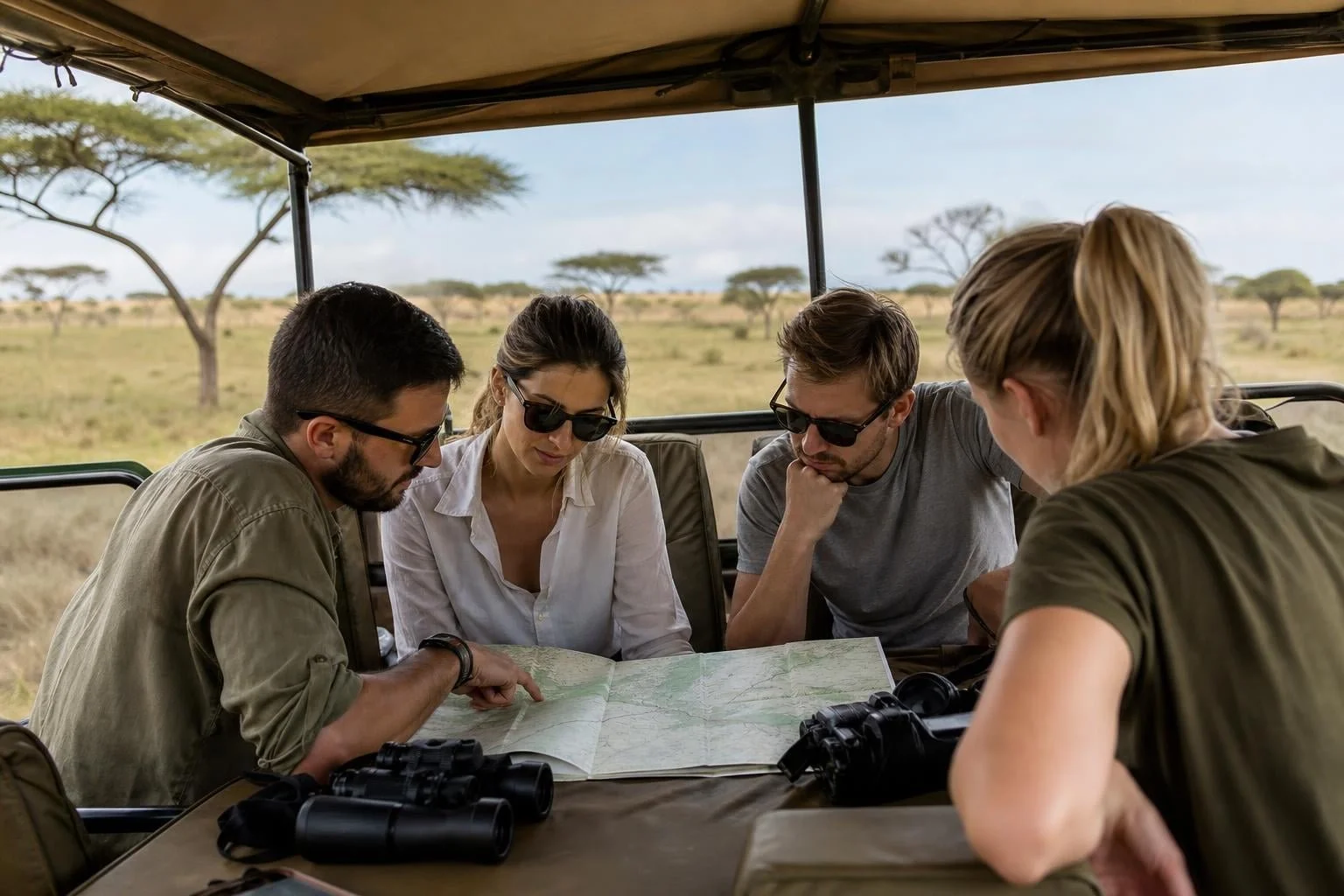
Planning a friends safari trip to Tanzania means balancing everyone's budget, choosing the right 4x4 safari vehicle, and agreeing on an itinerary that works for the whole group. From splitting vehicle costs to deciding between the Serengeti, Ngorongoro Crater, and Tarangire, a little planning can make the experience more comfortable and affordable.
This guide explains how to plan a Tanzania safari with friends in 2026, including estimated costs, vehicle capacity, accommodation options, park fees, and practical tips for organizing a group of four to eight travelers. You'll also learn which expenses can be shared, which are charged per person, and what to confirm before booking.
Whether you're organizing a group holiday, a milestone birthday trip, or a wildlife adventure with friends, use this guide to compare options and build a safari budget that works for everyone.
How Much Does a Friends Safari Trip to Tanzania Cost? A friends safari trip to Tanzania can cost several hundred dollars per person per day, depending on group size, accommodation, season, park fees, and whether the safari is private or shared. For a private safari, sharing a vehicle among four to six friends can reduce the per-person share of vehicle and guide costs. However, accommodation, meals, and most park entry fees are still charged per traveler. For an accurate group budget, compare the full package price for your travel dates and group size, and check whether park fees, crater fees, accommodation, meals, transfers, and activities are included. A seven-day safari budget should also account for international flights, travel insurance, tips, and optional experiences if these are not included in the operator's quote.
What Is the Best Safari Vehicle Size for a Group of Friends?
For most friends traveling together in Tanzania, the best vehicle arrangement depends on the group size, luggage, photography needs, and whether everyone wants to stay in one vehicle. A standard safari Land Cruiser often accommodates up to six passengers, but the operator should confirm the actual passenger configuration and available window seats.
|
Group Size |
Suggested Arrangement |
Main Consideration |
|---|---|---|
|
2 friends |
One private 4x4 |
More space and flexibility, but a higher vehicle cost per person |
|
3–4 friends |
One private 4x4 |
A good balance of comfort, photography access, and shared costs |
|
5–6 friends |
One suitable 4x4, subject to configuration |
Lower vehicle cost per person, but potentially less space |
|
7–8 friends |
Usually two vehicles |
More room and flexibility; ask how the guides will coordinate |
|
9–12 friends |
Usually two vehicles |
Confirm passenger capacity, luggage space, and communication arrangements |
|
13+ friends |
Multiple vehicles |
Requires a clear plan for guide assignments, stops, and group coordination |
These are planning guidelines rather than universal vehicle-capacity rules. Ask the operator how many passengers each vehicle is designed to carry, whether every passenger has a window seat, and how much room remains for camera equipment and luggage.
Questions to Ask Before Choosing a Vehicle
-
How many passengers can the vehicle comfortably accommodate?
-
Does every passenger have a dedicated window seat?
-
Is there enough space for daypacks, camera bags, and personal items?
-
Will our group have a private vehicle and dedicated driver-guide?
-
If we need two vehicles, will both follow the same itinerary?
-
Can the guides communicate by radio and coordinate wildlife sightings?
For photography-focused groups, prioritize passenger comfort and viewing access over maximizing vehicle occupancy. For budget-conscious groups, compare the total package price for one vehicle against the price of two vehicles before deciding.
Key Terms at a Glance
|
Term |
One-Line Definition |
|---|---|
|
Private Group Safari |
Your friend group gets a dedicated vehicle, guide, and flexible itinerary |
|
PPPD |
Per Person Per Day, the standard pricing unit for Tanzania safaris |
|
Northern Circuit |
The classic route through Tarangire, Ngorongoro, and Serengeti |
|
Vehicle Allocation |
How your group is distributed across one or more 4x4 Land Cruisers |
|
Cost-Splitting |
The math that makes private safaris dramatically cheaper as group size increases |
For a full breakdown of Tanzania safari itinerary and cost planning, that guide covers the broader picture. What follows here is specifically framed for friend groups.
Safari Format Terms
Private Group Safari
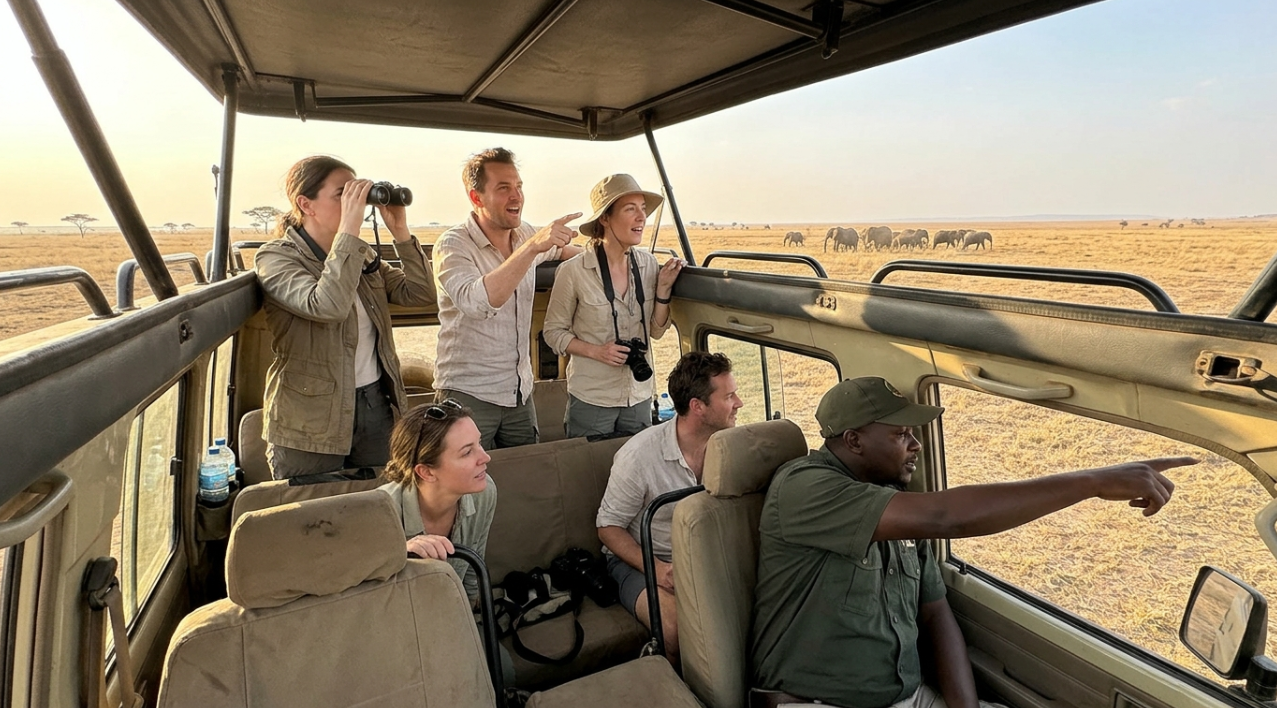
A private group safari means your friend group gets a dedicated 4x4 vehicle, a private driver-guide, and the ability to customize your itinerary. You decide when to linger at a leopard sighting, when to stop for lunch, and whether to add a sunrise game drive. This is the format that works for a Tanzania friends safari trip, and it’s what you should be requesting when you contact operators.
The alternative, a joining safari, puts you in a shared vehicle with strangers on a fixed schedule. That’s fine for solo travelers on a budget, but it defeats the purpose of traveling with friends. On a joining safari, you can’t customize the route, swap parks based on migration timing, or add a Zanzibar extension. The itinerary is set.
The good news: at six people, a private group safari often costs about the same per person as a joining safari. The vehicle cost that makes private safaris expensive for couples gets diluted across a larger group.
Joining Safari (Shared Vehicle Safari)
You buy a single seat in a shared 4x4 with travelers you’ve never met. The operator controls the pace. This option works well for backpackers and solo travelers who want to see Tanzania’s parks without paying for a whole vehicle. For a pre-formed friend group, it’s almost always the wrong choice unless you’re two people who genuinely can’t find a third or fourth friend to join.
Drive-In Safari vs. Fly-In Safari
A drive-in safari moves between parks by road in your private 4x4. The drive from Arusha to the Serengeti takes 6 to 8 hours, but the road itself passes through interesting terrain (including the Ngorongoro Conservation Area). For friend groups, drive-in safaris are usually more economical because you’re already splitting the vehicle cost.
A fly-in safari uses small charter planes to hop between parks, cutting travel time dramatically (Arusha to Serengeti drops to about one hour). Flight costs run roughly $650 to $950 per person, compared to $1,050 to $1,470 per person for a private 4x4 shared between two. But with six friends splitting vehicle costs, the drive-in option becomes significantly cheaper per head, and you get the experience of the road.
For more detail on how these formats compare financially, the private vs. group safari comparison breaks down the trade-offs.
Vehicle and Logistics Terms
Safari Vehicle (4x4 Land Cruiser)
Most Tanzania safari packages use modified Toyota Land Cruiser 4x4s with a pop-up roof. The terrain in national parks doesn’t allow for larger vehicles. A standard game-viewing configuration has three rows and seats a maximum of six passengers, with every seat having access to the roof hatch for standing, viewing, and photography. Some operators run customized stretch vehicles with an extra row that accommodate up to eight people.
For a deeper look at configurations, see this guide to safari vehicle types and features.
The 4 vs. 6 Passenger Trade-Off
This is one of the most important decisions for a friends safari trip in Tanzania, and most planning content ignores it entirely.
|
Factor |
4 Passengers |
6 Passengers |
|---|---|---|
|
Comfort |
Spacious; room for camera bags, extra layers, binoculars |
Tighter; gear needs to be stowed |
|
Photography |
Everyone gets a window with good angles |
Middle-row passengers have compromised angles |
|
Roof hatch access |
Plenty of room at the pop-up roof |
Crowded standing room; you’ll bump elbows |
|
Cost per person (vehicle only) |
~$75 to $100/person/day |
~$50 to $67/person/day |
|
Best for |
Photography-focused groups, longer trips |
Budget-conscious groups, shorter safaris |
Four passengers per vehicle is the quality standard for serious game viewing. Six is the maximum, and it works fine for groups that prioritize being together over having perfect photography angles. Safari photography tips become much more relevant when you’re deciding how many people to put in each vehicle.
Pop-Up Roof (Roof Hatch)
The opening in the vehicle roof that lets passengers stand and observe wildlife from an elevated position. This is where most of your best wildlife viewing and photography happens. With four people, everyone can stand comfortably. With six, you’ll be taking turns or rotating positions.
Window Seat Rotation
When a vehicle carries five or six passengers, the driver-guide should run a window seat rotation so nobody gets stuck in the middle row for the entire trip. This is worth asking your operator about before booking. A good operator will bring it up unprompted; if they don’t, that’s a signal.
Vehicle Allocation
How your group is distributed across vehicles. A group of four or five fits in one Land Cruiser. A group of seven or eight splits across two. This is a straightforward logistics term, but it has real implications for trip quality.
Multi-Vehicle Group
Once your Tanzania friends safari trip reaches seven or more people, you’ll need two vehicles. At 13 or more, three. The coordination challenge is real: a couple in one vehicle can respond to a wildlife sighting in seconds, but three vehicles carrying fourteen people need to communicate by radio, reposition without blocking sightlines, and manage lunch stops and bathroom breaks across a larger group.
The gap between a well-coordinated multi-vehicle safari and a poorly managed one is significant. Ask your operator how guides communicate between vehicles and whether a head guide oversees the group.
If your group is 7 or more and needs multi-vehicle coordination, Duma Explorer’s ground team in Arusha handles vehicle allocation, guide assignment, and radio communication between vehicles. Request a custom friends safari itinerary to see how this works for your group size.
Cost and Financial Terms
PPPD (Per Person Per Day)
The standard pricing unit for Tanzania safaris. A Tanzania safari costs between $250 and $1,500+ per person per day depending on accommodation tier, group size, and season. Most travelers on a mid-range private safari should budget $400 to $800 per person per day.
Cost-Splitting: The Math That Makes Friend Trips Smart
This is the single most important financial concept for a friends safari trip in Tanzania. The vehicle, guide, fuel, and certain park fees are fixed costs that don’t change whether two people or six people ride in the Land Cruiser. More people means a lower per-person share.
|
Group Size |
Vehicle Cost Per Person Per Day |
Mid-Range PPPD (Approximate) |
|---|---|---|
|
2 people |
$100 to $150 |
$400 to $450 |
|
4 people |
$50 to $75 |
$300 to $350 |
|
6 people |
$33 to $50 |
$250 to $300 |
A couple paying $450 per person per day on a 7-day safari spends $6,300 total per person. The same itinerary with six friends might run $300 per person per day, or $2,100 per person. That’s a $4,200 difference per person, all from splitting fixed costs.
Practitioners on Reddit repeatedly note that traveling with friends is the most direct way to reduce per-person safari costs. The savings are not marginal; they’re transformative.
Single Supplement
An extra charge for a traveler occupying a room or tent alone. Lodges and tented camps price per room (usually double occupancy), so a solo traveler pays more. In a friend group, this mainly affects anyone who doesn’t want to share a room. If everyone pairs up, nobody pays it. If one person insists on a private room, budget an extra $50 to $200 per night depending on the accommodation tier.
Tanzania Safari Park Fees and Conservation Charges
Park and conservation fees are an important part of a Tanzania safari budget. The amount depends on the destination, traveler category, applicable tariff, and the activities included in the itinerary.
|
Fee Type |
What It Covers |
What to Check |
|---|---|---|
|
National park entry fee |
Entry to a TANAPA-managed national park |
The current tariff for each park and traveler category |
|
Ngorongoro Conservation Area fee |
Applicable entry and conservation charges |
The current NCAA fee schedule and itinerary requirements |
|
Crater service fee |
Applicable vehicle-based charge for a crater visit |
The current rate, vehicle category, and number of chargeable visits |
|
Camping or concession fee |
Applicable campsite or concession charges |
Whether the charge is per person, per night, per vehicle, or included in accommodation |
|
Activity fee |
Optional activities such as balloon safaris or guided excursions |
Whether the activity is included in the operator's quote |
Before booking, ask your safari operator for an itemized breakdown of government fees and confirm the current rates using the official TANAPA park tariffs and Ngorongoro Conservation Area Authority fee schedule.
Government tariffs may change. Avoid relying on older fee tables or assuming that every park uses the same rate.
Crater Service Fee (NCAA Fee)
The Ngorongoro Conservation Area Authority charges a separate service fee for vehicles entering the crater. This fee is per vehicle, which means it splits differently depending on group size.
On a joining safari with six passengers, the crater service fee works out to about $49 per person. On a private safari for two, it’s $147.50 each. This single fee is one of the clearest examples of why group size matters for Tanzania safari costs. For full Ngorongoro Crater planning details, that guide covers access logistics and timing.
Concession Fee
A fee charged by private conservation areas or wildlife management areas that operate outside the national park system. These areas often offer exclusive game-viewing experiences with fewer vehicles. The concession fee is typically included in your accommodation cost at camps located within these areas.
Tipping (Safari Crew)
Tipping your driver-guide, cook, and other staff is customary in Tanzania. Standard guidance is $15 to $25 per group per day for the driver-guide, with smaller amounts for camp/lodge staff. In a friend group, pool the tip fund to avoid awkwardness. Designate one person to manage it. For detailed amounts and etiquette, see this safari tipping guide.
Deposit Structure
Most operators require a 25% deposit to confirm a booking, with the balance due 60 to 90 days before departure. For a group of friends, this means the organizer either collects deposits from everyone and sends one payment, or each person pays the operator individually. Clarify this with your operator early. Some accept split payments; others prefer a single point of contact.
Full Board (FB) and Half Board (HB)
Full board means all three meals are included. Half board covers breakfast and either lunch or dinner. Almost all safari packages in Tanzania are full board because you’re eating at your camp or lodge (there aren’t restaurants in the middle of the Serengeti). Drinks, especially alcohol, are usually extra.
Itinerary and Destination Terms
Northern Circuit
The classic Tanzania safari route covering Tarangire National Park, Ngorongoro Crater, and the Serengeti. A four-day version is the minimum for touching all three, but five to seven days is what most friend groups should target for a satisfying experience. Rushing the Northern Circuit means spending too much time in the vehicle and not enough time actually watching wildlife.
For a comprehensive look at routing and park sequencing, the Northern Circuit safari guide covers it thoroughly.
Game Drive
A game drive is a guided excursion in your safari vehicle through a national park or conservation area, searching for wildlife. Most itineraries include morning and afternoon game drives (roughly 6 AM to noon, then 3 PM to 6 PM), with a midday rest at camp during the hottest hours. Full-day game drives are also common, particularly in the Serengeti where distances between areas of activity can be significant.
Great Migration
The annual movement of over 1.5 million wildebeest (plus hundreds of thousands of zebra and gazelle) through the Serengeti ecosystem. Planning a friends group trip around the migration gives your safari a shared focal point. The dramatic Mara River crossings happen roughly July through October in the northern Serengeti; calving season in the southern Serengeti runs January through March.
One Duma Explorer client called a Mara River crossing “the most memorable experience of my life,” and another client documented seeing 42 big cats in three days during a well-timed visit. These outcomes aren’t guaranteed, but timing your trip around migration patterns dramatically increases the odds.
For month-by-month timing, see the best time for safari in Tanzania guide.
Ngorongoro Crater Descent
The drive down into the Ngorongoro Crater floor, a collapsed volcanic caldera roughly 19 kilometers across that contains one of the densest concentrations of wildlife in Africa. Vehicle access is controlled, and the crater service fee applies. Most itineraries spend half a day in the crater.
Zanzibar Extension
A post-safari beach trip to the Zanzibar archipelago, typically three to five days. Forum posts on Fodors and TripAdvisor show that friend groups commonly combine safari with beach time in Zanzibar, and for good reason: after a week of early mornings and dusty game drives, a few days of swimming, seafood, and Stone Town exploration is a natural counterbalance.
Flights from Arusha or the Serengeti to Zanzibar run about an hour. For activity ideas on the island, the Zanzibar day trips and excursions guide covers the main options.
Cultural Add-On (Maasai Village, Hadzabe Visit)
Visits to local communities that offer a different dimension beyond game viewing. Maasai village visits are the most common, but more experienced travelers might consider visits to the Datoga or Hadzabe communities for something less touristic. Duma Explorer reviewers have specifically highlighted Maasai village experiences at Mysigio Camp and Lake Natron hikes as group favorites.
These add-ons work well for friend groups because they create shared experiences that are completely different from game drives, breaking up the rhythm of the trip.
Sample 7-Day Tanzania Safari Itinerary for Friends
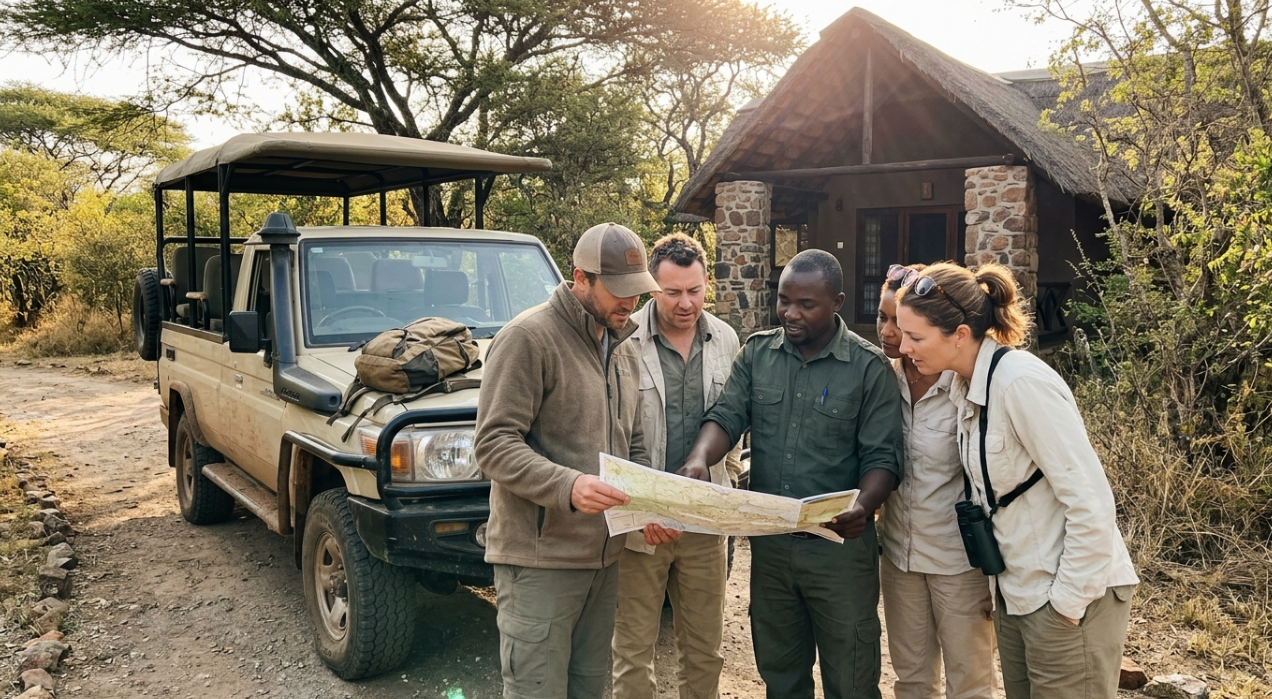
A seven-day Northern Circuit safari gives a group of friends time to explore several major wildlife destinations without rushing every day. The exact route should depend on the season, wildlife movements, accommodation availability, and your group's budget.
|
Day |
Suggested Plan |
Planning Consideration |
|---|---|---|
|
Day 1 |
Arrive in Arusha and prepare for the safari |
Allow time to recover from international travel |
|
Day 2 |
Visit Tarangire National Park |
Enjoy game viewing and travel to your overnight accommodation |
|
Day 3 |
Travel toward the Ngorongoro Conservation Area |
Include a game drive or scenic stops as appropriate |
|
Day 4 |
Explore the Ngorongoro Crater |
Confirm crater access, fees, and the day's schedule |
|
Day 5 |
Travel to the Serengeti |
Account for road travel and the distance to your camp |
|
Day 6 |
Enjoy a full Serengeti game-drive day |
Choose the area based on season and wildlife movements |
|
Day 7 |
Continue game viewing or begin the return journey |
Confirm departure logistics before booking flights |
This is an illustrative route, not a fixed seven-day schedule. Travel distances, overnight locations, and the amount of time available for game viewing vary considerably. Some itineraries require an additional day to make the route comfortable.
Should Your Group Add More Safari Days?
Consider extending the trip if your friends want more time in the Serengeti, a migration-focused itinerary, additional photography opportunities, or a slower travel pace.
If you also want Zanzibar, compare the cost of adding beach days with the cost of flying directly from the safari circuit. Treat Zanzibar as a separate itinerary component when comparing accommodation, transfers, and activities.
Before confirming the itinerary, ask your operator to specify the overnight location for every day, estimated driving times, included game drives, and the final airport transfer plan.
Accommodation Terms
Tented Camp
This trips up first-time safari planners. A “tented camp” in Tanzania is not camping in the backpacker sense. Mid-range and luxury tented camps have en-suite bathrooms, proper beds with linens, hot water, and often electricity (solar or generator). The “tent” part refers to canvas walls, which provide an immersive bush atmosphere while still delivering hotel-level comfort.
Duma Explorer reviewers have praised Nyumbani Camp in Central Serengeti for “the best food and hot water 24 hours a day” (Teresa A., 2025) and Lion’s Paw as a group favorite (Taylor P., 2025). These are the kinds of camps that change people’s perception of what “tented” means.
Lodge
A permanent structure (stone, wood, concrete) with standard hotel-style rooms. Lodges tend to be larger than tented camps and often have swimming pools, bars, and other amenities. They’re a good choice for friend groups where some members are hesitant about staying in tents, even fancy ones.
Mobile Camp
A temporary tented camp that moves seasonally to follow wildlife patterns, particularly the Great Migration. Mobile camps offer some of the most exclusive wildlife access in the Serengeti because they’re positioned exactly where the action is. Availability is limited, so book early if this interests your group.
Camp Buyout / Exclusive Use
For larger friend groups (10+), some camps allow you to book every room, giving your group exclusive use of the entire property. One experienced safari planner has organized group safaris ranging from 6 people sharing two vehicles to 22 people requiring a full private camp buyout. This is a premium option, but for milestone birthdays or reunions, it creates an unforgettable experience.
Special Campsite
A private campsite within a national park, separate from the public campsite areas. Costs roughly $50 to $100 per person per night, about double the public campsite rate. Worth considering for small friend groups who want a more exclusive bush experience without jumping to lodge pricing. You’ll still need your own camping equipment (operators handle this), but you get a private location.
Guide and Safety Terms
Driver-Guide
The person who both drives your 4x4 and leads wildlife interpretation. This is the single most important person on your safari. A skilled driver-guide knows where to find wildlife, when to be patient, how to position the vehicle for photography, and how to read animal behavior for safety.
Every vehicle gets a dedicated driver-guide. If your friend group splits across two vehicles, a head guide or tour leader might move between vehicles throughout the trip to ensure coordination. For understanding what separates good guides from great ones, the safari guide qualifications guide explains the certification standards.
Duma Explorer’s safari guides undergo advanced training through EcoTraining, with a FGASA Level 1 certification program currently rolling out. Their Kilimanjaro guides hold Wilderness First Responder (WFR) certification, which speaks to the company’s approach to safety and guide development.
FGASA (Field Guides Association of Southern Africa)
An internationally recognized certification for safari guides. FGASA Level 1 involves a 55-day training program covering wildlife identification, ecology, tracking, and guest management. When comparing operators, asking whether guides hold FGASA or equivalent certifications is a reasonable quality indicator.
Group Planning Terms
Trip Organizer (Group Coordinator)
The friend who takes point on communication with the safari operator, collects deposits, relays information to the group, and makes tie-breaking decisions. If you’re reading this glossary, this is probably you.
Practical advice: establish a shared document or group chat thread specifically for trip decisions. Keep the operator in one communication channel (email is best for records) and the group in another. You’ll lose your mind trying to relay every detail in both directions simultaneously.
What to Agree on Before You Book
This checklist is specific to a friends safari trip in Tanzania and covers the decisions that cause friction if left unresolved:
-
Budget ceiling: Agree on a per-person maximum before requesting quotes
-
Comfort tolerance: Tented camps vs. lodges, budget vs. mid-range vs. luxury
-
Daily pace: Some friends want 12-hour game-drive days; others want pool time by noon
-
Photography seriousness: This directly affects whether you want 4 or 6 per vehicle
-
Zanzibar yes or no: Adding beach days changes the trip length and budget significantly
-
Alcohol budget: Full board rarely includes drinks; some friends won’t care, others will
-
Room sharing: Who pairs with whom, and is anyone paying the single supplement?
-
Tipping fund: Pool it or handle individually?
Pacing (Game-Drive Fatigue)
This term rarely appears in safari planning content, but it matters enormously for friend groups. A full game-drive day starts before dawn (around 6 AM) and can run until sunset (6 PM), with a midday break. That’s 8 to 10 hours in a vehicle on rough roads.
One Duma Explorer reviewer (Pritpal C., 2026) specifically noted “long days on safari” as something to prepare for. In a group of friends with mixed energy levels, attention spans, and interests, this can create tension. Some friends will want to chase every sighting; others will be ready for camp by lunchtime.
The solution is building flexibility into the itinerary. A private group safari lets some friends return to camp early while others continue the afternoon drive. Discuss this possibility with your operator during planning, and be honest about your group’s dynamics.
Group-Specific Add-On Experiences
Beyond standard game drives, several experiences work particularly well for a friends group safari in Tanzania:
Hot-Air Balloon Over the Serengeti. A sunrise balloon ride over the Serengeti plains, followed by a champagne bush breakfast. This is a premium add-on (typically $500 to $600 per person), but it creates one of those shared moments that everyone talks about for years.
Maasai Village Visit. A cultural experience that breaks up the game-drive routine and gives the group a completely different perspective on the region. Best when arranged through your operator to ensure the visit is ethical and benefits the community.
Lake Natron Hike. A more adventurous add-on for active friend groups. The alkaline lake is home to massive flamingo populations and sits beneath Ol Doinyo Lengai, an active volcano. This works best as a pre- or post-safari day trip.
Zanzibar Beach Days. Three to five days of snorkeling, Stone Town exploration, spice tours, and general recovery from early safari mornings. For groups that want the complete East Africa experience, this is almost mandatory.
Estimated 7-Day Tanzania Safari Budget for Friends
The total cost of a private Tanzania safari depends on accommodation standards, travel season, itinerary, and group size. The following table is an illustrative planning example, not a live quote or a verified operator price list.
|
Expense |
2 Friends |
4 Friends |
6 Friends |
|---|---|---|---|
|
Vehicle and guide |
Higher per-person share |
Lower per-person share |
Lower per-person share |
|
Park entry fees |
Charged per traveler |
Charged per traveler |
Charged per traveler |
|
Accommodation and meals |
Depends on room sharing and camp rates |
Depends on room sharing and camp rates |
Depends on room sharing and camp rates |
|
Crater and other vehicle-based fees |
Shared among fewer travelers |
Shared among more travelers |
Shared among more travelers |
|
Optional activities |
Usually charged per participant |
Usually charged per participant |
Usually charged per participant |
|
Final package cost |
Request a quote for 2 |
Request a quote for 4 |
Request a quote for 6 |
How to Calculate Your Group's Safari Cost
To compare safari quotes fairly, separate the expenses into three categories:
-
Shared costs: Vehicle hire, driver-guide costs, and applicable vehicle-based fees.
-
Per-person costs: Park entry fees, activities, and many accommodation charges.
-
Optional or excluded costs: International flights, travel insurance, drinks, tips, and any activities not included in the package.
Divide shared expenses by the number of travelers paying for them, then add each person's individual costs. This produces a more realistic comparison than dividing the total quote by group size without checking what is included.
Request a written quote showing the total group price and the per-person price for your exact travel dates, itinerary, accommodation level, and room-sharing arrangements.
What Makes a Tanzania Friends Safari More or Less Expensive?
Five factors have the biggest impact on your final safari price:
-
Group size: More travelers can reduce each person's share of vehicle-based expenses, provided you do not need additional vehicles.
-
Accommodation: Public campsites, budget tented camps, mid-range lodges, and luxury camps have different nightly rates.
-
Travel season: Demand and accommodation availability vary throughout the year, particularly around popular wildlife-viewing periods.
-
Itinerary length: Longer safaris increase the total trip cost, while some fixed expenses may be spread over more days.
-
Package inclusions: Park fees, crater fees, meals, transfers, drinks, and activities may be included or billed separately.
When comparing quotes, make sure every operator is pricing the same route, dates, accommodation level, and inclusions. The lowest headline price is not necessarily the least expensive option once excluded charges are added.
Frequently Asked Questions About Tanzania Safaris With Friends
How many people should go on a Tanzania safari together?
Four to six friends can be a practical group size for a private safari because they may share one suitably configured vehicle. Smaller groups have more space, while larger groups may need multiple vehicles. Confirm passenger capacity and window-seat arrangements with the operator.
How much does a seven-day Tanzania safari cost per person?
The cost depends on accommodation, season, itinerary, park fees, and group size. A useful estimate should include the safari vehicle, driver-guide, accommodation, meals, park fees, and other required charges. Request a dated quote with itemized inclusions rather than relying on a single general price range.
Is a private safari worth it for a group of friends?
A private safari can be worthwhile if your group wants to control the itinerary, spend more time at wildlife sightings, and travel at its own pace. A shared safari may cost less for travelers who are comfortable following a fixed itinerary with other guests.
Should we book one safari vehicle or two?
Groups of up to six may be able to share one standard safari vehicle, depending on its configuration and the operator's passenger limits. Larger groups should compare the cost and comfort of multiple vehicles. Ask about radio communication and whether both vehicles can follow the same itinerary.
What is the best time of year for a friends safari in Tanzania?
June through October is generally a popular period for wildlife viewing during the drier season. January through March can be a good time to visit the southern Serengeti during the wildebeest calving season. Migration timing and sightings vary, so choose travel dates based on the specific experience your group wants.
Can we combine a Tanzania safari with Zanzibar?
Yes. Many itineraries combine a Northern Circuit safari with several beach days in Zanzibar. Budget separately for domestic flights, transfers, accommodation, meals, and activities that are not included in the safari package.
How far ahead should our group book?
Book as early as practical if you are traveling during a popular season or want specific camps and lodges. Six to twelve months can be a useful planning window, but availability depends on your dates, destination, group size, and accommodation preferences.
How should friends split the cost of a safari?
Start by dividing shared expenses, such as the vehicle and guide, among the travelers who share those costs. Then add individual charges, including accommodation differences, optional activities, and any single-room supplements. Agree on the payment schedule and cancellation rules before anyone pays a deposit.
A friends safari trip to Tanzania is one of those rare travel experiences that actually gets better and cheaper as you add people. The planning complexity is real, but the reward, splitting a sundowner with your closest friends while watching a Serengeti sunset, is worth every spreadsheet and group-chat debate.
Request a Custom Friends Safari Itinerary — Duma Explorer’s team in Arusha builds private group safaris for friends traveling together, handling vehicle allocation, guide selection, and multi-vehicle coordination so you can focus on the trip itself.