

Kilimanjaro Group Size 2026: Optimal Ratios & Success
TL;DR
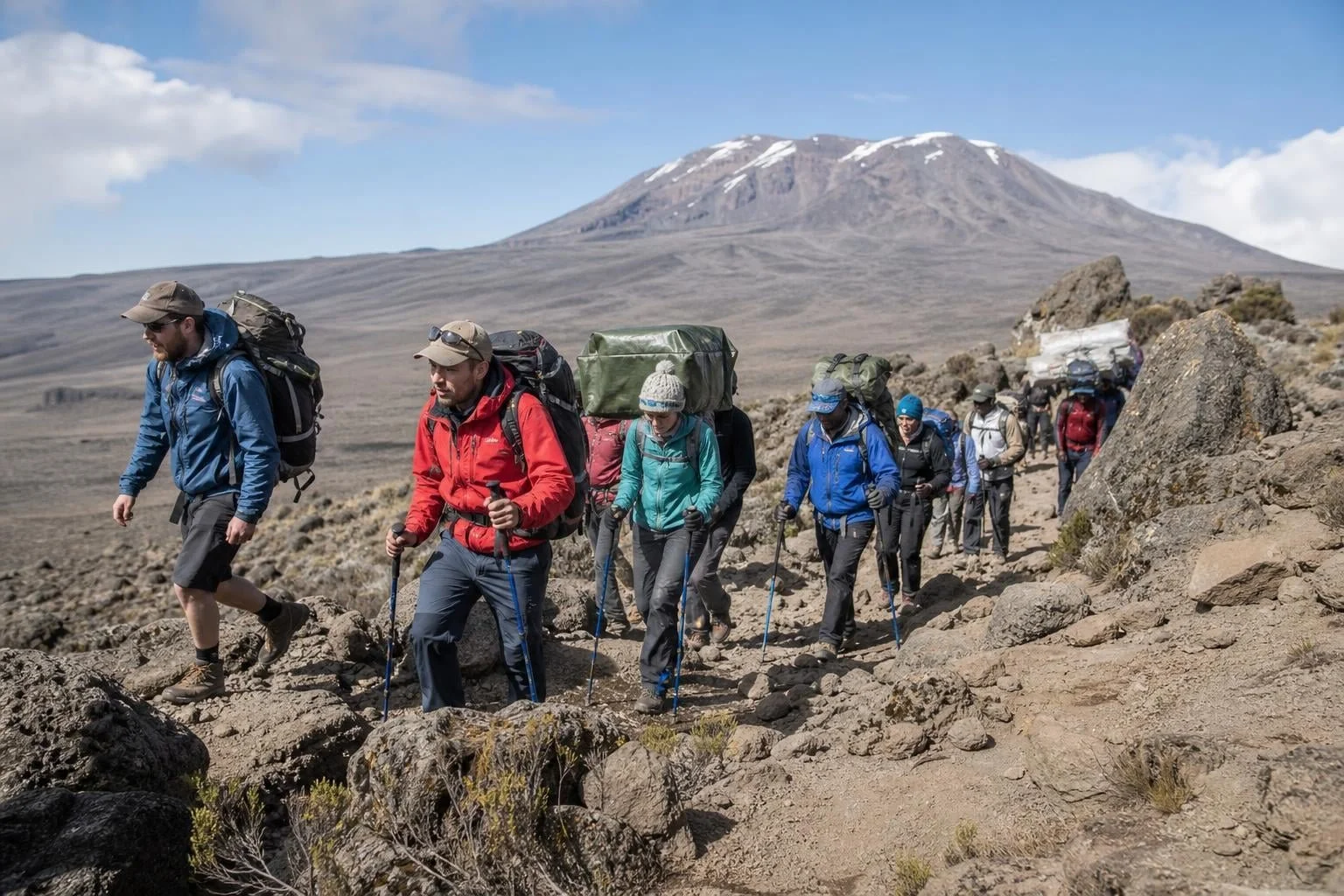
Kilimanjaro group size refers to two different numbers: the paying climbers (typically 6 to 15) and the total expedition including crew (often 40 to 60+ people). The optimal climber group size is 6 to 8, which allows better guide attention, faster medical response, and higher summit success rates. The most important number to ask any operator about is the guide-to-climber ratio on summit night, where 1:1 is ideal and anything beyond 1:4 becomes risky.
Roughly 40,000 people attempt to climb Mount Kilimanjaro each year. About 60% reach the summit. The difference between those who make it and those who don’t comes down to a handful of factors: route choice, acclimatization days, guide quality, and group size.
Group size is the factor most climbers underestimate and most operators obscure. This guide breaks down every term, ratio, and number that matters so you can make a sharper decision about how you climb.
Planning a Kilimanjaro climb? Check out the Kilimanjaro route comparison to pair the right route with the right group format.
Quick Answer: What Is the Best Kilimanjaro Group Size? For most climbers, 6 to 8 climbers is a practical small-group range for Kilimanjaro, balancing cost, social experience, and guide attention. However, group size alone does not determine summit success. Before booking, ask for the operator’s maximum number of climbers, guide-to-climber ratio during the trek and summit attempt, route length, acclimatization schedule, and porter policy. A smaller group is valuable primarily because it can make individualized pacing and monitoring easier.
Why this is better
It targets several conversational queries:
-
What is the best group size for Kilimanjaro?
-
How many people should climb Kilimanjaro together?
-
Is a small group better for Kilimanjaro?
-
What is the ideal Kilimanjaro group size?
-
How many people are in a Kilimanjaro group?
It also avoids making the unsupported claim that 6–8 guarantees better summit success.
What “Kilimanjaro Group Size” Actually Means
There are two numbers people consistently confuse when discussing Kilimanjaro group size, and the difference between them is enormous.
Climber group size is the number of paying trekkers walking together. This is the number you’ll see on an operator’s website when they say “small group” or “max 8 per group.” It’s the number most people think about.
|
Term |
What it means |
Why it matters |
|---|---|---|
|
Climber group size |
Number of paying trekkers |
Determines social environment, pacing and guide workload |
|
Guide-to-climber ratio |
Number of climbers assigned to each guide |
Helps indicate how much individual guide attention is available |
|
Total expedition size |
Climbers plus guides, porters, cooks and other crew |
Shows the true size of the operation |
|
Porter-to-climber ratio |
Number of porters supporting each climber |
Affects luggage handling, camp logistics and crew workload |
|
Private climb |
Your own climbing party rather than a shared departure |
Provides greater control over pace and schedule |
|
Group departure |
Climbers from different bookings sharing an expedition |
Usually lowers the cost per person |
Total expedition size is everyone on the mountain for your climb: climbers plus guides, assistant guides, cooks, porters, and sometimes a waiter and toilet attendant. This number is much larger than most first-timers expect.
Here’s what the math actually looks like:
|
Climbers |
Guides |
Porters |
Cooks/Support |
Total Expedition Size |
|---|---|---|---|---|
|
2 |
2 |
10 |
3 |
~15 |
|
4 |
2–3 |
11–12 |
4–5 |
~21 |
|
6 |
3–4 |
17–18 |
5–6 |
~28 |
|
8 |
4–5 |
25–30 |
5–6 |
~40 |
|
12 |
5–6 |
40+ |
6–8 |
~57 |
One climber writing about their experience on a Substack newsletter described the scale shock: for just two people, they had a crew of 15, including two guides, a chef, a waiter, a portable toilet manager, and 10 porters. A Kilimanjaro climb is not a hike with a guide. It’s a full expedition.
For a deeper look at the crew roles and what each person does, see the Kilimanjaro porters glossary.
How Is Kilimanjaro Group Size Determined?
A Kilimanjaro expedition's final size depends on more than the number of people who book together. Operators also consider the route, number of climbing days, camping requirements, porter workload, guide availability and whether the departure is private or shared.
A two-person private climb can therefore have a much larger support crew than the number of climbers suggests. Conversely, a larger shared departure may divide camp infrastructure and support staff across more trekkers.
Before booking, ask the operator to give you two separate numbers: the maximum number of climbers and the expected total crew size.
Optimal Kilimanjaro Group Size
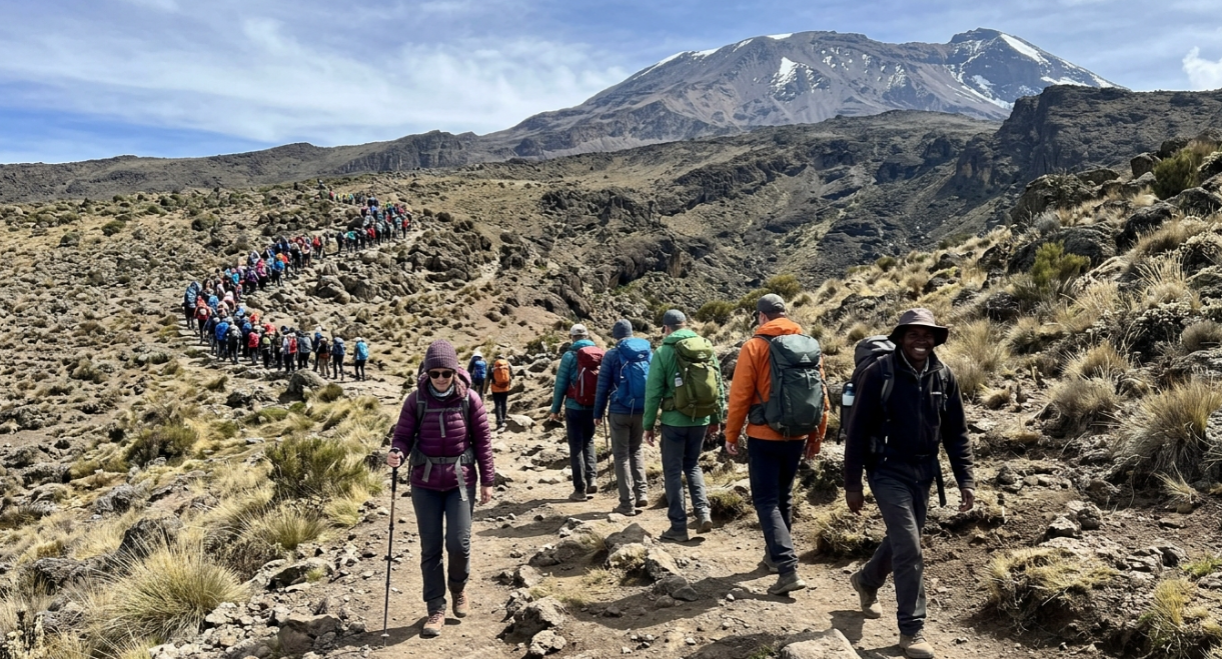
The consensus across operators, guides, and experienced climbers points to 6 to 8 climbers as the sweet spot. Groups this size are large enough to share costs and build camaraderie, but small enough for guides to monitor each person individually.
Here’s how different sizes play out on the mountain:
1 to 2 climbers (solo or couple). Maximum flexibility and attention. The most expensive per person, but the guide is focused entirely on you. Good for experienced hikers or those with specific medical concerns.
4 to 6 climbers (small group). The range where cost savings start to matter without sacrificing personalized care. Guides can track each climber’s condition, adjust pace individually, and respond quickly to altitude sickness symptoms.
8 to 10 climbers (medium group). Still manageable for experienced guide teams. Camp logistics get more complex, and pace tends to default to the group average rather than individual need.
12 to 16+ climbers (large group). Cost per person drops further, but so does the quality of medical monitoring, the flexibility to adjust pace, and the speed of emergency response. Practitioners on Reddit and mountaineering forums frequently report that groups this size create bottlenecks at camp, on narrow trail sections, and especially during the summit push.
Some operators run groups of 10 to 15 and call that optimal for camp management and social dynamics. Others cap at 6 and argue that anything larger compromises safety. The “optimal” number depends heavily on the operator’s priorities, whether they optimize for cost efficiency or for summit success and individual attention.
What “Small Group” Actually Means (And Why the Label Is Unreliable)
The term “small group” appears on nearly every Kilimanjaro operator’s website. Very few define what it actually means.
This is one of the biggest labeling problems in the Kilimanjaro industry. Some operators describe groups of 16 or more as “small.” Others cap at 12. A handful go lower. The number matters far more than the label.
Here’s the actual range of group caps across the industry:
|
Operator Cap Category |
Typical Max Climbers |
|---|---|
|
Ultra-small |
6 |
|
Small |
8 |
|
Medium |
10–12 |
|
Large |
12–16 |
|
Charity/corporate |
18–30+ |
When an operator says “small group,” the only response that matters is: “What is your stated maximum group size?” If the answer is 12 or higher, that’s a medium-to-large group by any honest standard. If it’s 6 to 8, you’re in genuine small-group territory.
The second question to ask: does that maximum include just paying climbers, or does it include the guides too? Some operators count guides in the group number, which inflates the apparent cap.
What Actually Has the Biggest Impact on Kilimanjaro Summit Success?
Group size matters operationally, but it should not be treated as the primary predictor of whether someone reaches Uhuru Peak.
The major variables to evaluate include:
|
Factor |
Why it matters |
What to look for |
|---|---|---|
|
Route duration |
Slower ascents generally provide more acclimatization opportunity |
Prefer itineraries with adequate acclimatization |
|
Altitude profile |
Rapid elevation gain increases altitude-related risk |
Review daily elevation changes |
|
Acclimatization days |
Additional time at altitude can improve adaptation |
Look for well-designed itineraries rather than the shortest climb |
|
Guide quality |
Guides monitor symptoms and manage pace |
Ask about experience and medical training |
|
Group size |
Smaller groups can make individualized attention easier |
Approximately 4–8 is a practical small-group range |
|
Guide ratio |
Determines how many climbers each guide monitors |
Ask for the actual ratio |
|
Personal response to altitude |
Individuals acclimatize differently |
Follow symptoms and guide/medical advice |
|
Emergency procedures |
Problems at altitude can require rapid descent |
Ask what happens if someone becomes ill |
Guide-to-Climber Ratio: The Number That Matters Most
Of all the numbers related to Kilimanjaro group size, the guide-to-climber ratio has the most direct impact on your safety and your chances of reaching the summit. It’s also the number that varies most dramatically between operators.
During the General Trek
On a typical hiking day (camps 1 through 4 or 5), reputable operators maintain a ratio of roughly 1 guide for every 2 climbers. This allows guides to observe and evaluate each person’s condition, watch for early signs of altitude sickness, and adjust the pace without slowing the entire group.
Budget operators sometimes run ratios of 1:6 or even 1:8 during the trek. At those ratios, a guide simply cannot monitor individual climbers effectively. Dangerous symptoms get missed.
For more on altitude sickness warning signs, pulse oximetry, and what Kilimanjaro safety terms mean, that glossary covers the medical vocabulary you’ll encounter.
On Summit Night (The Critical Phase)
Summit night is the most physically demanding and medically dangerous phase of the entire climb. You leave camp around midnight, climb in darkness and extreme cold through thin air, and push for the crater rim at 5,685 meters or higher. This is when altitude sickness peaks, when exhaustion is greatest, and when the margin for error shrinks to almost nothing.
A 1:1 guide-to-climber ratio on summit night means each climber has a dedicated guide monitoring their condition, adjusting pace, and ready to turn back with them individually if they show signs of serious altitude illness. No one else is affected if one person needs to descend.
A 1:4 or 1:6 ratio means one guide splits attention across multiple climbers in darkness, brutal cold, and oxygen-thin air. If one climber needs to turn back, the guide faces an impossible choice: escort that person down, or stay with the others.
The data supports this distinction clearly. Research from climbing operators and KPAP data shows that moving from a 1:3 ratio to a 1:8 ratio correlates with a 15 to 20 percentage point drop in summit success rates. That’s the difference between a 85% chance and a 65% chance, roughly speaking.
Duma Explorer runs a 1:1 guide-to-climber ratio on summit day, with WFR-certified (Wilderness First Responder) guides. This is the gold standard for summit-night support.
Porter-to-Climber Ratio
Porters carry your gear, camp equipment, food, water, cooking fuel, and the group’s shared infrastructure (mess tent, toilet tent, tables, chairs). The number of porters assigned per climber varies by route, trip length, and service level.
Most sources cite a range of 3 to 5 porters per climber on camping routes. A common standard is 4 porters per climber. The Marangu route, which uses permanent hut accommodations, requires fewer porters because there’s no tent infrastructure to carry.
One useful pattern: as the Kilimanjaro climbing group size increases, the number of porters per person tends to decrease slightly. That’s because shared group equipment (mess tent, cooking gear, toilet tent) gets spread across more climbers. A group of 2 might need 5 porters each, while a group of 12 might need only 3.5 per person.
KINAPA regulations cap porter loads at 20 kg of client gear per porter, a rule designed to protect porter welfare. Operators who comply with this regulation (and whose KPAP partnership status can verify it) will have the correct porter numbers. Operators cutting corners may overload porters or understaff the crew.
Your total porter count directly affects your tipping budget. For a clear breakdown of what to tip and how, see the Kilimanjaro tipping guide.
How Kilimanjaro Group Size Affects Summit Success Rates
The overall summit success rate across all Kilimanjaro climbers hovers around 65%, according to data from KPAP and TANAPA. But that average masks massive variation.
Shorter routes (5-day itineraries) produce success rates as low as 27%. Longer routes (7 to 8 days) push success rates up to 85% or higher. But route length alone doesn’t guarantee success. Guide quality, group size, and proper pacing are equally important.
Operator quality can swing outcomes by 30 to 40 percentage points on the same route. A budget operator running a large group on the Lemosho route might see 60% success. A premium operator running a small group on the same route with better guides and proper acclimatization protocols might see 90% or above.
Smaller groups perform better for three specific, compounding reasons:
Faster medical response. When a climber shows symptoms of HACE or HAPE (the two life-threatening forms of altitude sickness), minutes matter. In a group of 6 with a 1:2 guide ratio, the response is immediate. In a group of 15 with a 1:6 ratio, a guide might not notice the symptoms for 20 or 30 minutes.
Individualized pacing. Altitude acclimatization is deeply personal. In a small group, the guide can slow the pace for someone struggling and speed it up for someone doing well. Large groups default to a single pace that’s wrong for most people.
Morale and team cohesion. Smaller groups bond faster and maintain morale better, especially during the grueling summit night push. Practitioners on climbing forums consistently report that smaller groups develop a stronger “team” feeling that carries people through the hardest hours.
For a deeper look at success rates broken down by route and number of days, see the Kilimanjaro success rate guide.
The Summit Night Problem With Large Groups
A blog post from a climber on the Lemosho route illustrates exactly what goes wrong with large Kilimanjaro group sizes on summit night. At least half the group was, in the writer’s words, “hopelessly disorganised” during the midnight departure. A combination of sleep deprivation, darkness, and reluctance to leave warm sleeping bags created a cascading delay.
This isn’t just an inconvenience. Summit night is tightly time-constrained. You need to reach Stella Point or Uhuru Peak early enough to descend before afternoon weather rolls in. Every 30 minutes of delay at the departure camp compresses your summit window and increases exposure to cold and altitude.
In a group of 6, getting everyone ready and moving takes 15 to 20 minutes. In a group of 15, it can take an hour or more. That hour translates directly into reduced summit time, increased exhaustion, and higher risk of altitude-related medical emergencies.
Group Climb vs. Private Climb
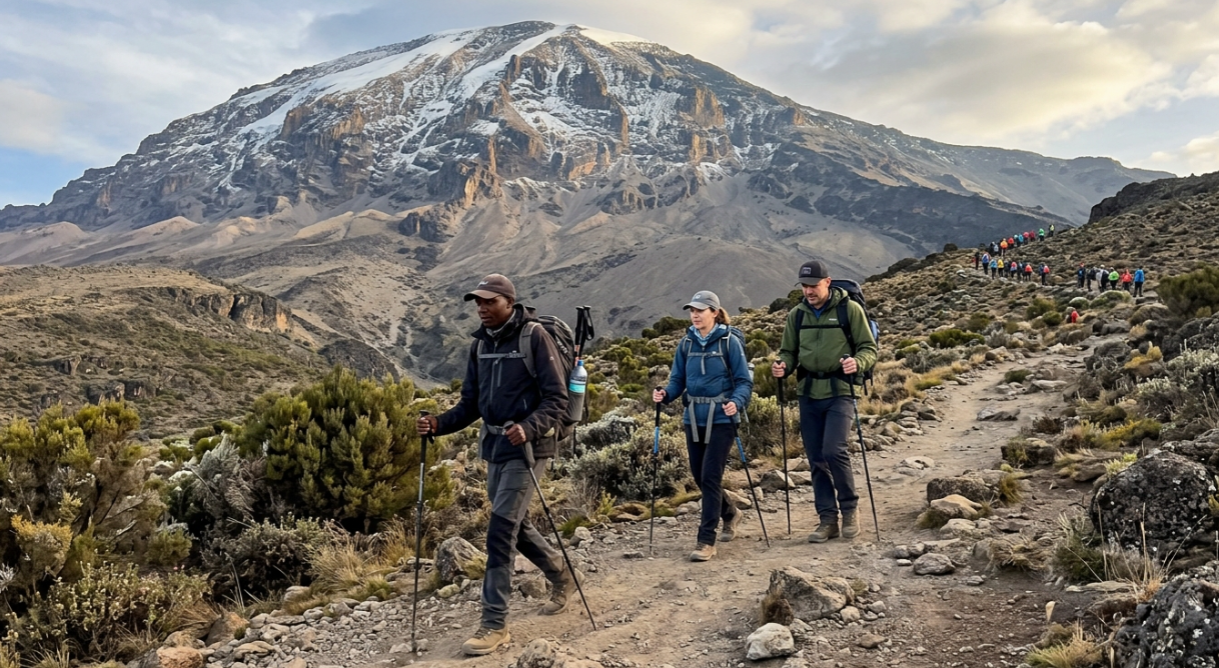
This is the core decision for most Kilimanjaro climbers, and it comes down to three factors: cost, flexibility, and social preference.
Cost
Group climbs are cheaper per person because you split the cost of guides, porters, cooking staff, and shared equipment with other climbers. A private climb for 2 people will cost meaningfully more per person than a group departure for 8.
The crossover point is around 3 to 4 people. If you have a private group of 4 or more, the per-person cost aligns closely with what you’d pay on a group departure. So “private” doesn’t necessarily mean “expensive” if you’re traveling with friends or family.
For a broader comparison of private versus group travel in East Africa, the safari private vs. group guide covers the same decision framework applied to game drives.
Flexibility
Private climbs give you control over your daily program. If you’re a slower hiker or have medical conditions, your guide can focus entirely on your needs. You won’t feel pressure from faster climbers in the group, and you won’t feel guilty about holding others back.
Group climbs lock you into a shared pace and schedule. For fit, sociable climbers without altitude concerns, this is usually fine. For anyone who needs personalized pacing, it’s a real limitation.
Social Factor
Some people climb Kilimanjaro specifically for the shared experience. Meeting strangers from around the world, suffering through summit night together, celebrating at the top as a group. For these climbers, a group departure is the right call.
Others want solitude, family time, or the ability to set their own rhythm. Private is better for them.
Questions to Ask Any Operator About Kilimanjaro Group Size
Before you book, ask these questions. The answers will tell you more about an operator’s quality than any marketing copy.
-
What is your maximum group size? Get a specific number, not a vague “small group” label.
-
What is the guide-to-climber ratio during the general trek? Look for 1:2 or better.
-
What is the guide-to-climber ratio on summit night? 1:1 is ideal. Anything beyond 1:3 is a red flag.
-
Are your guides WFR-certified or equivalent? Wilderness First Responder certification means they can handle altitude emergencies.
-
How many porters per climber do you assign? 3 to 5 is normal. Fewer than 3 on a camping route suggests understaffing.
-
Are you a KPAP partner? The Kilimanjaro Porters Assistance Project verifies fair treatment of mountain crews.
-
What happens if one climber needs to turn back on summit night? In a well-run small group, one guide descends with that person while others continue. In a large group with thin ratios, the logistics get messy.
-
Can you provide references from recent climbers in groups of similar size?
For guidance on evaluating guide credentials specifically, see the how to choose Kilimanjaro guides guide.
Summary Table: Kilimanjaro Group Size at a Glance
|
Factor |
Small Group (4–8) |
Medium Group (8–12) |
Large Group (12–18+) |
|---|---|---|---|
|
Guide ratio (trek) |
1:2 |
1:3 to 1:4 |
1:5 to 1:8 |
|
Guide ratio (summit night) |
1:1 to 1:2 |
1:2 to 1:3 |
1:4 to 1:6+ |
|
Total crew size |
15–40 |
40–57 |
57–80+ |
|
Summit success impact |
Highest |
Moderate |
Lowest |
|
Cost per person |
Higher |
Moderate |
Lowest |
|
Flexibility/pacing |
High |
Moderate |
Low |
|
Medical response time |
Fast |
Moderate |
Slow |
|
Social dynamic |
Tight-knit |
Mixed |
Variable |
KINAPA/TANAPA Regulations on Group Size
Tanzanian law requires every Kilimanjaro climber to have a licensed guide. Since 1991, KINAPA (Kilimanjaro National Park Authority) has required a minimum support team of a certified lead guide, an assistant guide, a cook, and porters for every climbing group.
Some sources state that the maximum Kilimanjaro group size is typically limited to 15 people. In practice, this appears to be a soft guideline rather than a hard regulatory cap. Charity treks and corporate groups have arranged climbs for 30 or more participants, though these are usually split into sub-groups on the mountain with separate guide teams.
The more meaningful regulations relate to porter welfare: the 20 kg weight limit per porter, minimum wage requirements, and proper equipment provisions. Operators partnered with KPAP submit to regular audits on these standards.
Choosing the Right Kilimanjaro Group Size for You
The right group size depends on what you prioritize. If safety and summit success matter most, book with an operator that caps groups at 6 to 8 and runs a 1:1 summit-night guide ratio. If budget is the primary driver, a group of 10 to 12 with a reputable operator is a reasonable compromise.
What you should avoid: any operator that won’t give you a specific maximum group size, won’t disclose their guide-to-climber ratios, or uses “small group” as a label without a number behind it.
Duma Explorer runs small-group Kilimanjaro departures with a maximum of approximately 8 climbers, a 1:1 guide-to-climber ratio on summit day, and WFR-certified guides. As a KPAP founding partner, their porter treatment standards are independently verified. For a full breakdown of route options and pricing, explore the Kilimanjaro climb cost breakdown.
Frequently Asked Questions
What is the ideal Kilimanjaro group size for a first-time climber?
Six to eight climbers. This range provides enough guide attention for individualized pacing and altitude monitoring, which first-timers need most. It also keeps costs reasonable compared to a fully private climb.
Does a smaller group size guarantee I’ll reach the summit?
No. Group size is one factor among several. Route choice, number of acclimatization days, personal fitness, and guide quality all matter. But smaller groups consistently produce higher success rates because they allow better medical monitoring and individualized pacing.
How many porters will my Kilimanjaro group need?
Expect 3 to 5 porters per climber on camping routes (Lemosho, Machame, Northern Circuit, Rongai, Umbwe). The Marangu route requires fewer because it uses permanent hut accommodations. A group of 8 climbers will typically have around 25 to 30 porters, plus guides and cooks, bringing the total expedition to roughly 40 people.
Is a private Kilimanjaro climb worth the extra cost?
If you have 4 or more people, the per-person cost of a private climb approaches group-climb pricing. For 1 to 2 climbers, the premium is significant but buys you complete schedule flexibility, personalized pacing, and undivided guide attention. It’s especially worth it for climbers with medical conditions or those who want to set their own rhythm.
What guide-to-climber ratio should I look for?
During the general trek, 1 guide for every 2 climbers (1:2) is the gold standard. On summit night, look for 1:1. If an operator runs 1:6 or higher on summit night, that’s a meaningful safety concern. Always ask for both ratios before booking.
Can I join a Kilimanjaro group climb as a solo traveler?
Yes. Most operators offer fixed-date group departures that solo travelers can join. You’ll be matched with other climbers who booked the same date. This is one of the most cost-effective ways to climb Kilimanjaro while still having a social experience on the mountain.
Why do some operators run groups of 15 or more?
Economics. A larger group means more paying climbers sharing the fixed costs of guides, cooks, and equipment. It’s more profitable per departure. The trade-off is lower guide ratios, slower medical response, and reduced summit success rates. Budget operators tend toward larger groups; safety-focused operators cap lower.