

TL;DR
A private group safari in Tanzania means your party gets its own vehicle, driver-guide, and custom itinerary, traveling without strangers. “Private” describes who is in the car, not the luxury level. Groups of 4 to 6 people often reach cost parity with shared tours while gaining full control over pace, route, and schedule. This glossary defines every term you’ll encounter when planning and comparing quotes.
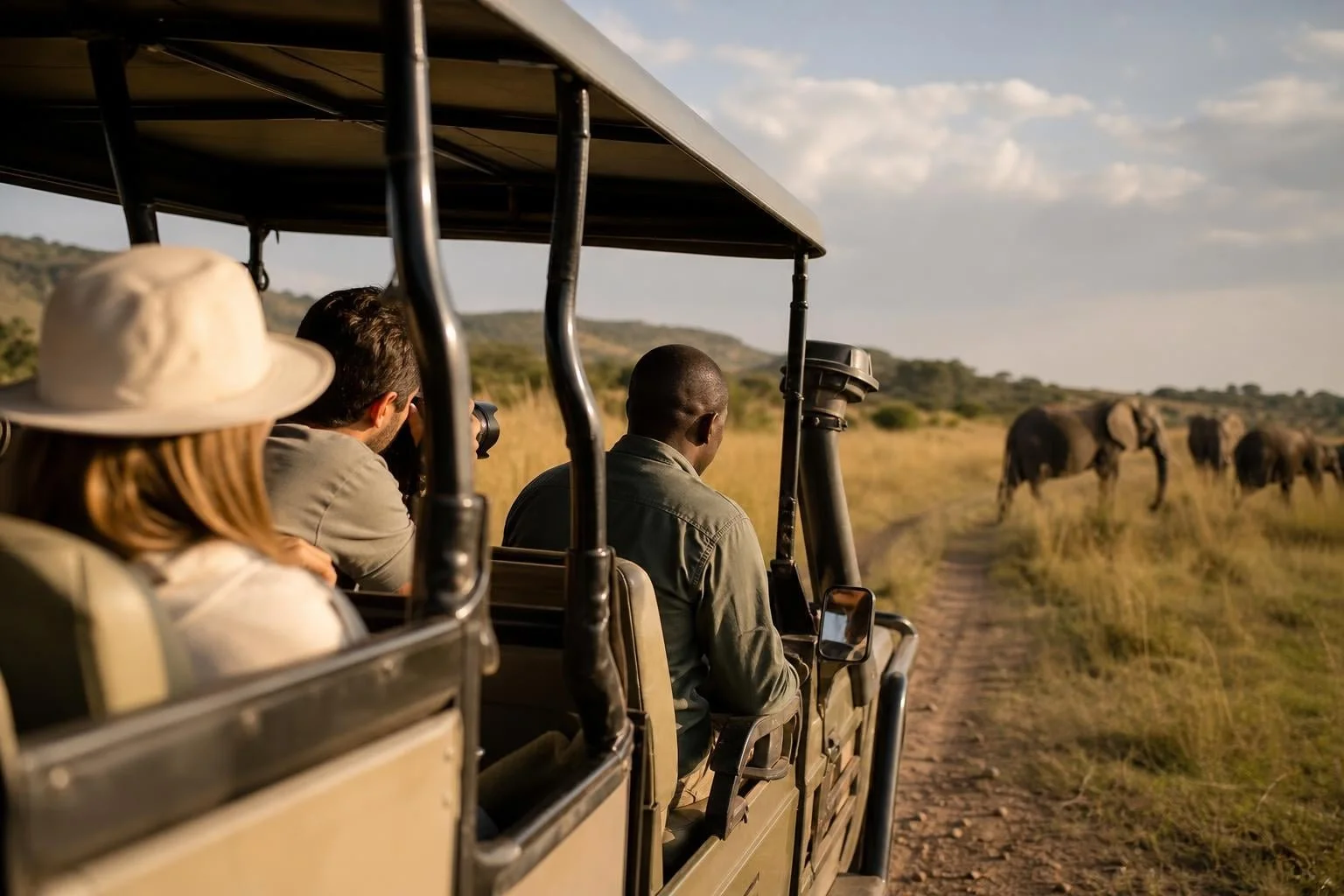
A private group safari in Tanzania is built around one simple idea: your group, your vehicle, your schedule. Whether you’re traveling with four college friends, a family of eight, or a reunion of sixteen, “private” means the 4x4 Land Cruiser, the driver-guide, and the daily itinerary belong exclusively to your party. Nobody else joins. You stop when you want, leave when you want, and spend an extra thirty minutes watching a leopard without worrying about five strangers getting restless in the back seat.
The biggest misconception travelers carry into the planning process is that “private” automatically means “luxury.” It doesn’t. You can run a private group safari on budget camping, mid-range lodges, or $2,000-a-night tented camps. The word describes who controls the vehicle, not the thread count of the sheets.
This distinction matters because it changes how you read quotes. One traveler on a Fodor’s planning forum captured the confusion perfectly: “The problem is in understanding what we get for what we pay for, since I see quotes from 1,500 per person to 6,000 per person, and in some cases up to 9,000 per person.” The terminology gap between operators and travelers is real, and it costs people money. This glossary closes that gap.
If your group is already forming and you want to understand the logistics of a friends safari trip, that planning guide walks through cost-splitting and itinerary design.
What Is a Private Group Safari in Tanzania? A private group safari in Tanzania is a wildlife trip arranged exclusively for your party, with dedicated safari vehicle arrangements, a driver-guide, and an itinerary planned around your group's interests. Unlike a group joining safari, it does not require you to share your vehicle with unrelated travelers. Private safaris are available at different budget levels, from camping trips to luxury lodge itineraries. The total cost depends on group size, accommodation, travel dates, park fees, transport, and included activities. For many groups, the main advantage is flexibility. You can coordinate game drives, choose accommodation that suits everyone, and decide whether to prioritize comfort, photography, wildlife viewing, or budget. Planning takeaway: Decide how many people will travel, how much space you want in each vehicle, and which accommodation tier you prefer before requesting quotations. These three decisions make it easier to compare private safari prices accurately.
Private Group Safari Tanzania: Quick-Reference Glossary
|
Term |
Definition |
Why It Matters for Your Group |
|---|---|---|
|
Private group safari |
A safari booked exclusively for your party, with dedicated vehicle arrangements and a planned itinerary. |
Gives your group greater control over the schedule and wildlife-viewing stops. |
|
Group joining safari |
A shared safari in which travelers who booked separately travel together. |
Usually reduces the cost per person but limits flexibility. |
|
Private safari vehicle |
A 4x4 safari vehicle reserved for your party. |
Vehicle capacity affects comfort, photography, and cost per person. |
|
Driver-guide |
A professional who drives the safari vehicle and guides wildlife-viewing activities. |
Their experience and communication can strongly influence the safari experience. |
|
Exclusive-use camp |
A camp or lodge booked entirely for one group. |
Provides accommodation privacy beyond having a private vehicle. |
|
Tented camp |
Safari accommodation featuring canvas tents, often with permanent beds and private bathrooms. |
Offers a different atmosphere and amenity level from a conventional lodge. |
|
Northern Circuit |
A safari route commonly combining destinations such as Tarangire, Ngorongoro, and Serengeti. |
Helps groups plan a classic northern Tanzania itinerary. |
|
Fly-in safari |
A safari itinerary using scheduled or chartered aircraft to reach remote destinations. |
Reduces some road transfers but increases transport costs. |
|
Park entry fee |
A charge for entering a national park or conservation area. |
Can represent a substantial portion of the total safari budget. |
|
Crater descent fee |
A vehicle-related charge associated with descending into the Ngorongoro Crater, where applicable. |
Needs to be identified separately when comparing safari quotations. |
|
Concession fee |
A charge associated with access to or use of a designated conservation area, depending on the property's location and arrangements. |
May be included in the accommodation price or itemized separately. |
|
Full board |
An accommodation meal plan that generally includes breakfast, lunch, and dinner. |
Does not automatically mean beverages or every activity are included. |
|
Game drive |
A wildlife-viewing excursion, usually conducted in a safari vehicle. |
The itinerary determines how much time your group spends looking for wildlife. |
|
Great Migration |
The seasonal movement of wildebeest, zebra, and other grazing animals through the Serengeti-Mara ecosystem. |
Travel dates and location influence which migration activity you may see. |
Safari Format Terms
Private Group Safari
Your party books one or more 4x4 vehicles, a dedicated driver-guide for each vehicle, and an itinerary designed around your interests, budget, and travel dates. You choose where to go, how long to stay, and when to start each morning. The group might be two couples, a family of six, or a corporate team of twenty. The defining feature is exclusivity: no strangers share your vehicle or dictate your schedule.
A practitioner on the Fodor’s travel forum reported: “I don’t think we paid much more than a group safari and it was great to have the vehicle to ourselves so we could spread out and always have a prime view. We could also tailor each day to our needs.”
Group Joining Safari (Shared Safari)
A group joining safari places individual travelers, couples, or small parties together in a shared 4x4 Land Cruiser, typically with four to seven people total. Everyone follows the same fixed itinerary. You share the driver-guide cost, which brings the per-person price down, but you lose all flexibility. If three other guests want to leave a sighting early, you leave early.
Fixed-Departure Escorted Tour
Global brands like G Adventures or Intrepid run scheduled departures with set itineraries, set dates, and set group sizes. You book online, show up, and travel with whoever else signed up. Good for solo travelers who want structure and a social atmosphere. Not ideal for a group that already has its own people and preferences.
The “Private vs. Luxury” Confusion
This is the single most important distinction to internalize before you start comparing quotes. “Private” and “luxury” are independent variables. A private group safari can run at budget level ($150 to $250 per person per day with camping), mid-range ($350 to $500 per person per day with comfortable lodges), or ultra-premium ($800 to $2,500+ per person per day with exclusive tented camps). When an operator quotes you a “private safari,” ask what accommodation tier the quote covers. The vehicle exclusivity is the same at every price point.
Private Group Safari vs. Shared Safari in Tanzania
A private group safari gives your party exclusive use of its arranged safari vehicle or vehicles, while a shared safari places travelers who booked separately together. The right option depends on your group size, budget, preferred pace, and need for flexibility.
|
Comparison Factor |
Private Group Safari |
Group Joining Safari |
|---|---|---|
|
Vehicle sharing |
Reserved for your party |
Shared with other travelers |
|
Itinerary |
Can be customized within logistical and park restrictions |
Usually follows a fixed route |
|
Daily schedule |
Greater flexibility over stops and timing |
Coordinated with the other passengers |
|
Driver-guide |
Dedicated to your party in each arranged vehicle |
Shared with the group |
|
Cost per person |
Depends on group size, accommodation, and itinerary |
Often lower for individuals and small parties |
|
Accommodation |
Can be selected for your group |
Depends on the package and operator |
|
Photography |
Easier to coordinate seating and stops around your interests |
Must accommodate other travelers |
|
Best suited to |
Families, friends, reunions, and organized groups |
Solo travelers, couples, and budget-conscious visitors |
Is a Private Safari Cheaper for Larger Groups?
A larger group can spread fixed transport and guiding costs across more travelers. However, savings depend on vehicle allocation, accommodation rates, park fees, and whether the group needs additional vehicles.
A private safari is not automatically cheaper than a shared safari at four or six passengers. Request quotations for the same dates, route, accommodation standard, and inclusions before deciding.
For a fair comparison, calculate the total package cost per person rather than comparing the headline prices alone.
Vehicle and Guide Terms
4x4 Land Cruiser
The Toyota Land Cruiser is the standard safari vehicle across Tanzania. In its game-viewing configuration, it seats a maximum of six passengers with a pop-up roof for standing, photographing, and scanning the bush. Every operator in the country uses some variation of this vehicle, though quality, maintenance, and age vary dramatically between companies.
For a deeper look at vehicle types and what to check before booking, see this guide to safari vehicles in Africa.
Vehicle Allocation by Group Size
The number of safari vehicles your group needs depends on the operator's permitted passenger capacity, your luggage requirements, and your preferred level of comfort.
For planning purposes, the table below compares a maximum-capacity arrangement of six passengers per vehicle with a more spacious arrangement of four passengers per vehicle. Confirm the actual seating configuration with your safari operator before booking.
|
Group Size |
Vehicles at 4 Passengers per Vehicle |
Vehicles at 6 Passengers per Vehicle |
|---|---|---|
|
2 people |
1 |
1 |
|
4 people |
1 |
1 |
|
6 people |
2 |
1 |
|
8 people |
2 |
2 |
|
10 people |
3 |
2 |
|
12 people |
3 |
2 |
|
16 people |
4 |
3 |
|
20 people |
5 |
4 |
These figures represent a planning preference, not a universal vehicle-capacity rule. Some operators may offer different configurations, and luggage, camera equipment, children, and accessibility requirements can affect the practical passenger limit.
For groups of six, using two vehicles with three passengers in each can provide more space than putting all six in one vehicle. For groups of eight, two vehicles with four passengers each provide a straightforward balance between comfort and cost.
Before requesting a quotation, decide whether your priority is the lowest possible cost per person or more space for photography, luggage, and individual seating preferences.
Plan Your Private Group Safari in Tanzania
Once your group has agreed on its travel dates, preferred accommodation, and budget, the next step is to compare itineraries that match your requirements.
Duma Explorer can help your group evaluate vehicle arrangements, accommodation options, route planning, and package inclusions based on your travel dates and group size.
When requesting a quotation, share your approximate number of travelers, preferred dates, target budget per person, and the experiences that matter most to your group.
Request a Custom Group Safari Itinerary
Four vs. Six Passengers per Safari Vehicle
Choosing between four and six passengers per vehicle affects the space available to each traveler, the amount of luggage the vehicle can carry, and the cost per person.
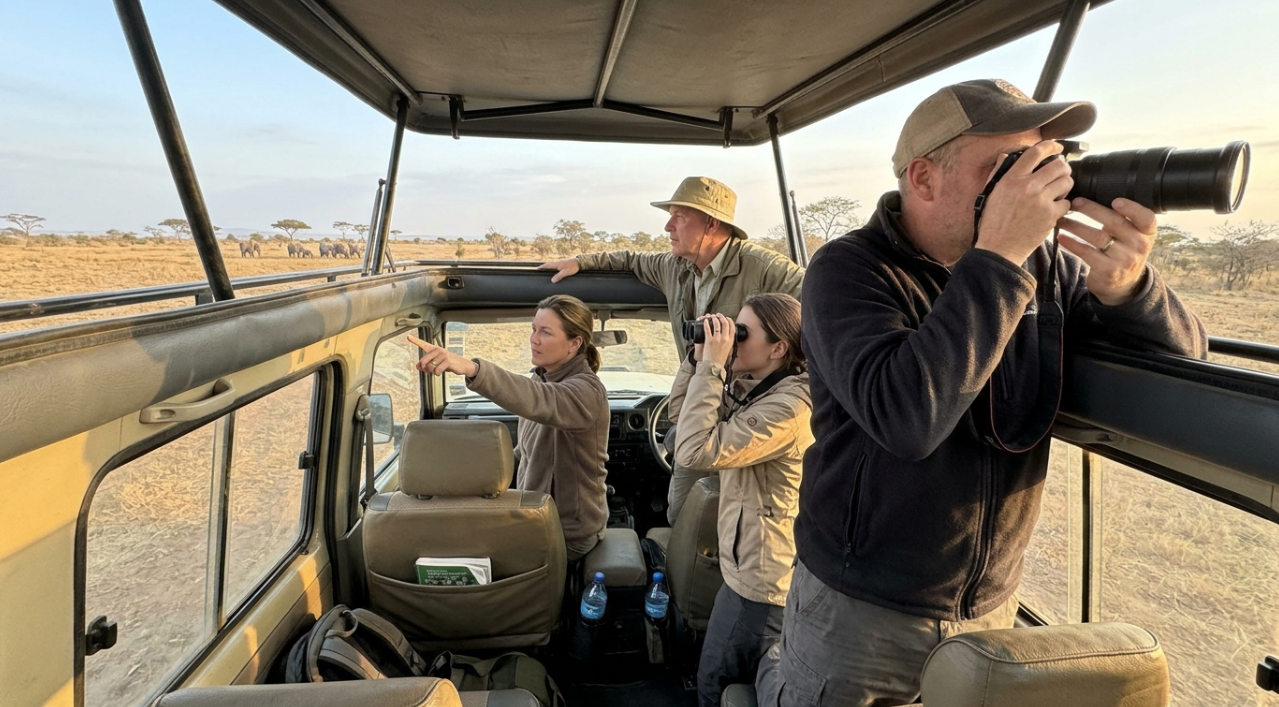
A six-passenger vehicle can offer a good wildlife-viewing experience when its seating arrangement is designed for that capacity. A four-passenger arrangement may provide more personal space and flexibility for photography, especially when travelers carry long lenses, camera bags, or other equipment.
|
Factor |
Four Passengers |
Six Passengers |
|---|---|---|
|
Personal space |
Usually more room per guest |
Depends on the vehicle's interior layout |
|
Photography equipment |
More room for camera bags and accessories |
Requires closer attention to luggage arrangements |
|
Window access |
Confirm the seating layout with the operator |
Confirm that every passenger has suitable viewing access |
|
Pop-up roof |
Check how easily each passenger can use the roof opening |
Check whether all passengers can use the viewing area comfortably |
|
Cost per person |
Usually higher when vehicle costs are shared by fewer people |
Usually lower when more passengers share the vehicle |
|
Best suited to |
Photography-focused trips and travelers who prioritize space |
Budget-conscious groups seeking a private vehicle |
How to Choose the Right Vehicle
Ask the operator for the exact vehicle configuration, maximum passenger capacity, luggage allowance, and seating arrangement.
If wildlife photography is a priority, explain how much equipment your group will carry and whether everyone needs regular access to the pop-up roof. Request photographs of the actual vehicle interior rather than relying on the phrase "six-seater Land Cruiser."
The best configuration is the one that meets your group's comfort, luggage, and viewing requirements without creating unnecessary vehicle costs.
Driver-Guide
The professional who both operates the vehicle and interprets wildlife, landscapes, and culture. On a private group safari in Tanzania, this person is dedicated exclusively to your group for the entire trip. They know where the resident leopard sleeps, which riverbank the hippos favor in the afternoon, and how to position the vehicle for the best light. The quality of your driver-guide is the single biggest variable in safari satisfaction.
Multiple safari reviewers highlight this point. Groups using experienced private guides consistently report exceptional sighting counts (one group documented 42 big cats in three days on a private itinerary), while shared-tour guests on the same roads often see far fewer because their guide has less flexibility.
Lead Guide and Convoy Coordination
For groups requiring three or more vehicles, one driver-guide typically takes the lead role, coordinating radio communication between vehicles about sightings, routes, and timing. This prevents the convoy from bunching up at park gates or overwhelming a single sighting with too many vehicles at once.
If your group is assembling for a work event or incentive trip, the incentive travel planning guide covers how multi-vehicle coordination works for corporate parties.
Accommodation Terms
Tented Camp
A “tented camp” in Tanzania is not camping in the backpacker sense. Mid-range and luxury tented camps have en-suite bathrooms, proper beds with linens, hot water, and often electricity from solar panels or generators. The “tent” part refers to canvas walls that connect you to the sounds of the bush. You’ll hear hyenas at night and birdsong at dawn.
One reviewer of a 14-day group safari in 2025 noted: “The tent camps were all very comfortable and their staff extremely friendly, often breaking into song.” This is typical of the Tanzania tented camp experience.
Mobile Tented Camp
A temporary camp that moves seasonally to follow wildlife patterns, particularly the Great Migration across the Serengeti. Mobile camps offer some of the most exclusive wildlife access because they’re positioned exactly where the herds are, rather than waiting for the herds to pass by a fixed location. They typically have 6 to 10 tents, keeping the experience intimate.
Safari Lodge
A permanent, built structure with standard hotel-style rooms or suites. Lodges tend to have more amenities (swimming pools, multiple dining areas, Wi-Fi) but less of the immersive bush atmosphere that tented camps provide. For groups with members who are uncomfortable sleeping in canvas, lodges are the safer bet.
Exclusive-Use Camp and Camp Buyout
An exclusive-use camp or lodge is a property reserved entirely for one group, subject to the property's booking conditions. It differs from a standard private safari, in which your group shares accommodation facilities with other guests but has its own safari vehicle.
An exclusive-use booking may provide greater privacy, coordinated dining arrangements, and more control over the group's schedule. However, the exact benefits depend on the property and the agreement with the operator.
Before booking a camp buyout, ask the property or safari operator to confirm:
-
The number of rooms or tents available.
-
The minimum number of nights required.
-
Whether the booking includes all accommodation units.
-
Whether dining areas and other shared facilities are exclusive to your group.
-
Whether dedicated staff, vehicles, or guides are included.
-
Whether there is a minimum occupancy or buyout charge.
-
Whether the quoted price includes meals, drinks, taxes, and applicable conservation fees.
Is a Camp Buyout Cheaper for a Large Group?
Not necessarily. A buyout can provide better value when enough people share the total property cost, but the result depends on the minimum charge, accommodation capacity, season, and package inclusions.
Compare the total cost of the buyout with the cost of booking the same number of rooms individually. Also consider whether the property requires you to pay for unused rooms.
For a private group safari, a camp buyout makes the most sense when exclusivity is a priority and the group's size justifies the additional cost.
Special Campsite
A private campsite within a national park, separate from the public campsite areas. These are fenced or designated plots where your group sets up tents (or your operator sets them up for you) without sharing the site with other parties. Relevant for budget-conscious private group safaris where the group wants exclusivity without lodge prices.
Full Board vs. All-Inclusive
Full board means all meals are included: breakfast, lunch, and dinner. This is the standard arrangement at most Tanzania safari camps and lodges. All-inclusive typically adds beverages (beer, wine, spirits, soft drinks) and sometimes laundry. On a private group safari, most properties operate on full board, with drinks charged separately or included depending on the accommodation tier.
Route and Access Terms
Northern Circuit
Tanzania’s classic safari route covering Tarangire National Park, Lake Manyara National Park, the Ngorongoro Conservation Area, and Serengeti National Park. This is the standard first-time private group safari route, and for good reason: it packs the highest density and diversity of wildlife into a manageable geography. Most Northern Circuit itineraries run 5 to 10 days, depending on pace and whether the Serengeti gets two nights or four.
The Northern Circuit safari guide breaks down each park, distances, and recommended time allocation.
Southern Circuit
A less-visited route covering Ruaha National Park, Nyerere National Park (formerly Selous), and Mikumi National Park. The Southern Circuit offers enormous, uncrowded wilderness but requires more travel time and typically fly-in logistics. Better suited to returning visitors or groups that prioritize remoteness over the Northern Circuit’s marquee names.
Private Concession and Conservancy
A private concession or conservancy is a designated area managed under particular land-use, conservation, or tourism arrangements. The precise meaning and permitted activities vary by location.
For a private group safari, staying in a concession may provide access to a different wildlife-viewing environment from the main public park areas. Depending on the property's location and applicable regulations, activities may include guided walks, night drives, or other experiences that are not permitted in the same way inside a national park.
However, do not assume that every concession allows off-road driving, night drives, or exclusive wildlife sightings. These permissions depend on the specific area and its operating rules.
Before booking, ask the operator to identify the concession, explain which activities are permitted, and confirm whether applicable conservation or concession charges are included in the package.
Fly-In Safari
An itinerary that uses light aircraft (Cessna Caravans, typically) to transfer between parks, landing at bush airstrips rather than driving for hours on unpaved roads. Fly-in safaris save enormous amounts of time. The trade-offs: higher cost (roughly $200 to $600 per person per flight segment), strict luggage limits (soft-sided bags only, typically 15 to 20 kg per person), and fixed flight schedules that reduce the spontaneity a road safari allows.
Road Safari
Overland driving between parks in the same private 4x4 used for game drives. More flexible, less expensive, and the transfer drives sometimes produce unexpected wildlife sightings. The downside is that some transfers (Arusha to Serengeti, for example) take 7 to 9 hours. For groups with limited time, flying one direction and driving the other is a common compromise.
Bush Airstrip
A small, typically unpaved landing strip within or near a national park. These are not airports. They have no terminal, no security screening, and sometimes no building at all. Your driver-guide meets you at the airstrip, and your luggage goes directly from the plane to the vehicle. Expect a 15- to 45-minute game drive from the airstrip to your camp.
Fees, Costs, and Financial Terms
TANAPA (Tanzania National Parks Authority)
The government authority responsible for managing Tanzania’s 22 national parks, including the Serengeti, Tarangire, and Arusha National Park. TANAPA sets park regulations, entry fees, and activity rules within park boundaries. All park fees are payable in USD and are non-negotiable.
NCAA (Ngorongoro Conservation Area Authority)
The separate authority that manages the Ngorongoro Conservation Area, which is not a national park but a multi-use conservation area where Maasai pastoralists coexist with wildlife. The NCAA sets its own entry fees and crater-specific charges.
Tanzania Safari Park Fees: What to Budget For
Park fees are a significant part of the cost of a private group safari in Tanzania. However, the applicable charges depend on the destination, visitor category, length of stay, and activities included in the itinerary.
Tanzania National Parks Authority (TANAPA) manages national parks such as Serengeti and Tarangire. The Ngorongoro Conservation Area Authority (NCAA) administers a separate fee structure for the Ngorongoro Conservation Area.
Before booking, ask your safari operator for an itemized breakdown of the following charges:
-
Park entry fees: Charges for entering the national parks included in your itinerary.
-
Conservation area entry fees: Charges associated with visiting the Ngorongoro Conservation Area.
-
Crater service fees: Charges associated with a planned descent into the Ngorongoro Crater.
-
Camping fees: Charges that may apply when using designated campsites.
-
Concession fees: Additional charges associated with accommodation or activities in applicable conservation areas.
-
Vehicle and activity charges: Any additional transport, access, or activity fees that apply to your route.
Do not assume that every charge is included simply because a quotation states that park fees are covered. Ask the operator to confirm the specific inclusions in writing.
For current rates, consult the official TANAPA park tariff information and the official NCAA tariff portal. Confirm the applicable schedule with your operator before making a payment.
Ngorongoro Crater Descent Fee
The Ngorongoro Crater descent charge is an important cost to check when comparing Tanzania safari quotations. The applicable fee, charging basis, and conditions should be confirmed against the current Ngorongoro Conservation Area Authority tariff.
Ask your operator whether the quotation includes the crater descent charge, how many descents are planned, and whether the quoted amount covers the entire vehicle or is calculated using another applicable tariff basis.
When a fee is charged per vehicle, the cost per traveler depends on how many passengers share that vehicle.
For example, if a verified fee were $295 per vehicle for one descent:
|
Passengers Sharing the Vehicle |
Illustrative Cost per Person |
|---|---|
|
2 |
$147.50 |
|
4 |
$73.75 |
|
6 |
$49.17 |
These figures illustrate cost allocation only. They are not confirmation of the current official fee. Verify the applicable tariff and any additional charges before using this calculation in a travel budget.
Concession Fee
A fee charged by private conservation areas or wildlife management areas that operate outside the national park system. At most camps within concessions, this fee is bundled into the accommodation rate, so you won’t see it as a separate line item unless you specifically ask.
Tipping Norms
Tips are never included in safari quotes. Standard 2026 tipping rates:
-
Safari driver-guide: $50 per vehicle per day, shared among passengers in the vehicle
-
Camp or lodge staff: $10 to $15 per guest per day, placed in a communal tip box
-
Hot-air balloon crew: $10 to $20 per person (optional)
For a group of six on a 7-day safari with one vehicle, that’s roughly $350 in guide tips and $420 to $630 in camp staff tips for the whole trip. Budget accordingly.
Private Group Safari Cost Benchmarks
The daily cost of a private group safari in Tanzania depends on accommodation, travel dates, route, vehicle arrangements, and the services included in the quotation.
The following categories can help you classify a quotation, but they should not be treated as verified market averages or guaranteed package prices.
|
Safari Category |
Typical Accommodation Style |
What to Examine |
|---|---|---|
|
Budget |
Camping or basic accommodation |
Campsite arrangements, meals, vehicle costs, and included park fees |
|
Mid-range |
Comfortable lodges or tented camps |
Room quality, location, guiding, transfers, and meal plans |
|
Premium |
Higher-end lodges or tented camps |
Property location, service level, room category, and included experiences |
|
Ultra-luxury |
Luxury camps, exclusive properties, or fly-in itineraries |
Private arrangements, premium accommodation, flights, and additional services |
When comparing quotations, ask whether the advertised daily rate is based on two, four, or six travelers; whether the vehicle is private; and whether park fees, accommodation, meals, and transfers are included.
For a useful cost comparison, calculate the full package total per person for the same itinerary and travel dates.
How Group Size Reduces Per-Person Cost
The vehicle, the driver-guide, and many fixed logistics costs stay constant regardless of group size. Park fees and accommodation are per-person, but the operational overhead is shared.
At six people, a private Tanzania safari is often comparable in per-person cost to a group joining safari, and the experience is incomparably better. This is the inflection point where private group safaris stop being a premium choice and start being the obvious one.
What Is the Best Group Size for a Private Tanzania Safari?
There is no single ideal group size for a private Tanzania safari. The best arrangement depends on your budget, preferred vehicle space, accommodation needs, and whether everyone wants to follow the same itinerary.
|
Group Size |
Typical Planning Approach |
Main Consideration |
|---|---|---|
|
2 travelers |
One private vehicle |
Fixed vehicle and guide costs are shared by only two people. |
|
3–4 travelers |
One vehicle |
Often a practical balance between privacy, space, and shared costs. |
|
5–6 travelers |
One vehicle if its capacity and configuration are suitable |
Confirm comfort, luggage capacity, and viewing access before booking. |
|
7–8 travelers |
Usually two vehicles |
Two vehicles can provide more space and allow some flexibility between subgroups. |
|
9–12 travelers |
Often two or three vehicles |
Balance vehicle capacity against comfort and the group's preferences. |
|
13–20 travelers |
Multiple vehicles with coordinated guiding and logistics |
Accommodation, transfers, meal arrangements, and group timing require additional planning. |
|
More than 20 travelers |
A multi-vehicle itinerary with a clear coordination plan |
Confirm convoy logistics, property capacity, and arrangements for activities. |
These are planning guidelines rather than mandatory vehicle allocations. The operator's available vehicles, legal capacity, passenger requirements, and luggage needs determine the final arrangement.
For larger groups, confirm whether all vehicles can follow the same itinerary and how the operator coordinates communication, accommodation arrivals, and wildlife-viewing activities.
Planning tip: Decide whether the group values traveling together in the fewest vehicles or having more room and flexibility across multiple vehicles. This decision can affect both the budget and the overall experience.
How to Estimate the Cost of a Private Group Safari in Tanzania
The cost of a private group safari depends on more than the number of travelers. Accommodation, park fees, vehicle arrangements, transfers, and optional activities can all change the final price.
Use the following framework to compare quotations for the same itinerary.
|
Cost Component |
What to Check |
How It Affects the Budget |
|---|---|---|
|
Safari vehicle and driver-guide |
Number of vehicles, days of use, and included guiding services |
Fixed operating costs may be shared across passengers |
|
Accommodation |
Number of nights, room configuration, and property category |
Rates vary by location, season, and room occupancy |
|
Meals and beverages |
Meal plan and included drinks |
Full board does not automatically include all beverages |
|
Park and conservation fees |
Applicable entry and conservation charges |
Varies by destination, visitor category, and time spent in each area |
|
Ngorongoro Crater descent |
Whether a descent is planned and which charges apply |
Adds a destination-specific cost |
|
Transfers |
Road transfers, domestic flights, and airport pickups |
Fly-in itineraries can cost more but reduce some travel time |
|
Activities |
Balloon flights, walking safaris, and cultural visits |
Optional activities can substantially increase the package total |
|
Tips |
Driver-guide and camp staff gratuities |
Usually need to be budgeted separately unless explicitly included |
|
Insurance and personal expenses |
Travel insurance, souvenirs, laundry, and other extras |
May sit outside the operator's quotation |
Calculate the Cost Per Person
Use this formula to compare private safari quotations:
Total group cost ÷ number of travelers = cost per person
For example, if a hypothetical safari quotation totals $24,000 for six travelers, the package costs $4,000 per person.
If another quotation totals $27,000 for the same six travelers, the difference is $500 per person. The higher-priced quotation may still represent better value if it includes superior accommodation, more convenient flights, or fees excluded from the cheaper package.
These figures are illustrative calculations, not current market quotations.
What Should You Ask Before Comparing Prices?
Ask every operator to confirm the number of safari days, accommodation nights, passengers per vehicle, park fees, meals, transfers, activities, and excluded expenses.
A reliable comparison uses the same travel dates, route, room configuration, and inclusion list for every quotation.
Activities and Experiences
Game Drive
A wildlife-viewing excursion in a 4x4 vehicle, typically 3 to 4 hours. Most private group safaris include a morning game drive (starting at 6:00 or 6:30 AM, when animals are most active) and an afternoon drive (starting around 3:30 or 4:00 PM). Some groups opt for full-day drives with a packed lunch eaten beside the vehicle in the bush.
If your first game drive will be in Tarangire, the Tarangire safari glossary covers what to expect and how to make the most of it.
Walking Safari
A guided walk through the bush on foot, accompanied by an armed ranger and your driver-guide. Walking safaris are permitted in certain parks and private concessions but not everywhere. Most operators require participants to be at least 12 or 16 years old, depending on the park’s rules. The experience is transformative: tracking animal prints, learning about medicinal plants, and understanding the ecosystem at ground level rather than from a vehicle.
Night Drive
Game driving after dark using a spotlight to find nocturnal species like aardvarks, bush babies, civets, and hunting leopards. Night drives are only permitted in private concessions, not inside national parks. If your group is staying in a Serengeti concession camp, this is one of the strongest arguments for spending at least one or two nights outside the park boundary.
Hot-Air Balloon Safari
A dawn balloon flight over the Serengeti, typically lasting about an hour, followed by a champagne bush breakfast. Costs approximately $500 to $600 per person. It’s a substantial add-on, but multiple private group travelers single it out as a trip highlight.
Cultural Visit
A visit to a Maasai boma (homestead) or a Hadzabe bushmen community, usually arranged by your driver-guide or camp. These visits typically last 1 to 3 hours, involve a fee that goes directly to the community, and offer a chance to learn about daily life, traditional hunting, or livestock herding. Quality varies by community and operator, so ask specifically about which village and how the visit is structured.
Great Migration
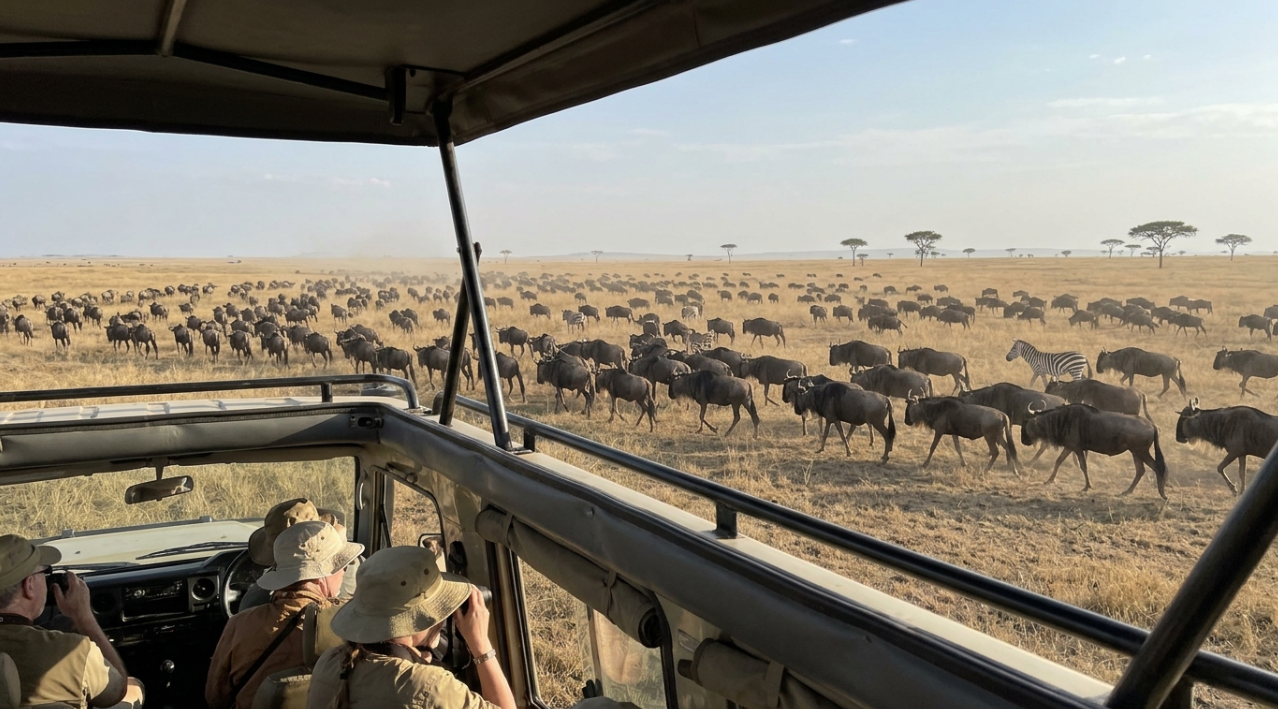
The Great Migration is the seasonal movement of wildebeest, zebra, and other grazing animals through the Serengeti-Mara ecosystem in Tanzania and Kenya. It is a continuous ecological cycle rather than a single event that takes place on one date.
For private group safari planning, the important consideration is where the herds are likely to be during your travel dates.
|
Approximate Period |
Typical Migration Activity |
Planning Consideration |
|---|---|---|
|
January to March |
Herds commonly gather in the southern Serengeti and Ndutu area, with calving activity during the early months of the year. |
Consider an itinerary focused on the southern plains and nearby wildlife areas. |
|
April to May |
Herds generally begin moving northwest as seasonal conditions change. |
Rainfall can affect road conditions, travel times, and camp availability. |
|
June to July |
Herds may move through the Western Corridor and toward the northern Serengeti. |
Route selection matters because migration activity varies across the ecosystem. |
|
July to October |
Northern Serengeti and Mara River areas can offer opportunities to observe river-crossing activity. |
River crossings are unpredictable and cannot be guaranteed. |
|
November to December |
Herds often move southward as rainfall and grazing conditions change. |
A southern Serengeti itinerary may suit travelers following the migration cycle. |
This calendar describes broad seasonal tendencies, not guaranteed herd locations. The migration's timing and distribution can vary from year to year.
When booking a private group safari, ask your operator to explain why the proposed route suits your dates and how the itinerary could be adjusted if the herds move elsewhere.
Planning and Booking Terms
Lead Time
How far in advance you should book. For a private group safari in Tanzania during peak season (July to October, December to February), 6 to 12 months is standard. Groups requiring exclusive-use buyouts or traveling during the Great Migration river-crossing season should book even earlier. Shoulder season trips (March to May, November) can sometimes be arranged with 2 to 4 months’ notice.
Deposit and Cancellation Terms
Most operators require a 25% to 30% deposit at booking, with the balance due 60 to 90 days before travel. Cancellation policies become progressively stricter as the travel date approaches, with partial or full forfeit common within 60 days. Read the terms carefully, especially for large groups where one family’s cancellation can throw off vehicle allocation and accommodation bookings.
Protect your investment with proper Tanzania travel insurance, which should cover trip cancellation, medical evacuation, and itinerary disruption.
Peak Season vs. Shoulder Season
Peak season (July to October, December to February) offers the best weather and the Great Migration river crossings in July through October. Shoulder season (March to May, November) brings lower prices, fewer tourists, and greener scenery, but also more rain and some camp closures. For a private group trying to balance cost and experience, late June or early November can hit a sweet spot.
Safari Operator Licensing in Tanzania
Before booking a private group safari in Tanzania, verify that the tour operator holds the appropriate current tourism licenses for the services it provides.
TALA refers to Tanzania's Tourist Agents Licensing Authority or Tourist Agent Licence terminology. It is not the name of the Tanzania Association of Tour Operators.
Ask the company for its current license details and verify them through the relevant Tanzanian government licensing system. You should also check the legal company name on the license against the name on your quotation and payment instructions.
Licensing is an important baseline check, but it does not by itself guarantee service quality, financial stability, or a successful safari. Review the company's itinerary, accommodation arrangements, cancellation terms, insurance provisions, and payment conditions before committing your group.
What “Park Fees Included” Means in a Quote
When a quote says “park fees included,” it should mean all TANAPA and NCAA entry fees, all crater descent fees, and all concession fees are covered. But some operators include park entry fees while excluding crater fees or concession fees as “optional extras.” Before comparing two quotes, make sure both define “park fees included” the same way. Ask specifically: “Does this include the Ngorongoro crater descent fee?”
What Is Included in a Private Group Safari Package?
A private group safari package may combine accommodation, meals, a safari vehicle, a driver-guide, park fees, and transfers into one price. However, inclusions vary by operator and itinerary, so the package description should always be checked before booking.
|
Package Item |
What to Confirm |
|---|---|
|
Private safari vehicle |
Is the vehicle exclusively reserved for your group throughout the safari? |
|
Driver-guide |
Is a dedicated guide included for each vehicle? |
|
Accommodation |
Are all nights included, and which properties and room categories are booked? |
|
Meals |
Are breakfast, lunch, and dinner included every day? |
|
Drinks |
Are drinking water, soft drinks, and alcoholic beverages included? |
|
Park fees |
Which national park and conservation area charges are covered? |
|
Ngorongoro Crater descent |
Is the applicable descent charge included if the itinerary visits the crater floor? |
|
Domestic flights |
Are all scheduled or charter flights included in the package total? |
|
Airport transfers |
Are arrival and departure transfers included? |
|
Optional activities |
Are balloon flights, walking safaris, and cultural visits included or charged separately? |
|
Tips |
Are gratuities excluded from the quoted price? |
|
Travel insurance |
Must each traveler arrange their own policy? |
|
Taxes and payment charges |
Are applicable taxes and payment-related charges included? |
|
Cancellation terms |
What happens if a traveler cancels or the group size changes? |
Why the Cheapest Safari Quote May Not Be the Best Value
Two safari quotations are only comparable when they cover substantially the same services.
A lower-priced package may exclude domestic flights, selected park fees, premium accommodation, or optional activities. A higher-priced package may include these items, reducing the difference once all expenses are considered.
Before comparing the final prices, ask both operators to identify every included item, every exclusion, and every charge that could arise during the trip.
Booking rule: Compare the total expected trip cost per person, not just the advertised package price.
How to Plan a Private Group Safari in Tanzania
Planning a private group safari is easier when the group agrees on the essentials before requesting quotations.
Step 1: Confirm the Group Size
Establish how many travelers are committed to the trip and whether children or travelers with particular accessibility requirements are joining.
The final number affects vehicle allocation, accommodation arrangements, and the cost per person.
Step 2: Choose Your Travel Dates
Identify your preferred dates and whether they are flexible. Seasonality can affect accommodation availability, pricing, and the wildlife-viewing areas best suited to your itinerary.
Step 3: Set Your Budget
Agree on a target budget per person and establish which expenses it should cover. Decide whether international flights, travel insurance, tips, and optional activities sit inside or outside that budget.
Step 4: Choose Your Accommodation Level
Decide whether the group prefers camping, comfortable lodges, tented camps, or luxury properties.
If exclusivity matters, clarify whether you mean a private vehicle, private accommodation, or a complete camp buyout.
Step 5: Select the Safari Route
Choose a route based on the time available, wildlife priorities, and willingness to travel by road or aircraft.
For a first visit, the Northern Circuit is a common starting point. Other regions may suit groups seeking different landscapes, activities, or a less conventional itinerary.
Step 6: Request Comparable Quotations
Send each operator the same group size, dates, route, accommodation preferences, and activity requirements.
Request an itemized quotation and ask for written confirmation of inclusions, exclusions, payment terms, and cancellation conditions.
Step 7: Confirm the Details Before Paying
Review the final itinerary, accommodation names, vehicle arrangements, licensing information, and payment instructions.
Make sure everyone in the group understands the cancellation policy and what happens if the number of travelers changes before departure.
How to Compare Private Group Safari Quotes
When your group starts receiving quotes from different operators, here’s a checklist for comparing them accurately:
-
Accommodation tier: Are you comparing lodge to lodge, or is one quoting tented camps while the other quotes a permanent lodge?
-
Vehicle allocation: How many passengers per vehicle? Four or six?
-
Park fees: All included, or are some listed as extras?
-
Crater descent: Included or excluded?
-
Internal flights: If any segments are fly-in, are flights quoted?
-
Tips: Never included. Budget separately.
-
Drinks: Full board (meals only) or all-inclusive (drinks included)?
-
Transfer days: Does the quoted number of “safari days” include transfer days, or only days with full game-driving?
A quote of $4,500 per person that includes everything and a quote of $3,200 per person that excludes park fees, tips, and crater charges might end up within $200 of each other.
If your group is still working out vehicle numbers, accommodation level, or whether a fly-in segment makes sense for your dates and budget, Duma Explorer can build a side-by-side comparison based on your actual group size and priorities.
Request a Custom Group Safari Itinerary →
Frequently Asked Questions
How Many People Fit in One Safari Vehicle in Tanzania?
Many Tanzania safari Land Cruisers are configured to carry up to six passengers, although capacity and seating arrangements vary by operator and vehicle. Some operators offer smaller configurations for travelers who want more space. Before booking, confirm the maximum passenger capacity, luggage allowance, and whether everyone will have suitable window and pop-up roof access.
Is a Private Group Safari Worth the Extra Cost Over a Shared Safari?
A private group safari can be worthwhile when your group values control over the itinerary, dedicated vehicle arrangements, and the flexibility to coordinate wildlife-viewing stops. Whether it costs more than a shared safari depends on group size, accommodation, travel dates, and package inclusions. Compare quotations for the same itinerary and calculate the total cost per person before deciding.
Can we book an entire camp or lodge just for our group?
Yes. This is called an exclusive-use buyout. Most tented camps in the Serengeti and Ngorongoro have 8 to 16 rooms. Buyouts are priced as a flat property rate, so larger groups pay less per person. Shoulder season buyouts are easier to negotiate and often come with meaningful discounts.
What Park Fees Should I Expect on a Tanzania Safari?
Park fees vary by destination, visitor category, and applicable tariff. Tanzania National Parks Authority (TANAPA) manages national parks such as Serengeti and Tarangire, while the Ngorongoro Conservation Area Authority (NCAA) publishes separate charges for the conservation area and activities such as crater descents. Ask your operator for an itemized fee breakdown and confirm the applicable rates using the official tariff information before booking.
How far in advance should a group book a private Tanzania safari?
Six to twelve months for peak season (July through October, December through February). Groups needing exclusive-use properties during Great Migration season should book even earlier. Shoulder season trips can sometimes be organized within two to four months.
Do we need multiple vehicles for a group of eight?
Yes. With eight travelers, you’ll use two vehicles whether you opt for four or six passengers per vehicle. At four per vehicle, everyone has a window and roof position. At six per vehicle (which would leave two people in a third vehicle or pack both to capacity), some travelers compromise on comfort. Two vehicles with four people each is the standard recommendation for a group of eight.
What Does a Private Concession Mean for Our Group's Experience?
A private concession is a designated area operating under particular land-use, conservation, or tourism arrangements. Depending on its location and rules, it may offer different wildlife-viewing activities or access arrangements from a public national park. Night drives and off-road driving are not automatically permitted everywhere, so confirm the activities available at your specific property before booking.
What Is the Difference Between a Private Safari and a Private Camp?
A private safari generally means your group has its own arranged safari vehicle and guiding services. A private camp or camp buyout means the accommodation property is reserved entirely for your group. You can book a private safari while staying at a lodge or tented camp that also hosts other guests.
How Much Should We Budget for Tips on a Private Tanzania Safari?
Tipping expectations depend on the operator, length of the safari, number of guides, and level of service. Ask your operator for current tipping guidance and budget separately for driver-guides and accommodation staff unless gratuities are explicitly included in the quotation. Any published amount should be treated as guidance rather than a mandatory fee.
Can a Large Group Travel Together on One Tanzania Safari?
Yes. Large groups can travel on a coordinated private safari using multiple vehicles and a shared itinerary. The operator should plan vehicle allocation, guide coordination, accommodation capacity, transfers, and group activities in advance. The number of vehicles required depends on passenger capacity, comfort preferences, luggage, and the group's requirements.