

Family Reunion Safari Tanzania: 2026 Planning Guide
In brief
A family reunion safari in Tanzania is a private or customized wildlife trip designed for relatives traveling together across multiple households and generations. Most groups benefit from private 4x4 safari vehicles, accommodation with enough rooms or shared gathering spaces, and an itinerary with fewer camp changes and time for rest.
For a group of 8–20 travelers, planning typically involves five key decisions:
-
Group size and vehicles: Choose vehicle numbers based on passenger capacity, comfort, luggage, and whether family members want different game-drive schedules.
-
Accommodation: Compare family suites, multi-room lodge bookings, safari houses, and exclusive-use camps.
-
Budget: Calculate accommodation, park and conservation fees, transport, activities, meals, and tips rather than comparing headline rates alone.
-
Itinerary: Allow enough time at each destination for wildlife viewing, rest, and shared family activities.
-
Booking and logistics: Coordinate travel dates, ages, dietary needs, mobility requirements, deposits, insurance, and visas.
For many multigenerational groups, Tanzania's Northern Circuit is a practical starting point because it combines established safari destinations with a range of accommodation and transport options. The right itinerary depends on your group's ages, interests, budget, travel dates, and preferred pace.
Reunion Planning at a Glance
|
Group Size |
Suggested Vehicle Setup |
Accommodation Approach |
Suggested Trip Length |
|---|---|---|---|
|
8 travelers |
2 vehicles with 4 passengers each |
Family suites or multiple rooms |
7–10 days |
|
10–12 travelers |
3 vehicles with 3–4 passengers each |
Multi-room lodge booking or private safari house |
7–10 days |
|
13–16 travelers |
4 vehicles with approximately 3–4 passengers each |
Large safari house or exclusive-use camp |
8–12 days |
|
17–20 travelers |
5 vehicles with approximately 3–4 passengers each |
Exclusive-use property or coordinated accommodation |
10–14 days |
These are planning examples, not fixed requirements. Final vehicle numbers depend on the operator's approved passenger capacity, luggage, vehicle configuration, mobility needs, and the group's preferred level of comfort.
The length of the trip also depends on how many parks you want to visit, whether you include a beach extension, and how much time the group wants to spend resting together.
Reunion Planning at a Glance
|
Group Size |
Vehicles Needed |
Accommodation Approach |
Recommended Trip Length |
Budget Range Per Person |
|---|---|---|---|---|
|
8 travelers |
2 vehicles |
Family suites or small lodge |
7–10 days |
$2,800–$4,500 |
|
10–12 travelers |
2–3 vehicles |
Exclusive-use camp or lodge buyout |
7–10 days |
$2,200–$4,000 |
|
15 travelers |
3–4 vehicles |
Exclusive-use property |
8–12 days |
$1,800–$3,500 |
|
20 travelers |
5 vehicles |
Full lodge buyout or split sub-groups |
10–14 days |
$1,800–$3,200 |
Per-person costs drop as group size increases because fixed expenses like vehicle hire, guide fees, and crater descent charges get shared across more people. But the total trip cost rises, which means reunion organizers need to think in both directions.
If your reunion involves 10 or more travelers across multiple generations, Duma Explorer can design the route, vehicle allocation, and accommodation around the specific ages and needs in your group.
Plan a private family safari in Tanzania
How to Plan a Family Reunion Safari in Tanzania
Planning a family reunion safari is easier when the group makes the major decisions in the right order. Start with the people, dates, and budget before selecting camps or finalizing the route.
Step 1: Confirm the Group Size and Travel Dates
Create a preliminary list of travelers, including adults, children, and older relatives. Collect each person's likely availability and identify the dates that work for the largest number of family members.
Keep a small amount of flexibility if possible. Different arrival dates can affect transfers, accommodation, and the start of the safari.
Step 2: Set a Realistic Budget
Agree on an approximate budget per traveler or family household before requesting detailed proposals. Decide whether the budget includes international flights, accommodation, meals, park fees, domestic flights, activities, tips, and travel insurance.
If relatives have different budgets, ask the safari operator whether the group can share some experiences while using different room categories or optional activities.
Step 3: Choose the Vehicle Arrangement
Decide whether everyone should follow the same game-drive schedule or whether smaller groups should have more flexibility. Ask the operator to confirm passenger capacity, window access, luggage space, and whether vehicles can return to camp separately when needed.
Step 4: Select Accommodation for the Whole Group
Compare family suites, connecting rooms, multiple rooms at one lodge, private safari houses, and exclusive-use camps.
Check room capacity, bathroom arrangements, accessibility, child policies, dining facilities, and whether the property can host the entire group comfortably.
Step 5: Build an Itinerary With Time to Rest
Choose destinations based on the group's wildlife interests, travel season, budget, and tolerance for long transfers. Avoid changing camps every night when possible.
Include time for meals together, relaxed mornings, celebration activities, and optional game drives for family members who want additional flexibility.
Step 6: Confirm Fees, Deposits, and Payment Responsibilities
Request a written quotation that identifies what's included and excluded. Confirm the deposit amount, payment deadlines, cancellation policy, currency, and whether the operator can invoice separate family households.
Assign one lead organizer to coordinate decisions, while giving each household responsibility for its own passport details, insurance, and travel documents.
Step 7: Finalize Special Requests Before Arrival
Share dietary requirements, allergies, mobility limitations, child ages, room preferences, and celebration plans with the operator in advance.
Confirm any age restrictions for activities and accommodation directly with the providers. Keep a copy of the final itinerary, emergency contacts, and payment schedule available to the group.
Planning tip: Before paying a deposit, ask for a written itinerary and a total trip estimate for the entire group—not just a per-person starting price.
People and Group Structure
Family Reunion Safari
A safari designed for multiple family units traveling together, typically 8 to 20 or more people spanning two or three generations. This is distinct from a standard family safari (one household, four to six people) because it involves coordinating across separate families with different budgets, physical abilities, and interests.
One real-world example: a 13-person family reunion spanning ages 11 to 62, requiring multiple vehicles, accommodation that kept the group together for meals and downtime, and enough flexibility for grandparents to skip an early morning game drive without affecting everyone else’s schedule.
Multigenerational Safari
A trip that includes grandparents, parents, and children. Most reunion safaris are multigenerational by nature, but not every multigenerational safari is a reunion. The distinction matters because reunions add a celebration element and group-coordination layer.
Age Bracket (Park Fee Implications)
Tanzania’s national parks structure fees by age. Children under five enter all parks free of charge. Children aged 5 to 15 pay reduced rates (roughly 20 to 50 percent of the adult fee). In premium parks like Serengeti and Ngorongoro, non-resident adults pay $83 per person per 24-hour period, while children 5 to 15 pay $24 per day.
For reunion groups with several children, these savings add up quickly. A reunion of 12 that includes four kids under 15 saves hundreds of dollars in park fees compared to an all-adult group.
Group Coordinator / Lead Traveler
The person managing communication between the reunion group and the safari operator. This role matters more than people expect. Someone needs to collect passport details, confirm dietary requirements, relay physical limitations, and coordinate payment across multiple households. Most operators work with a single lead traveler rather than fielding requests from eight different email addresses.
Vehicle Split
How your group gets divided across multiple safari vehicles. This is arguably the most important logistical decision for a Tanzania reunion safari, and it deserves careful thought rather than a last-minute assignment.
Vehicles and Transfers
Private Safari Vehicle
A 4x4 Toyota Land Cruiser (the standard in Tanzania) with a pop-up roof for game viewing, assigned exclusively to your group with a dedicated driver-guide. A standard game-viewing configuration seats a maximum of six passengers, though modified versions can hold six to seven.
Practitioners on Reddit consistently identify private vehicles as the single most important booking decision for multigenerational groups. The reason is control: your vehicle stops when you want, for as long as you want, and returns to the lodge when the youngest (or oldest) member is ready.
How Many Safari Vehicles Does a Family Reunion Need?
The number of safari vehicles depends on the group's size, the vehicle's approved passenger capacity, and how much space and flexibility travelers want. A vehicle that can legally carry six passengers may not be the most comfortable arrangement for a long game drive.
For planning purposes, many groups can use the following estimates:
|
Travelers |
Vehicles at 6 Passengers per Vehicle |
Vehicles at Approximately 4 Passengers per Vehicle |
|---|---|---|
|
8 |
2 |
2 |
|
10 |
2 |
3 |
|
12 |
2 |
3 |
|
15 |
3 |
4 |
|
16 |
3 |
4 |
|
20 |
4 |
5 |
These figures are planning estimates, not universal vehicle-capacity rules. Ask the safari operator to confirm the configuration of the actual vehicles assigned to your group.
Four passengers per vehicle can offer additional space for camera equipment, personal belongings, and comfortable wildlife viewing. Larger groups may also benefit from multiple vehicles because relatives can choose different game-drive schedules.
Before booking, ask whether the vehicles will be dedicated to your family, whether all passengers have suitable viewing positions, and how the operator handles luggage during transfers.
For deeper context on vehicle types and features, see this safari vehicles glossary.
Pop-Up Roof
The retractable roof on a safari Land Cruiser that allows passengers to stand up and view (or photograph) wildlife from an elevated position. Every game-viewing vehicle in Tanzania has one.
Fly-In Safari
Using small bush planes (Cessna Caravans, typically) to move between parks instead of driving. Fly-in transfers eliminate long road days, which makes them particularly valuable for reunion groups that include elderly travelers or young children. The trade-off is cost: bush flights run $200 to $500 per person per sector, and with 12 or 15 people, that multiplies fast.
Road Transfer
Driving between parks or from Arusha to the first game area. The Arusha-to-Ngorongoro drive takes roughly three to four hours. Arusha to Serengeti is a full day by road. For large reunion groups, road transfers mean a convoy of three to five vehicles, which requires coordination at fuel stops and park gates.
Convoy Challenge
Beyond 20 people, the vehicle convoy creates its own logistical problems at park gates, narrow tracks, and camp arrivals. Experienced operators recommend splitting groups of 20 or more into sub-groups with slightly different schedules, perhaps departing 15 minutes apart, to avoid bottlenecks and preserve the feeling of a private wilderness experience.
Accommodation for Reunion Groups
Exclusive-Use Lodge or Camp
This is the single most important accommodation concept for reunion safaris. An exclusive-use booking means the entire property, every room, every vehicle, every guide, runs exclusively for your group on your schedule.
As one Africa travel specialist noted: “A safari villa or family house can be ideal for several generations travelling together, combining private bedrooms with the places that make a reunion feel like a reunion, a dining table, lounge, pool, deck and fire.”
Exclusive-use properties transform the experience in ways that matter specifically for reunions. Meal times shift to match your group. Game drives start when you’re ready. The kids can be loud at breakfast without worrying about other guests. And critically, exclusive-use bookings typically remove minimum age restrictions, because the only guests affected by a crying baby are your own family.
Camp Buyout
Booking every room in a small tented camp (usually 6 to 12 tents) so it functions as exclusive-use even if the camp doesn’t normally market itself that way. Smaller camps are often willing to negotiate buyout rates during shoulder season.
Family Suite
A room configuration with connecting or adjacent bedrooms, usually with a shared living space. Useful for individual family units within the reunion, but not a replacement for exclusive-use when the goal is keeping the whole group together.
Interconnecting Rooms
Rooms with a door between them. Important for families with younger children who need to be within earshot. Not all lodges offer them, so this needs to be specified during booking. Our family safari rooms guide covers what different properties offer.
PPPN (Per Person Per Night)
The standard pricing unit in East African safari accommodation. A lodge quoting $450 PPPN for your reunion of 12 means $5,400 per night, not $450 total. Reunion organizers new to safari pricing sometimes misread this, so confirm whether a quote is PPPN or per-room.
Minimum Age Policy
Many upscale tented camps restrict children under 5, 8, or even 12 from staying at the property. This exists because unfenced camps in wildlife areas carry real risks for young children, and because other guests may not want young children at dinner.
Exclusive-use bookings sidestep this entirely. When your family is the only group in camp, age restrictions typically don’t apply.
Unfenced Camp
A camp without physical barriers between tents and the surrounding bush. Wildlife moves freely through camp, which is part of the experience but means young children need supervision. Reunion groups with toddlers should clarify fencing status when selecting accommodation. More on this in the safari with toddlers guide.
Itinerary and Pacing
Northern Circuit
Tanzania’s most popular safari route, connecting Arusha, Tarangire, Lake Manyara, Ngorongoro Crater, and Serengeti. The Northern Circuit remains the best option for a multigenerational reunion because it combines world-class wildlife viewing with manageable driving distances and the widest range of accommodation options for large groups.
For a full breakdown of this route, see the Northern Circuit safari guide.
Pacing
How quickly the itinerary moves between destinations. This is where reunion safaris most commonly go wrong. The instinct is to pack every park into the trip, but as one experienced safari planner emphasized: “For a large family, fewer, longer, more comfortable stays beat a packed route every time.”
Three nights at each location lets a family settle, find a rhythm, and actually rest. Two safari areas at three nights each, plus an optional beach finish, puts most reunion groups in the 10 to 14 day range.
Sample 8-Day Northern Circuit Family Reunion Safari
An eight-day itinerary can provide a starting point for a reunion group that wants to experience several Northern Circuit destinations without moving camp every night. The route below is illustrative; the final schedule should account for arrival times, accommodation availability, ages, and the group's interests.
|
Day |
Suggested Plan |
Reunion-Friendly Consideration |
|---|---|---|
|
Day 1 |
Arrive in Arusha |
Gather the group, rest after flights, and review the itinerary |
|
Day 2 |
Transfer to Tarangire National Park |
Start wildlife viewing after the group has recovered from travel |
|
Day 3 |
Tarangire game drives |
Allow flexible drive times and a relaxed afternoon |
|
Day 4 |
Travel toward the Ngorongoro area |
Keep the transfer day manageable and settle into camp |
|
Day 5 |
Ngorongoro Crater excursion |
Confirm vehicle arrangements, entry fees, and physical comfort needs |
|
Day 6 |
Travel toward the Serengeti |
Consider the road time carefully or ask about a suitable flight alternative |
|
Day 7 |
Serengeti game viewing |
Offer an optional rest period for relatives who prefer not to join every drive |
|
Day 8 |
Depart or continue the trip |
Arrange transfers according to the group's departure logistics |
This itinerary is a starting framework, not a guarantee that every destination can be covered comfortably in eight days. Driving distances, road conditions, flight schedules, and the group's arrival and departure times may require adjustments.
For a slower-paced reunion, consider adding nights to the itinerary or extending the trip to include Zanzibar after the safari.
Rest Day / Lodge Day
A day with no scheduled game drive, spent at the lodge using the pool, reading, playing cards, or napping. These matter far more for reunion groups than for couples. Not everyone in a group of 15 wants to be in a vehicle at 6:00 AM every morning. Building in a lodge day gives people permission to do nothing, which is often what makes a reunion feel like a reunion rather than a forced march.
Two-Night Minimum Stay
The shortest practical stay at any single safari camp. One night means you arrive late, do an evening drive if you’re lucky, then pack up and leave. Two nights gives you a full day of game viewing. Three nights is the sweet spot for reunions.
Zanzibar Extension
Adding beach days on Zanzibar (or sometimes Pangani/Saadani on the mainland coast) after the safari portion. For reunions, a few days on the beach provides unstructured time that the bush portion can’t, where the group can actually sit together, swim, eat long meals, and celebrate. The family safari Zanzibar guide covers logistics for adding this to a reunion trip.
Arusha Stopover
A night in Arusha at the start or end of the trip to recover from international flights before heading to the parks. For reunion groups arriving on different flights from different cities, an Arusha night also serves as the gathering point where the group actually assembles.
Costs and Fees
Understanding cost structure is critical for reunion organizers because the economics of large groups are fundamentally different from those of a couple or single family.
How Much Does a Family Reunion Safari in Tanzania Cost?
The cost of a family reunion safari in Tanzania depends on the number of travelers, trip length, accommodation category, park fees, transportation, season, and optional activities. Larger groups may share some fixed expenses, but they still need enough vehicles, rooms, and guides for their chosen itinerary.
When comparing safari quotations, distinguish between the price per person, the total cost for the group, and expenses that are not included.
What Determines the Cost of a Reunion Safari?
|
Cost Component |
What to Check |
|---|---|
|
Accommodation |
Room category, number of nights, meal plan, and exclusive-use charges |
|
Safari vehicles and guides |
Number of vehicles, driver-guide services, and transfer arrangements |
|
Park and conservation fees |
Applicable entry fees, vehicle charges, concession fees, and crater-related fees |
|
Transfers and flights |
Airport transfers, road transfers, and any domestic or bush flights |
|
Activities |
Balloon safaris, walking safaris, cultural visits, and celebration experiences |
|
Meals and drinks |
Included meals, beverages, special menus, and dietary requirements |
|
Gratuities |
Suggested tipping arrangements for guides and camp staff |
|
Insurance and international travel |
Travel insurance, international flights, visas, and other personal expenses |
How to Compare Safari Quotes

Ask each operator to quote the same travel dates, destinations, accommodation level, group size, and number of nights. Confirm whether the price includes park fees, transfers, meals, and taxes.
A lower per-person price does not necessarily mean a lower total cost if it excludes essential expenses or assumes more passengers per vehicle.
For a reunion group, request both the total trip estimate and the per-person estimate. If relatives are paying separately, ask whether the operator can also show the amount payable by each household.
Per-Person-Per-Day Cost
Private tailor-made safaris in Tanzania typically run $350 to $500 per person per day, depending on accommodation tier, park selection, and group size. A 7-day private safari for a family of four might run roughly $9,000 to $13,500 total. A reunion of 12 on the same itinerary could see per-person costs drop 20 to 30 percent because vehicle and guide expenses are shared.
For reunion groups wanting a clear cost picture before committing, the family safari cost guide breaks down what drives pricing.
Park Entry Fee
The daily fee charged by TANAPA for each person entering a national park. In premium parks (Serengeti, Ngorongoro), non-resident adults pay $83 per 24-hour period. Children 5 to 15 pay $24. Children under 5 are free.
For a reunion of 12 adults spending three days in the Serengeti, park fees alone total nearly $3,000. These fees are typically included in an operator’s quoted price, but it’s worth understanding what portion of your per-day cost goes directly to park access.
Crater Service Fee
A per-vehicle fee charged for each descent into the Ngorongoro Crater: $295 per vehicle, regardless of how many passengers are inside. This is one of the clearest examples of how reunion groups benefit from cost-sharing.
|
Scenario |
Crater Fee Per Person |
|---|---|
|
Couple (1 vehicle) |
~$148 each |
|
Family of 4 (1 vehicle) |
~$74 each |
|
Reunion of 12 (3 vehicles) |
~$74 each |
|
Reunion of 16 (4 vehicles) |
~$74 each |
The per-person cost flattens once you reach four people per vehicle. Full crater logistics are covered in the Ngorongoro Crater planning guide.
How Shared Vehicle Fees Affect the Cost Per Person
Some safari charges apply per vehicle rather than per passenger. When that is the case, the per-person cost depends on how many travelers share the charge.
For illustration, if a confirmed vehicle-level fee were $295, the cost would be divided as follows:
|
Passengers Sharing One Vehicle |
Illustrative Cost Per Person |
|---|---|
|
2 |
$147.50 |
|
4 |
$73.75 |
|
6 |
$49.17 |
These calculations illustrate cost-sharing only. Confirm the current applicable Ngorongoro fees, the number of chargeable vehicles, and any additional fees with your safari operator before using this table to prepare a budget.
Concession Fee
A fee charged by private wildlife concessions (areas adjacent to national parks that operate under different management). Concession camps often offer walking safaris, night drives, and off-road driving that national parks don’t permit, but they add a separate fee layer.
Vehicle Fee
A daily charge for each safari vehicle. Since reunion groups need multiple vehicles, this is a significant line item. Some operators bundle it into the per-person price; others list it separately. Ask for clarity.
Single Supplement
An extra charge when one person occupies a room designed for two. In a reunion context, this usually applies to a widowed grandparent, an aunt traveling solo, or a teenager who wants their own space. It typically adds 30 to 50 percent to that person’s accommodation cost.
Children’s Rate
Reduced pricing for children, usually 30 to 50 percent off the adult rate for ages 5 to 15 at most safari lodges. Children under 5 often stay free or at a heavily discounted rate when sharing a room with parents. The specifics vary by property and need to be confirmed at booking.
Tipping
Gratuities for safari guides, camp staff, and drivers. Standard practice in Tanzania is to tip guides $15 to $25 per group per day and camp staff $10 to $15 per guest per day. For a reunion with multiple vehicles and guides, tipping adds up. The lead traveler should coordinate this so the group contributes fairly and no guide feels overlooked.
Payment Splitting
Dividing the total trip cost across multiple family units. This is a reunion-specific challenge that standard family safaris don’t face. Some operators can invoice each family separately; others require a single payment from the lead traveler. Clarify this before booking to avoid awkward money conversations within your family.
Activities and Wildlife
Game Drive
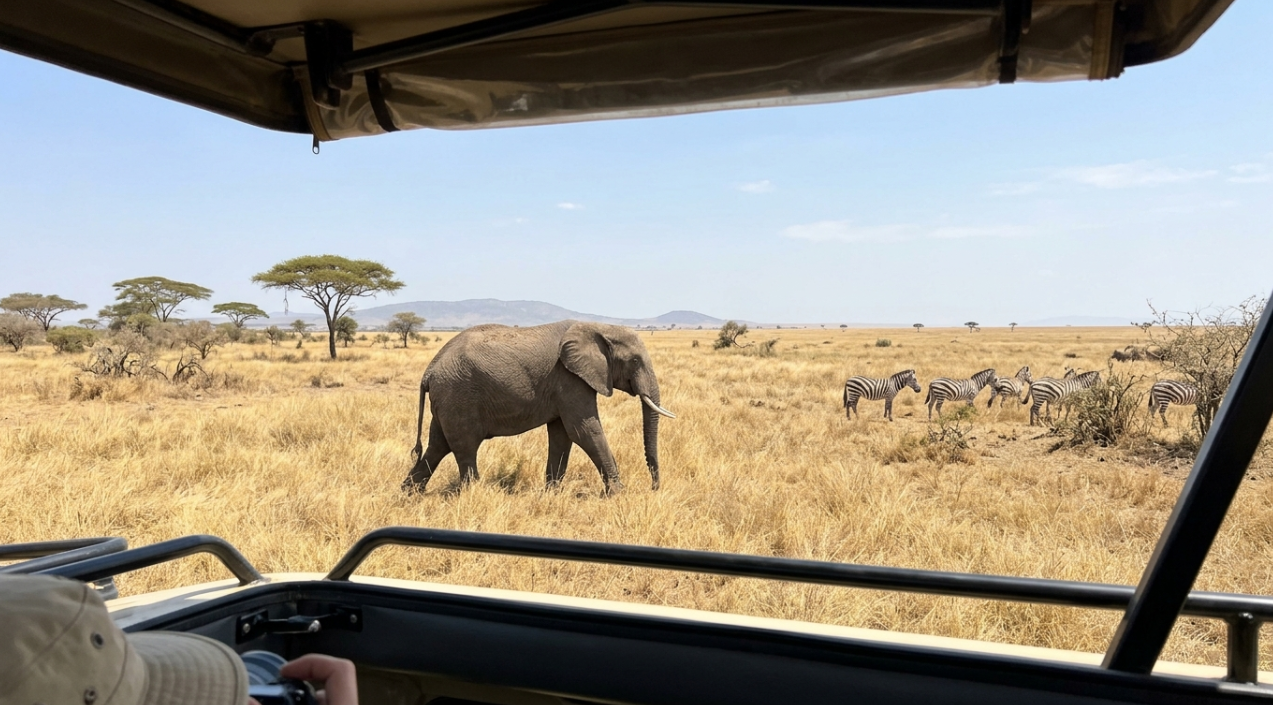
The core safari activity: driving through wildlife areas in an open-roof vehicle with a guide, typically in early morning (6:00 to 10:00 AM) and late afternoon (3:30 to 6:30 PM). Game drives work for all ages and fitness levels, which is why they’re the backbone of reunion safaris.
Walking Safari
A guided walk through the bush on foot with an armed ranger. Walking safaris offer a completely different perspective, but most operators require participants to be at least 12 or 16 years old. This makes them an activity that splits the reunion group by age, which is fine as long as it’s planned for.
Hot Air Balloon Safari
A sunrise balloon flight over the Serengeti, followed by a champagne bush breakfast. Spectacular but expensive ($500 to $600 per person) and restricted to passengers over a certain weight and age (typically 7 or older). For a reunion of 15, putting everyone in the balloon basket costs $7,500 to $9,000. Some reunion groups send a subset up while others do a morning game drive.
Bush Breakfast
A full breakfast set up in the wild, usually after an early morning game drive. The vehicles pull up to a spot where staff have arranged a table with linens, hot food, and coffee under an acacia tree. Bush breakfasts are included at many camps and work well as a reunion gathering moment.
Sundowner
Drinks at sunset, typically set up on a hillside or riverbank with chairs, a bar table, and a view. This is one of the most natural celebration moments on a reunion safari, where the whole group gathers with a glass in hand as the sun drops over the Serengeti.
Cultural Visit
A visit to a Maasai village or local community, often including traditional dance, conversation through a guide-translator, and a chance to see daily life. These visits work for all ages and give the reunion a shared experience beyond wildlife.
Great Migration
The annual movement of roughly 1.5 million wildebeest and hundreds of thousands of zebra through the Serengeti ecosystem. If your reunion timing overlaps with the migration (generally June through October in the Northern Serengeti for river crossings, December through March in the southern Serengeti for calving), it adds an unforgettable wildlife layer. Read more in the Serengeti safari guide.
Celebration and Special Touches
This is where a reunion safari separates from a standard group trip. Most quality safari camps can arrange celebration elements that turn a wildlife holiday into a genuine family milestone. These terms rarely appear in standard safari glossaries, but they’re essential for reunion planning.
Bush Dinner
A multi-course dinner set up outdoors, often under a canopy of stars or lanterns, away from the main camp dining area. The camp’s chef prepares a special menu, the table is set with full place settings and candles, and the sounds of the bush replace background music. For reunion groups with exclusive-use bookings, bush dinners can be arranged at the property itself or at a scenic spot nearby.
Private Sundowner
A sundowner setup exclusively for your group, with drinks, snacks, and sometimes a fire, at a scenic location chosen by the guide. Ideal for toasts, group photos, or simply a quiet hour together.
Celebration Setup
A catch-all term for what camps can arrange for birthdays, anniversaries, or the reunion itself. This might include a decorated dining table, a cake (ordered in advance through your operator), custom menus, a bonfire gathering, or even a local choir performance. The key is giving the camp enough advance notice so they can source what’s needed.
Private Chef
Some exclusive-use properties offer a dedicated chef who can customize menus to the group’s dietary needs and preferences. This is particularly valuable for reunions where ages range from 11 to 70+ and food preferences vary widely.
Group Photography
Several camps offer guided photography sessions or can arrange for a professional photographer to document the reunion. Given the setting, these photos tend to become the family images that hang on walls for decades. For photography-focused groups, the safari photography gear guide covers what to bring.
Booking and Logistics
Custom Safari
A fully tailor-made itinerary designed around your group’s specific dates, ages, interests, and budget, as opposed to a pre-set group departure. Every reunion safari should be custom-built.
One past traveler described the planning process this way: the operator “planned the perfect safari with the right amount of days at each park and listened to what type of accommodations we needed, not so high end, not so basic.” That collaborative design process is what makes a reunion work. Different families have different expectations, and the itinerary needs to accommodate all of them.
Booking Lead Time
How far in advance you need to book. Exclusive-use properties and multi-room blocks at popular camps during peak season (June through October) fill 8 to 12 months ahead. For a reunion safari in Tanzania, early booking isn’t just recommended; it’s often the difference between getting the property you want and settling for a Plan B.
Forum users on Fodor’s repeatedly warn against procrastinating on bookings for large groups. One commenter discussing a 9-person family emphasized the vehicle question: “Also, please tell me that you will be in two vehicles, rather than 10 people in a single vehicle.” The same urgency applies to accommodation, where popular exclusive-use properties have limited inventory.
Deposit Structure
Most operators require a 25 percent deposit at booking, with the balance due 60 to 90 days before arrival. For a reunion totaling $30,000 to $50,000 or more, that initial deposit represents a significant commitment, so the lead traveler should have financial coordination sorted out before confirming.
Travel Insurance
Non-negotiable for reunion groups. Policies should cover trip cancellation (with various family members, someone’s health issue could cancel the trip for everyone), medical evacuation from remote safari areas, and emergency medical treatment. Multi-age groups need to verify that policies cover travelers across the full age range, from children to grandparents, as some policies have upper age limits or require medical screening for travelers over 70. For more on coverage specifics, see the Tanzania travel insurance guide.
Tanzania e-Visa
All non-East African visitors need a visa. Tanzania’s e-Visa system allows online application before travel. The lead traveler should send application instructions and deadlines to the entire reunion group well in advance, because someone will inevitably leave it to the last week.
Best Time of Year
The dry season, June through October, remains the standard recommendation for family reunion safaris. Warm days, cool evenings, minimal rain, and animals concentrated around water sources make for excellent game viewing. The best time for a Tanzania safari guide covers month-by-month trade-offs.
However, reunion organizers are often constrained by school holidays across multiple families in different school systems. The reality is that your reunion will happen when the most people can attend, not when the wildlife calendar is theoretically perfect. Tanzania delivers strong game viewing year-round on the Northern Circuit.
Frequently Asked Questions
How many vehicles does a family reunion of 10 to 15 need?
For the best experience, plan on one vehicle for every four passengers. A reunion of 10 should have at least three vehicles; a group of 15 needs four. You can fit six per vehicle to cut costs, but everyone’s comfort and viewing angles suffer. Two vehicles is the absolute minimum for any group of eight or more.
Can we book an entire lodge for our reunion?
Yes. Many smaller tented camps (6 to 12 tents) and safari houses in Tanzania offer exclusive-use buyouts. This gives your group total privacy, flexible meal times, and the freedom to set your own game drive schedule. Availability is limited during peak season, so booking 8 to 12 months ahead is important.
What does a family reunion safari in Tanzania cost per person?
Expect $350 to $500 per person per day for a private, tailor-made safari. Per-person costs drop with larger groups because vehicle and guide fees are shared. A 7-day reunion for 12 people might run $2,200 to $4,000 per person depending on accommodation tier, while the same itinerary for a couple could cost $4,000 to $7,000 per person.
Are there age restrictions for children on safari?
Game drives in private vehicles have no age limit. Walking safaris typically require participants to be 12 to 16 or older. Hot air balloon rides usually start at age 7. Many upscale tented camps set minimum ages of 5 to 12, but exclusive-use bookings usually waive these restrictions.
How far in advance should we book a reunion safari?
Eight to twelve months is the safe window, especially for peak season (June through October). Exclusive-use properties have limited availability, and multi-room blocks at popular camps disappear quickly. The more people in your group, the earlier you should lock in dates.
Can a reunion safari include Zanzibar?
Absolutely. A Zanzibar beach extension of three to five days after the safari is one of the most popular ways to round out a reunion trip. It gives the group unstructured time together, which is harder to find during busy game-drive days. Direct flights connect Serengeti and Arusha to Zanzibar in about an hour.
What information do we need to start planning?
A reunion organizer should gather: approximate travel dates, total number of travelers, ages of all children, preferred trip length (7 to 14 days is typical), budget expectations per family unit, accommodation preferences, any mobility limitations, and whether the trip marks a specific celebration like a birthday or anniversary.
Reunion organizers who want to turn this planning into a real itinerary can share their group details, travel dates, and celebration goals with Duma Explorer, which designs custom reunion safaris across Tanzania’s Northern Circuit.