

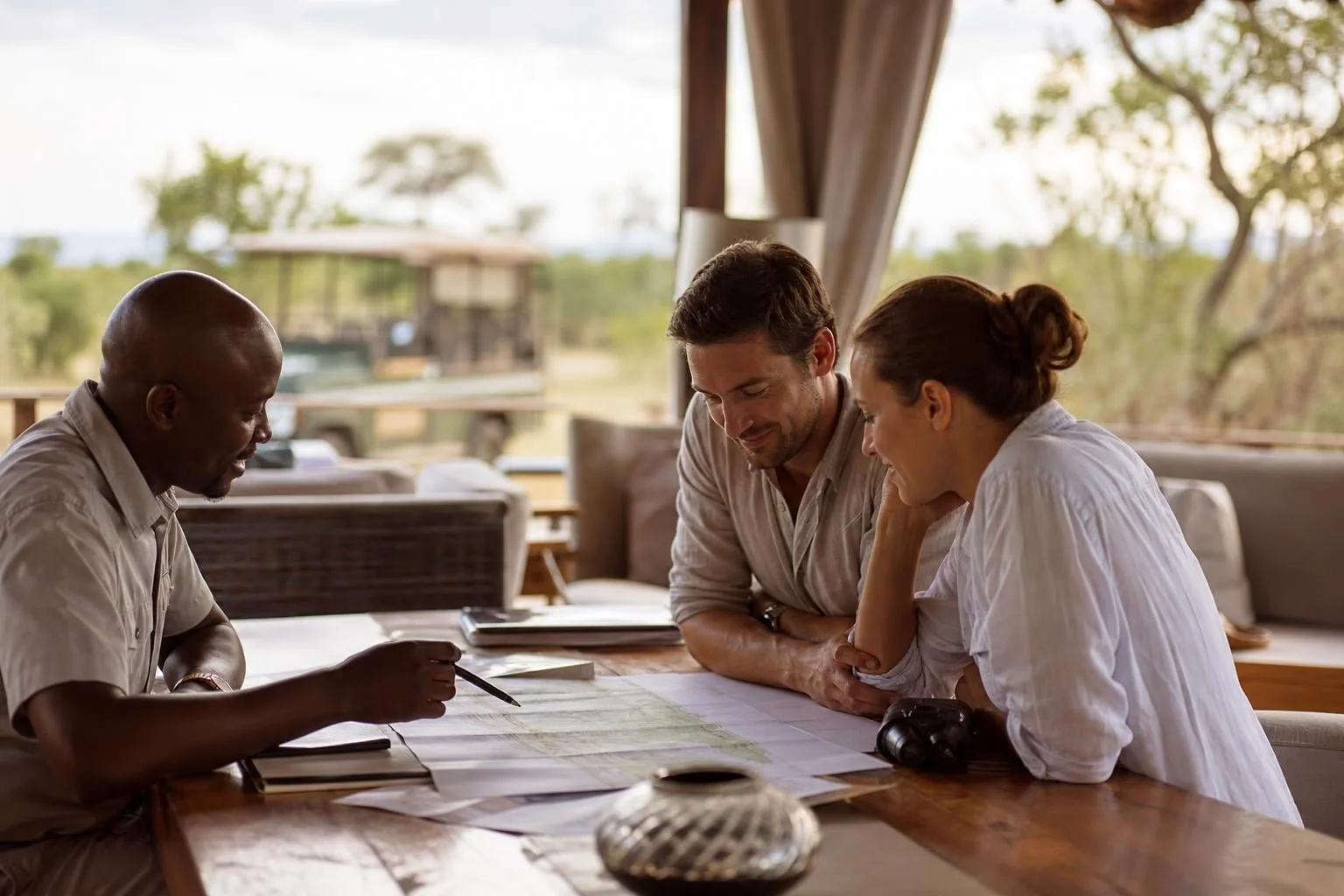
A luxury safari concierge in Tanzania is a dedicated planning and coordination service that manages the details of a high-end safari, including personalized itineraries, luxury lodge reservations, private safari vehicles, expert guides, domestic flights, park arrangements, and in-country assistance. Depending on the operator, concierge support may be provided by a dedicated trip planner, a local operations team, or a traveling concierge who accompanies guests throughout their journey.
Unlike a traditional booking service, a full-service safari concierge coordinates the entire travel experience, from initial planning and accommodation selection to airport arrivals, game drives, itinerary adjustments, and departure arrangements.
The short version: “Luxury safari concierge” gets used loosely across the industry. Some operators mean a pre-trip planning advisor. Others mean someone who travels with you. A few mean an integrated team that handles everything from first conversation to airport departure. This guide breaks down the vocabulary so you can evaluate what you’re actually being offered.
Luxury Safari Concierge Tanzania: At a Glance
|
Question |
Quick Answer |
|---|---|
|
What is it? |
A personalized safari planning and coordination service |
|
What does it include? |
Itinerary design, accommodation, transport, guides, and logistics |
|
Is it available locally? |
Yes, through Tanzania-based safari operators and their local teams |
|
Is a private vehicle included? |
Often, but this must be confirmed in the itinerary quotation |
|
Does it include a personal escort? |
Not necessarily. Some services provide remote coordination rather than a traveling concierge |
|
When should you book? |
Ideally 8–12 months ahead for popular peak-season properties |
|
Who benefits most? |
Families, couples, private groups, luxury travelers, and guests with complex itineraries |
What “Luxury Safari Concierge” Actually Means
The term “concierge” appears on dozens of operator websites, but it describes at least four distinct service models. Understanding the differences is the single most important thing you can do before committing to any provider.
Pre-trip design concierge. This person becomes your main point of contact after you book. They gather preferences, dietary requirements, and flight details, then coordinate logistics before you travel. You interact with them extensively during planning but may never meet them in person.
In-destination concierge. Some operators deploy a representative who checks in with you during the trip, liaising with lodge staff and transportation partners to anticipate each arrival. This person doesn’t travel with you but monitors your journey from a local base.
Escorted concierge. A dedicated traveling concierge accompanies you throughout the safari, managing logistics and addressing requests in real time. African Travel, Inc. introduced this model for their 2025 “Concierge Safaris,” with a U.S.-based concierge handling everything from restaurant reservations to personal matters on the ground.
Full-service operator (design + ground handling). This is the most comprehensive model: owner-led trip design combined with local ground operations, covering everything from itinerary creation through in-country execution. The concierge function isn’t siloed into a single role. It’s distributed across the team.
The distinction matters because when an operator says “concierge service,” they might mean any of these four things. Ask specifically which model applies before comparing prices.
If you’re weighing whether to plan your own Tanzania safari or work with an operator who handles every detail, Duma Explorer designs private luxury itineraries with a team that knows these parks and lodge networks firsthand.
What Does a Luxury Safari Concierge in Tanzania Include?
A luxury safari concierge coordinates the services required to create a seamless safari experience. The exact scope depends on the operator, but comprehensive concierge support typically covers six areas.
1. Personalized Safari Planning
The planning process starts with understanding your travel preferences, interests, budget, and expectations. A concierge uses this information to recommend suitable parks, accommodation, travel dates, and activities.
This may include:
-
Personalized Northern or Southern Circuit itineraries.
-
Great Migration safari planning.
-
Private family and honeymoon safaris.
-
Photography-focused wildlife experiences.
-
Safari and Zanzibar combinations.
-
Multi-country East African itineraries.
2. Luxury Accommodation Coordination
A concierge identifies and coordinates accommodation based on your preferred comfort level, location, and wildlife priorities.
Services may include:
-
Luxury safari lodge reservations.
-
Premium tented camp arrangements.
-
Private villas and exclusive-use properties.
-
Mobile camp reservations.
-
Dietary and accessibility requests.
-
Special occasion arrangements.
3. Private Transportation and Flight Arrangements
Transportation coordination is particularly important when visiting multiple parks.
Depending on your itinerary, this may include:
-
Private 4x4 Land Cruiser arrangements.
-
Kilimanjaro and Arusha airport transfers.
-
Domestic bush flights.
-
Inter-camp transfers.
-
Luggage and aircraft weight-limit guidance.
-
Flight disruption coordination.
4. Private Guides and Safari Experiences
The concierge coordinates the people and experiences that shape your safari.
These may include:
-
Experienced private driver-guides.
-
Wildlife photography guidance.
-
Walking safari arrangements.
-
Night game drives where permitted.
-
Hot air balloon safari reservations.
-
Cultural experiences and community visits.
5. In-Country Assistance
Once you arrive in Tanzania, the local operations team helps coordinate your itinerary and respond to unexpected changes.
This can include:
-
Airport meet-and-greet arrangements.
-
Lodge arrival coordination.
-
Flight and transfer updates.
-
Communication with accommodation providers.
-
Dietary and special requests.
-
Alternative arrangements when weather or operational disruptions affect travel.
6. Departure and Post-Safari Coordination
Concierge support should also cover the final stages of your trip.
Depending on the service agreement, this may include:
-
Final airport transfers.
-
International flight coordination.
-
Zanzibar departure arrangements.
-
Luggage assistance.
-
Confirmation of onward travel arrangements.
Important: Not every safari operator includes all these services automatically. Ask for a written breakdown of what is included, who provides it, and whether assistance is available throughout your trip.
Luxury Safari Concierge vs. Safari Planner vs. Travel Agent
Although these terms are sometimes used interchangeably, they describe different levels of involvement in organizing a Tanzania safari.
|
Service |
Main Responsibility |
Typical Involvement |
In-Country Support |
|---|---|---|---|
|
Travel Agent |
Books flights, accommodation, and travel packages |
Primarily booking and reservations |
Depends on the agency |
|
Safari Planner |
Recommends destinations, lodges, routes, and itineraries |
Planning and itinerary development |
May be provided through a local operator |
|
Safari Concierge |
Coordinates personalized travel arrangements and guest requests |
Planning, coordination, and ongoing assistance |
Depends on the service model |
|
Full-Service Safari Operator |
Designs and operates the safari through its own team or local partners |
Planning through trip execution |
Usually coordinated by an in-country operations team |
Which Service Should You Choose?
A traditional travel agent may be sufficient for straightforward travel arrangements. A safari planner can help when you need specialist destination knowledge and itinerary recommendations.
A luxury safari concierge is particularly useful when you want personalized coordination throughout the journey. This becomes more valuable when your itinerary includes several national parks, private guides, domestic flights, exclusive accommodation, or international extensions.
The most important distinction is not the title used by the company. It is the actual responsibility the company accepts before and during your safari.
The Five Markers of Concierge-Level Luxury
Luxury safari accommodation alone does not make a safari a luxury concierge experience. The quality of the overall journey depends on how well personalization, exclusivity, logistics, accommodation, and guiding work together.
Five characteristics help distinguish genuine concierge-level service from a standard luxury safari package.
|
Marker |
What It Means |
What to Look For |
|---|---|---|
|
Personal Attention |
Service tailored to individual preferences |
Dietary requests, flexible schedules, personal trip planning |
|
Exclusivity |
Greater privacy and control over the experience |
Private vehicles, exclusive-use camps, low-density concessions |
|
Time Efficiency |
Less time lost to unnecessary transfers |
Strategic routing, suitable bush flights, efficient park sequencing |
|
Quality of Accommodation and Transport |
Reliable, comfortable safari infrastructure |
Well-maintained vehicles, quality camps, dependable aircraft |
|
Expert Guiding |
Knowledgeable interpretation and wildlife expertise |
Experienced guides, photography awareness, tracking knowledge |
Why Your Private Safari Guide Matters
Accommodation determines where you stay, but your guide influences how you experience Tanzania's wilderness.
An experienced private driver-guide can interpret animal behavior, identify tracks, anticipate wildlife movements, explain ecological relationships, and position the vehicle for better viewing opportunities.
This is why guide selection should be an important part of the concierge planning process.
When comparing operators, ask whether you can request a guide with experience in your particular interests, such as wildlife photography, birding, family safaris, or specialized wildlife interpretation.
For more information, explore the private guide safari glossary.
Planning and Design Terms
Bespoke / Tailor-Made Safari
A custom-built itinerary designed around your dates, interests, group composition, budget, and pace, as opposed to a fixed-departure package tour where dates and routing are predetermined. In a concierge context, the bespoke process typically begins with a discovery conversation covering everything from wildlife priorities to how much driving you’re willing to tolerate in a day.
Safari Planner vs. Travel Agent vs. Concierge
These titles get used interchangeably, but they describe different levels of involvement. Experienced travelers on the Fodor’s forums note that the “agents” used by most safari planners are more like “safari planners” than traditional travel agents, because safari planning “is definitely not the sort of thing you can just pick out of a brochure.” A travel agent books what you ask for. A safari planner recommends what you should book based on expertise. A concierge handles the entire lifecycle: recommending, booking, coordinating, and managing through execution.
One forum contributor put it plainly: “I’ve used a travel agent when the logistics were beyond me.” That threshold, where logistics exceed your bandwidth, is exactly where concierge service becomes worth the premium.
Itinerary Architecture
How the sequence of parks, camps, and transfer methods shapes the overall experience. This is arguably the most underrated skill in luxury safari planning. The difference between a good itinerary and a great one often comes down to sequencing: which park you visit first, how you transition between ecosystems, and whether you end the trip on a high note or a logistical slog. For more detail on how luxury itineraries are structured in Tanzania, that page covers the topic in depth.
Lead Time
The advance planning window required to secure your preferred dates, camps, and guides. Average planning takes 4 to 12 weeks from first research to confirmed booking, but peak season (July through September) requires 8 to 12 months minimum. Popular camps and exclusive-use properties often sell out a year ahead. A concierge monitors availability and can flag when your window is closing.
Trip Design Consultation
The initial discovery conversation where a concierge gathers the information needed to build your itinerary: travel dates, budget range, group composition (adults, children, ages), interests (wildlife, photography, culture, relaxation), preferred pace, accommodation style, and any extensions you’re considering (Zanzibar, Kilimanjaro, gorilla trekking).
Pre-Departure Briefing
A pre-departure briefing is the final information session or communication provided before a guest travels to Tanzania. It covers practical arrangements such as airport arrival instructions, accommodation details, domestic flight restrictions, luggage limits, emergency contacts, and safari expectations.
A concierge should make sure guests understand their itinerary and know whom to contact if their travel arrangements change.
Guest Preference Profile
A guest preference profile is a record of the individual requirements and preferences collected during safari planning. It may include dietary restrictions, room preferences, preferred wake-up times, mobility requirements, wildlife interests, photography equipment needs, and special occasions.
This information helps the operator coordinate a more personalized experience across multiple lodges, camps, guides, and transport providers.
Accommodation Terms
Luxury Lodge
Permanent structures with full amenities: ensuite bathrooms, electricity, swimming pools, sometimes spa facilities. Lodges offer the most consistent comfort but are fixed in location, meaning they can’t follow wildlife movements.
Luxury Tented Camp
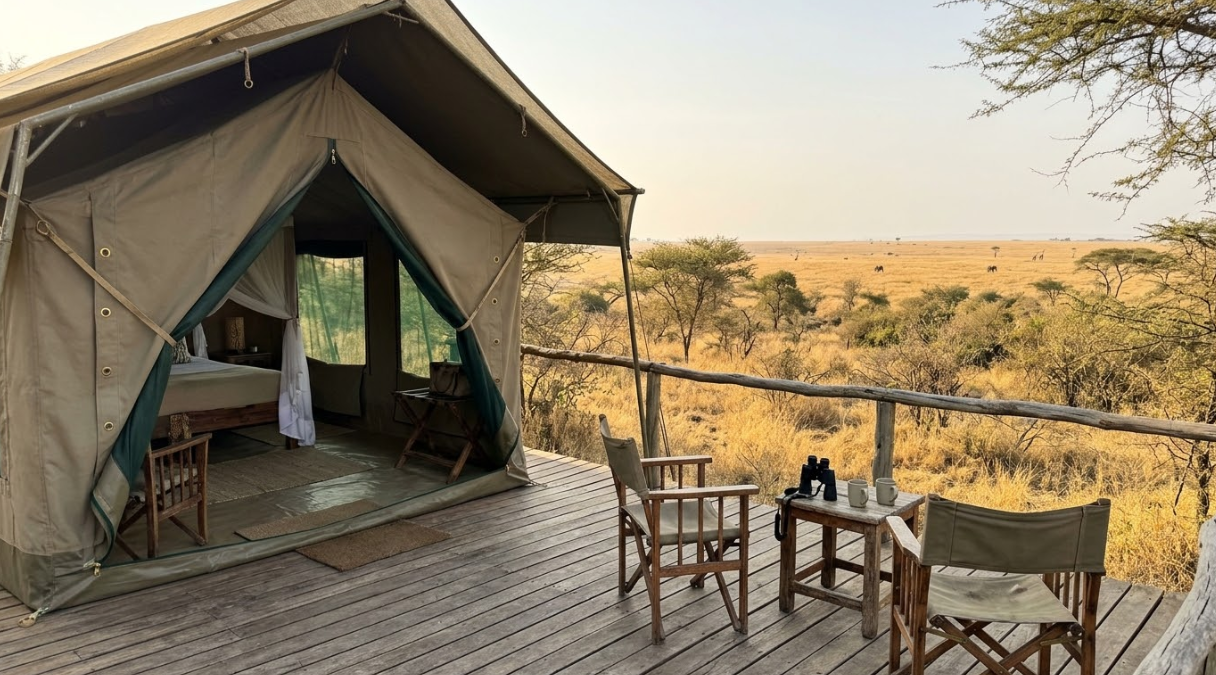
Canvas-sided accommodations that combine wilderness immersion with comfort. Think four-poster beds, hot showers, and gourmet dining, but with the sounds of the bush at night. These are permanent or semi-permanent structures, not the backpacking tents you’re imagining. For a guide to exclusive safari lodges in Tanzania, that resource covers property-level detail.
Mobile Tented Camp
Camps that physically relocate to follow wildlife movements, most notably the Great Migration in the Serengeti. These camps offer a more intimate experience with smaller guest numbers, but amenities are a step below permanent luxury camps.
Exclusive-Use Camp or Villa
An entire property booked for one party. This is the pinnacle of privacy: your group has the camp, its staff, guides, and vehicles entirely to yourselves. Pricing reflects this, but for families, celebrations, or groups who value privacy, it fundamentally changes the experience.
Concession Area
A concession area is a designated wildlife or conservation area where tourism activities operate under specific land-use agreements, management arrangements, or access permissions.
In Tanzania, some concessions are located within or alongside protected areas and provide access to more exclusive safari experiences. Depending on the location and applicable regulations, activities may include walking safaris, night drives, and off-road wildlife viewing.
Not every concession offers the same privileges. Ask your operator which activities are permitted in the specific area included in your itinerary.
Safari Logistics Terms
DMC (Destination Management Company)
The local ground operator. A DMC handles vehicles, guides, accommodation bookings, park permits, charter flights, and in-country coordination. For a Tanzania safari, the DMC is the single most important vendor in the chain. They determine vehicle allocation, guide quality, and lodge selection. When you book through an international concierge or travel advisor, a DMC is almost always doing the actual work on the ground. Some operators, including those with both international sales teams and local Tanzanian operations, function as their own DMC, which gives them more direct control over execution.
Ground Handling
All in-country logistics: vehicle provision, driver-guides, transfers between airports and camps, permit procurement, restaurant reservations, and coordination with lodge staff. Ground handling is where concierge service either proves itself or falls apart.
Fly-In Safari
Using bush flights instead of long road transfers between parks. Internal flights typically add $300 to $600 per person per leg, and a fly-in Southern Circuit itinerary adds roughly $600 to $1,200 per person compared to the drive-in equivalent. The trade-off is simple: you lose the scenic drive but gain hours of time in the bush instead of on a road. For travelers with limited days, this trade-off is almost always worth it.
Travelers coordinating fly-in transfers, multi-park routing, or extensions to Zanzibar or gorilla trekking can explore fly-in safari logistics in Tanzania for a detailed breakdown.
Transfer Day
A day primarily spent moving between locations. In poorly designed itineraries, transfer days eat into wildlife time. A well-designed luxury itinerary minimizes these through strategic fly-in routing or by sequencing nearby parks together.
Private Safari Vehicle
A dedicated 4x4 (typically a modified Toyota Land Cruiser) with your own driver-guide. This is non-negotiable at the concierge level. A private vehicle means you set the schedule: you can linger at a leopard sighting for an hour or leave early for breakfast without being governed by a group’s collective preferences.
Airport Meet-and-Greet
Your first point of contact on arrival. A representative meets you at Kilimanjaro International Airport (JRO), handles luggage, confirms onward logistics, and transfers you to your first hotel or camp. The concierge function starts here, not at the first game drive.
Domestic / Bush Flight
Small aircraft (often Cessna Caravans) connecting parks via grass or dirt airstrips. Soft-sided luggage is required, typically with a 15kg limit. This catches first-timers off guard, and a concierge flags it weeks before departure so you’re not repacking at the airport.
Meet-and-Greet Representative
A meet-and-greet representative is a person assigned to welcome guests at an airport or designated arrival point and help coordinate their onward transfer.
This service may include luggage assistance, identifying the correct driver, confirming transfer details, and helping travelers navigate their arrival arrangements.
Safari Operations Coordinator
A safari operations coordinator manages the practical execution of a booked itinerary. Responsibilities may include communicating with lodges, coordinating vehicles and guides, monitoring transfer schedules, and responding to operational changes.
Unlike a trip designer, who primarily focuses on planning, the operations coordinator concentrates on making sure the confirmed arrangements work during the journey.
24/7 Safari Support
24/7 safari support refers to the availability of an operator's designated contact or emergency coordination team outside normal office hours.
It is particularly relevant when guests are traveling between remote camps, taking domestic flights, or experiencing unexpected itinerary disruptions.
Travelers should confirm whether this means a continuously staffed contact service or an emergency number monitored by an on-call team.
Wildlife and Experience Terms
Great Migration Timing
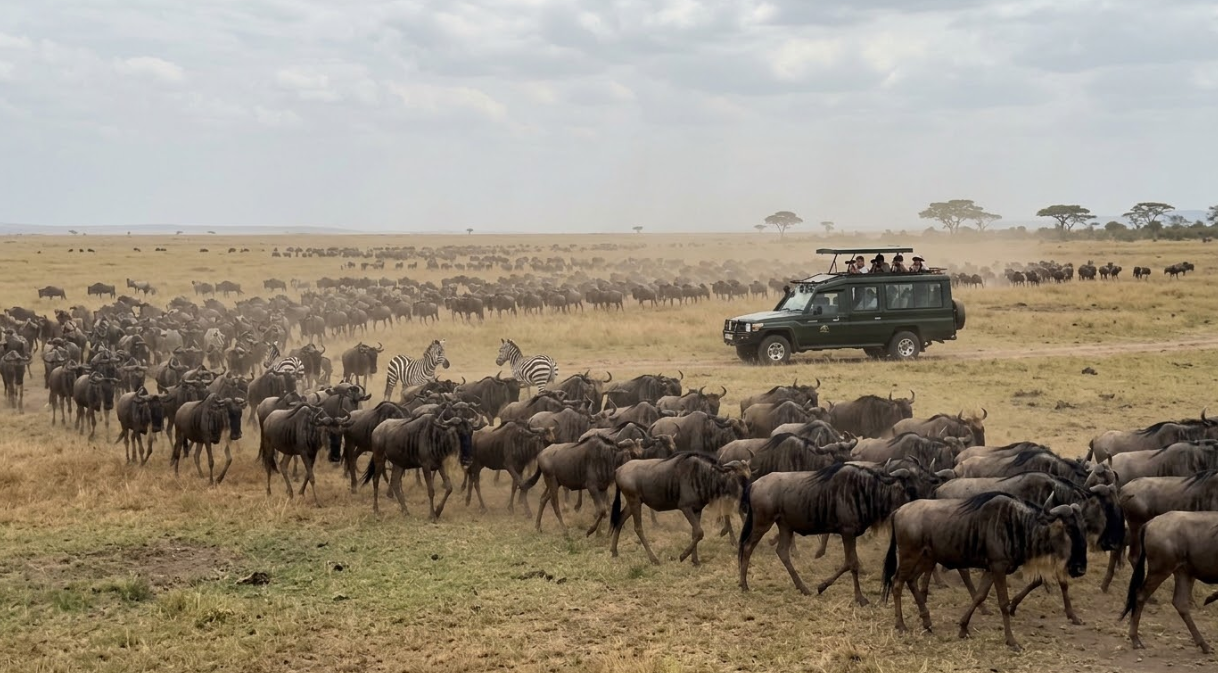
The annual movement of roughly 1.5 million wildebeest and hundreds of thousands of zebra through the Serengeti ecosystem. Where the herds are at any given time depends on rainfall patterns, and getting this wrong means you’re in the right park at the wrong time. Concierge-level knowledge of seasonal herd positions is one of the most tangible benefits of working with someone who operates on the ground in Tanzania year-round. For detailed timing guidance, the Great Migration safari guide covers month-by-month positioning.
Game Drive
Wildlife viewing from a vehicle, typically in early morning (6:00-6:30 AM departure) and late afternoon (3:30-4:00 PM departure). Some parks and concessions allow full-day drives with a packed lunch, giving you flexibility to stay out when the action is good.
Walking Safari
A guided bush walk with an armed ranger. Walking safaris shift the experience from vehicle-based observation to immersive engagement with the landscape: tracking, reading signs, understanding ecology at ground level. Available in select parks and most concession areas.
Night Game Drive
Vehicle-based wildlife viewing after dark using spotlights. Available only in certain parks (Tarangire, Lake Manyara, Nyerere) and most private concessions. Night drives reveal an entirely different cast of characters: aardvarks, bush babies, leopards hunting, and nocturnal birds.
Bush Dinner / Sundowner
Special-occasion meals arranged in a wilderness setting, often on a river bank or kopje at sunset. A sundowner is specifically a sunset drink in the bush. These are standard concierge-level arrangements at luxury camps and one of the experiences that distinguishes a curated safari from a transactional one.
Hot Air Balloon Safari
A premium Serengeti experience: a dawn flight over the plains followed by a champagne bush breakfast. Typically $500 to $600 per person. Availability is limited, and a concierge books this early in the planning process to lock in your preferred date.
Financial and Regulatory Terms
Park Fees (TANAPA)
Government-set, non-negotiable entry fees charged per person per day. These fees are substantial: TANAPA rates range from around $30 per day for less-visited parks like Udzungwa and Mkomazi to $70 to $85 per day for Ngorongoro and $59 to $82 for the Serengeti. Park fees alone for a 7-day Northern Circuit safari can exceed $500 per person. A concierge builds these into your quote transparently so there are no surprises.
Concession Fees
Per-night charges assessed by the government for lodges and camps operating inside national parks and conservation areas. These fees are passed through to guests as part of accommodation costs.
Ngorongoro Crater Service Fee
A $295 per-vehicle charge to descend into the Ngorongoro Crater. This is on top of the per-person conservation area fee. It’s a significant line item that some operators bury in fine print and others disclose upfront. Ask.
All-Inclusive vs. Partially Inclusive Pricing
What the quoted price actually covers matters enormously. “All-inclusive” in the safari context usually means accommodation, meals, house drinks, game drives, and park fees. “Partially inclusive” might exclude premium drinks, spa treatments, balloon flights, laundry, or gratuities. A concierge-level quote spells out what’s in and what’s out.
For a detailed breakdown of luxury Tanzania safari costs, that guide covers pricing at every tier.
Gratuities / Tipping
Almost never included in the safari price. Tipping norms in Tanzania follow general guidelines ($15 to $25 per group per day for a driver-guide, $10 to $15 per day for camp staff), but these vary by property and service level. A concierge team typically provides a tipping guide before departure so you’re prepared. The Tanzania safari tipping guide covers current norms.
Safari Supplement
A safari supplement is an additional charge applied to a booking under particular circumstances. Common examples include single-occupancy supplements, seasonal accommodation surcharges, festive-season supplements, and additional costs for exclusive-use arrangements.
When comparing luxury safari quotations, ask whether the price is based on two people sharing a room and whether any seasonal or occupancy supplements apply.
Non-Refundable Deposit
A non-refundable deposit is an initial payment that cannot normally be recovered if a guest cancels under the agreed booking terms.
Safari operators may use deposits to secure accommodation, flights, permits, and other arrangements with third-party suppliers. Always review the cancellation and refund conditions before making payment.
Travel Insurance and Evacuation Cover
Travel insurance helps protect travelers against eligible financial losses and unexpected travel disruptions, depending on the policy.
For remote safari travel, it is important to understand whether your policy covers medical emergencies, emergency evacuation, trip interruption, and activities included in your itinerary.
A concierge can explain the insurance requirements relevant to your trip, but travelers should verify coverage directly with their insurance provider.
Guide and Safety Terms
Driver-Guide
A combined driver and wildlife guide who both operates the vehicle and provides wildlife interpretation. This is the most important human element of the safari. A great driver-guide reads animal behavior, anticipates movement, positions the vehicle for photography, and tells stories that turn sightings into understanding. At the luxury concierge level, guide assignment is not random. It’s matched to your interests.
FGASA Certification
Field Guides Association of Southern Africa qualification. Increasingly adopted by East African operators as a benchmark for advanced wildlife interpretation training. FGASA certification signals that a guide has been formally assessed on ecological knowledge, tracking, and interpretive skills beyond basic driver training.
Wilderness First Responder (WFR)
An emergency medical certification relevant for Kilimanjaro climbs and remote safari operations. WFR-trained guides can assess injuries, manage medical emergencies, and make evacuation decisions, which matters when you’re hours from a hospital. Learn more about guide qualifications including FGASA and WFR.
KPAP (Kilimanjaro Porters Assistance Project)
A porter welfare verification organization. KPAP partnership signals that an operator pays fair wages, provides proper equipment, and limits porter loads. This matters for Kilimanjaro climbs specifically, but it also indicates broader operational ethics.
KPSGA Certification
The Kenya Professional Safari Guides Association (KPSGA) provides professional guide training and certification in Kenya.
It is important to distinguish KPSGA from Tanzanian guide qualifications. When booking a Tanzania safari, ask about the guide's relevant Tanzanian professional qualifications, practical experience, language ability, and specialist knowledge.
Emergency Evacuation Plan
An emergency evacuation plan describes the arrangements for responding to a medical or safety emergency in a remote safari location.
Depending on the situation, this may involve coordinating local medical assistance, ground transportation, or an air evacuation service.
Guests should confirm whether emergency evacuation arrangements are included in their travel insurance or booking and understand which organization is responsible for coordinating assistance.
Extensions and Combinations
Safari + Zanzibar
The classic bush-and-beach combination. Flights from the Serengeti or Arusha to Zanzibar are short (60 to 90 minutes), making this an easy extension. The concierge value is in timing: matching your safari endpoint with available flights and ensuring your Zanzibar accommodation aligns with the right coast for your travel season. See the safari and Zanzibar combination planning guide for a detailed walkthrough.
Kilimanjaro + Safari
Requires Arusha as a staging point. The logistics are cleanest when both halves share the same operator, avoiding handoff confusion between separate companies for the climb and the safari. Most travelers do the climb first and safari second, since you’ll want to recover on game drives rather than tackle a mountain on tired legs.
Gorilla Trekking Extension
Adding Uganda or Rwanda to a Tanzania safari creates a multi-country trip with significant logistical complexity: gorilla permits ($700 in Uganda, $1,500 in Rwanda), regional flights, border logistics, luggage limits, trekking fitness requirements, and weather considerations across different regions. This is precisely the scenario where concierge coordination justifies its cost. A local operator noted that international operators are particularly valuable for “a very complex multi-country trip.”
Maasai Mara Add-On
A cross-border Kenya extension for Migration viewing or predator concentrations. Requires flight coordination between the Serengeti and the Mara, different park fee structures, and sometimes visa considerations depending on your nationality and entry points.
How Concierge Service Changes the Actual Experience
A Business Insider contributor traveling solo on a luxury Tanzania safari observed that staff members at each lodge made decisions for her, and concluded: “I could’ve been more decisive, but I didn’t have to be, and that was a luxury.” That observation captures the experiential definition of what a luxury safari concierge in Tanzania actually provides. The service isn’t about having someone carry your bags. It’s about removing decisions you shouldn’t have to make.
Practitioners on safari forums echo this. Safari guides often play a concierge role behind the scenes, managing logistics so you can stay fully present. Your guide is, in many ways, your private concierge in the wild.
One traveler reviewing a concierge-level experience noted that “with the one-stop concierge service, you don’t need to worry about anything, even if it’s your first time visiting beautiful Tanzania.” Another described the feeling as knowing they were “in the hands of a very professional organisation” from the moment they landed at Kilimanjaro Airport until they departed from Zanzibar.
What Information a Concierge Needs From You
The quality of a bespoke itinerary depends directly on the quality of the initial conversation. Expect a luxury safari concierge in Tanzania to ask about:
-
Travel dates and flexibility. Fixed dates narrow options. Flexible dates unlock better camps and pricing.
-
Group composition. Number of adults, children and their ages, any mobility considerations.
-
Trip duration. How many total days, including travel days.
-
Budget range. Not an exact number, but a range that lets the concierge match you to the right tier.
-
Accommodation preferences. Lodges, tented camps, or a mix. Willingness to try mobile camps.
-
Safari priorities. Big cats, Great Migration, birding, photography, cultural visits, or general wildlife.
-
Extensions. Zanzibar beach time, Kilimanjaro, gorilla trekking, Maasai Mara.
-
Pace. Do you want to maximize game time, or do you prefer a slower rhythm with pool time and spa visits between drives?
-
Special occasions. Honeymoons, anniversaries, birthdays, proposals.
How Does the Luxury Safari Concierge Process Work?
A luxury safari concierge typically follows a structured process, beginning with an initial consultation and ending with departure coordination.
Understanding these stages helps travelers know what to expect when working with a Tanzania safari operator.
Step 1: Initial Consultation
The process begins with a discussion about your travel dates, budget, group size, accommodation preferences, wildlife interests, and expectations.
The concierge uses this information to understand what kind of safari you want to experience.
Step 2: Destination and Itinerary Recommendations
Based on your preferences, the team recommends suitable national parks, conservation areas, lodges, camps, and travel routes.
For example, a traveler interested in the Great Migration may need a different itinerary from someone prioritizing elephants in Tarangire or remote wilderness experiences in Nyerere National Park.
Step 3: Accommodation and Availability Coordination
The concierge checks accommodation availability and coordinates reservations based on your preferred dates.
For peak-season travel, this stage may involve considering alternative camps or adjusting the itinerary to secure suitable properties.
Step 4: Transportation and Experience Planning
The team coordinates private vehicles, driver-guides, domestic flights, airport transfers, and optional experiences.
This is also when luggage restrictions, flight connections, park entry arrangements, and special requests should be clarified.
Step 5: Pre-Departure Preparation
Before traveling, guests should receive the practical information needed for their journey.
This may include:
-
Final itinerary and accommodation confirmations.
-
Airport arrival instructions.
-
Domestic flight and luggage requirements.
-
Packing recommendations.
-
Emergency contact information.
-
Payment and tipping guidance.
-
Relevant travel and park information.
Step 6: In-Country Coordination
Once you arrive, the local operations team coordinates transfers, lodge arrivals, game drives, and other scheduled arrangements.
If unexpected changes occur, the team communicates with relevant suppliers and helps arrange alternatives where possible.
Step 7: Departure Coordination
At the end of your safari, the concierge coordinates the final transfer and any onward travel arrangements included in your booking.
The objective is simple: You should know who is responsible for each stage of your journey, who to contact when something changes, and what support is included in your booking.
How to Choose a Luxury Safari Concierge in Tanzania
Choosing a luxury safari concierge involves more than comparing accommodation photographs and package prices. You need to understand who will organize your trip, who will operate it on the ground, and what support you will receive after arriving in Tanzania.
Use the following criteria when comparing safari operators.
1. Verify Local Operational Experience
Ask whether the company has a Tanzania-based operations team or works through independent ground-handling partners.
A locally experienced team may have practical knowledge of park logistics, seasonal travel conditions, accommodation networks, and domestic flight arrangements.
2. Understand Who Will Manage Your Safari
Find out whether your initial trip planner will remain involved after booking or whether your reservation will be transferred to another team.
You should know who is responsible for coordinating your itinerary and who to contact during the safari.
3. Ask About Private Guides and Vehicles
Confirm whether your booking includes a private safari vehicle and dedicated driver-guide.
Ask about vehicle capacity, maintenance, charging facilities, photographic modifications, and whether the guide can be matched to your interests.
4. Request an Itemized Itinerary and Quotation
A professional operator should explain what the quoted price includes.
Check accommodation, meals, park fees, conservation fees, transportation, flights, activities, drinks, and optional experiences.
5. Check Emergency and Disruption Support
Ask what happens if a domestic flight is canceled, a vehicle develops a mechanical problem, or weather affects your itinerary.
Find out whether assistance is available outside normal business hours and whether the company has an established alternative-arrangement process.
6. Review Independent Guest Feedback
Look for reviews that describe the actual planning and operating experience, rather than focusing exclusively on accommodation quality.
Pay particular attention to comments about communication, guide knowledge, punctuality, problem resolution, and coordination.
7. Understand the Payment and Cancellation Terms
Before paying a deposit, review the payment schedule, cancellation policy, refund conditions, and any non-refundable supplier charges.
Make sure the company explains which arrangements are confirmed and which remain subject to availability.
Luxury Safari Concierge Evaluation Checklist
|
Question to Ask |
Why It Matters |
|---|---|
|
Do you have a local Tanzania operations team? |
Establishes who handles in-country arrangements |
|
Is my safari vehicle private? |
Clarifies exclusivity |
|
Can I request a specific guide profile? |
Helps match guiding expertise to your interests |
|
Who handles flight disruptions? |
Establishes operational responsibility |
|
Are park fees included? |
Prevents unexpected costs |
|
Is assistance available during the safari? |
Clarifies support arrangements |
|
What is your cancellation policy? |
Protects your booking expectations |
|
Can I receive an itemized quotation? |
Makes comparisons easier |
A reliable concierge should be able to explain these details clearly before you commit to a booking.
Is a Luxury Safari Concierge in Tanzania Worth the Cost?
A luxury safari concierge can be worthwhile for travelers who value personalized planning, coordinated logistics, private experiences, and assistance throughout their journey.
The value becomes particularly noticeable when an itinerary involves several destinations, exclusive accommodation, domestic flights, or multiple travel arrangements.
When Concierge Services Are Most Valuable
Multi-park itineraries: Visiting several destinations requires careful coordination of accommodation, vehicles, park arrangements, and transfers.
Great Migration safaris: Seasonal wildlife movements influence where travelers should stay and when they should visit particular areas.
Family safaris: Families may need child-friendly accommodation, flexible game drives, dietary arrangements, and activities suitable for different ages.
Honeymoons and special occasions: Private dinners, special accommodation arrangements, and personalized experiences often require advance coordination.
Fly-in safaris: Multiple bush flights introduce luggage restrictions, departure schedules, and transfer arrangements that need to work together.
Multi-country itineraries: Combining Tanzania with Kenya, Uganda, or Rwanda introduces additional flights, permits, border requirements, and accommodation arrangements.
When You May Not Need a Concierge
A full-service concierge may be less important if you are planning a straightforward itinerary, staying at one or two established properties, and are comfortable arranging your own transportation and activities.
Some lodges and established safari operators already provide substantial guest coordination within their standard packages.
What Should Determine the Value?
Rather than judging concierge services by an advertised premium, consider:
-
How much planning responsibility the company accepts.
-
Whether you receive a dedicated point of contact.
-
Whether the operator has reliable local ground support.
-
Whether private guiding and transportation are included.
-
How unexpected travel disruptions are handled.
-
Whether the quotation clearly explains all inclusions.
Ultimately, concierge service is most valuable when it removes logistical complexity while allowing you to enjoy a more personalized safari experience.
Frequently Asked Questions About Luxury Safari Concierge Services in Tanzania
What does a luxury safari concierge in Tanzania actually do?
A luxury safari concierge coordinates the planning and practical arrangements of a personalized Tanzania safari. Services may include itinerary design, lodge reservations, private safari vehicles, driver-guides, domestic flights, airport transfers, dietary requests, and in-country assistance. The exact level of support depends on the operator and the service agreement.
How is a safari concierge different from a travel agent?
A travel agent primarily assists with travel bookings, while a safari planner specializes in recommending destinations, accommodation, and itineraries. A safari concierge typically provides broader coordination, potentially including pre-trip planning, in-country assistance, and special arrangements throughout the journey.
How much does a luxury safari concierge in Tanzania cost?
There is no universal concierge service fee. Some operators incorporate planning and coordination into their safari packages, while others charge separately. The total cost depends on accommodation, season, group size, transportation, park fees, activities, and the level of personalized service.
When should I book a luxury Tanzania safari?
For popular peak-season travel between July and September, starting 8–12 months ahead is a useful guideline, particularly when you want specific luxury camps or exclusive-use properties. Less competitive travel dates may allow shorter planning windows, depending on availability.
Do I need a concierge if I have been on safari before?
Not necessarily. Experienced safari travelers may need less introductory guidance, but concierge support can still be valuable for complex itineraries, private photographic experiences, remote camps, and multi-country travel arrangements.
Can a luxury safari concierge arrange a Tanzania and Zanzibar combination?
Yes. Many Tanzania safari operators can coordinate a mainland safari followed by a Zanzibar beach stay. Arrangements may include domestic flights, airport transfers, accommodation reservations, and onward transportation. The itinerary should account for flight schedules and the location of your chosen Zanzibar accommodation.
Can a safari concierge arrange private guides and vehicles?
Yes, many luxury safari operators can arrange a private 4x4 vehicle and dedicated driver-guide. Confirm whether the vehicle is exclusively assigned to your group, how many passengers it accommodates, and whether the guide can be selected according to your interests.
Is a traveling concierge included in every luxury safari?
No. Concierge service does not automatically mean that someone accompanies you throughout the safari. Some operators provide pre-trip planning and remote in-country coordination, while others offer an escorted service with a traveling concierge. Confirm the exact arrangement before booking.
What happens if a domestic flight is canceled during my safari?
Your operator or designated ground operations team should help coordinate alternative arrangements, depending on the circumstances and your booking agreement. This may involve contacting the airline, adjusting transfers, notifying accommodation providers, and revising the itinerary.
Ask about disruption procedures before booking so you understand who is responsible for assistance and any additional costs.
What information should I provide when requesting a custom safari itinerary?
Provide your intended travel dates, number of travelers, ages of children if applicable, approximate budget, preferred accommodation level, wildlife interests, and desired trip duration. Mention any extensions, dietary requirements, mobility considerations, and special occasions.
This allows the concierge to recommend an itinerary that reflects your priorities rather than sending a generic package.
How do I know whether a Tanzania safari operator provides genuine concierge service?
Ask who handles your itinerary, whether the company has a local operations team, whether private guiding and transportation are included, and what assistance is available during the trip. Request a detailed itinerary and written quotation that clearly identifies the services being provided.
Ready to start the conversation? Duma Explorer designs private Tanzania safaris with an integrated team handling trip design and ground operations. Share your dates, group size, and priorities, and the team will map out an itinerary before you commit to anything.