

TL;DR
A luxury safari itinerary in Tanzania is a custom route through the country’s top wildlife parks using premium camps ($700–$2,500+ per person per night), private guides, and logistics designed around exclusivity, wildlife timing, and personal preferences. The word “luxury” gets applied loosely in safari marketing. In Tanzania, the distinction that actually matters is not thread count or lobby chandeliers. It is where you are, how few people are around you, and the quality of the person guiding you through it.
This glossary defines 35+ terms you will encounter while comparing luxury Tanzania safari quotes and building an itinerary. It covers accommodation tiers, pricing vocabulary, transport decisions, wildlife timing, park zones, and activity options, all specific to the luxury level. If a term appears on your operator’s proposal and you are not sure what it means or why it matters, it is probably here.
Before reading further, it helps to understand Tanzania safari itinerary costs at every level. This glossary narrows the focus to luxury-specific planning vocabulary.
What Is a Luxury Safari Itinerary in Tanzania? A luxury safari itinerary in Tanzania is a personalized travel plan combining premium safari camps or lodges, private wildlife guides, carefully selected national parks, and comfortable transport. Most luxury safaris cost approximately $700–$2,500+ per person per night, depending on the season, accommodation, location, and included services. A typical 10-day itinerary combines Tarangire, Ngorongoro Crater, and multiple Serengeti zones, with optional fly-in transfers and a Zanzibar beach extension. The defining features of a luxury safari are not simply expensive accommodation. They are personalized guiding, strategic camp locations, fewer shared experiences, efficient transportation, and access to activities that match your interests.
Quick Reference: 15 Essential Luxury Tanzania Safari Terms
|
Term |
Definition |
Why It Matters |
|---|---|---|
|
Private concession |
A privately managed wildlife area with additional permitted safari activities. |
Can provide night drives, walking safaris, and off-road tracking where authorized. |
|
Fly-in safari |
A safari using small aircraft to travel between parks and camps. |
Reduces road transfers and maximizes wildlife viewing time. |
|
Mobile tented camp |
A seasonal camp that relocates to follow wildlife movements. |
Helps position travelers near the Great Migration. |
|
All-inclusive |
A package covering accommodation, meals, and specified additional services. |
Makes it easier to compare the actual cost of different camps. |
|
PPPPN |
Per person per night. |
Standard accommodation pricing measurement. |
|
Northern Circuit |
Tanzania's principal northern safari route. |
Includes Tarangire, Ngorongoro, and Serengeti. |
|
Southern Circuit |
A safari route centered on Nyerere and Ruaha. |
Offers remote wildlife experiences and fewer visitors in many areas. |
|
Green season |
Tanzania's rainy-season travel period. |
Can offer lower rates and fewer visitors. |
|
Calving season |
The annual wildebeest birthing period around Ndutu. |
Offers excellent opportunities for predator sightings. |
|
Single supplement |
An additional accommodation charge for solo travelers. |
Affects the total cost of traveling alone. |
|
Private game drive |
A vehicle and guide reserved for one booking party. |
Provides more control over the safari schedule. |
|
Exclusive-use camp |
A property booked entirely by one group. |
Offers privacy for families and larger parties. |
|
Bush flight |
A small aircraft transfer between safari destinations. |
Connects remote camps and reduces long road journeys. |
|
Sundowner |
An evening drink served at a scenic outdoor location. |
A common luxury safari experience. |
|
Bush dinner |
An outdoor dinner arranged in a wilderness setting. |
Adds a private dining experience to the itinerary. |
What Makes a Tanzania Safari Truly Luxury?
A luxury Tanzania safari is defined by the quality of its accommodation, guiding, wildlife access, transportation, and personalized service. A high nightly rate does not automatically guarantee a luxury experience. Travelers should evaluate what is included and how the itinerary is designed rather than relying on the camp's marketing category.
The following factors help distinguish a genuine luxury safari from a standard safari with premium accommodation.
1. Private Safari Vehicles and Dedicated Guides
A private safari vehicle allows your group to control departure times, wildlife stops, photography breaks, and the overall pace of each game drive. Dedicated guides also provide continuity and can tailor the experience to your interests.
Always confirm whether your quoted itinerary includes a private vehicle throughout the safari or shared game drives at individual camps.
2. Strategic Camp Locations
Luxury accommodation is only as valuable as its location. A camp positioned near seasonal wildlife movements can reduce driving time and improve access to important sightings.
For example, staying near Ndutu during calving season or in the northern Serengeti during the river-crossing period can make a substantial difference to your itinerary.
3. Personalized Service
Premium safari camps may offer private dining, flexible meal times, laundry, butler service, personalized activities, and special arrangements for celebrations.
However, these services vary by property. Request a written list of inclusions rather than assuming every luxury camp provides the same experience.
4. Efficient Transportation
Fly-in transfers, private charter flights, and strategically planned road transfers help reduce unnecessary travel time. The objective is to spend more time enjoying the wildlife areas and less time moving between destinations.
5. Exclusive Wildlife Experiences
Some luxury camps operate in private concessions or designated areas where additional activities may be permitted. Depending on the location and applicable regulations, these can include night drives, walking safaris, and off-road wildlife tracking.
6. Accommodation and Comfort
Luxury camps typically provide comfortable beds, private bathrooms, quality linens, attentive housekeeping, and well-designed communal spaces. Ultra-luxury properties may add plunge pools, private decks, personal hosts, and customized dining.
The most important consideration: A well-designed luxury safari combines the right camp, location, guide, and transport arrangements. Paying more for a larger room does not necessarily produce a better wildlife experience.
Itinerary Structure Terms
Northern Circuit
Tanzania’s most famous and accessible safari route. It covers Arusha (the gateway city), Tarangire, Lake Manyara, the Serengeti, and Ngorongoro. This is the region most people picture when they imagine a safari, and it is the default route for the majority of luxury itineraries. The Northern Circuit supports every budget level from backpacker camping to ultra-luxury fly-in camps, which means you will encounter a wide range of vehicle traffic depending on the park, the zone, and the season.
For a detailed Northern Circuit planning breakdown, including park-by-park guidance, see our dedicated guide.
Southern Circuit
The Southern Circuit (primarily Nyerere National Park, formerly Selous, and Ruaha National Park) offers remote, exclusive adventures with boat safaris and walking safaris that the Northern Circuit cannot provide. The Southern Circuit is mostly luxury fly-in territory because the distances from Arusha are too far for practical road transfers. This natural access barrier means lower visitor density and a wilder, less curated feel. If your operator quotes a Southern Circuit extension, expect fly-in logistics and higher per-night rates, but fewer vehicles at every sighting.
Our Southern Circuit safari guide covers routing, camps, and wildlife expectations in more detail.
Bush and Beach
A safari combined with a beach stay, almost always meaning a Serengeti or Ngorongoro itinerary followed by a flight to Zanzibar. At the luxury level, bush and beach itineraries typically run 10 to 14 days total: 6 to 8 nights on safari, then 3 to 5 nights on the coast. The transition usually involves a bush flight from the Serengeti to a Zanzibar-connecting airport, not a long overland drive. For timing the beach portion of a bush and beach trip, Zanzibar’s weather and wind patterns matter more than most travelers expect.
Fly-In Safari
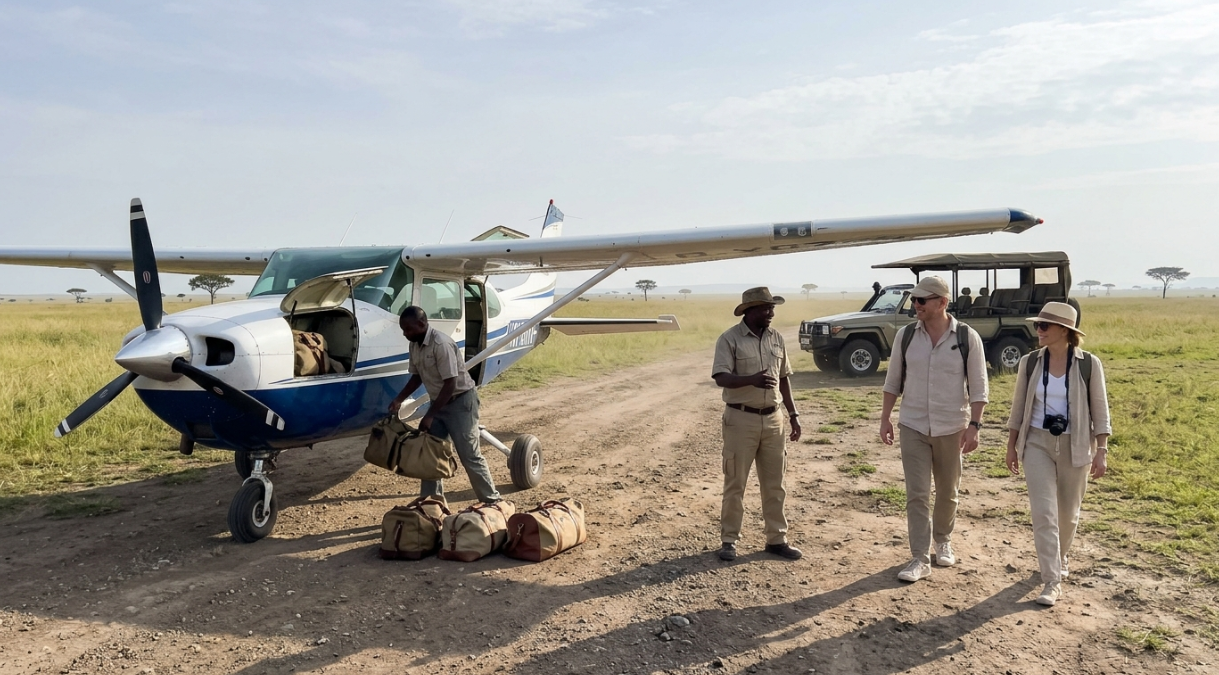
An itinerary that uses small bush planes to move between camps rather than driving. This is one of the bigger calls you will make because it shapes the pace, the cost, and the overall feel of the whole trip.
The key advantage of flying is time efficiency, maximizing hours spent on game drives rather than in transit. A drive from Arusha to the central Serengeti takes 7 to 8 hours. A bush flight takes about 90 minutes.
There is a second advantage that most planning resources miss entirely: open-sided vehicles are only available at the camps, not for the road transfers. You cannot drive Tanzania’s Northern Circuit in an open vehicle. Fly-in guests use the camp’s open Land Cruisers for every game drive. Drive-in guests travel in a closed 4x4 with a pop-top roof. For photographers especially, this distinction is significant.
A third benefit is guide quality. Drives with guides who are local to a specific camp area tend to be extremely up to date on animal movements and behavior patterns. Fly-in guests get these specialist camp guides rather than a single driver-guide covering the entire circuit.
Choose a fly-in safari if:
-
You have 5 to 6 days or fewer
-
You are visiting the Southern Circuit
-
You are combining a Kilimanjaro climb with your safari
-
You have mobility limitations
-
Photography is a priority
Choose a drive-in safari if:
-
You have 7 or more days
-
You are focused on the Northern Circuit only
-
You enjoy scenic road journeys
-
You are working with a tighter budget
Hybrid Safari (Drive + Fly)
A combination that uses road transfers for shorter distances (Arusha to Tarangire, for example) and bush flights for the longer legs (Ngorongoro to Serengeti, or Serengeti to Zanzibar). This is the most common approach for luxury Northern Circuit itineraries of 8+ days because it balances cost efficiency with time savings.
Transfer Day
A day on your itinerary dedicated primarily to moving between parks or camps. At the luxury level, transfer days are the enemy. Good itinerary design minimizes them by using fly-in logistics, strategic camp sequencing, or hybrid transport. When a transfer day is unavoidable, some operators schedule a game drive en route (for example, a morning drive in Tarangire before an afternoon transfer to Ngorongoro).
Game Drive
The core safari activity: driving through a wildlife area in a 4x4 vehicle with a trained guide. Luxury itineraries distinguish between several types:
-
Morning game drive: Departs at first light (around 6:00 AM), when predators are most active. Typically 3 to 4 hours.
-
Afternoon game drive: Departs around 3:30 to 4:00 PM, returns at sunset. Better light for photography.
-
Full-day game drive: Out all day with a packed lunch. Common in the Serengeti during Migration season.
-
Private game drive: Your vehicle, your guide, your schedule. Standard at luxury camps but worth confirming, as some lodges use shared vehicles.
-
Night game drive: Only possible in private concessions, not inside national parks. Uses a spotlight to find nocturnal species like aardvarks, bush babies, and leopards on the hunt.
If you are weighing a fly-in Serengeti itinerary against a road-based Northern Circuit loop, Duma Explorer can build a custom luxury itinerary with both options quoted side by side so you can compare what each costs and what you gain.
Accommodation Terms
Luxury Safari Accommodation Comparison: Camps vs. Lodges
|
Accommodation Type |
Main Characteristics |
Best For |
Important Consideration |
|---|---|---|---|
|
Luxury safari lodge |
Permanent buildings, spacious rooms, restaurants, and hotel-style facilities. |
Travelers who prioritize comfort and amenities. |
May feel less immersive than a tented camp. |
|
Luxury permanent tented camp |
Canvas suites, private bathrooms, raised platforms, and safari-style furnishings. |
Travelers who want comfort and a closer connection to nature. |
Usually remains in one location year-round. |
|
Mobile tented camp |
Seasonal canvas accommodation positioned near wildlife movements. |
Great Migration travelers and adventurous luxury guests. |
Location and availability change by season. |
|
Ultra-luxury safari camp |
High-end accommodation, personalized service, and exclusive experiences. |
Travelers seeking exceptional privacy and premium service. |
Rates and inclusions vary considerably. |
|
Exclusive-use camp |
An entire camp reserved for one family or group. |
Multigenerational families, celebrations, and private groups. |
Usually requires a minimum booking commitment. |
|
Fly-camp |
Temporary wilderness accommodation with simpler facilities. |
Travelers seeking a more adventurous overnight experience. |
Comfort and facilities are intentionally limited. |
How to choose: Select accommodation based on wildlife location, service level, activities, and your preferred travel style. A well-positioned luxury tented camp may provide a better safari experience than a more expensive lodge located farther from the wildlife you want to see.
Luxury Permanent Tented Camp
A camp with canvas-walled tents built on raised platforms, typically with en-suite flush toilets, hot showers, and real beds. These are permanent structures that stay in one location year-round. Despite the word “tent,” the experience is closer to a boutique hotel than anything involving sleeping bags. At the luxury tier, expect 10 to 20 tents, private verandas, quality linens, and a central dining and lounge area.
Ultra-Luxury Camp
The top tier. Ultra-luxury safari camps have fewer than ten tents, often with private plunge pools, personal butler service, and access to some of the most exclusive wildlife areas in Tanzania. Rates for these properties run $2,000 to $4,000+ per person per night. Six-tent camps in prime Serengeti concessions represent the ceiling of what is available.
Exclusive-Use Camp
A camp booked entirely by one party. This is not a separate accommodation category but a booking arrangement. Some smaller camps (4 to 6 tents) offer exclusive-use buyouts for families or groups who want the entire property to themselves. Exclusive-use is particularly popular for multi-generational family safaris and milestone celebrations.
Mobile Tented Camp
A canvas camp that relocates seasonally, usually to follow the Great Migration herds across the Serengeti. Mobile camps move two to four times per year, setting up in the southern plains for calving season (January through March), the western corridor (May through June), and the northern Serengeti for river crossings (July through October). This is a luxury-specific concept: budget and mid-range travelers do not use mobile camps because the logistics of moving an entire camp cost significantly more to operate. Expect the same comfort level as a permanent tented camp, but with a more intimate, expedition feel.
Safari Lodge
A permanent building, typically stone or wood construction with standard hotel-style rooms. At the luxury level, lodges offer larger rooms, better views, and more robust infrastructure (swimming pools, spa facilities, reliable Wi-Fi) than tented camps. The trade-off is that lodges feel less immersive. You are in a hotel that happens to overlook the bush rather than sleeping inside it.
Fly-Camp
A minimal bush camp set up in a remote area for one or two nights. Fly-camps are the most intimate safari experience available in Tanzania. They typically have simple stretcher beds, mosquito nets, and bucket showers. A fly-camp night is usually offered as an add-on from a luxury base camp, guided by a walking safari guide and an armed ranger. Not for everyone, but for travelers who want the feeling of sleeping in genuinely wild Africa, nothing else compares.
Barefoot Luxury
A term used almost exclusively for Zanzibar beach properties in bush and beach itineraries. It describes high-end accommodation with a deliberately casual, nature-forward atmosphere: thatched roofs, open-air bathrooms, no shoes required. Think $400 to $800 per night beach villas rather than large resort complexes.
How Much Does a Luxury Tanzania Safari Cost?
A luxury Tanzania safari typically costs approximately $700–$2,500+ per person per night, while ultra-luxury properties can exceed $4,000 per person per night. The final price depends on accommodation, season, park location, transportation, group size, and included activities.
The following table provides indicative planning ranges rather than fixed quotations.
Luxury Tanzania Safari Price Comparison
|
Safari Category |
Indicative Cost Per Person Per Night |
Typical Experience |
|---|---|---|
|
Entry-level luxury |
$700–$1,000 |
Comfortable luxury lodges, quality tented camps, and guided game drives. |
|
Premium luxury |
$1,000–$1,500 |
Higher-end camps, better locations, personalized service, and premium inclusions. |
|
High-end luxury |
$1,500–$2,500 |
Exclusive camps, specialist guiding, and more personalized experiences. |
|
Ultra-luxury |
$2,500–$4,000+ |
Exceptional properties, highly personalized service, and premium accommodation. |
Actual rates vary by property, season, occupancy, and package inclusions. These ranges should not be treated as standardized industry classifications.
What Is Usually Included in a Luxury Safari Quote?
|
Expense |
Commonly Included? |
What to Confirm |
|---|---|---|
|
Accommodation |
Yes |
Room or tent category and occupancy basis. |
|
Breakfast, lunch, and dinner |
Usually |
Whether meals are full board or all-inclusive. |
|
Game drives |
Usually |
Whether vehicles are private or shared. |
|
Professional guide |
Usually |
Whether the guide is dedicated to your group. |
|
Park and conservation fees |
Varies |
Whether all applicable fees are included. |
|
Airport transfers |
Varies |
Whether international and domestic transfers are covered. |
|
Bush flights |
Varies |
Whether scheduled flights or private charters are included. |
|
Alcoholic beverages |
Varies |
Whether premium wines and spirits are excluded. |
|
Laundry |
Varies |
Whether daily laundry is included. |
|
Balloon safari |
Usually extra |
Whether the activity is included or separately charged. |
|
Tips and gratuities |
Usually extra |
Recommended tipping guidance and payment arrangements. |
|
Travel insurance |
Usually extra |
Whether medical evacuation and safari activities are covered. |
Why Two Luxury Safari Quotes Can Have Different Prices
Two operators may quote different prices for what appears to be the same itinerary because their proposals include different services.
For example, one quote may include private vehicles, park fees, bush flights, and premium drinks, while another may exclude several of these expenses.
Before comparing proposals, ask for an itemized quotation showing:
-
Accommodation rates and room categories.
-
Number of nights at each camp.
-
Park and conservation fees.
-
Private versus shared game drives.
-
Domestic flights and baggage allowances.
-
Meals, drinks, and laundry.
-
Optional activities and additional charges.
This makes it easier to compare the actual cost of each itinerary instead of choosing based on the headline price alone.
Pricing and Booking Terms
PPPPN (Per Person Per Night)
The standard pricing unit for safari camps in Tanzania. When a camp quotes $1,200 PPPPN, that means $1,200 per person per night, assuming double occupancy. A couple staying three nights at that rate pays $7,200 total (2 people × 3 nights × $1,200). This is not an unusual figure at the luxury level.
Full Board vs. All-Inclusive
This distinction matters more than most travelers realize.
Full board means accommodation, breakfast, lunch, and dinner are included. Drinks (especially alcohol), laundry, park fees, and activities may be extra.
All-inclusive at luxury safari camps typically covers accommodation, all meals, house wines and spirits, soft drinks, laundry, scheduled game drives, and park fees. The difference between a $900 full-board rate and a $1,400 all-inclusive rate often narrows significantly once you add up all the extras at the full-board property.
Most safari camps are full-board at minimum, because there are no restaurants to visit in the middle of the Serengeti. But at the luxury level, always confirm exactly what “all-inclusive” covers. Some camps exclude premium spirits, champagne, or special activities like balloon safaris.
Concession Fee
A “bed night” tax paid to park authorities for the right to operate accommodation inside a national park or conservation area. If you stay at a luxury lodge or a permanent tented camp inside the park, you must pay a concession fee. This is usually folded into your nightly rate, but it is a real cost that partly explains why in-park camps charge more than properties just outside park boundaries.
TANAPA Park Fees
Tanzania National Parks Authority (TANAPA) collects conservation and entry fees for visitors entering its national parks. These charges are generally calculated according to the park, visitor category, age, and applicable tariff period.
For a luxury Northern Circuit safari, park fees can form a significant part of the overall itinerary cost, particularly when visiting multiple parks.
Before booking, confirm:
-
The applicable Serengeti National Park entry fee.
-
Tarangire and Lake Manyara entry fees, where applicable.
-
The visitor category used to calculate each fee.
-
Whether applicable taxes are included.
-
Whether the fees are already included in your accommodation or safari quotation.
TANAPA tariffs can change, so travelers should consult the official TANAPA park fees and tariffs before finalizing their safari budget.
Ngorongoro Crater Service Fee
The Ngorongoro Crater service fee is a separate charge associated with taking a vehicle onto the crater floor. It is administered by the Ngorongoro Conservation Area Authority (NCAA), rather than TANAPA.
This charge is calculated separately from other conservation and entry fees. Travelers should confirm the current applicable rate, visitor category, and vehicle requirements with their safari operator before booking.
The crater service fee is particularly important when comparing itineraries that include multiple crater descents.
For current charges, consult the official NCAA tariff portal.
Why Safari Park Fees Matter
A luxury safari quotation should clearly distinguish between accommodation charges, park entry fees, concession fees, crater service fees, and other government charges.
Some packages include these expenses in the total price, while others list them separately. Always check the quotation before comparing operators.
Crater Descent Fee (Ngorongoro)
A separate fee charged specifically for driving down into the Ngorongoro Crater floor: $295 per vehicle. The Ngorongoro Conservation Area is managed by the NCAA (Ngorongoro Conservation Area Authority), not TANAPA, which is why it has its own distinct fee structure. This fee applies per descent, so if your itinerary includes two crater visits on consecutive days, you pay it twice.
Single Supplement
The additional charge imposed by safari operators and camps when a solo traveler occupies a room or tent designed for two people. Tanzania safari single supplements vary widely. Some camps charge 25% to 50% above the per-person sharing rate, while a handful of ultra-luxury properties charge the full double-occupancy rate for a solo guest. If you are traveling alone, ask about single supplement policies before committing to any camp.
Green Season Rate / Shoulder Season
Green season (roughly late March through May, and November) is Tanzania’s rainy period. Wildlife viewing is still excellent, vegetation is lush, and bird populations explode. The practical benefit for luxury travelers: green season pricing at ultra-luxury camps can be 30 to 50% below peak season rates. A camp that charges $2,000 PPPPN in July might drop to $1,000 to $1,400 in April. The trade-off is afternoon rain showers, muddier roads, and some camps closing entirely.
GePG Control Number
An obscure but relevant term you may encounter when your operator explains how park fees are processed. Most payments to Tanzanian government entities (including TANAPA and NCAA) go through the Government electronic Payment Gateway (GePG). You receive a “control number” that allows payment via bank transfer or mobile money. Your operator handles this, but if you see “GePG” or “control number” on an invoice breakdown, this is what it refers to.
Wildlife and Timing Terms
Great Migration
The Great Migration is often talked about as a single event, usually the famous Mara River crossings captured in wildlife documentaries. In reality, it is a continuous, year-round clockwise circuit covering roughly 1,800 kilometers across Tanzania’s Serengeti and Kenya’s Masai Mara. According to TAWIRI’s 2023 aerial count, the Migration involves 1,366,109 wildebeest plus several hundred thousand zebra.
Where the herds are at any given time determines which Serengeti zone your luxury itinerary should target:
|
Month(s) |
Herd Location |
Serengeti Zone |
What You See |
|---|---|---|---|
|
Dec–Mar |
Southern plains / Ndutu |
Southern Serengeti (Ndutu) |
Calving, newborns, intense predator action |
|
Apr–May |
Moving west |
Central / Western Corridor |
Columns on the march, river crossings at Grumeti |
|
Jun–Jul |
Western Corridor → North |
Western to Northern Serengeti |
River crossings begin |
|
Jul–Oct |
Northern Serengeti |
Kogatende / Lamai |
Peak Mara River crossings |
|
Nov |
Returning south |
Central / Eastern Serengeti |
Herds moving back after short rains |
For peak crossing season (July through September), book 12 to 18 months ahead. Premium camps in the Kogatende and Lamai areas sell out first because there are fewer of them and the river crossing spectacle drives enormous demand.
For a comprehensive month-by-month breakdown, see our Great Migration safari guide.
Calving Season
January through March, when approximately 8,000 wildebeest calves are born per day on the short-grass plains around Ndutu in the southern Serengeti. This is arguably the best time for predator sightings because lions, cheetahs, hyenas, and wild dogs follow the vulnerable herds. Calving season is also peak season for Ndutu-area camps, which are almost exclusively mobile tented camps. One Duma Explorer traveler reported seeing 42 big cats in 3 days during this period.
Mara River Crossings
The dramatic phase of the Migration (July through October) when wildebeest herds cross the Mara River in the northern Serengeti. Crossings are unpredictable. Herds may approach the river and turn back multiple times before committing. Camps in the Kogatende and Lamai areas position guests at known crossing points, but there is no guarantee on any specific day. A good camp guide will know the herds’ patterns and position you accordingly.
Big Five
Lion, leopard, Cape buffalo, African elephant, and black rhinoceros. The term originates from colonial-era hunting (the five most dangerous animals to hunt on foot) and persists as a marketing shorthand. Tanzania is one of the few countries where all five can be seen, though black rhinos are critically endangered and sightings are concentrated in the Ngorongoro Crater and specific Serengeti zones.
Dry Season vs. Green Season
Dry season (June through October) is peak safari season. Vegetation thins out, animals concentrate around water sources, and game viewing is at its most predictable. This is also when camps charge their highest rates and parks see the most vehicles.
Green season (November and March through May) brings rain, green landscapes, fewer tourists, and lower prices. Wildlife disperses more widely, but the bush is alive with migratory birds, calving activity (January through March), and dramatic skies. For luxury travelers, green season is an underrated option because the reduction in vehicle traffic enhances the feeling of exclusivity that defines premium safari travel.
Location and Zone Terms
Serengeti Zones
The Serengeti is not one uniform place. It is divided into distinct zones, and where you stay determines what you see. This is itinerary-critical information.
Central Serengeti (Seronera): The most accessible zone and the area with the highest year-round predator density. Big lion prides, leopards in the sausage trees along the Seronera River, and resident wildlife that does not migrate. The downside: Seronera is also the busiest zone, with the highest vehicle concentration. Luxury travelers often spend one to two nights here before moving to more remote zones.
Western Corridor: A narrow strip extending toward Lake Victoria. Best from May through July when the Migration herds pass through and attempt the Grumeti River crossings. Less visited than Central or Northern zones.
Northern Serengeti (Kogatende / Lamai): The most remote zone accessible by road from the south, though most luxury travelers fly in. This is where the Mara River crossings happen (July through October). Camps here tend to be smaller, more exclusive, and harder to book.
Southern Serengeti (Ndutu Plains): Technically part of the Ngorongoro Conservation Area rather than Serengeti National Park, which means different fee structures and management. This is where the calving season unfolds (December through March). Almost all accommodation here is mobile tented camps.
Ngorongoro Crater
A collapsed volcanic caldera roughly 20 kilometers across, containing one of the densest concentrations of wildlife on Earth. The crater floor sits about 600 meters below the rim. A crater descent fee of $295 per vehicle applies each time you drive down. Most luxury itineraries include one full-day crater visit with a picnic lunch on the floor. Rim-side lodges and camps offer views into the crater and are significantly more expensive than properties on the outer slopes.
Ngorongoro Conservation Area (NCAA)
A common source of confusion. The Ngorongoro Conservation Area is not a national park. It is a UNESCO World Heritage Site managed by the NCAA (Ngorongoro Conservation Area Authority), not TANAPA. This distinction matters because the fee structures, rules, and governance differ. The NCAA area includes the crater, the Ndutu plains, and Maasai pastoral land where people and wildlife coexist. Ngorongoro park fees, crater fees, and concession rules are all NCAA-specific.
Tarangire National Park
Known for its massive baobab trees and enormous elephant herds (sometimes numbering in the hundreds). Tarangire is typically the first or last park on a Northern Circuit itinerary because of its proximity to Arusha. During the dry season, the Tarangire River draws wildlife from across the ecosystem. One or two nights here is standard for luxury itineraries. For first-time visitors, our Tarangire safari glossary covers what to expect on your first game drive.
Private Concession / Conservancy
This is the single most important term to understand when comparing luxury safari options. The difference between a private concession and a national park comes down to governance, and governance determines your experience.
TANAPA sets the rules inside all national parks: no night drives, no off-road driving, no walking outside designated areas, no vehicle limits at wildlife sightings. These rules apply uniformly to every visitor.
A concession holder sets its own rules. That means the concession can permit night drives, authorize off-road tracking of specific animals, allow guided walking safaris, and enforce strict vehicle limits at sightings. When a luxury camp says it is “in a private concession,” this is what it means.
Private Concession vs. National Park: What Changes?
|
Factor |
National Park |
Private Concession or Managed Wildlife Area |
|---|---|---|
|
Night drives |
Permitted in designated parks and under applicable regulations. |
Often available, depending on concession rules. |
|
Off-road driving |
Generally prohibited unless specifically authorized. |
May be permitted in designated areas under local rules. |
|
Walking safaris |
Available in approved areas with required permissions and guides. |
Often offered, subject to applicable regulations. |
|
Vehicle restrictions |
Governed by park regulations and wildlife-viewing rules. |
May have additional limits on vehicle numbers and viewing time. |
|
Other visitors |
Access depends on park entry and operating rules. |
Access may be more restricted to participating camps and guests. |
|
Main advantage |
Access to iconic landscapes and established wildlife areas. |
Potentially more flexible activities and lower visitor density. |
Which should you choose?
National parks are ideal for experiencing Tanzania's iconic wildlife destinations, including the Serengeti and Ngorongoro area. Private concessions can add more flexibility and specialized activities where permitted.
The best luxury itinerary may combine both rather than choosing one exclusively.
Ndutu Plains
The short-grass plains straddling the southern Serengeti and the Ngorongoro Conservation Area. This is the calving ground for the Great Migration (December through March) and home to some of Tanzania’s best predator viewing. Ndutu is technically under NCAA jurisdiction, not TANAPA, which affects fee structures. Most Ndutu camps are mobile and relocate to this area for calving season.
Activity and Experience Terms
Balloon Safari
A hot-air balloon flight over the Serengeti at dawn, lasting approximately one hour and typically followed by a champagne breakfast in the bush. Current cost is $500 to $599 per person. One Duma Explorer traveler described the experience as “royalty treatment.” Balloon safaris must be booked in advance and are weather-dependent. They launch from specific Serengeti zones (primarily Seronera in the central Serengeti), so your camp location determines availability.
For gear recommendations on capturing these moments, our safari photography guide covers lenses, settings, and practical advice.
Walking Safari
A guided walk through the bush on foot, accompanied by an armed ranger. Walking safaris are one of the clearest differentiators between a concession stay and a national park stay. Inside national parks, walking is restricted to a handful of designated zones and requires special arrangements. In private concessions, walking safaris are a standard offering, often lasting 2 to 3 hours in the early morning.
Walking shifts your attention from the big mammals to the smaller details: tracks, dung, insects, medicinal plants, and the tactics predators use. It is a fundamentally different experience from a vehicle-based game drive.
Night Drive
A night drive is a guided game drive conducted after sunset using a spotlight to observe nocturnal wildlife. Depending on the location and applicable regulations, travelers may encounter genets, civets, bush babies, porcupines, aardvarks, and leopards.
In Tanzania, night drives are not exclusively restricted to private concessions. TANAPA has published guidelines permitting regulated night game drives in designated national parks, while private concessions and game reserves may offer additional opportunities depending on their operating rules.
The availability of night drives depends on the specific park, concession, camp, and applicable permits. Before booking, ask your operator whether night drives are offered from your accommodation and whether they are included in the package.
For luxury travelers, this is an important distinction because a camp's location can determine which activities are available after sunset.
Sundowner
An evening drink served in the bush at a scenic viewpoint, usually timed to coincide with sunset. Sundowners are a standard feature at luxury camps and one of those experiences that sounds simple but becomes a defining memory: cold gin and tonic, a panoramic view of the plains, and the sounds of the bush shifting from day to night.
Bush Dinner / Boma Dinner
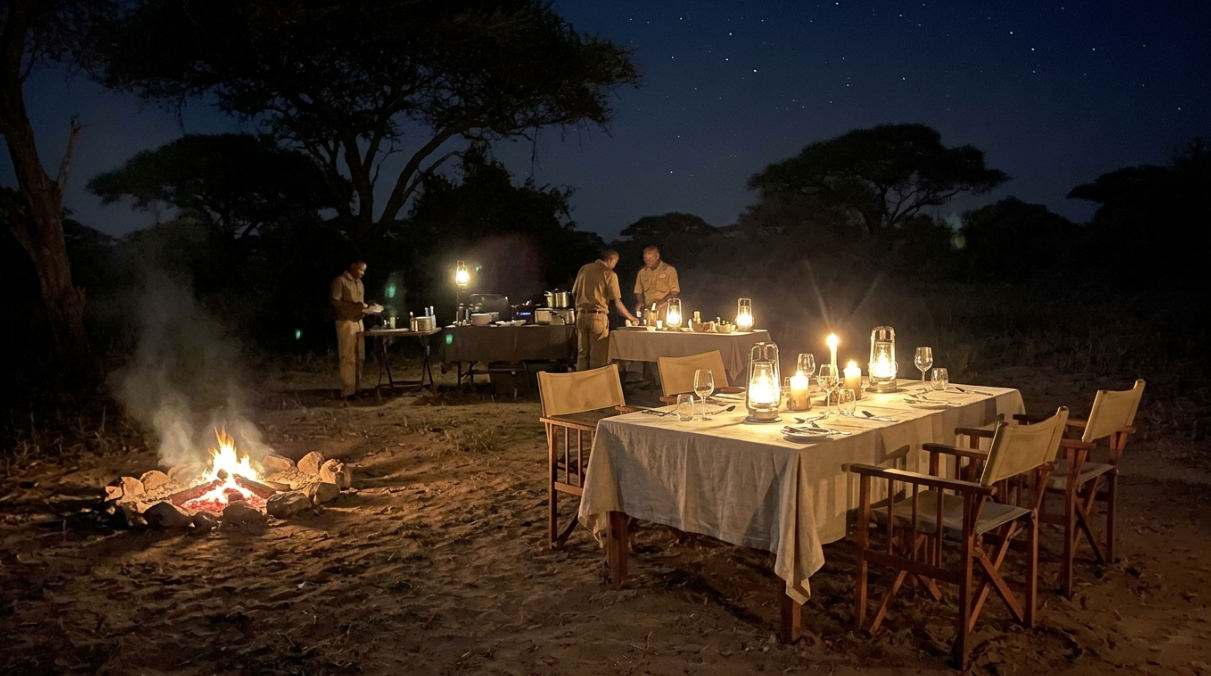
Bush dinner: A formal multi-course meal set up in the wilderness away from camp, often under a canopy of stars with lanterns and campfire. This is a luxury-camp signature experience.
Boma dinner: A communal evening meal held in a boma, a traditional fortified cattle enclosure historically built from thorned acacia branches. Some camps offer boma dinners featuring grilled meats, local dishes, and sometimes traditional dance performances. The setting is typically an open-air circle around a central fire.
Cultural Visit
Visits to local communities, most commonly Maasai villages, Hadzabe hunter-gatherer camps, or Datoga blacksmith settlements near Lake Eyasi. These are typically half-day excursions added to a Northern Circuit itinerary. At the luxury level, cultural visits are often arranged as private experiences rather than group tourism stops. The quality varies enormously depending on how the visit is structured and whether the community benefits directly.
Logistics Terms
Arusha
The gateway city for virtually all Northern Circuit safaris. Arusha is where you meet your guide, sort final logistics, and often spend one night before or after your safari. It is a working Tanzanian city, not a resort town. Luxury travelers typically stay at a boutique hotel or safari lodge on the outskirts rather than in the city center.
Kilimanjaro International Airport (JRO)
The primary international airport for Northern Tanzania safaris, located roughly 45 minutes east of Arusha. Most international flights arrive via connections through Nairobi, Doha, Istanbul, or Amsterdam. Do not confuse JRO with Arusha Airport (ARK), which handles domestic and small charter flights.
Bush Airstrip
A dirt or grass landing strip in or near a wildlife area, used by the small propeller planes that connect safari camps. Bush airstrips are basic: no terminal buildings, no baggage carousels, sometimes just a windsock and a cleared patch of ground. Your camp sends a vehicle to meet you at the airstrip, and the game drive begins immediately. This is one of the reasons fly-in itineraries feel more immersive.
Soft-Sided Luggage and Weight Limits
Bush flights in Tanzania use small aircraft with limited baggage capacity. Many safari airlines impose a luggage allowance of approximately 15 kg per person, including hand luggage, although some operators permit different limits.
Soft-sided duffel bags are commonly recommended because they fit more easily into aircraft baggage compartments. Hard-shell suitcases may be restricted depending on the aircraft and operator.
Before traveling, confirm:
-
The total weight allowance per passenger.
-
Whether camera equipment counts toward the allowance.
-
Maximum bag dimensions.
-
Whether soft-sided luggage is mandatory.
-
Charges or restrictions for excess baggage.
Do not assume that your international airline's baggage allowance applies to domestic bush flights.
Private Guide / Driver-Guide
At the luxury level, you should have a private guide for your entire safari, not a shared guide rotating between groups. The distinction between “guide” and “driver-guide” varies by operator. A driver-guide handles both the driving and the guiding. Some ultra-luxury camps employ dedicated walking guides and naturalists separately from the driver.
Guide quality is the single variable that most determines whether a safari is good or exceptional. Practitioners on Reddit consistently report that the guide matters more than the camp, the vehicle, or even the park. The best guides have formal qualifications (FGASA certification, for example), years of field experience, and a deep personal knowledge of the specific ecosystem where they operate.
How These Terms Shape Your Luxury Itinerary
The vocabulary in this glossary is not academic. Every term maps directly to a choice that affects your trip’s duration, cost, and quality of experience.
|
Decision |
Option A |
Option B |
Impact |
|---|---|---|---|
|
Transport |
Drive-in |
Fly-in |
Fly-in saves 1–2 full days, costs $300–$600 more per flight, unlocks open vehicles |
|
Accommodation zone |
National park |
Private concession |
Concession adds $400–$1,300 PPPPN but enables night drives, walking, off-road |
|
Camp type |
Permanent tented camp |
Mobile tented camp |
Mobile follows the Migration; permanent offers year-round consistency |
|
Pricing model |
Full board |
All-inclusive |
All-inclusive removes surprise costs; full board may look cheaper but rarely is |
|
Season |
Peak (Jul–Oct, Dec–Feb) |
Green (Mar–May, Nov) |
Green saves 30–50% with fewer visitors; peak offers best Migration viewing |
|
Itinerary length |
7 nights |
10–12 nights |
Under 8 nights means rushing; 10–12 is the sweet spot for the Northern Circuit |
The terms in this glossary affect every line of your safari quote. If you want a transparent proposal that maps these choices to a real itinerary and price, Duma Explorer’s team, led by an owner with 15+ years based in Tanzania, can design that for you. Request a custom luxury safari itinerary.
10 Questions to Ask Before Booking a Luxury Tanzania Safari
Not every luxury safari package offers the same level of privacy, guiding, or included services. Before paying a deposit, ask your operator these questions to understand exactly what you are purchasing.
|
Question |
Why It Matters |
|---|---|
|
1. Is my safari vehicle private? |
Confirms whether you share game drives with other guests. |
|
2. Will I have a dedicated guide? |
Clarifies whether the same guide accompanies you throughout the safari. |
|
3. Are park and conservation fees included? |
Prevents unexpected government and park charges. |
|
4. Are bush flights included? |
Identifies additional domestic transportation costs. |
|
5. What is the luggage allowance? |
Helps you prepare for small aircraft transfers. |
|
6. Are game drives shared at the camps? |
Some properties use shared vehicles even within luxury packages. |
|
7. Which wildlife area is the camp located in? |
Determines access to seasonal wildlife movements. |
|
8. What activities are available? |
Confirms whether walking safaris, night drives, and balloon safaris are possible. |
|
9. What happens if weather disrupts a bush flight? |
Clarifies alternative transport arrangements and associated costs. |
|
10. What is the cancellation and refund policy? |
Helps you understand financial risks before booking. |
What Should a Transparent Luxury Safari Quote Include?
A professional quotation should clearly identify every camp, room category, travel date, transfer, activity, and major inclusion.
It should also distinguish between confirmed services and optional extras.
If an operator cannot clearly explain whether your game drives are private, which fees are included, or how transfers are arranged, request clarification before making a payment.
A transparent quotation is one of the most useful indicators of a well-organized safari operator.
How Long Should a Luxury Tanzania Safari Be?
For luxury travelers doing Tanzania’s Northern Circuit properly, 10 to 12 days is the sweet spot. Less than 8 days and you are rushing between parks without absorbing any of them. More than 14 days without adding Zanzibar or a second circuit risks feeling repetitive.
A well-balanced luxury itinerary typically includes:
-
3 nights in the Serengeti (split across two zones if possible)
-
2 nights in Ngorongoro (rim lodge or camp)
-
1 to 2 nights in Tarangire or Lake Manyara
-
3 to 5 nights in Zanzibar if adding a beach extension
-
1 night in Arusha (pre- or post-safari)
A minimum of 7 nights is needed for a meaningful safari experience. Anything shorter requires fly-in logistics to work at all, and even then, you are making trade-offs.
If you are considering combining a safari with Zanzibar, our bush and beach honeymoon guide covers routing and timing for the beach portion, and it applies equally to non-honeymoon travelers.
Sample 10-Day Luxury Tanzania Safari Itinerary
A 10-day luxury Tanzania safari provides enough time to explore the Northern Circuit without spending every day traveling between destinations. A balanced route combines Tarangire, the Ngorongoro Conservation Area, and multiple Serengeti zones, with optional fly-in transfers depending on the season and accommodation selection.
The following example is a flexible itinerary rather than a fixed route. Camp locations should be adjusted according to wildlife movements and availability.
10-Day Northern Circuit Luxury Safari
|
Day |
Destination |
Suggested Experience |
Overnight |
|---|---|---|---|
|
Day 1 |
Arusha |
International arrival, private airport transfer, and safari briefing. |
Luxury lodge in Arusha |
|
Day 2 |
Tarangire National Park |
Private game drives among baobab trees and large elephant herds. |
Luxury tented camp |
|
Day 3 |
Tarangire |
Full-day game drive with a bush lunch and optional walking activity where available. |
Luxury tented camp |
|
Day 4 |
Ngorongoro Conservation Area |
Scenic transfer toward the crater highlands, with optional cultural experiences. |
Luxury lodge near Ngorongoro |
|
Day 5 |
Ngorongoro Crater |
Full-day crater safari with a picnic lunch. |
Luxury lodge near Ngorongoro |
|
Day 6 |
Central Serengeti |
Transfer or scheduled bush flight, followed by an afternoon game drive. |
Luxury Serengeti camp |
|
Day 7 |
Central Serengeti |
Private game drives focused on resident wildlife and predators. |
Luxury Serengeti camp |
|
Day 8 |
Northern or Southern Serengeti |
Relocate according to the Great Migration's seasonal position. |
Seasonal luxury tented camp |
|
Day 9 |
Serengeti |
Full-day wildlife viewing, photography, and optional balloon safari. |
Luxury Serengeti camp |
|
Day 10 |
Arusha or Zanzibar |
Return by scheduled bush flight or continue to Zanzibar for a beach extension. |
Departure or beach property |
How to Customize This Itinerary
For Great Migration river crossings: Allocate additional nights to the northern Serengeti around Kogatende or Lamai during the expected crossing season.
For wildebeest calving: Replace the northern Serengeti stay with Ndutu during the main calving period, generally January through March.
For maximum exclusivity: Consider adding a private concession stay where the permitted activities match your interests.
For a bush and beach holiday: Add three to five nights in Zanzibar after the safari.
For a shorter trip: Use fly-in transfers to reduce lengthy road journeys, but avoid trying to cover too many parks in a limited number of days.
A luxury itinerary should be designed around wildlife movements, accommodation availability, and the amount of time you want to spend on game drives rather than simply trying to visit as many parks as possible.
FAQs
What does “all-inclusive” mean at a luxury safari camp?
At luxury safari camps in Tanzania, all-inclusive typically covers accommodation, all meals, house wines and spirits, soft drinks, laundry, scheduled game drives, and park fees. It does not always include premium champagne, spa treatments, balloon safaris, or charter flights. Always ask for an itemized list of inclusions before comparing quotes.
Is a private concession worth the extra cost?
Yes, for most luxury travelers. The ability to do night drives, walk in the bush, and track animals off-road fundamentally changes the safari experience. Vehicle limits at sightings mean you might watch a leopard hunt with two other vehicles instead of twenty. The cost premium ($400 to $1,300 more per night) is significant, but the experiential gap between a concession and a busy national park zone is even more significant. The best approach is to combine both in one itinerary.
When should I book a luxury Great Migration safari?
For peak river crossing season (July through September in the northern Serengeti), book 12 to 18 months in advance. Premium camps in the Kogatende and Lamai areas have fewer than 10 tents each and sell out quickly. Calving season camps near Ndutu (January through March) are easier to book but still require 6 to 12 months lead time for first-choice properties.
What is the difference between a luxury tented camp and a lodge?
A luxury tented camp uses canvas-walled structures on raised platforms with full en-suite bathrooms, real beds, and premium furnishings. A lodge is a permanent building with hotel-style rooms. Tented camps feel more immersive and connected to the bush. Lodges offer more infrastructure (pools, spas, reliable electricity). Neither is objectively better. It depends on whether you prioritize atmosphere or amenities.
Do I need a fly-in safari for the Northern Circuit?
No. The Northern Circuit is fully accessible by road, and many excellent luxury itineraries use drive-in or hybrid transport. Fly-in becomes strongly recommended if you have fewer than 7 days, want to maximize game drive time, are adding the Southern Circuit, or prioritize open-vehicle game drives for photography.
How much does a luxury Tanzania safari cost per person per day?
Luxury safari rates in Tanzania start from approximately $700 to $800 per person per night and go up to $2,000 to $4,000+ per person per night for ultra-exclusive properties with six tents or fewer. A 10-night luxury safari for two people, including flights and Zanzibar, typically falls between $15,000 and $50,000 total depending on camp selection and season. For a detailed breakdown of safari costs at every level, see our cost glossary.
Can families do a luxury Tanzania safari?
Absolutely. Many luxury camps welcome children, and some offer dedicated family tents, child-friendly game drives, and junior ranger programs. The key logistics consideration is minimum age policies, which vary by camp (some require children to be 6 or older, others 12 or older for walking safaris). For families planning a premium private safari, our family safari planning glossary covers age policies, vehicle configurations, and camp selection.
Duma Explorer is a Tanzanian and American-owned safari operator founded in 2002, with offices in Arusha, Tanzania. Safari guides complete advanced training through EcoTraining and FGASA Level 1 certification programs. The company is Travelife Certified and a KPAP founding partner for porter welfare, with TripAdvisor Travelers’ Choice recognition from 2020 through 2025.