

TL;DR
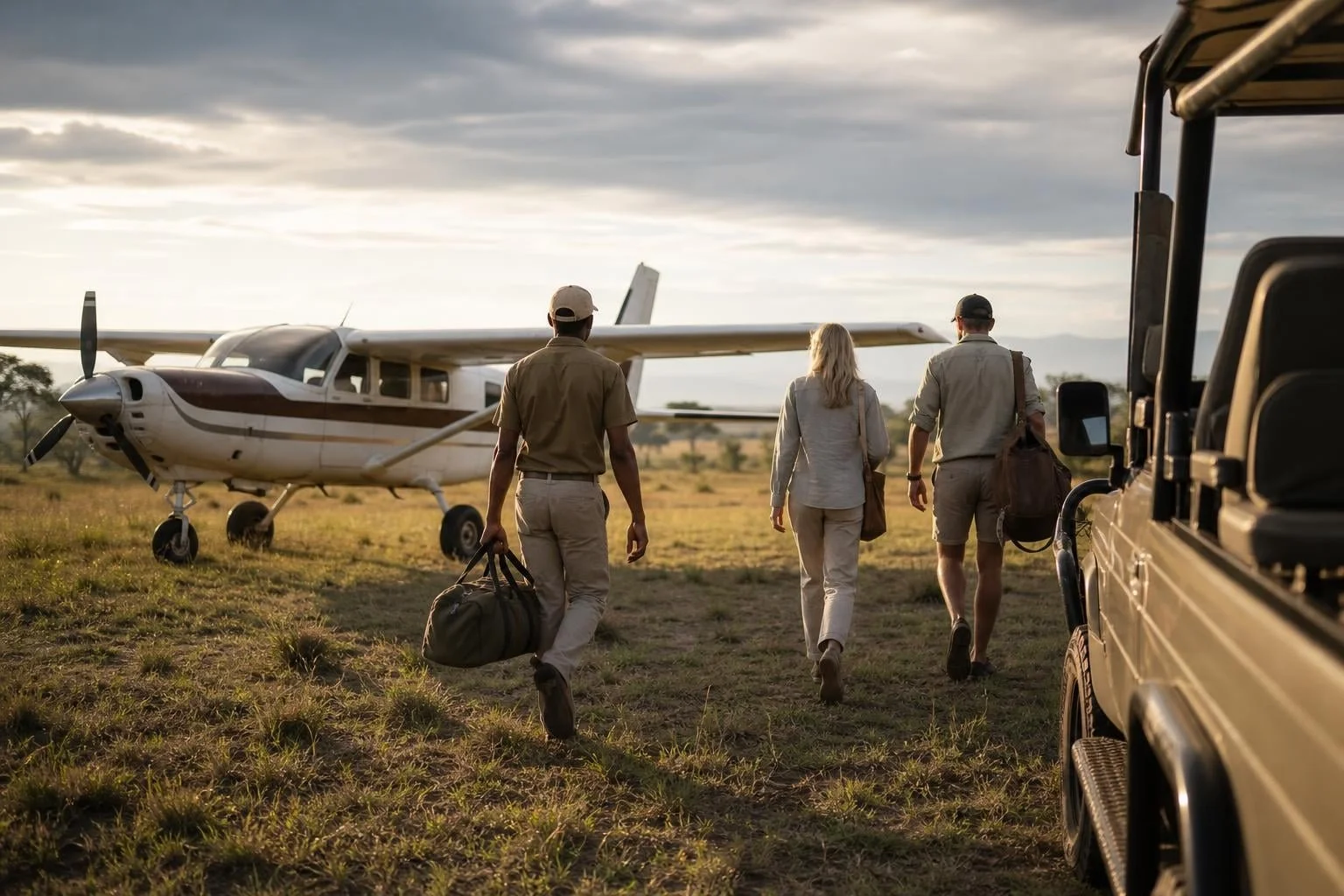
A luxury fly-in safari in Tanzania uses light aircraft to connect the country’s top wildlife parks, saving hours of overland driving and unlocking remote camps that simply cannot be reached by road. The best itinerary depends on your timing, interests, group size, and how many days you have. For first-timers, the Northern Circuit fly-in (Serengeti plus Ngorongoro) is the standard starting point at $8,000 to $15,000 per person for 7 to 10 days. Repeat visitors and serious wildlife travelers should look south to Nyerere and Ruaha, or west to Katavi and Mahale, where you can go days without seeing another vehicle. Below: 8 distinct fly-in itineraries compared on cost, duration, best season, camp tier, and traveler fit.
What Is a Luxury Fly-In Safari in Tanzania? A luxury fly-in safari in Tanzania is a wildlife holiday that uses small aircraft to transport travelers between national parks, remote airstrips, and exclusive safari camps. It reduces long road transfers and provides access to destinations such as the Serengeti, Nyerere, Ruaha, Katavi, and Mahale. A 7–10-day luxury fly-in safari typically costs $8,000–$15,000 per person, depending on camp quality, season, flights, and included activities.
At-a-Glance Comparison: 8 Luxury Fly-In Safari Itineraries
|
Itinerary |
Duration |
Cost Range (pp) |
Best Season |
Best For |
|---|---|---|---|---|
|
1. Northern Circuit Fly-In |
7–9 days |
$8,000–$13,000 |
Year-round (Jun–Oct peak) |
First-timers, families, broad wildlife |
|
2. Great Migration Fly-In Chase |
7–10 days |
$9,000–$16,000 |
Dec–Mar (calving) or Jul–Oct (crossings) |
Photographers, migration purists |
|
3. Southern Tanzania Circuit |
8–10 days |
$9,000–$14,000 |
Jun–Nov |
Second-safari veterans, walking safari fans |
|
4. Western Wilderness Expedition |
7–10 days |
$12,000–$20,000+ |
Jun–Oct (Katavi), Jul–Oct (Mahale) |
Experienced safari travelers, primate enthusiasts |
|
5. Safari + Zanzibar Beach Combo |
8–12 days |
$8,000–$15,000 |
Jun–Oct (safari), Dec–Mar (beach) |
Honeymooners, couples, mixed-interest groups |
|
6. Short Serengeti Fly-In |
3–5 days |
$3,500–$7,000 |
Year-round |
Time-limited travelers, safari extensions |
|
7. Family Fly-In Safari |
7–10 days |
$7,000–$14,000 (adults) |
Jun–Oct, Dec–Mar |
Families with children 6+, multigenerational groups |
|
8. Grand Circuit (North + South) |
12–16 days |
$15,000–$25,000+ |
Jun–Oct |
Travelers with 2+ weeks wanting everything |
How Fly-In Safaris Work in Tanzania
Before comparing itineraries, it helps to understand the mechanics. A fly-in safari replaces long overland drives with bush flights on small aircraft, typically Cessna Caravans carrying 8 to 13 passengers. These flights connect a network of remote airstrips scattered across the national parks.
Two airlines handle the majority of scheduled routes. Coastal Aviation, founded in 1987 and based at Julius Nyerere International Airport in Dar es Salaam, operates the largest network of bush routes, connecting parks, the coast, and the islands on Cessna Caravans. Auric Air covers 42 destinations across East Africa and also offers private charter. Smaller operators like Grumeti Air, Safari Airlink, and Regional Air fill specific routes.
Scheduled vs. charter flights. Scheduled light-aircraft seats run roughly $250 to $500 per person, per leg. Private charters cost $1,200 to $3,000 per aircraft depending on route and plane size. For a family or group of four to six, chartering the whole aircraft often costs about the same as buying individual seats, with the added flexibility of flying on your own schedule.
Baggage Allowance on Tanzania Bush Flights
Baggage allowances on Tanzania's domestic safari flights vary by airline, aircraft, and route. Many scheduled bush flights have strict weight and luggage-size restrictions, so travelers should confirm the current allowance with their specific operator before departure.
For example, Coastal Aviation publishes a standard allowance of 15 kg (33 lbs) per passenger, including hand luggage, cameras, and personal items. Auric Air publishes a standard allowance of 20 kg (44 lbs), also including hand luggage and personal items.
Soft-sided duffel bags are generally the safest choice because they are easier to fit into small aircraft cargo compartments. However, some operators accept appropriately sized hard-sided luggage.
Before flying, confirm:
-
The total permitted baggage weight per passenger.
-
Whether camera equipment counts toward the allowance.
-
Maximum bag dimensions.
-
Whether excess baggage can be purchased in advance.
-
Whether luggage can be stored at your arrival airport or hotel.
-
Whether additional restrictions apply to children and infants.
For travelers carrying professional photography equipment or traveling with children, baggage planning should be completed before booking flights.
Game-package camps vs. private-guide safaris. This distinction matters and most planning content ignores it. Practitioners on safari forums explain that a “flying” safari is typically a game-package (GP) safari where you use the camp’s own guide and vehicle, rather than traveling with a private driver-guide. Many of the best fly-in camps only accept guests on a GP basis. Far from being a drawback, this is often an upgrade. Camp-based guides know their micro-territory intimately, having driven the same concession for years. They know where the resident leopard dens, which crossing point the herds favor that week, and where the light falls best at golden hour. A private driver-guide covering the entire Northern Circuit simply cannot match that depth of local knowledge.
If you’re weighing whether flying or driving is right for your trip, Duma Explorer can compare both options for the same itinerary and show you what each approach costs and what each approach accesses.
Is a Fly-In Safari in Tanzania Worth It?
A fly-in safari in Tanzania is worth the additional cost for travelers who want to maximize wildlife-viewing time, visit remote parks, or stay at exclusive camps that are difficult to reach by road. It is particularly valuable for shorter trips, honeymoon itineraries, and travelers combining multiple national parks.
However, flying is not automatically the best option for every safari. Travelers with flexible schedules, longer holidays, or tighter budgets may get better value from a road-based itinerary.
Who Benefits Most From a Fly-In Safari?
|
Traveler type |
Why flying makes sense |
Recommended itinerary |
|---|---|---|
|
First-time visitors |
Covers major wildlife destinations with fewer road transfers |
Northern Circuit |
|
Honeymooners |
Combines remote luxury camps with Zanzibar |
Safari + Zanzibar |
|
Wildlife photographers |
Allows seasonal repositioning between Serengeti zones |
Great Migration Chase |
|
Families |
Reduces long and tiring road journeys |
Family Fly-In |
|
Repeat safari travelers |
Provides access to less-visited wilderness areas |
Southern Circuit |
|
Luxury travelers |
Connects exclusive camps and remote destinations |
Grand Circuit |
|
Short-stay travelers |
Maximizes limited time in the Serengeti |
Short Serengeti Fly-In |
When Is a Driving Safari Better?
A traditional driving safari may be better if you:
-
Want to visit several parks along the Northern Circuit at a slower pace.
-
Enjoy scenic road journeys and cultural stops.
-
Have enough time to travel between destinations.
-
Want more flexibility with your overall ground transportation budget.
-
Prefer having the same private guide and vehicle throughout the trip.
Tanzania Safari Airlines: Scheduled Flights vs. Private Charters
Tanzania's safari aviation network connects major cities, national parks, remote airstrips, and coastal destinations. Travelers can purchase individual seats on scheduled flights or charter an entire aircraft for greater flexibility.
Some operators to consider include Coastal Aviation, Auric Air, Regional Air, and Flightlink.
|
Flight option |
How it works |
Best for |
|---|---|---|
|
Scheduled bush flight |
Purchase individual seats on published routes |
Couples and solo travelers |
|
Private charter |
Reserve an entire aircraft for your group |
Families, private groups and luxury travelers |
|
Camp-arranged transfer |
The safari camp coordinates flights and ground transfers |
Travelers booking complete safari packages |
When Should You Book a Private Charter?
A private charter can make sense when:
-
You are traveling with a larger family or group.
-
Your itinerary requires an unusual flight connection.
-
You want more control over departure times.
-
You are visiting remote airstrips with limited scheduled services.
-
Your luggage requirements need special arrangements.
Private charter availability, aircraft type, landing permissions, passenger weight, and baggage capacity should all be confirmed before booking.
Which Airstrip, Which Season, Which Camps
This is the single most important planning detail for a fly-in safari in Tanzania, and almost no planning content explains it clearly. The Serengeti alone has multiple airstrips, and the one you fly into determines which camps you can reach and whether you’ll be near the wildlife action.
|
Airstrip |
Serengeti Zone |
Best Season |
What’s There |
Key Camps Nearby |
|---|---|---|---|---|
|
Seronera |
Central |
Year-round |
Resident big cats, hippo pools |
Four Seasons, Dunia Camp |
|
Kogatende |
Northern (Mara sector) |
Jul–Oct |
Mara River crossings, migration herds |
Singita Mara River, Lemala Kuria Hills, Serengeti Bushtops |
|
Ndutu |
Southern |
Dec–Mar |
Calving season, predator action |
Ndutu Safari Lodge, Nomad’s mobile camps |
|
Kusini |
Southern |
Dec–Mar |
Southern plains, quieter positioning |
Sanctuary Kusini |
|
Kirawira / Sasakwa |
Western corridor / Grumeti |
May–Jul |
Migration corridor, private concessions |
Singita Sasakwa, Singita Faru Faru |
|
Lobo |
Northern/eastern transition |
Jun–Oct |
Transition zone between central and north |
Mbuzi Mawe, Lobo Wildlife Lodge |
The practical implication: if you’re flying in during August and your operator books you into Seronera, you’ll be in the wrong zone. The herds will be 200 km north at Kogatende. A well-designed fly-in itinerary matches your travel dates to the zone where wildlife is concentrated, then selects the airstrip and camps accordingly.
1. Northern Circuit Fly-In (Serengeti + Ngorongoro Crater)
Best for: First-time safari travelers, families, anyone wanting Tanzania’s greatest-hits wildlife experience.
Duration: 7 to 9 days
Cost: $8,000 to $13,000 per person (all-inclusive with flights, camps, park fees)
Best season: Year-round, with June through October offering the driest conditions and best game viewing.
This is the classic luxury fly-in safari Tanzania itinerary, and for good reason. The structure typically involves flying into the Serengeti from Arusha (bypassing 8+ hours of driving), spending 3 to 4 nights in camp, then driving out through the Ngorongoro Crater and the Northern Circuit. That hybrid approach, fly in and drive out, gives you the time savings of aviation combined with the Crater experience, which requires road access.
The Serengeti portion anchors the trip. Depending on your dates, you’ll fly into the airstrip closest to the action: Seronera for year-round resident game, Kogatende for July through October migration crossings, or Ndutu for December through March calving season.
Camp options by tier:
-
Ultra-luxury: Singita Sasakwa Lodge on the private Grumeti Concession ($2,500 to $3,500 per night). Edwardian manor-house grandeur on one of East Africa’s most exclusive private wildlife areas.
-
High-end resort: Four Seasons Safari Lodge Serengeti in Central Seronera (from approximately $700 per night). Infinity pool overlooking a natural watering hole, strong for families and first-timers.
-
High-end tented: Namiri Plains in the eastern Serengeti (from approximately $740 per night). Known for cheetah and big cat concentrations in a low-traffic zone.
Guests who have traveled this circuit with Duma Explorer have stayed at properties like Nyumbani in Central Serengeti, praised for having “the best food and hot water 24 hours a day,” and Lion’s Paw in the Serengeti, where the feedback consistently noted that “luxury and hospitality were spot on.”
Tradeoffs:
-
The Northern Circuit is Tanzania’s most visited. You will share sightings with other vehicles in the Serengeti’s central zone and at the Crater.
-
Ngorongoro Crater is a drive-in destination, so this itinerary is always a hybrid, not a pure fly-in.
-
Peak season (July through October) commands premium camp rates and requires booking 6 to 12 months ahead.
For a deeper look at how the Northern Circuit safari connects these parks, that guide covers routing, timing, and park-by-park expectations.
2. Great Migration Fly-In Chase (Multi-Zone Serengeti)
Best for: Wildlife photographers, repeat visitors, migration purists who want to follow the herds.
Duration: 7 to 10 days
Cost: $9,000 to $16,000 per person
Best season: December through March for calving in the south; July through October for river crossings in the north.
This itinerary is built for travelers who don’t just want to see the migration but want to be in the right place at the right time. It involves flying between multiple Serengeti airstrips over the course of a week, repositioning as the herds move.
A typical 10-day structure might look like this: fly into Ndutu for the southern calving grounds, spend 3 nights watching hundreds of thousands of wildebeest giving birth on the open plains while predators circle. Then fly to Seronera for 2 nights of year-round big cat action in the central Serengeti. Finally, fly north to Kogatende for 3 nights to witness the Mara River crossings, where the herds plunge into crocodile-filled water in one of nature’s most dramatic spectacles.
The Kogatende airstrip in the northern Mara sector of the Serengeti provides access to camps like Singita Mara River Tented Camp, Lemala Kuria Hills, Serengeti Bushtops (from approximately $1,200 per night), and Nomad’s Kimondo Migration Camp. The best time to fly to Kogatende is July through October, when the migration is typically in the northern Serengeti and the Mara River area is active.
Mobile camps are the standout option here. Nomad Serengeti Safari Camp moves with the migration, operates just 6 tents, and runs approximately $1,100 to $1,600 per person per night. If guiding quality matters more to you than marble bathrooms, mobile camps deliver.
Tradeoffs:
-
Migration timing is never guaranteed. The herds follow rain, not calendars. A good operator adjusts your routing as close to departure as possible.
-
Multi-zone itineraries require more internal flights, adding $750 to $1,500 in extra flight costs.
-
Mobile camps are excellent but basic compared to permanent lodges. Expect canvas, bucket showers (sometimes), and minimal electricity.
Our Great Migration safari guide maps the herds’ movement month by month, which helps you understand why airstrip selection matters so much.
3. Southern Tanzania Circuit (Nyerere + Ruaha)
Best for: Second-safari veterans, walking safari enthusiasts, couples who want exclusivity over spectacle.
Duration: 8 to 10 days
Cost: $9,000 to $14,000 per person
Best season: June through November (dry season). Camps close during the heavy rains, roughly March through May.
Fly-in is not optional here. It’s the only practical way in. Tanzania’s southern parks have no realistic overland access from Arusha or Dar es Salaam, and that inaccessibility is precisely what makes them special.
You won’t get the Great Migration in Tanzania’s southern parks. What you do get is acres of wildlife-strewn landscapes with barely another vehicle in sight. An 8-day luxury fly-in safari combining Nyerere (formerly Selous Game Reserve) and Ruaha National Park typically costs from around $9,130 per person and includes boat safaris on the Rufiji River, walking safaris, and night drives, activities you simply cannot do in the Serengeti.
The majority of Nyerere’s remote wilderness camps are only accessible by charter aircraft. The Rufiji River boat safari, walking safaris, and night drives are the activities most travelers specifically fly in for. In Ruaha, you’ll find some of East Africa’s largest lion prides and elephant herds in a park so vast and empty that it receives fewer visitors annually than many Serengeti camps see in a month.
Guests booked through Duma Explorer on the southern circuit have stayed at Lemara Eco Lodge near Nyerere and Ruaha Hilltop Lodge, with reviews describing “fantastic service” and camps that minimize their environmental impact without sacrificing comfort.
Tradeoffs:
-
No Crater, no migration. This circuit trades iconic spectacle for intimate wildlife encounters.
-
Camp infrastructure is simpler than the Serengeti’s top lodges, though still comfortable.
-
The southern parks are best June through November. Outside that window, access becomes unreliable.
Tanzania’s dedicated wildlife travelers come here for their second or third safari. Our southern circuit safari guide covers what makes these parks fundamentally different from the north.
4. Western Wilderness Expedition (Katavi + Mahale)
Best for: Experienced safari travelers, primate enthusiasts, anyone seeking absolute solitude.
Duration: 7 to 10 days (3 days Katavi, 3 days Mahale, plus travel days from Arusha)
Cost: $12,000 to $20,000+ per person
Best season: June through October for Katavi, July through October for Mahale chimpanzee trekking.
This is Tanzania at its most raw and least visited. Both parks are fly-in only. There are no roads to Katavi or Mahale. Katavi receives fewer visitors in an entire year than the Serengeti sees in a single morning.
Katavi National Park offers enormous buffalo herds, hippo pools so densely packed they look staged, and lion prides that have never learned to fear vehicles. Mahale Mountains National Park, on the shores of Lake Tanganyika, is one of the world’s best places to trek wild chimpanzees. The combination of a classic savanna safari with forest primate trekking is unique in East Africa.
The fly-in logistics are more complex here. You’ll typically fly from Arusha to Katavi, spend 3 nights, then take a bush flight to Mahale. Camp options are extremely limited (two or three properties per park), so availability drives the itinerary.
Tradeoffs:
-
The most expensive fly-in circuit in Tanzania due to remote charter flights and limited camp supply.
-
Very few camp options. Book 9 to 12 months ahead for peak season.
-
No luxury resort infrastructure. This is refined wilderness camping, not Four Seasons.
-
Getting there takes a full travel day from Arusha in each direction.
If you’re interested in combining primate trekking with safari, our gorilla trekking FAQ covers permits, costs, and logistics for Uganda and Rwanda, which can be combined with Tanzania on a multi-country itinerary.
5. Safari + Zanzibar Beach Combo (Fly-In)
Best for: Honeymooners, couples, families wanting a bush-and-beach split.
Duration: 8 to 12 days
Cost: $8,000 to $15,000 per person
Best season: June through October for the safari portion; Zanzibar is pleasant year-round but best December through March and June through October.
This is one of the most searched-for luxury fly-in safari Tanzania combinations, and flying is what makes it work smoothly. A direct flight from a Serengeti airstrip to Zanzibar saves an entire day of ground transfers through Arusha. The typical structure is 4 to 5 nights in the bush, then 3 to 4 nights on the beach. Always bush first, beach last, because dust and early wake-ups belong at the start of a holiday, not the end.
A Tanzania and Zanzibar bush-and-beach package starts from approximately $7,200 for 8 days. The safari portion follows any of the Serengeti-based itineraries above, while the Zanzibar segment adds ocean activities, spice tours, Stone Town exploration, and recovery time.
Sequencing matters for honeymooners. The bush segment is active (4:30 a.m. wake-ups, bumpy roads, wildlife intensity), while Zanzibar is restorative. Reversing the order means ending your honeymoon exhausted instead of relaxed.
Tradeoffs:
-
The beach segment dilutes the safari. If wildlife is your priority, those 3 to 4 Zanzibar nights could be additional park time.
-
Zanzibar in April and May gets heavy rain. Match your dates carefully.
-
Internal flights add $400 to $600 per person for the Serengeti-to-Zanzibar leg.
For couples weighing this combination, our guide to planning a safari plus Zanzibar trip covers routing, timing, and resort selection. Honeymooners specifically should also look at our romantic safari lodges guide for properties that pair well with a fly-in itinerary.
6. Short Serengeti Fly-In (3 to 5 Days)
Best for: Time-limited travelers, business trip extensions, honeymooners splitting time with Zanzibar.
Duration: 3 to 5 days
Cost: $3,500 to $7,000 per person
Best season: Year-round, though June through October offers the best conditions.
For trips under 5 days focused on the Serengeti, flying is the clear recommendation. Driving from Arusha to the Serengeti takes 7 to 8 hours each way. On a 3-day trip, that would mean spending two of your three days in a vehicle on tarmac and dirt roads instead of watching wildlife. Flying reclaims those days entirely.
The structure is simple: fly in from Arusha, spend 2 to 3 nights at a single camp, fly out. You won’t cover the breadth of a longer itinerary, but a well-chosen camp in the right zone gives you concentrated wildlife viewing with minimal logistics.
This is also the most common add-on for travelers who are primarily visiting Zanzibar but want a taste of the Serengeti. A 2-night fly-in adds roughly $2,500 to $4,000 per person depending on camp tier.
Tradeoffs:
-
Limited to one zone of the Serengeti. You see what’s near your camp, period.
-
The cost per day is higher because flight costs are spread over fewer nights.
-
No time for the Crater, Tarangire, or any secondary parks.
7. Family Fly-In Safari (7 to 10 Days)
Best for: Families with children 6 and older, multigenerational groups.
Duration: 7 to 10 days
Cost: $7,000 to $14,000 per person (adults); children’s rates vary significantly by camp.
Best season: June through October dry season, or December through March school holiday windows.
Flying transforms family safaris. Children handle a 45-minute bush flight far better than 8 hours on dusty roads, and it eliminates the worst flashpoint of family travel: long, boring transfers. For multigenerational groups where grandparents need comfort and kids need stimulation, flying is usually the right call.
Camp selection matters more for families than for any other traveler type. Key considerations:
-
Age policies: Many fly-in camps have minimum age requirements, typically 6, 8, or 12 years old. This is not arbitrary. Small camps with open-sided tents near wildlife have genuine safety considerations.
-
Family suites: Properties like the Four Seasons Safari Lodge Serengeti offer interconnected rooms and family-friendly infrastructure. Smaller tented camps may only have double-occupancy tents.
-
Vehicle configuration: On a game-package basis, you’ll share a vehicle with other camp guests (typically 4 to 6 seats). For families who want a private vehicle, confirm this is possible and expect a supplement.
-
The 15 kg rule with kids: This is where the baggage limit bites hardest. A family of four has 60 kg total. That’s tight when you factor in children’s necessities.
Tradeoffs:
-
Camp options narrow significantly for families with children under 8.
-
Family suites at fly-in camps are limited in number and book fast during school holidays.
-
Chartering a private flight may be necessary for larger families and adds $1,200 to $3,000 per leg.
For Tanzania family safari costs and how fly-in versus drive-in changes the budget, that pricing guide breaks down what to expect by group size and trip length.
8. Grand Circuit (North + South Combined)
Best for: Travelers with two or more weeks who want both the migration spectacle and remote wilderness.
Duration: 12 to 16 days
Cost: $15,000 to $25,000+ per person
Best season: June through October, when both the northern and southern parks are at their best.
This is the comprehensive Tanzania fly-in safari, and it requires serious time and budget. The typical structure splits the trip: 6 to 8 days on the Northern Circuit (Serengeti, with a possible Ngorongoro drive-out), then a connecting flight south to Nyerere and Ruaha for 4 to 6 days of walking safaris, boat safaris, and low-traffic game drives.
The contrast between the two halves is the whole point. The north delivers scale: millions of wildebeest, hundreds of vehicles at a river crossing, the Crater’s natural amphitheater of wildlife. The south delivers intimacy: walking through the bush with an armed ranger, drifting down the Rufiji River past crocodile-lined banks, spending an entire morning with a pride of lions without seeing another soul.
Tradeoffs:
-
Two weeks is a significant commitment. Most travelers find 10 days is their sweet spot.
-
The connecting flight between north and south adds a travel day and $400 to $600 per person.
-
Fatigue is real. By day 12, some travelers are “safariied out.” Good itinerary pacing, with a rest day or a lodge with a pool in the middle, prevents this.
Sample 9-Day Luxury Fly-In Safari Tanzania Itinerary
A 9-day luxury fly-in safari is an excellent introduction to Tanzania for travelers who want to experience the Serengeti and Ngorongoro Crater without spending several days on long road transfers.
The itinerary below combines bush flights, luxury accommodation, guided game drives, and a road transfer to the Ngorongoro Conservation Area.
|
Day |
Destination |
Travel and activities |
Overnight |
|---|---|---|---|
|
1 |
Arusha |
Arrive at Kilimanjaro International Airport and transfer to your luxury lodge |
Arusha |
|
2 |
Central Serengeti |
Fly from Arusha to Seronera and enjoy an afternoon game drive |
Serengeti |
|
3 |
Central Serengeti |
Full-day game drives focusing on lions, leopards and resident wildlife |
Serengeti |
|
4 |
Northern or Southern Serengeti |
Transfer by bush flight to a seasonal wildlife zone, depending on travel dates |
Serengeti |
|
5 |
Serengeti |
Morning and afternoon game drives with a local camp guide |
Serengeti |
|
6 |
Ngorongoro |
Drive from the Serengeti toward the Ngorongoro highlands |
Ngorongoro |
|
7 |
Ngorongoro Crater |
Descend into the crater for a full-day wildlife safari |
Ngorongoro |
|
8 |
Karatu / Arusha |
Enjoy a relaxed morning before transferring toward Arusha |
Karatu or Arusha |
|
9 |
Departure |
Transfer to Kilimanjaro International Airport |
End of safari |
This is an illustrative itinerary, not a guaranteed flight schedule. The actual route, number of nights, airstrips, and camp choices depend on flight availability, seasonal wildlife movements, and the traveler's budget.
How to Customize This Itinerary
-
For the Great Migration: Position the Serengeti stay in the appropriate seasonal zone.
-
For honeymooners: Replace the final Arusha stay with a Zanzibar beach extension.
-
For photographers: Add another two or three nights in one Serengeti region rather than changing camps too frequently.
-
For families: Choose camps with suitable family accommodation and age policies.
-
For ultra-luxury travelers: Consider private concessions and exclusive-use accommodation.
How Much Does a Luxury Fly-In Safari in Tanzania Cost?
The cost question deserves its own breakdown because the range is wide and the variables are specific.
Per-night camp costs by tier:
|
Tier |
Nightly Cost (pp) |
Example Properties |
|---|---|---|
|
Ultra-luxury |
$1,500–$3,500+ |
Singita Sasakwa, Singita Mara River |
|
High-end permanent |
$700–$1,500 |
Four Seasons Serengeti, Serengeti Bushtops, Mwiba Lodge |
|
High-end mobile |
$1,100–$1,600 |
Nomad Serengeti Safari Camp |
|
Premium tented |
$500–$700 |
Namiri Plains, Lamai Serengeti |
All-in trip costs:
A 10-day luxury fly-in safari for 2 travelers in peak season runs $8,500 to $15,000 per person, with add-on activities (balloon rides, walking safaris, cultural visits) adding $500 to $900 per person. Ultra-luxury itineraries with Singita or comparable properties push past $20,000 per person.
What Is Included in a Luxury Fly-In Safari Package?
Luxury fly-in safari packages are usually sold as complete experiences rather than individual accommodation and transportation bookings. However, inclusions differ between operators, camps, and itinerary types.
|
Package component |
Typically included? |
What to confirm |
|---|---|---|
|
Luxury accommodation |
Yes |
Room category and occupancy |
|
Meals |
Usually |
Full board or selected meals |
|
Domestic bush flights |
Often |
Number of flight sectors and baggage allowance |
|
Airport and airstrip transfers |
Usually |
Whether all transfers are covered |
|
Safari game drives |
Usually |
Shared or private vehicle |
|
Professional safari guide |
Usually |
Camp guide or private guide |
|
National park fees |
Package-dependent |
TANAPA and conservation charges |
|
Ngorongoro Crater fees |
Package-dependent |
Crater service and applicable vehicle fees |
|
Alcoholic beverages |
Package-dependent |
Premium drinks and imported brands |
|
Hot-air balloon safari |
Usually extra |
Operator and seasonal availability |
|
International flights |
Usually excluded |
Arrival and departure airports |
|
Travel insurance |
Usually excluded |
Medical evacuation coverage |
|
Tips and gratuities |
Usually excluded |
Camp and guide tipping recommendations |
Always request a written quotation with a complete list of inclusions and exclusions before paying a deposit.
What Makes a Luxury Fly-In Safari More Expensive?
The biggest pricing factors are:
-
Season: July through October is generally more expensive in popular Serengeti regions because of migration demand.
-
Camp category: Exclusive-use lodges and private concessions command higher rates than standard luxury tented camps.
-
Flight routing: Multiple internal flights and remote destinations increase transportation costs.
-
Group size: Private charters and exclusive-use vehicles can increase the total trip price.
-
Length of stay: Longer itineraries increase accommodation and park-related expenses, although some camps offer extended-stay promotions.
-
Special activities: Balloon safaris, private walking experiences, and specialist photography arrangements can add to the budget.
The cost of flying vs. driving: Fly-in adds roughly $650 to $1,200 per person across a week. That premium buys back 1 to 2 full safari days that would otherwise be spent on road transfers. For travelers paying $700+ per night at camp, the math is straightforward: recovering even one lost safari day more than covers the flight cost.
Fly-In Safari vs. Drive-In Safari in Tanzania: Which Is Better?
Both safari styles offer excellent wildlife experiences, but they suit different travel priorities.
|
Comparison |
Fly-in safari |
Drive-in safari |
|---|---|---|
|
Travel time |
Faster between distant parks |
Longer road transfers |
|
Cost |
Generally more expensive |
Usually more budget-flexible |
|
Wildlife access |
Excellent access to remote camps |
Excellent access to road-connected parks |
|
Flexibility |
Depends on flight schedules and aircraft availability |
Greater flexibility for ground stops |
|
Luggage |
Subject to aircraft weight restrictions |
Generally more luggage capacity |
|
Guide arrangements |
Often uses camp-based guides |
Can use one private guide throughout |
|
Best for |
Luxury travelers, shorter trips, remote parks |
Longer trips, families, budget-conscious travelers |
|
Main advantage |
Saves time and reaches remote destinations |
More flexibility and a continuous road journey |
Which Safari Style Should You Choose?
Choose a fly-in safari if you want to maximize your time in the wilderness, visit remote camps, or combine distant parks within a shorter holiday.
Choose a drive-in safari if you have more time, prefer traveling with one private guide, and want to explore the landscapes between destinations.
A hybrid itinerary can provide the best of both approaches. For example, you can fly into the Serengeti, enjoy several nights in a luxury camp, and then drive toward Ngorongoro Crater.
Pre-packaged vs. custom: Products like SkySafari offer a well-known pre-set fly-in experience, traveling in a bespoke 9-seat executive aircraft between Elewana collection lodges. It’s polished and convenient. The tradeoff is rigidity. A fixed itinerary cannot reposition you to the exact Serengeti zone where the migration sits during your travel window. A custom fly-in itinerary, matched to your dates and priorities, almost always delivers better wildlife outcomes.
For a broader look at Tanzania safari costs across all styles, that guide covers budget through ultra-luxury pricing tiers.
What to Know Before Booking a Fly-In Safari
Book early for peak migration. The best fly-in camps have 6 to 12 tents. During July through October, Kogatende-area camps sell out 9 to 12 months in advance. If your dates are fixed, start planning a year ahead.
Wet season risk. Bush airstrips are unpaved. Heavy rain can make them unusable, leading to flight cancellations or diversions. This is rare during peak season but common during the long rains (March through May). Most fly-in camps close during this period anyway.
Photography gear on bush planes. The 15 kg limit includes camera equipment. A professional DSLR setup with two bodies and three lenses can weigh 8 to 10 kg alone, leaving very little for clothing. Our safari photography gear guide covers how to pack a serious kit within bush-flight constraints.
Travel insurance is essential. Bush flights, remote camps, and wildlife environments all carry inherent risks. Medical evacuation from a remote park can cost $50,000+. Coverage that includes air ambulance evacuation is non-negotiable for a fly-in safari.
The drive-or-fly decision. One experienced Tanzania traveler shared a useful framework: under 5 days with closer parks (Ngorongoro, Tarangire), drive. Under 5 days plus the Serengeti, fly. Six to 9 days, combine driving and flying. Nine or more days outside rainy season, driving becomes viable throughout. Budget-conscious, drive. Remote parks (Ruaha, Nyerere, Katavi), always fly. There is no other option.
Frequently Asked Questions
How much does a luxury fly-in safari in Tanzania cost per person?
Expect $8,000 to $15,000 per person for a 7 to 10 day itinerary at high-end camps, including internal flights, park fees, accommodations, meals, and game drives. Ultra-luxury options with properties like Singita push past $20,000 per person. Per-night camp costs range from $700 to $3,500 depending on the property tier.
What is the best time of year for a fly-in safari in Tanzania?
June through October is the overall best window, offering dry conditions, excellent game viewing, and reliable bush-flight operations. For the calving season in the southern Serengeti, December through March is ideal. The long rains from March through May close most fly-in camps and create airstrip access issues.
How many days do you need for a fly-in safari?
A minimum of 3 nights delivers a meaningful Serengeti experience when flying. Five to 7 nights allows you to combine two zones or add a secondary park. Ten or more days opens up multi-circuit itineraries including the southern or western parks.
Can you combine a fly-in safari with Zanzibar?
Yes. Direct flights connect Serengeti airstrips to Zanzibar, saving a full day of ground transfers. The standard structure is 4 to 5 nights on safari followed by 3 to 4 nights on the beach. Always sequence bush first, beach last.
What is the baggage limit on Tanzania bush flights?
Fifteen kilograms per person in soft-sided duffel bags. Cabin baggage is included in this total. Hard suitcases will be refused. This applies across Coastal Aviation, Auric Air, and all light-aircraft operators serving the park network.
Is a fly-in safari worth the extra cost over driving?
For trips under 7 days that include the Serengeti, almost always yes. Flying adds $650 to $1,200 per person over a week but recovers 1 to 2 full safari days. For remote parks like Nyerere, Ruaha, Katavi, and Mahale, there is no driving alternative. The camps are fly-in only.
What is the difference between a game-package safari and a private-guide safari?
On a fly-in game-package safari, you use the camp’s own guides and vehicles, sharing with other guests (typically 4 to 6 per vehicle). On a private-guide safari, you bring your own driver-guide and vehicle. Camp-based guides often know their specific territory far better than a generalist private guide, making the game-package model a genuine advantage at quality fly-in camps.
Which airlines operate fly-in safaris in Tanzania?
Several domestic aviation operators serve Tanzania's safari destinations, including Coastal Aviation, Auric Air, Regional Air, and Flightlink. Availability depends on the route, travel dates, and whether scheduled services or private charters are required.
Can you fly directly between Serengeti camps?
Some camps are connected through nearby airstrips, allowing travelers to move between different Serengeti regions by light aircraft. However, not every camp has its own airstrip. Ground transfers may be necessary, and some flights operate through intermediate airstrips.
Are Tanzania bush flights safe?
Tanzania's safari flights are operated by licensed aviation companies using small aircraft designed for regional and bush operations. As with any aviation journey, travelers should follow operator instructions, respect baggage and passenger-weight limits, and confirm that their travel insurance covers the activities and destinations involved.
Can you take children on a luxury fly-in safari?
Yes. Many luxury safari camps welcome children, although minimum age requirements vary. Families should confirm child policies, family accommodation availability, game-drive arrangements, and aircraft baggage allowances before booking.
Do luxury fly-in safari packages include park fees?
Many packages include applicable park and conservation fees, but this varies by operator. Travelers should request an itemized quotation confirming whether park entry, crater service fees, concession fees, domestic flights, and transfers are included.
Can you combine Serengeti, Ruaha, and Zanzibar in one safari?
Yes. A multi-destination itinerary can combine Serengeti game drives, Ruaha wilderness experiences, and a Zanzibar beach stay. However, flight connections and travel time need to be considered carefully. A longer itinerary is generally more comfortable than trying to fit all three destinations into a short holiday.
What is the best luxury fly-in safari in Tanzania for honeymooners?
A Serengeti and Zanzibar combination is one of the strongest options for honeymooners. It provides several days of wildlife viewing and luxury tented accommodation, followed by a relaxing beach stay. Couples seeking greater privacy can also consider exclusive-use camps and private safari arrangements.
Designing a fly-in itinerary that matches your dates to the right zones, camps, and airstrips takes local knowledge and relationships with the camps themselves. Duma Explorer builds custom fly-in safari itineraries across all the circuits covered above, matching your timing and interests to the properties and zones where you’ll have the best wildlife outcomes.