

Safari Zanzibar Honeymoon Guide 2026: Bush & Beach Glossary

TL;DR
A safari Zanzibar honeymoon combines a Tanzania wildlife safari with a Zanzibar beach stay, typically over 10–14 days. Most couples spend 4–7 nights on safari and 4–7 nights in Zanzibar, with the safari first and the beach second.
The most common safari route is Tanzania's Northern Circuit, combining destinations such as Tarangire National Park, the Ngorongoro Conservation Area and Serengeti National Park. A bush flight can connect the Serengeti directly with Zanzibar, avoiding a long return drive to Arusha.
For most couples, the best travel windows are June–October for dry-season wildlife viewing and December–February for Serengeti calving season combined with Zanzibar beach weather. Total pricing varies significantly by season, accommodation and transport style, but honeymoon itineraries commonly range from mid-four figures to well above $15,000 per person.
This guide explains the safari, Zanzibar, accommodation, wildlife, logistics and cost terms you are most likely to encounter while planning a Tanzania safari and Zanzibar honeymoon.
What Is a Safari Zanzibar Honeymoon? A safari Zanzibar honeymoon combines a wildlife safari in Tanzania with a beach stay in Zanzibar, usually with the safari first and the beach second. A typical trip lasts 10–14 days, with about 4–7 nights on safari and 4–7 nights in Zanzibar. Most couples fly between the safari region and Zanzibar rather than returning overland to Arusha. The most common safari route is Tanzania’s Northern Circuit, including Tarangire, Ngorongoro and the Serengeti.
Safari Zanzibar Honeymoon Quick Facts
|
Planning Element |
Typical Range / Recommendation |
|---|---|
|
Total trip length |
10–14 days |
|
Safari portion |
4–7 nights |
|
Zanzibar portion |
4–7 nights |
|
Most common safari region |
Tanzania Northern Circuit |
|
Common safari parks |
Tarangire, Ngorongoro, Serengeti |
|
Safari → Zanzibar connection |
Domestic/bush flight |
|
Best dry-season window |
June–October |
|
Calving-season window |
December–March |
|
Best beach areas for easy swimming |
Nungwi or Kendwa |
|
Best for dramatic tides + activities |
Matemwe or Paje |
|
Typical honeymoon budget |
Varies substantially by accommodation, season and transport |
How to Plan a Safari Zanzibar Honeymoon
Planning a safari Zanzibar honeymoon is easiest when you make the major decisions in sequence rather than choosing individual hotels first.
1. Choose your travel dates
Your dates determine both safari conditions and Zanzibar beach weather. They also affect where the Great Migration may be located and how much you are likely to pay for accommodation.
2. Choose the safari experience
Decide whether your priority is the Great Migration, Big Five viewing, luxury camps, privacy, walking safaris, night drives or minimizing driving time. This determines which parks and accommodation areas make the most sense.
3. Choose your safari route
For first-time visitors, the Northern Circuit is usually the easiest starting point because Tarangire, Ngorongoro and Serengeti can be combined into one itinerary.
4. Decide between driving and flying
Driving gives you more time to experience the landscape between parks. Fly-in safaris cost more but can save substantial travel time, particularly when visiting the Serengeti.
5. Choose your Zanzibar beach
Nungwi and Kendwa are generally better for couples who want easy swimming throughout the day. Matemwe and Paje have more noticeable tidal changes but offer different experiences, including snorkeling, diving and kitesurfing.
6. Build the itinerary around the transition
The simplest structure is usually safari first and Zanzibar second. After several early mornings and long game-drive days, the beach provides a slower final chapter before the flight home.
7. Check the practical requirements
Before departure, confirm current Tanzania visa requirements, Zanzibar entry requirements, travel insurance rules, luggage restrictions for bush flights, vaccination or health requirements that apply to your nationality, and the policies of your airline and safari operator.
Safari Zanzibar Honeymoon Glossary: Quick Index
Trip & Safari Structure
Bush-to-beach honeymoon · Northern Circuit · Southern Circuit · Fly-in safari · Bush flight · Private safari · Mobile tented camp · Full-board · All-inclusive · Concession
Wildlife & Safari Activities
Big Five · Great Migration · Calving season · River crossing · Game drive · Sundowner · Night drive · Walking safari · Hot-air balloon safari · Park fees · Conservation fees
Zanzibar
Spice Island · Stone Town · Dhow · Spice tour · Nungwi · Kendwa · Matemwe · Paje · Mnemba Island · Mnemba Atoll · Jozani Forest · Tides · Zanzibar inbound travel insurance
Accommodation
Safari lodge · Tented camp · Banda · Boutique hotel · Private plunge pool · Honeymoon perks
Logistics
Kilimanjaro International Airport (JRO) · Abeid Amani Karume International Airport (ZNZ) · eVisa · Bush airlines · Tipping · TANAPA · NCAA
Trip Format and Structure Terms
These are the big-picture concepts that define how a safari Zanzibar honeymoon is organized. Understanding them first makes every other planning decision easier.
Bush-to-Beach Honeymoon
The standard trip format: a wildlife safari in Tanzania’s national parks followed by a beach stay on Zanzibar. The adventure comes first, the relaxation second. This sequencing is not arbitrary. Practitioners on Reddit’s honeymoon planning threads consistently recommend doing the safari before the beach because it is physically more demanding. Ending on the beach gives couples time to decompress before flying home.
Why honeymooners care: This is the architecture of your entire trip. Almost every operator, itinerary template, and flight routing assumes bush-first, beach-second.
Northern Circuit
Tanzania’s most popular safari route, connecting Tarangire National Park, the Ngorongoro Conservation Area, and the Serengeti. Most safari Zanzibar honeymoons follow this circuit because it concentrates the country’s highest wildlife density into a logical driving sequence. A detailed guide to Tanzania’s safari circuits explains the routing in depth.
Why honeymooners care: The Northern Circuit is the default recommendation for first-time visitors. It offers the Big Five, the Great Migration (seasonally), and the Ngorongoro Crater in a single sweep.
Southern Circuit
An alternative safari route through Nyerere National Park (formerly Selous) and Ruaha National Park. These parks are wilder, less visited, and significantly more remote. The Southern Circuit is rarely recommended for honeymoons because the logistics are harder and the beach connection to Zanzibar is less seamless.
Why honeymooners care: You may see this term in operator brochures. Unless you specifically want off-the-beaten-track isolation, the Northern Circuit is the stronger honeymoon choice.
Fly-In Safari
A safari where you travel between parks or from a city to a park by light aircraft rather than driving. Fly-in safaris dramatically reduce transfer time and are more common in the Serengeti, where road distances are vast.
Why honeymooners care: On a 10-to-14-day honeymoon, every hour matters. A fly-in option between Arusha and the Serengeti can save an entire day of driving each way.
Bush Flight
A domestic flight on a small propeller aircraft, typically seating 12 to 14 passengers, between remote airstrips in the bush and major airports. The bush flight from a Serengeti airstrip directly to Zanzibar is the logistical centerpiece of a safari Zanzibar honeymoon. Operators like Coastal Aviation and Auric Air run these routes, and flights take one to two hours.
Why honeymooners care: Instead of a long drive back to Arusha followed by a separate flight to Zanzibar, a direct bush flight turns a full day of travel into a short scenic hop. This single connection is what makes the bush-to-beach format work so smoothly.
If you are trying to piece together a safari-to-Zanzibar route without losing days to unnecessary transfers, Duma Explorer can design the trip around your dates and priorities.
Private Safari
A safari where only your party occupies the vehicle, with a dedicated driver-guide. The alternative is a shared or group safari, where you ride with other travelers. For a deeper comparison of private and shared safari formats, including cost differences, Duma Explorer has a separate breakdown.
Why honeymooners care: Privacy is the point. A private safari lets you linger at a sighting, skip a stop you are not interested in, or ask your guide to find a quiet sundowner spot. Honeymoon couples almost universally choose private.
Mobile Tented Camp
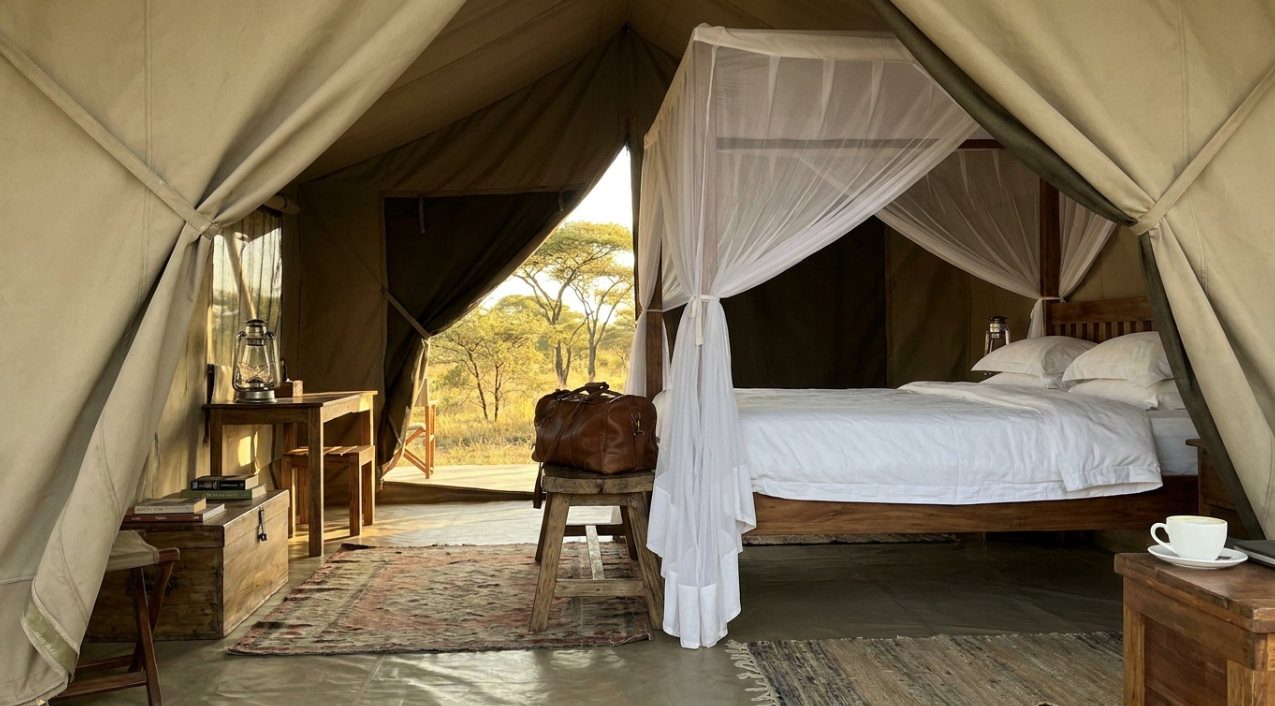
A safari camp that physically relocates throughout the year to follow wildlife movements, particularly the Great Migration. These camps break down and rebuild in different zones of the Serengeti depending on the season. Despite the word “tented,” most are surprisingly comfortable, with proper beds, hot showers, and full-service dining.
Why honeymooners care: If your honeymoon coincides with the Migration, a mobile camp puts you where the action is rather than waiting for the herds to pass by a fixed lodge.
Full-Board vs. All-Inclusive
Full-board means all meals are included (breakfast, lunch, dinner) but drinks are extra. All-inclusive adds beverages, often including local wines, beers, and spirits. In the safari world, most camps and lodges operate on full-board. Some premium properties offer all-inclusive packages.
Why honeymooners care: This distinction affects your final bill. On a 10-day trip, drinks can add $300 to $500 per couple. Knowing what your camp includes helps you budget accurately. For complete cost context, see our Tanzania safari cost guide.
Concession
A private wildlife area leased from the government or local community, bordering or adjacent to a national park. Concessions allow activities that are restricted inside the parks themselves, such as night drives, walking safaris, and off-road driving. Fewer vehicles operate in concessions, which means less crowding.
Why honeymooners care: Concession camps are where the most exclusive honeymoon experiences happen. They cost more, but the trade-off is genuine privacy in the bush, plus activities you cannot do inside Serengeti National Park proper.
Best Time for a Safari Zanzibar Honeymoon
There is no single best month for every safari Zanzibar honeymoon. The ideal timing depends on whether you prioritize dry-season wildlife viewing, the Great Migration, Serengeti calving season, beach weather or lower-season pricing.
|
Travel Window |
Safari Highlight |
Zanzibar Conditions |
Best For |
|---|---|---|---|
|
January–February |
Calving season |
Hot, generally dry |
Wildlife + beach combination |
|
March |
Calving season may continue |
Increasing rain risk |
Couples prioritizing safari |
|
April–May |
Green season, fewer visitors |
Long-rain period |
Lower-season travel |
|
June–July |
Migration moves north |
Dry season |
Wildlife + favorable weather |
|
August–October |
Northern Serengeti, possible Mara crossings |
Dry season |
Migration-focused honeymoons |
|
November |
Migration begins moving south |
Short rains possible |
Couples seeking flexibility |
|
December |
Herds return south; calving approaches |
Warm, generally favorable |
Festive-season beach + safari |
Best Months by Priority
Best for dry-season safari: June–October.
Best for Serengeti calving: January–March.
Best for potential Mara River crossings: August–October, although crossings are unpredictable.
Best for safari + beach balance: January–February or June–October.
The Great Migration is a year-round movement rather than a single event, so your safari location should be matched to your travel dates rather than simply choosing a month labeled “migration season.”
Safari and Wildlife Terms
Once you understand the trip structure, the next vocabulary layer involves the wildlife experiences you are actually planning around.
Big Five
The five most iconic African mammals: lion, leopard, elephant, Cape buffalo, and rhinoceros. The term originally referred to the five most dangerous animals to hunt on foot. Today it is a wildlife-viewing checklist. Tanzania’s Northern Circuit offers realistic chances of seeing all five, particularly in the Ngorongoro Crater and the Serengeti.
Why honeymooners care: Most first-time safari-goers consider “getting the Big Five” a trip goal. Your guide will know this without being told.
Great Migration
The continuous, year-round movement of approximately two million wildebeest and several hundred thousand zebra through the Serengeti-Mara ecosystem. There is no single “migration season.” The herds are always somewhere. What changes is where. A month-by-month migration guide explains the positioning in detail, but here is the short version:
-
December to March: Herds concentrate in the southern Serengeti and Ndutu plains for calving season.
-
April to May: Long rains push herds northwest through the Western Corridor toward Lake Victoria.
-
June to July: Herds gather in the Western Corridor and begin moving north toward the Grumeti and Mara rivers.
-
August to October: River crossings at the Mara River, the iconic photographic moment. Herds move between the northern Serengeti and Kenya’s Maasai Mara.
-
November: Herds begin the return south as short rains arrive.
Why honeymooners care: Timing your safari portion to match the Migration’s location means more dramatic wildlife viewing. This is the single biggest factor in choosing your travel dates.
Calving Season
The period from roughly December through March when wildebeest give birth on the short-grass plains of the southern Serengeti and Ndutu area. Hundreds of thousands of calves are born in a concentrated window, which attracts heavy predator activity, particularly from lions, cheetahs, and hyenas. It is some of the most dramatic wildlife viewing in Africa.
Why honeymooners care: A December to February safari Zanzibar honeymoon aligns calving season with Zanzibar’s best beach weather. It is one of the strongest timing combinations available.
River Crossing
The moments when migrating wildebeest and zebra attempt to cross the Mara or Grumeti rivers, typically between July and October. Crocodiles, strong currents, and steep banks make crossings chaotic and visually spectacular. Seeing a crossing is never guaranteed on any particular day.
Why honeymooners care: If river crossings are a priority, you need to be in the northern Serengeti between July and October and stay multiple days to improve your chances.
Game Drive
A vehicle-based wildlife viewing excursion, usually conducted in an open-top or pop-top 4x4. Most safari days include a morning game drive (departing at dawn) and an afternoon game drive (returning at sunset). Some camps offer full-day drives with a packed lunch.
Why honeymooners care: Game drives are the core activity of the safari portion. Everything else, the camps, the food, the sundowners, frames the drives.
Sundowner
Drinks served at a scenic viewpoint during sunset, typically set up by your guide in the bush. A table, camp chairs, cold drinks, and a view across the plains. It is one of the most romantic moments in any safari Zanzibar honeymoon.
Why honeymooners care: Sundowners are available at most mid-range and luxury camps. Some concession camps offer them in truly private settings where you are the only couple for miles.
Night Drive
An after-dark game drive using a spotlight to find nocturnal species like aardvarks, bush babies, genets, and hunting leopards. Night drives are not permitted in Serengeti National Park or most other TANAPA parks but are allowed in concession areas and the Ngorongoro Conservation Area.
Why honeymooners care: If nocturnal wildlife matters to you, this is a reason to choose a camp inside a concession rather than inside the national park.
Walking Safari
A guided, on-foot safari with an armed ranger. Walking safaris change the scale of the experience entirely: instead of watching elephants from a vehicle, you are tracking footprints through the bush, noticing dung beetles, learning about medicinal plants, and feeling genuinely immersed. Available in concessions and select conservation areas but not inside Serengeti National Park itself.
Why honeymooners care: For couples who want a mix of experiences, a single walking safari morning breaks up the rhythm of vehicle-based drives.
Hot-Air Balloon Safari
A dawn flight over the Serengeti in a hot-air balloon, typically lasting about an hour, followed by a champagne breakfast in the bush. Costs run approximately $500 to $600 per person. One Duma Explorer client described the Serengeti balloon ride as “incredible, 100% recommend,” calling it a highlight of their bespoke honeymoon trip.
Why honeymooners care: This is the single most popular honeymoon add-on in the Serengeti. It is worth budgeting for separately because most safari packages do not include it by default.
Park Fees and Conservation Fees
Per-person, per-day charges levied by TANAPA (Tanzania National Parks Authority) for entry to national parks. The current adult conservation fee for most Northern Circuit parks is $60 per person per day. Serengeti and Ngorongoro both charge $60 per adult per day, with Ngorongoro adding a separate $40 vehicle entry fee. On a typical seven-day Northern Circuit safari for two adults in a private vehicle, park fees represent roughly 15 to 20 percent of the total safari cost at mid-range level.
Why honeymooners care: Park fees are almost always included in your safari price, but knowing the figure helps you evaluate whether a quoted package price is reasonable. If an operator’s total seems unusually low, ask whether park fees are included.
Zanzibar Beach and Culture Terms
The second half of a safari Zanzibar honeymoon happens on the island. These terms cover the beach zones, cultural experiences, and practical details you will need.
Spice Island
Zanzibar’s historic nickname, earned through centuries as one of the world’s major producers of cloves, nutmeg, cinnamon, black pepper, and vanilla. The spice trade shaped the island’s architecture, culture, and cuisine.
Why honeymooners care: The name gives context to one of Zanzibar’s signature activities: the spice tour.
Stone Town
The historic center of Zanzibar City and a UNESCO World Heritage Site. A dense maze of narrow alleys, carved wooden doors, former slave market sites, palaces, and mosques. The best activities for couples in Stone Town include walking tours, spice market visits, rooftop tea at Emerson on Hurumzi, and sunset dhow cruises.
Why honeymooners care: Most couples spend one or two nights in Stone Town after landing in Zanzibar before heading to their beach resort. It adds cultural depth to what would otherwise be a pure beach extension.
Dhow
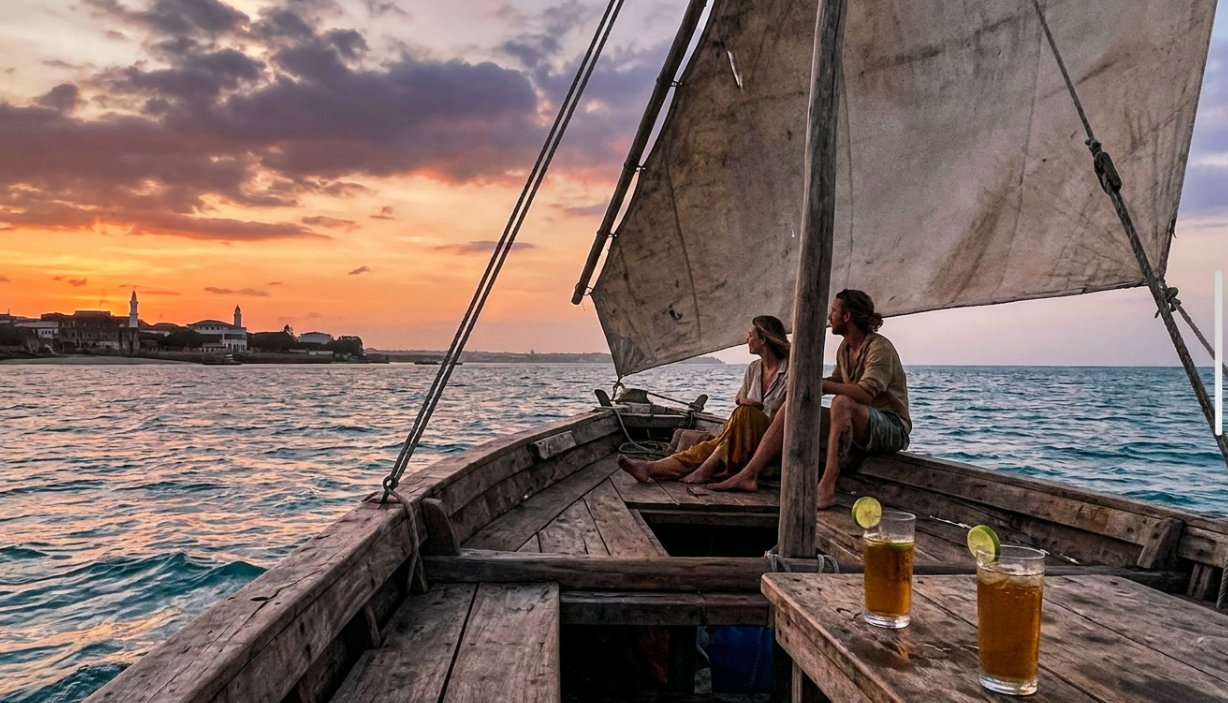
A traditional wooden sailing vessel with a triangular lateen sail, used for centuries along the East African and Arabian coasts. Today, sunset dhow cruises are one of Zanzibar’s top romantic activities. You sail out of Stone Town harbor as the sun drops, typically with drinks and snacks on board.
Why honeymooners care: A dhow cruise is low-cost, easy to arrange, and consistently rated as one of the most romantic evenings on the island.
Spice Tour
A guided visit to a working spice plantation where you see, smell, and taste cloves, vanilla, cinnamon, lemongrass, and dozens of other spices growing. Most tours last two to three hours. For a full breakdown, see the Zanzibar spice tour guide.
Why honeymooners care: It is the most popular half-day activity on Zanzibar and pairs well with a Stone Town walking tour on your first full day.
Zanzibar Beach Zones Compared
Choosing a beach area is one of the biggest decisions in a Zanzibar honeymoon. Here is how the four main zones compare:
|
Beach |
Coast |
Tide Impact |
Vibe |
Best For |
|---|---|---|---|---|
|
Nungwi |
North |
Minimal |
Lively, sunset-facing, restaurants and bars |
Couples who want options and social energy |
|
Kendwa |
North |
Minimal |
Calmer than Nungwi, same water quality |
Couples wanting luxury and privacy with swimmable water all day |
|
Matemwe |
Northeast |
Significant |
Quiet, exposed reef at low tide, remote |
Couples wanting tranquility and easy access to Mnemba Atoll snorkeling |
|
Paje |
Southeast |
Significant |
Boutique, kitesurfing hub, low-key |
Active couples, kitesurfers, budget-conscious honeymooners |
Nungwi
Zanzibar’s most popular beach on the northern tip. Sunset-facing, minimal tide impact, and a lively restaurant and bar scene. Accommodation ranges from mid-range to luxury.
Why honeymooners care: If you want the flexibility to choose between quiet resort time and evening social life, Nungwi offers both.
Kendwa
Just south of Nungwi on the north coast. Kendwa shares the same white sand and turquoise water but with a calmer atmosphere and fewer crowds. Tides do not affect swimming here, so couples can enjoy the ocean at any time of day.
Why honeymooners care: Kendwa is consistently the top beach recommendation for honeymoons. It balances luxury, privacy, and all-day swimmability.
Matemwe
On the northeast coast, facing the open Indian Ocean. When the tide goes out, Matemwe reveals tidal pools and sandbanks that are perfect for private walks. The trade-off is that swimming is tide-dependent, and the beach has a very different character at low water.
Why honeymooners care: Matemwe is the gateway to Mnemba Atoll, Zanzibar’s best snorkeling reef. If underwater experiences matter, this is the coast to pick.
Paje
On the southeast coast. Known for consistent winds (making it Zanzibar’s kitesurfing capital), boutique hotels, and a more laid-back, younger atmosphere. Paje has dramatic tidal shifts.
Why honeymooners care: Paje suits active couples on a lower budget who want a beachier, less resort-oriented experience. The tidal variations are significant, so manage expectations about swim access.
Mnemba Island and Mnemba Atoll
Two related but different things. Mnemba Island is a private 12-hectare coral island off Zanzibar’s northeast coast, home to an exclusive lodge with just 12 beach chalets. Mnemba Atoll is the surrounding reef system, one of East Africa’s premier snorkeling and diving sites. You can snorkel the atoll on a day trip from Matemwe without staying on the island.
Why honeymooners care: Mnemba Island Lodge is the ultra-luxury benchmark for Zanzibar honeymoons. If budget allows, it is extraordinary. If not, a day snorkeling the atoll is still world-class. One Duma Explorer client described snorkeling with dolphins and enjoying fresh lobster on a sandbank during their Zanzibar extension.
Jozani Forest
Zanzibar’s only national park, a mangrove and forest reserve in the island’s center. Home to the endemic Zanzibar red colobus monkey, found nowhere else on earth.
Why honeymooners care: A quick half-day trip that adds something different to a beach-heavy itinerary. Best combined with a spice tour.
Tides
Zanzibar’s east and southeast coasts experience dramatic tidal shifts. At low tide, the sea can recede hundreds of meters, exposing sand flats and reef. The north coast (Nungwi and Kendwa) is far less affected, making it possible to swim at any time. This is the single most important practical factor in choosing a beach zone.
Why honeymooners care: Couples who pick an east-coast resort without understanding tides are sometimes disappointed to find they cannot swim for several hours each day. Ask your operator about tide conditions for your specific travel dates.
Zanzibar Inbound Travel Insurance (ZIC)
Since October 1, 2024, the Revolutionary Government of Zanzibar requires all foreign visitors to carry mandatory inbound travel insurance. The cost is $44 per person. It is checked at immigration on arrival. Travelers without this insurance will be refused entry.
Why honeymooners care: This is new and catches many couples off guard. It is separate from any personal travel insurance you already carry. Purchase it online before departure. For broader guidance on trip protection, see the safari travel insurance guide.
Couples who want help choosing between Zanzibar’s beach zones and matching accommodation tiers to their honeymoon budget can ask Duma Explorer to compare options for their dates.
Accommodation Terms
The vocabulary around where you sleep matters because it directly affects comfort, romance, and cost.
Safari Lodge
A permanent, built structure inside or near a national park. Lodges are typically made from stone, wood, and glass, with solid walls and fixed infrastructure. They tend to feel more hotel-like than tented camps.
Why honeymooners care: Lodges offer reliability and creature comforts. They are a good choice for couples who are not sure they want the canvas-wall experience.
Tented Camp
Canvas-sided rooms set on raised platforms, often with hardwood floors, proper beds, en-suite bathrooms, and sometimes even bathtubs. The term “tented camp” in East Africa almost never means roughing it. Many tented camps are more luxurious than the lodges they compete with. The canvas walls let you hear the bush at night, hippos grunting, lions calling, which is part of the romance.
Why honeymooners care: Tented camps are the classic honeymoon accommodation on safari. They combine immersion in the environment with genuine comfort.
Banda
A Swahili-style beach hut, typically a small freestanding structure with a thatched or makuti palm roof. Bandas range from simple to spectacular. Mnemba Island Lodge, for example, uses the term “banda” for its beach chalets, which are among the most exclusive accommodations in East Africa.
Why honeymooners care: You will see this word in Zanzibar and coastal property descriptions. It simply means a standalone unit, not a room in a larger building.
Boutique Hotel
A small, design-forward property, usually with fewer than 20 rooms and strong individual character. Boutique hotels are common in Stone Town and along Zanzibar’s beaches. They tend to offer more personalized service than large resorts.
Why honeymooners care: For couples who value aesthetics and intimacy over resort amenities, a boutique property is often the better fit.
Private Plunge Pool
A small pool attached to your individual room or suite. Found at premium safari camps and many Zanzibar beach resorts. This is a honeymoon-tier amenity that can justify a higher room category.
Why honeymooners care: After a long morning game drive or a day at the beach, a private plunge pool with a view is one of those small upgrades that punches well above its price.
Honeymoon Perks
The extras that properties offer when they know a couple is celebrating their honeymoon: room upgrades, sparkling wine on arrival, spa credits, private bush dinners, flower arrangements, turndown surprises. These perks vary widely by property and are not always advertised. Duma Explorer clients have noted that when properties are informed in advance about the honeymoon occasion, it leads to small treats that are “an unexpectedly lovely touch.”
Why honeymooners care: Always tell your operator it is your honeymoon. The perks are free but only happen if the property knows. A good operator communicates this to every property on your route.
Logistics and Practical Terms
The final vocabulary layer covers the practical mechanics of getting to, through, and home from a safari Zanzibar honeymoon.
Kilimanjaro International Airport (JRO)
The main international airport for Northern Circuit safaris, located between Arusha and Moshi. Most couples fly into JRO, spend a night in Arusha, and depart for safari the following morning. For help with Tanzania visa requirements, including the eVisa process, see our separate logistics guide.
Why honeymooners care: JRO is your starting point. International flights arrive from Nairobi, Addis Ababa, Doha, Istanbul, and Amsterdam, among other hubs. Plan for an overnight in Arusha to recover from the long-haul flight before safari.
Abeid Amani Karume International Airport (ZNZ)
Zanzibar’s airport, where most couples end their honeymoon and fly home. Some international carriers operate direct flights from ZNZ; others require a connection through Dar es Salaam or Nairobi.
Why honeymooners care: Your departure airport is different from your arrival airport. A safari Zanzibar honeymoon is a “multi-city” booking: fly into JRO, fly out of ZNZ.
eVisa
Tanzania’s electronic visa, required for most nationalities. It costs $50 per person and should be applied for online before travel through Tanzania Immigration Services. Processing can take several business days.
Why honeymooners care: Do not leave this to the last minute. Apply at least two weeks before departure. Some nationalities require additional documentation.
Coastal Aviation and Auric Air
The two main domestic airlines operating bush flights between safari airstrips and Zanzibar. These are small propeller aircraft, not jets. Luggage limits are strict, typically 15 to 20 kilograms in soft-sided bags only. Hard-shell suitcases are not permitted.
Why honeymooners care: Pack accordingly. Soft duffel bags are mandatory for bush flights. Most couples leave a larger bag at their Arusha hotel and travel light during the safari portion.
Tipping
Tipping is customary and expected throughout Tanzania for safari guides, drivers, lodge and camp staff, and Zanzibar activity guides. Standard norms exist for each category. Our Tanzania tipping guide provides specific amounts.
Why honeymooners care: Budget for tips separately. They are not included in package prices and can add $300 to $500+ for a couple over a 10-to-14-day trip.
TANAPA
Tanzania National Parks Authority. The government body that manages all national parks (Serengeti, Tarangire, Lake Manyara, and others) and sets park entry fees.
Why honeymooners care: When you see “park fees” on your quote, those payments go to TANAPA. They fund conservation and park infrastructure.
NCAA
Ngorongoro Conservation Area Authority. A separate body from TANAPA that manages the Ngorongoro Conservation Area, including the Ngorongoro Crater. The NCAA has its own fee structure, including the $60 per adult per day conservation fee and a separate $40 vehicle entry fee for the crater floor.
Why honeymooners care: Ngorongoro is not technically a national park (it is a conservation area that allows Maasai pastoralism alongside wildlife). Its separate fee structure means operators quote it differently from other parks.
How Many Days Should You Spend on Safari vs Zanzibar?
For a 10–14-day honeymoon, a balanced starting point is roughly 4–7 safari nights followed by 4–7 Zanzibar nights. The right split depends on whether wildlife or beach time is the main priority.
|
Trip Length |
Safari |
Zanzibar |
Best For |
|---|---|---|---|
|
10 days |
4–5 nights |
4 nights |
First-time couples with limited vacation time |
|
12 days |
5–6 nights |
5 nights |
Balanced safari + beach honeymoon |
|
14 days |
6–7 nights |
6 nights |
Couples wanting a deeper safari and longer beach stay |
If the Great Migration or wildlife photography is the main reason for the trip, adding safari nights is usually more valuable than adding additional beach nights. If relaxation is the priority, a shorter safari followed by a longer Zanzibar stay may be the better fit.
12-Day Safari Zanzibar Honeymoon Itinerary
A 12-day safari Zanzibar honeymoon can comfortably combine three Northern Circuit safari areas with a Zanzibar beach stay. A common structure is one arrival night, five to six safari nights, and four to five nights in Zanzibar. The exact routing should change according to the season, wildlife priorities and flight schedule.
The key principle is simple: front-load the adventure and finish with the beach. This minimizes unnecessary transfers and gives couples a slower final stretch before flying home.
Sample 12-Day Structure
|
Day |
Location |
Experience |
|---|---|---|
|
1 |
Arusha |
Arrive at JRO and recover |
|
2 |
Tarangire |
Game drive |
|
3 |
Tarangire / Karatu |
Game drive and transfer |
|
4 |
Ngorongoro |
Crater-area experience |
|
5 |
Serengeti |
Transfer + game drive |
|
6 |
Serengeti |
Full safari day |
|
7 |
Serengeti |
Game drives / optional balloon safari |
|
8 |
Serengeti |
Final safari day |
|
9 |
Zanzibar |
Bush flight + beach transfer |
|
10 |
Zanzibar |
Beach / snorkeling |
|
11 |
Zanzibar |
Stone Town, spice tour or dhow cruise |
|
12 |
Zanzibar |
Final beach day / departure planning |
Important: This is a planning framework rather than a fixed route. Park access, migration location, flight schedules, accommodation availability and seasonal conditions can change the ideal sequence.
How Much Does a Safari Zanzibar Honeymoon Cost?
Understanding the price tiers helps couples budget realistically. Published competitor benchmarks and operator data cluster around these ranges:
|
Honeymoon Tier |
Approx. Per-Person Budget |
Typical Experience |
|---|---|---|
|
Value |
$3,500–$5,000+ |
Comfortable camps/lodges, fewer premium extras |
|
Mid-range |
$5,000–$8,000+ |
Private safari vehicle + quality beach resort |
|
Premium |
$9,500–$13,500+ |
High-end camps, better locations and upgraded beach stay |
|
Ultra-luxury |
$13,500–$20,000+ |
Fly-in logistics, exclusive camps and premium Zanzibar properties |
What Makes a Safari Zanzibar Honeymoon More Expensive?
The biggest price variables are:
-
Safari accommodation category
-
Private versus shared vehicle
-
Number of safari nights
-
Fly-in versus overland transfers
-
Travel season
-
Serengeti location
-
Private concessions
-
Zanzibar accommodation category
-
Internal flights
-
Special experiences such as hot-air ballooning
-
Private dinners and honeymoon upgrades
Two itineraries covering the same parks can therefore have very different prices. Comparing only the headline total can be misleading; check what accommodation, park fees, transfers, flights, meals and activities are actually included.
What Is Usually Included in a Safari Zanzibar Honeymoon?
The exact inclusions depend on the operator and accommodation level, but a safari Zanzibar honeymoon package commonly includes accommodation, meals during the safari, safari transportation, a private driver-guide when booked privately, park or conservation fees, and selected domestic flights or transfers.
Zanzibar packages may include accommodation, breakfast or other meals, airport transfers and selected activities.
Always Check Whether Your Quote Includes
|
Item |
Check Before Booking |
|---|---|
|
Safari accommodation |
Number of nights and room category |
|
Zanzibar accommodation |
Room type and meal plan |
|
Private vehicle |
Confirm whether the vehicle is exclusive to your couple |
|
Driver-guide |
Confirm whether guide and vehicle are included |
|
Park/conservation fees |
Ask whether all applicable fees are included |
|
Bush flights |
Confirm baggage allowance and airport/airstrip transfers |
|
Zanzibar transfers |
Check airport-to-hotel transportation |
|
Activities |
Check whether balloon rides, snorkeling and tours are extras |
|
Drinks |
Full-board does not necessarily mean drinks are included |
|
Tips |
Usually budgeted separately |
|
Travel insurance |
Check whether required Zanzibar insurance is separate |
Frequently Asked Questions
How many days do you need for a safari and Zanzibar honeymoon?
Ten days is the minimum that still feels complete: five safari nights, four Zanzibar nights, and one travel day on each end. Twelve to fourteen days is more comfortable because it allows for Tarangire, Ngorongoro, and the Serengeti without rushing, plus Stone Town and proper beach time.
Is it better to do safari first or Zanzibar first?
Safari first, beach second. This is the near-universal recommendation from operators and couples who have done it. The safari is more physically demanding (early wake-ups, bumpy roads, long drives), and the beach recovery afterward is exactly what you need before a long flight home.
What is the Zanzibar mandatory travel insurance and how do I get it?
Since October 2024, all foreign visitors to Zanzibar must carry inbound travel insurance costing $44 per person. It is separate from any personal travel insurance you already have. Purchase it online before you travel. Immigration officials check for it on arrival, and travelers without it will be refused entry.
When is the best month for a safari Zanzibar honeymoon?
June through October offers the best dry-season wildlife viewing and coincides with Zanzibar’s dry season. December through February combines Serengeti calving season (dramatic predator-prey viewing) with Zanzibar’s hot, dry, sunny beach weather. Both windows work well. For seasonal detail, see the guide to the best time for a Tanzania safari.
How much does a safari and Zanzibar honeymoon cost?
Expect to pay between $5,800 and $20,000+ per couple for a 10-to-14-day trip, depending on accommodation level and season. Value options start around $3,500 per person. Premium packages with top-tier camps and fly-in logistics run $9,500 to $13,500 per person.
Do I need a visa for Tanzania?
Most nationalities need an eVisa, which costs $50 per person and should be applied for online at least two weeks before travel. Some nationalities require additional documentation. Check the Tanzania Immigration Services portal for current requirements.
Can you add dietary requirements across the whole trip?
Yes. Safari camps and Zanzibar resorts routinely accommodate dietary needs, including coeliac, vegetarian, and allergy-related diets. A Duma Explorer client with coeliac disease confirmed that every venue on their safari-to-Zanzibar trip was informed in advance and they had “absolutely no issues the entire trip.” The key is communicating dietary needs to your operator early so every property along the route is prepared.
Ready to start building your trip? If you have rough travel dates, a sense of your accommodation preferences, and any priorities (Great Migration timing, a specific beach zone, a balloon ride over the Serengeti), that is enough to begin. Duma Explorer designs custom safari and Zanzibar honeymoons around your specific dates and budget, from the Northern Circuit through the bush flight to whichever beach zone fits your style.