

Quick summary
On a luxury Tanzania safari, budget $40 to $70+ per person per day in tipping cash across your guide, butler, camp staff, spa therapists, and incidentals. For a couple on a 7-day private luxury safari, that means roughly $560 to $980 total in tips. This guide breaks down every role, every amount, and every etiquette rule specific to properties charging $500 to $3,000+ per person per night.
Tipping on a luxury Tanzania safari is straightforward once you know the system, but almost nobody explains it for the premium tier. Most tipping guides online are written for mid-range travelers spending $200 to $400 per night. They quote $10 to $15 per day for a guide, mention a communal tip box, and call it done.
That advice doesn’t work when you’re staying at a $1,500-per-night tented camp with a personal butler, a dedicated tracker, spa therapists, and a bush plane pilot who just landed you on a grass strip in the Serengeti. The roles multiply, the expectations shift upward, and the logistics of getting enough small-denomination USD to a remote camp in the middle of nowhere become a genuine planning challenge.
This glossary covers every tipping scenario you’ll encounter on a premium Tanzanian safari, from the first airport transfer to the last Zanzibar beach resort. If you’re looking for general tipping guidance across all budget levels, our Tanzania safari tipping guide covers that ground. This page is specifically for travelers at the luxury end.
If you’re still designing your trip, Duma Explorer’s trip designers can match properties to your priorities and advise on tipping norms at each one.
Plan a luxury safari itinerary
How Much Should You Tip on a Luxury Tanzania Safari? For a luxury Tanzania safari, budget approximately $15–$25 per person per day for a private safari guide, $8–$15 per person per night for communal camp staff, and an additional $5–$10 per person per day for a personal butler when one is assigned and tipped separately. Trackers, spa therapists, transfer drivers, and other service providers may receive additional gratuities depending on the services provided. For two people on a seven-day luxury safari, a practical starting budget is approximately $450–$800 in total tipping cash, with more set aside for multiple camps, dedicated trackers, exceptional service, and Zanzibar extensions. These are voluntary planning estimates, not mandatory charges or universal Tanzanian industry rates. The most important rule is to distinguish between tips calculated per person, per vehicle, per room, and per night. Always confirm the property's tipping policy before distributing cash.
Luxury vs. Standard Tanzania Safari Tipping: What's Different?
Tipping on a luxury Tanzania safari follows the same basic principles as tipping on a budget or mid-range safari. The main difference is the number of individual service providers, the level of personalized attention, and the possibility of having dedicated staff such as personal butlers and wildlife trackers.
|
Tipping category |
Standard safari |
Luxury safari |
|---|---|---|
|
Private safari guide |
Operator-dependent; often a shared or vehicle-based amount |
Consider a more generous per-guest amount for dedicated private guiding |
|
Camp staff tip box |
Approximately $5–$10 per guest/night |
Approximately $8–$15 per guest/night |
|
Personal butler |
Usually not applicable |
Approximately $5–$10 per guest/day |
|
Dedicated tracker |
Often not applicable |
Approximately $5–$10 per guest/day |
|
Spa therapist |
Usually not applicable |
Approximately $5–$10 per treatment |
|
Bush flight pilot |
Usually not applicable |
Optional; approximately $5–$10 per flight |
These are indicative budgeting suggestions, not fixed industry rates. Some luxury properties use pooled gratuities that already include butlers, trackers, or other staff. Confirm the arrangement before tipping individuals separately.
The biggest difference: Luxury travelers may encounter more specialized service roles, but they should not assume that every employee requires a separate envelope or that tipping should increase in proportion to the accommodation price.
Why Tipping Matters More Than You Think at Luxury Properties
The question comes up constantly: “I’m already paying $2,000 a night. Why should I tip on top of that?”
It’s a fair question with a simple answer. Most of your nightly rate goes to the lodge operator, covering conservation fees, land leases, imported food and wine, staff housing, vehicle maintenance, and profit margins. The people serving you directly, your guide, your butler, the kitchen team cooking your meals at 4 a.m. before a dawn drive, see a fraction of that headline price in their monthly wages.
Safari guide base salaries in Tanzania typically range from $200 to $500 per month. Tips can represent 30% to 60% of a guide’s total annual income, depending on the operation. At a well-run luxury camp, a guide might earn $2,000 to $3,000 monthly in tips during high season, which brings their compensation closer to something commensurate with the extraordinary skill set required: wildlife tracking, vehicle mechanics, first aid, guest relations, and deep ecological knowledge.
A luxury travel agent recently reignited this debate on social media by sharing that despite paying around $6,000 per night per room, she still tipped an additional $150 to $300 per night at every lodge. Comments were split. Some called it excessive. Others pointed out the income reality for staff. The truth is somewhere in between, and it depends on your service experience, but understanding the wage structure makes the case clearly.
Expert Africa raises a thoughtful counterpoint worth considering: massive tips to front-of-house staff can distort local economies when a camp butler earns more than a district nurse or teacher. The ethically-minded approach is to tip generously but proportionally, and to make sure back-of-house staff (through the communal tip box) aren’t overlooked while you’re handing envelopes to the people you interact with directly.
Luxury Safari Tipping Table: Quick Reference
The following table provides suggested gratuity amounts for travelers booking private luxury safaris in Tanzania. All amounts are voluntary planning recommendations. Individual lodge policies and operator guidance should take priority.
|
Person or service |
Suggested tip |
Calculation basis |
When to tip |
|---|---|---|---|
|
Private safari guide |
$15–$25 |
Per guest, per day |
End of safari |
|
Dedicated wildlife tracker |
$5–$10 |
Per guest, per day |
End of camp stay |
|
Personal butler |
$5–$10 |
Per guest, per day |
End of camp stay |
|
General camp staff |
$8–$15 |
Per guest, per night |
At checkout |
|
Spa therapist |
$5–$10 |
Per treatment |
After treatment |
|
Bush flight pilot |
$5–$10 |
Per flight, optional |
After landing |
|
Airport transfer driver |
$5–$10 |
Per transfer |
At drop-off |
|
Hotel porter |
$1–$2 |
Per bag |
When luggage is delivered |
|
Walking safari guide |
$10–$20 |
Per walk, depending on group arrangement |
After the walk |
|
Balloon safari crew |
$10–$20 |
Per guest, optional |
After landing |
|
Local village guide |
$5–$10 |
Per visit, depending on group arrangement |
At the end of the visit |
|
Zanzibar resort staff |
$5–$10 |
Per guest, per day, as an optional pooled contribution |
At checkout |
Important tipping notes:
-
Private safari guide amounts are quoted per guest, not per vehicle. If your operator recommends a vehicle-based amount, do not multiply it by the number of passengers.
-
Camp staff tips should go into the communal tip box unless the property provides another system.
-
Ask whether butlers and trackers participate in the communal pool before tipping them separately.
-
Bush flight pilots and balloon crews do not have a universal tipping requirement. Treat these amounts as optional.
-
Zanzibar resort tipping policies differ from safari camp policies. Check whether a service charge or pooled gratuity is already included.
Per Person vs. Per Vehicle vs. Per Night: How to Calculate Safari Tips
One of the most common mistakes travelers make when budgeting for a Tanzania safari is confusing per-person tipping with per-vehicle tipping.
These are not interchangeable. A recommendation of $20 per person per day is very different from $20 per vehicle per day when two, four, or six guests share the same safari vehicle.
|
Tipping method |
What it means |
Example for two guests |
|---|---|---|
|
Per person, per day |
Each traveler contributes the stated amount daily |
$20 × 2 = $40/day |
|
Per vehicle, per day |
Everyone shares one total amount for the vehicle |
$30 total/day |
|
Per person, per night |
Each traveler contributes for every night at camp |
$10 × 2 = $20/night |
|
Per room, per night |
One amount is calculated for the entire room |
$15 total/night |
|
Per treatment |
One gratuity for an individual service |
$10 per massage |
|
Per transfer |
One amount for the completed journey |
$10 per transfer |
Example: Two People on a Private Safari
Suppose a couple receives a recommendation of $20 per person per day for their private guide.
The calculation is:
2 guests × $20 × 7 safari days = $280.
However, if the operator recommends $30 per vehicle per day, the calculation becomes:
$30 × 7 safari days = $210.
The difference is $70.
Always ask your safari operator whether its recommended gratuity is per guest or per vehicle before preparing your tipping budget. This is especially important for private family safaris and itineraries with multiple guests sharing a vehicle.
Worked Example: 7-Day Luxury Private Safari for Two
To understand how much tipping cash to bring, consider a couple taking a seven-day private luxury safari in Tanzania, staying at three different camps.
The following example assumes that the guide, butler, and communal camp staff receive separate gratuities. It also assumes seven camp nights. Adjust the calculations if your itinerary includes fewer nights or if some tips are already pooled.
|
Category |
Calculation |
Total |
|---|---|---|
|
Private safari guide |
2 guests × $20 × 7 days |
$280 |
|
Camp staff tip boxes |
2 guests × $10 × 7 nights |
$140 |
|
Personal butler |
2 guests × $5 × 7 days |
$70 |
|
Spa treatments |
2 treatments × $10 |
$20 |
|
Bush flights |
2 flights × $5 |
$10 |
|
Transfer drivers and incidentals |
Estimated allowance |
$30 |
|
Total |
$550 |
What if you want to tip more generously?
Travelers who receive exceptional service or stay at properties with additional dedicated staff can increase their tipping allowance.
For example:
-
Increase the guide gratuity from $20 to $25 per guest per day.
-
Increase the communal staff contribution from $10 to $15 per guest per night.
-
Increase the butler gratuity from $5 to $10 per guest per day.
-
Set aside additional cash for trackers, walking guides, spa treatments, and special arrangements.
This would bring the budget to approximately $720 before additional optional gratuities.
Important: Avoid Double-Tipping
Some luxury camps distribute pooled gratuities among butlers, trackers, waitstaff, and other employees. If these employees already receive a share of the communal tip box, separate gratuities are optional rather than automatically necessary.
Ask your camp manager how the system works before deciding on the final amount.
Planning takeaway: A couple on a seven-day luxury safari can use approximately $550 as a worked budgeting example, then increase the allowance based on the actual staff structure and tipping policies of their chosen camps.
Are Tips Included in Luxury Tanzania Safari Packages?
Most Tanzania safari packages do not automatically include all personal gratuities. However, some luxury lodges and tour operators may include service charges, staff gratuities, or specific tipping contributions in their quoted prices.
Before your trip, check exactly what your package covers.
|
Charge or payment |
What it may cover |
Should you tip separately? |
|---|---|---|
|
Safari package price |
Accommodation, meals, transport, park fees, and other inclusions |
Usually, yes |
|
Lodge service charge |
A property-defined service or operational charge |
Confirm whether staff receive any distribution |
|
Communal staff gratuity |
Pooled tips for lodge employees |
No need to duplicate the same contribution automatically |
|
Private guide gratuity |
A direct payment to your safari guide |
Usually separate unless explicitly included |
|
Personal butler gratuity |
Individual service recognition |
Depends on the property's pooling policy |
|
Spa service charge |
A charge added to the treatment bill |
Check whether an additional tip is necessary |
Five Questions to Ask Before Your Safari
-
Are guide gratuities included in the safari package?
-
Does the lodge have a communal staff tipping box?
-
Are butlers and trackers included in the communal pool?
-
Is a service charge already included in the accommodation price?
-
Can gratuities be paid by credit card, or is cash preferred?
A service charge and a gratuity are not automatically the same thing. Some properties use service charges to cover business or operational costs, while others distribute some or all of them to employees.
Best practice: Ask your safari operator for a written breakdown of included gratuities before departure. This prevents duplicate tipping and makes it easier to prepare the correct amount of cash.
Glossary of Luxury Safari Tipping Terms
Asante
Swahili for “thank you.” Say it when handing over your tip. For extra warmth, use “asante sana” (thank you very much). This small gesture matters, and staff notice when guests make the effort.
Butler (Luxury Camps)
At high-end safari properties, you may be assigned a personal butler who manages your schedule, arranges bush dinners, draws baths, unpacks your bags, and handles special requests. Because their service is individual and direct, butlers should be tipped separately from the general staff box. Budget $10 to $15 per person per day. At check-in, ask whether your butler participates in the communal tip pool or should be tipped independently. This varies by property.
Communal Tip Box / Staff Box
A collection box (usually near reception) where guests deposit tips that are pooled and distributed among all staff, including back-of-house workers you never see: laundry teams, kitchen staff, groundskeepers, night watchmen. At luxury properties, the camp manager typically distributes pooled tips monthly according to a formula that weights seniority and role. This is the single most important tipping mechanism for ensuring equity. Don’t skip it.
Direct Tipping
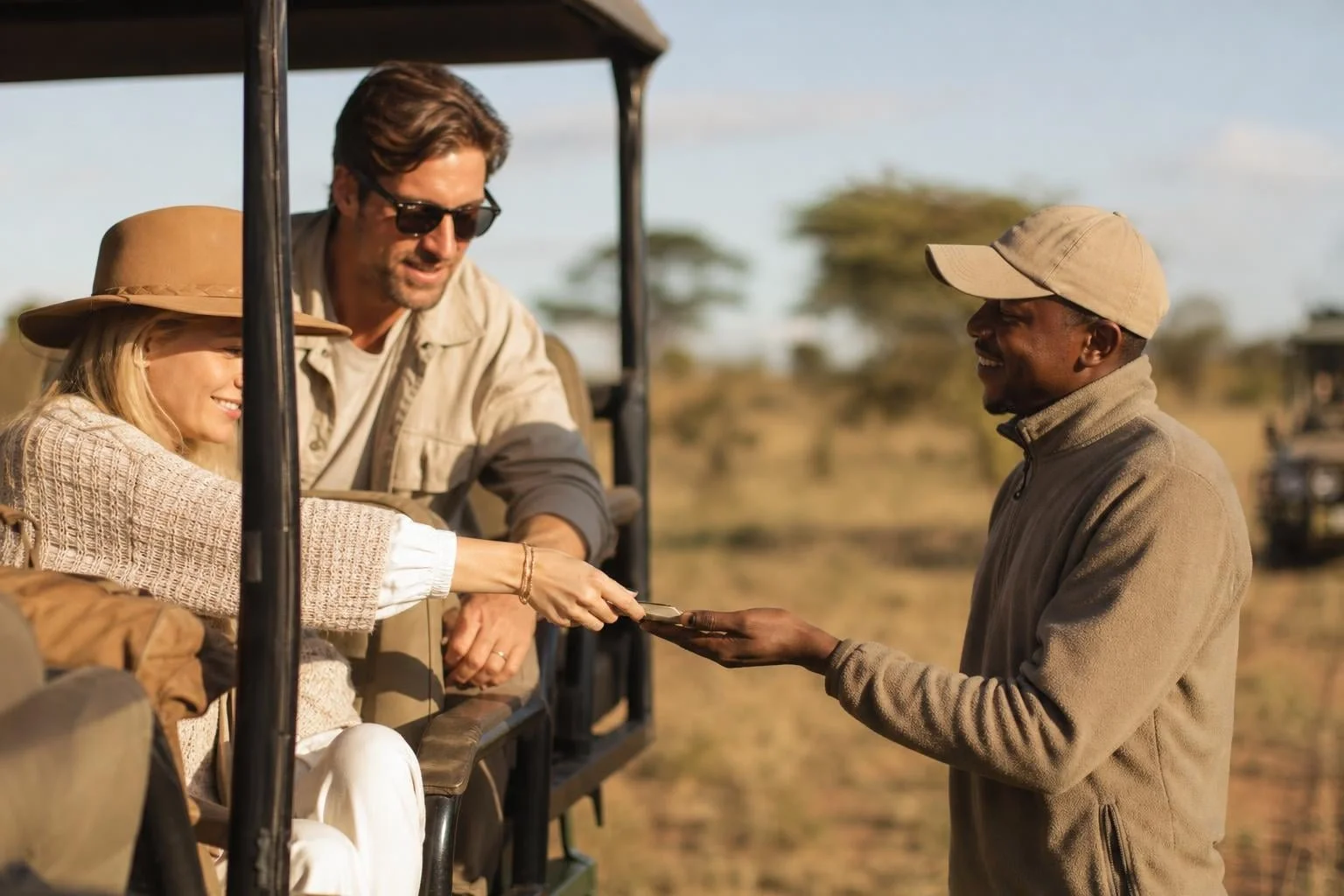
Handing an envelope or cash directly to a specific person, rather than using the tip box. Reserved for your guide, butler, tracker, and anyone providing personal, one-on-one service. Always use your right hand (the left hand is considered impolite in Tanzanian culture). A brief word of thanks, eye contact, and sincerity matter more than the dollar amount.
Driver-Guide
On a private safari in Tanzania, your driver-guide is the single most important person on your trip. They drive, spot wildlife, interpret behavior, navigate parks, manage logistics, and often become a friend by the end. At the luxury tier, $25 to $50 per person per day is the established range. Industry-wide, safari guide gratuities in Tanzania follow standards of $20 to $30 per person per day for private arrangements, with the upper end reserved for exceptional, multi-day private safaris. If you have the same guide for your entire trip (common on luxury itineraries), tip at the very end in one envelope with a handwritten note.
Fly-In Safari Pilot
Almost no tipping guide addresses this, yet it’s a real question for travelers on luxury fly-in safaris. Bush plane pilots operating small Cessnas between remote airstrips are skilled professionals. Tipping is not expected the way it is for guides, but $5 to $10 per flight is a welcome gesture, especially for scenic diversions or particularly smooth landings in crosswinds. Hand the tip directly after disembarking.
Guest Day
How camps calculate tipping recommendations. One “guest day” equals one guest for one night. If a lodge suggests $20 per guest day for the tip box and you’re a couple staying three nights, that’s 2 × 3 × $20 = $120 for the tip box at that property.
Lodge Staff Pool
The mechanism by which communal tip box contributions are divided. At most luxury operations, the camp manager collects the box weekly or monthly and distributes funds according to an internal formula. Back-of-house staff (kitchen, laundry, housekeeping, maintenance) typically receive a proportional share. Some camps split evenly; others weight by role or tenure. You don’t need to understand the exact formula, just know that your tip box contribution reaches people you never interact with directly.
Night Game Drive Guide
Some luxury camps offer night drives with a separate guide (often a specialist tracker with a spotlight). If this guide is different from your daytime driver-guide, tip them $10 to $15 at the end of the drive. If it’s the same person, no separate tip needed.
Per-Person vs. Per-Vehicle
A critical distinction that causes real confusion. Most tipping recommendations are quoted per person per day. But some sources (and some camps) quote per vehicle per day. On a private luxury safari, a vehicle typically carries one couple or one family, so per-vehicle amounts should be roughly double the per-person rate. Always clarify which convention a recommendation uses before doing your math.
Ranger (Ngorongoro Crater)
An armed ranger is assigned to every vehicle entering the Ngorongoro Crater floor. This is mandatory, not optional. Tip $5 to $10 per vehicle (not per person) at the end of your crater drive. Hand the tip directly to the ranger.
US Dollar Banknotes for Safari Tipping in Tanzania
US dollars are commonly used for safari gratuities, but travelers should bring clean, undamaged banknotes in small denominations.
Some Tanzanian businesses and currency exchange providers may be reluctant to accept older or damaged US dollar notes. Acceptance policies can differ between banks, exchange bureaus, hotels, and safari properties.
For easier tipping, prepare a selection of:
-
$1 bills for small incidental gratuities.
-
$5 bills for porters, drivers, and small services.
-
$10 bills for individual staff contributions.
-
$20 bills for larger gratuities and communal tip boxes.
As a precaution, bring newer-design US dollar notes, preferably printed in 2013 or later, and confirm the requirements with your safari operator before departure.
Avoid torn, heavily marked, taped, or badly worn notes.
Important: Do not assume every Tanzanian business follows the same banknote acceptance policy. Ask your operator which denominations and issue dates its camps will accept.
Spa Therapist
Many luxury lodges offer massage, facials, and other treatments. Tip roughly $5 to $10 per treatment directly to the therapist, immediately after the session. This is separate from the communal tip box.
Tip Envelope
The physical delivery method. Before your trip, divide your total tipping cash into labeled envelopes: one for each camp’s staff tip box, one for your guide (or one per guide if you have different guides at different camps), and a few loose small bills for porters, transfer drivers, and unexpected situations. Preparing envelopes in advance eliminates the scramble of counting cash in your tent at 5 a.m. on departure morning.
Tracker / Spotter
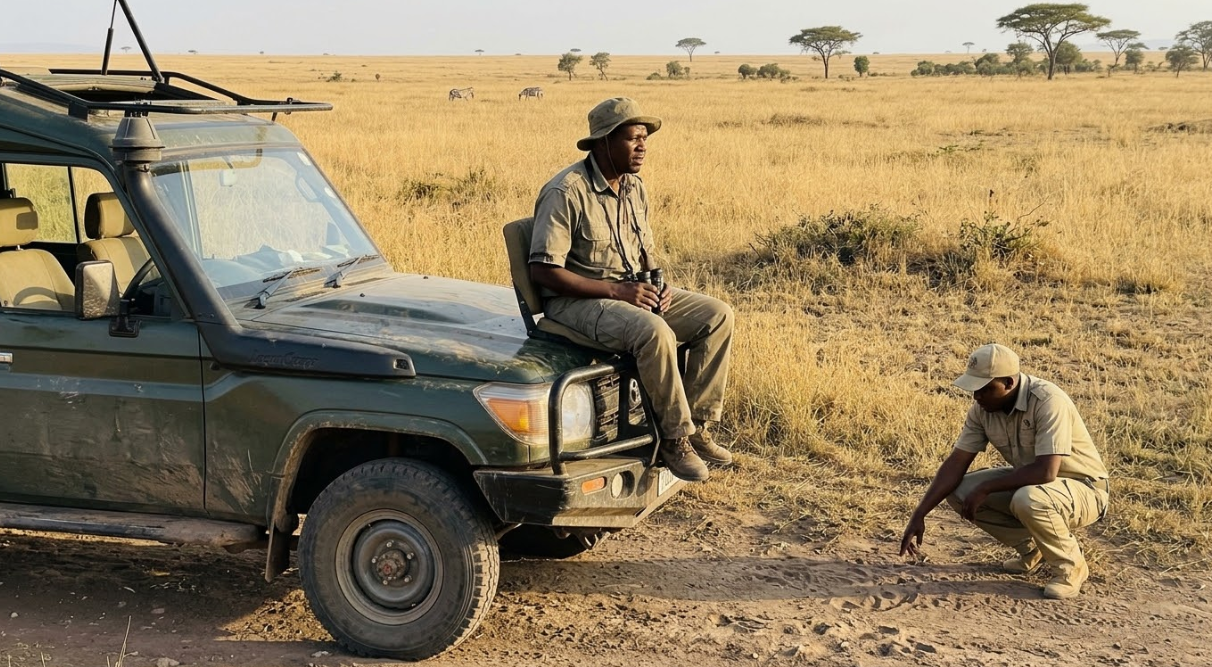
At some luxury camps (particularly in areas with high leopard or wild dog concentrations), a dedicated tracker rides on the front of the vehicle or scouts ahead on foot. This person works alongside your guide but performs a distinct role. Tip $10 to $15 per person per day, handed directly in an envelope at the end of your stay.
Walking Safari Guide
If your luxury camp offers walking safaris led by a guide other than your regular driver-guide, tip them separately: $15 to $25 per person for the walk. Walking safari guides carry significant responsibility (they’re typically armed and manage dangerous-game encounters on foot) and deserve recognition accordingly.
Gratuity
A gratuity is a voluntary payment given to recognize good service. On a Tanzania safari, gratuities may be given directly to an individual guide or placed into a communal staff tip box. Unlike mandatory park fees or accommodation charges, tips are discretionary.
Service Charge
A service charge is an additional amount applied to a bill by a hotel, restaurant, or lodge. Its distribution depends on the property's internal policy. It should not automatically be treated as a direct gratuity for your guide or other individual employees.
Tipping Pool
A tipping pool is a system in which gratuities are collected and distributed among multiple employees. At safari lodges, this can help recognize behind-the-scenes workers such as cooks, housekeeping teams, laundry staff, maintenance employees, and other support personnel.
Before contributing, ask whether the pool includes every staff category or whether certain employees receive separate tips.
Cash Logistics: How to Prepare for Luxury Safari Tipping in Tanzania
For most luxury travelers, the hardest part of tipping in Tanzania is not the etiquette but the cash logistics. Remote safari camps have no ATMs. Even in Arusha or Dar es Salaam, sourcing small-denomination USD bills at short notice can be surprisingly difficult.
How Much Cash to Bring
For a 7-day luxury private safari for two, bring $700 to $1,100 in tipping cash. For a 10-day trip with a Zanzibar extension, budget $1,000 to $1,500. These are tipping totals only and don’t include souvenir shopping or town restaurant meals.
Denomination Mix
Bring a mix of bills weighted toward smaller denominations:
-
$1 bills: 20 to 30 (for porters, small tips, Maasai village visits)
-
$5 bills: 20 to 30 (for spa, transfer drivers, individual staff)
-
$10 bills: 15 to 20 (for tracker, butler, daily guide calculations)
-
$20 bills: 10 to 15 (for guide envelopes, tip box contributions)
Avoid using $50 or $100 bills for tips. They’re hard to break at remote camps, and handing someone a $100 bill when you intend a $20 tip creates an uncomfortable situation.
The Pre-Labeled Envelope System
Before departure, organize your cash into envelopes labeled by recipient and property:
-
“Camp 1 — Staff Tip Box”
-
“Camp 2 — Staff Tip Box”
-
“Camp 3 — Staff Tip Box”
-
“Guide — Name if known”
-
“Miscellaneous — Porters, Transfers, Spa”
This removes all guesswork during the trip.
Card Tipping
Some luxury lodges allow you to add a tip to your final bill via credit card. Don’t count on this. Many camps are too remote for reliable card processing, and even where it works, cash is strongly preferred because it reaches staff faster and more directly. Treat any card option as a backup, not your plan.
Where to Get Small Bills
Order small-denomination USD from your bank two to three weeks before departure. Airport currency exchanges rarely stock enough $1s and $5s. If you forget, the front desk at a Nairobi or Arusha hotel can sometimes break larger bills, but availability is unpredictable.
Ensuring you have the right travel insurance and the right cash supply are both pre-trip logistics worth handling early.
Should You Bring Cash in USD or Tanzanian Shillings?
For safari gratuities, US dollars are commonly accepted by many established safari operators and luxury properties. However, Tanzanian shillings are also appropriate where accepted, particularly for smaller local transactions.
The most practical approach is to confirm your accommodation's preference before traveling.
Use USD for safari gratuities when your operator recommends it, and keep some Tanzanian shillings available for local purchases, small services, and everyday expenses.
Do not assume that every employee or business prefers the same currency.
Luxury Tanzania Safari Tipping Budget by Trip Length
The amount of tipping cash you need depends on the length of your safari, the number of guests, the number of camps, and the number of individual service providers.
The following table uses an illustrative budget of $20 per guest per day for the guide and $10 per guest per night for communal camp staff. It excludes optional butler, tracker, spa, and transfer gratuities.
|
Safari duration |
Guests |
Guide tip |
Camp staff tip (assuming equal nights) |
Combined estimate |
|---|---|---|---|---|
|
3 days / 2 nights |
2 |
$120 |
$40 |
$160 |
|
5 days / 4 nights |
2 |
$200 |
$80 |
$280 |
|
7 days / 6 nights |
2 |
$280 |
$120 |
$400 |
|
7 days / 7 nights |
2 |
$280 |
$140 |
$420 |
|
10 days / 9 nights |
2 |
$400 |
$180 |
$580 |
|
10 days / 9 nights |
4 |
$800 |
$360 |
$1,160 |
These are example calculations rather than mandatory tipping amounts. Adjust the budget if the guide's recommendation is quoted per vehicle, if you have different guides, or if your accommodation uses a pooled gratuity system.
For a more personalized estimate, calculate each category separately:
Total tipping budget = Guide tips + Camp staff tips + Personal service tips + Optional activity tips + Transfer tips.
Timing and Etiquette: When and How to Tip
Tip Your Guide at the End, Not Daily
Tip your safari guide at the conclusion of your time together, not after each game drive. Daily tipping creates an awkward performance dynamic where the guide feels pressure to “earn” each day’s tip rather than simply doing their job well. One envelope at the end, with a thank-you note, is the standard.
If you have the same guide across multiple camps (common on private luxury itineraries), tip once at the very end of the safari. If you switch guides at each camp, tip each guide when you part ways.
Tip Box: Morning of Departure
Drop your tip box contribution the morning you check out of each camp. Some guests do it the evening before. Either works. Don’t wait until you’re in the vehicle about to leave, as you’ll be rushed.
Right Hand, Eye Contact, Sincerity
Present tips with your right hand. The left hand is considered impolite across East African culture. Make eye contact and say “asante sana.” These aren’t empty formalities. They communicate respect.
What Should You Write on a Safari Tipping Envelope?
A short handwritten thank-you note is a thoughtful way to accompany a gratuity, especially when tipping a guide who has spent several days with your family or group.
You do not need an elaborate message. Keep it personal and sincere.
For example:
"Thank you for making our Tanzania safari so memorable. We appreciated your knowledge, patience, wildlife expertise, and the care you showed throughout our journey. Asante sana!"
For a communal staff envelope, you can write:
"Thank you to the entire camp team for your hospitality and excellent service. We appreciate everyone who helped make our stay special."
Label each envelope clearly so the money reaches the intended person or team.
Never Leave Cash on the Bed
Safari staff who find loose cash on the bed or nightstand will assume it was forgotten and radio the driver or guide to return it. This creates confusion and delays. Always use the tip box or hand an envelope to a specific person.
Group Tipping Coordination
If you’re traveling with friends or an extended family, agree on tipping amounts before the trip starts. One travel community discussion noted that groups “often struggle to coordinate tips. One couple thinks everyone is contributing equally; another person has already slipped an envelope privately.” Designate one person to collect contributions and handle the tip box. This avoids both shortfalls and awkward duplication.
For groups planning a Tanzania safari together, sorting out tipping logistics in advance saves real friction on the ground.
Luxury-Specific Tipping Scenarios
Fly-In Safari with Multiple Camps
On a fly-in itinerary visiting three or four camps, you tip the staff tip box and any personal service staff (butler, tracker) at each camp separately. Your guide situation determines how you handle that tip:
-
Same guide, all camps: One envelope at the end of the full trip.
-
Different guide at each camp: One envelope per guide, handed over on departure from each camp.
-
Camp-employed guides (no traveling guide): Tip at each camp. These guides are often included in the communal pool, so ask at check-in.
Mobile Tented Camp with Dedicated Cook
Mobile camps in the Serengeti sometimes include a dedicated cook who travels with your group. Tip the cook $10 to $15 per person per day, in a separate envelope from the general staff. Their role is physically demanding and their meals are often remarkable given the bush kitchen constraints.
Honeymoon Safari with Special Arrangements
If the camp arranges a private bush dinner, a sundowner setup, or decorates your tent for a special occasion, consider tipping the staff who organized it $10 to $20 as a direct thank-you. This is above and beyond the regular tip box. Couples planning a romantic safari in Tanzania should budget a small buffer for these moments.
Family Safari: Do Children Count?
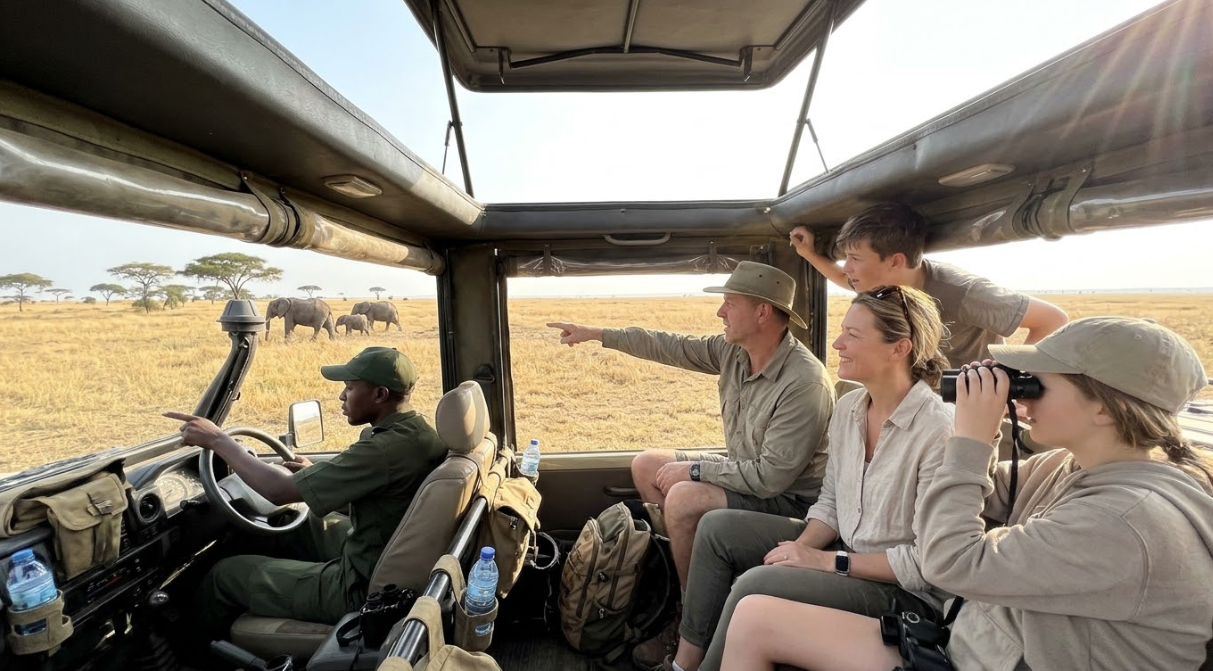
This trips up many parents. Industry convention at luxury properties is that children under about 5 or 6 don’t count toward tip calculations, but older children do. A family of two adults and two teenagers on a private safari should budget guide tips for four people, not two. For more on structuring and budgeting a family safari in Tanzania, the cost dynamics extend well beyond tipping.
Kilimanjaro + Safari Combination
If your trip includes a Kilimanjaro climb before or after your safari, the tipping systems are completely separate. Kilimanjaro tipping follows KPAP (Kilimanjaro Porters Assistance Project) guidelines and involves an entirely different crew: lead guide, assistant guides, cook, and porters. Budget separately for each segment. Our Kilimanjaro tipping guide covers those amounts in detail.
Zanzibar Extension
Zanzibar beach resorts operate more like international hotels than safari camps. Most run a communal staff tip box. Budget $10 to $20 per guest per day at luxury all-inclusives. Housekeeping staff are typically tipped $1 to $3 per day. Restaurant staff may receive 5% to 10% if no service charge is included. Activity guides (snorkeling, diving, spice tours) are tipped $5 to $15 per activity depending on length and quality.
Common Luxury Safari Tipping Mistakes
Under-budgeting for tips. A $10,000 safari with a $200 tipping budget signals that you either didn’t research or don’t value the service. Neither impression is the one you want to leave.
Bringing old or damaged USD bills. Notes from before 2009 (ideally before 2013) will be rejected. Torn, taped, or heavily marked bills will be rejected. This is not negotiable.
Tipping daily instead of at the end. It creates pressure and changes the dynamic. Wait until the conclusion of your stay with each guide.
Leaving cash on the bed. It will be returned to you, not kept. Use the box or hand it over personally.
Ignoring the tip box. The people you never meet, the dishwashers, the groundskeepers who keep snakes away from your tent, the laundry team, rely on the communal pool. Tipping your guide generously while skipping the box means back-of-house staff get nothing from your stay.
Not asking about butler pooling. At some properties, butlers participate in the communal pool. At others, they don’t. Asking at check-in takes five seconds and ensures your butler actually receives what you intend for them.
Over-tipping one person while skipping others. Handing your guide $500 while giving nothing to the camp staff creates resentment and imbalance within the team. Distribute proportionally.
One TripAdvisor debate captured the tension well: an experienced poster argued that $20 per group per day for a guide is generous given average Tanzanian monthly salaries of $100 to $150. Others countered that $30 per guest per day was customary. The range of opinions is genuinely wide. At the luxury tier, the higher amounts apply because service standards are higher, interactions are more personal, and guest-to-staff ratios are lower.
Frequently Asked Questions
Is tipping mandatory on a luxury Tanzania safari?
Technically, no. Tipping is voluntary everywhere in Tanzania. Practically, it is a deeply embedded part of the safari economy, and staff depend on it for a significant portion of their income. At luxury properties, the expectation is firm. Not tipping would be noticed and would affect the staff who served you.
Should I tip more at more expensive camps?
Generally, yes, though the increase is moderate, not proportional. A $3,000-per-night camp doesn’t require triple the tip of a $1,000-per-night camp. The higher tip box recommendations at premium properties (roughly $15 to $25 per person per night vs. $5 to $15 at mid-range) reflect the larger staff teams and higher service standards, not a percentage of the room rate.
Can I tip by credit card at luxury lodges?
Some lodges offer this, but most remote camps cannot process cards reliably. Even where possible, cash tips reach staff faster and more directly. Bring cash and treat card tipping as a last resort.
How much total cash should I bring for a 7-day luxury safari for two?
Between $700 and $1,100, depending on how many camps, whether you have a butler, and how generous you want to be. Add $200 to $400 if you’re extending to Zanzibar.
Do I tip the pilot on a bush flight?
It’s not expected the way guide tips are, but $5 to $10 per flight is appreciated and increasingly common on luxury fly-in itineraries.
Should I tip my guide if the operator includes a “service charge”?
Yes. Service charges typically cover operational costs and don’t flow to your guide as a tip. If in doubt, ask your operator directly whether the service charge includes gratuities. In almost every case, it does not.
Is it appropriate to tip in Tanzanian shillings?
For safari guides and camp staff, USD is strongly preferred and much more practical. Shillings are fine for small-town restaurant tips, market purchases, and Zanzibar taxis, but not for the safari tipping system.
Luxury safari tipping in Tanzania is ultimately about recognizing the people who make an extraordinary experience possible. The amounts matter, but so does the delivery: a sealed envelope, your right hand, eye contact, and “asante sana.” Get those right, and you’ll leave a lasting impression on the people who made your trip unforgettable.
Duma Explorer’s trip designers can advise on specific tipping amounts for each property on your itinerary and provide a pre-trip tipping worksheet tailored to your camps, guides, and travel style.
Design my luxury Tanzania safari