

TL;DR
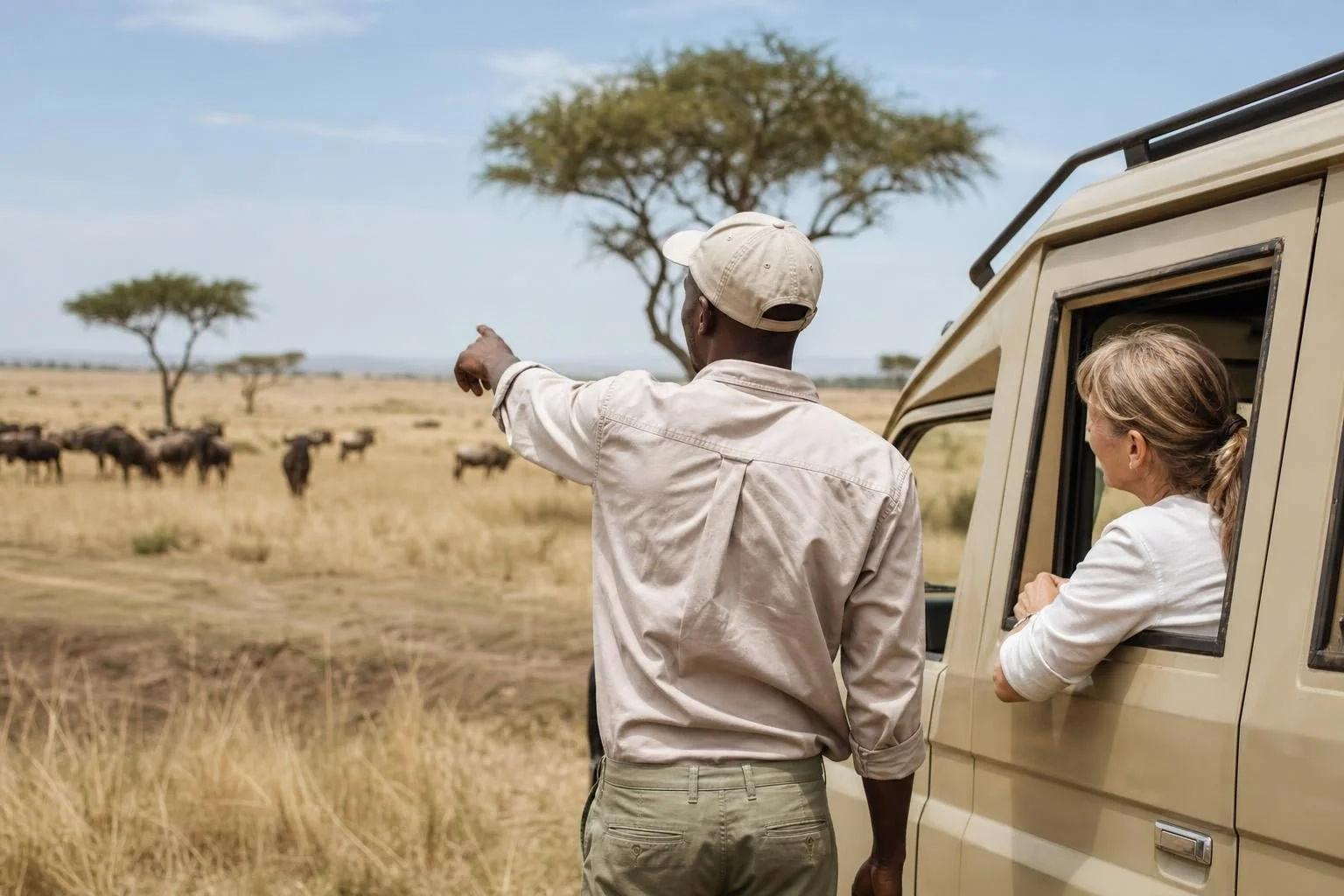
A private guide safari in Tanzania means you get your own vehicle, your own dedicated guide, and an itinerary shaped entirely around your pace. Unlike a group safari where 4 to 7 travelers share a vehicle and a guide balances everyone’s competing interests, a private guide safari lets you decide when to leave camp, how long to watch a leopard feed, and whether to skip a crowded sighting in favor of a quiet stretch of riverbank.
A private guide safari gives you a dedicated driver-guide and vehicle for your entire Tanzania trip. Expect to pay roughly 30 to 50% more than a comparable group safari. Your guide holds a TALA license, likely trained at Mweka College, and stays with you across multiple parks so they learn your preferences. This glossary defines every term you need to understand before booking.
What Is a Private Guide Safari in Tanzania? A private guide safari in Tanzania is a wildlife tour where travelers have an exclusive safari vehicle and a dedicated professional driver-guide throughout their itinerary. Unlike a shared group safari, a private safari allows guests to customize game drive schedules, choose how long to spend at wildlife sightings, and travel at their own pace. Most private road safaris cover Tanzania's Northern Circuit, including Serengeti National Park, Ngorongoro Crater, and Tarangire National Park. A private safari typically costs more than a shared group safari because travelers pay for exclusive vehicle use, a dedicated guide, and greater itinerary flexibility. It is particularly suitable for couples, families, photographers, birdwatchers, and small groups who value personalized wildlife experiences.
Quick Reference: Private Guide vs. Camp Guide vs. Group Guide
|
Feature |
Private Guide |
Camp Guide |
Group Guide |
|---|---|---|---|
|
Dedicated to you? |
Yes, for the full trip |
No, shared with camp guests |
No, shared with 4–7 travelers |
|
Same guide throughout? |
Yes |
No, changes daily or per camp |
Usually yes, but attention divided |
|
Schedule flexibility |
Full control |
Camp’s set departure times |
Fixed group schedule |
|
Vehicle |
Your own 4x4 |
Camp vehicle, shared |
Shared vehicle |
|
Best for |
Photographers, families, honeymooners, anyone who values flexibility |
Fly-in luxury lodge stays |
Budget-conscious travelers |
|
Typical cost premium |
30–50% more than group |
Built into high lodge rates ($700+ pppn) |
Baseline |
If you’re already weighing the practical trade-offs between these formats, a deeper breakdown of private vs. group safari costs covers the math in detail.
How a Private Guide Safari Works in Tanzania
A typical day on a private guide safari starts with a conversation. Your guide asks what you want to focus on, whether that’s finding the cheetah you spotted briefly yesterday or spending a quiet morning watching elephants at a waterhole. There is no vote among strangers, no compromise over departure times.
Your guide drives you through the parks, reads tracks in the dust, listens for alarm calls from birds and monkeys, and stays in radio contact with other guides to locate wildlife. Between game drives, they handle the logistics: water, bush breakfast setup, getting you back to camp before dark. For most travelers on Tanzania’s Northern Circuit, this means a road safari covering Tarangire, the Serengeti, and Ngorongoro Crater, with your guide driving you between parks rather than flying.
The Northern Circuit suits private guiding particularly well because the parks sit relatively close together. The Serengeti, Ngorongoro, and Tarangire can be connected by road in a single itinerary without losing days to transfers. Your guide knows the roads, the shortcuts, the timing. For a full park-by-park breakdown, the Tarangire safari glossary covers what first-time visitors should expect at one of the circuit’s best starting points.
Practitioners on TripAdvisor forums frequently highlight one underappreciated advantage: a guide who picks you up on day one knows by day five that you want to find the cheetah you only just missed on day two. With a different guide in every park, you start from scratch each time.
→ Planning a private safari across Tanzania’s Northern Circuit? Compare private safari options, routes, and costs to see how itineraries come together.
What Makes an Experienced Tanzania Safari Guide Different?
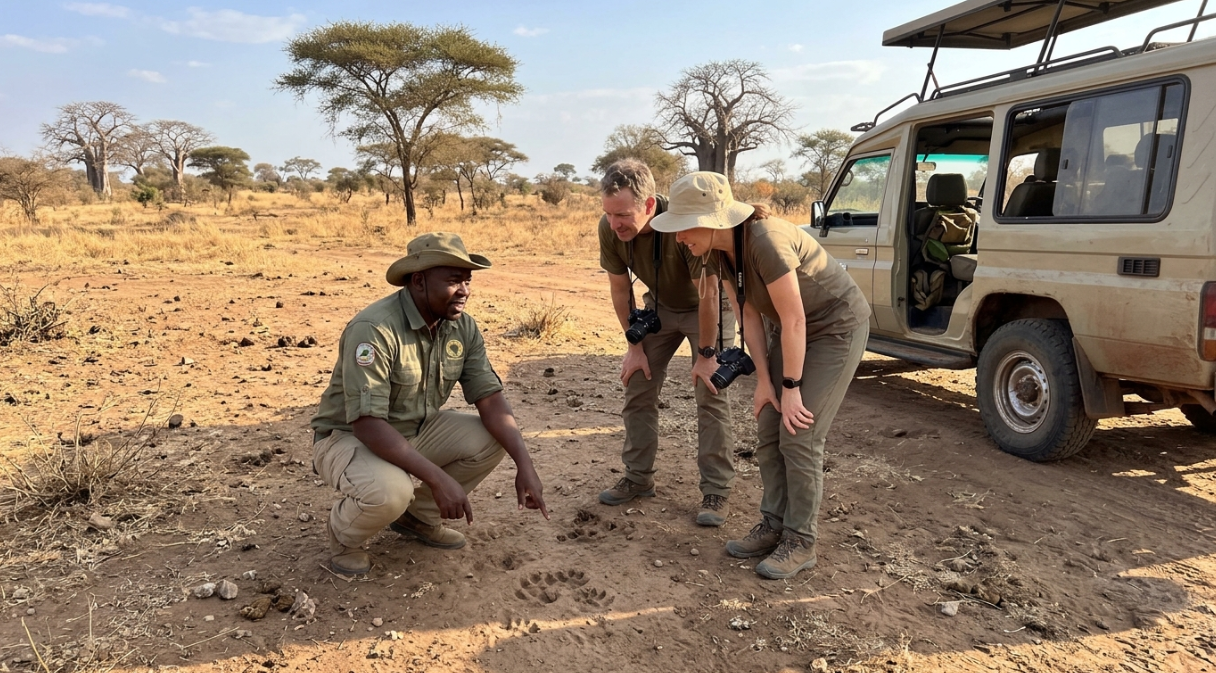
An experienced Tanzania safari guide combines wildlife knowledge, driving ability, ecological understanding, communication skills, and practical knowledge of local park conditions.
Years of experience matter, but the quality of that experience matters more. A guide who regularly works in the Serengeti may have a deeper understanding of its seasonal wildlife movements than someone who primarily operates in another region.
Wildlife Tracking and Animal Behavior
Experienced guides recognize animal tracks, listen for alarm calls, and interpret wildlife behavior to help locate animals. They also understand when to approach a sighting carefully and when to give wildlife more space.
Knowledge of Seasonal Wildlife Movements
Wildlife distribution changes throughout the year. Experienced guides understand how rainfall, vegetation, water availability, and migration patterns influence where animals are likely to be found.
Knowledge of Local Roads and Park Conditions
A guide familiar with the Northern Circuit understands the differences between driving in Tarangire, the Serengeti, and the Ngorongoro Conservation Area. They can adapt routes to changing road conditions, park regulations, and available game-viewing opportunities.
Wildlife Photography Positioning
Photography-focused guides understand lighting, vehicle positioning, animal movement, and sighting etiquette. They can help guests find suitable viewing angles without unnecessarily disturbing animals or blocking other vehicles.
Communication and Guest Management
A professional guide explains what is happening in the field, answers questions, and adjusts the experience to the group's interests. They should also communicate clearly about safety, travel times, and daily plans.
Responsible Wildlife Viewing
Experience should also translate into responsible decisions. A professional guide follows park regulations, avoids disturbing animals, and does not promise guaranteed sightings.
Ultimately, the best private safari guide is not simply someone who has spent many years driving through national parks. It is someone who combines field experience, sound judgment, local knowledge, and a genuine commitment to responsible wildlife tourism.
What Is Included in a Private Guide Safari in Tanzania?
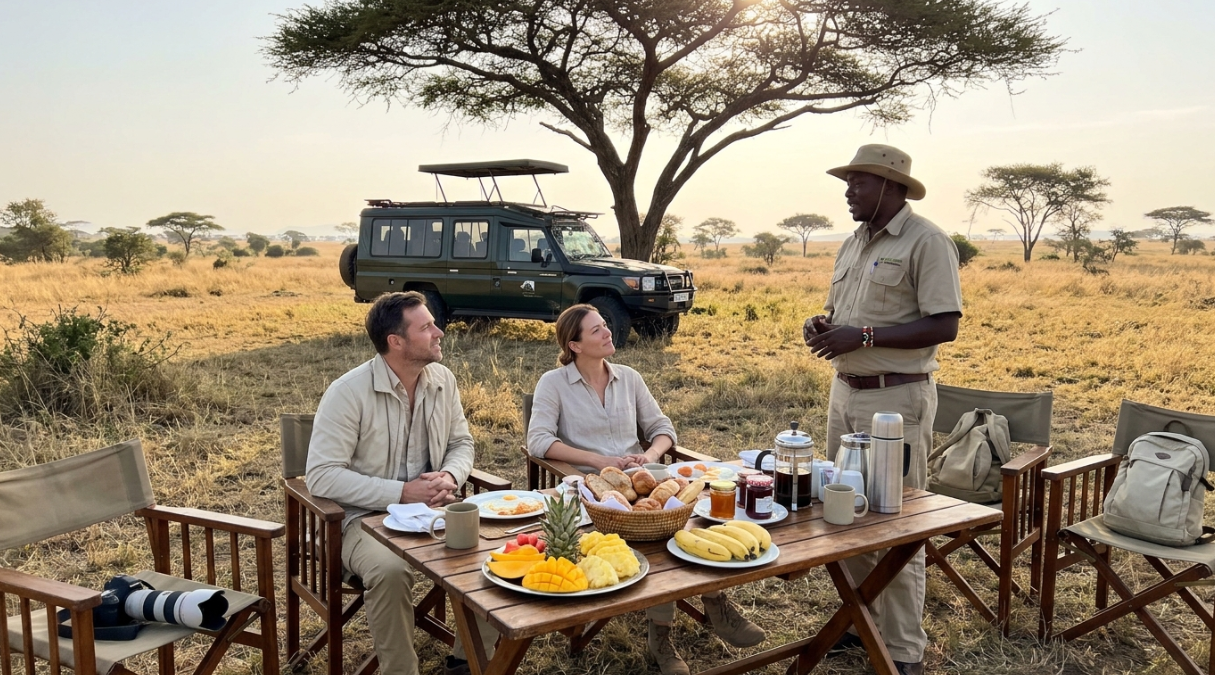
A private guide safari package typically combines a dedicated driver-guide, an exclusive safari vehicle, accommodation, meals, transportation, and applicable park fees. However, inclusions vary depending on the tour operator, accommodation category, and itinerary.
Before comparing safari quotations, check exactly which services are included.
Common Private Safari Inclusions
|
Safari component |
Typically included? |
What to confirm |
|---|---|---|
|
Private driver-guide |
Yes |
Same guide throughout the road itinerary |
|
Private 4x4 safari vehicle |
Yes |
Exclusive vehicle use and passenger capacity |
|
Game drives |
Yes |
Number and duration of daily drives |
|
Accommodation |
Usually |
Lodge or tented camp category |
|
Meals |
Usually |
Full board or specified meal plan |
|
Park entrance fees |
Often |
Which parks and dates are covered |
|
Ngorongoro fees |
Often |
Conservation and crater-related charges |
|
Drinking water |
Often |
Daily vehicle water supply |
|
Airport transfers |
Varies |
Arrival and departure transportation |
|
Domestic flights |
Varies |
Whether interpark flights are included |
|
Travel insurance |
Usually excluded |
Arrange appropriate personal coverage |
|
Guide gratuities |
Usually excluded |
Budget separately |
|
Optional activities |
Varies |
Walking safaris, cultural visits, and other extras |
What Is Usually Not Included?
Travelers should check whether international flights, visas, travel insurance, alcoholic beverages, personal expenses, optional excursions, and gratuities are excluded from their quotation.
Why Comparing Inclusions Matters
Two private Tanzania safari quotations can have very different prices even when they cover the same number of days. One may include premium lodges, all park fees, and airport transfers, while another may quote accommodation and guiding separately.
Compare the full itinerary and inclusions rather than choosing an operator based only on the lowest advertised per-person rate.
Core Glossary: Guide Types and Roles
Private Guide / Driver-Guide
The most common configuration on a Tanzania road safari. The driver and guide are the same person. They meet you at the airport or your Arusha hotel, drive you from park to park, conduct all game drives, and drop you off at the end of your trip.
What makes this role demanding is its breadth. A driver-guide navigates rough roads you would never want to drive yourself, searches for wildlife by reading tracks and listening for alarm calls, explains the animal in front of you plus the plant it feeds on and the village you pass, and manages your comfort, from water and bush breakfasts to getting you back to camp on time.
The relationship deepens over days. Guest reviews consistently describe this effect: a guide learns whether you are a morning person, how long you like to stay at a sighting, and what you still want to find. One reviewer described their guide as making “decisions that gave us a great experience without disturbing animals or the environment, even when other vehicles crowded in.” That kind of judgment comes from years of field experience.
Camp Guide / Resident Guide
A guide employed by a specific lodge or tented camp. When you fly between camps on a fly-in safari, each camp provides its own guide and vehicle for game drives. The guide knows the immediate area well, but you share the vehicle with other camp guests.
This is the single biggest confusion point in Tanzania safari planning. Forum threads on TripAdvisor and Fodor’s revisit this distinction constantly. The core difference: on a fly-in safari with camp guides, your guide changes from day to day and camp to camp. On a private guide safari, you retain the same person throughout. For the Northern Circuit specifically, experienced travelers on forums recommend a drive-in safari with the same guide throughout, noting that a skilled driver-guide out of Arusha will know the areas nearly as well as camp guides.
Walking Safari Guide / Armed Ranger
Walking safaris require separate qualifications beyond standard driver-guide certification. In most Tanzanian parks, walking safaris are led by Tanzania National Parks Authority (TANAPA) rangers, not your driver-guide. These rangers carry firearms and have specialized bush training. Your private guide may accompany you, but the ranger leads.
Specialist Guide
Some operators can match you with guides who have specific expertise: birding identification, wildlife photography positioning, or deep knowledge of particular ecosystems. This is worth requesting at booking time, not upon arrival.
Tracker / Spotter
Not a formal title in most Tanzania safari operations the way it is in Southern Africa, but some camps employ spotters who assist the guide in locating wildlife, particularly on foot. In vehicle-based Tanzania safaris, the guide typically handles both driving and spotting.
The Guide Radio Network
Experienced guides communicate with each other via two-way radio to share wildlife sighting locations in real time. This informal network is one of the strongest arguments for booking with an operator whose guides have deep local relationships. A guide with 20 years on the Northern Circuit has a radio network that a newer guide simply cannot match.
Private Safari Guide vs. Safari Tour Operator: What's the Difference?
A private safari guide and a safari tour operator perform different roles, even though they work together to deliver the same safari experience.
The private safari guide is responsible for the day-to-day experience in the field. The tour operator organizes the trip, manages reservations, arranges transportation and accommodation, and coordinates the logistics behind the itinerary.
|
Responsibility |
Private Safari Guide |
Safari Tour Operator |
|---|---|---|
|
Wildlife spotting |
Yes |
No, unless also acting as guide |
|
Explaining animal behavior |
Yes |
No |
|
Driving during game drives |
Usually |
Arranges the driver-guide |
|
Planning accommodation |
May provide input |
Yes |
|
Booking lodges and camps |
Usually no |
Yes |
|
Arranging park permits and fees |
Coordinates in the field |
Usually manages arrangements |
|
Managing itinerary logistics |
Day-to-day execution |
Overall planning |
|
Handling booking changes |
Communicates issues |
Coordinates changes |
|
Emergency coordination |
Immediate field response |
Wider logistical support |
Why Both Matter
An experienced guide cannot compensate for poor trip organization, and a well-organized itinerary cannot replace knowledgeable field guiding.
When comparing Tanzania safari operators, evaluate both the company's ability to organize the trip and the quality of the guide assigned to your vehicle.
Before paying a deposit, ask whether the operator directly employs its guides, works with contracted driver-guides, or subcontracts transportation and guiding to another company.
Licensing and Qualifications Glossary
Understanding guide credentials matters because you are trusting this person with your safety and your experience for a week or longer.
TALA License
TALA (Tourism Agent Licensing Authority) is Tanzania’s mandatory license for anyone operating in tourism. No company can legally sell safaris, mountain treks, or tourist vehicle hire without a valid TALA license. Individual guides also need personal TALA licenses, which are renewable annually and require first aid certification alongside training from recognized wildlife institutions.
Per the TATO Safari Guide Code of Conduct, a driver-guide must hold a genuine Class C driving license with an approved training certificate from VETA (Vocational Education and Training Authority) or equivalent, be registered with LATRA as an approved Class C driver, and carry a valid TALA safari guide license from the Ministry of Natural Resources and Tourism.
TATO Membership
The Tanzania Association of Tour Operators is a professional membership body founded in Arusha in 1983. TATO membership requires a valid TALA license as a prerequisite, but the reverse is not true. TALA is the legal permission to operate; TATO is an optional professional association layered on top. When vetting operators, confirm TALA first. TATO membership is a positive signal but not a substitute for legal licensing.
Mweka College (CAWM)
The College of African Wildlife Management, located near Mweka on the southern slopes of Kilimanjaro, is the leading institution for professional safari guide training in Tanzania. Established in 1963, the college offers courses in wildlife and tourism management, including safari guiding short courses that cover mammal, bird, plant, reptile, and insect interpretation.
Tanzania requires all safari guides to be Tanzanian citizens, a rule that distinguishes the country from Kenya or Southern Africa where some foreign guides operate. Mweka-trained guides form the backbone of Tanzania’s safari industry.
FGASA Certification
The Field Guides Association of Southern Africa sets the industry benchmark for safari guide certification across Africa. Levels range from Nature Site Guide through Advanced Field Guide, with the qualification pathway starting at FGASA Level 1, the minimum required to work as a vehicle-based guide. Levels go up to Level 3, then branch into specialist fields.
FGASA is not mandatory in Tanzania, but it signals that an operator has invested in guide quality beyond the legal minimum. Some Tanzania-based operators are now enrolling their guides in FGASA Level 1 certification (a 55-day NQF2 program) through accredited training providers.
For a full breakdown covering how FGASA, TALA, and other credentials compare across East and Southern Africa, the safari guide qualifications glossary is a useful reference.
EcoTraining
A professional safari guide training provider offering FGASA-accredited programs. Course lengths range from 28 days for a Trails Guide or Safari Guide certification to 55 days for the Apprentice Field Guide Level 1 (NQF2). EcoTraining operates training camps across multiple African countries and is the primary pathway for Tanzanian guides seeking FGASA credentials.
TANAPA (Tanzania National Parks Authority)
The government body that manages Tanzania’s national parks, sets park rules, collects fees, and employs the armed rangers who lead walking safaris. TANAPA regulations dictate vehicle types allowed in parks, off-road driving restrictions, and entry/exit times, all of which your private guide must follow.
Wilderness First Responder (WFR)
A medical certification focused on emergency care in remote settings. More commonly associated with Kilimanjaro climbing guides than safari guides, but it indicates a broader safety culture within an operation. An operator that invests in WFR certification for mountain guides is likely applying similar rigor to safari guide training.
How to Choose the Best Private Safari Guide in Tanzania
Choosing the right private safari guide in Tanzania can make a significant difference to your wildlife experience. A good guide does more than drive between national parks. They understand animal behavior, identify wildlife, navigate changing park conditions, communicate clearly, and adapt game drives to your interests.
Before booking a private Tanzania safari, evaluate the following factors.
1. Verify the Guide's Qualifications
Ask whether your assigned driver-guide holds the required Tanzanian licenses and professional credentials. Request confirmation of their driving qualifications, safari guide training, and relevant first aid certification.
Additional training through recognized wildlife institutions can indicate a commitment to professional development, although optional international certifications should not be confused with mandatory Tanzanian licensing.
2. Check Northern Circuit Experience
If your itinerary includes Serengeti, Ngorongoro, and Tarangire, look for a guide with practical experience in these specific destinations.
An experienced Northern Circuit guide should understand seasonal wildlife movements, road conditions, park entry procedures, and the differences between each ecosystem.
3. Ask About Wildlife Specializations
Different guides have different strengths. Some focus on big cats, while others have extensive bird identification knowledge or experience positioning vehicles for wildlife photography.
Tell your operator what interests you before booking so they can match you with an appropriate guide.
4. Confirm Guide Continuity
Ask whether the same driver-guide will accompany you throughout the entire road safari.
Having one guide across multiple destinations creates continuity. Your guide can remember previous sightings, understand your preferences, and adjust future game drives based on what you have already experienced.
5. Evaluate Communication Skills
A knowledgeable guide should explain wildlife behavior, answer questions, and communicate clearly about daily schedules and safety procedures.
If English is not your preferred language, confirm whether the operator can provide a guide who speaks your requested language.
6. Review Independent Guest Feedback
Read recent traveler reviews that specifically mention the guide, not just the accommodation or tour company.
Look for repeated comments about wildlife knowledge, punctuality, driving standards, communication, flexibility, and responsible animal viewing.
7. Confirm the Vehicle and Group Size
A private guide safari should provide exclusive use of your vehicle for your traveling party. Ask how many passenger seats are available, whether everyone gets a window seat, and whether the vehicle has charging ports, a pop-up roof, and working communication equipment.
The best guide is not necessarily the one with the longest résumé. It is the person whose experience, communication style, wildlife knowledge, and approach to responsible tourism match your expectations.
Vehicle and Logistics Glossary
Safari Vehicle / Pop-Up Roof Land Cruiser
The Toyota Land Cruiser Series 70/76 with a pop-up roof conversion is the dominant safari vehicle in Tanzania. These are closed-sided vehicles with windows and doors for protection from dust, sun, rain, and wind, featuring a roof that lifts hydraulically for 360-degree standing views and photography during game drives. Most seat 4 to 7 passengers, though operators typically limit occupancy to 4 or 6 for comfort and better sightlines.
In the Ngorongoro Crater, closed pop-up vehicles are required by regulation, so this is not a choice, it’s the standard. For more on vehicle types across different safari formats, the safari vehicles glossary covers the full range.
Private Safari Vehicle Capacity and Passenger Comfort
Vehicle capacity is an important consideration when booking a private Tanzania safari. Although a safari vehicle may have several passenger seats, the number of travelers affects personal space, luggage capacity, photography angles, and visibility during game drives.
|
Traveling party |
What to consider |
|---|---|
|
1–2 travelers |
Maximum personal space and flexibility |
|
3–4 travelers |
Good balance between cost-sharing and comfort |
|
5–6 travelers |
Confirm individual seating and luggage space |
|
7 or more travelers |
Ask whether multiple vehicles are necessary |
For photography-focused safaris, fewer passengers can provide more flexibility when positioning cameras and moving between viewing windows.
Before booking, request the exact vehicle configuration and seating arrangement rather than relying only on the advertised maximum passenger capacity.
Road Safari (Drive-In)
An itinerary where you travel between parks by road in your private vehicle. This is the standard format for a private guide safari in Tanzania and the reason guide continuity is possible. Your guide drives you from Arusha to Tarangire, from Tarangire to the Serengeti, from the Serengeti to Ngorongoro, and back.
Fly-In Safari
An itinerary where you fly between camps on light aircraft (typically Cessna Caravans operated by regional carriers). Game drives are handled by the camp’s resident guides, not a single guide who travels with you. The trade-off is significant: fly-in safaris save road time and typically use the most exclusive lodges and camps (starting at roughly $700 per person per night), but you lose guide continuity and often share vehicles with other guests.
Full Board (FB) vs. Game Package (GP)
These two pricing models create confusion. On a full-board private safari, you pay for accommodation and meals at each lodge, and your private guide and vehicle are arranged separately through your operator. On a game-package fly-in safari, the camp bundles accommodation, meals, house drinks, and shared game drives with their own guides into one per-night rate.
Forum travelers on TripAdvisor draw a clear line: a full-board safari uses your own private guide and vehicle; a game-package safari uses the guide and vehicle provided by the camp.
Northern Circuit
Tanzania’s most popular safari route, connecting Arusha to Tarangire National Park, Lake Manyara, the Ngorongoro Conservation Area, and the Serengeti. These parks are close enough together that road connections work well, making the Northern Circuit the natural home of the private guide safari format. Most trips range from 5 to 10 days.
Cost and Booking Glossary
Per-Person-Per-Day (PPPD) Pricing
The standard way safari costs are quoted. A PPPD rate typically includes accommodation, meals, and sometimes park fees. Many mid-range private safaris land around $350 to $500 per person per day for comfortable lodges, a private vehicle, and a professional guide.
An important nuance: the more people in your group, the lower the per-person cost. A couple paying $500 per person is absorbing the full cost of the guide and vehicle between two people. A group of four or six splits that same cost more ways, which can drop the per-person premium substantially. For a detailed cost breakdown by trip length and accommodation level, the Tanzania safari cost guide covers the numbers.
Park Fees / Conservation Fees
Fees paid to TANAPA or the Ngorongoro Conservation Area Authority for entering each park. These are real costs that add up quickly: Serengeti and Ngorongoro alone can run $70 to $100+ per person per day. Park fees are almost always included in a private safari package but worth confirming with your operator.
Vehicle Entry Fee
A separate per-vehicle fee charged by each park. Your operator includes this in the package price, but it explains part of why private safaris cost more than group trips: a group of six splits one vehicle entry fee, while a couple on a private safari absorbs the same fee between two.
Concession Fee
Some camps and lodges sit on private or semi-private concessions adjacent to national parks. These concessions charge their own access fees, which are built into the lodge rate. The advantage: concession areas allow off-road driving and walking safaris that are restricted in national parks.
Tipping Your Private Safari Guide
Tipping is expected in Tanzania and represents a meaningful portion of your guide’s income. For a private safari, the standard range is $20 to $25 per person per day, or roughly $40 to $50 per day for a couple. A group of four would tip $80 to $100 per day total.
A few important details:
-
Currency: Bring clean, crisp US dollar bills printed after 2009. Older notes are often refused by banks in Tanzania.
-
Timing: Tips are typically given in an envelope at the end of the safari, not daily.
-
Basis for tipping: Tip for your guide’s professionalism, knowledge, safety awareness, and effort throughout the trip, not for specific sightings. Tipping based on whether the guide found a kill or a river crossing incentivizes driving off-trail, crowding animals, and prioritizing spectacle over ethics.
-
Right-hand etiquette: In Tanzanian culture, hand items (including tips) with the right hand or both hands.
For a complete breakdown covering all staff categories (guides, cooks, camp staff), the Tanzania safari tipping guide covers everything.
Who Actually Needs a Private Guide Safari?
Not everyone does. Here’s a framework for deciding.
A private guide safari is the right fit if you:
-
Want full control over your daily schedule
-
Are traveling as a couple, family, or small group that wants a cohesive experience
-
Prioritize wildlife photography (a private guide can position for light, wait through an entire hunt, and skip crowded sightings)
-
Have children whose energy levels and attention spans need flexibility
-
Are on a honeymoon and want the trip to feel personal
-
Are a serious birder who needs the guide to stop for every sighting
-
Have specific physical accessibility needs
A group or camp guide may work if you:
-
Are traveling solo and want to share costs
-
Have a flexible temperament about schedules and sighting times
-
Are on a tight budget and would rather spend on accommodation than guide exclusivity
-
Prefer fly-in logistics and luxury lodges where camp guides are part of the package
For photography specifically, the case for a private guide is strong. A private guide can position for sunrise or sunset shots precisely, while group vehicles work on set schedules. A private guide might watch a predator hunt for 45 minutes if you want; group guides typically move on after 15 to 20 minutes to balance the group’s interests. If photography is a priority, the safari photography gear guide covers the equipment side.
Couples planning a honeymoon safari will find that the private format transforms the trip. Details on structuring a private honeymoon safari cover how to combine bush and beach.
→ Families traveling with kids have different considerations. The private family safari planning guide addresses age restrictions, vehicle setup, and pacing for younger travelers.
Private Safari Guide Booking Checklist
Before booking a private guide safari in Tanzania, confirm the following details with your tour operator.
|
Booking consideration |
What to confirm |
|---|---|
|
Guide qualifications |
Relevant registration, licenses, and training |
|
Guide experience |
Years of experience and familiarity with your route |
|
Guide continuity |
Whether the same guide stays throughout the safari |
|
Language |
Confirmed spoken language |
|
Specialization |
Wildlife photography, birding, or other interests |
|
Vehicle exclusivity |
Whether the vehicle is reserved exclusively for your party |
|
Passenger capacity |
Number of passengers and available seats |
|
Vehicle equipment |
Pop-up roof, charging ports, and communication equipment |
|
Accommodation |
Exact lodges and tented camps |
|
Park fees |
Which conservation and entry charges are included |
|
Emergency arrangements |
Communication, medical assistance, and evacuation procedures |
|
Cancellation policy |
Deposit, cancellation deadlines, and refund conditions |
|
Tipping |
Recommended gratuities and payment arrangements |
Questions to Ask Before Paying a Deposit
-
Can you confirm the name or profile of my assigned guide?
-
Will the same guide accompany us throughout the road safari?
-
What training and professional qualifications does the guide hold?
-
How many passengers will share the vehicle?
-
Is the vehicle exclusively reserved for our party?
-
What happens if the assigned guide becomes unavailable?
-
What emergency procedures are in place during the safari?
-
Can you provide a detailed written quotation showing all inclusions and exclusions?
A reputable safari operator should be able to answer these questions clearly and provide the important arrangements in writing.
Questions to Ask Your Operator About Guide Quality
Before booking, these questions separate serious operators from those reselling someone else’s vehicles:
-
What certifications do your guides hold? Look for TALA licensing at minimum. FGASA certification, EcoTraining completion, or advanced courses from Mweka College indicate investment beyond the baseline.
-
How do you match guides to clients? Good operators ask about your interests (photography, birding, big cats, cultural interaction) and assign guides accordingly, rather than using whoever is available.
-
Will I have the same guide for the entire trip? On a road safari, the answer should be yes. If the operator hedges, ask why.
-
What happens if the guide and I aren’t a good fit? Reputable operators have a process for this. It should not involve you suffering in silence for a week.
-
How experienced are your guides with my specific route? A guide with 15 years on the Northern Circuit has relationships, radio contacts, and instincts that a newer guide does not.
-
What vehicle will I be in, and how many seats? Confirm the vehicle type, the maximum passenger count, and whether charging ports are available for camera batteries.
-
Does your company invest in ongoing guide training? Operators that send guides for annual refreshers, first aid recertification, or advanced programs like FGASA treat guiding as a profession rather than a commodity.
Also confirm that your operator carries proper travel insurance arrangements and can explain emergency protocols clearly.
Common Mistakes When Booking a Private Safari Guide in Tanzania
Booking a private safari involves more than selecting an itinerary and accommodation. Travelers should also understand who will guide them, what the vehicle arrangement includes, and how the operator manages the trip.
Avoid these common mistakes when choosing a private Tanzania safari.
1. Assuming Every Private Safari Includes the Same Guide
Some itineraries use one driver-guide throughout the road safari, while fly-in itineraries may use different guides at each lodge.
Confirm whether guide continuity is included before booking.
2. Choosing an Operator Based Only on Price
A low quotation may exclude park fees, airport transfers, certain meals, or other services.
Compare the complete itinerary and inclusions rather than relying on the advertised daily rate.
3. Confusing Company Licensing With Individual Guide Qualifications
A licensed tour operator and a qualified individual guide are not necessarily the same thing. Ask for the company's current operating credentials and the assigned guide's relevant professional documentation separately.
4. Not Confirming Vehicle Occupancy
A private safari should provide exclusive use of the vehicle for your party, but the passenger capacity and seating arrangement still matter.
Confirm how many people will travel, whether everyone has a window seat, and whether the vehicle has sufficient space for luggage and camera equipment.
5. Waiting Until Arrival to Request a Specialist Guide
If you want a birding specialist, photography-focused guide, or guide who speaks a particular language, communicate this before the operator finalizes the assignment.
Specialist availability may be limited during busy travel periods.
6. Expecting Guaranteed Wildlife Sightings
No professional guide can guarantee that you will see a particular animal, predator hunt, or migration crossing. Wildlife movements depend on natural conditions.
Choose a guide based on their knowledge, effort, and ethical approach rather than promises of guaranteed sightings.
7. Ignoring Emergency and Communication Arrangements
Ask how your guide communicates with the operator, what happens during a vehicle breakdown, and how medical emergencies are handled in remote areas.
Understanding these arrangements before departure provides greater confidence during the trip.
Ethical Wildlife Viewing and Guide Conduct
A good private guide does more than find animals. They manage the encounter responsibly. The TATO Safari Guide Code of Conduct requires guides to maintain minimum distances from wildlife, stay on designated roads in national parks, and prioritize animal welfare over guest demands.
Guest reviews illuminate what this looks like in practice. One traveler described their guide finding areas away from large crowds of vehicles, a skill that requires knowing alternative routes and having the confidence to leave a popular sighting for a quieter one. Another praised their guide for “making decisions that gave us a good experience without disturbing animals,” even when other vehicles were pressing closer.
This is one of the strongest arguments for an experienced private guide: they have the judgment to balance your experience with the ecosystem’s wellbeing, and the authority (since you are their only client) to act on that judgment without group pressure.
Frequently Asked Questions
Is a private guide the same as a driver-guide in Tanzania?
In most cases, yes. On a standard road safari across the Northern Circuit, the terms are interchangeable. Your private guide drives the vehicle, conducts all game drives, and handles logistics throughout the trip. The exception is on walking safaris, where a TANAPA armed ranger leads and your driver-guide may accompany but does not lead the walk.
Can I request a specific guide?
Most reputable operators allow guide requests, especially if you have traveled with the company before or a specific guide has been recommended to you. Making the request early gives the operator better scheduling flexibility.
What’s the difference between FGASA and TALA?
TALA is Tanzania’s legal licensing requirement. Every guide must have it to work legally. FGASA is a voluntary professional certification originating in Southern Africa that tests ecological knowledge, guiding skills, and field interpretation at progressive levels. A guide with both TALA and FGASA has met the legal minimum and invested in advanced professional development.
How much extra does a private guide safari cost compared to a group safari?
Roughly 30 to 50% more for equivalent accommodation, because you are absorbing the full cost of the guide and vehicle rather than splitting it among 4 to 7 travelers. For a couple on a 7-day mid-range private safari, expect $6,000 to $8,000 per person. The premium shrinks significantly for groups of four or more.
Do private guides speak languages other than English?
Many Tanzanian guides speak English and Swahili fluently. Some speak French, German, Italian, or Spanish, but availability varies. If you need a guide who speaks a specific language, request this at booking time so the operator can confirm availability.
What happens if my guide and I aren’t a good fit?
With a reputable operator, you contact them and they arrange a replacement guide, sometimes within the same day depending on logistics. This is rare but not unheard of, and it should not feel awkward to raise. Good operators would rather swap a guide than have you endure a subpar experience for a week.
Do I need a private guide for the Ngorongoro Crater?
You do not strictly need one, since group safaris also enter the crater. But the crater is a confined space with many vehicles, and a skilled private guide can time your descent, choose less-crowded routes along the crater floor, and linger at sightings without worrying about the group’s schedule. For a place this spectacular and this busy, the private format makes a noticeable difference.
How do I find a reputable private safari guide in Tanzania?
Start by choosing a properly licensed safari operator and asking about the qualifications, experience, and registration of the individual guide assigned to your trip. Read recent guest reviews that specifically mention guiding quality, wildlife knowledge, communication, and driving standards. Confirm whether the same guide will accompany you throughout your road safari.
Is a private safari guide worth the extra cost?
A private safari guide can be worth the additional expense if you value flexible game drives, exclusive vehicle use, personalized wildlife viewing, and continuity throughout your itinerary. It is particularly beneficial for photographers, families, couples, and travelers with specific wildlife interests. Budget-conscious solo travelers may find shared safaris more economical.
Can I have the same safari guide throughout Tanzania?
Yes. On a private road safari, you can generally arrange for the same driver-guide to accompany you between destinations such as Tarangire, Serengeti, and Ngorongoro. However, this should be confirmed with your operator. Fly-in safaris typically use guides assigned by individual camps.
Are private safari guides responsible for booking accommodation?
Usually not directly. The safari tour operator generally handles lodge reservations, transportation, park arrangements, and the overall itinerary. The private guide focuses on driving, wildlife viewing, guest assistance, and day-to-day safari activities.
What qualifications should a Tanzania private safari guide have?
Ask for the guide's applicable Tanzanian registration and identification, relevant professional training, first aid certification, and appropriate driving credentials. Additional wildlife training and professional development are valuable indicators of experience. Requirements can vary according to the guide's specific role.
Can I request a female private safari guide in Tanzania?
You can ask your tour operator whether a female driver-guide is available. Availability depends on the operator's staffing and travel dates, so make the request when planning your safari rather than waiting until arrival.
Should I tip my private safari guide separately from camp staff?
Yes. Your private driver-guide and accommodation staff perform different roles, so gratuities are generally handled separately. Confirm the operator's tipping recommendations and whether any service charges are already included in your package.
A private guide safari in Tanzania is not just a logistical upgrade. It changes the texture of the entire trip, from the conversations you have to the wildlife encounters you get to stay for. Understanding the terminology, the credentials, and the trade-offs puts you in a stronger position to choose the right operator and the right guide.
→ Ready to start building your trip? Request a custom private safari itinerary with routes, lodges, and guide details matched to your travel style.