

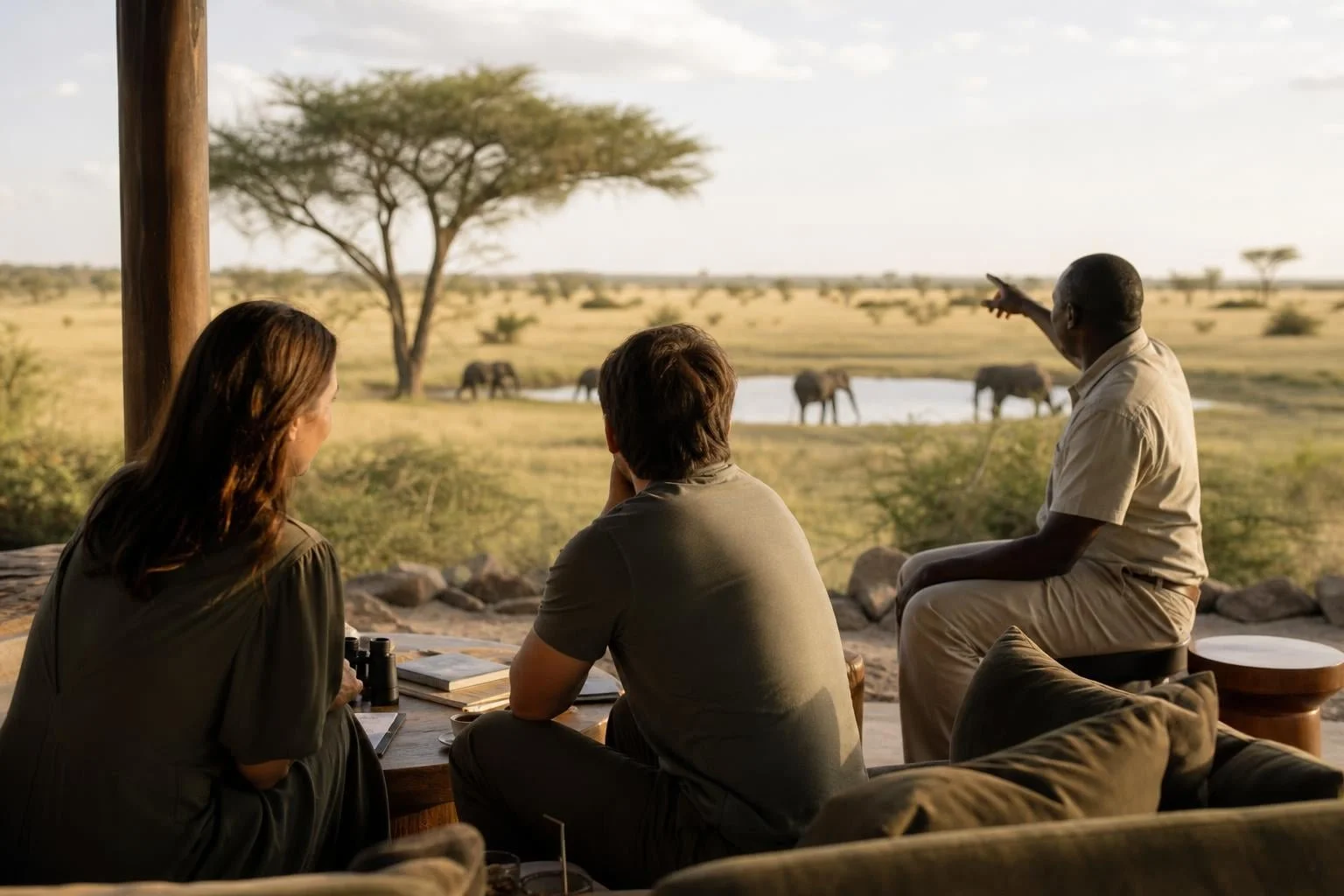
A luxury Tanzania safari costs $700 to $1,500 per person per day in 2026. Ultra-luxury safaris run $1,500 to $3,000+ per person per day. A 7 to 10 day trip totals between $5,000 and $20,000+ per person, depending on accommodation, transport method, season, and whether you stay in national parks or private conservancies. This glossary explains every term you’ll encounter on a luxury safari quote so you can compare proposals with confidence.
How Much Does a Luxury Tanzania Safari Cost in 2026? A luxury Tanzania safari costs approximately $700–$1,500 per person per day, while ultra-luxury safaris can cost $1,500–$3,000 or more per person per day in 2026. A typical seven-day luxury safari can cost approximately $4,900–$10,500 per person before optional extras, depending on accommodation, travel season, park fees, and transportation.
The biggest factors affecting the total price are: 1. Accommodation: Luxury lodges, permanent tented camps, and private conservancy camps have different nightly rates. 2. Travel season: Peak-season travel, particularly June through October, generally costs more than green-season travel. 3. Transportation: Fly-in safaris save travel time but add domestic flight costs. 4. Park and conservation fees: Government charges can represent a significant portion of the total package. 5. Activities: Balloon safaris, private experiences, and Zanzibar extensions increase the overall budget.
For an accurate comparison, check whether each quote includes accommodation, meals, park fees, concession fees, transportation, game drives, and domestic flights.
Why Luxury Safari Quotes Are So Confusing
If you’re holding two or three competing luxury Tanzania safari quotes and wondering why they range from $7,000 to $18,000 for what looks like the same trip, you’re not alone. Practitioners on Reddit report this exact confusion constantly, and the answer almost always comes down to three variables: national park lodges versus private conservancy camps, fly-in versus drive-in transport, and peak season versus green season timing.
A luxury safari quote typically contains 15 to 20 line items, many using industry-specific terms that most travelers have never encountered. Some operators bundle everything into a single per-day rate. Others itemize park fees, concession charges, vehicle costs, and domestic flights separately. Without understanding the vocabulary, you can’t tell whether a $12,000 quote is a better deal than an $8,000 one.
This glossary exists to fix that. It defines each term, explains how it affects your total cost, and gives you the framework to evaluate any quote you receive. For lodge-level comparisons and full itinerary planning, see the companion luxury safari planning guide.
Quick-Reference: Luxury Tanzania Safari Cost Summary (2026)
|
Tier |
Per Person Per Day |
7-Day Total Per Person |
What Defines This Tier |
|---|---|---|---|
|
Luxury |
$700–$1,500 |
$5,000–$10,000 |
Top-tier permanent lodges and tented camps, private vehicle, experienced guide, full-board or all-inclusive |
|
Ultra-Luxury |
$1,500–$3,000+ |
$10,000–$20,000+ |
Private conservancy camps, fly-in transfers, exclusive-use options, fully all-inclusive with premium drinks and activities |
|
With Common Add-Ons |
Add $800–$1,500 |
$6,000–$21,000+ |
Balloon safari, Zanzibar extension, private charter flights, walking safaris |
Real traveler spending data shared on Reddit communities confirms these ranges, with luxury safari totals typically running $12,000 to $20,000+ per person when flights, add-ons, and tipping are included.
Luxury Tanzania Safari Cost by Trip Length (2026)
The total cost of a luxury Tanzania safari depends on how many nights you spend in the national parks, the accommodation category, and whether you travel between destinations by road or aircraft.
The following estimates provide an initial planning budget for international visitors booking a private luxury safari. They are indicative estimates rather than fixed package prices.
|
Safari Duration |
Luxury Budget Per Person |
Ultra-Luxury Budget Per Person |
|---|---|---|
|
5 days |
$3,500–$7,500 |
$7,500–$15,000+ |
|
7 days |
$4,900–$10,500 |
$10,500–$21,000+ |
|
10 days |
$7,000–$15,000 |
$15,000–$30,000+ |
|
14 days |
$9,800–$21,000 |
$21,000–$42,000+ |
These estimates use the indicative daily rates in this guide and assume that accommodation, meals, safari activities, and applicable safari arrangements are covered. Actual package inclusions vary by operator.
Additional expenses to consider:
-
International flights to Tanzania.
-
Travel insurance and applicable visa fees.
-
Optional hot-air balloon safaris.
-
Tips for safari guides and camp staff.
-
Domestic flights and Zanzibar extensions if not included.
-
Premium beverages and personal expenses.
For the most accurate estimate, request an itemized quotation based on your travel dates, group size, and preferred accommodation.
What Is Included in a Luxury Tanzania Safari Package?
A luxury Tanzania safari package commonly includes accommodation, meals, private game drives, a professional driver-guide, and applicable park fees. However, the exact inclusions depend on the operator, lodge, and package category.
Before booking, check whether the following expenses are included in your quotation.
|
Expense |
Usually Included? |
What to Confirm |
|---|---|---|
|
Luxury accommodation |
Yes |
Room category and occupancy |
|
Breakfast, lunch, and dinner |
Usually |
Full-board or all-inclusive |
|
Private safari vehicle |
Usually |
Dedicated vehicle or shared vehicle |
|
Professional safari guide |
Usually |
Guide experience and qualifications |
|
National park entry fees |
Often |
Which parks and number of entry days |
|
Ngorongoro crater service fee |
Often |
Whether it is included separately |
|
Concession fees |
Depends |
Applicable camps and overnight stays |
|
Domestic bush flights |
Depends |
Baggage allowance and flight routes |
|
Airport transfers |
Depends |
Arrival and departure transfers |
|
Laundry |
Depends |
Included allowance |
|
Local alcoholic beverages |
Depends |
House drinks versus premium brands |
|
Balloon safari |
Usually extra |
Price and advance reservation |
|
Travel insurance |
Usually excluded |
Coverage and policy requirements |
|
International flights |
Usually excluded |
Flights to and from Tanzania |
|
Guide and camp staff tips |
Usually excluded |
Recommended tipping budget |
|
Zanzibar accommodation |
Excluded unless added |
Hotel, transfers, and flights |
Questions to Ask Before Accepting a Safari Quote
-
Are all national park and conservation fees included?
-
Is the safari vehicle private for the entire trip?
-
Are domestic flights included in the quoted price?
-
Does the accommodation rate cover full-board or all-inclusive services?
-
Are premium drinks, laundry, and activities included?
-
Are airport transfers included?
-
Are tips, travel insurance, and international flights excluded?
-
Are there additional charges for peak-season travel?
A transparent safari quotation should clearly separate included services, optional extras, and expenses payable directly by the traveler.
Comparing these details is more useful than choosing an operator based on the lowest advertised daily rate.
Pricing and Quote Mechanics
These are the terms that structure every luxury Tanzania safari cost quote. Understanding them is the difference between comparing apples to apples and accidentally overpaying by thousands.
Per Person Per Day (PPPD)
The standard pricing unit across the safari industry. Every rate, from park fees to accommodation, is quoted per person per day (sometimes written as “pp/pd” or “pppn” for per person per night). When someone says a luxury safari costs “$1,000 a day,” they mean $1,000 for one person for one day, not the whole group.
All-Inclusive
At the luxury level, all-inclusive means accommodation, all meals, house wines, local spirits, soft drinks, laundry, and usually two game activities per day (morning and afternoon drives). Some ultra-luxury camps extend this to premium imported wines, spa treatments, and specialty activities like walking safaris. Always ask what “all-inclusive” covers at a specific property, because the definition varies. This is one of the most misunderstood terms in luxury Tanzania safari cost discussions.
Full-Board
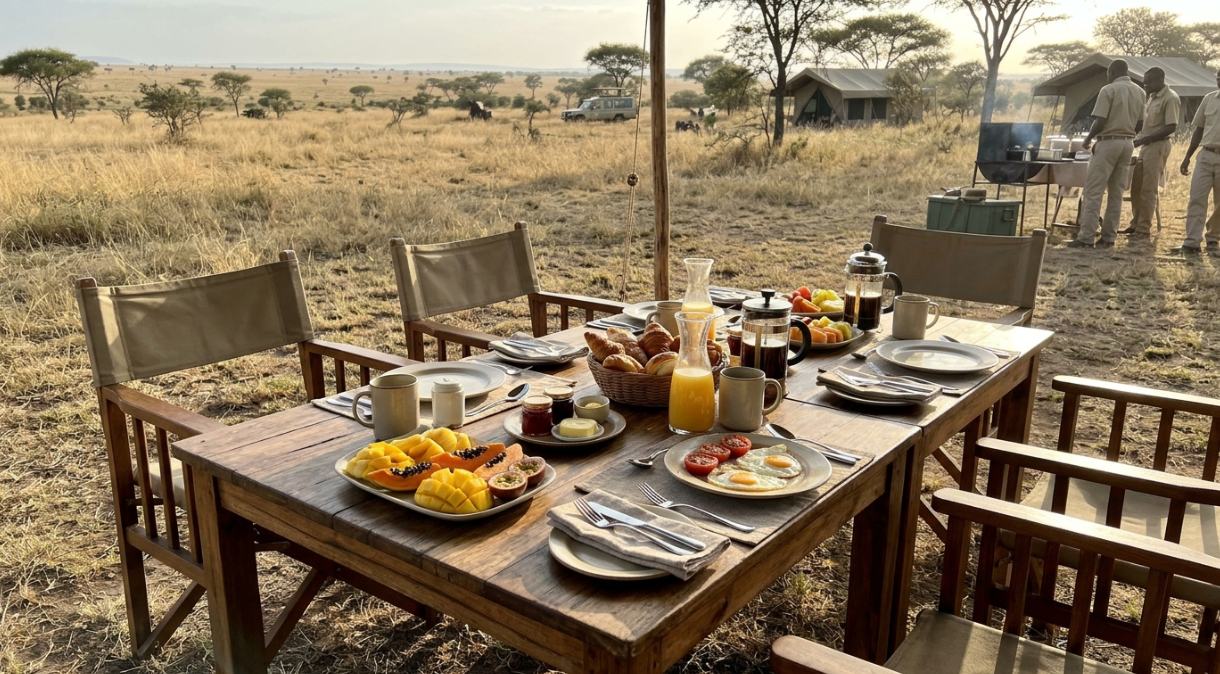
Full-board covers accommodation, breakfast, lunch, and dinner. It does not mean everything is free. Premium wines, imported spirits, balloon safaris, spa services, and specialty activities cost extra. Full-board is the standard inclusion level at many luxury camps, and travelers who assume it means all-inclusive often face unexpected bar tabs and activity charges. The gap between full-board and all-inclusive at a luxury camp can be $50 to $150 per person per day in additional spending.
Single Supplement
A surcharge applied when one person occupies a room or tent designed for two. At the luxury level, single supplements typically add 30% to 50% on top of the per-person rate. On a 7-day luxury safari, this can mean $1,500 to $4,000 in extra charges. Some operators waive or reduce single supplements during green season.
Rack Rate
The published, non-discounted price a lodge or camp lists for direct bookings. Experienced operators negotiate contracted rates below rack rate, sometimes 15% to 30% lower, especially for properties they book regularly. When you see a “rack rate” on a lodge website, understand that most travelers booking through a reputable operator pay less.
Green Season Rate (Low Season Discount)
From November through March (and especially April through May), luxury lodges drop their rates by 25% to 40%. Some of the best properties cut peak-season prices nearly in half during April and May. The wildlife is still there, the landscapes are greener, and the crowds thin dramatically. On a full safari package, you can save roughly 20% in low season and 10% in shoulder season, with most savings coming from accommodation, which represents 40% to 60% of the total budget.
Peak Season Surcharge
June through October is high season in Tanzania, driven by the Great Migration crossings and dry-weather game viewing. Luxury camp rates during these months run 20% to 40% higher than green season pricing. Some ultra-luxury properties also apply a premium surcharge during specific Great Migration windows (July through September in the northern Serengeti).
Best Time to Book a Luxury Tanzania Safari for Lower Prices
The best time to find lower luxury Tanzania safari accommodation rates is generally during the quieter travel periods, particularly April and May. However, seasonal pricing varies by lodge, camp, and safari region.
Tanzania's safari calendar is not divided into one universal high-season and low-season schedule. Individual properties publish their own seasonal rates, and some periods offer excellent wildlife viewing despite lower accommodation prices.
|
Travel Period |
Typical Pricing Position |
Safari Experience |
|---|---|---|
|
January–March |
Varies by property; often higher during calving season |
Southern Serengeti calving season and predator activity |
|
April–May |
Often the lowest accommodation rates |
Green landscapes, fewer visitors, and occasional heavy rain |
|
June |
Shoulder to high season |
Drying landscapes and increasing wildlife concentration |
|
July–September |
Usually peak pricing |
Great Migration river-crossing season in the northern Serengeti |
|
October |
Generally high to shoulder season |
Dry-season game viewing and changing migration patterns |
|
November–December |
Rates vary by property and holiday dates |
Short rains, green landscapes, and changing wildlife distribution |
How Much Can You Save by Traveling in Low Season?
Some luxury properties offer substantial discounts during their designated low-season dates. However, savings depend on the individual property's published rates and availability.
Before choosing a travel month based on price alone, consider:
-
Whether your preferred camp remains open.
-
The expected rainfall and road conditions.
-
The location of the Great Migration.
-
Whether the wildlife experiences you want are seasonal.
-
Whether your preferred lodge offers discounted rates for your dates.
Money-saving tip: Ask your safari operator to compare the same accommodation and itinerary across two different travel periods. This provides a more meaningful comparison than comparing different camps with different standard rates.
Child Rate
TANAPA charges reduced park fees for children aged 5 to 15. Some luxury lodges allow children under 5 to stay free, while others restrict children under a certain age entirely. Child rates at camps vary widely. If you’re planning a family trip, the family safari cost guide breaks down these variations in detail.
Deposit and Payment Terms
Most luxury safari operators require a 25% deposit at booking, with the balance due 60 to 90 days before travel. Peak season bookings at popular camps sometimes require earlier full payment. Credit card payments often carry a 3% to 4% processing surcharge. Cancellation policies tighten as the travel date approaches, standard practice for bespoke safari operators.
If you’re comparing luxury safari quotes and the line items don’t match up, Duma Explorer can build a transparent, itemized itinerary so you know exactly where every dollar goes. Request a custom itinerary to see exactly how the numbers break down.
Tanzania Safari Government Fees and Taxes Explained (2026)
Government fees are an important part of every luxury Tanzania safari quotation. These charges cover access to national parks and conservation areas, overnight stays in certain protected areas, and specific safari activities.
Unlike accommodation and transportation rates, government fees are determined by the relevant authorities and can vary according to visitor category, location, vehicle type, and applicable tariff schedule.
Main Government Fees on a Tanzania Safari
|
Fee Type |
What It Covers |
How It Is Charged |
|---|---|---|
|
National park entry fee |
Access to a national park such as Serengeti or Tarangire |
Per visitor, per applicable entry period |
|
Ngorongoro conservation fee |
Access to the Ngorongoro Conservation Area |
Per visitor, according to the applicable tariff |
|
Crater service fee |
Vehicle descent into Ngorongoro Crater |
Per vehicle, per descent |
|
Concession fee |
Overnight accommodation in designated protected areas |
According to the applicable property and tariff |
|
Vehicle entry fee |
Entry of an authorized safari vehicle into a protected area |
Per vehicle, according to the applicable tariff |
|
Activity fees |
Specific experiences such as walking or other regulated activities |
Depends on the activity |
Serengeti National Park Entry Fee
Serengeti National Park is managed by Tanzania National Parks Authority (TANAPA). International visitors pay the applicable non-resident conservation fee, while residents, expatriates, and East African citizens may qualify for different rates.
The fee is generally calculated according to the applicable visitor category and entry period.
Official reference: TANAPA Park Fees and Tariffs.
Ngorongoro Conservation Area Fees
The Ngorongoro Conservation Area is managed by the Ngorongoro Conservation Area Authority (NCAA), which has its own fee structure.
Travelers should distinguish between the conservation area entry fee and the crater service fee. They are separate charges and should be identified separately when reviewing a safari quotation.
Official reference: Ngorongoro Conservation Area Authority Tariffs.
Why Government Fees Matter When Comparing Quotes
Government fees can represent a substantial portion of a Northern Circuit safari budget, particularly when visiting multiple parks and staying inside protected areas.
When comparing quotations, ask your operator to identify:
-
Which national parks are included.
-
How many park entry periods are covered.
-
Whether Ngorongoro conservation fees are included.
-
Whether the crater service fee is included.
-
Whether concession and vehicle charges are included.
-
Whether applicable taxes are already incorporated into the quoted amount.
Important: Government tariffs can change. Always confirm the applicable rates for your travel dates before making a booking.
Accommodation Types and What You’re Paying For
Accommodation is 40% to 60% of your total luxury Tanzania safari cost, making it the single biggest controllable cost lever. The type of property you choose shapes not just comfort, but access, activities, and wildlife experience.
Luxury Tanzania Safari Accommodation: Cost Comparison
Different accommodation styles offer different levels of comfort, exclusivity, and wildlife access. The best option depends on your budget and the experience you want.
|
Accommodation Type |
Main Characteristics |
Relative Cost |
|---|---|---|
|
Permanent luxury lodge |
Fixed buildings, established facilities, and hotel-style comfort |
Luxury |
|
Luxury tented camp |
Spacious canvas suites, en-suite bathrooms, and personalized hospitality |
Luxury to ultra-luxury |
|
Mobile tented camp |
Seasonal locations that follow wildlife movements |
Luxury to ultra-luxury |
|
Private conservancy camp |
Exclusive land access and additional safari activities where permitted |
Often ultra-luxury |
|
Exclusive-use camp |
Private use of an entire camp or property |
Premium, priced by property |
Actual rates vary significantly according to season, location, room category, and occupancy.
When comparing accommodation, look beyond the nightly price. Consider its location, wildlife access, included activities, meal plan, and whether additional government or concession fees apply.
Permanent Lodge
A fixed-structure, hotel-style property built inside or adjacent to a national park. Permanent lodges offer solid walls, reliable plumbing, swimming pools, and consistent amenities. They range from comfortable to spectacular. Rates for luxury permanent lodges typically fall at the lower end of the luxury spectrum ($700 to $1,200 PPPD) because they have more rooms and higher occupancy than tented camps.
Luxury Tented Camp
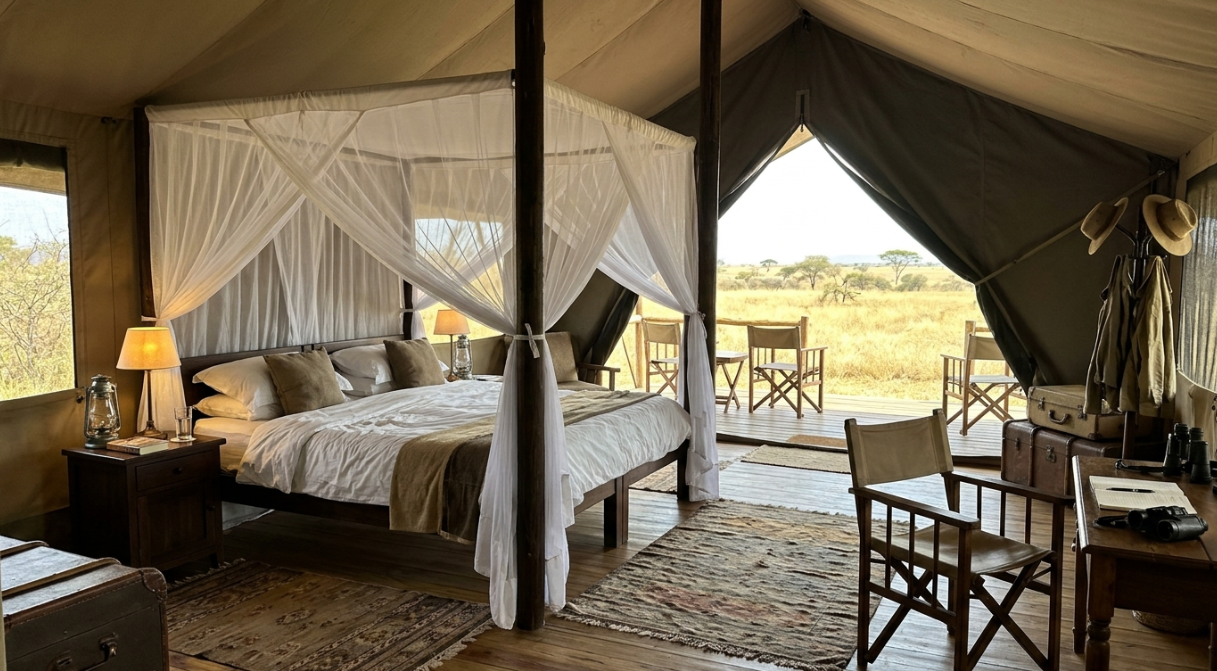
Canvas-sided rooms with en-suite bathrooms, hot running water, full-size beds, and daily housekeeping. Don’t let “tented” fool you. These are not camping experiences. A luxury tented camp in the Serengeti offers the same comfort as a high-end boutique hotel, with the added experience of hearing wildlife outside your tent at night. Duma Explorer travelers have specifically praised properties like Nyumbani Camp in the Central Serengeti for exceptional food and 24-hour hot water, and Lion’s Paw for outstanding luxury and hospitality.
Mobile Tented Camp
Camps that physically relocate throughout the year to follow wildlife, most notably the Great Migration herds across the Serengeti. Mobile camps offer a more authentic, expedition-style experience at the luxury level. They set up in remote locations away from permanent camp clusters, which means fewer vehicles and more exclusive sightings. The trade-off: slightly less polish than a permanent luxury camp, with higher rates because of the logistics involved in moving an entire camp multiple times per year.
Private Conservancy Camp
Located on exclusive-use land adjacent to (but outside) national parks. Conservancy camps represent the top tier of luxury Tanzania safari pricing, typically $800 to $2,500 per person per night, all-inclusive. The premium, usually 30% to 50% more than a comparable national park lodge, buys three things that fundamentally change safari quality: strict vehicle limits at sightings, permission for off-road driving to track predators, and access to night drives. More on this critical distinction below.
Exclusive-Use / Buyout
Renting an entire camp for your group. This is the pinnacle of privacy, popular for honeymoons, milestone celebrations, and multi-generational family trips. Buyout rates vary enormously, from $3,000 to $15,000+ per night for the whole property. For couples considering this for a romantic safari experience, the cost per person becomes more reasonable with larger groups.
Transport and Logistics: Fly-In vs. Drive-In
How you move between parks is the second biggest cost variable in luxury Tanzania safari pricing, and it affects far more than your budget.
Fly-In Safari
Small bush planes hop between airstrips located inside or near each national park. Scheduled seats cost $250 to $500 per person per leg. Private charters run $1,200 to $3,000 per aircraft. Across a full week, a fly-in itinerary adds $650 to $1,200 per person compared with driving. What you’re buying is time: a fly-in safari saves two or more full days that would otherwise be spent on roads, converting transit hours into game-viewing hours. For detailed logistics and pricing on this option, see the fly-in safari planning guide.
Drive-In Safari
Traveling between parks by private 4x4 Land Cruiser, typically with your own driver-guide. Drive-in safaris cost less in vehicle fees but more in time. The drive from Arusha to the Serengeti takes a full day. From the Serengeti to Ngorongoro is another half day. For travelers who enjoy the journey and want to see the landscape between parks, driving is rewarding. For those maximizing game-viewing time on a 7-day trip, the cost of lost days often exceeds the savings.
Bush Flight / Charter Flight
Bush flights are the small aircraft (Cessna Caravan or similar) that operate on Tanzania’s safari circuit. Scheduled bush flights run on fixed timetables between major airstrips. Charter flights operate on your schedule, to any airstrip, at higher cost. The distinction matters when planning: scheduled flights are cheaper but lock you into specific departure times.
Private Vehicle / Dedicated Guide
Your own 4x4 Land Cruiser and driver-guide for the entire safari, rather than sharing a vehicle with other travelers. This runs $200 to $350 per day and is standard on luxury safaris. The benefit isn’t just comfort; it’s control. A private guide lets you linger at sightings, skip crowded spots, and adapt the day to your interests, whether that’s big cats, birds, or photography.
Domestic Flight
Scheduled commercial flights between major points: Arusha (or Kilimanjaro International) to Serengeti, or mainland Tanzania to Zanzibar. These are different from bush flights, operating from paved airstrips on larger aircraft. Domestic flights to Zanzibar typically cost $150 to $300 per person.
Activities and Add-Ons That Change Your Total
These line items appear on quotes as optional extras or are sometimes bundled into all-inclusive rates. Each one has a meaningful impact on the overall luxury Tanzania safari cost.
Balloon Safari
A sunrise hot-air balloon flight over the Serengeti, followed by a champagne bush breakfast. At $500 to $600 per person, the Serengeti balloon safari is the most expensive single add-on on a Tanzania safari. Most travelers who do it say it was worth every dollar. It needs to be booked in advance, especially during peak season.
Walking Safari
A guided walk through the bush with an armed ranger, offering a ground-level perspective that vehicles can’t provide. Walking safaris carry an additional fee of $24 to $30 per person on top of standard park entry fees. Not all parks and camps offer them, and availability depends on the specific area and camp.
Night Drive
Game drives conducted after dark using spotlights, revealing nocturnal species like leopards hunting, aardvarks, bush babies, and civet cats. Night drives are only available in private conservancies, not in national parks. This is one of the key reasons conservancy camps charge higher rates. If seeing nocturnal wildlife matters to you, it directly affects your accommodation choice and budget.
Off-Road Driving
The ability to leave established tracks to follow predators, approach wildlife more closely, and reach sightings that road-bound vehicles can’t access. Like night drives, off-road driving is a conservancy-only privilege. In national parks, all vehicles must stay on designated roads, even if a leopard is 50 meters off-track. This restriction alone drives many serious wildlife enthusiasts toward conservancy camps.
Zanzibar Extension
Adding beach days after a safari is one of the most popular ways to extend a Tanzania trip. Beach accommodation runs $200 to $800 per night depending on the property. You’ll also need a domestic flight ($150 to $300) and mandatory Zanzibar health insurance at approximately $44 per person. For a detailed look at planning the beach portion, the Zanzibar extension glossary covers logistics and costs.
National Park vs. Private Conservancy: The Fundamental Pricing Fork
This is the single most important cost decision on a luxury Tanzania safari, and it’s the one most travelers don’t fully understand when comparing quotes.
What a Private Conservancy Actually Costs
A night in a private conservancy camp costs $800 to $2,500 per person, all-inclusive. A comparable national park lodge costs $400 to $1,200 per person per night. The premium, typically $300 to $800 per person per night, buys time, space, and access, the three variables that most directly shape safari quality.
What You Get for the Premium
|
Feature |
National Park |
Private Conservancy |
|---|---|---|
|
Vehicle limits at sightings |
None (can be 20+ vehicles at popular sightings) |
Strictly limited (2–3 vehicles) |
|
Off-road driving |
Not permitted |
Permitted |
|
Night drives |
Not permitted |
Available |
|
Walking safaris |
Limited, regulated |
Widely available |
|
Overall exclusivity |
Shared with all park visitors |
Exclusive to conservancy guests |
|
Conservation funding |
Park fees to TANAPA |
Conservancy fees to local communities and landowners |
National Park vs. Private Conservancy: What Changes?
The main difference between a national park and a private conservancy is the level of access, activity flexibility, and visitor management available to safari guests.
|
Feature |
National Park |
Private or Community Conservancy |
|---|---|---|
|
Access |
Open to authorized park visitors |
Access governed by the conservancy |
|
Game drives |
Subject to park regulations |
Subject to conservancy rules |
|
Off-road driving |
Generally prohibited outside authorized exceptions |
May be permitted in designated areas |
|
Night drives |
Generally not permitted |
May be available |
|
Walking safaris |
Available in approved areas with required arrangements |
Often available, subject to local rules |
|
Vehicle restrictions |
Park-wide visitor and wildlife regulations |
May have stricter vehicle limits |
|
Wildlife viewing |
Access to large protected ecosystems |
More controlled access to designated land |
|
Accommodation |
Public and concession-based properties |
Camps operating on private or community-managed land |
Does a Private Conservancy Always Cost More?
Private conservancy accommodation often commands a premium because of its exclusivity, additional activities, and operating arrangements.
However, prices vary according to location, property category, season, and the services included.
Before paying a premium, ask the operator which additional experiences are actually available at the specific camp. Do not assume that every conservancy offers night drives, off-road driving, or unlimited walking safaris.
Who Should Choose Which
Choose national park lodges if you want the iconic Serengeti landscape, Great Migration river crossings, and don’t mind sharing sightings with other vehicles. National parks offer the widest range of wildlife density and the most famous backdrops.
Choose private conservancies if intimate, uncrowded wildlife encounters matter more than being in a specific named park. Conservancies are particularly valuable for photographers, honeymooners, and travelers who have already done a park-based safari and want something different.
The smart approach for most luxury travelers: Mix both. Spend some nights in a national park for sheer wildlife density and Migration access, then move to a conservancy for exclusivity, off-road tracking, and night drives.
Deciding between national park lodges and private conservancy camps is one of the biggest cost decisions on a luxury safari. Duma Explorer designs itineraries that mix both, combining park-based days for iconic sightings with conservancy nights for exclusivity. Explore luxury itinerary options to see how this works in practice.
Concession Area
A government-granted operating area within or adjacent to a national park. Concession areas are sometimes confused with private conservancies but differ in governance. A concession is leased from the government (TANAPA or NCAA), while a conservancy is privately owned or community-owned land. Both offer more exclusivity than general park access, but concession areas still fall under national park regulations regarding off-road driving and night activities.
Hidden Costs of a Luxury Tanzania Safari
Even when a luxury Tanzania safari is advertised as all-inclusive, some expenses may remain outside the quoted package price.
These costs are not necessarily hidden intentionally. They often depend on individual preferences, optional experiences, and the services selected during the booking process.
|
Potential Extra Cost |
What to Check |
|---|---|
|
International airfare |
Whether flights to Tanzania are included |
|
Visa fees |
Applicable entry requirements and fees |
|
Travel insurance |
Medical, cancellation, and evacuation coverage |
|
Balloon safari |
Whether the experience is included or optional |
|
Premium beverages |
Whether imported wines and spirits are covered |
|
Laundry |
Whether laundry services have limits |
|
Tips |
Whether guide and camp staff gratuities are included |
|
Domestic flights |
Whether baggage restrictions or excess baggage charges apply |
|
Zanzibar extension |
Accommodation, transfers, and flights |
|
Single supplement |
Additional cost for occupying a double room alone |
|
Bank and card charges |
Currency conversion and payment processing fees |
How to Avoid Unexpected Safari Expenses
Before paying your deposit, ask for a written list of exclusions.
Pay particular attention to international flights, travel insurance, optional activities, premium beverages, gratuities, and additional accommodation nights.
A well-prepared safari quotation should make it clear what you will pay before departure, what you may pay during the trip, and what expenses are entirely optional.
Tipping and Service Charges
Tipping is expected at all levels of Tanzania safari. At luxury camps, the amounts are higher and the systems more formalized.
Tip Box / Staff Tip Box
Most luxury camps have a shared tipping box at reception. Tips placed here are pooled and distributed among all staff members, from housekeeping to kitchen crew to maintenance. The suggested amount varies by camp but typically runs $15 to $25 per person per day for the camp staff collectively.
Driver-Guide Tip
Your safari guide receives a separate, personal tip. At the luxury level, $25 to $50 per person per day is standard for a private guide. For a 7-day safari, budget $175 to $350 per person for the guide alone. Guides with advanced certifications (like the EcoTraining and FGASA-qualified guides that top operators invest in) often receive tips at the higher end of this range.
Askari
A night guard who patrols the camp perimeter and escorts guests between their tent and common areas after dark. The askari is a standard feature at tented camps located in wildlife areas. A small personal tip ($5 to $10 per night) is appreciated but not always expected.
Total tipping budget for a 7-day luxury safari: approximately $150 to $350 per person, which is rarely included in quoted prices.
How to Read a Luxury Safari Quote: The Three Levers
When two luxury Tanzania safari cost quotes look wildly different, check these three variables first. They explain most of the price gap.
Lever 1: National Park vs. Private Conservancy
Switching from park-based lodges to conservancy camps adds $300 to $800 per person per night. On a 7-night trip, that’s $2,100 to $5,600 in additional cost.
Lever 2: Fly-In vs. Drive-In
A fly-in itinerary adds $650 to $1,200 per person across a week, but recovers 2+ full days of game viewing that would otherwise be spent on roads.
Lever 3: Peak Season vs. Green Season
Traveling in April/May instead of July/August can reduce accommodation costs by 25% to 50%. On a $10,000 trip, that’s $2,500 to $5,000 in savings.
Applying the Framework
Take any two luxury quotes and check where each one falls on these three axes. A quote for a peak-season, fly-in, conservancy-based safari will legitimately cost 2 to 3 times more than a green-season, drive-in, park-based trip of the same length, and both can accurately be called “luxury.”
The Middleman Factor
One more variable that doesn’t appear on the quote itself: who you’re booking through. Larger international travel agents and safari companies based in the US or UK can add 30% to 300% onto base prices. Booking through an operator with direct ground operations in Tanzania eliminates this middleman layer. Duma Explorer operates locally as Alika Africa, with vehicles, guides, and logistics managed directly from Arusha, which is one of the reasons transparent pricing is possible.
Why Do Two Luxury Tanzania Safari Quotes Have Different Prices?
Two luxury Tanzania safari quotations can differ by thousands of dollars even when they cover the same number of days and visit the same national parks.
The difference usually comes from accommodation standards, seasonal rates, transportation arrangements, and the services included in the package.
Consider these common pricing differences:
|
Pricing Factor |
Lower-Cost Option |
Higher-Cost Option |
|---|---|---|
|
Accommodation |
Luxury permanent lodge |
Exclusive luxury tented camp |
|
Location |
Outside national park boundaries |
Inside the park or a private concession |
|
Transportation |
Private road transfer |
Scheduled or private bush flights |
|
Safari vehicle |
Standard private 4x4 |
Premium private safari vehicle |
|
Meals |
Full-board |
All-inclusive with selected beverages |
|
Activities |
Standard game drives |
Game drives, walking safaris, and additional experiences |
|
Season |
Low or shoulder season |
Peak migration season |
|
Room occupancy |
Two guests sharing |
Single occupancy or private-use arrangement |
How to Compare Quotes Fairly
When reviewing two quotations, compare the following five things:
-
Accommodation: Are both operators using properties of similar quality and location?
-
Transportation: Does either quotation include domestic flights or private charters?
-
Government fees: Are park entry, conservation, and concession fees included?
-
Activities: Are balloon safaris, walking experiences, and additional game drives included?
-
Payment conditions: Do deposits, cancellation terms, and payment deadlines differ?
A cheaper quotation is not necessarily a better deal. If it excludes domestic flights, park fees, or premium accommodation, the final amount may be considerably higher.
The best quotation is the one that provides the experience you want with clearly explained costs and inclusions.
Sample 7-Day Luxury Tanzania Safari Cost Breakdown
To understand how a luxury Tanzania safari quotation works, consider a hypothetical seven-day Northern Circuit itinerary visiting Tarangire, Serengeti, and Ngorongoro.
The following example illustrates how different expenses contribute to the total safari budget. These are planning estimates, not a live supplier quotation.
Example assumptions:
-
Two adults sharing accommodation.
-
Seven days of private safari arrangements.
-
Three nights in the Serengeti.
-
Two nights in Tarangire.
-
One night near Ngorongoro.
-
Road-based transportation.
-
International flights excluded.
-
Optional balloon safari excluded.
-
Government fees shown separately from accommodation to avoid double-counting.
|
Expense |
Estimated Cost Per Person |
|---|---|
|
Luxury accommodation and meals |
$4,200–$7,500 |
|
Park and conservation fees |
To be confirmed by itinerary |
|
Private safari vehicle and guide |
$700–$1,225 |
|
Airport transfers |
$50–$150 |
|
Domestic flights |
Not included |
|
Optional activities |
Not included |
|
Core package subtotal |
Depends on confirmed government fees and inclusions |
Additional Expenses to Budget For
|
Additional Expense |
Estimated Cost Per Person |
|---|---|
|
Serengeti balloon safari |
$500–$600 |
|
Safari guide and camp staff tips |
$150–$350 |
|
Premium drinks at full-board properties |
Depends on consumption |
|
Travel insurance |
Depends on coverage |
|
International flights |
Depends on departure country |
|
Zanzibar extension |
Depends on accommodation and duration |
How to Interpret This Example
The accommodation rate may already include meals, park charges, concession fees, or other services depending on the property's pricing structure.
Always request an itemized quotation that identifies which charges are included in the accommodation rate and which are added separately.
For this reason, there is no single reliable total that applies to every seven-day luxury safari. The final price should be calculated from the actual properties, travel dates, park schedule, vehicle arrangements, and package inclusions.
How Group Size Affects Luxury Tanzania Safari Cost
The number of travelers sharing a private safari vehicle and accommodation can significantly affect the per-person cost of a luxury Tanzania safari.
Some expenses are charged per person, while others are charged per vehicle or per room. This means couples, families, and larger private groups may receive different per-person quotations for the same itinerary.
Example: Sharing a Private Safari Vehicle
Suppose a private safari vehicle costs $300 per day and is used for seven days.
The total vehicle cost is $2,100.
|
Travelers Sharing the Vehicle |
Total Vehicle Cost |
Vehicle Cost Per Person |
|---|---|---|
|
2 travelers |
$2,100 |
$1,050 |
|
3 travelers |
$2,100 |
$700 |
|
4 travelers |
$2,100 |
$525 |
|
5 travelers |
$2,100 |
$420 |
|
6 travelers |
$2,100 |
$350 |
These figures illustrate vehicle-cost sharing only. They do not represent the complete safari package price.
Accommodation, park fees, meals, flights, and activities may still be charged separately per person or per room.
Planning tip: When requesting a luxury safari quotation, provide the exact number of travelers and room arrangements. This allows your operator to calculate the actual per-person cost rather than applying a generic daily rate.
How We Estimate Luxury Tanzania Safari Prices
The price estimates in this guide are intended to help travelers understand the potential cost of a luxury safari in Tanzania.
Safari prices are not fixed across the industry. They vary according to accommodation contracts, seasonal rates, park fees, transportation arrangements, group size, and the services included in each package.
When comparing safari prices, we consider the following cost components:
-
Accommodation rates published by safari lodges and tented camps.
-
Applicable national park and conservation fees.
-
Private vehicle and professional guide arrangements.
-
Domestic flights and airport transfers.
-
Meals, beverages, and included safari activities.
-
Optional experiences and additional travel expenses.
Government charges should be checked against the relevant authority's published tariffs, while accommodation and activity prices should be confirmed with the individual property or service provider.
Price validity: All estimates should be treated as indicative planning figures. Actual quotations depend on travel dates, supplier availability, room categories, and applicable fees at the time of booking.
For an accurate price, request an itinerary-specific quotation with a breakdown of included services and exclusions.
Frequently Asked Questions
How much does a luxury Tanzania safari cost per day?
A luxury Tanzania safari costs $700 to $1,500 per person per day in 2026. Ultra-luxury options, including private conservancy camps and fly-in transfers, range from $1,500 to $3,000+ per person per day. These figures typically include accommodation, meals, game drives, and park fees, though the exact inclusions depend on whether the property is full-board or all-inclusive.
What is the difference between all-inclusive and full-board on safari?
Full-board covers accommodation and three meals per day. All-inclusive adds house wines, local spirits, soft drinks, laundry, and usually two daily game activities. At luxury camps, the gap between full-board and all-inclusive can be $50 to $150 per person per day in additional spending. Always confirm which inclusion level your quote reflects.
Are park fees included in luxury safari quotes?
Usually, yes. Most reputable operators include park fees in their quoted price. However, some quotes list them separately. On a Northern Circuit itinerary visiting the Serengeti, Ngorongoro, and Tarangire, park fees alone total approximately $177 per person per day. If a quote seems unusually low, check whether park fees, concession fees, and the crater service fee are included or listed as extras.
Is a private conservancy worth the extra cost?
For travelers who prioritize intimate, uncrowded wildlife encounters, yes. Conservancies limit vehicles at sightings (2 to 3 versus potentially 20+ in national parks), permit off-road driving to track predators, and offer night drives that are prohibited inside national parks. The premium is typically $300 to $800 per person per night. Photographers and repeat safari travelers especially tend to find this worthwhile.
How much should I tip on a luxury Tanzania safari?
Budget $150 to $350 per person for a 7-day luxury safari. This breaks down to $25 to $50 per person per day for your private guide, plus $15 to $25 per person per day for camp staff (deposited in the communal tip box). Tipping is almost never included in the quoted price and should be planned as a separate budget line.
What hidden costs should I expect beyond the quoted price?
The most common costs not included in luxury safari quotes are: balloon safari ($500 to $600), premium alcoholic drinks at full-board properties, spa treatments, Zanzibar extension costs ($200 to $800/night plus flights plus $44 insurance), tips ($150 to $350 per person for a week), travel insurance, international flights to Tanzania, and visa fees. A thorough operator will flag all of these upfront.
Can I save money by traveling in green season?
Significantly. Luxury lodge rates drop 25% to 40% in green season (November through March), and some properties cut prices nearly in half during April and May. The wildlife doesn’t disappear. The Serengeti calving season (January through March) actually offers some of the year’s best game viewing. The trade-offs are occasional rain, some camps closing in April/May, and muddier roads.
How much does a 7-day luxury Tanzania safari cost?
A seven-day luxury Tanzania safari can cost approximately $4,900–$10,500 per person using the indicative luxury rate of $700–$1,500 per person per day. Ultra-luxury itineraries can exceed $21,000 per person. The final price depends on accommodation, travel season, transportation, and package inclusions.
Is $10,000 enough for a luxury Tanzania safari?
Yes, $10,000 per person can be enough for a seven-day luxury Tanzania safari, depending on the travel season, accommodation choices, and included services. However, international airfare, optional activities, tips, and Zanzibar extensions may require an additional budget.
What is the cheapest month to book a luxury Tanzania safari?
April and May are often among the least expensive months for luxury accommodation because many properties offer low-season rates. However, some camps close during this period, and rainfall can affect road conditions and travel plans. Always compare the actual lodge rates for your dates.
Is a fly-in luxury safari worth the extra cost?
A fly-in safari can be worthwhile when you want to reduce long road transfers and spend more time in remote wildlife areas. However, scheduled bush flights and private charters add transportation costs. Driving can offer better value for travelers with longer itineraries or those who enjoy exploring the landscape between parks.
Do luxury Tanzania safari prices include international flights?
Most Tanzania safari package quotations exclude international flights. Travelers usually arrange their own flights to Kilimanjaro International Airport, Julius Nyerere International Airport, or another suitable arrival airport. Confirm whether airport transfers and domestic bush flights are included.
Is a private safari cheaper for couples or larger groups?
A private safari can offer better per-person vehicle value for larger groups because vehicle expenses can be shared. However, accommodation and park fees remain important parts of the total cost. Couples may pay more per person for private transportation than groups sharing the same vehicle.
Planning a luxury Tanzania safari involves more decisions than most travelers expect. If you’d like a transparent, line-by-line quote that accounts for your specific travel dates, group size, accommodation preferences, and whether you want to include Zanzibar, Kilimanjaro, or gorilla trekking, Duma Explorer can build an itinerary around exactly what matters to you. Request a custom luxury safari itinerary to get started.