

TL;DR
A group of 10 is too large for one safari vehicle (max 6-7 passengers) but too small to need a full lodge buyout. You need 2-3 private 4x4s, a 7-day mid-range Northern Circuit itinerary typically costs $2,200-$4,000 per person, and you should book 9-12+ months ahead for peak season. This glossary covers every term and decision a trip organizer needs.
If you’re the person everyone nominated to “figure out the Tanzania thing,” this page is for you. Planning a safari for 10 people in Tanzania means navigating vehicle splits, room configurations, park fee math, tipping logistics, and budget conversations that smaller groups never face. None of the standard safari planning guides address these specifics for a 10-person party, whether that’s a group of friends, an extended family, or a corporate retreat.
This glossary breaks down every term you’ll encounter during planning, with the math calculated for exactly 10 travelers.
How Much Does a Tanzania Safari for 10 People Cost? A private Tanzania safari for 10 people typically requires two or three 4x4 safari vehicles, depending on passenger capacity and comfort preferences. The total cost of a seven-day trip depends on accommodation, travel season, park fees, activities, and the number of vehicles. A mid-range itinerary should be priced using confirmed operator quotes rather than a single universal rate. For peak-season travel, start planning 9–12 months ahead, or earlier if you want exclusive use of a small tented camp.
For most groups, the three biggest decisions are:
-
Vehicles: Two vehicles can reduce costs, while three generally provide more space and flexibility.
-
Budget: Compare the complete group price and per-person price, checking exactly what each quote includes.
-
Accommodation: Five double or twin rooms may accommodate 10 adults, but room configurations and exclusive-use requirements vary by property.
→ Already know what you need? Request a custom group itinerary with vehicle and accommodation options mapped for your group.
Quick Reference: Tanzania Safari for 10 People
|
Planning factor |
Recommendation for 10 travelers |
|---|---|
|
Safari format |
Private safari with dedicated vehicles and driver-guides |
|
Number of vehicles |
Usually 2–3, subject to confirmed vehicle capacity |
|
Passengers per vehicle |
Aim for 3–4 for additional space; 5 may be possible in a suitable six-passenger vehicle |
|
Accommodation |
Approximately 5 double or twin rooms for 10 adults |
|
Trip duration |
7 days is a useful starting point for a Northern Circuit itinerary |
|
Main cost drivers |
Accommodation, season, vehicles, park fees, route, and optional activities |
|
Park and conservation fees |
Calculate by park, traveler age, applicable fee category, and number of chargeable days |
|
Ngorongoro Crater descent |
Budget separately using the applicable per-vehicle charge |
|
Booking lead time |
Start 9–12 months ahead for peak-season travel; allow more time for exclusive-use properties |
|
Group tipping budget |
Establish a per-person, per-day allowance and confirm the operator's tipping guidance |
|
International flights and visa |
Budget separately unless explicitly included in the quotation |
Vehicle and Logistics Terms
The vehicle question is the single most important planning decision for a 10-person Tanzania safari. Every other cost and comfort factor flows from how you split your group across vehicles.
Safari Vehicle (4x4 Land Cruiser)
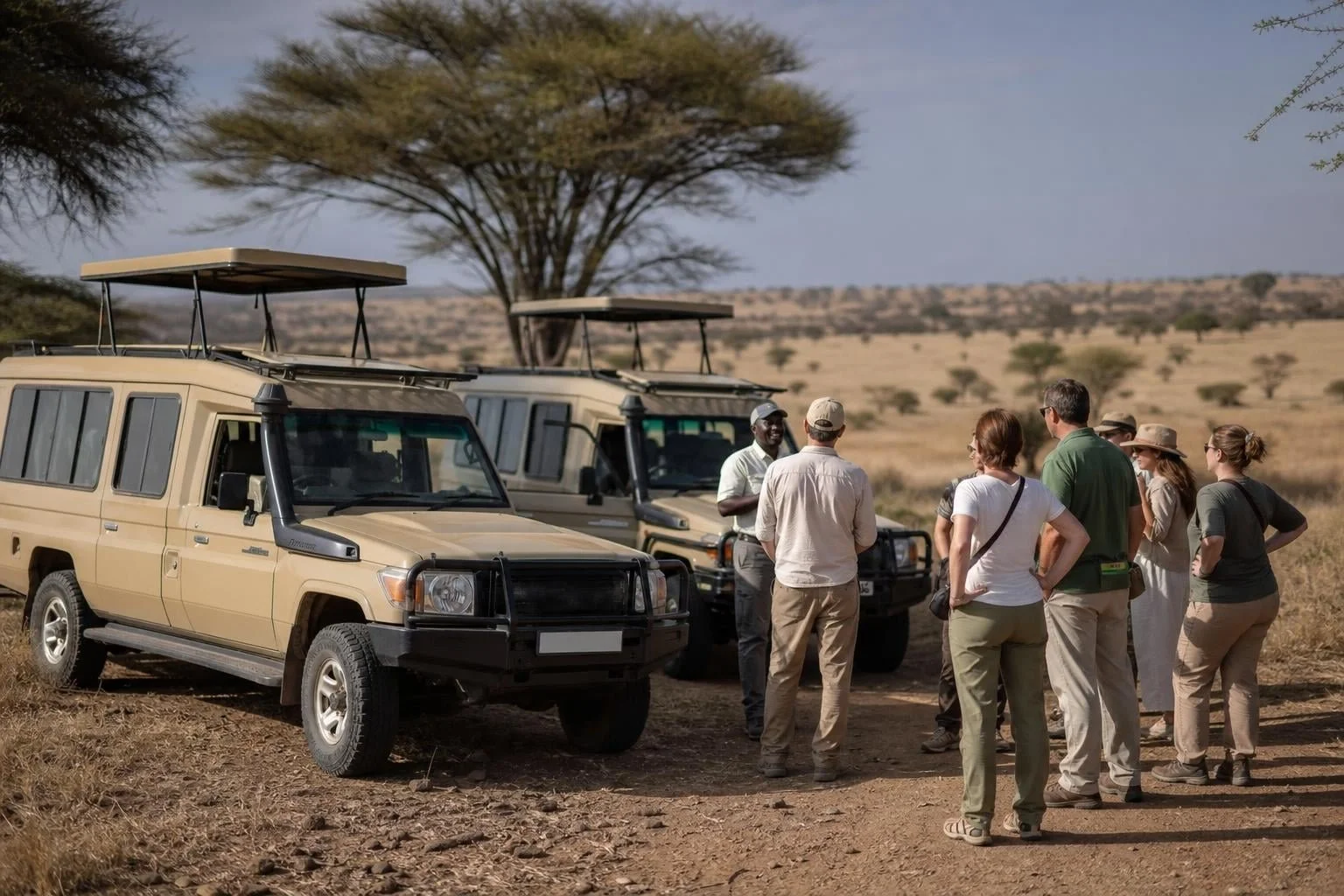
The standard game-viewing vehicle in Tanzania’s Northern Circuit is a modified Toyota Land Cruiser with a pop-up roof. A typical configuration has three rows and seats a maximum of six passengers, with every seat having access to the roof hatch for standing, viewing, and photography. Some operators run stretch vehicles with an extra row that accommodate up to eight, but the terrain limits anything larger.
For a group of 10, a single vehicle is never an option.
How Many Safari Vehicles Do 10 People Need?
For a private Tanzania safari, two vehicles are generally the lower-cost option, while three vehicles can offer greater personal space and flexibility. The best arrangement depends on the operator's actual vehicle configuration, passenger capacity, luggage requirements, and the group's priorities.
|
Factor |
Two vehicles |
Three vehicles |
|---|---|---|
|
Example passenger split |
5 + 5 |
4 + 3 + 3 |
|
Vehicle hire |
Usually lower |
Usually higher |
|
Space per passenger |
Depends on seating configuration |
Generally more room per passenger |
|
Photography |
Depends on seat layout and roof access |
More flexibility to position passengers |
|
Guide allocation |
Typically one driver-guide per vehicle |
Typically one driver-guide per vehicle |
|
Wildlife viewing |
Two vehicles can follow different sightings |
Three vehicles can operate more independently |
|
Group coordination |
Two vehicles to coordinate |
Three vehicles to coordinate |
|
Best suited to |
Cost-conscious groups comfortable with the proposed layout |
Photography enthusiasts and groups prioritizing personal space |
Before deciding, ask the operator to confirm the exact passenger capacity of each vehicle, whether every passenger has a suitable viewing position, and how luggage will be carried.
Is Three Vehicles Worth the Extra Cost?
Three vehicles may be worthwhile if your group prioritizes space, photography, and the ability to pursue different wildlife sightings. Two vehicles may be sufficient if everyone is comfortable with the seating arrangement and the operator confirms that the vehicles can safely accommodate the passengers and luggage.
Request quotes for both configurations using the same dates, accommodation, route, and inclusions. Compare the difference in the total group price and the additional cost per traveler before making the decision.
The 4-Per-Vehicle Rule
A guideline used by experienced operators: plan for four passengers per vehicle, then adjust the count upward if needed. For 10 people, this means starting with three vehicles (4-4-2 or 4-3-3 splits). Families with small children who share seats can sometimes go with two vehicles, but photography-focused groups should stick with three.
Stretch Vehicle
Some operators offer customized stretch Land Cruisers seating up to eight passengers. A stretch vehicle plus a standard 6-seater could handle 10 people in two vehicles with more breathing room than two standard cars holding five each. Worth asking about during the quoting process, though availability varies by operator.
Convoy Coordination
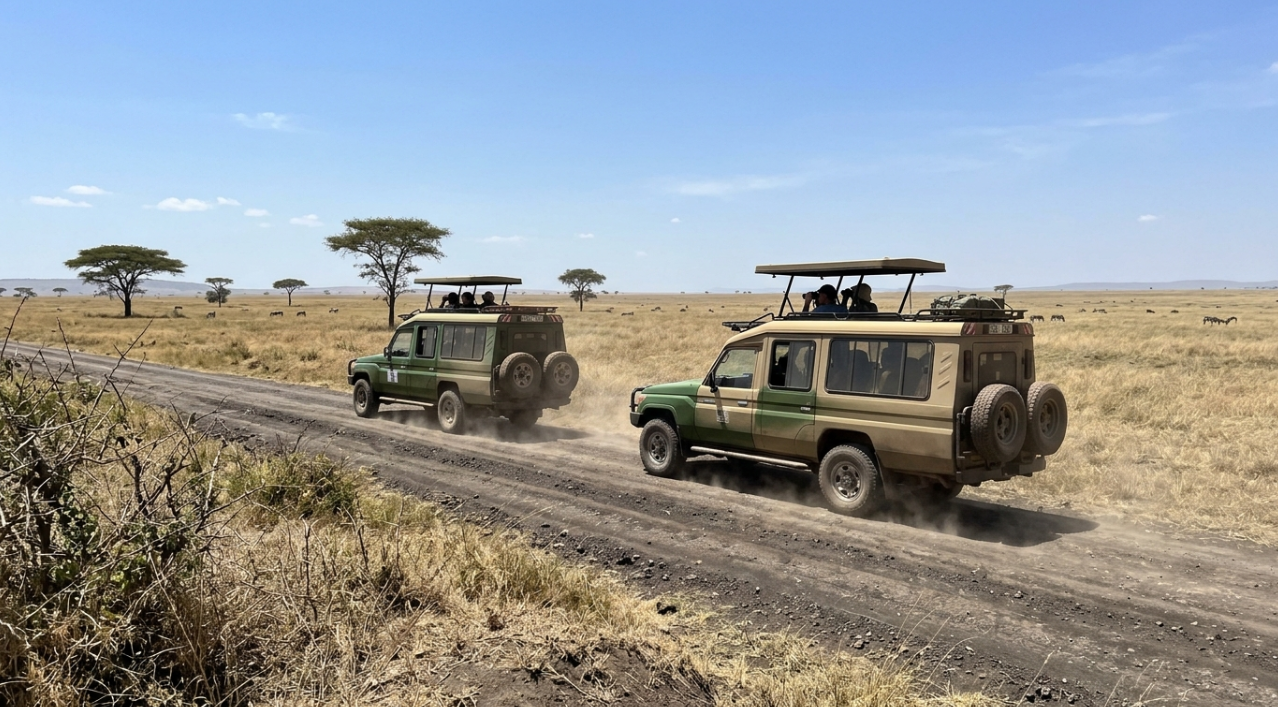
Two or three vehicles traveling together need active coordination. Radios or mobile phones keep guides in contact so vehicles can share sighting locations, stagger arrivals at narrow tracks, and avoid bottlenecks at park gates. A 10-person group with 2-3 vehicles is well under the 20-person threshold where convoy logistics become genuinely problematic, but communication between drivers still matters.
Head Guide / Tour Leader
When your group splits across multiple vehicles, an experienced operator will typically assign a head guide or tour leader who coordinates the overall game-drive strategy. This person may rotate between vehicles throughout the trip, ensuring consistent quality across the group. Every vehicle will have its own knowledgeable driver-guide regardless.
For groups navigating the complexities of multi-vehicle safari logistics, having a designated lead makes a noticeable difference in how smoothly the trip runs.
Road Transfer
Distances between parks on Tanzania’s Northern Circuit are substantial. Tarangire to the Serengeti’s central zone involves a full day of driving, and the road from Ngorongoro to Arusha takes 3-4 hours. For a convoy of 2-3 vehicles, road transfers require coordinated departure times and rest stops, especially when traveling with children or older family members.
Fly-In Safari
An alternative to long road transfers. Charter flights between parks eliminate drive days but change the vehicle dynamic: lodges and camps typically provide their own shared game-drive vehicles at each destination rather than your group having dedicated cars throughout. For 10 people, a fly-in approach might mean chartering a small aircraft (Cessna Caravans seat 12-13), which can actually be cost-effective at this group size. The trade-off is less continuity with your guide and vehicle.
Cost and Budget Terms
Per-person costs drop as group size grows because fixed expenses like vehicle hire, guide fees, and crater descent charges get divided across more people. A 10-person group sits in a cost-efficient sweet spot.
Tanzania Safari Budget for 10 People: What to Include
The total cost of a private Tanzania safari for 10 people includes more than the advertised per-person package price. Group organizers should separate the main safari package from personal expenses, optional activities, and contingency funds.
Use the following budget framework when comparing seven-day Northern Circuit itineraries.
|
Budget category |
How to calculate it |
What to confirm |
|---|---|---|
|
Accommodation |
Total room charges for all nights |
Room types, meals, taxes, and single supplements |
|
Safari vehicles |
Daily vehicle rate × number of vehicles × chargeable days |
Whether fuel, driver-guides, and vehicle fees are included |
|
Park and conservation fees |
Applicable fee × number of travelers × chargeable days |
Park-specific rates, age categories, and tax treatment |
|
Ngorongoro Crater descent |
Applicable vehicle charge × number of vehicles making the descent |
Current tariff and which vehicles incur the fee |
|
Airport transfers |
Transfer charges for the group |
Vehicle capacity, luggage space, and arrival times |
|
Domestic flights |
Fare per traveler or charter price |
Baggage limits, airport transfers, and seasonal availability |
|
Optional activities |
Activity price × number of participants |
Whether participation is optional and whether transport is included |
|
Tips |
Agreed daily allowance × applicable days |
Who receives tips and whether the guide and camp staff are budgeted separately |
|
International flights |
Fare per traveler |
Whether flights are included in the safari quotation |
|
Visa and travel insurance |
Individual cost × number of travelers |
Eligibility, coverage, and current application requirements |
|
Contingency |
An agreed reserve based on the final budget |
How the group will approve and handle unexpected expenses |
Group budget formula:
Total group budget = safari package + excluded travel expenses + optional activities + tips + contingency.
Per-person budget = total group budget ÷ 10.
Ask every operator to identify included and excluded costs in writing. This makes it easier to compare proposals and prevents a low headline rate from hiding additional expenses.
Per-Person Per-Day Rate
The per-person-per-day (PPPD) rate is the average daily cost of a Tanzania safari for each traveler. It allows you to compare itineraries with different durations, accommodation standards, and group sizes.
For a group of 10, the total price depends on the travel season, accommodation category, number of safari vehicles, park fees, and activities included in the package.
Before comparing quotes, confirm whether the rate includes:
-
Accommodation and meals
-
Private 4x4 safari vehicles and driver-guides
-
National park and conservation fees
-
Ngorongoro Crater descent charges, where applicable
-
Airport transfers and domestic flights, if required
-
Taxes and other mandatory charges
International flights, visas, travel insurance, tips, and optional activities may be excluded.
To compare two proposals fairly, divide the total package price by the number of travelers and safari days. Use the same inclusions and trip duration for both calculations.
For a 10-person group, the most useful comparison is the total cost of the trip alongside the per-person price. A lower per-person rate is only a better deal if the itinerary, accommodation, inclusions, and service level are comparable.
For deeper cost context, the Tanzania safari cost guide breaks down what’s included at different budget levels.
Vehicle Cost Sharing
This is where 10 people gain a real advantage. Vehicle hire and guide fees are fixed daily costs split across passengers. With a Westway Safaris cost table as reference, a 7-day mid-range Northern Circuit safari for 8 people across 2 vehicles runs $2,300-$4,200 per person, while 12 people across 3 vehicles drops to $2,100-$3,800 per person. A group of 10 falls between these brackets.
The savings compared to a couple traveling alone are substantial, often $500-$1,000 per person on the same itinerary with the same accommodations.
Park Fees
Non-negotiable, per-person, per-day charges paid directly to Tanzania’s national park authorities. These don’t change regardless of group size. Current 2026 rates for the most visited parks:
|
Park |
Daily fee per person (USD) |
|---|---|
|
$82.60 |
|
|
Ngorongoro Conservation Area |
$70.80 |
|
Tarangire National Park |
$59.00 |
|
Lake Manyara National Park |
$59.00 |
For a 7-day Northern Circuit itinerary covering Serengeti, Ngorongoro, Tarangire, and Lake Manyara, park fees total approximately $265 per person. For 10 people, that’s $2,650 in park fees alone, a fixed cost no operator can discount.
Ngorongoro Crater Descent Fee
A separate $295 charge per vehicle (not per person) for driving down into the crater floor. This is one of the clearest examples of how vehicle count affects your group’s budget:
|
Vehicles |
Total crater fee |
Per person (10 people) |
|---|---|---|
|
2 vehicles |
$590 |
$59.00 |
|
3 vehicles |
$885 |
$88.50 |
The $29.50 per-person difference is real but modest. Most groups find the comfort of three vehicles worth the extra cost over a multi-day trip.
Concession Fee
Some Serengeti camps operate in private concession areas adjacent to the national park rather than inside it. These concessions charge their own nightly fees (often $50-$100 per person) but offer benefits like off-road driving, night drives, and walking safaris that aren’t permitted inside the park. For 10 people seeking exclusive experiences, concession properties are worth considering.
Tipping
The budget item that surprises group organizers most. Standard guidelines for Tanzania safaris:
|
Role |
Amount per person per day (USD) |
|---|---|
|
Safari guide |
$15-$20 |
|
Camp/lodge staff |
$5-$10 |
At $20-$30 per person per day (all staff combined), a 7-day safari for 10 people generates $1,400-$2,100 in total tips. This is a significant sum that needs to be communicated to everyone in the group before departure.
Many groups pool tips into a single envelope managed by the trip organizer. This simplifies things and avoids the awkward situation of different group members tipping wildly different amounts. The Tanzania safari tipping guide covers this in more detail.
Budget Alignment
Perhaps the most uncomfortable but necessary planning conversation. Gnade Safaris notes a practical rule: if everyone’s realistic range falls between $250 and $500 per person per day, you can build a great trip. If the range spans $150 to $1,000 per person per day, you have a fundamental mismatch that needs an honest conversation before any planning begins.
The smart approach: design the core itinerary around the budget most of the group can genuinely afford. Optional upgrades (a private tent instead of a shared room, a hot-air balloon ride, a spa treatment) can be offered as individual add-ons.
Optional Add-Ons
Activities priced individually, not included in the base safari rate:
-
Balloon safari over the Serengeti: ~$500-$600 per person
-
Walking safari in select concession areas: varies by camp
-
Cultural visits to Maasai communities: ~$30-$50 per person
-
Zanzibar extension: a separate itinerary segment with its own pricing
Not everyone in a group of 10 will want the same extras. A good operator builds the base trip to work for everyone and layers optional activities on top.
Deposit Structure
Most operators require a 25-30% deposit to confirm the booking, with the balance due 30-60 days before travel. For 10 people, this means coordinating payments from multiple individuals or families. One person’s delayed payment can hold up accommodation confirmations for the entire group. Establish who pays what, and when, before the first deposit goes out.
Accommodation Terms
Good news: Tanzania’s safari accommodation ecosystem is practically built for groups of 10.
Room Configuration
Ten adults typically need five rooms in double or twin configuration. Families with children may need fewer rooms (if kids share with parents) or more (if teenagers want their own space). Clarify this early because room count affects both availability and total cost.
The Tanzania family safari room guide covers room types, triple configurations, and interconnecting options across popular camps.
Exclusive Use / Camp Buyout
Small tented camps in Tanzania commonly have just 8 to 12 rooms. A group of 10 falls squarely within the typical exclusive-use sizing of 8 to 16 people. Booking every room in a small camp means your group has the entire property to yourselves: private dining, flexible meal times, game drives on your schedule, and no other guests. This is one of the most compelling accommodation options for a 10-person safari in Tanzania, especially for celebrations or family reunions.
Exclusive-use properties often require a minimum spend rather than a per-room rate. For 10 people, the per-person math can be surprisingly reasonable.
Multi-Camp Split
If the best-fit camp at a particular destination has only four rooms, your group of 10 might split across two nearby properties. This works when logistics allow but adds complexity. Most operators try to keep the full group together at each stop.
Tented Camp
Permanent tented camps are the signature accommodation style in Tanzania’s national parks. “Tented” is somewhat misleading. These are spacious canvas structures with proper beds, en-suite bathrooms, and often verandas overlooking the bush. Room counts are typically 8-15, making them ideal for absorbing a group of 10. Mobile tented camps, which move with the Great Migration, tend to be smaller (6-10 tents) and may require a buyout for larger groups.
Lodge
Permanent structures, often built from stone or timber, with more rooms than tented camps (sometimes 30+). Lodges offer more predictable comfort (air conditioning, swimming pools) but less bush atmosphere. For 10 people, a lodge guarantees room availability but won’t offer the exclusive-use intimacy of a smaller camp.
Child Policies
Some camps set minimum age requirements (often 5, sometimes 8 or 12). If your group of 10 includes young children, this narrows your accommodation options at certain destinations. Check age policies before falling in love with a property. The guide to family-friendly safari lodges identifies which properties welcome younger kids.
Itinerary and Route Terms
Northern Circuit
Tanzania’s most popular safari route, connecting Tarangire, Lake Manyara, the Ngorongoro Crater, and the Serengeti. Most 10-person groups follow this circuit because it offers the widest range of landscapes and wildlife density within a 5-10 day timeframe. All camps, lodges, and infrastructure along this route are designed to handle multi-vehicle groups.
Sample 7-Day Tanzania Safari Itinerary for 10 People
A seven-day Northern Circuit safari can combine Tarangire National Park, the Ngorongoro Conservation Area, and the Serengeti. The best route depends on the group's arrival time, travel season, wildlife priorities, and accommodation availability.
For 10 travelers, plan the route around realistic driving times and avoid changing accommodation every night when a longer stay would improve the experience.
|
Day |
Destination or activity |
Group-planning considerations |
|---|---|---|
|
Day 1 |
Arrive in Arusha |
Coordinate airport transfers, confirm room assignments, and hold a group briefing |
|
Day 2 |
Tarangire National Park |
Confirm vehicle assignments, park entry arrangements, and lunch logistics |
|
Day 3 |
Travel toward the Serengeti |
Allow time for the road journey and scheduled stops |
|
Day 4 |
Serengeti game drives |
Give each vehicle flexibility to follow wildlife sightings |
|
Day 5 |
Serengeti game drives |
Consider a second full day in the area rather than rushing to another destination |
|
Day 6 |
Ngorongoro area |
Confirm accommodation location and the following day's crater arrangements |
|
Day 7 |
Ngorongoro Crater or departure transfer |
Check the feasibility of the crater visit against the departure schedule before booking |
This is a starting point, not a fixed itinerary. Depending on flight times and the selected route, you may need to add a night, remove a destination, or change the order of visits.
Should a Group of 10 Spend More Time in the Serengeti?
Consider allocating two or more nights to the Serengeti if wildlife viewing is a major priority. A longer stay can reduce the pressure to cover large distances in a short period.
For a group with children, older travelers, or mixed activity preferences, ask the operator to build in enough time for rest, meals, and comfortable transfers.
Should You Add Zanzibar?
A Zanzibar extension is worth considering if the group wants beach time after the safari. However, it adds flights, accommodation, transfers, and additional planning. Price it separately so travelers can decide whether to participate without changing the core safari budget.
Game Drive
The core safari activity. Morning drives typically depart at 6:00-6:30 AM and return by late morning. Afternoon drives run from around 3:30 PM until sunset. Full-day drives (common in the Serengeti during migration season) include a packed lunch.
For a multi-vehicle group, game drives are where the 3-vehicle advantage really shows. Each vehicle can follow different animal sightings, then reconvene for lunch or at camp. Two vehicles locked into convoy formation lose this flexibility.
Private Safari
For 10 people, “private” means your group has its own vehicles, its own guides, and complete control over the daily schedule. You aren’t sharing a vehicle with strangers, and your guide responds to your group’s interests (birding, big cats, photography) rather than a generic route.
This is the only format that makes sense at this group size. A comparison of private versus group safaris explains the trade-offs in more detail.
Group-Joining Safari
A group-joining (or “shared”) safari places individual travelers or small parties into a shared vehicle with strangers. Standard joining vehicles hold 4-6 passengers. A group of 10 cannot fit into a single joining vehicle and would need to be split across two vehicles of strangers, defeating the purpose of traveling together. The cost savings from sharing vehicles within your own group of 10 effectively replaces any joining-safari discount.
Put simply: 10 people are too many for group-joining and enough to make private safaris cost-effective.
Pacing
How aggressively the itinerary moves between destinations. A 7-day Northern Circuit with two nights in the Serengeti and one night everywhere else feels rushed for any group, but especially for 10 people who need extra time for bathroom stops, slower-paced mornings with children, or mixed energy levels across ages. Build in at least one “rest morning” where the group can sleep in, swim, or simply sit on a veranda without a 5:30 AM wake-up call.
For multigenerational groups, pacing becomes even more critical. Not everyone needs to do every game drive.
Zanzibar Extension
Many 10-person groups add 3-5 days on Zanzibar after the safari. Flying 10 people from the Serengeti or Arusha to Zanzibar is straightforward (daily scheduled flights on multiple carriers), though booking 5+ rooms at a beach hotel during peak season requires advance planning. The Zanzibar safari and beach planning guide covers logistics and timing.
Booking and Planning Terms
Lead Time
For a 10-person safari in Tanzania during peak season (July-October, December-February), 9-12 months of lead time is the minimum. Small exclusive-use camps that fit your group perfectly can book out 12-18 months ahead. Off-peak travel (March-May, November) offers more flexibility, but even then, coordinating 5+ rooms across multiple properties takes time.
Trip Organizer / Point Person
The person reading this article. Your job is to collect travel dates, budget ranges, dietary restrictions, passport details, and room preferences from everyone, then communicate a unified brief to the operator. The cleaner your brief, the faster and more accurate the first itinerary proposal will be.
Payment Collection
Operators handle group payments differently. Some accept a single lump-sum payment from the organizer. Others invoice each traveler individually. Clarify this upfront. Agree on deposit and balance payment deadlines before booking, and hold everyone to them. One person’s delayed payment can prevent accommodation confirmations that affect the whole group.
Cancellation Terms
Read these carefully. Most operators have per-person cancellation policies (percentage of the total depending on how close to departure), but some group bookings carry stricter terms because the operator has blocked multiple rooms and vehicles. Understand what happens if one person drops out versus half the group canceling.
Travel Insurance
Individual policies are standard. Each traveler should carry their own policy covering trip cancellation, medical evacuation, and emergency medical treatment. Group policies exist but are less common for leisure travel. The Tanzania travel insurance guide covers what to look for in a policy.
E-Visa
Tanzania requires an electronic visa ($50 per person) applied for individually online before arrival. For 10 people, that’s $500 total, a minor cost but a coordination task. Make sure everyone applies at least 2-3 weeks before departure. The process is straightforward but occasionally slow.
On-Safari Terms
Pop-Up Roof
The defining feature of a Tanzania safari vehicle. The roof hatches open upward, allowing passengers to stand and view or photograph animals from an elevated position. In a vehicle carrying 4 people, everyone has comfortable standing room. In a vehicle carrying 6, it gets crowded at the hatch during popular sightings.
Window Seat
In a 3-row Land Cruiser, window seats provide the best viewing angles and unobstructed photography. Middle seats exist in some configurations but offer limited visibility. The safari photography gear guide covers equipment and positioning tips.
With 3-4 people per vehicle, every passenger gets a window. With 5 per vehicle, someone doesn’t. This alone is worth the cost of a third vehicle for photography-oriented groups.
Sighting Etiquette
Tanzania’s national parks enforce rules about vehicle behavior near animals. Vehicles must stay on designated tracks (no off-road driving in national parks), maintain minimum distances, and limit time at popular sightings when other vehicles are waiting. Your guide will manage this, but in a 2-3 vehicle convoy, all your drivers need to understand the protocols so your group doesn’t unintentionally crowd a sighting.
Rest Stops
Bathroom logistics on game drives deserve a mention for groups of 10. There are no restrooms in the middle of the Serengeti. Guides know designated rest areas, and most lodges have facilities at the park gates. With multiple vehicles, staggering bathroom stops helps, especially when traveling with children. It’s a small detail, but one that forum users on Fodor’s mention repeatedly when discussing large-group safari planning.
Sundowner
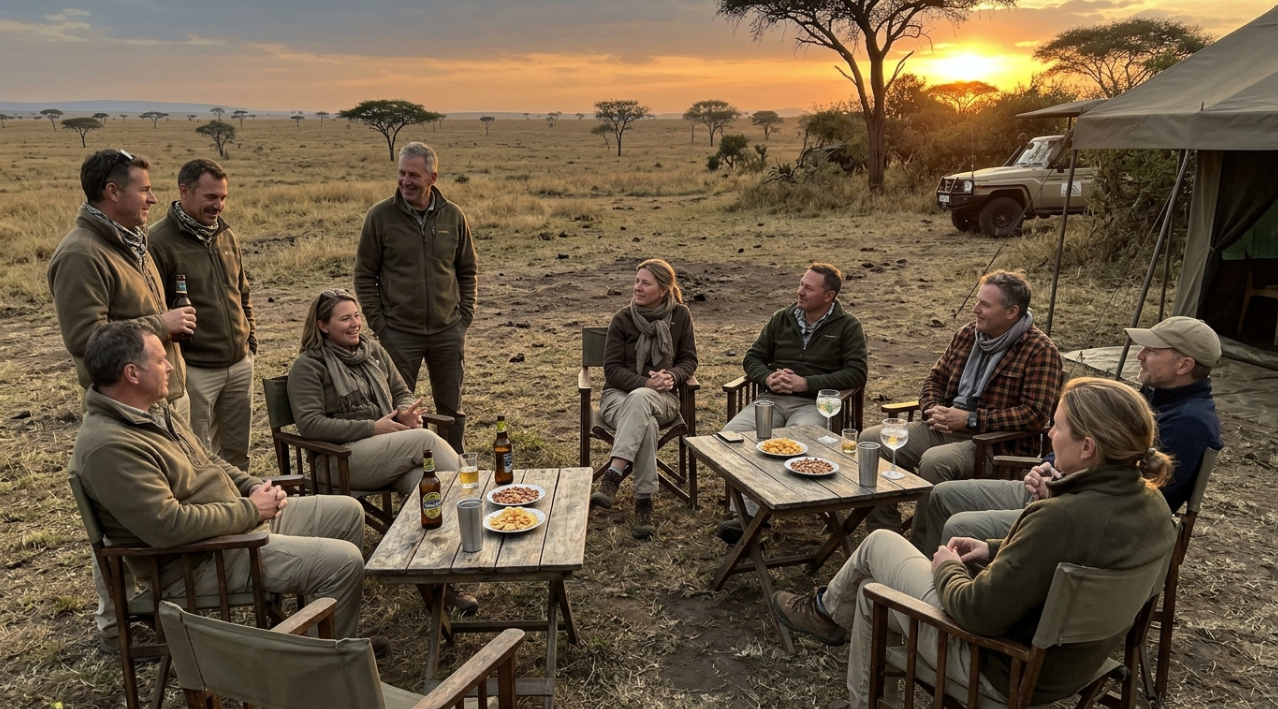
An evening drinks stop at a scenic viewpoint, common at camps in concession areas. Some properties can arrange group sundowners with bush-bar setups for a party of 10, complete with appetizers and a campfire. It’s one of the most memorable communal moments on a group safari.
Frequently Asked Questions
How many vehicles does a group of 10 need for a Tanzania safari?
Two vehicles minimum, three for optimal comfort. Two vehicles means 5 passengers each, with compromised window access and photography angles. Three vehicles (splits of 4-3-3 or 4-4-2) gives everyone a window seat and allows each car to pursue different sightings. The 4-per-vehicle rule used by experienced operators recommends starting with three.
Is a group-joining safari possible for 10 people?
Not practically. Joining safaris use shared vehicles seating 4-6 passengers. Ten people would need to be split across at least two vehicles with strangers, which defeats the purpose of traveling together. A private safari for 10 people often costs the same per person as a joining safari because you’re sharing vehicle and guide costs within your own group.
How much does a 10-person Tanzania safari cost in total?
For a 7-day mid-range Northern Circuit (Tarangire, Serengeti, Ngorongoro), expect $2,200-$4,000 per person, or $22,000-$40,000 for the group. This typically includes accommodation, meals, private vehicles with guides, and park fees. Not included: international flights, Tanzania e-visa ($50 per person), tips ($1,400-$2,100 total for the group over 7 days), travel insurance, and optional activities.
Can 10 people get exclusive use of a lodge or camp?
Yes, and this is one of the best options at this group size. Many intimate tented camps have 8-12 rooms, making a group of 10 (needing roughly 5 rooms) eligible for exclusive-use arrangements at smaller properties. Some require filling all rooms; others offer buyout options at a set minimum spend. Book early, as exclusive-use dates are limited.
How far in advance should a group of 10 book a Tanzania safari?
Nine to twelve months minimum for peak season (July-October, December-February). If you’re targeting an exclusive-use property or traveling during the Great Migration, 12-18 months is safer. Off-peak travel allows slightly shorter lead times, but coordinating 5+ rooms across multiple destinations always takes longer than booking for two.
How are tips handled for a group of 10?
Most groups designate one person to collect and distribute tips. At $20-$30 per person per day across guides and camp staff, a 7-day trip generates $1,400-$2,100 in total tips. Pooling this amount and presenting it in envelopes at the end of each camp stay is cleaner than having 10 people individually tipping different amounts.
What information should the trip organizer collect before requesting quotes?
Travel dates (or a range), number of adults and children with ages, room configuration preferences, approximate per-person budget, accommodation style preference (lodge vs. tented camp), any must-do activities (balloon safari, walking safari), mobility considerations, and whether the group wants a Zanzibar extension. The more specific the brief, the more accurate and useful the first itinerary proposal will be.
Planning a safari for 10 people in Tanzania involves more moving parts than a trip for two, but the payoff is real: lower per-person costs, the possibility of exclusive-use camps, and shared experiences that individual travel can’t replicate. The key decisions (2 vs. 3 vehicles, accommodation style, budget alignment) are best made early and with an operator who handles this group size regularly.
Duma Explorer designs private Tanzania safaris for groups of this size with owner-led trip planning, dedicated vehicles with trained guides, and direct coordination through their local operations team.