

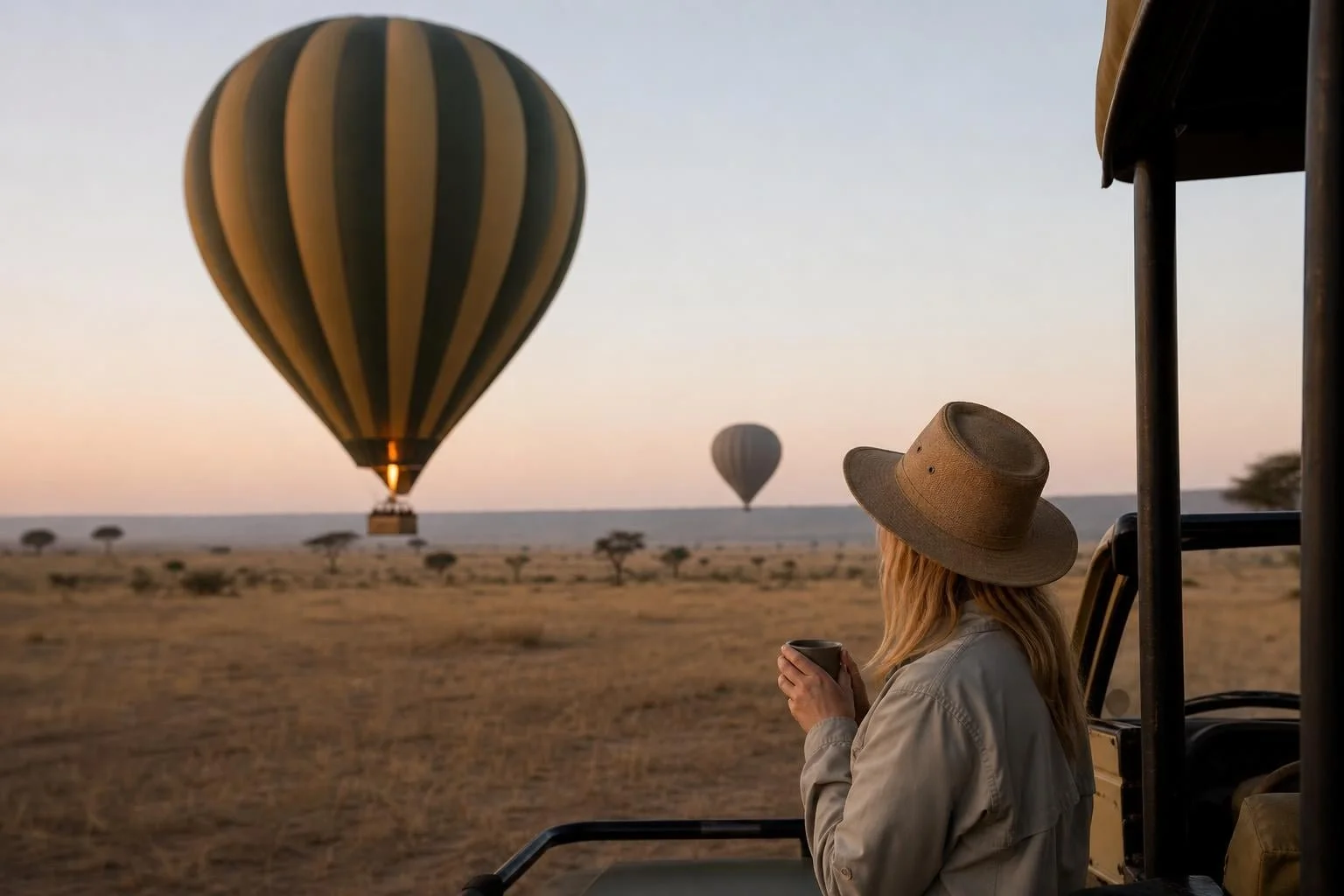
A Serengeti balloon safari costs $599 per person in 2026 for a shared flight, confirmed by both licensed operators (Serengeti Balloon Safaris and Miracle Experience). That price rises to $660 per person from January 2027, a 10% increase. The fee covers your pre-dawn transfer, a one-hour sunrise flight, champagne bush breakfast on landing, flight certificate, and return to your camp. It does not cover tips, park entry fees, or professional photos. This guide breaks down every cost, explains what drives the price, and helps you decide whether a balloon ride belongs in your safari budget.
Quick Cost Summary
| Item | 2026 Cost | 2027 Cost |
|---|---|---|
| Shared balloon flight (per person) | $599 | $660 |
| Couple (two seats, shared balloon) | $1,198 | $1,320 |
| Private charter (small group) | ~$1,200+/person | Confirm with operator |
| Private balloon (up to 4 guests) | ~$4,800/balloon | Confirm with operator |
| Tips for pilot and ground crew | $10–$20/person | $10–$20/person |
| Professional balloon photos | Purchased separately | Purchased separately |
How Much Does a Serengeti Balloon Safari Cost in 2026?
The standard rack rate is $599 per person for a shared flight. Both licensed Serengeti operators, Serengeti Balloon Safaris and Miracle Experience, publish this same price. You will find some websites quoting a range of $550 to $650, but those variations typically reflect third-party booking markups or outdated information. The price at the source is $599.
For a couple, that means roughly $1,200 before tips. For a family of four (with children old enough to fly), you are looking at $2,400.
Here is the number that matters for trip budgeting: a typical multi-day luxury Tanzania safari runs $5,000 to $8,000 per person. At $599, the balloon adds 8 to 12 percent to your total trip cost. That framing helps more than staring at the number in isolation.
Starting in January 2027, Serengeti Balloon Safaris has confirmed the price increases to $660 per person. The same operator’s Tarangire and Ruaha balloon flights will stay at $599 for 2027.
One TripAdvisor forum user reported getting a discounted rate by booking through their tour operator upfront: “Our TO was doing a discounted price if we booked it up front ($450) so might be worth asking about.” This is not guaranteed, but some safari operators absorb margin or negotiate volume rates, so it is worth raising the question when you are building your itinerary.
What Is Included in the $599 Price
The balloon safari is a packaged experience with several components built into the flat rate:
- Pre-dawn transfer: A vehicle collects you from your Serengeti lodge or camp around 4:30–5:00 AM and drives you to the launch site.
- Pre-flight safety briefing: The pilot walks passengers through positioning, landing posture, and what to expect.
- One-hour sunrise balloon flight: The balloon lifts off around 6:00 AM and drifts across the Serengeti plains for approximately 60 minutes.
- Champagne bush breakfast: After landing, the ground crew sets up a full hot breakfast in the bush, complete with sparkling wine. This is not a quick snack. Travelers consistently describe it as one of the most memorable meals of their trip.
- Flight certificate: A signed certificate commemorating the flight.
- Return transfer: A vehicle takes you back to your camp or lodge.
- TANAPA ballooning concession fee: The Tanzania National Parks Authority charges a per-passenger fee (approximately $40–$50) that is already baked into your $599.
You do not need to bring anything except a camera and a warm layer.
Costs Not Included (the Hidden Extras)
Several costs sit outside the $599:
Tips for the pilot and ground crew. The standard suggestion is $10 to $20 per person. Bring cash, since there is no card reader waiting at breakfast in the bush. For more context on safari tipping norms in Tanzania, Duma Explorer has a separate guide.
Serengeti park entry fees. The daily Serengeti park fee runs $82.60 per person per 24-hour period. This is charged whether or not you fly in a balloon and is typically already included in your safari package.
Professional balloon photos. Some operators have photographers who capture images during the flight and at the bush breakfast. You can buy prints or digital files afterward, but they are not included.
Your safari vehicle and guide. The balloon experience replaces a morning game drive. Your private safari guide and vehicle are part of your broader safari package, not the balloon operator’s responsibility. When you return from the balloon, your guide will typically pick you up for an afternoon game drive.
Why Does a Serengeti Balloon Safari Cost So Much?
Six hundred dollars for one hour of flight time raises fair questions. The pricing reflects real operational costs, not arbitrary markups.
Equipment replacement. Each hot air balloon costs over $100,000 and is retired after only about 950 flight hours to maintain safety standards. That is not a vehicle you amortize over decades.
Staffing. Each flight requires a licensed pilot plus a ground crew of roughly 20 people: the chase vehicles, the breakfast setup team, the inflation crew, and the support staff. All of this happens before sunrise in a remote national park.
Park concession fees. TANAPA charges a per-passenger ballooning operation fee (reported at $40 to $50 depending on the source, potentially varying pre- and post-VAT). On top of that, operators pay 18% VAT on all revenue.
Limited competition. The Serengeti operates on a concession model. Only two licensed operators (Serengeti Balloon Safaris, which has held the concession since 1990, and Miracle Experience) run flights. With no open marketplace of a dozen competitors, the concession holders set pricing.
Remote logistics. Setting up a full bush breakfast with hot food, silverware, and champagne in the middle of the Serengeti every morning is not simple catering. Everything must be transported, prepared, and cleaned up without leaving a trace.
The result is an experience that costs roughly $10 per minute of flight time. Whether that exchange is worth it depends on what you value. More on that below.
Private Balloon Safari Cost
If the idea of sharing a basket with 15 strangers does not appeal, private charters exist but at a steep premium.
| Private Option | Approximate Cost |
|---|---|
| Small group private charter | ~$1,200+ per person (minimum group required) |
| Exclusive balloon for up to 4 guests | ~$4,800 per balloon |
| Exclusive balloon for up to 8 guests | ~$5,500 per balloon |
| Private couples flight | ~$4,800 per person (some operators) |
Private balloon pricing is inconsistent across sources and varies by operator, season, and availability. Treat these figures as starting points and confirm directly when booking.
Private flights suit honeymooners, anniversary travelers, families who want the basket to themselves, or photographers who need unobstructed angles. If you are planning a safari proposal in Tanzania, a private sunrise balloon flight over the Serengeti is hard to top as a setting.
Launch Sites and Seasonal Pricing
The Serengeti balloon safari costs the same $599 regardless of which launch site you fly from. But the value of that flight changes dramatically based on what is on the ground below you.
| Season | Launch Site | What You Will See |
|---|---|---|
| Year-round | Central Serengeti (Seronera) | Resident predators, hippo pools, year-round plains game |
| Late Dec – Mid Mar | Ndutu / Southern Serengeti | Wildebeest calving herds, concentrated predators hunting newborns |
| Jun – Oct | Western Corridor (Kirawira) | Migration columns moving through, possible river crossings |
| Jul – Oct/Nov | Northern Serengeti (Kogatende) | Mara River crossings, peak migration drama |
The critical planning insight most cost guides miss: a balloon safari booked during peak migration season without confirming that your camp is near the active launch site risks a beautiful flight over empty grassland. As one experienced safari planner noted, the price is the same whether you are drifting over 100,000 wildebeest or a quiet stretch of savanna. The difference is entirely in camp placement and timing.
This is where working with an operator who designs itineraries around migration patterns pays for itself. If you want the balloon built into a fly-in Serengeti safari, Duma Explorer can coordinate camp selection near the active launch site for your specific travel dates.
For travelers considering their best timing for a Tanzania honeymoon, the February calving season at Ndutu is worth special attention. Balloon flights over the southern plains during calving offer huge herds, golden morning light, and far fewer fellow tourists than the July–October crossings.
Serengeti vs. Masai Mara Balloon Cost
Travelers choosing between Tanzania and Kenya often compare balloon pricing across both parks.
| Factor | Serengeti | Masai Mara |
|---|---|---|
| Shared balloon cost | $599 (2026) | $450–$550 |
| Price difference | ~$100 more | ~$100 less |
| Park size | 14,750 km² | 1,510 km² |
| Licensed operators | 2 | 5+ |
| Availability pressure | Book weeks ahead for Jul–Oct | Easier to book on shorter notice |
| Ecosystem scale | Vast, varied terrain | Smaller but wildlife-dense |
The Serengeti balloon safari costs roughly $100 more than the Mara equivalent. Three factors explain the gap: higher TANAPA fees in Tanzania compared to Kenya’s park authority, larger ecosystem logistics requiring longer support drives, and Kenya’s more competitive operator market pushing prices down.
That said, the Serengeti’s sheer scale creates a different flying experience. As one traveler in a Fodor’s forum put it years ago: “You never truly understand the vastness of the national park until you see it from the air.”
Who Can (and Cannot) Fly
Before you budget for the balloon, confirm everyone in your group is eligible.
- Minimum age: 7 years old. Children under 7 are not permitted regardless of height or maturity. If you are traveling with younger kids, see the guide to kid-friendly Serengeti camps for alternative morning activities while the rest of the group flies.
- Weight limit: 120 kg (265 lbs) per person. Passengers exceeding this limit may need to reserve (and pay for) two places in the basket.
- Health restrictions: Balloon flights are not suitable for pregnant women, travelers with limited mobility, or those with certain health conditions. The landing can be bumpy, and passengers must be able to stand for the entire flight and brace in a crouching position on touchdown.
- Basket capacity: Each balloon carries 12 to 16 passengers in a shared flight. The basket is divided into compartments, so you will have your own section.
For families planning a Tanzania safari budget, the balloon for two adults and two teenagers adds $2,400 to the trip total. That is a significant line item and worth discussing with your operator before confirming.
Booking Tips from Travelers Who Have Done It
Practitioners on travel forums and review sites consistently share these lessons:
Book when you book the itinerary, not after you land. Demand spikes hard during the wildebeest migration months. Balloon slots for July through October can sell out weeks in advance. Trying to book after arrival in Tanzania is risky during peak season.
Book through your safari operator. Your tour operator handles the logistics of coordinating the balloon pickup with your camp location and game drive schedule. Booking direct creates coordination headaches that your operator is better positioned to manage.
Bring cash for tips. The ground crew and pilot do not have a card machine at the bush breakfast. $10 to $20 per person is the standard suggestion.
Dress warmly for the pre-dawn transfer. The 4:30 AM pickup happens in darkness. Early morning on the Serengeti plains can be surprisingly cold. Bring a fleece or light jacket. Once the burner fires up, you will warm quickly, but the drive to the launch site is chilly.
Understand the cancellation policy. If the flight is cancelled because of wind or weather, you will be rebooked on a later flight (if your itinerary allows) or receive a full refund. This is standard across operators. Balloon flights depend entirely on calm morning conditions, and cancellations, while uncommon, do happen.
Is a Serengeti Balloon Safari Worth $599?
The TripAdvisor community offers a balanced verdict. As one frequent contributor summarized: “The overwhelming majority of people who go hot air ballooning in the Serengeti love the experience and are very glad they did it.” Another added more nuance: “Consider for yourself that it’s a nice experience but not always AMAZING. That it might be your only chance.”
The consensus across forums is straightforward: nobody regrets doing it, and nobody regrets skipping it either.
The balloon is worth it if:
- This is a once-in-a-lifetime safari and you want the full range of experiences
- You are celebrating something (honeymoon, anniversary, milestone birthday). One TripAdvisor poster booked it for twin daughters who had just finished exams: “It is a lot of money, but I think it was worth it. Gave them a memory to cherish.”
- You are a photographer who wants aerial perspectives of the Serengeti
- Your flight coincides with the migration at the right launch site
- $599 represents a small fraction (under 10%) of your overall trip budget
You can skip it if:
- Your budget is tight and you would rather add an extra game drive day or upgrade your camp
- Your Serengeti stay is only one or two nights (the early morning commitment displaces a morning game drive)
- You have already done balloon safaris elsewhere
The reframe that matters: on a luxury safari itinerary in Tanzania costing $6,000 to $8,000 per person, the balloon is about 8 to 10 percent of the total. For one of the most photographed and talked-about moments of the trip, that is a reasonable allocation for most travelers in this budget range.
Duma Explorer designs Serengeti itineraries that position you at the right camp for the right launch site on the right dates. If you want the balloon woven into a broader private safari, Duma Explorer can coordinate the booking as part of your custom itinerary, including migration-matched camp selection.
Plan My Serengeti Balloon Safari Itinerary
Frequently Asked Questions
How far in advance should I book a Serengeti balloon safari?
Book when you finalize your safari itinerary, ideally three to six months before travel for July through October dates. Outside peak migration season, two to four weeks is usually sufficient, but earlier is always safer.
Can children go on a Serengeti balloon flight?
Children must be at least 7 years old. There is no discounted child rate. Younger children will need to stay at camp with a guide or staff while the rest of the group flies.
What happens if weather cancels the flight?
You receive either a rescheduled flight (if your itinerary has another available morning) or a full refund. The pilot makes the call based on wind conditions, and safety is not negotiable.
Do I need to tip the balloon pilot and crew?
Tipping is not mandatory but is customary. The standard suggestion is $10 to $20 per person, paid in cash after the bush breakfast.
Is the Serengeti balloon more expensive than the Masai Mara?
Yes, by about $100 per person. The Serengeti shared flight costs $599 versus $450 to $550 in the Mara. Higher Tanzanian park concession fees and fewer competing operators account for the difference.
How does the balloon fit into a safari itinerary?
The balloon replaces your morning game drive on one day. You leave camp around 4:30 AM, fly at sunrise, eat breakfast in the bush, and return to camp by late morning. Your guide picks you up for an afternoon game drive as normal. Most travelers schedule it for a day when they have two or more nights at the same Serengeti camp.
Will the price increase in 2027?
Yes. Serengeti Balloon Safaris has confirmed the price rises to $660 per person starting January 1, 2027. If you are booking a 2027 trip and want to lock in planning, factor in the higher rate.