Zanzibar Family Travel: 2026 A–Z Glossary for Parents
TL;DR
Zanzibar works well for families, but it’s not a standard beach destination. Tides can pull the ocean over a kilometer from shore on the east coast, mandatory government insurance kicked in October 2024, and malaria prophylaxis still matters for kids. This glossary covers every term parents need to understand, from which coast to pick to what reef shoes are for, so you can plan with confidence instead of guesswork.
Planning Zanzibar family travel means learning a vocabulary you probably don’t encounter at other beach destinations. Tidal cycles that empty entire coastlines. A brand-new insurance mandate. Cultural dress codes. Swahili phrases your kids will actually use. These aren’t obstacles, they’re the things that make Zanzibar different from Cancún or Bali, and the things that trip up families who don’t know about them ahead of time.
This glossary exists to close that gap. It covers the terms, places, and concepts specific to traveling in Zanzibar with children, organized alphabetically so you can scan it quickly or bookmark it for later reference. Whether you’re combining Zanzibar with a Tanzania family safari or flying direct for a beach week, these definitions will sharpen your planning.
Zanzibar is an archipelago off the coast of mainland Tanzania. The main island is called Unguja, and that’s where nearly all family tourism happens. It’s predominantly Muslim, culturally Swahili, and shaped by African, Arab, and Indian influences. Understanding even a handful of its unique terms makes the difference between a frustrating trip and a great one.
Zanzibar Family Travel: Quick Answer for Parents
Zanzibar is one of the best beach destinations in East Africa for families, especially when paired with a Tanzania safari. The best beaches for kids are Nungwi and Kendwa on the north coast because tides are minimal and swimming is possible all day.
Families should know four things before booking:
- East coast beaches experience dramatic tides that can move the ocean over a kilometer away at low tide - Zanzibar requires mandatory ZIC travel insurance for foreign visitors - Most doctors still recommend malaria prophylaxis for children - Stone Town is culturally conservative, so modest clothing matters outside resorts
For most families, the ideal Zanzibar itinerary is:
|
Family Type |
Recommended Stay |
|---|---|
|
Zanzibar only |
5–7 days |
|
Safari + Zanzibar combo |
10–14 days |
|
Families with toddlers |
North coast only |
|
Families with teens |
North or east coast |
The best time for Zanzibar family travel is June through October, followed by December through February.
A
Abeid Amani Karume International Airport (ZNZ)
The main airport on Unguja island, located just south of Zanzibar City. Domestic flights connect here from Arusha, Dar es Salaam, and the Serengeti, making it the arrival point for families combining a mainland safari with beach time. The terminal is small and straightforward. Immigration lines can be slow during peak season (July through September), so budget extra time if traveling with restless kids.
Age Brackets (What Works When)
Most Zanzibar guides say the island is “great for all ages” and leave it there. That’s not helpful. Here’s a more honest breakdown:
Ages 0 to 2: Zanzibar is doable but not ideal. The malaria risk, while below 1%, still exists, and some travel health specialists (including Expert Africa) actively discourage Zanzibar holidays with toddlers for this reason. If you go, stick to the north coast where swimming is reliable and mosquito nets are standard at resorts.
Ages 3 to 5: Beaches, tortoises, and monkeys are the sweet spot. Short attention spans mean half-day activities (spice tours, Prison Island) work better than full-day excursions. Carriers beat strollers everywhere on this island.
Ages 6 to 10: The best age range for Zanzibar. Kids this age can snorkel at Mnemba Atoll, handle a dhow cruise without getting seasick, and actually absorb a spice tour. Plan 10 to 14 days if pairing with a safari.
Ages 11 and up: Teenagers get more from diving courses, kitesurfing lessons on the east coast, and the independence of exploring Stone Town’s alleys. Longer stays of two to three weeks work well.
B
Bush-to-Beach
The most common travel pattern for families visiting East Africa: do a mainland safari first, then fly to Zanzibar to decompress. Most families spend five to six nights on safari (typically the Serengeti and Ngorongoro Crater) followed by four to five beach nights. The pace works because wild, early-morning game drives are exhausting for kids, and Zanzibar provides the reset everyone needs.
For families considering a broader trip that combines multiple East Africa experiences, the bush-to-beach structure is the foundation most itineraries build on. A well-paced family trip usually runs 10 to 12 days total.
C
Changuu Island (Prison Island)
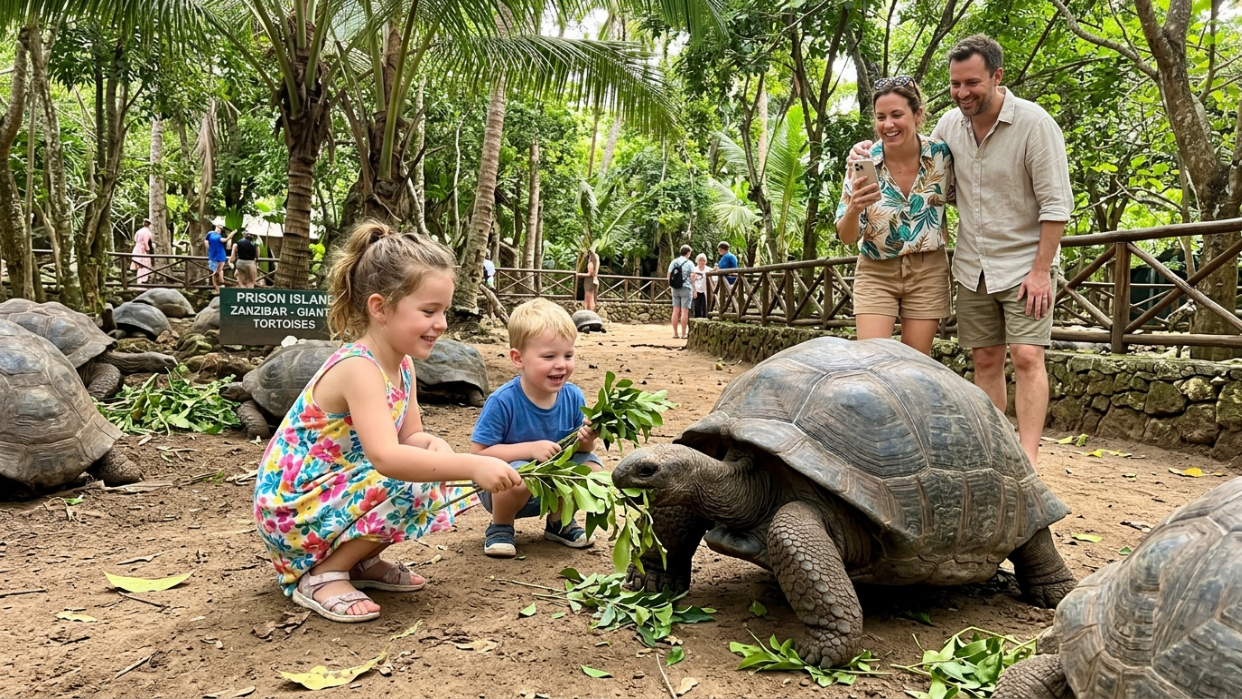
A small island roughly 20 minutes by boat from Stone Town. The main draw for families is the colony of Aldabra giant tortoises, some over 100 years old. Kids can feed and touch them under supervision. The surrounding waters are calm enough for short swims and easy snorkeling. It’s a half-day trip and one of the most reliable family activities on the island regardless of your children’s ages.
Chumbe Island Coral Park
A UNESCO-recognized marine sanctuary off Zanzibar’s southwest coast. The coral reef here is pristine, but the experience skews older: snorkeling is the primary activity, and the island limits visitor numbers. Best suited for families with children aged 8 and up who are comfortable swimmers. Younger kids may find it boring, and there’s limited shade or play space on shore.
D
Daladala
Zanzibar’s shared minibus system. Daladalas are the cheapest way to get around the island, but they’re crowded, lack child safety features, and run on unpredictable schedules. Practitioners on Reddit’s r/zanzibar community frequently confirm that these buses are impractical with small children. Taxis or pre-arranged private transfers are the better choice for families. Your hotel or tour operator can arrange these.
Dhow
A traditional wooden sailing vessel with a triangular sail. Sunset dhow cruises are a popular family activity, usually departing from Nungwi or Stone Town. The boats are beautiful but basic. Always confirm that life jackets are available for children before boarding. Some operators provide them automatically; others don’t carry child-sized ones at all.
Dry Season
Zanzibar has two dry windows: June through October (cooler temperatures, calm seas) and December through February (hotter, still mostly sunny). Both are good for families. The June-to-October window is often considered best for active kids because the cooler weather makes outdoor activities more comfortable. For detailed month-by-month conditions, the Zanzibar timing guide breaks this down further.
E
East Coast (Matemwe, Pongwe, Paje, Jambiani)
The east coast of Unguja sits on a very shallow, flat continental shelf. This means even a small vertical drop in the ocean’s height causes the water to retreat horizontally across the sand for a vast distance. On beaches like Chwaka and Charave, the seabed gets exposed for as far as 1.5 to 2 kilometers from the coastline at low tide.
This is the single biggest source of frustration for families who don’t understand Zanzibar’s tidal patterns. One widely cited observation puts it bluntly: “most bad Zanzibar reviews are ‘the beach disappeared.’” But low tide on the east coast has its own appeal. Exposed sandbars and reef pools are perfect for exploring on foot, and families with young children often find them endlessly entertaining. The key is knowing what you’re signing up for.
If your kids demand swimmable water at any hour, choose the north coast instead. If you’re happy planning beach time around the tide schedule, the east coast offers quieter beaches and better value accommodations.
F
Fly-in Safari
A safari where you fly between parks on small bush planes rather than driving. For families doing the bush-to-beach combination, a fly-in safari means less time on bumpy roads and more time in game-viewing areas. From the Serengeti, a direct flight to Zanzibar takes roughly 90 minutes. This is usually the most practical connection for families with young children.
Forodhani Gardens
A waterfront park in Stone Town that transforms into an open-air night market after sunset. Vendors cook Zanzibar pizza on hot griddles, grill seafood skewers under lanterns, and press fresh sugarcane juice. It’s a sensory spectacle that kids love. Keep children close in the crowds, though, as the market gets packed and there are no guardrails near the water. For more on what to eat and where, the Zanzibar food guide covers the full range of options.
G–H
Hakuna Matata
Swahili for “no worries.” Your kids already know this from The Lion King. What they might not know is that people in Zanzibar actually say it, frequently and sincerely. It’s a useful cultural bridge for children.
Health Precautions
Three things matter most for family travelers:
Malaria prophylaxis: Zanzibar has made major progress against malaria, with rates below 1% in recent years. But most travel clinics still recommend antimalarial medication for children. Consult your pediatrician or a travel medicine specialist before departure, not after.
Vaccines: The CDC recommends being current on routine vaccinations and considering hepatitis A and typhoid shots for travelers to Zanzibar.
Medical facilities: The main hospitals are in Zanzibar Town. They can handle basic emergencies, but for anything serious, evacuation to Dar es Salaam or Nairobi may be required. This is one reason the new ZIC insurance (see below) matters. For a deeper look at Zanzibar safety considerations, including water quality and sun protection, there’s a separate guide worth reading.
J
Jozani Chwaka Bay National Park
Zanzibar’s only national park, located in the center-south of Unguja. The main attraction is the endemic red colobus monkey, a species found nowhere else on Earth. The monkeys often hang low enough on branches that children can lock eyes with them from the trail. Walking paths are short and manageable, making this suitable for families with young children. A carrier works better than a stroller here, though the main boardwalk section is flat.
The Zanzibar Butterfly Centre sits near the park entrance and makes a natural add-on. It houses dozens of colorful butterfly species and gives kids a close-up look at the lifecycle from caterpillar to adult.
K
Karibu
Swahili for “welcome.” You’ll hear it constantly, from hotel staff, shopkeepers, and strangers on the street. It’s one of several phrases worth teaching your kids before arrival (see the Swahili Phrases section below).
Kendwa Beach
A north coast beach with minimal tidal impact. Unlike many beaches in Zanzibar, Kendwa doesn’t experience extreme tides, making it safe for children to swim at any time of day. It’s quieter and more resort-oriented than neighboring Nungwi, which some families prefer. The trade-off is fewer restaurants and shops within walking distance.
Kids’ Club
On-site supervised childcare programs available at some of the larger Zanzibar resorts. These typically accept children ages 3 to 12 and run structured activities (crafts, beach games, local storytelling) for a few hours each day. They’re not available at boutique or family-run properties. Practitioners on TripAdvisor forums note this as a real planning decision: kids’ clubs offer parent downtime, while smaller properties tend to provide a more intimate, family-run atmosphere where kids interact with local staff and culture more directly.
Kizimkazi
A village on Zanzibar’s southern tip, famous for dolphin-watching boat trips. Morning departures offer the best chances of spotting bottlenose and humpback dolphins. The boat ride can be bouncy, so this works better for children aged 6 and up. Some operators allow swimming with dolphins, but the experience is unregulated, and the ethical considerations are worth discussing with older kids beforehand.
L
Long Rains (Masika)
The heavy rainy season running from March through May. Roads flood, some hotels close, and beach days are unreliable. Not recommended for family beach trips. If your travel dates fall here, consider shifting to the mainland safari portion of your trip instead, or rescheduling entirely.
M
Malaria Prophylaxis
Preventive medication taken before, during, and after travel to reduce malaria risk. Even though Zanzibar’s malaria rates are under 1%, most travel health professionals still recommend prophylaxis for children. Common options include atovaquone-proguanil (Malarone) and doxycycline, though the latter isn’t suitable for young children. Start the conversation with your doctor at least six weeks before departure.
Mnemba Atoll
A protected marine area off Zanzibar’s northeast coast. The shallow, clear waters make it one of the best snorkeling spots for families. Children aged 6 and up who are comfortable in the water can safely spot colorful fish, sea turtles, and coral without going deep. Access is by boat only. Check conditions before booking because wind and current can make the crossing rough during the short rains.
For a broader overview of Zanzibar snorkeling spots, including options for beginners and younger kids, there’s a full guide available.
Modest Dress
Zanzibar is approximately 99% Muslim. Dressing modestly, particularly covering shoulders and knees, is expected in Stone Town, villages, and cultural sites. Swimwear belongs at the beach and pool only. This applies to children too, though locals are generally understanding with very young kids. Packing a light sarong or cover-up for each family member solves most situations. The Stone Town travel guide covers cultural etiquette in more detail.
N
Neap Tide
A tide cycle that occurs around the quarter moons (first quarter and third quarter). Neap tides produce a smaller range between high and low water, which means beaches stay more usable throughout the day. If you’re staying on the east coast, timing your visit around neap tides gives your family longer swimming windows. A lunar calendar is the simplest planning tool.
North Coast (Nungwi, Kendwa)
The north coast has a steeper underwater drop-off than the rest of the island. While the tide still rises and falls, the horizontal change is minimal. You can almost always swim here regardless of the time of day. This makes the north coast the default recommendation for families who want predictable, hassle-free beach access.
Best Zanzibar Areas for Families
|
Area |
Best For |
Tide Impact |
Family Vibe |
Best Ages |
|---|---|---|---|---|
|
Nungwi |
Easy swimming |
Very low |
Lively |
All ages |
|
Kendwa |
Relaxed resorts |
Very low |
Quiet |
Toddlers + young kids |
|
Matemwe |
Snorkeling access |
High |
Peaceful |
Ages 6+ |
|
Paje |
Kitesurfing |
Very high |
Active/social |
Teens |
|
Jambiani |
Quiet beach walks |
High |
Local feel |
Ages 5+ |
|
Stone Town |
Culture/history |
None |
Urban |
Ages 8+ |
If your priority is easy beach access for young children, choose Nungwi or Kendwa. If you prefer quieter beaches and don’t mind planning around tides, the east coast offers better value and fewer crowds.
Nungwi Beach
Located at the northern tip of Unguja. Calm, shallow areas make it safe for small children. Unlike other beaches on the island, Nungwi is less affected by tides, allowing families to enjoy swimming throughout the day. It’s the busiest beach area in Zanzibar, with restaurants, shops, and resort infrastructure clustered nearby. More lively than Kendwa, which sits just to its south.
R
Red Colobus Monkey
An endemic primate found only in Zanzibar’s Jozani Forest. Their rust-colored fur and expressive faces make them a highlight for children. They often come close to the walking trails, sometimes within arm’s reach. Guides will remind your family not to touch them (they can carry diseases transmissible to humans), but the proximity alone makes this one of the most memorable wildlife encounters on the island.
Reef Shoes (Water Shoes)
Closed-toe water shoes that protect feet from sea urchin spines, coral fragments, and sharp rocks. These are essential for children on the east coast’s tidal flats. Pack them from home because quality options are limited on the island. The Zanzibar packing list covers other items families should bring.
S
Semi-Diurnal Tide
The tidal pattern in Zanzibar. It means there are two high tides and two low tides every 24 hours, roughly six hours apart. On the east coast, this cycle can shift the shoreline by hundreds of meters. Understanding this pattern is the single most useful piece of beach-planning knowledge for Zanzibar family travel. Check your hotel’s tide chart (most display one in the lobby) to plan swimming and beach time each day.
Short Rains (Vuli)
A period of brief afternoon showers running from November through December. Travel is possible during this window, and hotel rates are often lower. Expect occasional disruptions to beach plans, but mornings are usually clear.
Spice Tour
A guided visit to a working spice farm, usually lasting half a day. Kids chew sugarcane, smell cinnamon bark, and wear crowns woven from palm leaves. Cloves taste sharp like toothpaste, nutmeg smells like Christmas, and turmeric stains little fingers bright yellow. It’s tactile, interactive, and works for ages 3 and up.
Spring Tide
The opposite of a neap tide. Spring tides occur around full and new moons and bring the biggest range between high and low water. On the east coast, this means the most dramatic water retreat. If you’re staying in Paje or Jambiani, check the lunar calendar and plan accordingly. Spring tides create the most impressive reef walks but also the longest waits for swimmable water.
Stone Town
The UNESCO World Heritage historic core of Zanzibar City, on the island’s west coast. Narrow alleys, carved wooden doors, spice markets, and centuries of layered architecture. Strollers are completely impractical here (cobblestones, stairs, tight passages), so bring a carrier for young children. A morning walking tour followed by lunch and Forodhani Gardens in the evening makes a solid family day.
Swahili Phrases for Families
A handful of Swahili words go a long way in Zanzibar, and kids pick them up fast:
-
Jambo — Hello
-
Karibu — Welcome
-
Asante sana — Thank you very much
-
Rafiki — Friend
-
Hakuna matata — No worries
-
Pole pole — Slowly, slowly (you’ll hear this on every nature walk)
Teaching these to children before arrival creates immediate connection with locals and gives kids a sense of participation in the culture around them.
T
Taarab
Traditional Swahili music that blends African, Arab, and Indian influences. Older kids may encounter it at Stone Town cultural events or hotel performances. It’s an acquired taste, but the instruments (oud, violin, qanun) are visually interesting, and some performances include dancing.
Tidal Literacy: Why It Matters for Families
This isn’t a single glossary term, but it’s the most important concept in this entire guide. Zanzibar’s tidal behavior is the number one source of bad reviews and trip disappointment, and it’s almost entirely avoidable with basic knowledge.
Here’s what you need to know: Zanzibar experiences semi-diurnal tides (two highs and two lows daily). On the north coast, the water stays close to shore throughout the cycle. On the east coast, the water can retreat over a kilometer. Spring tides (full and new moons) amplify this effect. Neap tides (quarter moons) reduce it.
One source puts it simply: “If you’re traveling with kids who demand the sea now, choose north.” If you’re flexible, the east coast’s exposed sandbars and tidal pools offer a different kind of magic. Either way, understanding tides before you book your hotel is the single biggest factor in Zanzibar family travel satisfaction.
Z
Zanzibar Insurance Corporation (ZIC)
Since October 1, 2024, all foreign non-residents traveling to Zanzibar must purchase mandatory inbound travel insurance from the Zanzibar Insurance Corporation before arrival. This is required regardless of any other travel insurance you carry.
Pricing:
-
Adults: $44 USD
-
Children ages 3 to 17: $22 USD (50% discount)
-
Children under 3: Free
-
A family package is available
Coverage: Emergency medical treatment up to $50,000 USD. Validity up to 92 days.
Practical note: Multiple travelers on Reddit have reported the online portal being unreliable, with one user stating “the site to do it online is not working, I’ve been trying to submit application for 2 days now.” Apply well in advance, not the night before departure. If the portal fails, some travelers have completed the purchase on arrival, but this adds unpredictable time to an already slow immigration process.
This cost should be factored into your trip budget. For a full breakdown of what a Zanzibar trip costs, the Zanzibar budget guide includes fees, accommodation ranges, and activity pricing.
Zanzibar Pizza
A street-food specialty found at Forodhani Gardens and night markets across the island. Thin dough is filled with combinations of meat, egg, cheese, vegetables, or Nutella, then folded and cooked on a hot griddle. It’s closer to a stuffed crepe than an Italian pizza. The Nutella-banana version is a guaranteed kid favorite.
Quick-Reference: What to Pack for Kids in Zanzibar
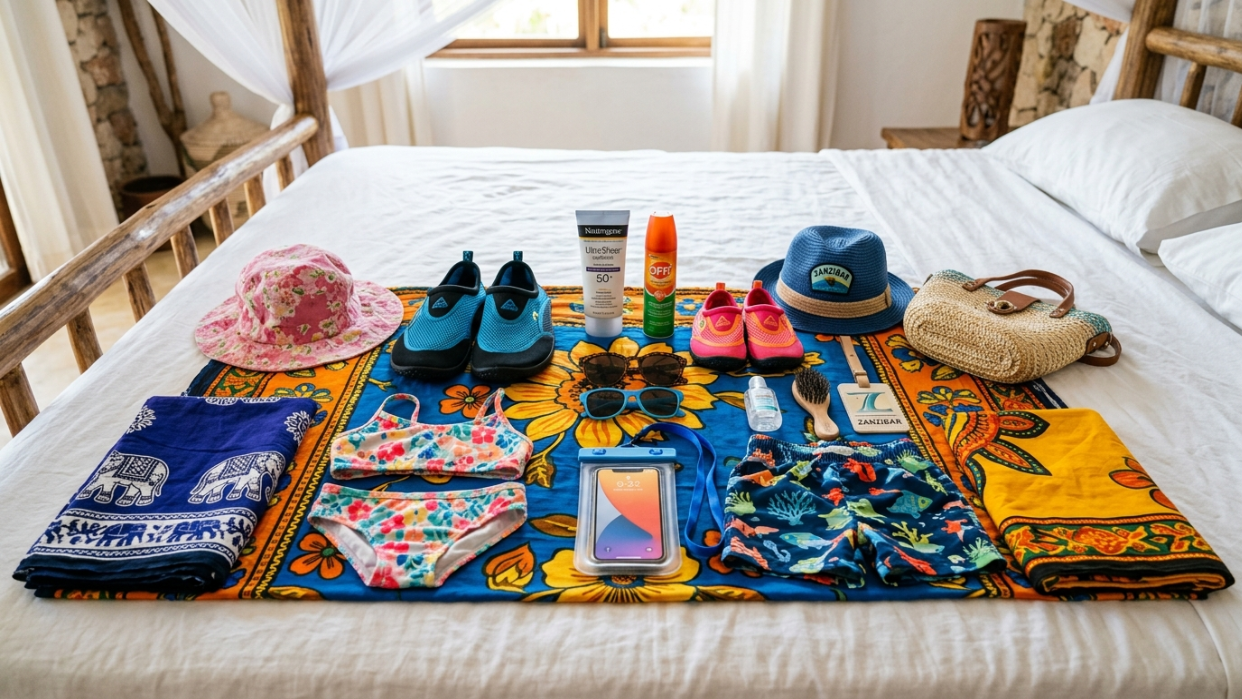
-
Reef shoes (essential for east coast beaches)
-
Child-safe insect repellent with DEET or picaridin
-
Reef-safe sunscreen (SPF 50+)
-
A baby carrier or sling (not a stroller)
-
Light long-sleeve shirts and pants for evenings and mosque visits
-
A sarong or cover-up for each family member
-
Malaria prophylaxis (prescribed by your doctor)
-
A waterproof phone case for boat trips
Sample Zanzibar Family Itineraries
5-Day Zanzibar Family Trip
-
Day 1: Arrive and relax at north coast resort
-
Day 2: Beach day + sunset dhow cruise
-
Day 3: Jozani Forest + spice tour
-
Day 4: Prison Island + Stone Town
-
Day 5: Departure
10-Day Safari + Zanzibar Family Trip
-
Days 1–5: Tanzania safari (Serengeti + Ngorongoro)
-
Day 6: Fly to Zanzibar
-
Days 7–9: Beach stay in Nungwi or Kendwa
-
Day 10: Stone Town + departure
Zanzibar With Toddlers
Families with children under 5 usually have the smoothest experience staying entirely on the north coast and limiting activities to half-day excursions.
Frequently Asked Questions
Is Zanzibar safe for families with young children?
Zanzibar is one of East Africa’s safest and most culturally welcoming destinations for families. Crime against tourists is rare, particularly in resort areas. The main risks are health-related (malaria, sun exposure, waterborne illness) rather than security-related. A Zanzibar-based mom blogger described the island as feeling like “a village that helps raise your child,” noting she felt supported and never unsafe even when traveling solo with kids.
Which Zanzibar beach is best for families?
Nungwi and Kendwa on the north coast. Both have minimal tidal variation, meaning children can swim at virtually any time of day. The east coast beaches (Paje, Matemwe, Jambiani) are beautiful but experience dramatic tidal shifts that can leave the water over a kilometer from shore at low tide. Choose the north coast if predictable swimming matters to your family.
What is the best time of year for Zanzibar family travel?
June through October offers the best combination of dry weather, calm seas, and cooler temperatures. December through February is the second-best window (hotter, but still mostly dry). Avoid March through May, when heavy rains make beach days unreliable and some hotels close entirely.
Do I need the ZIC insurance for my children?
Yes. All foreign visitors to Zanzibar need ZIC insurance as of October 2024. Children aged 3 to 17 receive a 50% discount ($22 instead of $44). Children under 3 are exempt. The insurance is mandatory regardless of any other travel insurance policies you hold.
Can I use a stroller in Zanzibar?
In resort areas and on flat beaches, a lightweight stroller works. In Stone Town, it’s useless. The narrow alleys, cobblestones, and constant stairs make wheeled anything a liability. A baby carrier or sling is the practical choice for sightseeing, nature walks, and market visits.
How do I combine a safari with Zanzibar for a family trip?
The standard approach is to fly from a mainland safari destination (usually the Serengeti or Arusha) to Zanzibar. Most families spend five to six nights on safari followed by four to five beach nights, for a total trip length of 10 to 12 days. Safari first, beach second works better than the reverse because the transition from high-energy game drives to slow beach days feels natural.
If you’re planning both legs, the safari-or-beach comparison guide helps clarify how to split your time.
What activities work for children under 6 in Zanzibar?
Prison Island (giant tortoises), Jozani Forest (red colobus monkeys), spice farm tours, and beach time on the north coast are the core activities for younger children. Keep excursions to half-day lengths. Dhow cruises and snorkeling work better for ages 6 and up.
Is malaria a serious risk in Zanzibar?
Zanzibar’s malaria prevalence has dropped below 1%, which is a significant improvement from a decade ago. However, most travel medicine clinics still recommend prophylaxis for children visiting the island. The risk is low but not zero, and the consequences of malaria in young children can be severe. Talk to your pediatrician.
Planning a family trip that combines Tanzania’s wildlife with Zanzibar’s coast? Explore East Africa safari itineraries to see how the pieces fit together, or start with the Tanzania family safari guide for park-by-park recommendations designed around traveling with kids.