Is Zanzibar Safe in 2026? Crime, Health & the US Advisory
TL;DR
Is Zanzibar Safe to Visit in 2026?
Yes, Zanzibar is considered safe for the vast majority of travelers. While the US State Department issued a Level 3 advisory for Tanzania in late 2025 due to mainland unrest, the Zanzibar archipelago remains stable and peaceful. Most visits are trouble-free, provided travelers take standard precautions against petty theft, use malaria prophylaxis, and respect local Islamic customs regarding dress and behavior. The most common "safety" issues are non-violent, such as persistent beach vendors or sea urchin stings.
Zanzibar is broadly safe for tourists, with over 736,000 visitors in 2024 and numbers approaching one million in 2025. The biggest risks are petty crime, beach vendor pressure, and preventable health issues like malaria, not violent crime. The US Level 3 advisory covers all of Tanzania and was triggered by mainland unrest, not events on the islands. This glossary breaks down every safety-related term you will encounter while planning your trip, from advisory levels to sea urchins.
Zanzibar welcomed 736,755 tourists in 2024, a 15.4% jump from the year before. By September 2025, monthly arrivals had surged to 84,154, putting the archipelago on track for roughly one million visitors for the year. Those numbers don’t suggest a dangerous destination. They suggest a popular one getting more popular.
Still, “Zanzibar safety” is one of the first things travelers search when they start planning, and that makes sense. The October 2025 US advisory upgrade rattled a lot of people. Malaria is real. The cultural context is different from what most Western visitors know. And scam reports from forums can make any destination sound sketchy when you read enough of them.
This glossary cuts through the noise. It organizes every safety-related term, concept, and risk factor into scannable categories so you can find exactly what applies to your trip. Each entry gives you a plain definition, the Zanzibar-specific context, and a practical tip.
Planning safari plus Zanzibar? We’ll handle airport transfers and the $44 insurance so you are not figuring it out on arrival.
See Tanzania safari itineraries →
Travel Advisory Terms
Travel Advisory Level (US State Department)
The US government rates countries on a four-tier scale: Level 1 (Exercise Normal Precautions), Level 2 (Exercise Increased Caution), Level 3 (Reconsider Travel), and Level 4 (Do Not Travel). On October 31, 2025, Tanzania was upgraded to Level 3, with risk indicators for unrest, crime, terrorism, and targeting of LGBTQ+ individuals. This applies to the entire country, including Zanzibar.
Reconsider Travel (Level 3)
This is the second-most-serious US advisory level, but it does not mean “do not travel.” It means the State Department wants you to think carefully, prepare thoroughly, and register with their enrollment program. Countries like Colombia, Honduras, and Pakistan have also carried Level 3 ratings while receiving millions of tourists annually. The designation reflects worst-case risk across the whole nation, not necessarily conditions in every region.
FCDO Advice (UK Foreign, Commonwealth & Development Office)
The UK’s equivalent of a travel advisory. The FCDO currently notes risk of armed crime throughout Tanzania, with specific mention that incidents in Zanzibar have occurred in Stone Town, at hotels, and on tourist beaches. The UK system doesn’t use numbered levels; it issues narrative guidance with regional breakdowns.
Smartraveller (Australian Government)
Australia’s travel advisory platform, managed by the Department of Foreign Affairs and Trade. Its Tanzania guidance generally mirrors the UK’s, focusing on crime awareness and health precautions. Worth checking if you hold an Australian passport, since consular support details differ by nationality.
STEP (Smart Traveler Enrollment Program)
A free US government service that registers your trip with the nearest embassy or consulate. If there is a natural disaster, civil unrest, or family emergency, the embassy can locate and contact you. Takes about five minutes to complete at step.state.gov. Non-US citizens should check their own government’s equivalent registration system.
Semi-Autonomous Status (Zanzibar)
This is the single most important context for understanding Zanzibar safety advisories. Zanzibar is a semi-autonomous archipelago within Tanzania. It has its own president, its own House of Representatives, and a distinct cultural identity. The October 2025 advisory upgrade was driven primarily by mainland political unrest and crime patterns in cities like Dar es Salaam. Zanzibar remained calm and unaffected. TripAdvisor Destination Experts with thousands of posts consistently describe the islands as significantly safer than mainland urban areas. One longtime expert called it “very safe, a lot safer than, say, Cape Town.” For a deeper look at how Zanzibar differs from mainland Tanzania, the distinction matters for trip planning well beyond safety.
Global Peace Index
Published annually by the Institute for Economics and Peace, the GPI ranks 163 nations. Tanzania ranked 73rd in 2025, making it the most peaceful country in East Africa, though it dropped eight positions year-over-year.
Crime and Personal Security Terms
Petty Crime
Pickpocketing and opportunistic theft. In Zanzibar, petty crime exists but occurs at lower rates than in mainland cities or many other popular beach destinations. Keep phones and wallets in front pockets or a money belt. Avoid flashing expensive jewelry or electronics in markets.
Beach Boys
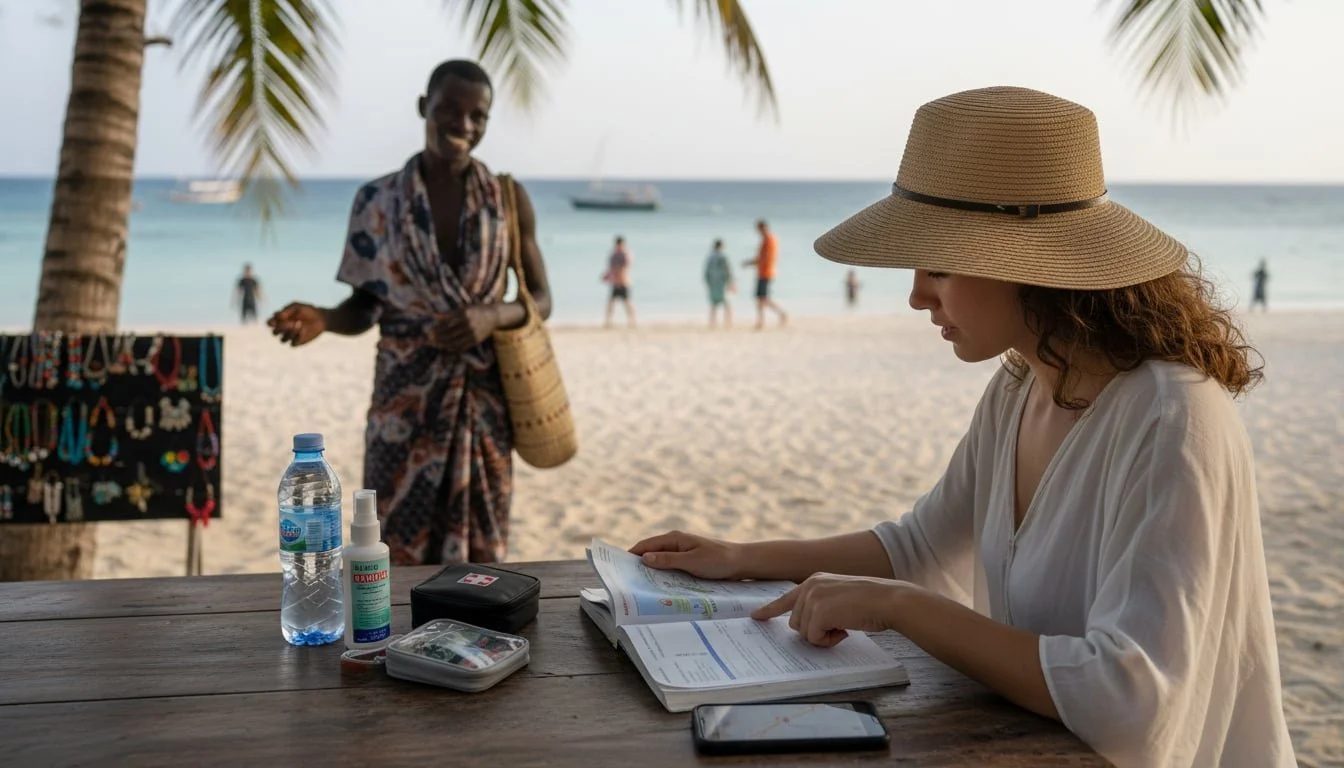
Perhaps the most discussed Zanzibar safety topic in traveler forums. Beach boys are persistent vendors who approach tourists on the sand to sell tours, spice excursions, snorkeling trips, and souvenirs, often at inflated prices. They are not dangerous. Practitioners on Reddit describe the main concern as “harassment from beach boys, not physical safety,” with one user calling Zanzibar “a very touristy island” where pressure sales are the norm. A local operator confirms that scams in Zanzibar “are rarely violent or sophisticated, they’re mostly opportunistic.” A firm, polite “no thank you” repeated consistently works. Once you have a relationship with one local guide or vendor, others tend to back off.
Bag Snatching
A specific tactic where thieves on motorbikes grab bags from pedestrians. The UK FCDO recommends walking against the direction of traffic so you can see approaching vehicles, and avoiding carrying bags loosely on the traffic side of your body. Don’t strap a bag across your chest, which could pull you off your feet if grabbed. This is more of a risk in Dar es Salaam than in Zanzibar, but the precaution applies anywhere.
Express Kidnapping
A crime pattern reported in Dar es Salaam where victims are held briefly and forced to withdraw cash from ATMs. This has not been reported as a pattern in Zanzibar. Mentioned here because it appears in Tanzania-wide advisories and travelers confuse mainland risks with island risks.
Taxi Scam / Unlicensed Taxi
Unlicensed drivers at the airport and ferry terminal quote fares two to three times the standard rate. Official taxis in Zanzibar have yellow license plates. Typical reference fares: Airport to Stone Town is roughly 30,000 to 50,000 TZS; Airport to Nungwi is roughly 80,000 to 120,000 TZS. Pre-booking your airport transfer through your hotel or tour operator eliminates this risk entirely.
Stone Town Street Safety
Stone Town’s narrow alleys are part of its charm but create disorientation, especially at night. During the day, the area is bustling and safe for walking. After dark, stick to lit, populated streets and consider hiring a local guide. Mugging incidents have been reported in isolated alleys late at night. For daytime exploration, a guided walk actually enhances the experience. There are plenty of things to do in Stone Town that are best appreciated with someone who knows the history behind each doorway and alley.
Nightlife Safety
Zanzibar has a modest nightlife scene, mostly concentrated in Stone Town and around the Nungwi/Kendwa beach areas. The same rules that apply anywhere in the world apply here: don’t walk alone at night in unfamiliar areas, watch your drinks, and arrange transport back to your accommodation in advance. Violent incidents targeting tourists at bars are rare but not unheard of.
Solo Female Traveler Safety
A Destination Expert on TripAdvisor who has traveled solo in Zanzibar since age 19 advises covering shoulders and knees outside of resorts, not walking alone at night, and wearing a “wedding ring” to deter unwanted attention. These precautions reflect the conservative cultural context more than a specific danger. Solo female travelers consistently report positive experiences on the islands when they respect local norms.
Health and Medical Terms
Malaria Zone
The CDC classifies all of Tanzania below 1,800 meters (5,900 feet) as a malaria transmission area. Zanzibar is at sea level. Malaria risk is real, and this is not something to be casual about.
Antimalarial Prophylaxis
Prescription medication taken before, during, and after your trip to prevent malaria infection. The CDC recommends atovaquone-proguanil (Malarone), doxycycline, mefloquine, or tafenoquine for Tanzania. Each has different dosing schedules and side effect profiles. Consult a travel medicine doctor at least four to six weeks before departure. Chloroquine-resistant malaria exists in Tanzania, so chloroquine alone is not effective.
Cholera
The CDC notes widespread cholera transmission in Tanzania. The primary precaution is avoiding unsafe food and water and washing hands frequently. An oral cholera vaccine exists but is not routinely recommended for most travelers; discuss with your doctor if you have underlying conditions.
Yellow Fever Certificate
Required for travelers arriving from yellow fever endemic countries, including those with layovers longer than 12 hours in endemic areas. If you are flying direct from Europe or North America, you typically do not need one. If your routing passes through Nairobi or Addis Ababa, check whether your layover duration triggers the requirement.
Mandatory Travel Insurance ($44 USD)
Starting mid-2025, Tanzania requires all foreign visitors to purchase mandatory travel insurance for $44 per person. This government-mandated policy covers medical emergencies, accidents, emergency evacuations, and repatriation. It does not replace personal travel insurance. The mandatory policy has limited coverage caps and does not cover trip cancellation, lost luggage, stolen gear, or higher medical expenses. Buy the $44 policy because you have to, then carry your own comprehensive policy because you should. For context on what a full trip budget looks like, understanding the complete cost of a Tanzania trip helps you plan for insurance alongside everything else. If Zanzibar is your main stop rather than a safari add-on, our Zanzibar cost guide breaks down this and every other expense.
Tap Water
Not safe to drink anywhere in Zanzibar. Use bottled water (check the seal is intact) or filtered water. This includes brushing teeth. Most hotels and resorts provide bottled water in rooms.
Aga Khan Hospital (Stone Town)
The best-equipped medical facility in Zanzibar, located in Stone Town. Contact: +255 24 223 0710. It handles emergencies and routine care. For anything serious (major surgery, intensive care), evacuation to Dar es Salaam or Nairobi is standard practice, which is why personal travel insurance with evacuation coverage matters.
Mnazi Mmoja Hospital
Zanzibar’s main government hospital. Contact: +255 24 223 1071. Adequate for basic care but limited by resources. Foreign visitors are better served at private facilities.
Zanzibar Medical Group
A private clinic option. Contact: +255 777 410 078. Useful for non-emergency medical needs.
Cultural Safety Terms
Cultural awareness is arguably the single biggest Zanzibar safety multiplier. Respecting local norms doesn’t just keep you out of trouble. It opens doors, earns goodwill, and transforms surface-level interactions into genuine connections.
Modest Dress
In towns, markets, and anywhere outside your resort’s beach or pool area, cover shoulders and knees. This applies to all genders, though women receive more scrutiny. Swimwear and revealing clothing in Stone Town or village settings draws negative attention and can provoke confrontation. For tips on what to pack, our guide to what to wear on safari and beach trips covers the practical details.
Zanzibar’s Religious Context
Approximately 99% of Zanzibar’s population is Muslim. This shapes daily life, dress expectations, alcohol availability in certain areas, and social norms around interactions between men and women. Understanding this context is not just polite, it is practical. Travelers who dress appropriately and greet people respectfully report overwhelmingly positive interactions.
Public Displays of Affection (PDA)
Discouraged for all couples, regardless of orientation. Holding hands is generally fine. Kissing, embracing, and other physical affection in public spaces will draw disapproval and can cause genuine offense in more conservative areas.
LGBTQ+ Safety
This requires honest treatment. Homosexuality is illegal in Tanzania, including Zanzibar, with penalties of up to 30 years imprisonment for same-sex acts. The US State Department specifically lists “targeting of gay and lesbian individuals” as a risk factor in its Level 3 advisory. Prosecutions targeting foreign tourists are described as extremely rare, but no openly gay-friendly establishments, bars, or pride events exist. LGBTQ+ travelers should exercise complete discretion. This is not a destination where visibility is safe. Couples should present as friends in all public settings.
Ramadan
During the Islamic holy month (dates shift annually based on the lunar calendar), many restaurants in Stone Town and villages close during daylight hours. Eating, drinking, or smoking in public during fasting hours is considered deeply disrespectful. Resort restaurants and tourist-oriented establishments typically continue normal service. If your trip overlaps with Ramadan, plan meals around your resort and show sensitivity in public spaces.
Greeting Culture (“Jambo” / “Habari”)
A simple Swahili greeting goes remarkably far. “Jambo” (hello) or “Habari” (how are you?) followed by a smile transforms interactions with vendors, taxi drivers, hotel staff, and locals on the street. Zanzibar’s culture places high value on greetings, and skipping them can be perceived as rude. This small effort is genuinely connected to your safety experience because people who feel respected are far more likely to help you and look out for you. For more on this cultural dimension, Tanzania’s rich cultural heritage provides useful context.
Ocean and Beach Safety Terms
Tidal Range (East Coast vs. North Coast)
This is the most underappreciated Zanzibar safety factor for beach travelers. The east coast beaches (Paje, Jambiani) experience dramatic tidal swings. At low tide, the water can recede hundreds of meters, exposing seagrass flats and tidal pools. Swimming is only practical at certain times of day. The north coast (Nungwi, Kendwa) has much less tidal variation, offering consistent swim-depth water throughout the day. Neither is better or worse, but they require different expectations. Check our breakdown of Zanzibar’s best beaches to understand what each coast offers.
Sea Urchins
The primary marine hazard in Zanzibar. Black, spiny, and lurking on rocks and reef flats, especially at low tide. Stepping on one drives dozens of thin, brittle spines into your foot. Removal is painful and infection is possible. Prevention is simple: wear reef shoes.
Reef Shoes / Dive Boots
Closed-toe water shoes with hard soles. Essential gear for any beach time in Zanzibar, not optional. They protect against sea urchins, sharp coral fragments, and rough volcanic rock. Available cheaply in Stone Town if you forget to pack them, but quality varies. For the full list of what to bring, see our Zanzibar packing list.
Coral Reef
The fringing reefs along Zanzibar’s east coast serve as natural barriers that block large waves and significantly reduce shark presence in nearshore waters. They also mean the seafloor is rough and sharp. Swimming shoes aren’t just for urchins, they protect against coral cuts, which heal slowly in tropical climates and infect easily.
Rip Current
Less common in Zanzibar than in open-ocean destinations because the reefs break wave energy, but still possible at certain beaches and during specific tidal conditions. Standard rip current advice applies: swim parallel to shore, not against the current.
Life Jacket (Boat Tours)
Dhow cruises, snorkeling trips, and island-hopping excursions don’t always provide life jackets by default. Ask for one and insist on wearing it, especially if you are not a confident swimmer. This applies to sunset cruises and fishing trips too, not just open-water excursions.
Transport Safety Terms
Yellow-Plate Taxi
Official, registered taxis in Zanzibar carry yellow license plates. This is your visual check for legitimacy. Unlicensed cars with white plates may offer rides at the airport, ferry terminal, or on the street. They are unregulated, uninsured, and often charge significantly more.
Dala Dala
Local minibus transport. Extremely cheap (a few hundred TZS per ride), packed to capacity, no seatbelts, no fixed schedules. An authentic local experience if you want one, but not recommended for airport transfers, long distances, or anyone carrying valuables. Pickpocketing risk is higher in crowded dala dalas.
Airport Transfer (Pre-Booking)
The single most effective way to avoid the top reported Zanzibar safety annoyance: being hassled or overcharged at the airport. Pre-book your transfer through your hotel, resort, or tour operator. The driver meets you at arrivals with a sign. No negotiation, no confusion, no stress. This is standard practice for nearly all organized trips.
Road Conditions
Main routes between the airport, Stone Town, and major beach areas (Nungwi, Kendwa, Paje) are paved and generally in reasonable condition. Secondary roads to more remote areas can be rough, especially during the rainy season. Organized transfers in appropriate vehicles handle this without issue.
Ferry Safety (Dar es Salaam to Zanzibar)
The Dar es Salaam to Zanzibar ferry crossing takes roughly 90 minutes to two hours. Use reputable companies, Azam Marine being the most commonly recommended. Older, cheaper ferries have a poor safety record, including several capsizing incidents over the past two decades. This is not an area to save money. Book economy or business class on a modern, well-maintained vessel.
Emergency Reference
Emergency Phone Numbers
| Service | Number |
|---|---|
| Police | 999 |
| Fire | 114 |
| General Emergency | 112 (may not work outside Dar es Salaam) |
| Traffic Police | +255 24 223 0772 |
Medical Facilities in Zanzibar
| Facility | Contact |
|---|---|
| Aga Khan Hospital (Stone Town, best on island) | +255 24 223 0710 |
| Mnazi Mmoja Hospital (government) | +255 24 223 1071 |
| Zanzibar Medical Group (private clinic) | +255 777 410 078 |
Save these numbers in your phone before you arrive. Screenshot this table or write the numbers on a card you keep in your daypack. Cell service in Zanzibar is generally reliable in populated areas.
Travel Insurance Claims
If you need to make a claim, contact your personal insurance provider’s 24/7 emergency line (found on your policy card) before or immediately after seeking treatment. Keep all receipts, medical reports, and police reports (for theft). The mandatory $44 government insurance has a separate claims process through the issuing authority.
Putting It All Together
Zanzibar safety comes down to preparation, not worry. The risks are real but manageable: take antimalarials, wear reef shoes, dress modestly in towns, pre-book your airport transfer, and carry personal travel insurance on top of the mandatory policy. Do those five things and you have addressed the vast majority of what could go wrong.
The archipelago’s tourism numbers are growing for a reason. The beaches are stunning, the culture is rich, the diving is world-class, and the overwhelming majority of visitors leave with nothing worse than a sunburn and a lighter wallet from too many spice market purchases.
For travelers combining Zanzibar with a mainland safari or Kilimanjaro climb, working with an operator who handles ground logistics across both the mainland and the islands makes the safety equation even simpler. Our complete East Africa planning guide walks through how to stitch together a multi-destination trip where transfers, permits, and local coordination are handled end-to-end. And if you want to see how a safari and Zanzibar combination fits into one trip, that is exactly what we design.
Want help planning a safe, well-timed Zanzibar trip from the start? Contact Duma Explorer and we'll build the safety and logistics into your itinerary from day one.
Frequently Asked Questions
-
Yes. Despite Tanzania’s Level 3 US travel advisory (issued October 2025), Zanzibar has remained calm and unaffected by the mainland unrest that triggered the upgrade. Over 736,000 tourists visited in 2024, and 2025 numbers are tracking toward one million. TripAdvisor Destination Experts with thousands of posts describe Zanzibar as “very safe” compared to many popular destinations.
-
No. The advisory covers all of Tanzania. Zanzibar is a semi-autonomous archipelago with its own government and a distinct security situation. The advisory was driven by mainland unrest, crime patterns in cities like Dar es Salaam, and other nationwide risk factors. Travelers should register with the STEP program regardless.
-
Starting mid-2025, all foreign visitors must purchase a government-mandated travel insurance policy for $44 per person. It covers basic medical emergencies, accidents, evacuation, and repatriation. It does not cover trip cancellation, lost luggage, or higher medical limits. You still need your own comprehensive travel insurance.
-
Generally yes, with cultural awareness. Cover shoulders and knees outside resorts, avoid walking alone after dark, and consider wearing a ring on your wedding finger to reduce unwanted attention. Veteran solo travelers on TripAdvisor forums consistently report positive experiences when these basic precautions are followed.
-
For most visitors, it is not crime or health, it is beach boys (persistent beach vendors) and petty scams like taxi overcharging. These are annoyances, not dangers. Firm, polite refusal handles the first, and pre-booking transport handles the second.
-
Yes. The CDC classifies all of Tanzania below 1,800 meters as a malaria zone, and Zanzibar is at sea level. Prescription antimalarials (atovaquone-proguanil, doxycycline, mefloquine, or tafenoquine) are recommended. See a travel medicine doctor at least four to six weeks before your trip.
-
Yes, with awareness of tidal patterns and marine hazards. The east coast has extreme tidal swings that limit swimming to certain hours. The north coast (Nungwi, Kendwa) offers consistent swimming conditions. Wear reef shoes everywhere to protect against sea urchins, which are the primary marine hazard.
-
Homosexuality is illegal in Tanzania, with penalties of up to 30 years imprisonment. The US State Department flags targeting of LGBTQ+ individuals as a specific risk. While prosecutions of foreign tourists are described as extremely rare, no openly gay-friendly venues exist. Complete discretion is essential. LGBTQ+ couples should present as friends in all public settings.