

Zanzibar Culture: 35+ Terms, Traditions & Etiquette (2026)
TL;DR
Zanzibar culture is a thousand-year fusion of African, Arab, Persian, and Indian influences centered on the Swahili coast. This glossary covers 35+ cultural terms you’ll encounter, from greetings like “shikamoo” to traditions like taarab music and the kanga cloth’s hidden messages. It also includes practical etiquette for visiting an island that is over 95% Muslim, where greetings matter deeply and the right hand is the only polite hand.
Why Zanzibar Culture Feels Unlike Anywhere Else
The word “Swahili” comes from the Arabic sawāḥil, meaning “coasts.” That single etymology captures the whole story. Zanzibar was never just one thing. For over a millennium, African Bantu traditions blended with Arab, Persian, Indian, and eventually European influences along these shores, producing a culture that is simultaneously familiar and foreign to nearly every visitor who steps off the ferry in Stone Town.
Today the archipelago sits as a semi-autonomous region of Tanzania, with Afro-Shirazi communities making up roughly half the population. The main industries are spices, tourism, and raffia. But what draws people culturally is the living, breathing Swahili civilization that still shapes daily life: the call to prayer echoing through coral-stone alleyways, the smell of clove and cardamom in morning tea, the proverb stitched across a woman’s kanga cloth.
This glossary organizes the key terms, customs, and practices of Zanzibar culture into thematic sections. Whether you’re planning a trip or simply curious, it’s designed to work as both a quick-reference lookup and a deeper read.
Planning to visit? Our Zanzibar cost and budget guide covers what to expect financially.
Zanzibar Culture Quick Answer
Zanzibar culture is a blend of African, Arab, Persian, and Indian traditions shaped by over 1,000 years of Indian Ocean trade. The islands are predominantly Muslim, and daily life is influenced by Swahili language, Islamic customs, spice farming, taarab music, coral-stone architecture, and strong social etiquette around greetings, modest dress, and hospitality.
Visitors should know: - Greetings are culturally important - Modest clothing is expected outside beaches - The right hand is used for eating and greeting - Swahili phrases earn strong local respect - Stone Town is the cultural center of the islands - Festivals like Mwaka Kogwa and Sauti za Busara showcase traditional heritage
Key cultural symbols include kangas, dhow boats, taarab music, carved Zanzibar doors, and spice markets.
Language and Greetings
Kiswahili (Swahili)
“Kiswahili” is the name of the language in the language itself. “Swahili” is the English equivalent. Now spoken by over 200 million people across East Africa, its roots are coastal. The grammar is Bantu African, but the vocabulary carries a significant number of loanwords from Arabic, Portuguese, English, and German, reflecting every wave of contact the coast has absorbed.
Jambo
The most recognized Swahili greeting worldwide, but here’s a distinction that matters: “Jambo” literally means “thing” or “issue” and is most commonly used as a greeting for tourists. Locals notice when someone speaks “tourist Swahili.” The more authentic singular greeting is Hujambo? (“Do you have any issues?”), with Hamjambo? for addressing multiple people. Using the real version earns visible respect.
Shikamoo
A respectful greeting reserved for elders or people you wish to honor. The response is Marahaba. Using “shikamoo” with an older person in a village will likely get you a warm smile and a longer conversation.
Karibu
Means both “welcome” and “you’re welcome.” You’ll hear it constantly, from hotel staff to market vendors to families sitting outside their homes. It reflects Zanzibar’s deep culture of hospitality.
Pole Pole
“Slowly, slowly.” This is the unofficial motto of life in Zanzibar. It’s not laziness. It’s a philosophy. Rushing is considered rude and pointless. The related proverb, haraka haraka haina baraka (“hurry hurry has no blessing”), reinforces the same idea.
Hakuna Matata
“No worries.” Widely known from pop culture, but a more natural local alternative is hamna shida, meaning “you don’t have a problem.” Using that version signals you’ve done your homework.
Methali
Swahili proverbs. These aren’t just sayings but cultural touchstones, poetic reminders of values, behavior, and the rhythm of life. You’ll encounter them in conversation, on walls, and printed on fabric. A few worth knowing:
-
Mgeni siku mbili; siku ya tatu mpe jembe (“A guest for two days; on the third, give them a hoe.”)
-
Mwacha mila ni mtumwa (“He who abandons his culture is a slave.”)
Asante / Asante Sana
“Thank you” and “thank you very much.” Use them often. Gratitude is currency in Zanzibar’s social life.
|
Swahili |
English |
When to Use |
|---|---|---|
|
Jambo |
Hello |
General tourist greeting |
|
Habari? |
How are you? |
After initial greeting |
|
Asante |
Thank you |
After receiving anything |
|
Tafadhali |
Please |
Ordering, requesting |
|
Karibu |
Welcome / You’re welcome |
Greeting or responding to thanks |
|
Pole pole |
Slowly, slowly |
Embrace the pace |
|
Sawa sawa |
OK / Alright |
Agreement |
|
Samahani |
Excuse me / Sorry |
Apology or getting attention |
|
Ndiyo / Hapana |
Yes / No |
Basic replies |
|
Kwaheri |
Goodbye |
Departing |
For broader travel vocabulary across the region, see our East Africa travel tips glossary.
Zanzibar Culture at a Glance
|
Category |
Key Details |
|---|---|
|
Main Culture |
Swahili |
|
Dominant Religion |
Islam (95%+ Muslim) |
|
Main Language |
Kiswahili (Swahili) |
|
Cultural Influences |
African, Arab, Persian, Indian |
|
Famous Music |
Taarab |
|
Traditional Clothing |
Kanga, Kanzu, Kikoy |
|
Cultural Center |
Stone Town |
|
UNESCO Site |
Stone Town |
|
Famous Festivals |
Mwaka Kogwa, Sauti za Busara |
|
Traditional Food |
Pilau, Urojo, Zanzibar Pizza |
|
Important Etiquette |
Modest dress, right-hand use, greetings |
|
Historical Trade |
Spice and Indian Ocean trade |
Music and Arts
Taarab
Zanzibar’s signature musical genre and one of the most distinctive sounds in East Africa. The word comes from the Arabic tarab (طرب), meaning “delight with music.” Taarab originated in the late 19th century under the patronage of Sultan Seyyid Barghash bin Said (r. 1870–1888), who sent a musician named Mohammed Ibrahim to Egypt to study classical Arab music. Upon his return, Ibrahim established Zanzibar’s first taarab orchestra.
The result is a marriage of Arabic melody, Indian instrumentation, and Swahili poetry. It is both elegant and emotionally powerful.
What many visitors don’t realize is that taarab historically served as a feminist vehicle. Many songs are crafted with layered meanings, and taarab provided a space for women, particularly in private gatherings, to express personal feelings through metaphor and innuendo. The first famous female taarab singer was Siti bint Saad, who in 1928 became the first East African musician to make commercial recordings. Decades later, the fierce and charismatic Bi Kidude became a cultural icon whose voice captivated audiences until her passing in 2013.
Today you can hear live taarab at cultural events, in community centers, or at the Dhow Countries Music Academy in Stone Town.
Kidumbak
The grassroots counterpart to taarab. Kidumbak ensembles grew popular among working-class Zanzibaris, featuring two small drums, bass, violins, and dancers using claves and maracas. Where taarab is orchestral and formal, kidumbak is raw and communal.
Ngoma
Traditional dances using intricate drumming and energetic movements. Ngoma reflects the communal spirit of Zanzibar culture. The term itself simply means “drum” or “dance” in Swahili, but in practice it refers to a whole performance tradition that predates any of the island’s foreign influences.
Dhow Countries Music Academy (DCMA)
Founded in 2002, DCMA was the first school to teach taarab at a time when there was no formal music education in Zanzibar’s public schools. Students can enroll in full-time certificate or diploma programs for free. The academy is central to keeping Zanzibar’s musical traditions alive for a new generation.
Ikhwani Safaa Musical Club
Established in 1905, Ikhwani Safaa is one of the oldest surviving taarab groups in the world. It remains active in promoting traditional music and occasionally hosts public performances in Stone Town.
Dress and Fabric
Kanga (Khanga)
If Zanzibar culture had a single signature object, the kanga would be a strong contender. These brightly printed rectangular cotton textiles measure approximately 45 by 65 inches and feature three distinct parts: the pindo (wide border), the mji (central motif), and the jina (a Swahili proverb or message).
The name comes from the guinea fowl. The earliest kanga patterns were covered in small dots resembling the bird’s speckled plumage, and “kanga” is Swahili for guinea hen.
But the truly fascinating dimension is communicative. Kangas have been called East Africa’s original “social media.” Women often buy a specific kanga to send a message to someone without speaking. The proverb printed on the cloth might convey a religious thought, a political stance, or a piece of pointed wisdom directed at a neighbor, a husband, or a rival. Women in Zanzibar have been known to “debate” by wearing opposing proverbs, a cultural practice sometimes called “kanga wars,” where fabric speaks louder than words.
Jina
The Swahili proverb or message printed on a kanga. This is the element that transforms a piece of cloth into a communication tool. Ask a vendor to translate the jina before you buy; the message you wear carries meaning.
Kanzu
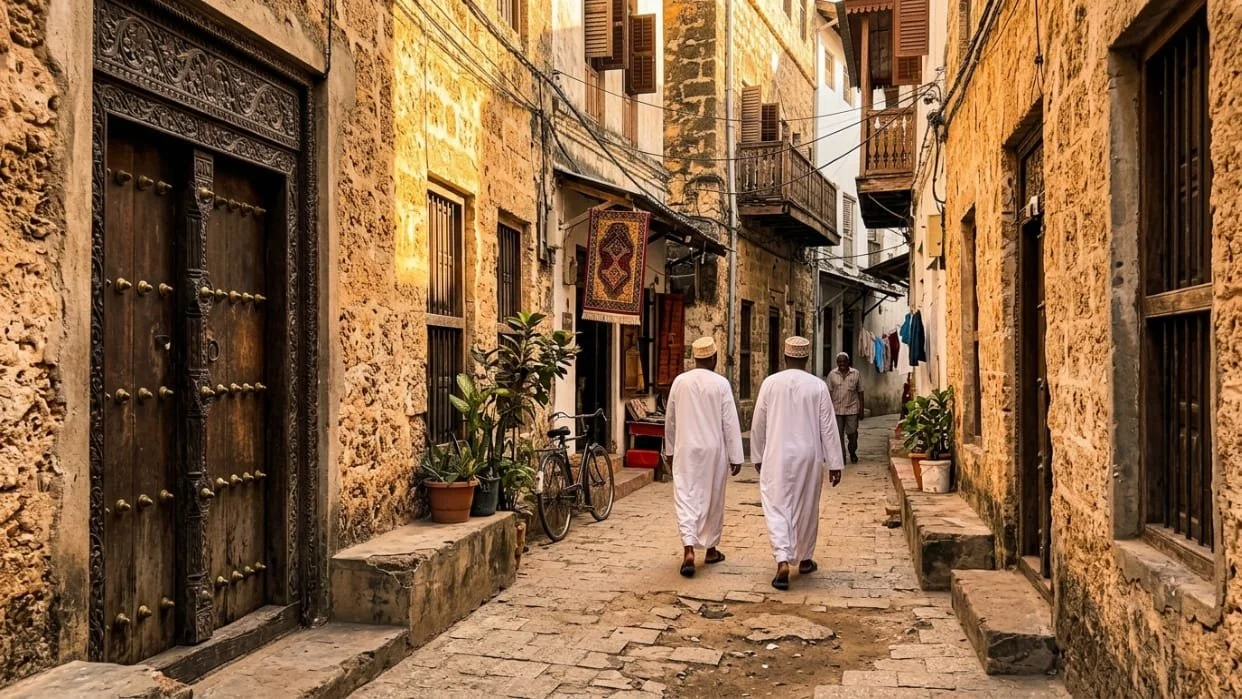
The traditional men’s garment: a long white tunic, often paired with a kofia (embroidered cap). You’ll see kanzus everywhere in Zanzibar, especially on Fridays and during religious celebrations.
Kitenge
The kanga’s more versatile cousin. Kitenge fabric carries no text, just bold patterns and vivid colors. It’s thicker and more structured, commonly tailored into dresses, shirts, suits, and even handbags.
Kikoy
A traditional wrap cloth, similar in size to a kanga but typically used by men. Kikoys are commonly worn around the waist for casual daily wear and increasingly popular as a souvenir textile.
For guidance on what to wear and pack when visiting, check the Zanzibar packing list.
Architecture and Heritage Sites
Stone Town (Mji Mkongwe)
The historic heart of Zanzibar and a UNESCO World Heritage Site since 2000. With over 1,700 historic buildings, Stone Town retains its urban fabric virtually intact. Its architecture, mostly dating to the 19th century, reflects the diverse influences underlying Swahili culture: African coral-stone construction, Omani arches, Indian carved balconies, and European colonial additions.
What visitors often don’t know is that the town faces a conservation crisis. About 80% of its 1,709 historic buildings need maintenance due to friable coral stone, and rising sea levels are eroding foundations. Walking through Stone Town is extraordinary, but it’s worth understanding that what you’re seeing is fragile.
For a full exploration of what to see and do, read our Stone Town travel guide.
Zanzibar Doors
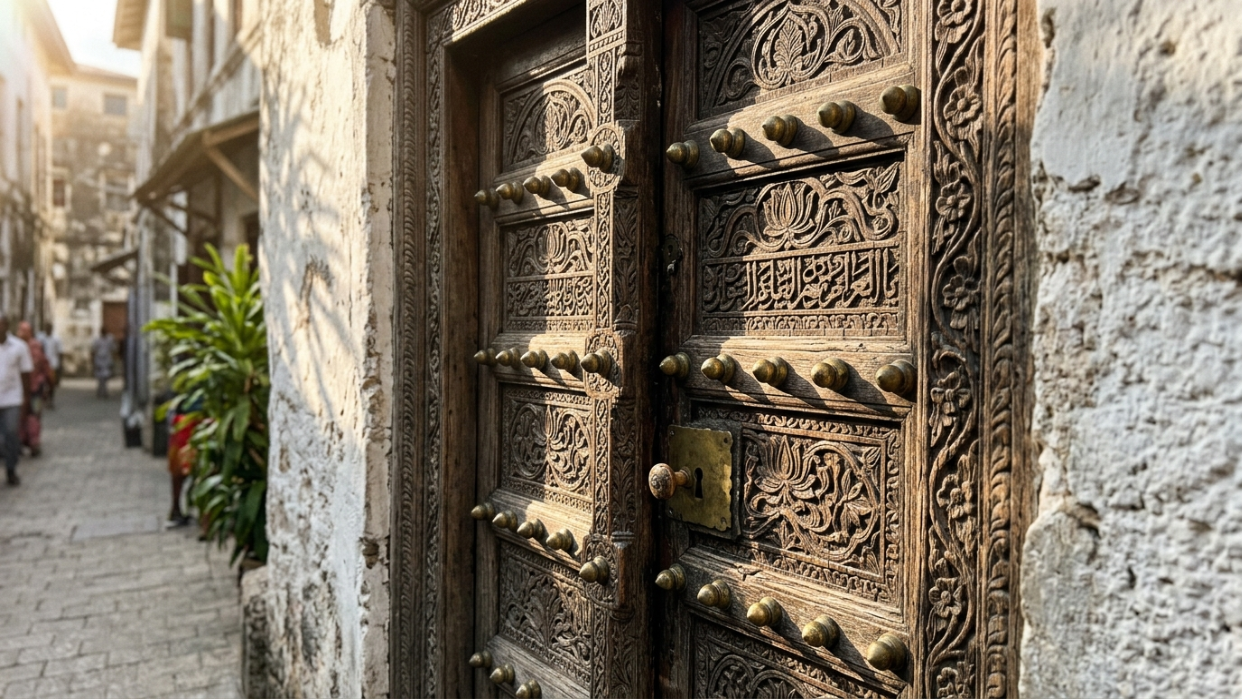
The most photographed feature of Zanzibari houses. These massive teak or mahogany structures are adorned with rich carvings and decorative brass studs. The studs originated in India as a defense against war elephants, a practical feature that became purely ornamental in Zanzibar.
Two main styles exist: Indian-style doors have rounded tops, while Omani Arab doors are rectangular. Each tells you something about the original owner’s heritage.
Baraza
Stone benches built along the exterior walls of traditional buildings. A baraza serves double duty: it’s an elevated sidewalk when heavy rains flood the narrow streets, and the rest of the time it’s where neighbors sit, rest, and socialize. The baraza captures something essential about Zanzibar culture, the idea that public life happens outdoors, in conversation.
House of Wonders (Beit al-Ajaib)
Built in 1883 by Sultan Barghash, this was the first building in East Africa to have electricity and an elevator. Its blend of Omani and colonial architecture makes it an enduring symbol of Zanzibar’s modern heritage. The building has undergone restoration in recent years after partial collapse.
Makuti
Palm-leaf thatching woven and laid by skilled local roofers. Makuti roofing creates a naturally cool and shaded atmosphere, and you’ll see it on everything from beach bars to village homes. In broader Swahili culture, palm leaves are also woven into mats, baskets, and fences.
Old Slave Market and Christ Church Cathedral
The Anglican Cathedral of Christ Church was built on the exact site where the largest slave market in Eastern Africa operated. Its altar was placed where enslaved people were whipped before sale. In 1873, under mounting pressure from British abolitionists, Sultan Barghash bin Said formally abolished the slave trade. The cathedral’s foundation was laid on Christmas Day 1873, and construction was completed by Christmas 1879. Visiting is sobering and essential for understanding the island’s full history.
Old Fort (Ngome Kongwe)
The oldest standing building in Stone Town, built in 1699 by the Omanis after ousting the Portuguese. Today it hosts cultural events, including the Sauti za Busara music festival and the Zanzibar International Film Festival.
Festivals and Celebrations
Mwaka Kogwa
A traditional Zanzibari cultural event symbolizing renewal, reconciliation, and hope. Introduced centuries ago by Persian (Shirazi) settlers, the festival blends African ritual, Islamic heritage, and Zoroastrian symbolism, a combination that surprises many visitors. The festival marks the Shirazi New Year (Nairuz), and its Zoroastrian roots make it genuinely unique among East African celebrations.
Key rituals: men engage in mock combat using banana stalks, representing a symbolic release of communal tensions from the past year. A temporary hut made of palm fronds is then constructed and burned by the village healer (mganga). The direction of the smoke is interpreted as a prediction of fortune for the coming year.
Mwaka Kogwa takes place every July for four days in Makunduchi village, southern Unguja. Timing your visit around it? Our month-by-month Zanzibar guide can help with planning.
Sauti za Busara
Held each February inside the Old Fort in Stone Town, Sauti za Busara is East Africa’s most celebrated music festival. Featuring over 400 artists from across the continent, it’s the best single opportunity to hear taarab, ngoma, Afrobeat, and contemporary African music in one setting.
Zanzibar International Film Festival (ZIFF)
An annual cultural event focused on cinema from the “dhow countries,” meaning the Indian Ocean region. Screenings, workshops, and cultural performances take place at the Old Fort and venues around Stone Town.
Eid al-Fitr and Eid al-Adha
In an island that is over 95% Muslim, Eid celebrations are major events. Communal meals, traditional songs, and family gatherings define these days. Visitors during Eid will find a festive, generous atmosphere, though many shops and services may adjust hours.
Traditional Zanzibar Weddings
Zanzibar weddings are elaborate multi-day celebrations blending Islamic customs with Swahili traditions. Events often include separate gatherings for men and women, communal feasting, music, dancing, and ceremonial processions through neighborhoods.
Henna Ceremonies
Before the wedding, women gather for henna nights where intricate designs are painted onto the bride’s hands and feet. Taarab music and dancing are central to these celebrations.
Wedding Clothing
Brides may wear richly embroidered dresses with gold jewelry and head coverings, while men often wear kanzus and embroidered kofias.
Community Importance
Weddings in Zanzibar are not private affairs. Entire neighborhoods may participate, reinforcing family ties and social identity within Swahili culture.
Food and Spice Culture
Spice Islands
The Zanzibar Archipelago earned the nickname “Spice Islands” through centuries of cultivation. The main spices produced are clove, nutmeg, cinnamon, coconut, and black pepper. It was the Omanis who scaled up spice production in the 17th century, and that legacy defines the island’s economy and cuisine to this day.
Spice farm tours now operate as community enterprises, earning extra income by hosting travelers. They’re worth doing, not just for the sensory experience but for understanding how deeply agriculture shaped Zanzibar’s culture and trade relationships.
Pilau
A spiced rice dish flavored with cardamom, cinnamon, and cloves, influenced by Indian and Persian cooking. Pilau is central to celebrations and gatherings. It’s also the dish most likely to appear at a wedding, a funeral, or any event where community matters.
Urojo (Zanzibar Mix)
A tangy, turmeric-based soup layered with fritters, boiled cassava, coconut chutney, and chili. Urojo is iconic Stone Town street food and the kind of dish that doesn’t photograph well but tastes extraordinary.
Zanzibar Pizza
Not traditional in any historical sense, but deeply embedded in modern Stone Town street-food culture. These are stuffed dough parcels cooked on flat griddles at the Forodhani Gardens night market. Fillings range from egg and cheese to Nutella and banana.
For a fuller tour of what to eat and where, see the Zanzibar food guide.
Chai ya Tangawizi
Ginger-spiced tea, often with cardamom, served morning, afternoon, and evening. This is the rhythm of daily social life in Zanzibar. Refusing a cup of chai when offered is borderline rude, and it’s rarely just about the drink. It’s an invitation to sit and talk.
Zanzibar Etiquette Checklist for Visitors
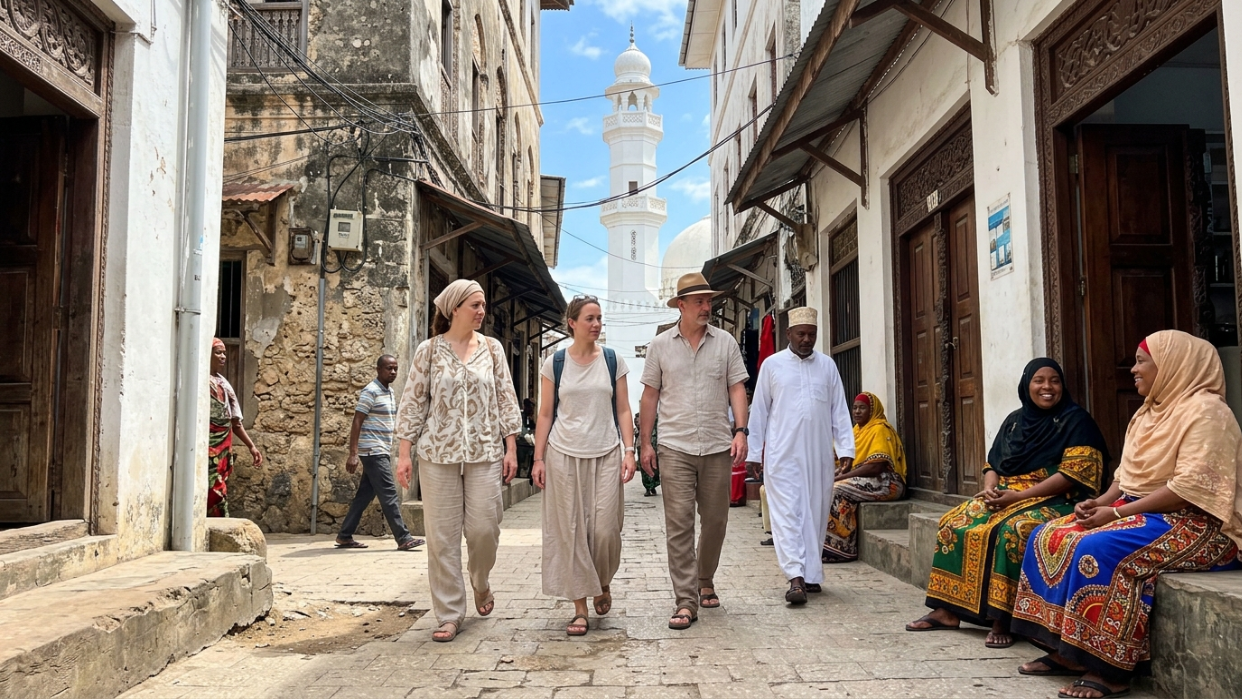
Before visiting Zanzibar, remember these important cultural norms:
Do
-
Greet people before asking questions
-
Dress modestly in towns and villages
-
Use your right hand when eating or giving items
-
Ask permission before taking photos
-
Learn a few basic Swahili phrases
-
Respect prayer times and Ramadan customs
Don’t
-
Wear swimwear away from beach resorts
-
Publicly criticize religion or politics
-
Show anger or raise your voice in public
-
Photograph mosques without permission
-
Drink alcohol openly in local neighborhoods
-
Ignore greetings during conversations
Respectful behavior is deeply appreciated in Zanzibar and often leads to warmer interactions with locals.
Religion and Daily Life in Zanzibar
Islam influences the rhythm of daily life across Zanzibar. The call to prayer sounds throughout towns and villages five times a day, shaping business hours, social routines, and community gatherings.
Friday Culture
Friday is the most important religious day of the week. Many shops close temporarily during midday prayers, and men often wear white kanzus to mosque.
Community Values
Hospitality, patience, modesty, and respect for elders are central social values. Greetings are considered essential social etiquette rather than optional politeness.
Blended Traditions
Although Islam is dominant, many older Swahili traditions still exist alongside religious practices, especially in healing rituals, festivals, music, and family ceremonies.
Religion and Etiquette
Islam in Zanzibar
Zanzibar is over 95% Muslim, and Islam shapes not only its architecture and music but its everyday manners. The call to prayer marks the day’s rhythm. Friday is the holy day. Understanding this context is not optional for respectful travel; it’s fundamental.
Ramadan Etiquette
During the holy month of Ramadan, avoid eating, drinking, or smoking in public during daylight hours. Restaurants in tourist areas will still serve food, but discretion matters. The evening iftar (breaking of the fast) is a beautiful time to be on the island.
Dress Code
Swimwear is fine on the beach. Walking through towns and villages is different. Light, loose-fitting clothing that covers shoulders and knees is the standard. This applies to men and women both, though women will attract more attention for violations. It’s not about restriction, it’s about respect in a conservative community.
Photography Etiquette
Always ask permission before photographing people, especially in villages. Mosques are generally off-limits unless someone explicitly grants permission. Most people will say yes when asked, but the asking is what matters.
Right-Hand Rule
Always use your right hand for eating, passing food, greeting, and giving or receiving items. The left hand is considered unclean across Muslim East African cultures. This is not a suggestion. It’s a firm social norm.
Public Behavior
Zanzibaris value calmness and patience. Showing frustration or anger in public is considered deeply inappropriate. While alcohol is available in tourist areas, public drunkenness is frowned upon. Keep it private and moderate.
For a deeper look at etiquette across the region, our cultural safaris glossary covers Tanzania’s broader cultural norms.
Historical and Ethnic Context
Shirazi
Persian settlers who arrived from the 10th century onward, primarily from the city of Shiraz in modern Iran. The Shirazis were the first foreigners to settle in Zanzibar in significant numbers, and many aspects of their culture were absorbed into what became Swahili civilization. Their most visible legacy is the Mwaka Kogwa festival.
Omani Sultanate
The Omanis grew spice production and transformed Stone Town into a major commerce hub when Sultan Seyyid Said relocated his capital from Muscat in 1840. Omani influence is visible everywhere: in the rectangular doors, the taarab orchestras, the Arabic loanwords in Swahili, and the island’s Islamic character.
Zanzibar Revolution (1964)
In January 1964, the Sultanate was overthrown in a revolution. Zanzibar then united with Tanganyika to form the present-day United Republic of Tanzania. The island retains semi-autonomous status, with its own president and house of representatives. The revolution is still a sensitive topic locally.
Dhow
The traditional wooden sailing vessel of the Indian Ocean trade routes. Dhows symbolize centuries of cultural exchange between East Africa, Arabia, India, and beyond. They’re still used daily for fishing, and sunset dhow cruises are one of the most popular tourist activities.
Mganga
A traditional Swahili healer. The mganga plays a central role in the Mwaka Kogwa fire ritual, interpreting smoke direction and performing spiritual cleansing. The role predates Islam on the island and coexists with it in a way that surprises outsiders.
Frequently Asked Questions
What is the main culture in Zanzibar?
Zanzibar culture is Swahili, a fusion of African Bantu, Arab, Persian, and Indian traditions that developed over more than a thousand years of Indian Ocean trade. Islam is the dominant religion (over 95% of the population), and it shapes daily life from greetings to dress to food. The culture expresses itself through taarab music, kanga textiles, spice cuisine, and distinctive coral-stone architecture.
What should I not do in Zanzibar?
Avoid eating, drinking, or smoking in public during Ramadan daylight hours. Don’t wear revealing clothing outside of beach areas. Never use your left hand to greet, eat, or pass items. Don’t photograph people without asking first. Avoid public displays of anger, excessive affection, or drunkenness.
Is “Jambo” the right way to greet people in Zanzibar?
It works, but locals recognize it as tourist Swahili. More authentic greetings include Hujambo? (singular) or Hamjambo? (plural). Using Shikamoo with elders shows real cultural awareness and earns genuine respect.
What is taarab music?
Taarab is Zanzibar’s signature musical genre, blending Arabic melody, Indian instrumentation, and Swahili poetry. It originated in the late 19th century under Sultan Barghash and has historically served as a vehicle for women to express personal feelings through metaphor. You can hear live taarab at the Dhow Countries Music Academy in Stone Town.
What are the messages on kanga cloth?
The text on a kanga is called a jina, a Swahili proverb or message. Women use kangas to communicate silently, sending pointed messages to specific people through the proverb they choose to wear. This tradition has been called East Africa’s original social media.
When is the best time to visit Zanzibar for cultural festivals?
Mwaka Kogwa happens every July in Makunduchi. Sauti za Busara takes place each February in Stone Town’s Old Fort. The Zanzibar International Film Festival is typically held mid-year. Eid celebrations vary by the Islamic calendar. Check our month-by-month Zanzibar guide for specific timing.
Is Zanzibar safe for tourists?
Zanzibar is generally safe for visitors who respect local customs. The biggest risks are cultural missteps rather than physical dangers. Covering up in towns, greeting people properly, and showing patience go a long way. For detailed safety guidance, see our Zanzibar safety glossary.
Can I combine Zanzibar with a mainland Tanzania safari?
Absolutely. Many travelers pair a few days of cultural exploration in Stone Town and beach time with a Serengeti or Ngorongoro safari. Flights between Arusha and Zanzibar take about an hour. For help deciding how to structure a combined trip, read our guide on combining multiple East Africa experiences.
What language do people speak in Zanzibar?
Most people in Zanzibar speak Kiswahili (Swahili). English is widely spoken in tourist areas, hotels, and tour operations, but learning a few Swahili greetings is appreciated and often improves interactions with locals.
Why is Zanzibar called the Spice Island?
Zanzibar became famous through centuries of spice cultivation and trade, especially cloves, nutmeg, cinnamon, and black pepper. During the 19th century, the islands became one of the world’s largest clove producers under Omani rule.
Is Stone Town worth visiting?
Yes. Stone Town is considered one of the most culturally significant historic towns in East Africa. Its coral-stone buildings, carved doors, winding alleys, mosques, and markets reflect centuries of Swahili, Arab, Persian, Indian, and European influence.