East Africa Safety 2026: A Traveler's Guide & Glossary
TL;DR
East Africa safety is not one thing. It varies by activity (safari, mountain climb, gorilla trek, city visit) rather than by country. This glossary defines every safety-related term you’ll encounter while planning a trip across Tanzania, Kenya, Uganda, and Rwanda, from medical preparedness and guide certifications to wildlife encounter protocols and altitude sickness vocabulary. Understanding these terms is the single best way to evaluate operators, prepare properly, and travel with confidence.
Quick Answer: Is East Africa Safe to Travel in 2026? East Africa is generally safe for tourists in 2026 when visiting established safari circuits and using licensed operators. Countries like Tanzania, Kenya, and Rwanda have well-regulated tourism zones with strong guide systems and low crime in national parks. The main risks are activity-specific—not country-wide—and include malaria, altitude sickness on Kilimanjaro, and wildlife safety during safaris or gorilla trekking. Urban areas require normal big-city precautions, while remote trekking requires trained guides and proper medical evacuation insurance.
Safety in East Africa is a vocabulary problem. Operators talk about WFR-certified guides, FGASA credentials, acclimatization protocols, and Gamow bags. Park authorities publish rules about 7-meter distance minimums and group size caps. The CDC issues travel advisories with numbered levels. If you don’t know what any of that means, you can’t tell the difference between a serious operator and one that just sounds serious.
This glossary fixes that. Every term is organized by the type of trip it applies to, defined in plain language, and connected to why it matters for your safety. Whether you’re planning safari itineraries across the Serengeti, climbing Kilimanjaro, tracking gorillas in Bwindi, or spending a few days in Arusha or Nairobi, the terms below will help you prepare and ask the right questions.
One critical framing point before we start: East Africa safety is itinerary-specific, not country-wide. Tanzania’s overall U.S. travel advisory sits at Level 3, yet the Serengeti, Ngorongoro Crater, and Kilimanjaro National Park have high security, strong guide presence, and millions of visitors. Tanzania recorded 2.14 million international arrivals in 2024. The advisory level reflects conditions in specific border regions, not the safari circuits that sit hundreds of kilometers from any flashpoints.
Keep that distinction in mind as you read through each section below.
Travel Advisory and Entry Terms
U.S. State Department Advisory Levels (1 through 4)
The U.S. State Department assigns every country a travel advisory level from 1 to 4:
-
Level 1: Exercise normal precautions
-
Level 2: Exercise increased caution
-
Level 3: Reconsider travel
-
Level 4: Do not travel
Why it matters: These levels apply to entire countries, but risk within a country varies enormously by region. Safari zones, national parks, and established tourist circuits consistently remain low-risk even when a country carries a Level 2 or 3 advisory. When evaluating East Africa safety, check both the advisory level and the specific regions cited in the advisory text. The State Department’s country information pages break down which areas drive the rating.
eTA, eVisa, and East African Tourist Visa
An eTA (Electronic Travel Authorization) or eVisa is the digital permit most East African countries now require before arrival. Tanzania, Kenya, Uganda, and Rwanda each have their own online application portals.
The East African Tourist Visa is a multi-country visa valid for Uganda, Rwanda, and Kenya that allows movement between all three countries on a single permit. It costs $100 and is valid for 90 days.
Why it matters: Entry requirements change frequently. Arriving without proper documentation creates immediate problems at immigration. Confirm current requirements through your operator or the destination country’s immigration website at least 60 days before travel.
Yellow Fever Certificate
A yellow fever vaccination certificate is mandatory for entry into most East African countries. Some nations require it for all travelers; others require it only for travelers arriving from countries with yellow fever transmission risk.
The CDC notes that the booster requirement was eliminated from the International Health Regulations in 2016. A completed primary vaccination certificate is now valid for life.
Why it matters: Without this certificate, you may be denied entry or vaccinated on the spot at the airport. Get vaccinated at least 10 days before travel, as the certificate becomes valid only after that window.
PHEIC (Public Health Emergency of International Concern)
A PHEIC is the highest level of alarm the World Health Organization can declare. It signals that a health event constitutes a public health risk to other countries through international spread and potentially requires a coordinated international response.
Current context (May 2026): On May 17, 2026, the WHO declared a PHEIC related to the Ebola outbreak in the Democratic Republic of the Congo and Uganda. As of May 16, 2026, 246 suspected cases and 80 deaths had been reported in DRC’s Ituri Province.
The U.S. State Department raised Uganda to Level 4 (Do Not Travel) and Rwanda to Level 3 (Reconsider Travel). Tanzania has tightened border checks and increased monitoring at airports and seaports. Kenya and Tanzania have announced health-screening and traveler-form requirements for some arrivals from or via the DRC and Uganda.
What this means for travelers: The outbreak is concentrated in eastern DRC, with cases in Uganda. Tanzania’s safari circuits and Kilimanjaro are not directly affected, and safari operations in Kenya and Tanzania continue normally. However, this situation is evolving. Check the CDC and State Department advisories before booking, and work with an operator that has real-time ground intelligence. Gorilla trekking plans in Uganda require particular scrutiny right now.
Smart Traveler Enrollment Program (STEP)
STEP is a free service from the U.S. State Department that lets American citizens register their trip with the nearest embassy or consulate. Enrolled travelers receive security alerts, travel warnings, and emergency contact from the embassy if a crisis occurs.
Why it matters: Registration takes five minutes and can be the difference between receiving timely evacuation information and missing it entirely. Enroll at step.state.gov before departure.
Health and Medical Preparedness Terms
Malaria Prophylaxis
Preventive medication taken before, during, and after travel to malaria-endemic areas. Common options include atovaquone-proguanil (Malarone), doxycycline, and mefloquine. Each has different dosing schedules, side effects, and costs.
Malaria is present throughout East Africa at lower elevations. The CDC Yellow Book 2026 advises that a pre-travel consultation with a travel medicine specialist is essential. This is non-negotiable for East Africa travel safety, even for short trips.
Why it matters: Malaria kills. Prophylaxis dramatically reduces infection risk but must be combined with insect repellent (DEET 30%+), long sleeves at dusk and dawn, and sleeping under treated mosquito nets. No single measure is sufficient alone.
Recommended Vaccinations
Beyond yellow fever, the CDC recommends the following for East Africa travelers:
-
Typhoid (especially if eating street food or visiting smaller towns)
-
Hepatitis A and B
-
Tetanus/diphtheria booster (if not current)
-
Meningitis (particularly for extended travel or during outbreaks)
-
Rabies (for travelers who will have significant animal exposure or visit remote areas far from medical care)
Schedule vaccinations at least 4 to 6 weeks before departure. Some require multiple doses.
Travelers’ Diarrhea
The most common health issue for visitors to East Africa. Caused by consuming contaminated food or water. Symptoms range from mild inconvenience to debilitating illness that can disrupt an entire trip.
Prevention: Drink only bottled or purified water. Avoid ice in drinks unless you’re confident in the source. Eat freshly cooked food. Peel your own fruit. Carry oral rehydration salts and a course of antibiotics prescribed by your travel medicine provider.
Travel Insurance with Medical Evacuation
A travel insurance policy that covers emergency medical treatment and, critically, medical evacuation by air ambulance. Standard health insurance from your home country almost never covers care or evacuation in East Africa.
Why it matters: Many safari lodges and camps are hours from the nearest hospital. On Kilimanjaro, medical facilities on the mountain are extremely limited. A medical evacuation from a remote location can cost $50,000 to $100,000+ without insurance. Every reputable operator will tell you this coverage is essential, not optional.
Flying Doctor Service
Emergency air ambulance services that operate across East Africa, most notably AMREF Flying Doctors in Kenya and partners in Tanzania. Many lodges and camps maintain partnerships with flying doctor services for rapid evacuation of critically ill or injured guests.
Why it matters: In remote safari locations, the flying doctor may be the fastest path to a hospital. Some travel insurance policies include flying doctor membership as part of the package. Confirm this coverage before departure.
Most Common Safety Risks for East Africa Travelers (Ranked)
Understanding real-world risk is more useful than general fear-based assumptions.
1. Malaria infection
-
Present in low-altitude regions
-
Preventable with prophylaxis and mosquito protection
2. Altitude sickness (Kilimanjaro)
-
Affects most climbers to some degree
-
Preventable with slow ascent and acclimatization
3. Vehicle-related safari incidents
-
Rare but possible due to wildlife proximity or driving conditions
-
Mitigated by licensed operators and experienced guides
4. Petty theft in cities
-
Most common urban risk (phones, wallets, bags)
-
Prevented with basic awareness
5. Wildlife encounters outside vehicles
-
Extremely rare in regulated parks
-
Controlled through strict guide protocols
Safari Safety Terms
FGASA Certification (Field Guides Association of Southern Africa)
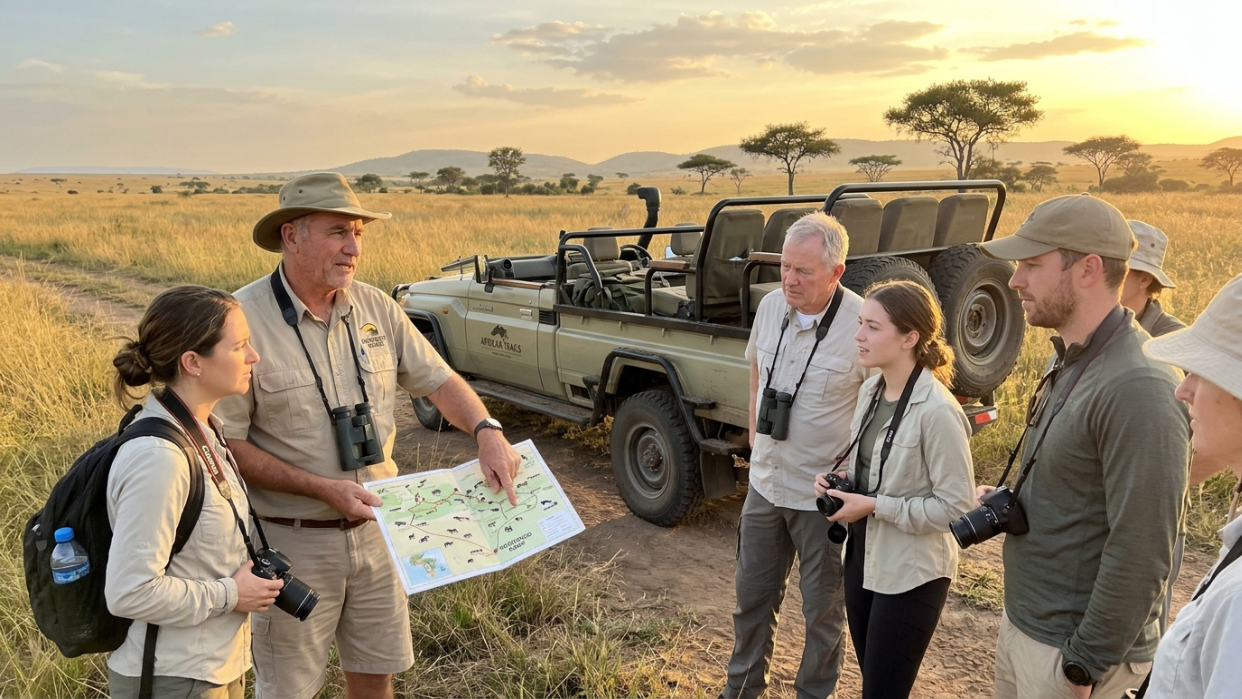
FGASA is the leading professional certification body for field guides in Africa. It operates a tiered qualification system:
-
NQF2 / Level 1 (Nature Site Guide): The entry-level professional qualification. A 55-day intensive course covering ecology, animal behavior, guest safety, firearm handling, first aid, and interpretation skills. This qualifies a guide to lead guests at a specific site or reserve.
-
Level 2 (Advanced Field Guide): Deeper ecological knowledge, advanced tracking, and greater interpretive ability.
-
Professional Trails Guide: The highest level, authorizing a guide to lead walking safaris in big-game areas.
Why it matters for your safety: A FGASA-certified guide has formal training in animal behavior, threat assessment, and emergency response. When evaluating an operator, ask whether their guides hold FGASA or equivalent certifications. Guides who read animal body language correctly keep you out of dangerous situations before they develop.
Game Drive Safety Protocol
The set of rules that govern behavior during a vehicle-based game drive in a national park or reserve. Standard protocol includes:
-
Stay in the vehicle at all times unless the guide explicitly says you can exit
-
Keep arms and legs inside the vehicle
-
Speak in low tones near wildlife
-
Never stand up suddenly or make loud noises
-
If you need a bathroom break, ask the guide to take you to a designated safe spot
-
Never wander off into the bush on your own
Professional guides navigate wildlife encounters with deep understanding of animal behavior. They position vehicles for optimal viewing while maintaining safe distances. The guide’s instructions override your instincts, every time.
Walking Safari Safety Briefing
Before any walking safari in big-game territory, guides conduct a thorough safety briefing covering formation (single file, specific walking order), hand signals, what to do if you encounter dangerous animals, and emergency procedures.
Routes are carefully chosen to minimize risk. Guides are armed on walking safaris as a precaution, though discharging a firearm is an absolute last resort. Walking safaris are well-controlled experiences, not reckless adventures.
Why it matters: Walking safaris offer an entirely different experience from a vehicle, but they carry higher inherent risk. The safety briefing is not a formality. Pay attention, follow instructions exactly, and trust your guide’s judgment about when to move, stop, or retreat.
Unfenced Camp Protocol
Most safari camps in East Africa are unfenced, meaning wildlife can move freely through the property. This is by design: fencing disrupts migration corridors and animal behavior. Safety is maintained through trained staff, 24-hour security patrols, and strict guest protocols.
Guests are never expected to navigate camps alone after dark. A staff member escorts you between your tent and common areas at night (see “Night Escort” below). Most wild animals avoid human activity naturally and are rarely interested in entering guest areas.
Night Escort
The practice of having a camp staff member or askari (security guard) walk you to and from your tent after dark. At unfenced camps, this is standard procedure, not a sign of unusual danger.
Why it matters: Hippos, elephants, buffalo, and hyenas can pass through camp at night. Your escort carries a flashlight and knows how to handle encounters. Never walk to your tent alone after dark in an unfenced camp, even if it’s 50 meters away.
If you’re considering private safari options, ask your operator about the specific camps on your itinerary and their security protocols.
Mountain Safety Terms (Kilimanjaro)
Kilimanjaro is the most popular high-altitude trek in Africa, and altitude sickness is its most serious risk. Understanding this vocabulary is essential for anyone planning a climb. For a deeper look at training terminology, we have a companion glossary.
AMS (Acute Mountain Sickness)
The most common form of altitude illness. Symptoms include headache, nausea, fatigue, dizziness, and loss of appetite. AMS typically begins above 2,500 meters and affects the majority of Kilimanjaro climbers to some degree.
Mild AMS is manageable with rest, hydration, and slower ascent. Moderate to severe AMS requires descent. Ignoring worsening symptoms is how people die on Kilimanjaro.
HAPE (High Altitude Pulmonary Edema)
A life-threatening condition where fluid accumulates in the lungs due to altitude. Symptoms include severe breathlessness at rest, persistent cough (sometimes with pink frothy sputum), extreme fatigue, and chest tightness. HAPE can develop from untreated AMS or appear suddenly.
Immediate descent is mandatory. Supplemental oxygen is a temporary measure, not a cure. HAPE is fatal without treatment.
HACE (High Altitude Cerebral Edema)
The most severe form of altitude illness, involving swelling of the brain. Symptoms include severe headache unresponsive to medication, ataxia (inability to walk in a straight line, staggering), confusion, hallucinations, and loss of consciousness.
HACE is a medical emergency. Like HAPE, it requires immediate descent. The presence of ataxia (have the climber walk heel-to-toe in a straight line) is the most reliable field test.
Acclimatization (“Climb High, Sleep Low”)
The process of gradually adapting your body to higher altitude by ascending slowly and spending nights at lower elevations than your highest point that day. This is the single most important factor in preventing altitude sickness on Kilimanjaro.
Longer itineraries (7 to 9 days) provide better acclimatization than shorter ones. Routes with built-in “climb high, sleep low” profiles, like the Lemosho, have higher success rates by route and days. The cheapest climb is not the safest climb if it sacrifices acclimatization days.
Pulse Oximetry
The measurement of blood oxygen saturation (SpO2) using a small clip device placed on the fingertip. On Kilimanjaro, guides from reputable operators check pulse oximetry readings twice daily (morning and evening) at every camp.
Normal sea-level readings are 95 to 100%. At altitude, readings naturally drop. On Kilimanjaro, readings below approximately 80% at altitude warrant immediate attention and potential descent. Pulse oximetry is not diagnostic on its own but is a critical early warning tool when combined with symptom assessment.
Why it matters: If your operator doesn’t mention health monitoring protocols that include pulse oximetry, that’s a red flag. Ask specifically.
Gamow Bag (Portable Hyperbaric Chamber)
A sealed, inflatable bag that simulates descent of 1,500 to 3,000 meters by increasing air pressure around the patient. The climber is placed inside, and the bag is pumped to higher pressure. It’s used as a temporary emergency measure for severe altitude sickness when immediate physical descent isn’t possible (due to darkness, weather, or terrain).
Some operators carry a Gamow bag and medical oxygen at high-altitude camps. Many do not. This is another concrete question to ask when vetting operators.
Wilderness First Responder (WFR)
The gold standard certification in wilderness medicine for outdoor professionals. The 70 to 80 hour course, issued by NOLS (National Outdoor Leadership School) or WMA (Wilderness Medical Associates), prepares guides to manage medical emergencies where advanced care may be hours or days away.
WFR training covers patient assessment, wound management, spinal injuries, anaphylaxis, altitude illness, evacuation decision-making, and improvised treatment in the field.
Why it matters for Kilimanjaro safety: A WFR-certified guide knows when mild AMS is becoming HAPE. They know when to push fluids versus when to start descent. They can stabilize a patient and coordinate evacuation. Budget operators often skip this training because it’s expensive and time-consuming. Ask your operator whether their summit guides hold WFR certification.
Kilimanjaro SAR (Search and Rescue)
The Kilimanjaro Search and Rescue team operates the helicopter rescue service on the mountain. Park authorities can be reached at +255 27 275 3767 or +255 27 205 0033.
There is no charge for the initial rescue and medical attention provided by Kilimanjaro SAR. However, helicopter evacuation availability depends heavily on weather (wind, cloud cover, visibility), and the service cannot guarantee response in all conditions.
Helicopter Evacuation (Kilimanjaro)
Helicopter evacuation is possible on Kilimanjaro but is not guaranteed. Weather conditions at high altitude frequently prevent helicopter access for hours or even days. This is why the guide’s decision to begin physical descent must never be delayed in hopes of a helicopter.
Why it matters: Travel insurance with helicopter evacuation coverage is essential for any Kilimanjaro climb. But insurance doesn’t control the weather. The guide’s willingness to make hard calls about descent, regardless of summit ambitions, is your most important safety mechanism.
Western Breach
A direct, steep route to the summit crater of Kilimanjaro known for rockfall danger. Several fatalities have occurred on this section due to falling rocks, particularly at higher points of the breach wall.
Why it matters: Some operators still route climbers through the Western Breach. Responsible operators avoid it while still offering summit experiences (including Crater Camp) via safer ascent paths like the Barafu route. When comparing Kilimanjaro routes, ask explicitly whether the Western Breach is part of the itinerary.
Gorilla Trekking Safety Terms
Gorilla trekking in Uganda and Rwanda has its own distinct safety vocabulary, driven by the need to protect critically endangered mountain gorillas from human disease. For a full breakdown, see our gorilla trekking safety rules guide.
7-Meter and 10-Meter Distance Rule
The minimum distance visitors must maintain from mountain gorillas during a trek. Rwanda’s Volcanoes National Park enforces a 7-meter minimum. Uganda’s Bwindi and Mgahinga parks enforce a 10-meter minimum.
These rules exist to protect the gorillas, not you. Mountain gorillas share approximately 98% of human DNA, making them highly susceptible to human respiratory viruses. According to IUCN best-practice guidelines, 7 meters has historically been the minimum, with recommendations to increase it and add surgical masks when within 10 meters.
Practical tip: Adopt Uganda’s 10-meter standard as your personal rule regardless of which country you visit. If a gorilla approaches you within the minimum distance (they sometimes do), stay still and let the guide manage the situation.
One-Hour Viewing Window
Both Uganda and Rwanda limit visitor viewing time to a maximum of one hour per gorilla family per day. The clock starts when the guide confirms you’ve located the family, not when you begin hiking.
This limit reduces stress on the gorillas and limits disease transmission exposure. Your guide will enforce it strictly.
Group Size Cap (8 Visitors Per Family)
No more than 8 visitors are permitted per gorilla family per day, across both Uganda and Rwanda. This cap controls human impact on habituated gorilla groups and creates the exclusivity that makes gorilla trekking permits scarce and valuable.
Rwanda limits total daily permits across Volcanoes National Park to 96 (12 habituated families x 8 visitors). Uganda has more families available across Bwindi’s four sectors and Mgahinga.
Minimum Age (15 Years)
The minimum age for gorilla trekking is 15 years, enforced without exception across Uganda, Rwanda, and the DRC. No waivers, no exceptions.
Why it matters: Children under 15 are considered higher disease transmission risks and less predictable around wildlife. If you’re traveling with younger children, they cannot join the trek. Plan alternative activities for them on trekking day.
Gorilla Habituation Experience
Available only in Uganda’s Bwindi Impenetrable Forest, the habituation experience allows visitors to spend up to four hours with a semi-habituated gorilla family. These are families still in the process of becoming accustomed to human presence.
The same strict safety protocols apply, but the experience is more immersive and physically demanding, as semi-habituated gorillas may move more unpredictably through dense forest. It costs more than a standard trek and is limited to 4 visitors per group.
For practical planning details, see our Bwindi gorilla trekking guide.
Mock Charge Protocol
Mountain gorillas, particularly silverbacks, occasionally perform a mock charge. This is a bluff display of dominance, not an actual attack. The gorilla may rush toward you, beat its chest, and make loud vocalizations.
What to do: Do not panic. Do not run. Drop to a low, submissive posture, avert your gaze (direct eye contact is interpreted as a challenge), and stay completely still. Follow your guide’s instructions. Gorillas are fundamentally shy animals, and mock charges are rare with habituated families.
Surgical Mask Recommendation
IUCN best-practice guidelines recommend wearing a surgical mask when within 10 meters of mountain gorillas to reduce the risk of transmitting respiratory infections. Both Uganda and Rwanda now enforce or strongly encourage mask-wearing during gorilla encounters.
Why it matters: A common cold that barely affects you can be fatal to a gorilla. This rule protects the species, not the visitor.
Gorilla Permit Costs (2025 to 2026)
-
Rwanda (Volcanoes National Park): Approximately $1,500 USD per person
-
Uganda (Bwindi / Mgahinga): Approximately $800 USD per person
These prices include park entry. Permits are non-transferable and date-specific. Booking months in advance is standard practice, especially for peak season (June through September, December through February).
Urban and Transit Safety Terms
Flycatcher (Arusha Tout)
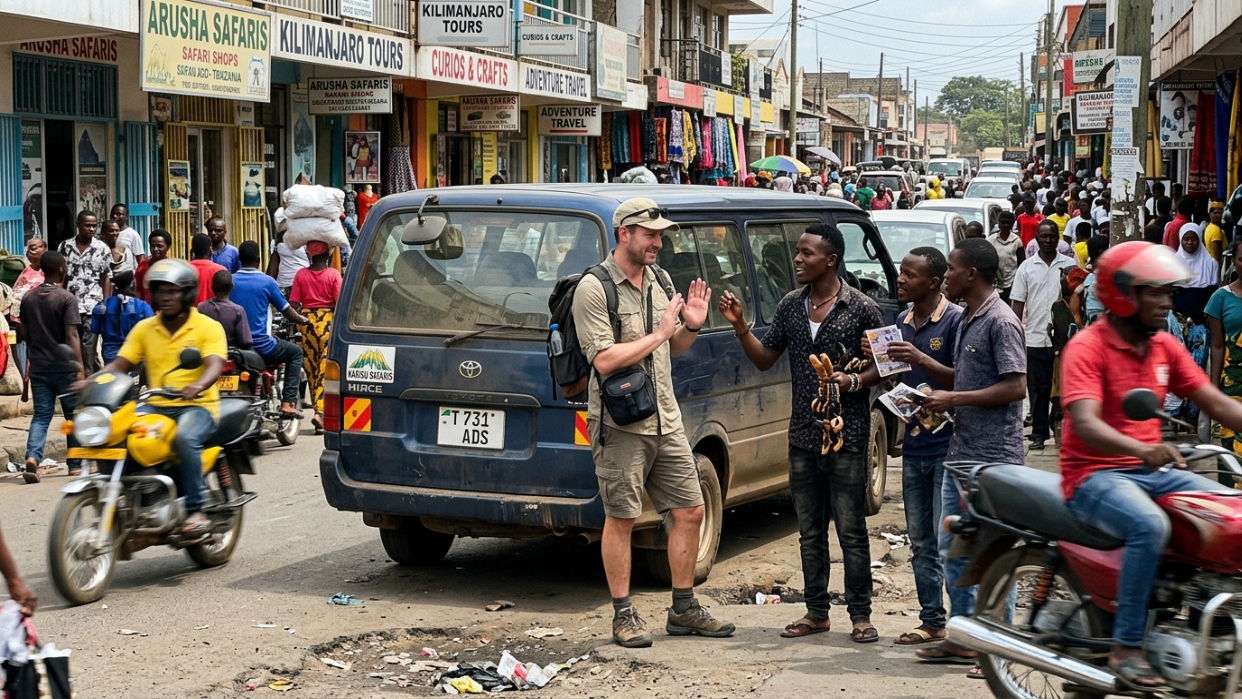
A local term for aggressive street touts in Arusha, Tanzania, who approach tourists to sell safari packages, souvenirs, or services. They may swarm your vehicle at traffic lights or follow you on foot through town.
Flycatchers are annoying, not dangerous. The appropriate response is a firm “no, thank you” without engaging further. Do not book a safari from someone you meet on the street in Arusha. Scams are common, and there’s no recourse once you’ve paid cash to an unlicensed tout.
Street Safari Scams
Unlicensed operators or individuals who sell safari packages on the street, typically at suspiciously low prices. Common patterns include collecting full payment upfront and delivering substandard vehicles, unqualified guides, and missing park fee payments (which means you get turned away at the gate).
Prevention: Book with a licensed, verifiable operator before you arrive. If a price seems too good to be true, it is.
Ride-Hail Apps (Uber, Bolt)
Ride-hail apps are available in Nairobi, Dar es Salaam, Kampala, and Kigali. They provide metered, trackable transportation that eliminates fare negotiation and provides a record of your trip.
Why it matters for urban East Africa safety: Ride apps are consistently safer than hailing random taxis on the street, especially at night or when you don’t know the local fare structure. Use them.
Hotel-Arranged Transport
Most hotels and lodges in East African cities will arrange airport transfers and local transport through trusted drivers. This costs more than a street taxi but provides accountability.
Practical tip: For your first arrival in a new city, arrange airport pickup through your hotel or operator. Once you’re oriented, ride-hail apps work well for subsequent trips.
Common Urban Crime Patterns
Petty theft and pickpocketing are the most common crimes affecting tourists in East African cities. Crowded markets, public transport, and nightlife districts carry the highest risk. Violent crime against tourists is rare.
Standard precautions apply: avoid walking alone at night, keep valuables secured and out of sight, use front pockets or a money belt, don’t flash expensive cameras or phones in busy areas, and maintain awareness of your surroundings. These are the same precautions you’d follow in any major city worldwide.
For coastal travel, our Zanzibar safety glossary covers beach-specific and Stone Town safety terms.
Operator Safety Credentials
This section defines the certifications and credentials that distinguish operators with genuine safety cultures from those making empty claims. Every term here represents something you can verify before booking.
KPAP (Kilimanjaro Porters Assistance Project)
A nonprofit organization that advocates for fair treatment of porters on Kilimanjaro. KPAP partner operators commit to verifiable standards: fair wages, proper equipment (warm clothing, sleeping bags, shelter), weight limits on loads (20 kg maximum), and adequate food.
Why it matters: Porter welfare is a safety issue. Overloaded, underfed, poorly equipped porters cut corners that affect climber safety, from rushing camp setup to being unable to assist in emergencies. KPAP partnership is verifiable through their public database. Duma Explorer is a KPAP founding partner.
Travelife Certified
An international sustainability certification for travel companies. Travelife evaluates environmental practices, labor conditions, community impact, and supply chain management through independent audits.
Why it matters: Travelife certification indicates an operator that submits to external accountability. It’s particularly rare among Tanzania-based operators, which makes it a meaningful differentiator.
EcoTraining
A professional wildlife training institution that offers courses in field guiding, wildlife tracking, and conservation. EcoTraining programs develop the skills guides need to interpret wildlife behavior, assess risk in the field, and manage guest safety during close animal encounters.
Why it matters: An operator that invests in ongoing guide training through programs like EcoTraining is investing in the competence that keeps you safe. Ask whether your safari guide has completed recent professional development.
Duma Explorer’s safari guides complete EcoTraining programs, and the company is rolling out FGASA Level 1 certification for its safari guide team. Its Kilimanjaro guides hold Wilderness First Responder certification.
Licensed vs. Unlicensed Operator
In Tanzania, legitimate safari and mountain climbing operators must hold a license from TALA (Tanzania Association of Tour Operators, formerly TANAPA licensing) and be registered with the relevant national authorities. Licensed operators carry mandatory insurance, maintain vehicle safety standards, and are subject to regulatory oversight.
Unlicensed operators have none of these obligations. They’re the ones selling $500 Kilimanjaro climbs or $50-per-day safaris. The savings come directly from safety: uninsured vehicles, untrained guides, no emergency protocols, and underpaid crew.
How to verify: Ask for the operator’s TALA membership number. Check it against published member lists. Any legitimate operator will provide this without hesitation.
Guide-to-Climber Ratio (Summit Day)
The number of guides assigned per climber during Kilimanjaro’s summit night push, typically starting around midnight for a 6 to 8 hour ascent. Budget operators may assign one guide to four or more climbers. This means if one climber develops altitude sickness, the single guide must either abandon the sick climber or leave the others unsupervised on a dark, steep, subzero summit trail.
A 1:1 guide-to-climber ratio on summit day means every climber has a dedicated guide who can monitor their condition, adjust their pace, and initiate descent immediately if needed. This is the standard that separates operators who prioritize safety from those who prioritize margins.
Red Flags When Choosing a Safari or Trek Operator
Avoid operators that show any of the following warning signs:
No licensing or certification proof
If they cannot provide a TALA license or equivalent registration, do not book.
Extremely low pricing
Prices significantly below market average often mean:
-
Unqualified guides
-
No insurance coverage
-
Poor equipment and safety standards
No mention of safety protocols
Reputable operators clearly discuss:
-
Evacuation plans
-
Medical equipment
-
Guide certifications
-
Insurance requirements
Cash-only or pressure sales tactics
Street bookings or urgency-based discounts are common scam patterns in tourist hubs like Arusha.
No clear itinerary or camp details
Vague descriptions usually indicate lack of operational control.
How Safe Are East Africa’s Main Safari Zones?
To put all of these terms in perspective: the primary safari regions across East Africa, including the Serengeti, Ngorongoro Crater, Tarangire, Lake Manyara, Masai Mara, and Amboseli, have high security, strong guide presence, and structured lodge operations. These are well-developed tourism ecosystems with decades of operational experience.
Countries like Tanzania, Kenya, and Rwanda operate highly regulated safari systems with controlled wildlife management. The CDC describes health and safety issues on African safaris as “mostly predictable and largely avoidable” with proper preparation.
Safety depends on location, season, and behavior. Safari ecosystems are generally low-crime environments. Urban centers require standard metropolitan awareness. Mountains require altitude preparation. Gorilla treks require disease prevention protocols. Each activity has its own risk profile and its own safety vocabulary, which is exactly what this glossary exists to teach.
Safety Overview by Country (2026 Snapshot)
While safety depends more on activity than geography, travelers often compare countries before planning. Here is a practical breakdown of risk context:
Tanzania
-
Safest for safari circuits (Serengeti, Ngorongoro, Kilimanjaro)
-
Low crime in parks, high tourism infrastructure
-
Urban caution needed in Dar es Salaam and Arusha
Kenya
-
Strong safari safety infrastructure (Masai Mara, Amboseli)
-
Nairobi requires urban awareness (petty theft, traffic safety)
-
Highly developed tourism ecosystem
Rwanda
-
One of the safest countries in Africa for tourists
-
Extremely organized gorilla trekking system
-
Strict enforcement of park rules
Uganda
-
Safe for gorilla trekking and safaris with guides
-
Higher variability in infrastructure outside tourist zones
-
Current health advisories may affect travel planning (check updates)
If you’re ready to move from research to planning, explore East Africa trip options that combine these experiences into a single, well-coordinated itinerary.
Best Time to Visit East Africa for Safer Travel Conditions
June to October (Dry Season)
-
Best wildlife visibility
-
Lower malaria risk in some regions
-
Easier road access in parks
December to February
-
Good for Kilimanjaro climbs
-
Peak gorilla trekking season
March to May (Rainy Season)
-
Fewer tourists but harder travel conditions
-
Higher risk of road delays and muddy terrain
Final Takeaway: How to Stay Safe in East Africa East Africa is safest when travelers understand that risk is not defined by country, but by activity. Safaris in regulated parks, guided mountain climbs, and organized gorilla trekking are all highly controlled experiences with strong safety systems in place. The most important factors are choosing licensed operators, following guide instructions, preparing for altitude or disease risks, and using proper travel insurance with medical evacuation coverage.
Frequently Asked Questions
Is East Africa safe for tourists in 2026?
Yes, with appropriate preparation. Safari zones, national parks, and established tourist circuits across Tanzania, Kenya, and Rwanda remain safe and fully operational. The main variable right now is the Ebola outbreak affecting eastern DRC and Uganda, which has led to elevated travel advisories for those countries. Tanzania and Kenya have increased border health screening but are not directly affected. Check current CDC and State Department advisories before finalizing plans.
What vaccinations do I need for East Africa?
Yellow fever vaccination is mandatory for entry into most East African countries. The CDC also recommends typhoid, hepatitis A and B, tetanus/diphtheria booster, meningitis, and rabies (for remote travel). Malaria prophylaxis is essential throughout the region. Schedule a pre-travel consultation with a travel medicine specialist at least 4 to 6 weeks before departure.
How do I know if a Kilimanjaro operator is safe?
Ask five specific questions. Do your guides hold Wilderness First Responder (WFR) certification? Do you carry supplemental oxygen and a Gamow bag at high-altitude camps? What is your guide-to-climber ratio on summit day? Are you a KPAP partner? Do you use the Western Breach route? The answers will tell you more than any marketing copy.
Is gorilla trekking safe?
Gorilla trekking with habituated families is a well-controlled, low-risk activity when conducted through licensed operators following park authority rules. Mountain gorillas are shy, not aggressive. The safety rules (distance minimums, group size caps, masks, one-hour viewing limits) primarily exist to protect the gorillas from human disease, not the other way around. Follow your guide’s instructions and the risk to you is minimal.
Do I need travel insurance for East Africa?
Absolutely, and it must include medical evacuation coverage. Standard health insurance from your home country almost certainly won’t cover treatment or evacuation in East Africa. A medical evacuation from a remote safari location or Kilimanjaro can cost $50,000 to $100,000+ without insurance. This is not optional.
What is the biggest safety risk on Kilimanjaro?
Altitude sickness. It affects most climbers to some degree and can progress from mild AMS to life-threatening HAPE or HACE. The most effective prevention is choosing a longer itinerary (7 to 9 days) that allows proper acclimatization. The most important safety mechanism is a guide who monitors your health daily and will enforce descent when necessary, regardless of summit ambitions.
Are Arusha and Nairobi safe for tourists?
Both cities are safe for tourists who exercise standard urban precautions: avoid walking alone at night, secure valuables, use ride-hail apps or hotel-arranged transport, and stay alert in crowded areas. Petty theft and pickpocketing are the primary risks. Violent crime against tourists is rare. The “flycatcher” touts in Arusha are persistent but not dangerous.
How does East Africa safety compare to other popular safari destinations?
East Africa’s safari zones are comparable in safety to southern African destinations like Botswana and Namibia. All operate with professional guiding, structured security, and decades of tourism management. The key difference is that East Africa offers a wider range of activities (safari, high-altitude climbing, gorilla trekking, beach travel) across multiple countries, which means travelers need to prepare for a wider range of activity-specific safety considerations rather than a single type of trip.