Zanzibar Packing List 2026: What to Wear, Pack & Avoid
TL;DR
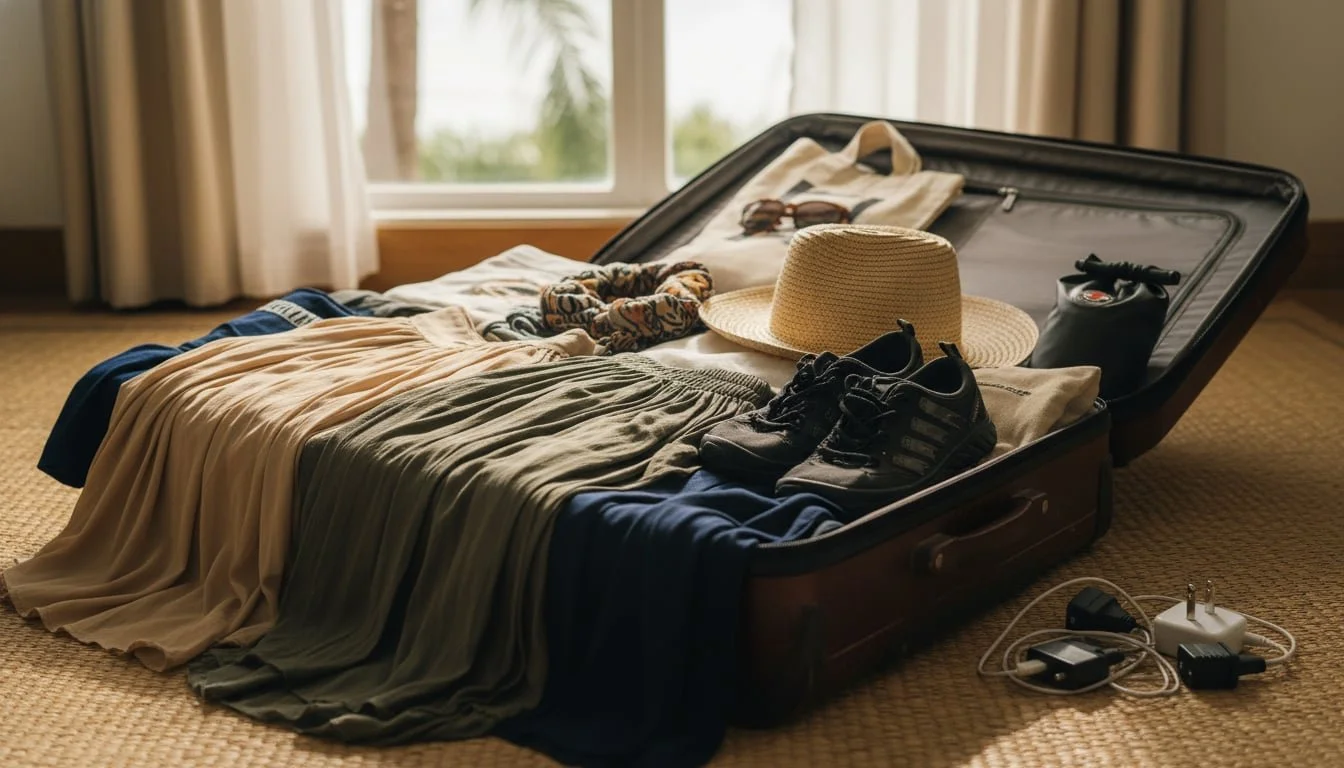
Zanzibar requires more thoughtful packing than a typical beach vacation because of Islamic modesty norms, Tanzania’s plastic bag ban, specific power plug types (D and G), and extreme tidal conditions that make water shoes essential. If you’re combining a mainland safari with Zanzibar, domestic bush flights enforce a strict 15 kg soft-bag luggage limit that forces strategic choices. This guide covers every item category, explains why each one matters for Zanzibar specifically, and breaks down what to pack by season so nothing catches you off guard at the airport.
Quick Checklist: Zanzibar Essentials
What are the most important things to pack for Zanzibar? To stay compliant with local laws and customs in 2026, your Zanzibar packing list must include:
Modest Clothing: Shoulders and knees covered for Stone Town and villages.
Water Shoes: Essential for East Coast coral/sea urchins during low tide.
Soft-Sided Luggage: Strictly under 15kg if taking bush flights.
Universal Adapter: Type G (UK) and Type D (Tanzania-specific).
Reef-Safe Sunscreen: To protect the fragile Mnemba and Chumbe ecosystems.
Prohibited: All plastic carrier bags (subject to fines/confiscation).
Why Zanzibar Demands Its Own Packing List
Zanzibar is not a generic tropical destination. It is a semi-autonomous archipelago off Tanzania’s coast, a UNESCO World Heritage site (Stone Town), and home to a population that is roughly 97 to 99 percent Muslim. These facts shape every packing decision you make, from the clothes on your back to the bags you carry them in.
A standard beach packing list will leave you underprepared. You’ll need to account for how Zanzibar differs from mainland Tanzania in terms of culture, climate, and logistics. You’ll need to understand Tanzania’s nationwide plastic bag ban, know which power adapters fit the outlets, and plan your wardrobe for both resort beaches and conservative town settings.
If you’re arriving from a safari on the mainland (as most East Africa travelers do), you also face a wardrobe transition challenge: fitting neutral-colored safari layers and light beach wear into a single soft duffel that weighs under 15 kilograms. This Zanzibar packing list covers all of it.
Clothing and Cultural Dress
Zanzibar Dress Code and Modesty Norms
This is the single most important concept on your Zanzibar packing list that separates it from any other beach destination. Modesty is a core value deeply rooted in Islamic culture on the island. When you show too much skin in public areas, it is considered inappropriate and offensive to locals.
What this means in practice: avoid short shorts, mini-skirts, crop tops, strapless tops, low-cut necklines, sleeveless shirts, and overly tight clothing when you’re in Stone Town, at markets, or walking through villages. At your resort pool or private hotel beach, standard swimwear is perfectly fine. The key is knowing when you’re transitioning from a tourist zone to a public space.
Zanzibar hotel operators report that a scarf or shawl for modesty is one of the items guests forget most frequently. Pack one.
Cover-Up, Sarong, and Kanga
A kanga is the local East African wrap, a rectangular cotton cloth with printed borders and often a Swahili proverb along the edge. A sarong serves the same function. Either one is arguably the most versatile item on the island.
Travelers consistently describe this as their hardest-working piece of clothing: sun shield at the beach, cover-up for walking into town, light blanket on a dhow boat trip, towel in a pinch, and mosque cover when exploring Stone Town’s historic sites. You can buy kangas cheaply at Darajani Market in Stone Town, but pack at least one from home so you’re covered from day one.
Linen and Breathable Fabrics
Natural fibers (cotton, linen, bamboo, silk) allow airflow in Zanzibar’s tropical humidity, which regularly exceeds 80 percent. Linen breathes better than anything else in those conditions, though it wrinkles easily. Cotton is the reliable middle ground.
Synthetic athletic fabrics wick moisture but tend to trap heat against your skin. They work for active excursions but feel miserable during a slow afternoon wandering Stone Town’s narrow alleys. Pack lightweight, loose-fitting pieces in natural fabrics for town days and save the synthetics for water sports or snorkeling trips.
Modest Swimwear and Rash Guards
For snorkeling or swimming near local (non-resort) beaches, a one-piece swimsuit or rash guard strikes the right balance between cultural sensitivity and practicality. Rash guards also serve double duty as UV protection, which matters enormously near the equator where the UV index regularly hits 11 or higher.
If you’re booking a snorkeling trip to Mnemba Atoll or swimming off Chumbe Island, a rash guard is the smarter choice over a bikini top anyway. It prevents sunburn on your back during hours spent floating face-down over coral.
Neutral-Colored Safari Layers for Combo Trips
Here’s a packing insight that no other Zanzibar packing list seems to cover: if you’re arriving from a Tanzania safari, your safari wardrobe can do double duty. The neutral-toned long-sleeved shirts and lightweight trousers you wore on game drives work perfectly as modest town clothing in Zanzibar. Olive, khaki, and tan all fit Stone Town’s relaxed aesthetic.
This matters because of luggage constraints (more on the 15 kg rule below). Instead of packing entirely separate wardrobes for safari and beach, plan for overlap. A linen button-down in a muted tone works in a Land Cruiser and in a Stone Town restaurant. For women, safari outfit tips translate directly to Zanzibar town wear.
Light Evening Layer
During the dry season (June through October), nighttime temperatures on Zanzibar drop to around 20°C (68°F), according to climate data for the region. After spending all day in 30°C heat, that drop feels significant. A light fleece, linen cardigan, or cotton hoodie takes up minimal bag space and makes rooftop dinners in Stone Town far more comfortable.
Footwear
Water Shoes and Reef Shoes
These are not optional on Zanzibar’s east coast. At beaches like Paje, Jambiani, and Michamvi, the tidal range is extreme. At low tide, the water recedes hundreds of meters and exposes a vast flat of razor-sharp coral reef. To reach swimmable depth, you walk across this exposed reef. Without water shoes, you risk deep cuts from coral and puncture wounds from sea urchin spines.
Practitioners on travel forums call water shoes “non-negotiable” for Zanzibar’s east coast, and they’re right. Neoprene or mesh reef shoes with a solid sole are the standard. They’re also useful for beach entries on the north coast, where rocky patches appear without warning. Check our guide to Zanzibar’s best beaches to understand which coastlines require them most.
Walking Shoes for Stone Town
Stone Town’s streets are a maze of narrow alleys paved with old stone and coral rag. These surfaces are uneven, slippery when wet, and rough on bare feet or thin-soled shoes. A pair of comfortable closed-toe walking shoes or sturdy sneakers makes a full day of exploring much more pleasant.
You don’t need hiking boots. Lightweight trail shoes or comfortable sneakers with good traction are enough.
Hybrid Sandals vs. Flip-Flops
Sport sandals (the kind with adjustable straps and textured soles) work for casual beach walks, boat transfers, and light town exploration. Most experienced Zanzibar travelers recommend these over flip-flops for anything beyond the resort pool. Stone Town’s uneven streets and steep staircases are genuinely hazardous in flip-flops.
That said, flip-flops still earn a spot on your Zanzibar packing list for showers, pool decks, and quick walks from your room to the beach. Just don’t make them your primary footwear.
Sun and Reef Protection
Reef-Safe Sunscreen
Approximately 14,000 tons of sunscreen enter the ocean every year, and chemicals like oxybenzone and octinoxate have been shown to damage coral DNA and accelerate bleaching. Zanzibar’s coral reefs, particularly around Mnemba Atoll and Chumbe Island Coral Park, are protected marine ecosystems.
Reef-safe sunscreen uses mineral-based active ingredients, typically zinc oxide or titanium dioxide, instead of chemical UV filters. It leaves a slight white cast on skin but does not dissolve into the water to poison coral. Given that snorkeling and diving are among Zanzibar’s biggest draws, packing reef-safe sunscreen is both an environmental and practical choice.
SPF 50+ and UPF Ratings Explained
SPF (Sun Protection Factor) measures how long sunscreen protects against UVB rays. SPF 50 blocks about 98 percent of UVB. UPF (Ultraviolet Protection Factor) measures the same thing for fabric. A UPF 50 shirt blocks roughly 98 percent of UV radiation from reaching your skin.
Zanzibar sits at approximately 6 degrees south of the equator, meaning the sun is nearly directly overhead year-round. The UV index routinely exceeds 11, which the WHO classifies as “extreme.” Reapply sunscreen every two hours, and more often after swimming. A UPF-rated hat and shirt remove the guesswork.
Wide-Brim Hat and Polarized Sunglasses
A wide-brim hat (not a baseball cap) protects your ears, neck, and nose. Polarized sunglasses cut the intense glare off Zanzibar’s turquoise water, which matters both for comfort and for actually seeing the reef while snorkeling from a boat. Bring a retention strap for your sunglasses. Losing them overboard on a dhow trip is a common and expensive mistake.
Health and Safety Essentials
DEET and Picaridin Insect Repellent
These are the two most effective active ingredients for mosquito repellent. The CDC recommends that travelers going to Tanzania take malaria precautions for all areas below 1,800 meters elevation, and Zanzibar is at sea level. While Zanzibar’s malaria risk is lower than the mainland, it is not malaria-free.
Peak mosquito activity runs from roughly 5 PM to 9 PM. A repellent with 25 to 50 percent DEET or 20 percent picaridin provides effective protection. Apply it to exposed skin every evening, especially if you’re dining outdoors.
Malaria Prophylaxis
This is prescription anti-malarial medication that you begin taking before arriving in Tanzania and continue for a period after leaving (the duration depends on the drug). Recommended options include atovaquone-proguanil (Malarone), doxycycline, mefloquine, and tafenoquine. Each has different side effect profiles and dosing schedules.
Consult a travel medicine doctor at least four to six weeks before departure. This isn’t something to sort out at the last minute, because some prophylaxis regimens start one to two weeks before you enter the malaria zone.
Yellow Fever Certificate
A yellow fever vaccination certificate (the “yellow card”) is required if you’re arriving from or transiting through a country where yellow fever is endemic. This includes many East African and South American nations. If you’re flying directly from the US, UK, or Europe, it is not required.
Enforcement at Zanzibar’s airport can be strict. Travelers on forums report being pulled aside and asked to show the certificate upon arrival, particularly those with connecting flights through Nairobi, Addis Ababa, or Kigali. If your routing passes through an endemic country, get the vaccine and bring the card. No exceptions.
Basic Medical Kit
Zanzibar has pharmacies in Stone Town and some tourist areas, but the selection is unpredictable and quality varies. Pack a small kit with: anti-diarrhea medication (loperamide), oral rehydration salts, adhesive bandages, antiseptic wipes, antibiotic ointment, pain relievers (ibuprofen and acetaminophen), and any personal prescriptions.
A broad-spectrum antibiotic prescribed by your travel doctor is worth having for bacterial infections that might develop in remote beach areas far from a pharmacy.
Hydration Salts and Electrolytes
Zanzibar’s hot season (December through March) pushes maximum temperatures to 32 to 33°C with high humidity. Dehydration sneaks up fast, especially when you’re spending full days in the sun or on boat excursions. Electrolyte sachets weigh almost nothing and can prevent a miserable day. Toss five or six packets into your medical kit.
Documents and Money
Tanzania eVisa
Tanzania offers an electronic visa through its official immigration portal. The cost is $50 for most nationalities and $100 for US travelers. You can also get a visa on arrival, but the eVisa process avoids long queues at immigration.
Your passport must be valid for at least six months beyond your entry date and have a minimum of two blank pages. Apply for the eVisa at least two weeks before travel. Processing times vary, and applying early removes one source of pre-trip stress.
Tanzanian Shillings (TZS)
The local currency is the Tanzanian shilling. US dollars are widely accepted at hotels, tour operators, and some restaurants, but you’ll need shillings for markets, street food, local buses (dala-dalas), and small shops. ATMs are available in Stone Town and major tourist areas.
Experienced travelers recommend carrying $200 to $500 USD in cash as backup. Bring clean, newer bills (2006 series or later for USD), as older or damaged notes are sometimes refused. Smaller denominations ($5, $10, $20) are more useful than $100 bills for everyday transactions.
Travel Insurance
This belongs on every Zanzibar packing list, even though it’s not a physical item. A policy that covers medical evacuation is essential. Zanzibar has basic medical facilities, but anything serious requires evacuation to Dar es Salaam or Nairobi. Medical evacuation flights can cost $10,000 to $50,000 without insurance. Read the fine print to confirm your policy covers water sports like snorkeling and diving if you plan to do either.
Passport Requirements
Six months validity beyond your entry date. Two blank pages minimum. Make a photocopy of your passport’s information page and store it separately from the original (a photo on your phone works too). If your passport is stolen, having a copy dramatically speeds up the replacement process at your embassy.
Electronics and Gear
Zanzibar Power & Connectivity at a Glance
| Feature | Specification | Requirement |
|---|---|---|
| Voltage | 230V / 50Hz | Voltage converter needed for US 110V devices |
| Plug Types | Type G (Primary), Type D (Old buildings) | Universal "World" Adapter |
| Mobile Data | Zantel or Airtel | Purchase eSIM or local SIM at Stone Town |
| Power Stability | Frequent brownouts | 10,000+ mAh Power Bank essential |
Type D and Type G Power Adapters
Zanzibar uses Type D and Type G power plugs at 230V and 50Hz. Type G is the UK-style three rectangular pins. Type D has three large round pins in a triangular pattern. Most accommodations have Type G outlets, but you may encounter Type D in older buildings.
A universal travel adapter covers both. North American travelers absolutely need one, as US plugs won’t fit either socket type. Do not forget that the voltage is 230V. Devices with built-in voltage converters (laptops, phone chargers, most modern electronics) are fine, but older appliances designed for 110V only will be damaged without a voltage converter.
Power Bank
A power bank rated at 10,000 mAh or higher is a genuine necessity on Zanzibar, not a convenience. Full-day excursions (spice tours, snorkeling trips, dhow cruises) keep you away from outlets for 8 to 12 hours. Power outages are also a reality, particularly at guesthouses and lodges outside Stone Town. Practitioners on Reddit and travel forums frequently mention evening blackouts in rural areas along the east coast.
A headlamp or small flashlight serves a similar purpose. When the power goes out at your guesthouse at 9 PM, you’ll be glad you packed one.
Waterproof Phone Case and Dry Bag
Between boat transfers, snorkeling excursions, and unexpected rain, your electronics face constant moisture exposure. A waterproof phone case rated IPX8 lets you take underwater photos while protecting against the obvious. A small dry bag (5 to 10 liters) protects your wallet, passport, and camera during boat trips where spray is unavoidable.
Camera and Memory Cards
Zanzibar is absurdly photogenic: turquoise water, white sand, carved wooden doors in Stone Town, dhow boats at sunset. If you’re bringing a camera beyond your phone, pack extra memory cards and a lens cleaning cloth (salt spray coats everything). A polarizing filter cuts water glare for reef shots from boats.
Luggage and Packing Logistics
Soft-Sided Duffel and the 15 kg Bush Flight Rule
This is the most overlooked item on any Zanzibar packing list, and it matters enormously for travelers combining safari with beach time. Domestic bush flights between safari parks and Zanzibar (operated by carriers like Coastal Aviation and Auric Air) enforce a maximum luggage allowance of 15 kg (33 lbs) per person including carry-on, in soft bags only. Maximum dimensions are 40 cm x 40 cm x 80 cm for soft duffel-style bags.
Hard-shell suitcases may not physically fit in the cargo pods of small Cessna aircraft. This isn’t a suggestion. Travelers report being asked to leave hard luggage behind at the airstrip. If you’re planning a multi-experience East Africa trip that moves from safari to Zanzibar, a soft-sided duffel is the only sensible luggage choice.
Tanzania Plastic Bag Ban
What Counts as "Plastic" in 2026?
To avoid delays at Abeid Amani Karume International Airport (ZNZ), swap these common items:
REMOVE: Plastic grocery bags used for dirty laundry.
REPLACE WITH: Nylon or mesh drawstring laundry bags.
REMOVE: Plastic "Ziplocs" used for snacks.
REPLACE WITH: Silicone reusable pouches (Stasher bags).
STAY: Transparent toiletry "Ziplocs" are currently permitted for liquids, provided they leave the country with you.
Tanzania has prohibited the importation, exportation, manufacture, sale, storage, supply, and use of all plastic carrier bags. This isn’t a vague policy. Customs officers at airports and border posts have designated desks where they collect prohibited plastic bags.
Ziplock bags used to carry toiletries are allowed, as they’re considered to remain in your possession. But the plastic shopping bags, garbage bags, and carrier bags many travelers use to organize clothes inside their luggage? Those can be confiscated. TikTok creators who’ve traveled to Zanzibar consistently flag this as catching people off guard at the airport. Replace plastic bags with reusable alternatives before you leave home.
Packing Cubes
Compression cubes or packing organizers become especially valuable when you’re fitting two trip contexts (safari and beach) into a single 15 kg soft duffel. Organize by activity: one cube for safari layers, one for beach and town wear, one for swimwear and undergarments. The compression versions can reduce volume by 30 to 50 percent.
For travelers looking at Tanzania safari itineraries that end with a Zanzibar extension, packing cubes transform a logistical headache into something manageable.
Reusable Tote Bag
With the plastic bag ban in effect, a lightweight, foldable tote bag handles everything from market shopping in Stone Town to carrying your snorkel gear to the beach. It weighs almost nothing and solves a real, recurring problem throughout your trip.
Seasonal Packing Adjustments
Zanzibar’s climate is tropical year-round, but what you add to your base packing list shifts meaningfully with the seasons.
Dry Season: June Through October
This is the easiest packing window. Warm days around 29 to 30°C, low humidity, and breezy evenings. The cooler period runs from May through August, and nighttime lows around 20°C mean you’ll want a light layer for evenings. Otherwise, pack your standard Zanzibar essentials and not much else. This is also prime time for combining with a mainland safari, as it coincides with the best time for a Tanzania safari.
Hot Season: December Through March
The hottest period, with maximum temperatures hovering around 32 to 33°C and high humidity. Plan for two shirt changes per day due to sweat. Pack extra breathable tops, more underwear than you think you need, and strong antiperspirant. Electrolyte sachets earn their weight in gold during this window. Dehydration risk is real, especially on full-day boat excursions without shade.
Long Rains: March Through May
Heavy afternoon downpours are the norm. A packable rain jacket and quick-dry clothing become essential additions to your Zanzibar packing list. A waterproof bag or dry bag for electronics is mandatory, not optional. Some east-coast beaches accumulate seaweed during this period, which can affect your beach plans and reduce the utility of packing exclusively for swimming.
Short Rains: November Through December
Quick tropical showers interspersed with mostly sunny days. A compact travel umbrella or packable poncho is enough. This is still strong beach weather, and the brief rains often clear within an hour. The shoulder season also means fewer crowds at popular spots.
What NOT to Bring to Zanzibar
Knowing what to leave behind saves weight and prevents hassles.
Plastic carrier bags. They will be confiscated at customs. Use reusable bags or packing cubes instead.
Heavy jeans or thick fabrics. Denim in 80 percent humidity is pure misery. Leave it at home.
Revealing clothing for town use. Crop tops, short shorts, and strapless tops are inappropriate outside resort grounds. You won’t be arrested, but you’ll draw negative attention and disrespect local culture.
Hard-shell luggage. If you’re flying domestically between safari parks and Zanzibar on bush planes, hard cases may not fit and will likely exceed the 15 kg limit.
Excessive “just in case” items. The 15 kg limit forces discipline. If you haven’t used an item in your last three trips, it doesn’t belong in the bag. Stone Town has shops and pharmacies if you’ve genuinely forgotten something critical.
Valuable jewelry. Leave it at home. You don’t need it, and it creates unnecessary risk.
Planning a Safari and Zanzibar Trip?
Most travelers visiting Zanzibar are combining it with a mainland Tanzania safari or Kilimanjaro climb. That dual-context trip creates specific packing challenges, from wardrobe crossover to luggage weight limits to visa and vaccination logistics. Working with an operator who handles these transitions daily makes the planning significantly easier. Duma Explorer designs custom safari and Zanzibar itineraries that account for bush flight logistics, seasonal timing, and the small details that turn a trip from stressful to seamless. If you’re weighing Zanzibar beach resorts alongside safari lodges, having one operator coordinate both sides removes the guesswork.
Frequently Asked Questions
-
On the east coast, yes. Beaches at Paje, Jambiani, and Michamvi have extreme tidal shifts that expose hundreds of meters of sharp coral reef at low tide. Walking to swimmable water without reef shoes risks serious cuts and sea urchin punctures. On the north and west coast beaches, water shoes are less critical but still useful for rocky entry points.
-
Hotels, tour operators, and some restaurants accept USD. But markets, street food vendors, dala-dala buses, and small shops operate in Tanzanian shillings. ATMs in Stone Town dispense shillings. Carry both currencies and keep smaller USD bills ($5, $10, $20) for flexibility.
-
Customs officers at Zanzibar’s airport have designated desks where they inspect luggage and confiscate prohibited plastic carrier bags. Ziplock bags for toiletries are allowed since they stay in your possession. Replace any plastic shopping or garbage bags with reusable alternatives before you travel.
-
Use a soft-sided duffel (not a hard suitcase) that fits within the 15 kg domestic flight limit. Choose neutral-colored clothing that works for both game drives and modest town wear. Pack two or three beach-specific items (swimsuit, sarong, water shoes) and let your safari wardrobe handle the rest. Packing cubes keep everything organized.
-
Yes, though the risk is lower than mainland Tanzania. The CDC recommends malaria prophylaxis for all areas of Tanzania below 1,800 meters, and Zanzibar is at sea level. Consult a travel medicine doctor at least four to six weeks before your trip to get a prescription and start the appropriate medication on schedule.
-
Zanzibar uses Type D and Type G plugs at 230V/50Hz. Type G is the UK-style three rectangular pins. A universal travel adapter handles both socket types. Most modern phone chargers and laptop adapters automatically convert voltage, but check your devices before plugging them in.
-
The dry season from June through October requires the lightest packing load: warm days, cool breezes, low humidity, and virtually no rain. The hot season (December through March) demands more clothing changes and hydration supplies. Both rainy seasons add rain gear to the list.
-
Only if you’re arriving from or transiting through a yellow fever endemic country (common transit hubs like Nairobi and Addis Ababa may trigger this requirement depending on your routing). Direct arrivals from the US, UK, or Europe do not need the certificate. Check your specific itinerary carefully, as enforcement at Zanzibar’s airport is strict.