

Flying into Tanzania’s remote bush camps is one of the best ways to experience a safari, but it comes with a constraint that catches many first-time travelers off guard: strict luggage limits. On most luxury safari luggage flights, you’re allowed just 15 to 20 kg per person (including everything you carry on board), and your bag must be soft-sided. Hard suitcases are refused. This glossary defines every term you’ll encounter when navigating luggage rules, airline policies, bag types, and flight logistics for fly-in safaris in Tanzania.
TL;DR
Fly-in safari flights in Tanzania typically allow 15 kg (Coastal Aviation) or 20 kg (Auric Air) per person, including hand luggage and camera gear. Soft-sided duffel bags are required because rigid suitcases don’t fit in bush plane cargo holds. Excess luggage can be stored at Arusha hotels or airline offices. Coastal Aviation offers a premium XL seat class that doubles your allowance to 30 kg, which is worth knowing if you’re traveling with heavy photography equipment.
What Is the Luggage Limit for Luxury Safari Flights in Tanzania? Luxury safari flights in Tanzania generally allow between 15 kg and 20 kg of total luggage per passenger, depending on the airline. Coastal Aviation allows 15 kg, while Auric Air allows 20 kg, with both allowances including hand luggage and camera equipment. Coastal Aviation also offers an XL seat class that can increase the allowance to 30 kg, subject to availability and operational confirmation. Soft-sided duffel bags are recommended for most bush flights because small aircraft have limited cargo space. However, bag requirements vary by airline: some require soft-sided luggage, while others accept different bag types within specified dimensions. Travelers carrying additional luggage can arrange excess baggage, use airline storage facilities, or leave unnecessary items with their Arusha hotel or safari operator. The most important packing rule: Always follow the baggage policy of the airline operating your specific flight, not the allowance of your international airline.
Quick Reference: Tanzania Safari Flight Luggage Allowances (2026)
Tanzania's domestic safari airlines have different baggage allowances, bag requirements, and excess luggage arrangements. The allowance depends on the airline operating your flight, so check the rules for every flight segment before packing.
|
Airline |
Standard allowance |
Hand luggage included? |
Bag requirements |
Extra luggage options |
|---|---|---|---|---|
|
Coastal Aviation |
15 kg (33 lbs) |
Yes |
Soft-sided bags strongly recommended |
XL seat class: 30 kg, subject to operational confirmation |
|
Auric Air |
20 kg (44 lbs) |
Yes |
All bag types accepted; soft bags recommended |
Pre-booked excess baggage in 10 kg slabs |
|
Regional Air |
15 kg (33 lbs) |
Yes |
Soft-sided bags required |
Excess baggage subject to availability and freight charges |
|
Flightlink |
20 kg checked + up to 5 kg cabin baggage |
Separate allowances |
One checked bag; small soft-sided cabin bag |
Excess baggage charges and availability restrictions apply |
Important: These allowances are not interchangeable. Flightlink's published policy separates checked baggage from cabin baggage, whereas Coastal Aviation, Auric Air, and Regional Air include hand luggage in their stated total allowances.
Before departure, confirm the operating airline, aircraft, route-specific restrictions, and any additional baggage arrangements directly with the carrier.
Sources: Official Coastal Aviation luggage policy, Auric Air baggage policy, Regional Air baggage terms, and Flightlink baggage terms.
Core Luggage Terms
Soft-Sided Duffel
A bag made from flexible fabric (nylon, polyester, canvas) with no rigid internal frame. This is the standard requirement for bush flights because soft bags can be compressed and shaped to fit into small, irregularly shaped cargo holds. Most safari operators and airlines either require or strongly recommend them. Hard-shell suitcases and wheeled luggage are typically not accepted on safari bush flights because they can’t conform to the cargo space.
Popular choices among repeat safari travelers include the Patagonia Black Hole Duffel (40L or 55L) at around $169 to $199, the North Face Base Camp Duffel near $149, and the Eagle Creek Cargo Hauler 60L at roughly $80. The 40L size fits a 15 kg safari kit well. Every gram the bag itself weighs is a gram taken from your gear allowance, so avoid heavy leather weekender bags that eat up 3 kg before you’ve packed anything.
How to Choose a Duffel Bag for a Tanzania Safari Flight
Choosing the right safari duffel is about more than finding a bag with enough capacity. The bag must fit the airline's size restrictions, remain lightweight when empty, and be practical to carry between aircraft and safari vehicles.
Consider these factors before purchasing:
|
Feature |
What to look for |
Why it matters |
|---|---|---|
|
Capacity |
Approximately 40–60 liters |
Provides enough room for a compact safari wardrobe |
|
Empty weight |
Preferably around 1 kg or less |
Preserves more of your baggage allowance |
|
Material |
Durable nylon or polyester |
Handles frequent transfers and outdoor conditions |
|
Construction |
Flexible, soft-sided design |
Makes loading easier in small aircraft |
|
Handles |
Reinforced carry handles |
Useful when moving between aircraft and vehicles |
|
Zippers |
Durable, secure closures |
Helps protect belongings during transfers |
|
Organization |
Simple internal compartments |
Makes packing and unpacking easier |
Should you choose a 40L or 60L duffel?
A 40L bag is often sufficient for a short fly-in safari, especially when your camps provide laundry. A 55–60L bag offers more room for additional layers and accessories, but its dimensions and packed weight must still comply with the airline's requirements.
Remember that a bag's advertised capacity does not guarantee that it will fit inside an aircraft cargo pod. Check its actual dimensions against your airline's baggage policy before purchasing.
My recommendation: Choose a lightweight, flexible duffel rather than buying the largest bag available. For a 15 kg flight allowance, keeping the bag itself light can make a noticeable difference.
Bush Plane Weight Limit (The 15 kg Rule)
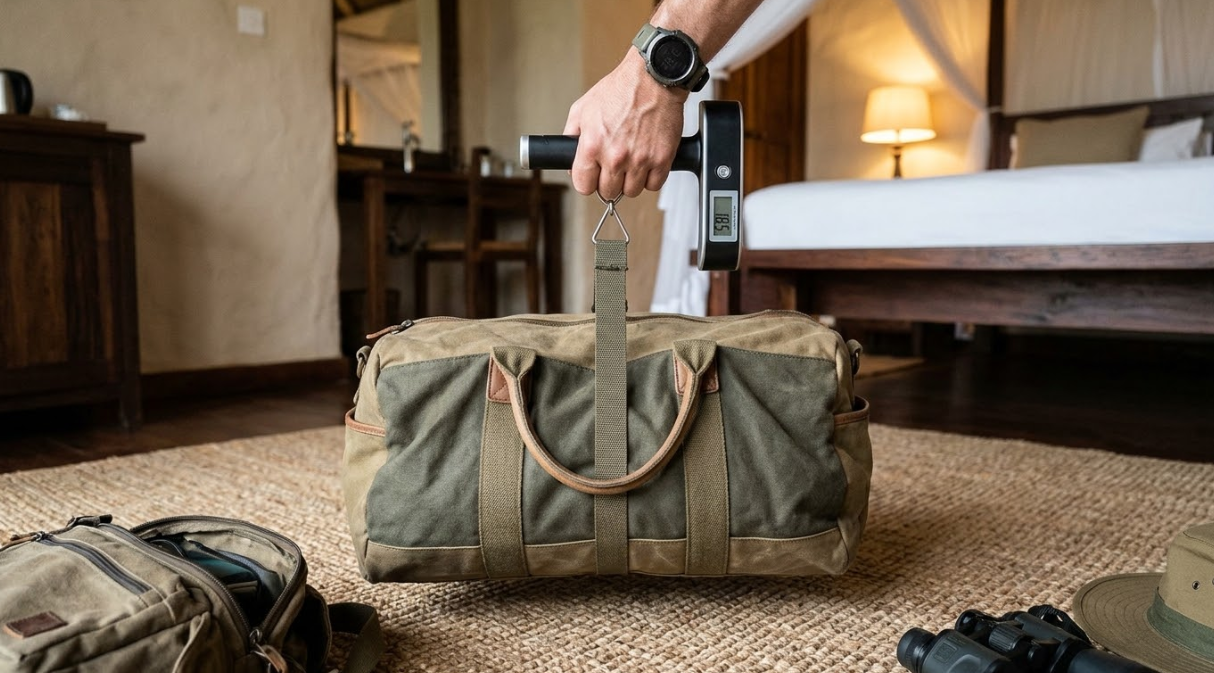
The standard luggage allowance on most Tanzania domestic safari flights. Coastal Aviation sets the bar at 15 kg per person, including carry-on items, cameras, and personal belongings. This is a safety limit, not a convenience policy. Bush aircraft like the Cessna Grand Caravan operate from short dirt airstrips, often at higher elevations and in heat that reduces lift performance. Weight-and-balance calculations are done per flight based on the actual weight of every passenger and bag.
Auric Air is more generous at 20 kg total, which gives photographers and families noticeably more breathing room.
Cargo Pod / Cargo Hold
The small external or internal storage compartment on a bush plane where checked bags are stowed. On a Cessna Grand Caravan, the cargo pod sits beneath the fuselage. Coastal Aviation’s cargo pod door measures just 76 cm × 48 cm × 29 cm. This is why a rigid hard-shell suitcase physically cannot be loaded the way a compressible duffel can. Some bags are also loaded around passengers’ legs and in the tail compartment.
Combined Weight Limit
A critical concept many travelers miss: on bush flights, your luggage allowance includes everything. Checked bag, carry-on, camera bag, handbag, water bottle, jacket. It all counts toward that 15 or 20 kg total. There is no separate carry-on allowance.
Example Safari Packing Weight Budget
A 15 kg allowance can be manageable when you choose lightweight luggage and take advantage of laundry services at safari camps.
Here is an example of how one traveler could distribute a 15 kg luggage allowance.
|
Item |
Estimated weight |
|---|---|
|
Lightweight duffel bag |
1.0 kg |
|
Camera body and telephoto lens |
2.2 kg |
|
Additional lens, batteries, and charger |
1.0 kg |
|
Safari clothing |
4.5 kg |
|
Toiletries and personal care |
1.0 kg |
|
Shoes and sandals |
1.5 kg |
|
Fleece jacket and additional layers |
1.0 kg |
|
Binoculars and accessories |
0.8 kg |
|
Other personal items |
1.0 kg |
|
Total |
14.0 kg |
|
Remaining allowance |
1.0 kg |
These are illustrative planning weights, not airline-approved measurements. Actual equipment and clothing weights vary.
Remember that camera bags, hand luggage, and personal belongings may count toward the total allowance. Weigh everything together before leaving your hotel.
Packing recommendation: Aim for 1–2 kg below the published allowance rather than packing exactly to the maximum. This gives you a small buffer for unexpected items and differences between home and airport scales.
Frameless Bag
A soft bag with no internal frame, stays, or rigid structure. This is the ideal bag type for luxury safari luggage flights because it collapses completely when empty and conforms to tight cargo spaces. A bag with a small frame or stiffened base may still be accepted, but fully frameless options give ground crew the most flexibility during loading.
If you’re traveling with family and need to manage multiple bags, the family safari packing list covers how to distribute weight across travelers.
Airlines and Flight Terms
Bush Plane / Light Aircraft
Small propeller-driven aircraft, typically seating 8 to 14 passengers, used for scheduled and charter flights between Tanzania’s parks and remote airstrips. The Cessna Grand Caravan is the workhorse. These planes fly low (offering excellent aerial views of the Serengeti) but impose strict weight limits because of their operating environment.
Bush Airstrip
An unpaved landing strip, usually packed dirt or short grass, located inside or near a national park or conservancy. Airstrips in the Serengeti, Ruaha, Selous (Nyerere), and other parks are basic by design. There are no baggage carousels, check-in counters, or luggage scales at most bush airstrips. Your bags are hand-carried from the plane to a waiting safari vehicle.
Coastal Aviation
Tanzania’s largest domestic bush airline, operating scheduled flights across the northern and southern safari circuits. Key luggage facts:
-
15 kg total allowance (checked + carry-on + personal items)
-
Cargo pod: 76 × 48 × 29 cm
-
Soft bags strongly recommended but not technically mandatory
-
Luggage storage available at their Dar es Salaam Terminal 1 office
-
XL/premium seat class available (see below)
Auric Air
Another major domestic carrier in Tanzania, operating scheduled services to Serengeti airstrips and other destinations. Auric Air allows 20 kg total per person with maximum bag dimensions of 65 cm × 35 cm × 90 cm. Soft-sided bags are required. That extra 5 kg over Coastal’s allowance can be the difference between leaving your binoculars behind or packing them comfortably.
Other Regional Carriers
Airlines like Regional Air, Flightlink, and Air Excel also operate scheduled services within Tanzania. Each has its own baggage policy, though limits generally fall in the 15 to 20 kg range with soft bag requirements. Confirm the specific airline’s rules when your itinerary is finalized.
Scheduled Flight vs. Private Charter
A scheduled flight follows a fixed route and timetable, picking up and dropping off passengers at multiple airstrips. A private charter is booked exclusively for your party. Charters offer more flexibility, including potentially higher luggage allowances since you control the total payload. They cost substantially more but make sense for groups or travelers with heavy camera equipment who need the extra weight capacity.
XL Seat Class: How to Get 30 kg on Coastal Aviation Flights
Coastal Aviation offers an XL seat class for passengers who need additional luggage capacity on safari flights. Instead of the standard 15 kg allowance, an approved XL booking provides up to 30 kg per passenger.
This option is particularly useful for wildlife photographers, travelers carrying specialist equipment, and guests combining a safari with a longer international holiday.
How the XL seat works:
-
Standard allowance: 15 kg per passenger.
-
XL allowance: 30 kg per passenger.
-
Availability: Subject to operational assessment and confirmation by Coastal Aviation.
-
Booking: Request the XL class when arranging your flight.
-
Aircraft restrictions: Additional weight must be approved according to the aircraft's permitted payload.
Coastal Aviation explains that XL bookings initially remain pending while its operations team assesses whether the additional weight can be accommodated. If approved, the passenger receives the increased allowance. If it cannot be accommodated, the airline may revert to a standard booking and discuss alternative luggage arrangements.
Who should consider the XL seat?
-
Wildlife photographers carrying multiple camera bodies and telephoto lenses.
-
Travelers bringing specialist photography or filming equipment.
-
Guests combining a safari with an extended international trip.
-
Travelers who cannot conveniently store or forward excess luggage.
Is the XL seat worth it?
For travelers with substantial equipment, the additional allowance can make packing considerably easier. However, request the current price and confirmation directly from Coastal Aviation rather than relying on historical upgrade prices reported in travel forums.
Official reference: Coastal Aviation luggage policy.
Weight and Packing Terms
Excess Luggage / Overweight Bags
Bags that exceed the airline’s published weight allowance. Unlike commercial airlines, you usually cannot pay a surcharge and load an overweight bag. Practitioners on TripAdvisor and travel forums report that excess baggage charges, where available, are steep. In some cases, bags are simply left behind for the next available flight. One contributor on Fodor’s forums noted that while some flights don’t actively weigh bags, the consequences of noncompliance can be real, so “follow the soft-sided rule” regardless.
What Happens If Your Safari Luggage Exceeds the Weight Limit?
If your luggage exceeds the airline's baggage allowance, the airline may charge for excess weight, accept additional luggage subject to available aircraft capacity, or arrange for the extra baggage to travel separately. The outcome depends on the carrier, aircraft, route, and passenger load.
Unlike large international aircraft, bush planes have strict payload limitations. Even if you are willing to pay an additional fee, the pilot or airline may not be able to accommodate extra luggage safely.
Here are the most common solutions:
-
Pre-book excess baggage: Some airlines allow travelers to purchase additional baggage before departure. Auric Air, for example, offers pre-booked excess baggage in 10 kg slabs, subject to its published conditions.
-
Book an additional luggage seat: Coastal Aviation offers an XL seat class that increases the allowance to 30 kg, subject to operational confirmation.
-
Store unnecessary luggage: Leave clothing and personal belongings you will not need during the safari at your Arusha hotel, safari operator's storage facility, or an airline storage office where available.
-
Arrange separate luggage transportation: Your safari operator may be able to transport additional luggage by road if the itinerary and logistics permit.
-
Consider a private charter: A charter can provide more flexibility, but the final luggage allowance still depends on aircraft payload and operational restrictions.
Practical tip: Never assume that excess baggage will automatically be accepted at the airstrip. Contact the airline before departure, disclose the actual weight and dimensions, and obtain confirmation of any additional allowance.
This is particularly important when carrying photography equipment, medical supplies, or luggage needed for a safari and Zanzibar combination.
Luggage Storage
The practical solution for travelers who arrive in Tanzania with more than they can take on a bush flight. Several options exist:
-
Arusha hotels: Many safari operators and hotels routinely store excess bags for guests at no charge, provided you’re booked for a night on either end of your trip.
-
Coastal Aviation’s Dar es Salaam office: The airline provides storage at Terminal 1 for bags you don’t need during safari, available for pickup when leaving the country.
-
Operator storage: Good operators handle this seamlessly, holding your extra bags in Arusha while you fly light to the Serengeti. This is a routine part of pre-trip logistics for any well-planned fly-in safari.
Note that there are no lockers at Kilimanjaro Airport itself. Storage must be arranged through your hotel or operator.
If you’re considering travel insurance for Tanzania, check whether your policy covers lost or delayed luggage on domestic bush flights, not just international legs.
Where to Store Extra Luggage Before a Tanzania Fly-In Safari
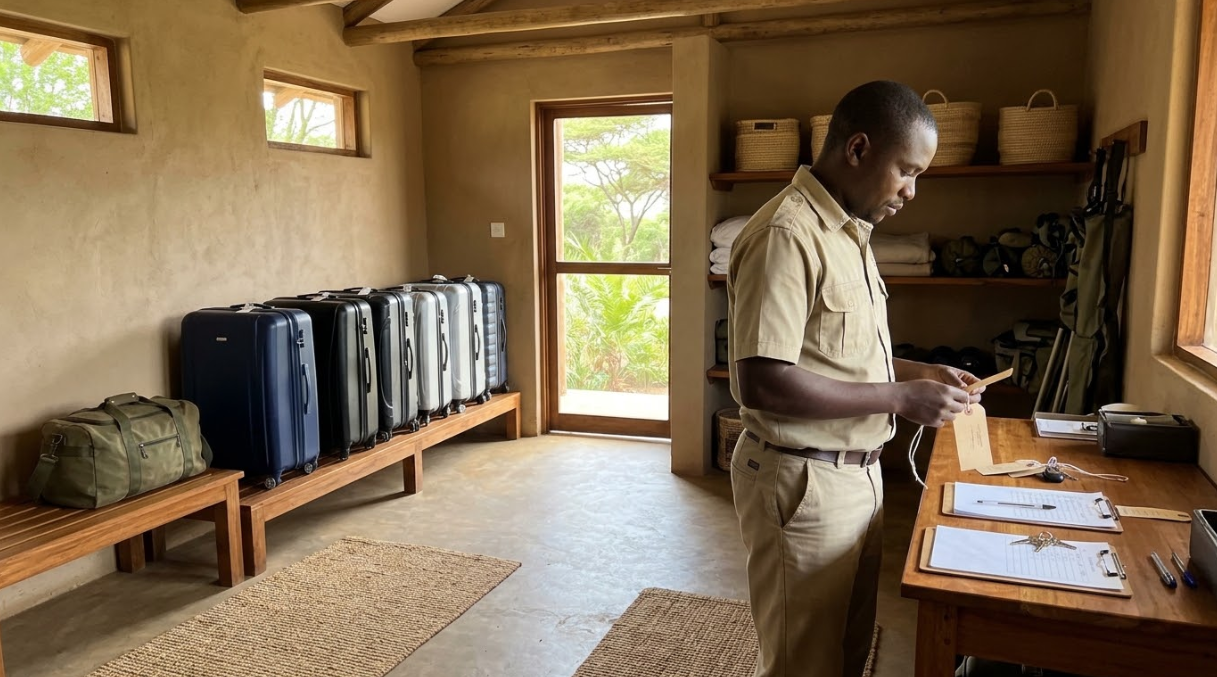
Travelers arriving in Tanzania with large international suitcases do not necessarily need to take everything on their bush flights. A practical solution is to separate the belongings needed during the safari from those required for the rest of the holiday.
Common luggage storage options include:
|
Storage option |
Best for |
What to confirm |
|---|---|---|
|
Arusha hotel |
Guests returning to the same accommodation after safari |
Storage availability, security, and collection arrangements |
|
Safari operator |
Travelers with multi-camp itineraries |
Whether storage is included and where bags will be held |
|
Coastal Aviation Dar es Salaam office |
Passengers flying with Coastal Aviation |
Storage arrangements and collection times |
|
Auric Air Dar es Salaam office |
Passengers flying with Auric Air |
Advance inquiry and storage availability |
How to organize your luggage storage:
-
Pack your international luggage before leaving home.
-
Identify clothing and personal items that will not be needed during the safari.
-
Separate these belongings into a clearly labeled storage bag.
-
Confirm storage arrangements with your hotel, airline, or safari operator.
-
Take only your safari essentials on the domestic flight.
-
Collect your stored belongings before continuing to your next destination.
Important: Do not assume that luggage storage is automatically available at every airport or safari camp. Confirm the location, operating hours, collection process, and any applicable charges before departure.
For a multi-destination holiday involving Tanzania's national parks and Zanzibar, coordinate luggage collection with your safari operator so that your stored belongings are available when you need them.
Camera Gear Allowance (Weight Budgeting)
There is no separate allowance for camera equipment on bush flights. Your cameras, lenses, batteries, and chargers all count toward the total weight limit. This makes weight budgeting essential for serious photographers.
A practical breakdown on a 15 kg Coastal Aviation flight:
-
Camera body + telephoto lens: ~2.2 kg
-
Second lens + batteries + charger: ~1.0 kg
-
Clothing and toiletries: ~8.0 kg
-
Shoes: ~1.5 kg
-
Bag weight: ~1.0 kg (lightweight duffel)
-
Remaining buffer: ~1.3 kg
Practitioners on travel blogs recommend carrying camera gear in your personal bag rather than the checked duffel, though remember it still counts toward your total. Safari camps typically offer same-day laundry service, which means you can genuinely get by with three to four days of clothing even on a ten-day trip.
How Luxury Safari Camp Laundry Helps You Pack Light
Laundry services can significantly reduce the amount of clothing you need to bring on a Tanzania safari. Many luxury lodges and tented camps offer laundry facilities, allowing guests to reuse lightweight clothing instead of packing a separate outfit for every day.
For example, a traveler on a seven-day safari may only need:
-
2–3 safari shirts.
-
2 pairs of safari trousers.
-
1 pair of shorts.
-
1 lightweight fleece.
-
3–4 sets of underwear.
-
3–4 pairs of socks.
-
1 additional evening outfit.
However, laundry services are not identical across all properties. Some camps provide complimentary laundry, while others charge separately or have limitations on turnaround times and available services.
Before departure, ask your safari operator:
-
Is laundry included in the accommodation rate?
-
Is same-day laundry available?
-
Are there restrictions on washing certain garments?
-
How long does laundry normally take?
-
Are laundry services available at every camp on the itinerary?
Practical tip: Pack enough clothing for at least two or three days without relying on immediate laundry service. This is particularly important when moving between camps or staying at remote properties.
Luxury Safari Packing List: What to Bring on a Bush Flight
Packing for a luxury safari requires balancing comfort, practicality, and airline baggage restrictions. Although luxury lodges provide many amenities, travelers should still bring the personal essentials they need throughout the journey.
The goal is to create a compact packing list that works within your airline's weight allowance.
Safari Clothing
-
2–3 lightweight safari shirts.
-
2 pairs of comfortable safari trousers.
-
1 pair of shorts.
-
1 lightweight fleece or sweater.
-
1 waterproof or windproof jacket.
-
3–4 sets of underwear.
-
3–4 pairs of socks.
-
Comfortable walking shoes.
-
Sandals or lightweight camp footwear.
-
Sleepwear.
Personal Essentials
-
Toothbrush and toothpaste.
-
Sunscreen.
-
Insect repellent.
-
Personal toiletries.
-
Prescription medication.
-
Basic personal first-aid supplies.
-
Sunglasses.
-
Hat or cap.
Photography and Electronics
-
Camera body.
-
Telephoto lens.
-
Spare batteries.
-
Battery charger.
-
Memory cards.
-
Binoculars.
-
Phone and charging cable.
-
Universal travel adapter.
-
Power bank, subject to airline battery and carriage rules.
Travel Documents and Important Items
-
Passport.
-
Flight confirmations.
-
Safari itinerary.
-
Travel insurance information.
-
Emergency contact details.
-
Any required medical documentation.
What Can You Usually Leave Behind?
Many luxury safari camps provide amenities that reduce the amount you need to pack.
Depending on the property, these may include:
-
Towels and basic toiletries.
-
Hair dryers.
-
Laundry services.
-
Basic clothing-care facilities.
-
Some bathroom amenities.
Check with your specific lodge before leaving these items at home. Amenities differ between properties.
Packing tip: Keep essential medication, travel documents, valuables, and items needed during the flight accessible. Never place essential medication or irreplaceable equipment in luggage that may be delayed.
Compression Packing Cubes
Lightweight fabric organizers that compress clothing to reduce volume. They don’t reduce weight (your clothes weigh the same), but they help you organize a tightly packed duffel so you can find things without unpacking everything. Useful when every item needs to earn its place.
Transfer and Logistics Terms
Fly-In Safari
A safari itinerary where transfers between parks (or from a gateway city to a park) are done by light aircraft rather than by road. Fly-in safaris save significant travel time. The drive from Arusha to central Serengeti can take seven or more hours over rough roads. A bush flight covers the same distance in about 90 minutes. The trade-off is strict luggage limits.
If you’re weighing your options, explore how a luxury Tanzania safari itinerary can combine fly-in and road segments.
Road Safari / Overland Transfer
A safari where all transfers between parks are done by vehicle, usually a 4x4 Land Cruiser. The luggage rules are dramatically different. On a road-only safari, hard suitcases are generally fine, and there’s no strict weight limit beyond what fits in the vehicle. The weight restriction is a flying rule, not a safari rule. Travelers who choose an entirely road-based itinerary can pack whatever they like.
Hybrid Itinerary (Fly-In + Road Segments)
Many well-designed safari itineraries combine road transfers for shorter distances (Arusha to Tarangire, for example) with bush flights for longer legs (Serengeti to Ruaha, or Serengeti back to Arusha). In a hybrid itinerary, you still need to pack for the most restrictive leg. If any segment involves a bush flight, your entire packing plan must conform to that airline’s rules.
Duma Explorer designs custom itineraries that balance pacing, wildlife priorities, and logistics, including which legs make sense as fly-in versus road transfers.
Explore fly-in safari options in Tanzania →
Luggage Forwarding
Some operators send excess luggage by road with a ground crew vehicle while guests fly to their next destination. This works when the road transfer is happening anyway (a driver repositioning a vehicle, for example). It’s not universally available and should be arranged in advance, but it’s a practical solution for travelers who need items at a beach destination after their safari that they couldn’t fit on the bush plane.
Airport Transfer
Ground transportation between an international airport (Kilimanjaro International or Julius Nyerere in Dar es Salaam) and your first accommodation, usually in Arusha or Dar es Salaam. This is the leg where your full international luggage is still with you. The luggage transition happens when you move from your hotel to the domestic bush flight.
How Different Tanzania Safari Itineraries Affect Your Luggage
Your luggage requirements depend on how you travel between destinations. A road safari offers different packing flexibility from an itinerary involving several domestic bush flights.
|
Safari itinerary |
Luggage considerations |
Recommended approach |
|---|---|---|
|
Road-only safari |
No standard bush-plane weight restriction |
Choose luggage that fits comfortably in your safari vehicle |
|
Fly-in safari |
Airline-specific weight and dimension restrictions |
Pack within the most restrictive flight allowance |
|
Hybrid fly-in and road safari |
Bush-flight restrictions apply to relevant flight segments |
Use a soft-sided duffel and organize excess luggage |
|
Safari and Zanzibar |
Restrictions depend on the aircraft and airline operating each segment |
Confirm baggage rules for domestic and connecting flights |
|
Kilimanjaro climb and safari |
Trekking equipment and safari luggage may require different arrangements |
Arrange storage and repacking before the safari |
|
Photography-focused safari |
Camera equipment consumes part of the total allowance |
Discuss excess baggage or additional-seat options before booking |
Important: International airlines, domestic scheduled airlines, and safari bush-flight operators can have different baggage policies. Never assume that your international baggage allowance will automatically apply to a domestic safari flight.
For travelers combining safari with Zanzibar, the safari-to-Zanzibar planning guide explains how luggage transitions work across the beach extension.
How to Fit Camera Gear Within a 15 kg Limit
This is the biggest pain point for luxury safari travelers, particularly those investing in a trip built around wildlife photography. The safari photography tips guide covers technique and settings, but the logistics of getting your gear onto the plane deserve specific attention.
Camera Equipment Weight: What Should You Bring?
Photography equipment can consume a significant portion of your bush flight luggage allowance. The best approach is to prioritize versatile equipment that covers multiple wildlife photography situations.
|
Photography equipment |
Approximate weight |
|---|---|
|
Mirrorless camera body |
0.6–0.8 kg |
|
DSLR camera body |
0.7–1.0 kg |
|
100–400mm telephoto lens |
1.0–1.5 kg |
|
100–500mm telephoto lens |
1.3–1.6 kg |
|
24–70mm lens |
0.7–0.9 kg |
|
Spare batteries and charger |
0.2–0.4 kg |
|
Camera bag |
0.5–1.0 kg |
|
Compact binoculars |
0.3–0.6 kg |
These figures are approximate examples. Check the manufacturer's specifications for your particular camera and lens combination.
A practical photography setup for a 15 kg allowance:
-
One camera body.
-
One versatile telephoto zoom lens.
-
Two spare batteries.
-
One charger.
-
Memory cards.
-
Compact binoculars.
-
A lightweight protective camera bag.
If wildlife photography is the primary purpose of your trip, discuss your equipment weight with your safari operator before booking flights. An additional seat or approved excess baggage arrangement may be more practical than leaving essential equipment behind.
Prioritize ruthlessly. Bring one camera body and one versatile telephoto lens. A 100-400mm or 100-500mm zoom covers the vast majority of safari situations. Leave the wide-angle at the hotel in Arusha unless you’re also photographing landscapes.
Wear your heaviest items. A photography vest with pockets can hold batteries, memory cards, and a small lens without adding to your weighed luggage. Not every airline permits this, so confirm in advance.
Book a Coastal Aviation XL seat. At $20 to $100 extra, this is the most cost-effective way to get your photography kit to the bush. You get 30 kg total, which is enough for a full camera kit plus normal safari clothing.
Consider a private charter. For photography groups, the per-person cost of a charter may be justified by the ability to bring 25+ kg of equipment per person without negotiation.
Road vs. Fly-In: The Real Luggage Trade-Off
The decision between a road safari and a fly-in safari isn’t just about time or cost. It directly affects what you can bring.
Road transfers carry more luggage without the strict weight limits that light aircraft enforce. If packing flexibility matters to you (traveling with young children, bringing extensive camera equipment, or simply preferring not to think about weight), a road-based itinerary removes the constraint entirely.
A fly-in safari is usually better when time is limited, camps are remote, and pacing matters more than packing volume. The luggage restriction is a manageable trade-off, especially once you understand the tools available: lightweight duffels, camp laundry, luggage storage, and the XL seat option.
Many experienced travelers find that the discipline of packing light actually improves the trip. Less stuff means less decision fatigue, faster transitions between camps, and a cleaner focus on the experience itself.
Recommended Duffel Bag Types for Tanzania Safari Flights
The right duffel bag depends on your airline's luggage restrictions, safari duration, and the amount of photography equipment you plan to carry.
|
Duffel bag |
Approximate capacity |
Best suited for |
Main consideration |
|---|---|---|---|
|
Patagonia Black Hole Duffel 40L |
40 liters |
Lightweight fly-in safaris |
Compact packing and lower overall volume |
|
Patagonia Black Hole Duffel 55L |
55 liters |
Longer trips and additional layers |
Check packed dimensions and weight |
|
The North Face Base Camp Duffel M |
Medium size |
Travelers prioritizing durability |
Compare empty weight with lighter alternatives |
|
Eagle Creek Cargo Hauler 60L |
60 liters |
Travelers needing additional storage volume |
Avoid overpacking beyond airline limits |
Which Duffel Bag Size Is Best?
For most travelers on a 15 kg baggage allowance, a 40L duffel is a practical starting point. It encourages lightweight packing while leaving enough room for clothing, toiletries, and essential safari accessories.
A 55–60L bag may be more appropriate for travelers with additional clothing or equipment, but a larger bag does not mean you can exceed the airline's weight or dimensional restrictions.
Before purchasing, check:
-
Empty bag weight.
-
External dimensions when packed.
-
Flexibility of the bag.
-
Ease of carrying between aircraft and safari vehicles.
-
Compatibility with the operating airline's cargo compartment.
Always prioritize the airline's actual size and weight restrictions over a bag manufacturer's general travel recommendations.
Frequently Asked Questions About Luxury Safari Flight Luggage
What is the luggage weight limit on Tanzania bush flights?
Most Tanzania safari bush flights have baggage allowances between 15 kg and 20 kg per passenger. Coastal Aviation allows 15 kg, while Auric Air allows 20 kg. These allowances include hand luggage, cameras, and personal belongings. Always check the airline operating your specific flight.
Can I bring a hard suitcase on a Tanzania safari flight?
It depends on the airline. Coastal Aviation strongly recommends soft-sided bags, while Auric Air accepts different bag types within its published size restrictions. Regional Air requires soft-sided bags. Even when hard suitcases are accepted, flexible duffels are generally easier to fit into small aircraft cargo compartments.
Do camera bags count toward the safari flight luggage allowance?
Yes. Coastal Aviation and Auric Air include camera equipment, filming equipment, hand luggage, and personal belongings in their total baggage allowances. Your camera bag is not automatically exempt because you carry it separately.
Can I take a 20 kg suitcase on a Coastal Aviation flight?
Not under the standard 15 kg allowance. Coastal Aviation offers an XL seat class that can increase the allowance to 30 kg, subject to availability and operational confirmation. Alternatively, contact the airline about approved excess baggage arrangements.
Does Coastal Aviation offer a 30 kg luggage allowance?
Yes. Coastal Aviation offers an XL seat class with a 30 kg allowance instead of the standard 15 kg. The booking must be assessed and confirmed by its operations team before the additional allowance is guaranteed.
Does Auric Air allow 20 kg of luggage?
Yes. Auric Air's standard allowance is 20 kg per passenger, including hand luggage, cameras, filming equipment, and personal items. It also offers pre-booked excess baggage options subject to its published conditions.
What happens if my luggage is overweight on a safari flight?
The airline may charge for additional weight, accept excess luggage if aircraft capacity permits, or arrange for the extra baggage to travel separately. The decision depends on the carrier, aircraft, route, and operational conditions. Always arrange additional baggage before reaching the airstrip.
Where can I store luggage during a Tanzania safari?
Travelers can ask their Arusha hotel or safari operator to store luggage that is not needed during the safari. Coastal Aviation and Auric Air also advertise luggage storage facilities at their Dar es Salaam Terminal 1 offices. Confirm availability and collection arrangements in advance.
What size duffel bag should I take on a fly-in safari?
A lightweight 40L duffel is a practical starting point for many travelers. A 55–60L bag may work for longer trips, but its external dimensions must comply with the airline's requirements. The bag's capacity does not determine how much weight you are allowed to carry.
Can I take a backpack as hand luggage on a bush flight?
This depends on the airline and the backpack's dimensions. Some airlines accept small soft-sided backpacks, while others have specific restrictions on cabin baggage. Remember that hand luggage may count toward the overall allowance, so confirm the policy before departure.
Do luxury safari lodges provide laundry services?
Many luxury safari lodges and tented camps offer laundry services, which can help travelers pack fewer clothes. However, availability, charges, turnaround times, and garment restrictions vary by property. Confirm the details with your accommodation before departure.
Can I combine a Tanzania safari with Zanzibar without exceeding my luggage allowance?
Yes. You can combine a safari with Zanzibar by planning your luggage around the baggage policies of each flight segment. If your safari involves a small bush aircraft, arrange storage for unnecessary luggage or organize approved excess baggage before traveling.
Are private safari charter flights more flexible with luggage?
Private charters can offer greater flexibility because luggage arrangements can be planned around your group and aircraft. However, the total baggage allowance is still determined by aircraft payload, passenger weights, fuel requirements, and operational restrictions. Confirm the approved allowance with the charter operator before departure.
Planning a fly-in safari involves more than choosing camps and timing the migration. The luggage logistics, from airline selection to bag storage and weight budgeting, are a real part of the experience. Duma Explorer handles domestic flight bookings, luggage coordination, and pre-trip packing guidance as part of every custom itinerary.