

Tanzania Safari Photography: 11 Best Tips for 2026
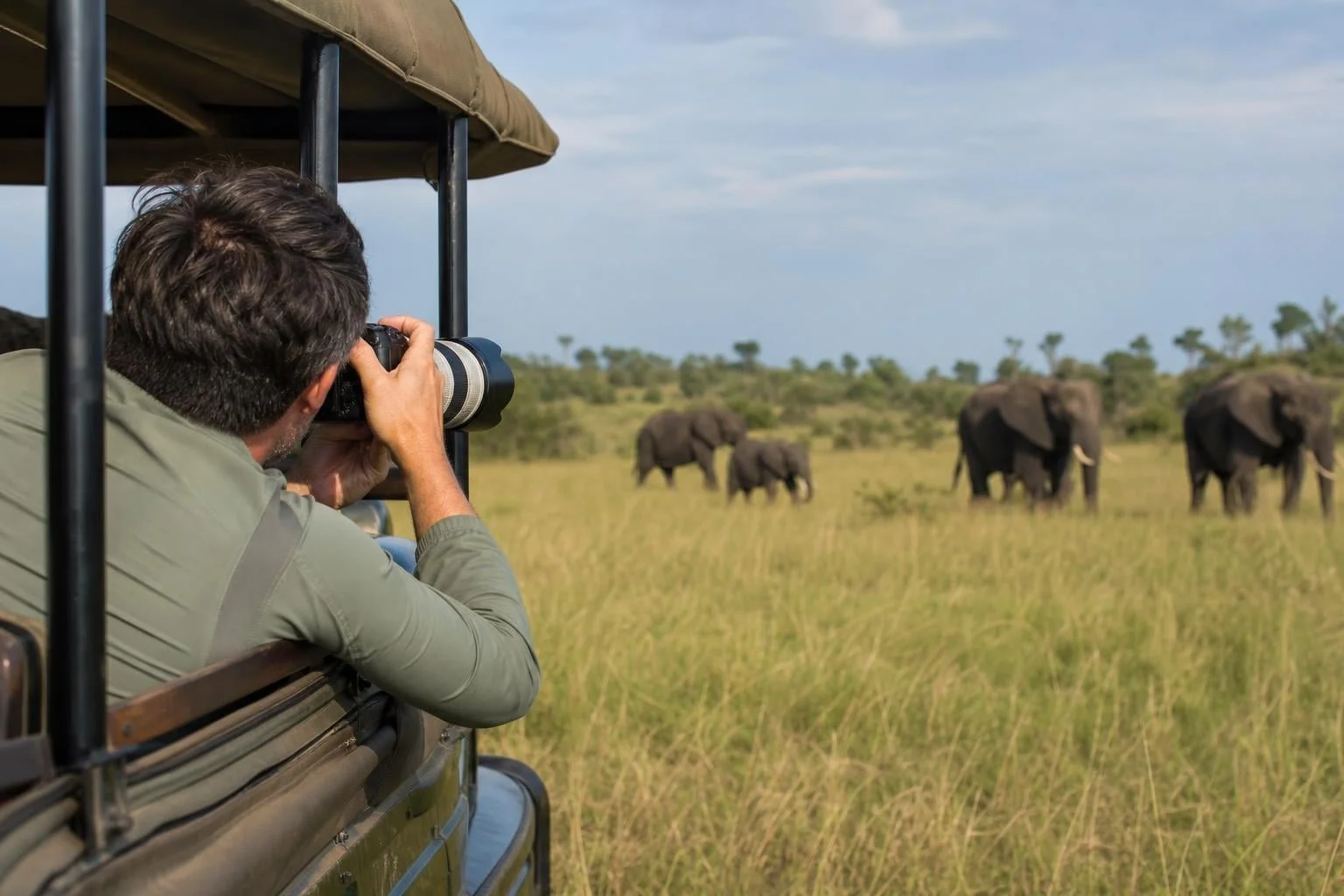
TL;DR
Tanzania offers the best combination of wildlife density, open terrain, and reliable light for safari photography anywhere in Africa. Your guide matters more than your lens, a private vehicle is the single biggest upgrade you can make, and green season is the contrarian play that delivers more original images. This guide covers park selection, seasonal timing, gear, camera settings, and the logistics that make or break photo quality on the ground.
Quick Answer: How Do You Take Better Photos on a Tanzania Safari? The best Tanzania safari photos come from choosing the right park, visiting during the right season, and working with an experienced guide rather than buying expensive camera equipment.
If you only remember five things, remember these:
|
Priority |
Recommendation |
Why It Matters |
|---|---|---|
|
1 |
Book a private vehicle |
Better positioning and more time at sightings |
|
2 |
Use a 100-400mm or 150-600mm lens |
Covers most wildlife situations |
|
3 |
Shoot during golden hour |
Produces softer, warmer light |
|
4 |
Visit during green season |
Creates more unique images |
|
5 |
Protect your gear from dust |
Dust damages cameras faster than anything else |
Most photographers should plan their trip between June and October for easier wildlife photography or January through March for dramatic calving-season images.
Why Tanzania Is One of the Best Places in the World for Safari Photography
Three factors make Tanzania unique for wildlife photographers.
Exceptional Wildlife Density
Few destinations can match the concentration of animals found in Tanzania's parks. The Serengeti ecosystem alone supports millions of large mammals, including the annual wildebeest migration.
Diverse Landscapes
Most safari destinations specialize in one type of landscape.
Tanzania offers:
-
Endless grasslands
-
Volcanic craters
-
Ancient baobab forests
-
Lakes
-
River systems
-
Woodlands
Photographers can create dramatically different images without leaving the country.
Consistent Equatorial Light
Because Tanzania sits close to the equator, sunrise and sunset occur at relatively consistent times throughout the year.
This creates predictable golden-hour shooting windows that photographers can plan around.
At-a-Glance: Best Tanzania Parks for Photography
|
Park |
Best For |
Peak Photo Season |
Crowd Level |
Key Subjects |
Unique Angle |
|---|---|---|---|---|---|
|
Serengeti |
Migration, predator hunts |
Jun–Oct (dry), Aug–Sep (crossings) |
High at crossings |
Wildebeest, lions, cheetahs |
Endless-plain compositions, kopje backdrops |
|
Ngorongoro |
Dense Big Five in one frame |
Year-round |
Moderate–High |
Rhino, lion, elephant, flamingo |
Crater-rim landscape shots |
|
Tarangire |
Elephant herds + baobabs |
Jul–Oct |
Moderate |
Elephants, baobabs, birds |
Red earth + baobab framing |
|
Lake Manyara |
Tree-climbing lions, birds |
Jun–Oct |
Low–Moderate |
Lions, flamingos, baboons |
Alkaline lake reflections |
|
Ruaha |
Remote predator photography |
Jun–Nov |
Low |
Wild dogs, lions, elephants |
Fewer vehicles, intimate sightings |
|
Nyerere |
Boat safari photography |
Jun–Oct |
Low |
Wild dogs, hippos, crocs |
Water-level perspective |
Tanzania safari photography isn’t about owning the most expensive camera body or the longest lens. It’s about being in the right park, at the right time, with the right guide, making smart decisions about light, positioning, and patience. Professional photographers return year after year because the combination of wildlife density, open terrain, and reliable weather creates opportunities that simply don’t exist at this scale anywhere else.
This isn’t a generic photography guide. Every tip below is grounded in the realities of shooting from a 4x4 in Tanzanian parks, where dust, equatorial light, bush-flight weight limits, and park regulations shape what’s actually possible.
Wondering what a photography-focused trip might cost? See a full breakdown of Tanzania safari costs per person.
1. Choose Your Parks for the Shots You Want
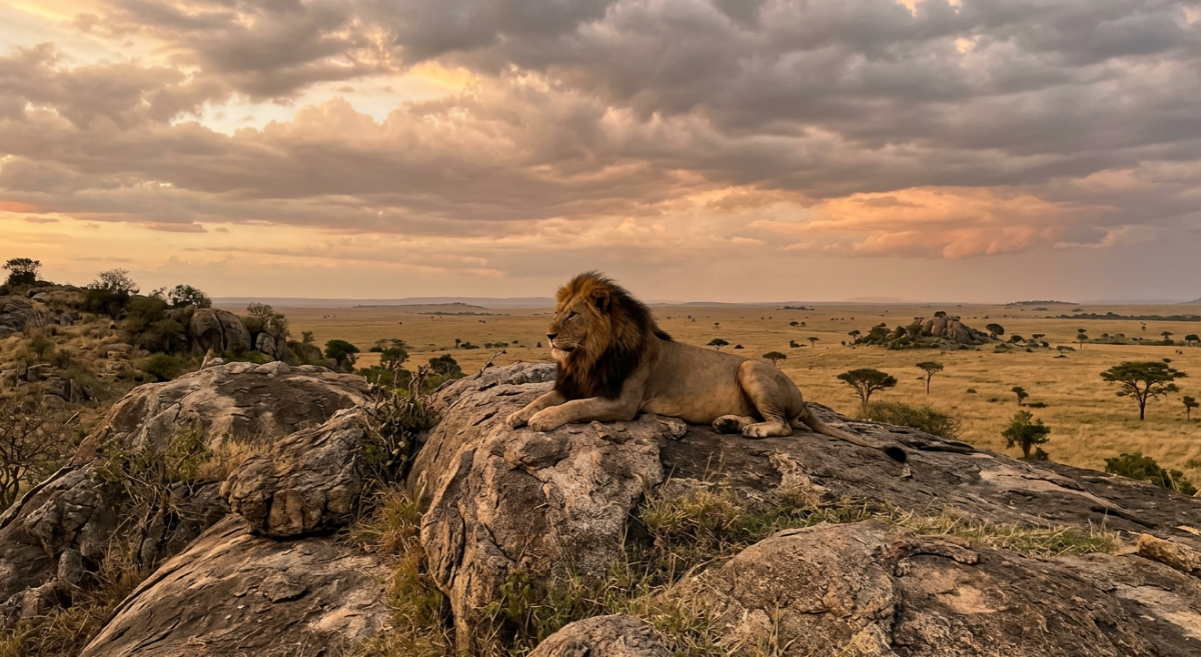
The biggest mistake photographers make is treating all Tanzania parks the same. Each park rewards a different style of shooting, and knowing this before you book determines whether you come home with portfolio-worthy images or tourist snapshots.
Serengeti National Park is the headliner for a reason. The annual Great Migration of wildebeest and zebras provides the most dramatic wildlife spectacle on Earth, but the Serengeti also delivers lions, leopards, cheetahs, elephants, and giraffes across diverse landscapes, from open grasslands to riverine forests and granite kopjes. Those kopjes make exceptional natural backdrops, especially at golden hour when the warm light turns the rock formations orange.
Ngorongoro Crater, a UNESCO World Heritage Site, is the world’s largest unbroken volcanic caldera. The contained bowl means a high concentration of wildlife, including all of the Big Five, within a relatively small area. Compositions come easier here because the animals are closer together and the crater walls provide a dramatic frame.
Tarangire National Park is a personal favorite among many photographers. The giant baobab trees and large elephant herds create images you won’t get anywhere else in East Africa. The contrast between red earth, lush vegetation, and ancient baobabs gives every frame a painterly quality. Shoot at f/8 with a baobab framing your elephant herd, and you have something distinctive.
Ruaha National Park, Tanzania’s second-largest park, is where you go when you want remote, uncrowded sightings. It’s home to Tanzania’s largest elephant population, plus lions, cheetahs, leopards, and endangered wild dogs. Fewer vehicles means you can spend an hour with a predator without another tourist in your frame.
Lake Manyara is small but punches above its weight. Famous for its tree-climbing lions and large flamingo gatherings, it offers a different visual palette, especially for bird photographers.
Nyerere National Park (formerly Selous) is one of only two parks in East Africa where you can do a boat safari. Shooting from water level, with hippos surfacing and crocodiles on the banks, is a completely different photographic experience from vehicle-based game drives.
For a deeper look at how these parks fit into circuits, read about Tanzania’s best safari parks.
2. Time Your Trip to the Season and the Light
Seasonal timing affects Tanzania safari photography more than any single piece of gear. The difference between the right week and the wrong one can mean the difference between a charging wildebeest crossing the Mara River and an empty riverbank.
Dry season (June through October) is the default recommendation, and for good reason. Clear skies, thinner grass, and animals congregating around water sources make wildlife easier to spot and photograph. Short grass means clean backgrounds. Animals stand out against golden plains rather than disappearing into head-high vegetation.
Green season (November through March) is the contrarian play, and it’s underrated. Fewer vehicles mean cleaner compositions without a row of Land Cruisers in the background. Dramatic storm clouds create the kind of skies that make landscape-integrated wildlife shots extraordinary. Colors are richer, more saturated. Migratory birds arrive. And in the Ndutu area of the southern Serengeti, calving season (January through March) produces newborn wildebeest, which in turn draws every predator in the region. The images you get during green season are more original precisely because fewer photographers are there to capture them.
August and September bring the peak drama: Mara River crossings in the northern Serengeti. Thousands of wildebeest plunging into crocodile-infested water. This is the highest-action wildlife photography on the planet, but it comes with the highest vehicle congestion at crossing points. Plan to arrive early and stay late.
For month-by-month detail, check our guide to the best time for safari in Tanzania.
Dry Season vs. Green Season for Tanzania Safari Photography
|
Factor |
Dry Season (June-October) |
Green Season (November-March) |
|---|---|---|
|
Wildlife visibility |
Excellent |
Good |
|
Predator activity |
High |
Very high during calving |
|
Crowds |
Heavy |
Light |
|
Landscapes |
Golden |
Green |
|
Bird photography |
Good |
Excellent |
|
River crossings |
August-September |
No |
|
Original compositions |
Moderate |
Excellent |
|
Difficulty level |
Easier |
More challenging |
3. Book a Private Vehicle (Your Single Biggest Photo Upgrade)
This is the tip that changes everything. A private vehicle with a knowledgeable guide is worth more to your photography than any lens upgrade.
When you control the vehicle, you control the schedule. You can leave camp at 5:45 AM for first light instead of waiting for a group breakfast at 7:00. You can stay at a leopard sighting for 45 minutes while it descends from a tree, instead of moving on because someone else wants to find elephants. Your guide can reposition the vehicle so the sun is behind you, not behind the animal.
Group safaris are more affordable, typically $1,200 to $3,500 per day for photography-focused options versus $3,500 to $8,000 per person for dedicated multi-day photo safaris with specialist operators. But the compromises are real. You may have to leave a great scene early. You can’t ask the driver to wait through a predator stalk that might take 20 minutes to develop.
A practical compromise that many photographers use: book a group vehicle for transit parks or less photography-intensive days, then upgrade to a private vehicle for your Serengeti time, where the highest-value sightings justify the cost.
Read a detailed comparison of private vs. group safari options to figure out which model fits your budget and priorities.
4. Build a Safari-Proof Camera Kit
The Core Setup
A mirrorless or DSLR body paired with a telephoto zoom is the foundation. The 100-400mm or 150-600mm range covers the vast majority of safari situations, from a full-frame elephant at 20 meters to a distant cheetah at 200 meters. This versatility, hand-held from a beanbag, is more valuable than raw reach from a 600mm prime that weighs twice as much and costs five times more.
A second body with a shorter lens (24-70mm or 70-200mm) handles landscapes, cultural moments, and close encounters. Switching lenses in the field is slow and risky in dusty conditions, so two bodies eliminate that problem entirely.
The Crop-Sensor Advantage
Practitioners on YouTube and photography forums frequently point out that a crop-sensor camera like the Canon R7 gives you a built-in reach multiplier. A 400mm lens on a crop sensor behaves like a 640mm lens because the smaller sensor naturally “crops” into the center of the image. For photographers on a budget who need maximum reach without the weight and expense of a 600mm prime, this is a genuine advantage.
Stability
You’ll shoot almost everything from a vehicle, often hand-held with quick reactions. A beanbag draped over the window frame or roof hatch is the standard stabilization tool. Wildlife photographer Chris Martin recommends always using a support: “I rarely hand-hold a camera when working from my safari vehicle.” He also cautions that you should turn off the engine at sightings, as even idle vibrations can ruin sharpness.
Tripods are impractical in vehicles. Leave them behind.
Essential Accessories
-
Three or more batteries (cold mornings and hot afternoons both drain power)
-
High-capacity memory cards (expect to shoot thousands of frames per day)
-
Cleaning kit: blower and microfiber cloth, minimum
-
UV filter on every lens for dust and scratch protection
Bush-Flight Weight Limits
This catches photographers off guard. Many light aircraft sectors in Tanzania cap luggage at 15 to 20 kg per person, soft bags only, and that total includes your camera gear. If you’re flying between parks (say, Arusha to Ruaha or Serengeti to Zanzibar), you need to plan your kit weight carefully. A 150-600mm zoom, a second body with a 24-70mm, batteries, cards, and a cleaning kit can push close to 8 kg before any clothing.
For a full gear and clothing checklist, see our Tanzania safari packing list.
Smartphone Shooters
Not everyone brings a dedicated camera, and that’s fine. Photographic safaris welcome everyone from beginners with a smartphone to professionals with long lenses. If you’re shooting on a phone, use burst mode for action, stabilize against the vehicle frame, and consider a clip-on telephoto lens attachment. Use your volume button as a shutter release to reduce camera shake. Phones actually excel at wide-angle landscape shots, especially the dramatic green-season skies.
Tanzania Safari Photography Packing Checklist
Camera Equipment
-
Camera body
-
Backup camera body
-
100-400mm or 150-600mm lens
-
Wide-angle lens
-
Beanbag
-
Lens hood
-
UV filters
Electronics
-
Portable SSD
-
Memory cards
-
Battery charger
-
International adapter
-
Power bank
Protection
-
Rain cover
-
Microfiber cloth
-
Blower
-
Ziplock bags
-
Cleaning kit
Clothing
-
Neutral-colored shirts
-
Lightweight layers
-
Hat
-
Sunglasses
-
Comfortable shoes
5. Lock In These Camera Settings Before the Game Drive
Don’t fumble with settings when a cheetah breaks into a sprint. Configure your camera before you leave camp each morning.
Quick Reference by Scenario
|
Scenario |
Mode |
Shutter Speed |
Aperture |
ISO |
|---|---|---|---|---|
|
Stationary animal |
Aperture Priority |
1/500s+ |
f/5.6–f/8 |
Auto (max 3200) |
|
Walking/grazing |
Shutter Priority |
1/1000s |
f/5.6–f/8 |
Auto (max 3200) |
|
Trotting/running |
Shutter Priority |
1/1600s+ |
Wide open |
Auto (max 6400) |
|
Birds in flight |
Shutter Priority |
1/2000s+ |
Wide open |
Auto (max 6400) |
|
River crossing chaos |
Shutter Priority |
1/2000s+ |
f/5.6 |
Auto (max 6400) |
|
Portrait/close-up |
Aperture Priority |
1/500s+ |
f/2.8–f/5.6 |
Auto (max 3200) |
Burst mode stays on, always. Continuous shooting is the only way to capture the split-second peak of action, whether it’s a lion mid-pounce or a wildebeest launching off a riverbank.
Auto ISO capped at 3200 gives you flexibility in changing light without introducing too much noise. On newer mirrorless bodies, you can push this to 6400 comfortably.
Back-button focus separates your focus activation from your shutter release, making it faster to track moving subjects and then fire at the decisive moment.
Shoot RAW. One experienced safari photographer on forums was unequivocal about this: don’t even think about using JPEG. RAW files give you the latitude to recover highlights in harsh midday light and pull detail from shadows in early-morning scenes. The storage cost is trivial compared to the editing flexibility.
Use These Safari Composition Techniques
Fill Only 60% to 70% of the Frame
Many photographers zoom in too much.
Leaving space around an animal creates a stronger composition and tells a better story.
Use Environmental Portraits
Don't isolate every animal.
Include:
-
Acacia trees
-
Baobabs
-
Kopjes
-
Rivers
-
Storm clouds
Environmental portraits create a sense of place.
Focus on the Eyes
An image immediately becomes more engaging when the animal's eyes are sharp.
Shoot at Eye Level
Whenever possible, lower your shooting position to create a more intimate perspective.
6. Work With Your Guide, They’re Your Secret Weapon
Your guide matters more than your lens. This is the single most underappreciated factor in Tanzania safari photography.
A guide trained in wildlife behavior doesn’t just find animals. They predict what animals will do next. They see a lion’s posture shift 30 seconds before it stalks. They read the hesitation in a wildebeest herd approaching a river crossing. They know which tree a leopard returns to at dusk. This anticipation is what separates a great wildlife photo from a snapshot of an animal’s backside as it walks away.
Practically speaking, here’s how to work with your guide for better photos:
-
Communicate priorities at the start of each day. Tell your guide whether you want predators at golden hour, bird close-ups, or landscape shots. A good guide adjusts the route and timing accordingly.
-
Ask for sun-behind-you positioning. Your guide can angle the vehicle so frontlight falls on the animal, not on the back of its head.
-
Request the engine-off policy at sightings. Even idling creates vibrations that degrade sharpness through a telephoto lens.
-
Trust their judgment on approach distance. A guide who knows an animal’s comfort zone gets you closer, for longer, than one who charges in and spooks it.
Guides with advanced training, such as FGASA or EcoTraining certifications, translate their wildlife knowledge into better photo positioning. It’s worth asking about guide qualifications when booking.
7. Master the Golden Hours (and Don’t Sleep Through Them)
Tanzania sits close to the equator, which means sunrise and sunset happen fast, but the golden hours on either side are remarkably consistent and generous. Expect soft, warm light roughly from 6:00 to 7:30 AM and again from 4:30 to 6:30 PM.
These windows produce the best safari images, period. The low-angle light wraps around animals, creates long shadows that add depth, and turns the Serengeti’s grasslands into a sea of gold. Dawn departures are non-negotiable for serious photographers. If your camp serves breakfast at 7:00, ask for a packed breakfast and leave at 5:45.
Midday light (roughly 10:00 AM to 3:00 PM) is harsh, overhead, and unflattering. Use those hours for scouting, napping, charging batteries, and reviewing your morning shots. Some photographers use midday for high-contrast black-and-white compositions, but that’s a niche approach.
Dusk in the Serengeti is particularly special for silhouettes. A lone acacia tree with a giraffe against a burning orange sky is one of the most iconic images in wildlife photography, and it only happens in a five-minute window. Be ready.
8. Shoot Beyond the Big Five
The images that stand out in portfolios are often not the obvious ones. Every photographer returns from Tanzania with a lion portrait. Fewer return with the dung beetle rolling its ball across the road, the weaver bird threading grass into an impossible nest, or the termite mound glowing red at sunset.
Small wildlife: Dung beetles, chameleons, colorful agama lizards, and insects are everywhere and almost always ignored. They’re also much easier to photograph because they don’t run away.
Landscapes without animals: The Ngorongoro crater rim at sunrise, kopjes in the Serengeti silhouetted against storm clouds, a line of baobabs in Tarangire against red earth. These images provide context and variety in your portfolio.
Night sky: Remote camps in Ruaha or the southern Serengeti have almost zero light pollution. If your camp allows it, set up a tripod and shoot the Milky Way. The southern hemisphere sky is spectacular.
Cultural photography: The Maasai people are often willing to be photographed, but always ask permission first, tip appropriately, and engage respectfully. Avoid treating people as props. A genuine interaction produces a genuine portrait. For more on ethical cultural encounters, read about Maasai safari experiences.
If birdlife is a priority, Tanzania’s parks host over 1,000 species. Green season especially brings migratory arrivals and breeding plumage.
9. Protect Your Gear from Tanzania’s Dust
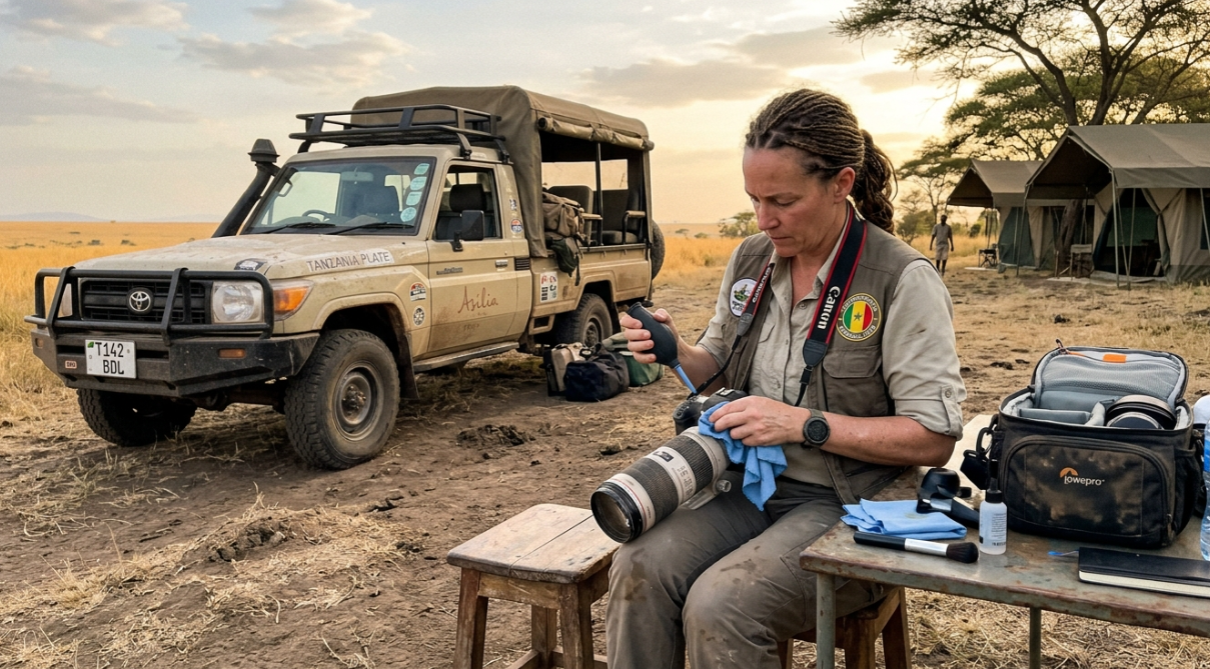
Dust is your real enemy on safari, not wildlife distance. Tanzania’s fine volcanic dust penetrates every crevice of every camera body. It gets into lens barrels, viewfinder seals, card slots, and sensor chambers. A $30 daily habit protects thousands of dollars of gear.
The dust protocol:
-
Never swap lenses in open air. If you must change lenses, do it inside the vehicle with all windows closed.
-
Keep a UV filter on every lens at all times. The filter takes the scratches and dust abrasion, not your front element.
-
Use a blower (not compressed air) at the end of every game drive to clear dust from body seams and lens threads.
-
Wipe down lens surfaces with a microfiber cloth before each shooting session.
-
Store cameras in ziplock bags overnight if your accommodation doesn’t have sealed storage.
-
For green-season trips, bring a camera rain cover. Afternoon downpours come fast and hard.
This routine takes five minutes per day and will save you a sensor-cleaning bill (or worse) when you get home.
10. Leave the Drone at Home
This disappoints some photographers, but the reality is clear: drones are prohibited in all TANAPA (Tanzania National Parks Authority) parks without pre-approved permits from both aviation and park authorities. These permits take months to process and are rarely granted for tourists.
Even where Tanzania’s civil aviation authority might allow hobby drone operations, park rules override, and they typically ban drones outright. The risk of confiscation, fines, and ruined relationships with park authorities isn’t worth it.
Focus your energy on what you can control from the vehicle. A pop-top roof gives you 360-degree shooting capability, and a skilled guide can position you for overhead-style angles on animals below kopjes or crater rims. For a deeper look at how different safari vehicle types affect your shooting angles, that’s worth reading before you book.
11. Plan Your Post-Safari Photo Workflow
Most photography guides stop at the moment you click the shutter. But managing thousands of images in the field is a real challenge, especially at remote camps with no WiFi and unreliable power.
Back up every night. Bring a portable SSD and a card reader. Copy all cards to the SSD before bed. Don’t format cards until you’ve confirmed the backup. One practitioner on a photography forum described losing an entire day of Mara River crossing images to a corrupted card, something a 30-second nightly backup would have prevented.
Cull ruthlessly. Expect a 5% keeper rate from thousands of shots. Burst mode at a river crossing can produce 500 frames in five minutes, and maybe 10 are worth keeping. Flag your favorites each evening while the memory is fresh.
Label by park, day, and species for future reference. Six months later, you won’t remember whether that leopard was in the central or eastern Serengeti.
Consider a Zanzibar extension as editing downtime. A few beach days with reliable WiFi, a comfortable chair, and no 5:00 AM wake-up calls is the perfect environment for your first editing pass. A 14-day Tanzania and Zanzibar itinerary builds in exactly this kind of balance.
What Photography-Focused Safaris Actually Cost
Photography-focused safaris in Tanzania range widely. Group photography tours with a shared vehicle and dedicated photography guide start around $1,200 to $3,500 per day. Specialist photography companies running multi-day dedicated trips charge $3,500 to $8,000 per person for the full experience, which typically includes private vehicles, extended game-drive hours, professional photography instruction, and premium lodge or tented-camp accommodations.
The price difference mostly comes down to three things: whether your vehicle is private, how many hours per day you spend in the field, and the quality of your guide. A private custom safari designed around photography doesn’t have to be the most expensive option. It needs to prioritize the right things.
To avoid common pitfalls that inflate costs without improving the experience, read about safari booking mistakes before you commit.
Putting It All Together
Three tips matter more than all the others combined. First, book a private vehicle with a guide who understands photography. Second, time your trip to match the photographic conditions you want, whether that’s dry-season simplicity or green-season drama. Third, protect your gear from dust with a simple daily routine.
Everything else, the lenses, the settings, the parks, builds on that foundation. Tanzania rewards photographers who prepare, who communicate with their guides, and who stay patient when the light is right.
Planning a photography-focused safari where every detail is designed around getting the best possible images? Start by exploring what a custom Tanzania safari costs and build from there.
Seven Tanzania Safari Photography Mistakes to Avoid
|
Mistake |
Better Approach |
|---|---|
|
Bringing only a wide-angle lens |
Carry a telephoto zoom |
|
Sleeping through sunrise |
Leave camp before first light |
|
Ignoring green season |
Consider January-March |
|
Changing lenses outside |
Change lenses inside the vehicle |
|
Shooting only the Big Five |
Photograph landscapes and birds |
|
Using JPEG |
Shoot RAW |
|
Waiting to back up images |
Back up every night |
Frequently Asked Questions
What is the best camera lens for a Tanzania safari?
A 100-400mm or 150-600mm telephoto zoom is the workhorse lens for Tanzania safari photography. It covers the range from full-frame elephants at close range to distant cheetahs across the plain. A second body with a 24-70mm or 70-200mm handles landscapes and close encounters. If weight is a constraint (especially for bush flights with 15-20 kg limits), prioritize one versatile telephoto over multiple specialized lenses.
Can I take good safari photos with a smartphone?
Yes. Smartphones excel at wide-angle landscape shots, especially dramatic green-season skies. For wildlife, use burst mode, stabilize the phone against the vehicle frame, and consider a clip-on telephoto lens attachment. You won’t match the reach of a dedicated telephoto, but you can absolutely come home with compelling images. Many safari operators welcome photographers of all levels and equipment.
Is dry season or green season better for Tanzania safari photography?
Dry season (June through October) is easier: clean backgrounds, short grass, concentrated wildlife. Green season (November through March) is more challenging but produces more original images: dramatic storm clouds, lush colors, fewer vehicles, newborn animals, and migratory birds. Most photographers default to dry season. Those who want distinctive portfolio images should seriously consider green season, especially the Ndutu calving period in January through March.
Do I need a private vehicle for safari photography?
You don’t need one, but it’s the single biggest upgrade a photographer can make. Private vehicles let you control timing (leave at first light), positioning (sun behind you), and pace (stay at a sighting as long as the action continues). Group vehicles save money but force compromises. A hybrid approach, group for some parks and private for the Serengeti, is a reasonable middle ground.
Are drones allowed in Tanzania’s national parks?
No. Drones are prohibited in all TANAPA parks without pre-approved permits from both aviation and park authorities. These permits are rarely granted for tourists, take months to process, and the penalties for flying without one include confiscation and fines. Plan to leave the drone at home for safari days.
How do I protect my camera gear from dust on safari?
Never change lenses in open air. Keep UV filters on every lens. Use a blower after each game drive to clear dust from body seams. Store cameras in ziplock bags overnight. Bring a microfiber cloth for daily lens cleaning. This five-minute daily routine prevents the fine volcanic dust of Tanzania from damaging sensors, lens barrels, and card slots.
What should I tell my safari guide to get better photos?
Communicate your priorities at the start of each day: species, type of shot (action vs. portrait), and lighting preference (golden hour vs. midday). Ask the guide to position the vehicle with the sun behind you, request the engine be turned off at sightings to eliminate vibration, and trust their judgment on approach distances. A guide who understands photography anticipates action and positions you for it before it happens.
How many photos should I expect to take on a Tanzania safari?
Serious photographers typically shoot 1,000 to 3,000 frames per day, especially during high-action sightings like river crossings or predator hunts. Expect a keeper rate of about 5%. Bring high-capacity memory cards, back up to a portable SSD every night, and cull your favorites each evening while the details are fresh.