

Safari Tipping Africa: 2026 Guide to Who, How Much, When
TL;DR
Tipping on African safaris is customary but not mandatory. Expect to budget $10-20 per person per day for your safari guide, $5-15 per person per night for lodge staff via a communal tip box, and significantly more for Kilimanjaro climbs (roughly $180-300 per climber total). US dollars are preferred across East Africa, but bills must be Series 2009 or newer. This guide covers every role, amount, and term you need to know across safari game drives, Kilimanjaro climbs, and gorilla treks.
Planning a Tanzania safari or Kilimanjaro climb? We'll include a tipping sheet with your itinerary.
See Tanzania safari itineraries → https://www.dumaexplorer.com/tanzania
Get a custom quote → https://www.dumaexplorer.com/contact-us
Few things cause more pre-trip anxiety than figuring out safari tipping in Africa. How much is enough? Who exactly gets tipped? Do you hand cash directly to your guide or drop it in a box? What if you bring the wrong currency?
The stress is real. The second-highest ranking Google result for this topic is a TripAdvisor thread titled “How much tip during Safari: quite different opinions,” which tells you everything about the confusion travelers face. Advice varies wildly depending on who you ask, which country you’re visiting, and whether your safari is shared or private.
This glossary cuts through the noise. It defines every tipping-related term you’ll encounter across East African safaris, Kilimanjaro climbs, and gorilla treks, with specific amounts and practical mechanics for each. The goal is simple: tip fairly, with confidence.
Planning a trip and want to understand total safari costs including tips? Start with a full fee breakdown.
Quick Answer: How Much Should You Tip on an African Safari?
If you only need the short answer, here are the recommended tipping amounts for most East African safaris in 2026.
Person
Recommended Tip
Safari driver-guide (group safari)
$10–20 per person per day
Safari driver-guide (private safari)
$40–50 per vehicle per day
Lodge staff tip box
$5–15 per guest per night
Butler (luxury camps)
$10–15 per day
Transfer driver
$2–10 per transfer
Gorilla trekking guide
$10–15 per person
Gorilla trekking porter
$5–10 plus porter hire fee
Kilimanjaro lead guide
Around $20 per day
Kilimanjaro porter
Around $5–7 per day
Most travelers should budget around 5–10% of their total safari cost for gratuities.
Safari Tipping at a Glance
Trip Type
Total Suggested Tip Budget
3-day group safari
$80–150 per person
5-day private safari
$150–300 per couple
7-day Kilimanjaro climb
$180–300 per climber
Gorilla trekking day
$20–35 per person
Luxury safari (7 days)
$400–700+ per couple
How Much Cash Should You Bring for Safari Tips?
One of the most common mistakes first-time safari travelers make is bringing enough money for the safari itself but not enough cash for gratuities.
A good rule is to separate your tipping money before leaving home and keep it in a different envelope or money pouch.
For example:
Trip
Cash to Bring for Tips
3-day safari
Around $100–150
5-day safari
Around $250–350
7-day Kilimanjaro
Around $300–400
Gorilla trek
Around $30–40
Bring mostly:
$5 bills
$10 bills
$20 bills
Avoid carrying large numbers of $50 or $100 notes because many guides and camps cannot make change.
Why Safari Tipping in Africa Matters
Tipping in East Africa is not a bonus on top of a generous salary. For many roles in the tourism industry, tips represent a significant portion of total compensation. Base wages for safari guides, lodge staff, and especially Kilimanjaro porters are modest by international standards.
Practitioners on travel forums report that some budget operators in Tanzania pay guides very little, with one noting that startup guides sometimes “work for free, relying solely on tips.” The Kilimanjaro Porters Assistance Project (KPAP) confirms that crew wages are a basic amount and tips complement these to provide a living wage.
This doesn’t mean you should throw money around recklessly. Overtipping creates its own problems (covered below). But understanding that your gratuity is part of how these professionals earn their living reframes the entire conversation. You’re not being generous. You’re participating in the compensation system.
A-to-Z Glossary of Safari Tipping Terms
Askari (Night Watchman)
The askari is the security guard who patrols your camp or lodge overnight. You’ll rarely see them working, which is exactly the point. They keep wildlife and unwanted visitors away while you sleep. Askaris are typically compensated through the communal tip box rather than individual tips. Knowing they exist, and that the tip box reaches them, is reason enough to contribute.
Back-of-House Staff
Kitchen teams, cleaners, laundry workers, maintenance crews. These are the people who make a safari lodge function but whom you may never meet face-to-face. The communal tip box exists primarily for them. Without it, the only staff receiving tips would be guides and front-of-house workers, leaving dozens of essential employees with nothing extra.
Butler (Private/Luxury Camps)
At high-end safari properties, you may be assigned a personal butler who manages your schedule, arranges meals, draws baths, and handles special requests. Because their service is individual and direct, butlers should be tipped separately from the general staff box. Roughly $10-15 per day is appropriate. If you’re staying at luxury lodges in Tanzania, ask at check-in whether your butler is included in the communal pool or tipped independently.
Camp Staff Tip Box
A physical box, usually at reception or the main lodge area, where guests deposit tips that are divided equally among all non-guide staff. This is the standard mechanism at most East African camps and lodges. The recommended contribution is $5-15 per guest per night. Some properties split the box weekly, others monthly. If you’re unsure whether your tip reaches everyone, ask the manager how distribution works. Reputable operations are transparent about this.
Camping Safari Crew
On mobile camping safaris, your crew typically includes a cook, a camp hand or two, and your driver-guide. Unlike lodge stays where staff are anonymous, you’ll eat meals prepared by a specific person and watch someone set up your tent each evening. Tip each crew member individually at the end of the trip. The cook usually receives $8-12 per day, and camp hands $5-8 per day, though amounts depend on group size and trip length.
Cook (Kilimanjaro)
The mountain cook prepares three meals a day plus snacks at altitude, often working over a small gas stove in freezing conditions. KPAP recommends tipping your Kilimanjaro cook approximately $12 per day. If you’ve ever tried to boil water at 15,000 feet, you’ll appreciate what this person does. For more on what meals look like on the mountain, see the Kilimanjaro food guide.
Currency for Tips
US dollars are the preferred tipping currency across Tanzania, Kenya, Uganda, Rwanda, Zimbabwe, and Botswana. In South Africa, use South African rand (ZAR); tipping in USD there is possible but not appreciated. The rand is also accepted in Eswatini, Lesotho, and Namibia, since their currencies are pegged to it.
Tips can also be given in Tanzanian shillings, Kenyan shillings, euros, or British pounds, but USD remains the most universally useful.
Driver-Guide (Safari)
In East Africa, your safari guide and driver are usually the same person. This combined role means one individual handles wildlife spotting, route planning, vehicle maintenance, and guest experience for the entire trip. Tipping norms differ based on whether you’re on a shared or private safari:
Group/shared safari: $10-20 per person per day
Private safari: $40-50 per vehicle per day
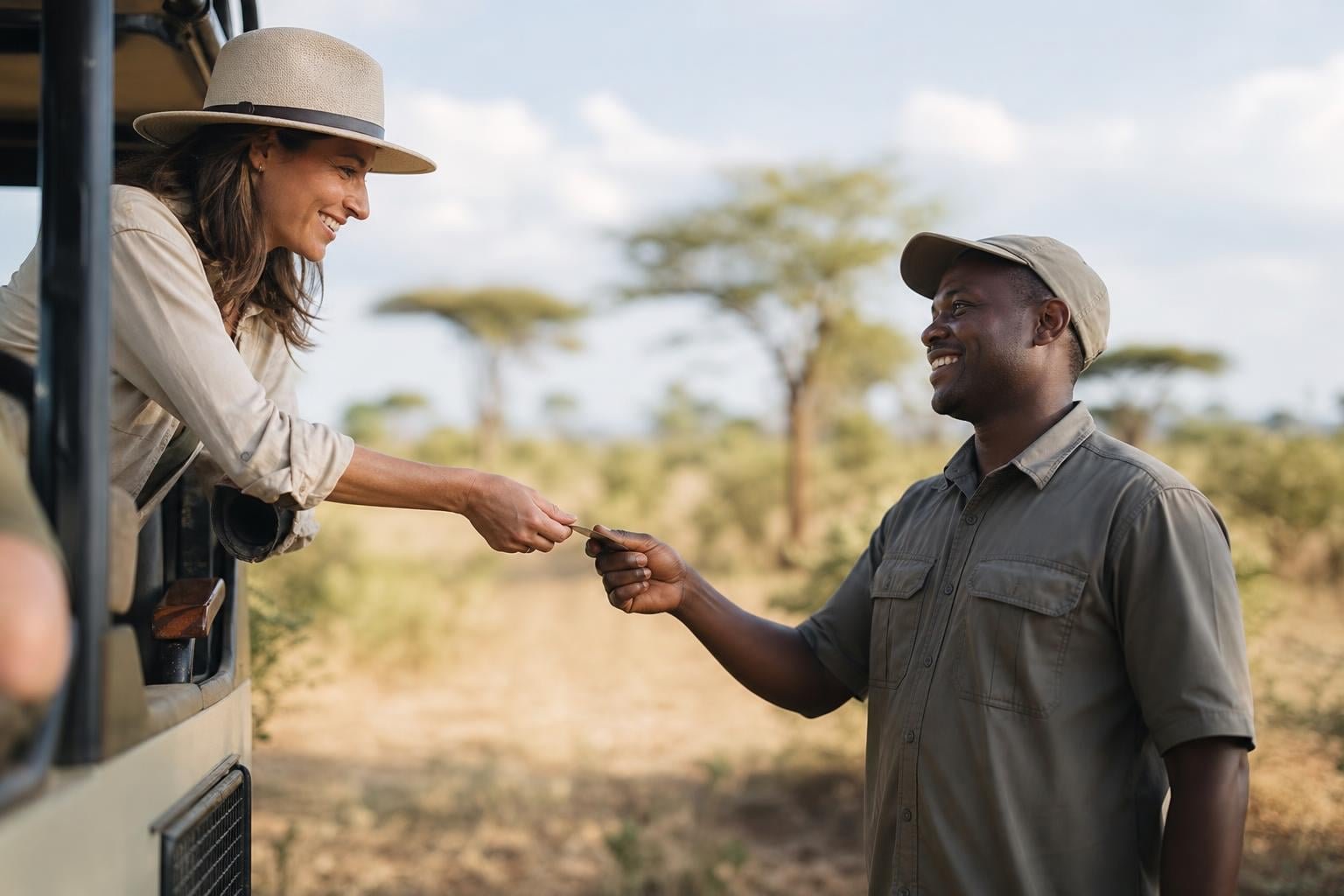
These are widely cited ranges across multiple East African operators. Tip at the end of your safari, not daily. Daily tipping can create an awkward performance dynamic where the guide feels pressure to “earn” each day’s tip rather than simply doing their job well.
Choosing between private and group safaris affects your tipping math significantly, so factor that into your budget from the start.
Envelope Method
The practice of preparing labeled envelopes before your trip, each containing the correct amount for a specific person or role. This is especially useful on Kilimanjaro climbs where you might tip 10-15 individual crew members. Label each envelope with the recipient’s role (Lead Guide, Assistant Guide, Cook, Porter 1, Porter 2, etc.) and fill them with the right denominations. Many experienced travelers prepare envelopes at home as part of their packing checklist and pack them in a ziplock bag.
Fly-In Safari
When your safari involves small bush planes between camps, you might wonder about tipping the pilot. Don’t. Bush pilots are salaried professionals and tipping them is not expected or customary. Your guide and lodge staff at each destination are tipped normally.
Gorilla Trekking Guide
A park-employed ranger who leads your group through the forest to find a habituated gorilla family. These guides work for the national park authority (UWA in Uganda, RDB in Rwanda) rather than for a private tour company. Tip $10-15 per person per trek. In some cases, a single guide leads the entire group, while in others, multiple rangers and trackers work together. When comparing gorilla trekking in Rwanda vs Uganda, tipping norms are similar in both countries.
Gorilla Trekking Porter
This is the single most tip-dependent role in East African tourism. Gorilla trekking porters do not earn any salary; their entire income comes from the hire fee and your tip. They carry your daypack, help you navigate steep and muddy terrain, and sometimes physically pull you up hillsides. Hiring a porter costs about $20 in Uganda or $10 in Rwanda. Add $5-10 as a tip on top of that. Always hire a porter. It directly supports the local community surrounding the park, and you will be glad you did when the trail gets steep.
Gratuity vs. Service Charge
These terms are not interchangeable. A gratuity is a voluntary tip you choose to give. A service charge is an amount automatically added to your bill, typically 5-10% at upscale hotels and some restaurants. Always check your bill before adding an additional tip. If a service charge is included, you can still leave a small extra amount for exceptional service, but you’re not obligated to.
Head Guide / Lead Guide (Kilimanjaro)
The most experienced member of your mountain crew, responsible for pacing, route decisions, altitude sickness monitoring, and overall safety. KPAP recommends tipping the lead guide approximately $20 per day. On a 7-day Machame climb, that’s $140 for the lead guide alone. This person holds your summit chances in their hands, quite literally. Learn more about Kilimanjaro training and key terms to understand the full crew structure.
Kirunje
A Swahili term for “ghost porters,” people who appear at the tipping ceremony but did not actually work on your climb. KPAP warns about this practice and works to prevent it through crew registration and monitoring. Kirunje is one reason why tipping each crew member directly, rather than handing a lump sum to the head guide, is so important. If your operator is a KPAP partner, they’ll have systems to verify that every person at the ceremony actually carried loads on your climb.
KPAP (Kilimanjaro Porters Assistance Project)
A non-profit organization that monitors porter welfare on Kilimanjaro, setting minimum wage standards and tipping recommendations. KPAP-partner operators agree to transparency requirements including tip distribution reports. The project was founded because exploitation of porters, through underpayment, overloading, and inadequate gear, was widespread. Choosing a KPAP-partner operator is one of the most meaningful decisions you can make when booking a Kilimanjaro climb.
Lodge Staff
An umbrella term for housekeeping, dining room attendants, grounds crew, and other service staff at safari lodges. The general recommendation is $10-15 per guest per night contributed to the communal tip box. You don’t need to identify or tip individual lodge staff unless someone provides notably personal service (like arranging a surprise birthday setup or carrying heavy luggage a long distance).
Massage Therapist / Spa Staff
Many mid-range and luxury lodges offer spa treatments. Tip roughly $5 per treatment directly to the therapist. This is separate from the general staff tip box.
Mokoro Poler
In Botswana’s Okavango Delta, mokoro (dugout canoe) excursions are guided by polers who stand at the back and navigate through channels. Tip approximately $5 per person per activity. If your poler is also your walking safari guide, tip at the higher guide rate.
Overtipping
The idea that too much tipping can be harmful sounds counterintuitive, but it’s a real concern in East African tourism economies. Expert Africa notes that excessive tips can throw out the balance of the local economy. When a lodge porter earns more than a national park ranger, or when a Kilimanjaro porter can out-earn a local teacher, the incentive structures of entire communities shift. One commenter on TripAdvisor put it bluntly: “When a porter can earn more than a teacher due to tips, then the local economy is being badly skewed.”
The solution isn’t to stop tipping. It’s to tip within recommended ranges and resist the urge to dramatically exceed them, even when service is outstanding. A heartfelt thank-you, a positive online review, or a letter to the operator praising a specific staff member can mean as much as extra cash.
Per Diem
Latin for “per day.” This is the standard unit for calculating safari and climb tips across Africa. When someone says “tip your guide $15 per diem,” they mean $15 per person, per day of service. On a 5-day safari, that’s $75 total per person for the guide. Simple math, but worth clarifying since some sources quote per-trip amounts without specifying the number of days.
Porter (Kilimanjaro)
The backbone of every Kilimanjaro expedition. Porters carry up to 20 kilograms of gear, food, water, and equipment up and down the mountain, often moving faster than climbers despite carrying more weight. KPAP recommends tipping porters approximately $5-7 per day. On a 7-day climb with 8 porters, that’s $280-392 just for porter tips. Some budget operators pay porters as little as $2-3 per day, making your tip the difference between a poverty wage and a reasonable one.
Restaurant Tipping (East Africa)
At sit-down restaurants in cities like Arusha, Nairobi, or Kigali, 10-15% of the bill is standard. At safari camp meals, tipping is already covered by the staff tip box, so no additional restaurant-style tip is needed. In Zanzibar, tipping practices follow similar patterns, though you can learn more about Zanzibar cultural etiquette for specific contexts.
Specialty Porter (Kilimanjaro)
Not all porters carry the same loads. Waiter porters serve meals at camp, toilet porters manage portable facilities, summit porters carry emergency equipment to the peak, and medical porters haul first-aid supplies. These specialized roles deserve tips at the higher end of the porter range, or slightly above.
Tipping Ceremony (Kilimanjaro)
A formal event, usually held at the last campsite or at your hotel in Moshi or Arusha after the climb. The group pools their tips, and the head guide introduces each crew member by name and role. Tips are announced publicly and distributed individually. This transparency is the point: it prevents managers from skimming and ensures each person receives their share.
KPAP strongly recommends tipping each crew member directly rather than giving a lump sum to the head guide. In the past, tip money has not always been distributed fairly when given in bulk. If your operator provides a tip distribution report for each crew member to sign, that’s a strong sign of accountability.
Tip Distribution Report
A signed document confirming that each crew member received their individual share of the group’s tips. KPAP-partner operators use these reports as an accountability measure. After each climb, the operator reviews the reports to verify fair distribution. If your trekking company can’t tell you how they handle tip distribution, that’s a red flag.
Tracker / Spotter
More common in Southern Africa than East Africa, a tracker works alongside the main guide to locate wildlife. They often sit on a special seat at the front of the vehicle, reading animal tracks and signs. Tip $5-10 per person per day directly.
Transfer Driver
The person who drives you from the airport to your hotel or between camps. Transfers are brief interactions, and a tip of $2-10 per transfer is appropriate depending on distance and service.
USD Bill-Year Rule
This is the single most important practical detail that most tipping guides bury or skip entirely. US dollar bills in East Africa must be Series 2009 or newer (generally printed after 2013) to be accepted. Older bills may be refused by banks, currency exchanges, and the people you’re trying to tip. Local banks adopted this policy due to past counterfeiting issues with older series notes. Your guide literally cannot deposit or exchange an old $20 bill.
Before your trip, visit your bank and specifically request newer bills in small denominations ($1, $5, $10, $20). Bringing the wrong bills is one of the most common safari booking mistakes travelers make.
Walking Safari Guide
A licensed, armed guide who leads on-foot game walks. Walking safari guides undergo additional training and certification beyond vehicle-based guiding. Tip at the same rate as your vehicle guide: $10-20 per person per day.
Quick-Reference Tipping Tables
Safari Game Drive Tipping
RoleAmountWhenHowDriver-guide (group)$10-20/person/dayEnd of safariCash, directly or in envelopeDriver-guide (private)$40-50/vehicle/dayEnd of safariCash, directly or in envelopeTracker/spotter$5-10/person/dayEnd of safariCash, directlyLodge staff (tip box)$5-15/person/nightEach checkoutCash in communal boxButler$10-15/person/dayEnd of stayCash, directlyTransfer driver$2-10/transferEnd of transferCash, directlySpa therapist~$5/treatmentAfter treatmentCash, directly
Kilimanjaro Climb Tipping (KPAP Recommendations)
RoleDaily Rate7-Day Climb ExampleLead guide~$20/day$140Assistant guide~$12/day$84Cook~$12/day$84Porter~$5-7/day$35-49 eachTotal per climber estimate$180-300
Note: Total depends on crew size, group size, and route length. Ask your operator for the exact crew count before your climb so you can prepare the right number of envelopes.
Gorilla Trekking Tipping
RoleAmountNotesTrekking guide/ranger$10-15/person/trekPark-employed; tip directlyTracker/ranger assistant$5/person/trekOften 1-2 per groupPorter$5-10 tip + hire feeNo salary; tip is their incomeDriver (if separate)$5-10/daySame as transfer driver norms
For details on gorilla trekking permits and costs, including how to budget the full experience beyond tips, see the dedicated guide.
Safari Tipping Differences by Country
Although tipping customs are similar across Africa, there are important regional differences.
Country
Typical Guide Tip
Notes
Tanzania
$10–20/person/day
USD preferred
Kenya
$10–20/person/day
USD or KES accepted
Uganda
Similar to Tanzania
Gorilla trekking tips common
Rwanda
Similar to Uganda
Gorilla trekking focus
Botswana
Often higher for luxury safaris
USD or BWP
Namibia
Usually lower than East Africa
NAD or ZAR
South Africa
10–15% restaurants, ZAR preferred
Different tipping culture
Currency Cheat Sheet
CountryPreferred Tip CurrencyBill RestrictionsTanzaniaUSDSeries 2009+, post-2013 printKenyaUSD or KESSeries 2009+ for USDUgandaUSDSeries 2009+RwandaUSDSeries 2009+South AfricaZAR (strongly preferred)None for ZARBotswanaUSD or BWPSeries 2009+ for USDNamibiaZAR or NADNoneZimbabweUSDSeries 2009+
Worked Tipping Budget: 5-Day Safari + 7-Day Kilimanjaro Climb
No other tipping guide provides a complete worked example, so here’s what a typical combined trip looks like. This assumes a couple traveling together on a private safari followed by a small-group Kilimanjaro climb.
5-Day Private Northern Circuit Safari (2 travelers)
ExpenseCalculationTotalDriver-guide$45/vehicle/day x 5 days$225Lodge tip boxes$10/person/night x 2 people x 5 nights$100Transfer drivers (2 transfers)$5 x 2$10Safari tipping subtotal$335
7-Day Lemosho Kilimanjaro Climb (per climber, assuming 4-person group)
ExpenseCalculationTotalLead guide$20/day x 7 days$140Assistant guide$12/day x 7$84Cook$12/day x 7$844 porters (shared across group)$6/day x 7 x 4 porters ÷ 4 climbers$42 per climberClimb tipping subtotal per climber~$350
Combined total per person: roughly $520-$550
Bring this amount in clean, new, small-denomination USD bills. Having a few extra $5 and $10 bills provides a cushion for unexpected great service or roles you didn’t anticipate.
For a comprehensive look at East Africa safari costs beyond tipping, including park fees, accommodation, and transport, the full pricing guide covers it all.
The Ethics of Tipping on African Safaris
Tipping in Africa is more than etiquette. It’s embedded in how tourism wages work across the continent. But treating tips as a feel-good gesture without thinking about consequences misses the bigger picture.
Why Your Tip Is the Real Wage
Many operators, especially budget ones, keep prices low by paying crew members less. Some Kilimanjaro operators pay porters as little as $2-3 per day, well below the minimum wage set by Kilimanjaro National Park (KINAPA). Your tip doesn’t just supplement their income. In some cases, it is their income. This means the choice of operator you book with directly affects whether your tip is a thank-you bonus or a survival necessity. For thoughts on choosing responsible operators, see the cultural safari ethics and etiquette guide.
The Overtipping Trap
Generosity without context can backfire. When tourism-adjacent roles pay dramatically more than teaching, nursing, or park management, communities lose skilled workers to tip-heavy positions. This isn’t theoretical. Lodge porters in popular safari areas sometimes earn more than the park rangers who protect the very wildlife tourists come to see.
Tip within the recommended ranges. If you want to do more, write a glowing review naming specific staff members, request the same guide on a future trip, or donate to organizations like KPAP.
What Good Operators Do Differently
Responsible operators pay fair base wages, provide proper gear for Kilimanjaro crews, and use transparent tip distribution systems. KPAP-partner companies have each crew member sign a tip distribution report confirming receipt. These reports are reviewed after every climb. That kind of accountability makes a real difference.
Practical Tips for Safari Tipping in Africa
Bring the right cash. Small USD bills ($1, $5, $10, $20), Series 2009 or newer. Visit your bank well before departure. Airport currency exchanges rarely stock the right denominations.
Prepare envelopes at home. Label them by role, not by name (you won’t know names yet). Fill them once you confirm crew sizes with your operator.
Ask for crew details before your trip. Any good operator will tell you how many porters, guides, and cooks will be on your Kilimanjaro climb or safari. This lets you budget precisely.
Tip at the end of your stay, not daily. This avoids turning each game drive into a performance review. The exception: if you’re moving between multiple lodges, tip each lodge’s staff at checkout.
Use your right hand. When handing tips in East Africa, use your right hand or both hands. The left hand is considered impolite in many East African cultures.
Don’t tip the camp manager. This question comes up often. Camp and lodge managers are senior employees, similar to a restaurant owner. Tipping them is not expected.
Don’t forget the unseen staff. The askari, the kitchen crew, the cleaner who arranged flowers in your tent. The tip box exists for them. Use it.
Frequently Asked Questions
Is tipping mandatory on African safaris?
No. Tipping across East Africa is customary, not obligatory. Nobody will confront you if you don’t tip. But it is deeply embedded in the compensation structure for tourism workers, and skipping it entirely means these professionals receive only their modest base wage.
What happens if I bring old US dollar bills?
Bills printed before 2013 (pre-Series 2009) are frequently refused by banks and currency exchanges in Tanzania, Kenya, Uganda, and Rwanda. Your guide cannot deposit or spend them. You’ll need to bring newer bills or use local currency instead.
Should I tip in US dollars or local currency?
USD is preferred and most practical across East Africa. In South Africa, always tip in rand. If you’re doing a multi-country trip that includes Southern Africa, carry both USD and ZAR.
How much should I budget for tipping on a Kilimanjaro climb?
Plan for roughly $180-300 per climber, depending on crew size, group size, and route length. KPAP-recommended rates are approximately $20/day for the lead guide, $12/day for assistant guides and cooks, and $5-7/day for porters.
What is the best way to distribute tips on Kilimanjaro?
Tip each crew member individually during the tipping ceremony rather than giving a lump sum to the head guide. This prevents misallocation and aligns with KPAP recommendations for transparency.
Do I tip a bush pilot on a fly-in safari?
No. Bush pilots are salaried professionals and tipping them is not customary. Save your tips for guides, trackers, and lodge staff at each destination.
Can I tip with a credit card?
Almost never in a safari or climbing context. Tips are cash-only for guides, porters, and lodge staff in virtually all East African destinations. Some upscale hotel restaurants might allow adding a gratuity to a card payment, but don’t count on it.
Why do tipping recommendations vary so much between sources?
Because context matters. A shared budget safari in Tanzania has different economics than a private luxury safari in Botswana. Group size, trip style, lodge tier, and even the season can shift what’s appropriate. The ranges in this guide reflect the middle ground across reputable operators and destinations.
Should I tip every day or only once?
Generally, tip once at the end of the safari or climb. Daily tipping is uncommon unless different guides rotate throughout your trip.
Should couples tip double?
Usually yes. Most recommendations are per guest rather than per booking, although private safari vehicle tips are often given per vehicle.
What if service was poor?
Tips are voluntary. If service was genuinely poor because of avoidable issues, reducing the gratuity is acceptable. If problems were outside the guide's control, such as weather or wildlife sightings, standard tipping is still appropriate.
Should children tip?
Children are not generally expected to tip separately. Families usually calculate gratuities based on paying adults unless the operator recommends otherwise.
Should I tip if my safari is all-inclusive?
Yes. "All-inclusive" almost always refers to accommodation, meals, and activities rather than gratuities.
Ready to plan your trip with tipping already figured into the budget? Explore private Tanzania safari options to see what a well-organized, ethically run safari looks like from start to finish.