

Safari With Grandparents: Tanzania 2026 Planning Guide
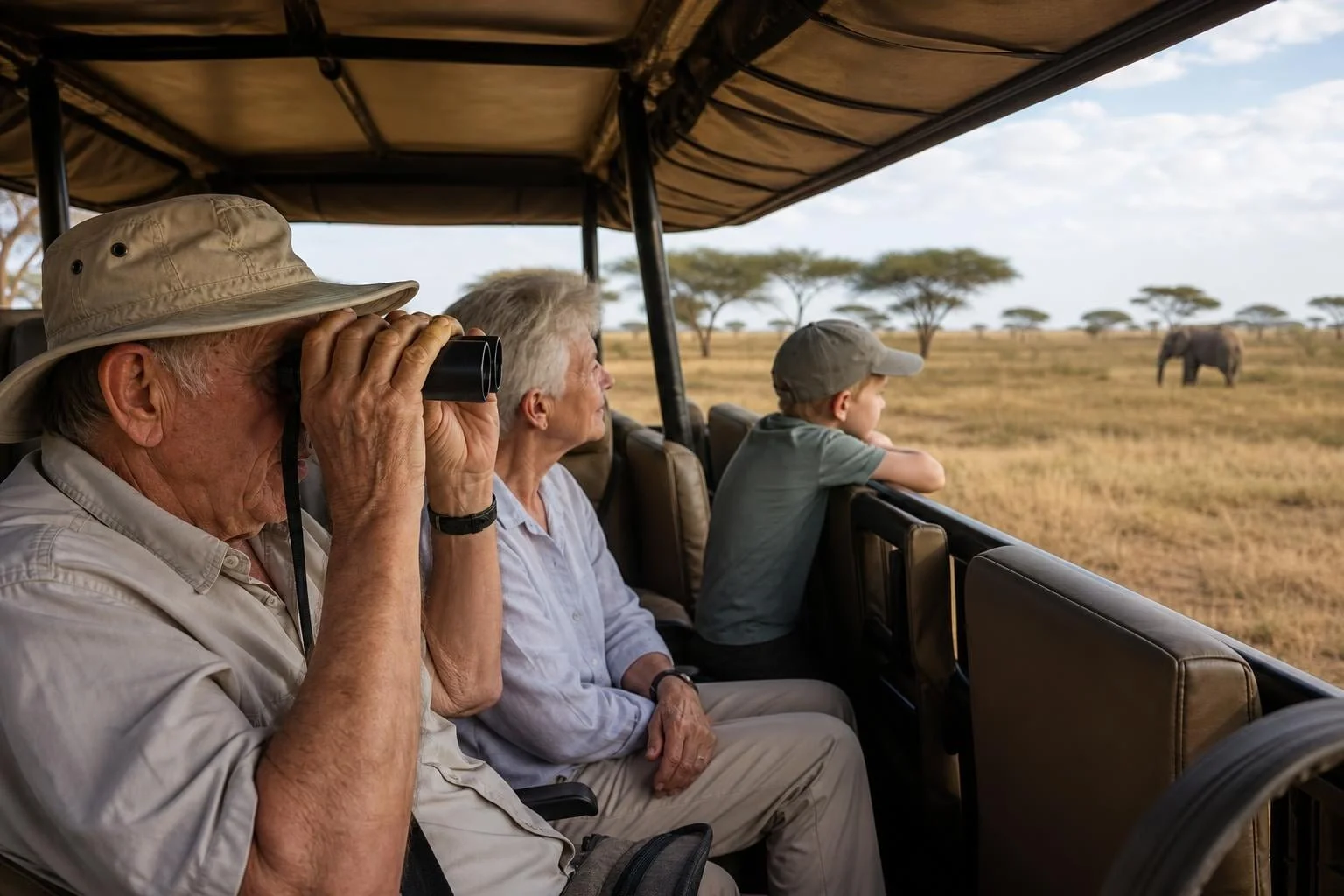
TLDR: A safari with grandparents works best with a private vehicle, fewer camp moves, lodges chosen for practical access (not just star rating), realistic health preparation, and built-in flexibility so different generations can enjoy the same trip without doing the same thing every hour. Tanzania’s Northern Circuit through Tarangire, Ngorongoro, and the Serengeti is a strong fit when pacing is right.
Safari With Grandparents: The Key Planning Rules A safari with grandparents works best when the itinerary uses a private vehicle, limits long road transfers and frequent camp changes, chooses accommodations based on accessibility and room location, and allows family members to skip individual game drives. For Tanzania, a 7–10 day private Northern Circuit itinerary with 2–3 nights per main location provides a practical starting point for many multigenerational families, while health, mobility, insurance, and activity requirements should be reviewed before booking.
A safari with grandparents is a multigenerational safari designed around different energy levels, mobility needs, sleep schedules, and attention spans. The best versions use a private vehicle, limit one-night camp stays, choose lodges with easy room access and flexible meals, and build in downtime so grandparents and children are not expected to join every game drive. Tanzania works especially well for this style of trip, particularly on a private Northern Circuit route through places like Tarangire, Ngorongoro, and the Serengeti. But the pacing matters more than the number of parks. The goal is not to make everyone follow the same schedule every day. The goal is to create shared wildlife moments while giving each generation room to rest.
This is not a niche idea. The 2025 U.S. Family Travel Survey from the Family Travel Association, NYU, and Good Housekeeping found that 57% of parents were planning a multigenerational trip and 71% of grandparents had taken one in the past three years. But a safari requires more careful design than a beach resort. There are game-drive schedules, remote lodges, bush flights, park transfers, health considerations, and wildlife safety rules that a family reunion at a Hilton does not involve.
For families comparing broader family safari options in Africa, this article focuses specifically on what changes when grandparents are part of the group.
Key Safari Terms for Grandparents and Multigenerational Families
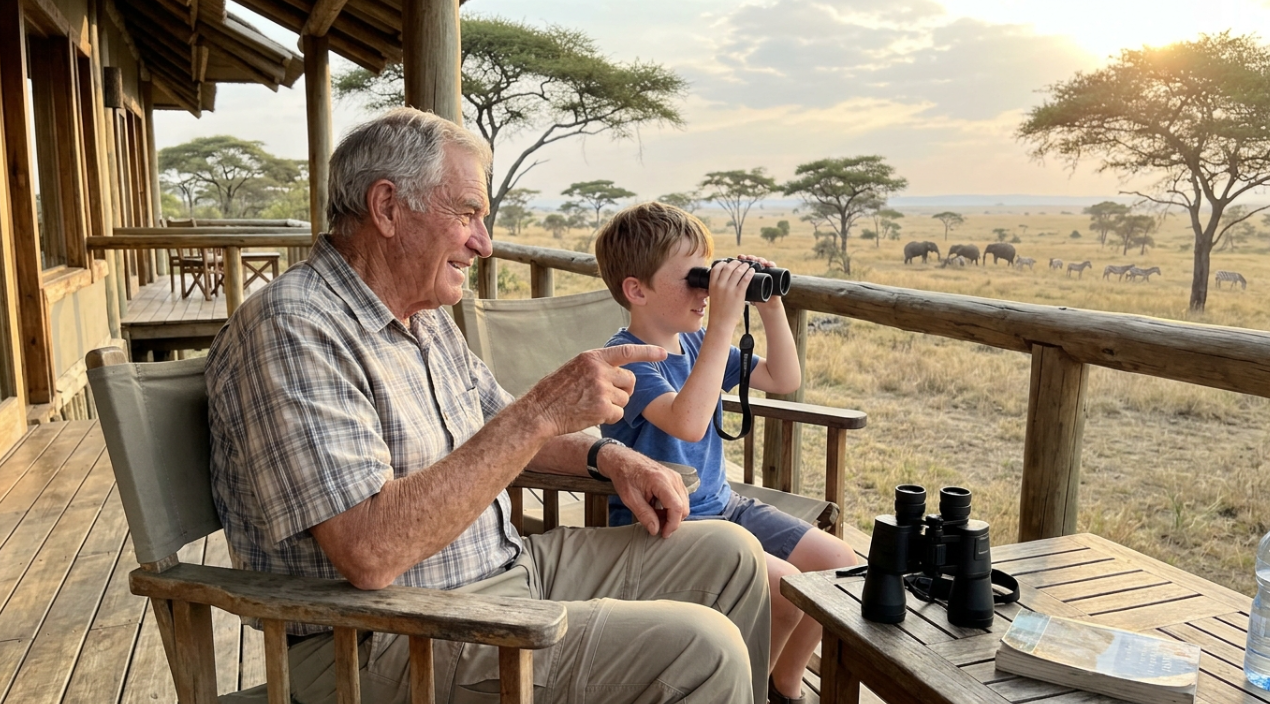
Several safari terms have a bigger practical impact when grandparents are traveling with children. Understanding these terms before requesting an itinerary makes it easier to compare vehicles, lodges, transfers, room configurations, and activities.
Use the glossary below as a quick reference when discussing your trip with a safari operator.
|
Term |
What it means |
Why it matters for a safari with grandparents |
|---|---|---|
|
Multigenerational safari |
A safari for three or more generations traveling together |
Must balance wildlife ambition with comfort, rest, and room logistics |
|
Private safari vehicle |
A 4x4 used only by your family |
Lets grandparents skip early starts, children take breaks, and the guide adjust pace |
|
Rest day / lodge day |
A day with no major transfer or required game drive |
Prevents fatigue and makes the trip feel like a vacation, not an endurance test |
|
Fly-in safari |
Using small aircraft between parks instead of long road transfers |
Saves time and bumps, but luggage limits and aircraft steps matter |
|
Family tent / interconnecting rooms |
Room setups that keep children close while giving adults privacy |
Room layout can make or break sleep and safety in unfenced camps |
|
Senior-friendly camp |
A camp with short walks, good lighting, escorts, accessible bathrooms, and minimal steps |
“Luxury” does not always mean easy for older knees or balance issues |
|
Medical evacuation cover |
Insurance for emergency transport to higher-level care |
Important for remote safari areas and older travelers |
|
Activity age policy |
Lodge or operator rules for children on drives, walks, or other activities |
Must be checked before booking, especially for young children |
Safari With Grandparents: Quick Planning Checklist
Before booking a Tanzania safari with grandparents, confirm these 10 details:
-
Private vehicle: Can the family control departure and return times?
-
Vehicle access: How high are the vehicle steps, and can a portable step be provided?
-
Camp access: How far are the rooms from dining and common areas?
-
Night movement: Are escorts required after dark?
-
Room configuration: Are family tents, interconnecting rooms, or nearby rooms available?
-
Pacing: Can the family skip individual game drives without disrupting the itinerary?
-
Transfers: Which long road transfers can be replaced with flights?
-
Medical preparation: Have grandparents reviewed the itinerary with a travel-health professional?
-
Insurance: Does the policy cover emergency medical treatment and evacuation in remote areas?
-
Children's activities: Do the camps and operators allow activities for the children's ages?
The goal is not to eliminate every inconvenience. It is to identify the issues that would be difficult to solve after arriving in Tanzania.
What Makes a Safari With Grandparents Different
A family safari with grandparents is not simply a regular safari with older travelers added to the vehicle. It requires a different rhythm. The itinerary must account for the least flexible needs in the group: a grandparent’s mobility limitations, a five-year-old’s attention span, medication schedules, bathroom access, step heights, and the reality that not everyone wants to wake up at 5:30 a.m. every day for a week.
The good news is that none of these constraints make the trip worse. They usually make it better. Families who plan around flexibility tend to enjoy the wildlife more because nobody is exhausted or resentful by day four.
Three things define a successful multigenerational safari:
-
Private pacing. The family controls the schedule, not a group departure time.
-
Fewer moves. Staying two or three nights per location instead of changing camps daily.
-
Permission to split up. Grandparents can skip a drive without guilt. Parents and teens can do a longer outing. Everyone regroups for dinner.
One Duma Explorer traveler captured this well: “There were 13 of us ranging in age from 62 to 11 years old. We had such an amazing experience. Truly a trip of a lifetime.” That kind of result does not happen by accident. It happens because the route, pace, guide, and accommodation were matched to the group.
The Planning Rule That Matters Most: Private Pacing
For a safari with grandparents, a private vehicle is less about status and more about control. Control over start times, bathroom stops, drive length, and whether everyone has to follow the same plan.
On a shared safari vehicle, the group leaves when the operator says it leaves. That often means 6:00 a.m. departures, set return times, and no flexibility if a child melts down or a grandparent needs a slower morning. With a private 4x4 and guide, the family can leave thirty minutes later, return an hour earlier, stop when someone needs to, and change plans mid-drive.
Practitioners on Reddit consistently identify private vehicles as the single most important booking decision for multigenerational groups. One commenter in a family travel thread said downtime is “HUGE” on safari, that animals are amazing but long drives and early mornings add up, and that a private safari is worth it for the flexibility alone. Another recommended at least one full lodge day between park transfers for kids and grandparents.
A private vehicle also unlocks the “do together, rest separately” model that makes three-generation trips work:
-
Everyone joins the first afternoon drive together.
-
Grandparents skip one sunrise drive and join brunch instead.
-
Parents and teens do a longer photography drive while younger kids swim.
-
Grandparents do a shorter afternoon drive and sundowner.
-
The family regroups for dinner.
Nobody is taking attendance. The best multigenerational safaris create shared anchor moments, not mandatory togetherness all day long.
If you are weighing private versus shared options, the differences in cost and flexibility are worth understanding early.
If you are trying to plan one safari that works for grandparents, parents, and children, Duma Explorer can build the route around the family’s actual energy levels rather than forcing everyone into a fixed group schedule.
Best Tanzania Safari Style for Grandparents and Grandchildren
Tanzania’s Northern Circuit is a natural fit for multigenerational families. The route connects three of the country’s strongest wildlife areas within a manageable geography, and it maps well to the kind of pacing older travelers and young children need.
The Tanzania Tourist Board positions the Northern Circuit around Tarangire, Ngorongoro, and the Serengeti, highlighting elephants, crater wildlife, and open-plains game viewing. Each park offers a different experience, which keeps things fresh across a week-plus itinerary.
Tarangire works well as a first safari park. TANAPA describes it as home to Tanzania’s largest elephant herds and baobab-dotted landscapes, with wildlife gathering around the Tarangire River during the dry season. It is less overwhelming than starting in the deep Serengeti, and the elephant sightings tend to make an immediate impression on children and grandparents alike. For a deeper look at what to expect, the Tarangire first game drive guide covers the park in detail.
Ngorongoro Crater is a major highlight but needs careful pacing. UNESCO describes it as the world’s largest caldera, combining wildlife, archaeology, and Maasai pastoralist history. The crater floor offers concentrated game viewing, but the descent road is steep and bumpy. Plan for a full day and do not add a long transfer on either side of it. The Ngorongoro planning guide explains the logistics.
Serengeti is the iconic destination. UNESCO recognizes it as 1.5 million hectares of savannah with around two million wildebeest, hundreds of thousands of zebras, and major predator-prey interactions. It is worth the distance, but it requires enough nights to justify the transfer. Do not fly or drive five hours each way for a single overnight.
A Simple Tanzania Structure
|
Trip length |
Suited for |
Notes |
|---|---|---|
|
5-6 days |
Short private Northern Circuit |
Works only if expectations are realistic; avoid too many camp moves |
|
7-9 days |
Better family pace |
Tarangire + Ngorongoro area + Serengeti with 2-3 nights each |
|
10-12 days |
Strong multigenerational pace |
Allows rest days between transfers |
|
12-14+ days |
Safari + Zanzibar or Kenya extension |
Better for families with enough time and budget |
To compare full Tanzania itinerary structures and costs, the itinerary glossary breaks down what goes into each route option.
Which Tanzania Parks Work for a Safari With Grandparents?
|
Destination |
Why families choose it |
Grandparent planning consideration |
Typical role in itinerary |
|---|---|---|---|
|
Tarangire |
Elephants, baobabs, varied wildlife |
Use private pacing and avoid unnecessarily long drives |
Strong early safari stop |
|
Ngorongoro Crater |
Concentrated wildlife and dramatic scenery |
Roads can be steep and bumpy; avoid pairing the crater with another demanding transfer |
Major wildlife highlight |
|
Serengeti |
Large landscapes, predators, migration opportunities |
The park is extensive, so allow enough nights to justify the transfer |
Longer stay and core safari experience |
|
Zanzibar |
Beach, swimming, relaxation, slower pace |
Adds another transfer but can provide recovery time after safari |
Optional post-safari extension |
The right combination depends on travel dates, mobility requirements, wildlife priorities, and how much time the family has. More parks do not automatically create a better multigenerational itinerary.
Sample 8-Day Tanzania Safari With Grandparents
A sample multigenerational itinerary can look like this:
|
Day |
Location |
Planning focus |
|---|---|---|
|
1 |
Arusha |
Arrival, recovery, early night |
|
2 |
Tarangire |
Afternoon game drive rather than an aggressive early start |
|
3 |
Tarangire |
Flexible game-drive day with lodge downtime |
|
4 |
Ngorongoro area |
Transfer at a manageable pace and settle in |
|
5 |
Ngorongoro |
Crater game drive with no major transfer afterward |
|
6 |
Serengeti |
Fly or drive according to mobility, time, and budget |
|
7 |
Serengeti |
Full safari day with optional shorter drive |
|
8 |
Serengeti / onward flight |
Flexible final morning and onward travel |
This is a planning example rather than a fixed itinerary. Actual routing should account for the travel season, park conditions, flight schedules, accommodation availability, and the family's mobility and activity requirements.
For families with grandparents, the important feature is the rhythm: arrive, explore, rest, transfer, explore, rest, rather than changing locations every day.
One Country Is Usually Easier
Cross-border Tanzania-Kenya safaris can be excellent, but for grandparents and young children, one-country routing often reduces friction. Practitioners on Reddit specifically warn that splitting Kenya and Tanzania on a short itinerary adds visa complexity, inconvenient border crossings, and full-day bumpy transfers that are hardest on the oldest and youngest travelers. One commenter recommended picking one country and adding varied parks within it rather than stretching across borders.
For 7-10 days, a Tanzania-only Northern Circuit is often the simplest choice. For 12-14+ days, multi-country combinations become more realistic, especially with flights and buffer time.
How Many Days for a Safari With Grandparents and Kids
Take enough time. International flights from the U.S. take at least 14 hours across multiple time zones. The first day usually needs arrival recovery. Park transfers are tiring. And older travelers and children both benefit from two to three nights per location rather than a new camp every morning.
Minimum: 5-6 safari days, if the route is simple and expectations are realistic.
Better: 8-10 days for a balanced multigenerational Tanzania safari.
Best for safari plus beach: 12-14 days including a Zanzibar or coast extension. A 14-day Tanzania itinerary shows how safari and beach can work together without exhausting the group.
Rules of Thumb for Pacing
-
Avoid changing camps every night.
-
Use 2-3 nights per safari location when possible.
-
Build “soft” afternoons after early drives.
-
Add a lodge or pool day after long transfers.
-
Treat skipped drives as normal, not failure.
A Reddit commenter who traveled with kids and grandparents recommended choosing a few camps in good locations and using a private guide rather than booking one-night-everywhere itineraries. Daily packing and bumpy transfers can be hard on older travelers and children in equal measure.
Lodge and Camp Features That Matter More Than Star Rating
The right lodge for a safari with grandparents is not always the most expensive lodge. It is the lodge that fits the group’s practical needs. Beautiful camps can have long walks between rooms and the dining area, stairs, uneven paths, low lighting, and late formal dinners that do not work for young children.
Practitioners on Reddit warn that tented camps can be stressful with children and older travelers after dark if guests need escorts for every movement between tents, including bathroom trips.
Practical Lodge Checklist
Before booking any camp or lodge, ask:
-
How far are rooms or tents from the main dining area?
-
Is the path level, lit, and easy to walk at night?
-
Are golf carts or escorts available?
-
Are there interconnecting rooms or family tents?
-
Can grandparents have rooms closest to the main area?
-
Are meals flexible in timing and content?
-
Is there an early dinner option for children?
-
Is there a pool or shaded rest space?
-
Is there reliable charging for devices and medical equipment?
-
How many stairs or steps are involved?
-
Is vehicle access close to rooms?
-
Is the camp fenced or unfenced?
-
Are night escorts required?
-
What is the children’s minimum age policy for drives and activities?
Ask for practical lodge fit, not just star rating. “Luxury” and “accessible” are not the same thing.
For multigenerational groups, Duma Explorer can help compare lodges by practical details: room distance, family configurations, meal flexibility, transfer time, and whether a fly-in route is worth the cost.
What Makes a Safari Senior-Friendly?
A senior-friendly safari is not necessarily a safari with luxury accommodation. It is an itinerary designed around manageable walking distances, practical vehicle access, appropriate transfer times, comfortable sleeping arrangements, and enough flexibility to rest.
Look for these characteristics:
-
Private vehicle and dedicated guide
-
Short walking distances between rooms and common areas
-
Minimal stairs and uneven terrain where possible
-
Easy vehicle entry and exit
-
Flexible game-drive timing
-
Two or more nights at major locations
-
Reliable access to meals, drinking water, and required medications
-
Accommodation that can meet the family's room configuration needs
-
Clear night-time escort procedures at unfenced camps
-
A realistic emergency and evacuation plan
When comparing lodges, ask for specific information rather than relying on terms such as “luxury,” “premium,” or “family-friendly.” A lodge can be luxurious while still requiring substantial walking or stairs.
Match the Safari Setup to Mobility Needs
|
Need |
What to ask the safari operator |
|---|---|
|
Difficulty with stairs |
How many steps are required to enter the vehicle and accommodation? |
|
Difficulty walking long distances |
How close can the vehicle park to the room and dining area? |
|
Balance concerns |
Can a portable vehicle step or other assistance be arranged? |
|
Back or neck discomfort |
How long are typical drives and how rough are the roads? |
|
Frequent bathroom needs |
How often can the vehicle stop and what facilities are available? |
|
Walking after dark |
Are escorts provided between rooms and common areas? |
|
Medical equipment |
Can the accommodation support charging, electricity, storage, or other requirements? |
|
Reduced stamina |
Can individual game drives be shortened or skipped? |
These questions should be answered before deposits are paid because some accessibility constraints are difficult to change once the itinerary is confirmed.
The Detail Nobody Thinks About: Getting In and Out of the Vehicle
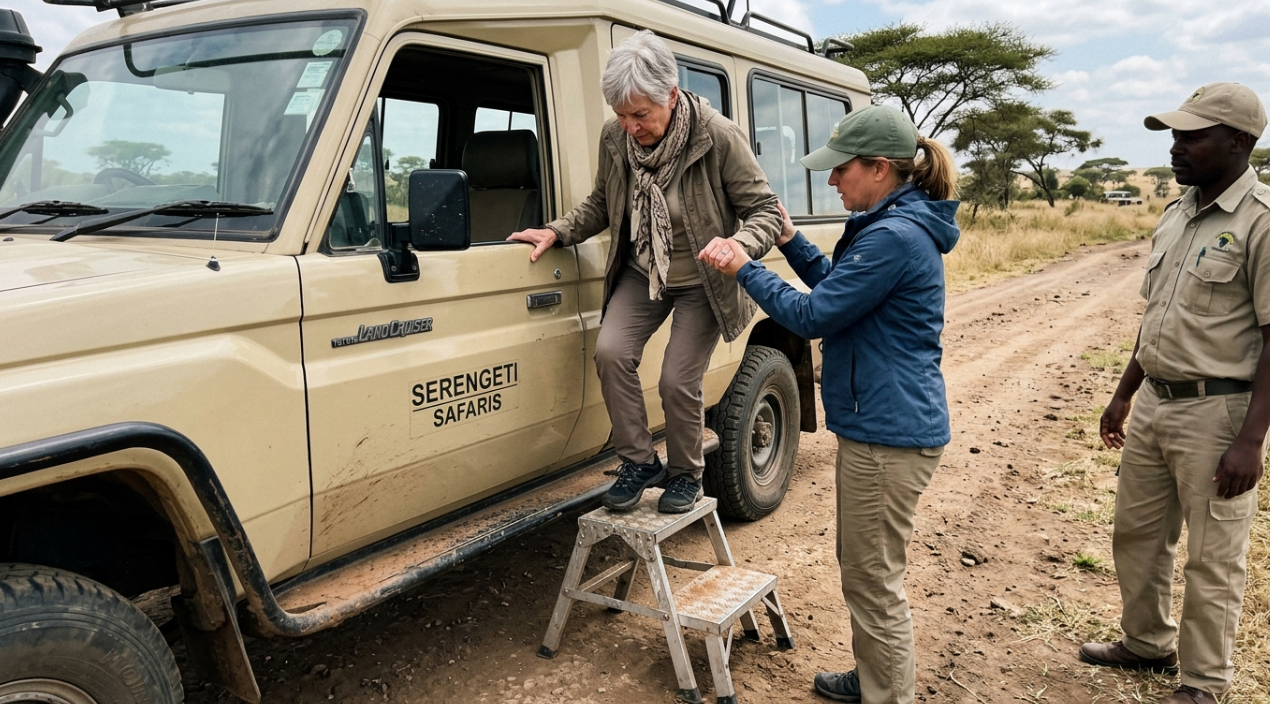
This comes up surprisingly often in practitioner discussions but rarely appears in planning articles. In a Reddit thread about taking an 80-year-old parent on safari, a traveler noted that an older guest was injured getting into a safari truck. The original poster responded that truck step height was a genuinely useful planning detail they had not considered.
On a typical safari day, grandparents may enter and exit the vehicle four to six times: morning departure, a mid-drive stop, return to camp, afternoon departure, a sundowner stop, and return. That is a lot of climbing for someone with knee, hip, or balance issues.
Before booking, discuss with your operator:
-
What is the vehicle step height?
-
Can a portable step be provided?
-
Where do grandparents sit for easiest entry and exit?
-
Is the pop-top roof comfortable for standing?
-
Will rough roads aggravate back or neck issues?
-
Are bathroom stops planned at reasonable intervals?
-
Is motion sickness a concern for any children?
These details are easy to address before the trip and hard to fix once you are on a bumpy track in the Serengeti.
Fly-In Safaris: Solving One Problem, Creating Another
For grandparents, fly-in routing can eliminate punishing six-to-eight-hour road transfers. But small aircraft come with their own considerations.
Coastal Aviation’s luggage policy allows 15 kg (33 lb) per person including carry-on luggage. Soft-sided bags are strongly recommended, and cargo pod dimensions are limited. An XL seat class allowing 30 kg is available subject to availability, but excess luggage needs advance arrangements.
What this means for a multigenerational family:
-
International luggage will probably not fit small-aircraft limits. Plan for repacking.
-
Soft bags are easier to load than rigid suitcases.
-
Medical devices, camera gear, walking aids, and excess luggage should be disclosed early.
-
Small aircraft have narrow doors and steep steps, which can be challenging for travelers with mobility limitations.
-
If the family is arriving from a beach extension or long international flight, baggage planning matters.
Fly-ins are often worth the cost for grandparents if the alternative is a full-day rough drive. But they are not automatically easier. The decision should weigh road conditions, transfer distance, luggage volume, and boarding ability.
Private Vehicle vs. Fly-In Safari for Grandparents
|
Consideration |
Private road safari |
Fly-in safari |
|---|---|---|
|
Schedule flexibility |
High |
Depends on flight schedule |
|
Long road transfers |
Still required on some routes |
Can substantially reduce them |
|
Vehicle access |
Easier to customize |
Aircraft boarding and steps need consideration |
|
Luggage |
Generally less restrictive |
Weight and bag-size restrictions may apply |
|
Family privacy |
High with private vehicle |
High once at destination |
|
Cost |
Depends on vehicle and route |
Usually adds flight costs |
|
Best planning question |
How long will each road transfer be? |
Can everyone comfortably board the aircraft? |
Neither option is automatically better for older travelers. The decision depends on mobility, transfer length, luggage, budget, flight availability, and the family's tolerance for road travel.
Health, Mobility, and Safety Planning
This section should be practical, not alarming. Most healthy grandparents in their 60s and 70s handle safaris well. The key is preparation, not anxiety.
Health Planning Starts Before the Itinerary Is Finalized
Health planning should influence the itinerary rather than happen after the safari has already been booked. Travel distance, altitude, road conditions, walking requirements, heat exposure, sleeping arrangements, and access to medical care can vary substantially between safari locations.
Grandparents should discuss the actual planned itinerary with an appropriate healthcare or travel-medicine professional. The purpose is not to determine whether someone is “too old” for safari. It is to identify practical requirements that the itinerary needs to accommodate.
Pre-Trip Medical Planning
The CDC advises older adult travelers to see a healthcare provider or travel health specialist 4-6 weeks before departure. That appointment should cover chronic medical conditions, the specific itinerary and accommodations, planned activities, routine vaccines, and medications.
For Tanzania specifically, the CDC recommends typhoid vaccine for most travelers. Yellow fever vaccine is generally not recommended for direct travel from the United States but is required for travelers arriving from countries with yellow fever transmission risk, including airport transits or layovers over 12 hours in those countries.
The CDC’s Yellow Book notes that malaria transmission occurs in most game parks and that safari activities like tented sleeping and dusk animal viewing can increase mosquito exposure. Malaria prevention medication should be discussed with the travel medicine clinic.
What to Bring and Disclose
-
Medication in original packaging, plus extra in case of delays.
-
A copy of medical history and immunization records.
-
Any walking aids, CPAP machines, or medical devices (and confirmation that camps can support them).
-
Information about dietary needs, allergies, or restrictions.
Insurance
The CDC notes that medical evacuation can range from USD 25,000 within North America to over USD 250,000 for more distant or remote locations. Specialized travel health and evacuation policies may be particularly beneficial for travelers with preexisting conditions and travelers over age 65.
For detailed guidance, the safari travel insurance guide covers what to look for in a policy.
Beyond Africa-Specific Health
Competitors often jump straight to malaria and vaccines. For grandparents, also consider:
-
Long-haul flight fatigue and blood clot risk (discuss with physician).
-
Medication timing across time zones.
-
Mobility assistance at airports.
-
Heat and dust tolerance on game drives.
-
Hydration in dry, hot environments.
This article cannot replace medical advice. Families should review their exact itinerary with a travel medicine clinic or physician, especially when grandparents have chronic conditions, mobility limits, immune concerns, or complex medications.
What Each Generation Needs
Planning a three-generation safari means thinking about roles, not just a generic “family.”
|
Traveler |
What they often need |
Planning response |
|---|---|---|
|
Grandparents |
Comfort, shorter walks, manageable steps, rest, medical confidence, meaningful family time |
Nearby rooms, private vehicle, no daily moves, medical and insurance preparation |
|
Parents |
Less logistics stress, safety, meals, room layout, child engagement |
Operator coordination, flexible guides, family tents, clear schedules |
|
Young children (under 8) |
Breaks, snacks, pool time, shorter drives, predictable meals |
Split drives, nature activities, downtime, camps with children’s programs |
|
Teens |
Wildlife goals, photography, independence, active options |
Longer drives, camera tips, cultural visits, optional activities |
|
Whole family |
Shared memories |
First or last night rituals, sundowners, special bush breakfast, photo moments |
The FTA survey data is interesting here: 40% of grandparents plan and organize multigenerational trips themselves, and 37% pay for the trip. This means grandparents should be included early in the planning process. Ask what “comfortable” means to them specifically. Do not design the trip only around the children and assume grandparents will adapt.
Where to Spend More (and Where You Might Not Need To)
Worth the investment:
-
Private vehicle and guide. The single highest-return upgrade for a multigenerational safari.
-
Fewer but better-located camps. Two well-chosen lodges beat four rushed ones.
-
Fly-in transfers when road days would be punishing for older travelers.
-
Rooms closest to the main area for grandparents.
-
An experienced guide who can read the group’s energy and adjust.
-
Travel insurance and medical evacuation coverage.
Not always necessary:
-
The most formal ultra-luxury lodge if it has poor access for older travelers.
-
Too many destinations crammed into limited days.
-
Back-to-back premium activities that exhaust the group.
-
International multi-country complexity on a trip shorter than 12 days.
For a clear breakdown of what drives safari pricing, the Tanzania cost per person guide explains how route, season, accommodation level, and group size affect the total.
Common Mistakes When Planning a Safari With Grandparents
Booking too many one-night stays. Packing and unpacking exhausts everyone. Transfers are often bumpy. Children and grandparents lose routine. Stay two to three nights per location.
Assuming luxury means accessible. Beautiful camps can have long walks to rooms, stairs, uneven paths, low lighting, and unfenced perimeters requiring escorts. Always ask about practical access.
Making every game drive mandatory. Fatigue causes people to stop enjoying the wildlife. One Reddit commenter who observed a large multigenerational group noted the organizer gave family members “grace” when they skipped drives, and another reinforced that nobody is taking attendance.
Crossing borders on a short itinerary. Kenya-Tanzania combinations can be excellent, but not if the trip becomes a transfer exercise with visa fuss, inconvenient crossing points, and full-day bumpy drives.
Ignoring vehicle entry and exit. Older travelers may struggle with repeated steps into high-clearance 4x4s. One Reddit traveler reported an older guest was injured getting into a safari truck. Ask about step height before booking.
Forgetting bush-flight luggage limits. Families arrive with international luggage that cannot fit small-aircraft restrictions. Plan for repacking and soft bags.
What Information to Give Your Safari Planner
The more a planner knows about the group, the better the trip design. Before reaching out, gather this information:
-
Travel dates or flexible month range
-
Number of travelers
-
Grandparents’ ages and mobility considerations (stairs, walking distance, balance, vehicle steps)
-
Children’s ages
-
Medical or dietary needs
-
Desired trip length
-
Approximate budget range
-
Preferred accommodation style
-
Private vehicle preference
-
Wildlife priorities (elephants, big cats, migration, birds, photography)
-
Tolerance for early mornings and bumpy drives
-
Interest in Zanzibar or beach extension
-
Special occasion (milestone birthday, anniversary, retirement, family reunion)
-
Room configuration needs
This is not a checklist to overwhelm anyone. It is the information that separates a well-matched itinerary from a generic package that does not fit.
Ready to build a safari that works for every generation? Share your travel dates, grandparents’ mobility needs, children’s ages, preferred comfort level, and ideal trip length, and Duma Explorer can design a private family safari with the right pace from the start.
How to Choose a Safari Operator for a Multigenerational Trip
When comparing safari operators, ask questions that reveal how well they can adapt an itinerary rather than simply asking whether they offer “family safaris.”
Ask:
-
Do you provide a private vehicle and dedicated guide?
-
Can game-drive times be changed during the trip?
-
How do you accommodate travelers with limited mobility?
-
Can you provide vehicle-step assistance?
-
Which lodges have the shortest walking distances?
-
How do you handle medical or dietary requirements?
-
Which road transfers can be replaced with flights?
-
What are the luggage restrictions on internal flights?
-
What happens if a traveler needs to skip a planned activity?
-
What emergency and evacuation procedures apply to the itinerary?
-
What are the minimum ages for activities?
-
Can grandparents and children have nearby rooms?
A useful operator should be able to explain the practical trade-offs behind the itinerary rather than simply recommend the most expensive accommodation category.
Frequently Asked Questions
Is a safari with grandparents realistic?
Yes, if the itinerary is private, paced well, and built around mobility, health, and rest needs. The main issue is rarely age alone. It is usually too many transfers, too many early mornings, poor lodge fit, or lack of schedule flexibility. Families traveling with grandparents in their 60s, 70s, and even 80s have successful safaris when the planning accounts for practical needs.
Should grandparents go on every game drive?
No. A good multigenerational safari makes it easy for grandparents, children, or anyone to skip a drive without guilt. Shared anchor moments (a sundowner, a bush breakfast, a big wildlife sighting) matter more than mandatory togetherness every hour. Choose camps where staying behind still feels rewarding, with a pool, a deck with wildlife views, or a good book and a cup of coffee.
Is a private safari vehicle worth it for a family with grandparents?
Almost always. A private vehicle lets the family adjust start times, return early, stop for bathrooms, shorten or lengthen drives, and avoid affecting other travelers. For families with mixed ages and energy levels, this is the single upgrade that changes the trip from stressful to flexible.
How many days should a multigenerational Tanzania safari be?
Eight to ten days provides a balanced pace for most multigenerational families on a Northern Circuit route. Five to six days is possible but tight. Twelve to fourteen days works well if you want safari plus a Zanzibar beach extension. International travel fatigue, park transfers, and the need for rest days between moves all add up.
What medical preparation do grandparents need for a Tanzania safari?
Families should speak with a physician or travel medicine clinic 4-6 weeks before departure. The appointment should cover destination-specific vaccines, malaria prevention, chronic conditions, medications, and planned activities. Travel health and medical evacuation insurance is strongly recommended, especially for travelers over 65 and those in remote safari areas.
Should we add Zanzibar after safari?
For many multigenerational families, yes. A beach extension helps everyone rest after early mornings and dusty drives. But it should be planned with transfer time, luggage limits for bush flights, and room needs in mind. Do not treat it as an afterthought; build it into the trip design from the start.
Is Tanzania or Kenya better for a safari with grandparents and kids?
Both can work well. Tanzania’s Northern Circuit offers strong wildlife diversity and pairs naturally with Zanzibar. Kenya’s Maasai Mara conservancies offer shorter fly-in options and family-friendly private experiences. For a first multigenerational safari of 7-10 days, sticking to one country reduces logistical friction. Cross-border trips become more realistic at 12-14+ days with proper buffer time.