

Safari With Grandkids: 2026 Guide to Key Terms & Tips
TL;DR
A safari with grandkids is easiest to plan when the itinerary is built around the youngest child, oldest traveler, and activities everyone can safely enjoy. Private vehicles provide more flexibility than shared game drives, while family suites or exclusive-use properties can simplify sleeping arrangements for three generations. Lodge and activity age limits vary, so check each property's current policy before booking. For mixed-age groups, a 7-to-10-day safari with a slower pace, shorter transfers, and at least one rest period can provide a practical starting framework.
Planning a safari with grandkids means encountering terminology you won’t find in a standard travel glossary. Multigenerational safari, skip-gen travel, exclusive-use villa, junior ranger programme, fly-in transfer: these terms show up repeatedly in lodge descriptions and operator itineraries, and each one carries practical implications for how your trip will feel.
This glossary exists to give grandparents (and the adult children helping them plan) a clear reference for the concepts that matter most. Not alphabetical, but organized by the order you’ll actually need them: trip structure first, then accommodations, activities, age rules, and booking logistics.
For a deeper look at family safari packages and itinerary options across East Africa, that resource covers the full planning picture. This page focuses on definitions and why each term matters for your specific group.
Safari With Grandkids: 7 Things to Know Before Booking Before comparing safari lodges or choosing parks, identify the ages, mobility needs, and interests of everyone traveling. These seven factors affect almost every other safari decision. 1. Start with the youngest traveler. Some lodges, walking activities, and shared safari experiences have minimum-age requirements. 2. Consider a private vehicle. A dedicated vehicle gives the family more control over departure times, stops, game-drive duration, and daily pacing. 3. Check lodge age policies individually. “Family-friendly” does not necessarily mean that every age is accepted for every activity. 4. Build in slower days. A safari does not need to mean a full day of game drives every day. Rest periods can make the itinerary easier for both children and older adults. 5. Reduce long overland transfers when appropriate. Domestic flights can shorten travel between distant safari areas, although baggage limits and aircraft access need to be considered. 6. Match activities to ages. Game drives may work for a broad age range, while walking safaris, night activities, and gorilla trekking can have additional restrictions. 7. Confirm current rules before paying deposits. Age limits, park regulations, flight baggage rules, and lodge policies can change. Get important restrictions confirmed in writing by the safari operator or property.
|
Term |
What It Means |
Why It Matters With Grandkids |
|---|---|---|
|
Multigenerational safari |
Three or more generations traveling together |
Requires an itinerary that accommodates different ages and energy levels |
|
Skip-gen safari |
Grandparents traveling with grandchildren without the parents |
Adds additional planning considerations because grandparents are the accompanying adults |
|
Private vehicle safari |
A dedicated safari vehicle and guide for your group |
Allows greater control over timing, stops, and game-drive duration |
|
Family suite |
Accommodation designed for families, often with multiple sleeping areas |
Keeps generations close while providing separate sleeping space |
|
Exclusive-use safari house |
A private property booked for one group |
Provides privacy, flexible meals, and a dedicated setting for family groups |
|
Lodge minimum age |
The youngest age accepted by a lodge or camp |
Can determine which properties are available to families with young children |
|
Junior ranger programme |
Children's wildlife and conservation activities |
Gives younger travelers age-appropriate activities beyond game drives |
|
Fly-in safari |
Traveling between safari areas by light aircraft |
Can reduce long overland transfers |
|
Walking safari |
Guided wildlife experience conducted on foot |
Often subject to minimum-age and safety requirements |
|
Gorilla trekking |
Guided trek to observe habituated mountain gorillas |
Usually subject to a minimum age requirement |
|
Rest day |
A day without a major transfer or scheduled game drive |
Helps prevent fatigue across different generations |
|
Beach extension |
Adding a coastal stay after the safari |
Provides a slower-paced second part of the trip |
|
::: |
Quick-Reference Table: Key Terms at a Glance
|
Term |
What It Means |
Why Grandparents Should Care |
|---|---|---|
|
Multigenerational safari |
Safari with three or more generations traveling together |
Trip pacing and accommodation layout must serve everyone from age 7 to 70+ |
|
Skip-gen travel |
Grandparents travel with grandchildren, parents stay home |
Different legal and logistical requirements than a full-family trip |
|
Private vehicle safari |
Your family gets its own dedicated 4x4 and guide |
Eliminates age restrictions in Tanzania and Kenya; controls pace entirely |
|
Exclusive-use villa |
A fully staffed private property booked for one group |
Gold standard for multigenerational comfort and togetherness |
|
Junior ranger programme |
Lodge-run kids’ activities: tracking, wildlife journals, bush skills |
Frees grandparents for longer drives or rest while kids stay engaged |
|
Gorilla trekking age limit |
Minimum 15 years in Uganda, Rwanda, and DRC |
Splits the group if younger grandchildren are part of the trip |
|
Fly-in safari |
Light-aircraft transfers between parks |
Reduces hours of road travel, critical for comfort with older adults or very young children |
|
Beach extension |
Adding Zanzibar or coastal days after the safari |
Decompresses the group after intensive wildlife viewing |
What Does a Good Safari With Grandkids Look Like?
There is no single itinerary that works for every family, but a practical multigenerational safari usually combines private transportation, family-friendly accommodation, flexible game drives, shorter transfer days, and time to rest.
|
Planning Factor |
Practical Starting Point |
Why It Helps |
|---|---|---|
|
Vehicle |
Private safari vehicle |
Lets the family adjust the schedule around children and older adults |
|
Accommodation |
Family suite or connected rooms |
Provides proximity without requiring everyone to share one room |
|
Safari length |
About 7–10 days |
Allows multiple wildlife areas without requiring constant movement |
|
Game drives |
Flexible private drives |
The guide can shorten or extend drives according to the group's energy |
|
Transfers |
Mix of driving and flights |
Reduces long road journeys when distances are significant |
|
Rest |
At least one slower day |
Gives children and grandparents time to recover |
|
Activities |
Game drives plus age-appropriate alternatives |
Allows different generations to participate at different levels |
|
Final stop |
Optional beach or relaxed lodge stay |
Creates a slower transition after several days in the bush |
Trip Structure Terms
Multigenerational Safari
A safari designed for three or more generations traveling together, typically grandparents, parents, and grandchildren. Often shortened to “multi-gen” or “3G safari” in operator marketing.
Why it matters: Family and multigenerational travel is now the second-leading travel category sold by U.S. and Canadian travel advisors, rising from 39% to 66% according to TMR’s 2025 Distribution Outlook. This is no longer a niche request. But the dynamics are specific. Grandparents often want culture and comfort. Parents want a break that doesn’t feel like more work. Children want excitement. A well-designed multigenerational safari accounts for all three without forcing constant compromise.
Duma Explorer has planned safaris for groups ranging in age from 11 to 62, so the realities of mixed-age pacing and accommodation calibration are familiar territory for their team.
Skip-Gen Travel (Skip-Generation Safari)
A trip where grandparents travel with grandchildren without the parents present. The term “skip-gen” comes from skipping the middle generation entirely.
Why it matters: According to Hilton’s 2026 Trends Report, skip-generation holidays are growing rapidly. An AARP survey found that nearly a third of grandparents have taken at least one grandchild on a skip-gen trip. For safari planning, this creates specific considerations. Grandparents become the sole responsible adults, which affects travel insurance, medical consent documentation, and activity decisions. A skip-gen safari in East Africa works well precisely because game drives are low-exertion activities that both a 70-year-old and a 10-year-old can enjoy fully. The FTA’s 2025 survey found that grandparents spent an average of $2,043 on skip-gen travel, compared to $5,205 on multigenerational trips where parents also attend.
Private Vehicle Safari
A safari where your family group has a dedicated 4x4 vehicle and driver-guide, rather than sharing with other guests.
Why it matters: This is effectively non-negotiable for a grandkids safari. A private vehicle means bathroom stops happen when needed, not when the group schedule allows. Game drive duration adjusts to energy levels. A cranky four-year-old doesn’t ruin another couple’s honeymoon drive. And critically: in Tanzania and Kenya, private vehicle safaris typically have no minimum age restriction. This single distinction opens the safari to toddlers and babies who would be turned away from shared vehicles. Practitioners on Reddit’s r/FATTravel consistently recommend private vehicles for multigenerational groups, calling the flexibility difference “night and day.” For more on vehicle types and features, that guide breaks down the options.
Split Itinerary
Designing different segments within one trip so that subgroups can do different things. For example, grandparents rest at the lodge with a pool afternoon while teenagers do a walking safari with the guide.
Why it matters: Not everyone needs to do everything together every day. A split itinerary preserves family harmony by acknowledging that a 12-year-old’s energy level at 3 PM is very different from a 68-year-old’s. Good operators build these splits into the planning stage rather than leaving families to negotiate them on the ground.
Rest Day (Down Day)
A day built into the itinerary with no scheduled game drive or transfer. The group stays at the lodge, swims, reads, plays cards, or does gentle activities at their own pace.
Why it matters: Seven to ten days is the ideal length for a multigenerational safari, but that doesn’t mean seven to ten consecutive days of 5:30 AM wake-up calls. Rest days prevent burnout in young children and fatigue in older adults. They also create space for the unstructured family time that grandparents often value most.
Beach Extension
Adding a coastal destination, most commonly Zanzibar, after the safari portion of the trip. Sometimes called “beach decompression.”
Why it matters: Children have a finite attention span for game drives, no matter how thrilling the wildlife. A few days on the beach after the safari gives the whole group a different rhythm: snorkeling, swimming, exploring Stone Town, eating seafood. For a family splitting time between bush and coast, a 14-day Tanzania and Zanzibar itinerary shows how the sequencing works in practice.
Fly-In Safari
A safari where transfers between parks happen by light aircraft (typically Cessna Caravans seating 12 to 14 passengers) rather than overland driving.
Why it matters: The drive from Arusha to the central Serengeti takes roughly 8 hours. A flight takes about 90 minutes. For grandparents with back or joint issues, or for families with children under five, fly-in transfers change the trip from endurance test to comfortable experience. The trade-off is cost, as domestic flights in Tanzania typically add $200 to $500+ per person per sector, but multigenerational groups consistently report it’s worth it.
If mobility is a real concern, Duma Explorer has a full guide on accessible safari options for seniors that covers vehicle modifications, lodge accessibility, and pacing strategies.
Accommodation Terms
Family Suite (Family Tent)
A multi-bedroom accommodation unit, often with two or three bedrooms and shared living space. In tented camps, this might be two connected safari tents with a shared veranda. In lodges, it’s typically interconnecting rooms or a self-contained wing.
Why it matters: Family suites solve the central tension of multigenerational accommodation: togetherness without sacrificing space. Parents and children sleep close together while grandparents have their own comfortable quarters nearby. One Duma Explorer client review captured this balance perfectly: the operator calibrated accommodations that were “not so high end that we didn’t feel like we were on a safari and not so basic that the kids wouldn’t want to return to Africa when they got older.” That middle ground matters.
Exclusive-Use Villa (Safari House)
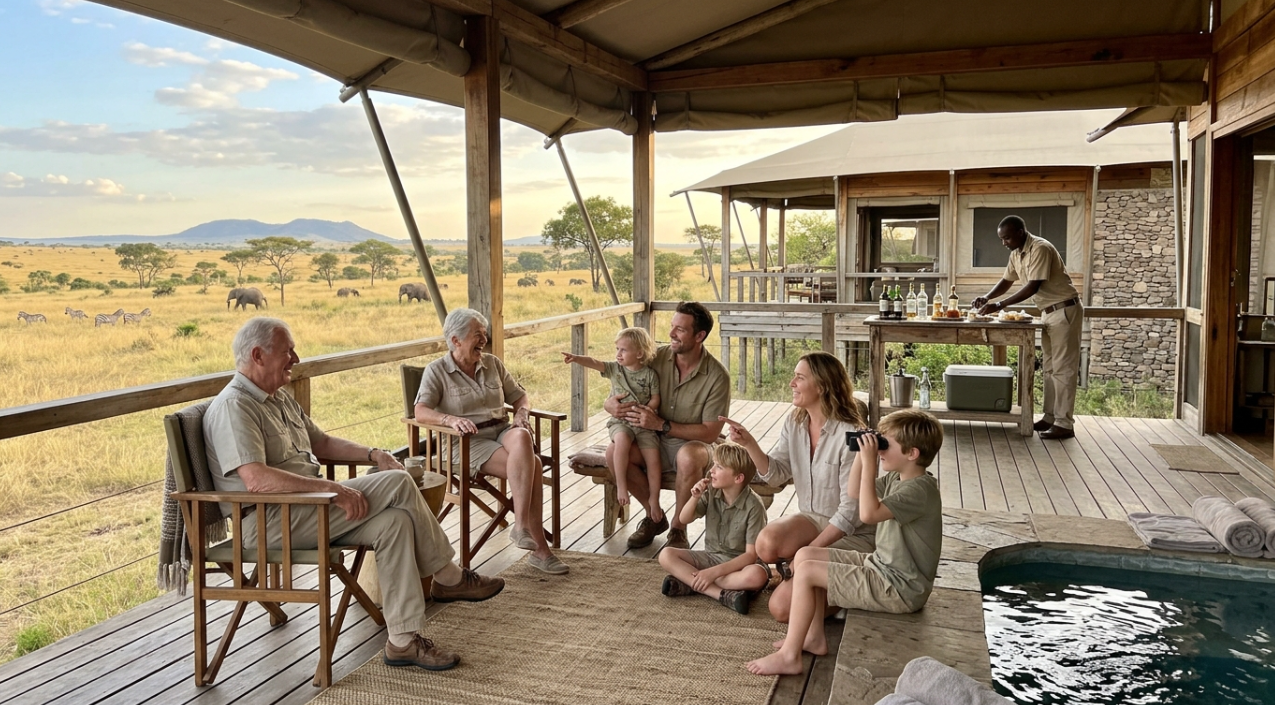
A fully staffed private property, complete with personal chef, guide, vehicle, and often a pool, booked exclusively for one family group. No other guests.
Why it matters: For multigenerational groups of six or more, an exclusive-use property often costs less per person than individual rooms at a premium lodge, while providing far more privacy and flexibility. Mealtimes adapt to the family. The guide works on your schedule. Grandchildren can be noisy without worrying about other guests. This is the gold standard for safari with grandkids planning.
Family-Friendly Lodge
A lodge or camp that actively welcomes children, as opposed to adults-only properties. Indicators include kids’ clubs, flexible mealtimes, swimming pools, dedicated family guides, and child-friendly meal options.
Why it matters: Not all safari lodges welcome children. Many luxury properties are adults-only or set high minimum ages (10 or 12) to maintain a certain atmosphere. When planning a grandkids safari, confirming a property is genuinely family-friendly, not just “children tolerated,” saves disappointment.
Interconnecting Rooms
Adjacent rooms with an internal door connecting them, allowing access without going through the corridor or outside.
Why it matters: Practical for grandparents who want to be close to younger grandchildren at night without sharing the same room. Interconnecting rooms also let parents check on small children easily while grandparents maintain their own space and sleep schedule.
Lodge Minimum Age
The youngest age a property will accept as a guest. This varies from 4 to 12 depending on the lodge, and some properties set different ages for different activities or meal seatings.
Why it matters: According to SafariBookings, most safari camps and lodges welcome children of nearly all ages, but some set minimum ages between 4 and 12. This is the single most common planning obstacle for families with younger grandchildren. Always confirm minimum age policies directly with the operator, as these can change seasonally and some properties make exceptions for exclusive-use bookings.
Safari With Grandkids by Age
The best safari setup depends heavily on the youngest child's age. Age affects lodge eligibility, activity restrictions, attention span during game drives, and how much downtime the family may need.
|
Grandchild's Age |
Planning Considerations |
Safari Approach |
|---|---|---|
|
Under 4 |
More frequent breaks, nap schedules, and stricter property policies may apply |
Consider a private vehicle and carefully selected family-friendly accommodation |
|
4–6 |
Game drives may need to be shorter and more flexible |
Prioritize private vehicles, engaging guides, and properties with child-focused activities |
|
7–10 |
Children can often participate more actively in wildlife viewing and educational programmes |
Combine game drives with junior ranger or cultural activities |
|
11–14 |
Longer drives and more active experiences may become practical |
Consider walking or other activities where the specific operator permits the child's age |
|
15+ |
More activities may become available depending on local rules |
Consider trekking and other age-restricted activities when permitted |
|
Grandparents 60+ |
Mobility, heat, transfer duration, and accommodation layout may become important |
Consider shorter drives, easier-access accommodation, private transportation, and optional flights |
These are planning guidelines rather than universal age rules. The minimum age for a particular lodge, activity, vehicle, or park should always be confirmed before booking.
How Much Does a Safari With Grandkids Cost?
The cost of a safari with grandkids depends on the destination, season, accommodation level, group size, transportation, and number of private services. Multigenerational trips can also cost more than standard safaris when the family chooses private vehicles, exclusive-use accommodation, or domestic flights.
|
Cost Factor |
What Can Increase the Cost |
|---|---|
|
Accommodation |
Luxury lodges, family suites, and exclusive-use properties |
|
Transportation |
Private vehicles and domestic flights |
|
Season |
Peak travel periods can have higher accommodation rates |
|
Group size |
Larger families may require additional rooms or vehicles |
|
Activities |
Private or age-specific activities can add costs |
|
Trip length |
More nights increase accommodation and activity costs |
|
Beach extension |
Adds accommodation, transfers, and activities after the safari |
Rather than comparing a safari only by its nightly rate, compare the total itinerary cost, including accommodation, vehicles, guides, internal flights, park fees, activities, and transfers. Confirm current inclusions and exclusions with the operator before booking.
Activities and Programmes
Junior Ranger Programme
Lodge-run educational activities for children, typically including animal tracking, wildlife journals, bush skills (identifying prints, learning bird calls), and sometimes supervised nature walks within safe areas around the property.
Why it matters: A junior ranger programme keeps grandchildren engaged during times when adult activities (long game drives, wine tastings, spa treatments) are happening. It also gives grandparents genuine rest time without guilt. Children who participate tend to become more invested in subsequent game drives because they have new knowledge to apply.
Game Drive
Vehicle-based wildlife viewing in a national park or conservancy. Morning drives typically depart around 6:00 to 6:30 AM and return by noon. Afternoon drives run from roughly 3:30 PM until sunset.
Why it matters: Game drives are the core safari activity, and they naturally suit mixed ages because everyone participates from the vehicle without physical exertion. The key for multigenerational groups is drive duration. A standard shared drive runs 3 to 4 hours. With a private vehicle, you can cut it shorter if a young grandchild gets restless or extend it if the whole family is mesmerized by a leopard in a tree.
Walking Safari
A guided walk through wildlife areas on foot, accompanied by an armed ranger and a trained walking guide.
Why it matters: Most walking safaris restrict children under 12, and many set the floor at 16. The restrictions exist for sound safety reasons, as participants must be able to follow instructions instantly and move quickly if needed. This is a common split-itinerary opportunity: grandparents and teenagers walk while younger grandchildren do a vehicle-based activity.
Night Drive
A game drive conducted after dark, using spotlights to find nocturnal animals like aardvarks, bush babies, civets, and hunting predators.
Why it matters: Tanzania’s national parks (TANAPA) do not permit night drives within park boundaries. However, private conservancies bordering parks sometimes do. This distinction matters for itinerary design. Night drives are exciting for older grandchildren but generally too late (and too cold) for young ones.
Cultural Visit (Maasai Village Visit)
An off-vehicle activity where the family visits a local community, often a Maasai boma in Tanzania or Kenya, to learn about traditional life, see dancing, and sometimes participate in activities like beadwork or fire-starting.
Why it matters: Cultural visits are suitable for all ages and provide a welcome change of pace between game drives. They also give grandchildren context about the people who live alongside the wildlife, which makes the safari more meaningful.
Sundowner
Drinks and snacks served at a scenic viewpoint around sunset, typically on a kopje (rock outcrop), riverbank, or elevated clearing with panoramic views.
Why it matters: Nearly 89% of respondents in the FTA’s 2025 survey believe traveling with family supports grandparents’ health and well-being, and 50% of grandparents say time with grandchildren is the most valued part of travel. A sundowner, watching the African sun set with a grandchild pointing out animals on the plain below, is often the moment that crystallizes the entire trip.
Bush Picnic (Bush Breakfast)
A meal served in the field rather than at the lodge, set up by staff at a scenic location during a game drive.
Why it matters: Bush breakfasts create shared family memories that feel adventurous even for grandparents who wouldn’t consider themselves adventurous. Eating scrambled eggs under an acacia tree while a giraffe walks past in the background is the kind of story a grandchild tells for years.
Age Rules and Safety Terms
Minimum Age Restriction
The youngest age permitted for a specific lodge stay or activity. This is the single most important practical detail for planning a safari with grandkids.
Here’s the breakdown:
|
Activity/Setting |
Typical Minimum Age |
Notes |
|---|---|---|
|
Shared game drive |
6 to 8 years |
Varies by park and operator |
|
Private game drive (Tanzania/Kenya) |
No strict minimum |
The private vehicle exception applies |
|
Luxury lodge stay |
8 to 12 years |
Property-specific; some allow younger for exclusive-use |
|
Walking safari |
12 to 16 years |
Lodge/park discretion |
|
Gorilla trekking |
15 years |
Universal across Uganda, Rwanda, DRC |
|
White-water rafting |
15 years |
Operator-specific |
|
Night drive |
Varies |
Usually 6+; not available in most Tanzanian parks |
For a complete picture of safari safety rules and risks in Tanzania, that guide covers what to expect.
Gorilla Trekking Age Limit
Gorilla trekking has strict minimum-age requirements, and travelers should confirm the current rule with the relevant wildlife authority before booking. A commonly applied minimum age is 15, but families should verify the requirement for the specific country, permit, and travel date.
For multigenerational groups that include children who are not eligible to trek, the itinerary can be structured so that eligible travelers trek while younger children participate in another activity.
The important planning point is to check the age requirement before purchasing permits or finalizing the entire itinerary. Age rules and permit conditions should be confirmed directly with the relevant wildlife authority or safari operator.
Private Safari Age Considerations
A private safari vehicle can make traveling with younger children easier because the family does not have to follow another group's schedule. However, a private vehicle does not automatically override every age restriction.
Lodge policies, park regulations, specific activities, insurance requirements, and operator rules may still apply. Families traveling with babies, toddlers, or preschool-age children should confirm the minimum age for the accommodation and each planned activity before booking.
The practical advantage of a private vehicle is flexibility: if a child needs a break, the family can often return to camp or shorten the game drive without affecting other guests.
Malaria Zone / Malaria-Free Reserve
Whether a safari destination falls within a malaria transmission area. Most of Tanzania and Kenya’s safari regions are in malaria zones.
Why it matters: Malaria prophylaxis decisions weigh differently for a 5-year-old and a 70-year-old. Young children have fewer medication options, and some antimalarials are not recommended for older adults with certain conditions. Discuss options with a travel medicine specialist well before departure. Some South African reserves (like those in the Eastern Cape) are malaria-free, but East African parks generally are not. The CDC’s travel health guidance for Africa provides current recommendations by country and region.
Guide Qualifications (FGASA, WFR)
Professional certifications held by safari and wilderness guides. FGASA (Field Guides Association of Southern Africa) certifies wildlife knowledge and guiding skill. WFR (Wilderness First Responder) certifies emergency medical response in remote settings.
Why it matters: When grandchildren are on the vehicle, guide qualifications stop being an abstract credential and become a direct safety consideration. Duma Explorer’s safari guides are completing FGASA Level 1 certification, and their Kilimanjaro guides hold WFR certification. For more on what these guide qualifications mean in practice, that reference explains the training pipeline and what to look for when comparing operators.
Mobility-Friendly Safari Planning
A safari can be adapted for travelers with different mobility levels, but the vehicle itself is only one part of the equation. Families should evaluate the entire journey from airport arrival to lodge departure.
Before booking, ask about:
-
Steps into the safari vehicle
-
Walking distance from rooms to dining areas
-
Uneven paths and terrain
-
Distance from the airstrip to the accommodation
-
Vehicle access and seating configuration
-
Bathroom access during long game drives
-
Transfer duration between destinations
-
Whether staff can assist with luggage or transfers
-
Whether domestic flights have restrictions relevant to the traveler
A private vehicle can provide more control over the daily schedule, while carefully selected accommodation can reduce unnecessary walking. Ask the operator to describe the physical demands of each day rather than relying only on a general “accessible” or “family-friendly” label.
Safari With Grandkids Safety Checklist
Before departure, families should review the practical safety requirements for both the youngest and oldest travelers.
Health and medication
Discuss destination-specific health precautions with an appropriate healthcare professional before travel. This is particularly important when the group includes young children or older adults.
Sun and heat
Pack sun protection, refillable water bottles, lightweight clothing, hats, and any other items recommended for the destination and season.
Vehicle safety
Children should follow the guide's instructions while inside the safari vehicle. Do not allow children to stand, climb onto seats, or leave the vehicle unless the guide confirms that it is safe.
Accommodation safety
Ask whether rooms require walking between buildings, whether paths are uneven, and how the property handles children around pools, wildlife areas, and after-dark movement.
Transfers
Check the length of road transfers and the baggage requirements for any domestic flights. Families should also ask how young children are accommodated during transfers.
Emergency planning
Confirm how the operator handles medical emergencies, where the nearest appropriate medical facility is located, and what emergency assistance is included in the booking.
Age-restricted activities
Confirm minimum ages separately for walking safaris, night drives, water activities, trekking, and other experiences rather than assuming that the lodge's general child policy applies to every activity.
How Long Should a Safari With Grandkids Be?
For many multigenerational families, a 7-to-10-day safari provides enough time to visit more than one wildlife area without requiring a new transfer every day. The exact length should depend on the children's ages, grandparents' mobility, number of parks, and whether domestic flights are used.
A slower itinerary can be more comfortable than trying to maximize the number of parks visited. For example, a family might spend several nights in one area, move to a second wildlife region, and include a rest period rather than changing accommodation every night.
Example 7-Day Structure
|
Day |
Focus |
|---|---|
|
Day 1 |
Arrival and easy evening |
|
Day 2 |
Morning and afternoon game-drive options |
|
Day 3 |
Game drive plus relaxed lodge time |
|
Day 4 |
Transfer to the next safari area |
|
Day 5 |
Full or flexible safari day |
|
Day 6 |
Shorter game drive or family activity |
|
Day 7 |
Final safari activity and departure/continuation |
Families adding Zanzibar or another coastal destination can extend the trip after the safari rather than making the safari portion unnecessarily long.
Booking and Logistics Terms
Bespoke (Custom) Itinerary
A trip designed from scratch around a specific group’s ages, interests, fitness levels, and pace preferences, rather than selected from a fixed template.
Why it matters: A safari with grandkids is the definition of a trip that can’t be booked off the shelf. The age range, the energy-level differences, the accommodation needs, and the activity restrictions all require custom planning. One family might include a marathon-running grandparent and a five-year-old with a short attention span. Another might include a grandparent using a cane and a teenager who wants adventure. The itinerary must reflect the actual group.
Private Guide
A dedicated guide assigned exclusively to your family group for the duration of the safari, as opposed to a guide shared with other lodge guests.
Why it matters: Your private guide becomes the trip’s central figure: part naturalist, part entertainer, part safety officer, part schedule manager. They’ll know within the first morning whether your seven-year-old grandchild needs more elephant time and less driving, or whether your grandmother prefers birds over big cats. For multigenerational groups, a private guide’s ability to read the room (or the vehicle) and adjust accordingly is worth every dollar.
Domestic Flight (Light Aircraft)
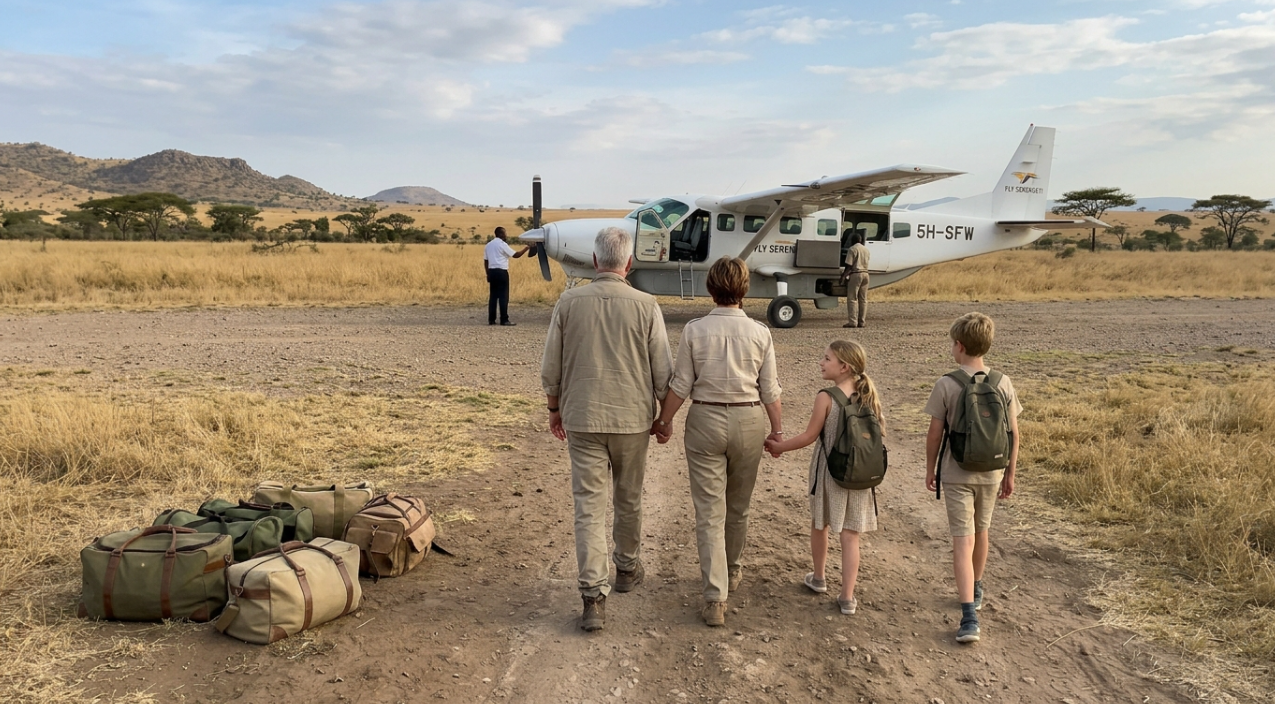
Internal flights between safari parks, typically operated by Auric Air, Coastal Aviation, or similar carriers in Tanzania. Aircraft are small (usually 12 to 14 seats), and luggage is limited to soft-sided bags of 15 to 20 kg.
Why it matters: Soft-bag luggage restrictions catch multigenerational groups off guard. Grandparents accustomed to wheeled suitcases need to switch to duffels. Families with young children carrying bulky items (car seats, strollers) need to plan ahead, as these often won’t fit.
Group Size
The number of people sharing a vehicle or camp activity. Standard shared game drives carry 6 to 8 guests. Private vehicles serve only your group.
Why it matters: When your multigenerational family IS the group, the vehicle question answers itself. A family of six, say two grandparents, two parents, and two children, fills one extended Land Cruiser. Larger groups of 8 to 13 need two vehicles, which means coordinating two guides but also gaining flexibility for split activities.
Shoulder Season
The weeks immediately before or after peak season, when wildlife viewing remains strong but visitor numbers and prices drop. In Tanzania, shoulder seasons typically fall in late March to early April and late October to November.
Why it matters: Multigenerational groups often have more scheduling flexibility than couples or solo travelers. If grandchildren are young enough to travel outside school holidays, shoulder-season booking can save 20% to 30% on lodge rates while still delivering excellent wildlife. For specific month-by-month guidance, the best time for safari in Tanzania breaks it down.
Tanzania-Specific Terms for Family Safaris
Northern Circuit
Tanzania’s classic safari route, connecting Tarangire National Park, Lake Manyara, the Ngorongoro Conservation Area, and the Serengeti. This is the most visited circuit and the one best suited to multigenerational pacing because parks are relatively close together and infrastructure is well established.
For full Northern Circuit planning, including park sequencing and cost considerations, that guide covers the logistics in detail.
Ngorongoro Crater
A collapsed volcanic caldera roughly 20 km across, with one of the highest wildlife densities in Africa. Game drives within the crater are compact, typically 4 to 5 hours, with animals concentrated in a relatively small area.
Why it matters for grandkids: The crater is one of the best places for a short, high-reward game drive. Because animals are everywhere and the driving distances are small, even young children with limited patience are likely to see lions, elephants, hippos, flamingos, and possibly black rhino in a single morning. The Ngorongoro Crater planning guide covers rim lodges, crater-floor logistics, and timing.
Zanzibar
The semi-autonomous island archipelago off Tanzania’s coast, reachable by a short flight from the Serengeti or Arusha. White-sand beaches, Stone Town’s UNESCO heritage, spice tours, and snorkeling make it the most popular beach extension for families finishing a mainland safari.
Why it matters for grandkids: Zanzibar gives children a completely different sensory experience, swimming in warm Indian Ocean water, exploring narrow Stone Town alleyways, tasting tropical fruit at a spice farm, after days of sitting in a safari vehicle. For grandparents, the pace shift is equally welcome.
Frequently Asked Questions
What is the best age for grandkids to go on safari?
There is no single best age. Children as young as 2 or 3 can go on private vehicle safaris in Tanzania and Kenya, since private bookings bypass the standard minimum age of 6 to 8 that shared drives enforce. That said, most families find the sweet spot is around 6 to 10, when grandchildren are old enough to remember the experience, sit quietly during game drives, and engage with junior ranger activities, but young enough to still find everything magical. Teenagers bring a different energy: they’re eligible for walking safaris and, at 15+, gorilla trekking.
Can grandparents with mobility issues do a safari?
Yes. Game drives require virtually no walking. You sit in a vehicle, and the guide drives to the wildlife. The physical challenge comes during transfers (boarding small aircraft, walking from the airstrip to the lodge) and in camp (some lodges involve long walks between rooms and the dining area). Fly-in transfers eliminate long road drives. Lodges with flat terrain and rooms close to common areas are essential for grandparents with limited mobility. Duma Explorer’s guide to accessible tours for seniors covers specific lodge recommendations and vehicle modifications.
How many days should a multigenerational safari be?
Seven to ten days is the recommended range, often split between two contrasting parks (like Tarangire and the Serengeti) with at least one rest day built in. Six to nine actual safari days works well for mixed ages. Going shorter than six days feels rushed. Going longer than ten risks fatigue, especially for young children and older adults. Adding a Zanzibar beach extension of three to four days after the safari brings the total trip to roughly two weeks, which most multigenerational groups find ideal.
Is a safari safe for young grandchildren?
Safari vehicles in reputable camps are designed for wildlife viewing at safe distances, and guides are trained to maintain those distances. The biggest safety considerations are sun exposure, dehydration, and malaria prevention rather than wildlife encounters. Children must stay seated in the vehicle during game drives, which is a non-negotiable safety rule. Private vehicle safaris allow the guide to focus entirely on your family’s safety. For specific safety protocols, Tanzania safari safety rules covers what to expect.
What is the difference between a multigenerational safari and skip-gen travel?
A multigenerational safari includes three generations: grandparents, parents, and grandchildren all travel together. Skip-gen travel removes the middle generation entirely, so grandparents travel alone with their grandchildren. Both work well on safari, but skip-gen trips require additional documentation (medical consent forms, notarized travel authorization) and a simpler itinerary, since grandparents are the sole decision-makers and caregivers. The FTA’s 2025 survey found that 48% of grandparents plan to spend more on skip-gen travel in the coming year.
Can grandchildren under 15 do gorilla trekking?
No. The minimum age is 15 in Uganda, Rwanda, and DRC, with no exceptions in Rwanda. Uganda occasionally permits children who turn 15 during the calendar year of the trek, but this should be confirmed directly with Uganda Wildlife Authority at the time of booking. Families with younger grandchildren can plan a split day: eligible members trek while others enjoy community walks, nature hikes, or cultural experiences near the trekking base.
How far in advance should we book a family safari?
For multigenerational groups traveling during peak season (July through October, or late December through February), booking 9 to 12 months in advance is strongly recommended. Family suites, exclusive-use properties, and larger room configurations sell out first because supply is limited. Gorilla trekking permits in Rwanda and Uganda also require advance booking, sometimes 6+ months ahead. Shoulder-season travel allows slightly shorter lead times, but the accommodation constraint for large family groups remains.
Planning a safari with grandkids involves more moving parts than a standard trip. Ages, energy levels, and interests pull in different directions. The terminology can feel opaque. But the underlying reality is simple: watching a pride of lions wake at dawn, or tracking an elephant herd across open plains, captivates a seven-year-old and a seventy-year-old in precisely the same way. The planning details exist to make sure everyone is comfortable enough to be fully present for those moments.
If you’re ready to start matching parks, lodges, and pacing to the specific ages in your group, share your travel dates, ages of all travelers, and any mobility considerations, and Duma Explorer will design an itinerary that works for every generation.