

First Family Safari Africa: Parents’ 2026 Guide to 20 Terms
TL;DR
A first family safari in Africa comes with unfamiliar vocabulary that directly affects your trip’s cost, safety, and enjoyment. This glossary covers every term parents encounter during planning, from game drives and Big Five to age restrictions, park fees, malaria zones, and pacing strategies. Knowing these terms before you start requesting quotes will save you money and help you ask the right questions.
Planning your first family safari in Africa means stepping into a world of unfamiliar terms. Game drives, concession fees, Big Five, fly-in transfers, green season, private vehicles, PPPN pricing. Each one changes how a trip is planned, what it costs, and whether your children can participate. Most parents start their research overwhelmed, and the safari industry doesn’t always make it easy.
This glossary defines the terms first-time safari families encounter most, with family-specific context for each. It covers the basics, then moves through vehicles, accommodations, age rules, destinations, wildlife seasons, health, costs, and trip pacing. Bookmark it and come back as your planning evolves.
If your family is considering Tanzania specifically, our guide to private family safaris in Tanzania goes deeper into logistics and itineraries.
What should first-time families know before going on safari in Africa? For a first family safari in Africa, the most important terms to understand are private vehicle, game drive, child policy, PPPN, park fees, concession fees, malaria prophylaxis, green season, and booking lead time. These terms directly affect whether children can participate in activities, how much the safari costs, when you should travel, and how flexible your itinerary will be. For most families, booking a private vehicle, choosing age-appropriate accommodation, limiting long transfer days, and confirming each lodge’s child policy before paying a deposit are the most important planning decisions.
The 5 Safari Terms That Matter Most to Parents
If you remember only five terms from this guide, make them these:
|
Term |
Why parents should care |
|---|---|
|
Private vehicle |
Gives your family control over departure times, stops, drive length, and when to return to camp. |
|
Child policy |
Determines whether your children can join game drives and other activities at a specific lodge or camp. |
|
PPPN |
Explains how accommodation pricing works and prevents confusion when comparing safari quotes. |
|
Park and concession fees |
These can add significantly to the advertised safari price, particularly for families traveling across several parks. |
|
Malaria prophylaxis |
Determines part of your pre-trip health planning for destinations where malaria transmission occurs. |
The practical rule: Choose the destination and accommodation around the youngest traveler, then build the itinerary around realistic drive times and rest periods.
Quick-Reference Table: 20 Terms Every First-Time Family Needs
|
Term |
One-Line Definition |
|---|---|
|
Safari |
Swahili for “journey”; refers to your entire wildlife trip |
|
Game drive |
A guided wildlife-viewing excursion in a safari vehicle |
|
Big Five |
Lion, leopard, elephant, rhino, Cape buffalo |
|
Private vehicle |
A 4x4 reserved exclusively for your family |
|
Shared game drive |
A vehicle shared with other lodge guests |
|
Fly-in safari |
Traveling between parks by small bush plane |
|
Northern Circuit |
Tanzania’s most popular safari route (Tarangire, Ngorongoro, Serengeti) |
|
Pop-up roof |
Raised roof section on a Land Cruiser for 360-degree viewing |
|
Family suite |
Accommodation with connected rooms for parents and children |
|
Fenced camp |
A lodge with physical barriers against wildlife at night |
|
Junior ranger program |
Guided activities designed specifically for children |
|
PPPN |
Per Person Per Night, the standard safari pricing unit |
|
Park fee |
Daily entry charge for each national park |
|
Concession fee |
Additional conservation area charge (e.g., Ngorongoro Crater descent) |
|
Great Migration |
Annual movement of ~2 million wildebeest across the Serengeti ecosystem |
|
Calving season |
January to March, when ~8,000 wildebeest calves are born daily |
|
Malaria prophylaxis |
Preventive medication taken before, during, and after travel |
|
Green season |
The wet/rainy months, with lower prices and fewer tourists |
|
Beach extension |
Adding coastal days (typically Zanzibar) after the safari |
|
Booking lead time |
How far in advance you should reserve, ideally 9 to 12 months |
How to Use This Family Safari Glossary
You do not need to memorize every safari term before booking your trip. Instead, use this guide at different stages of planning.
Before choosing a destination: Start with the sections on destinations, seasons, malaria, and age restrictions.
Before requesting quotes: Learn PPPN, park fees, concession fees, private vehicle, shared vehicle, and fly-in safari.
Before choosing accommodation: Check the definitions of family suite, fenced camp, tented camp, mobile camp, and child policy.
Before booking activities: Confirm the minimum age for walking safaris, night drives, balloon flights, canoe activities, and other excursions.
Before paying a deposit: Ask the operator to confirm the child policy, vehicle type, park fees, accommodation configuration, transfers, and any additional conservation or activity fees in writing.
The goal is not to become a safari expert. It is to know enough terminology to compare itineraries accurately and ask better questions before you book.
Safari Basics: The Foundation Terms
Safari
A Swahili word meaning “journey.” In practice, it refers to your entire wildlife trip, not just one outing. When someone says “our safari was ten days,” they mean the whole itinerary. A common source of confusion for first-timers: the safari is the trip, while individual wildlife outings within it have their own names.
Game Drive
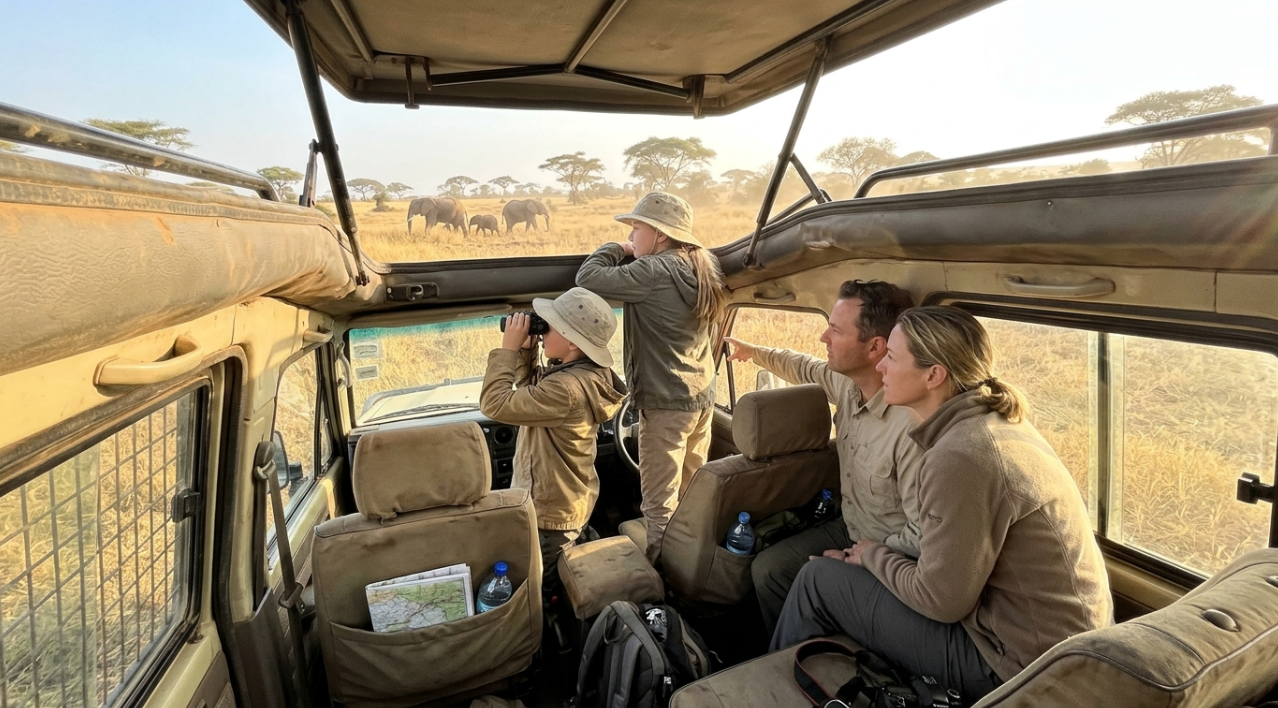
The core safari activity. A game drive is a guided excursion through a national park or reserve in a specialized vehicle. Most camps run two drives per day: an early morning departure around 6:00 to 7:00 AM and a late afternoon drive starting around 3:30 to 4:00 PM. Each lasts roughly three to four hours.
For families, the morning drive is usually the hardest adjustment. Young children who struggle with early wake-ups may do better with a late-morning departure on some days, which is one of several reasons a private vehicle matters (more on that below).
Full-Day Game Drive
Instead of returning to the lodge for lunch, the family stays out all day with a packed picnic. These work well for big parks like the Serengeti where distances between wildlife areas are long, but they’re tough on children under eight. Many families alternate full-day drives with half-day drives and rest time at camp.
Night Game Drive
A drive after dark using spotlights to find nocturnal animals like aardvarks, genets, and bush babies. Night drives are only permitted in certain areas (private concessions, some reserves) and are typically restricted to children aged six and older.
Walking Safari
A guided walk through the bush on foot, accompanied by an armed ranger. Walking safaris give older children a completely different perspective on wildlife. Age minimums range from 12 to 16 years depending on the reserve and operator. One Duma Explorer family of four with two teenagers did a walking safari in Arusha National Park as their trip opener before heading to the Serengeti, a common structure that gives teens an active start.
Bush Walk
A shorter, less intensive version of a walking safari. Some lodges offer guided nature walks focused on tracks, insects, and plants rather than large game. Age minimums are usually lower (sometimes eight or older), making these a better fit for younger families.
Big Five
Lion, leopard, elephant, rhinoceros, and Cape buffalo. The name has nothing to do with size. It comes from the old hunting era, when these five were considered the most difficult and dangerous animals to track on foot. Today the Big Five is a wildlife checklist, and most families will encounter at least three or four of them on a standard safari. Rhinos and leopards are the hardest to spot.
You can see the Big Five across multiple countries, with the strongest concentrations in Tanzania’s Serengeti, Kenya’s Masai Mara, and South Africa’s Kruger ecosystem.
Northern Circuit (Tanzania)
Tanzania’s most visited safari route and the backbone of most first family safari Africa itineraries. It typically includes Tarangire National Park, the Ngorongoro Crater, and the Serengeti. These parks are connected by drivable roads from Arusha, the gateway city where most Tanzania safaris begin. The Northern Circuit offers the highest wildlife density in East Africa and is well set up for families, with a range of accommodation levels at every stop.
Vehicle and Guide Terms
Your vehicle choice is arguably the single most important family decision after choosing a destination. Practitioners on Reddit and travel forums consistently rate it as the number-one upgrade families should prioritize.
Private Vehicle
A 4x4 reserved exclusively for your family. This is the most frequently recommended upgrade for families planning their first safari in Africa, and for good reason. A private vehicle lets you control drive length, bathroom stops, return-to-camp timing, and how long to stay at each sighting. If a toddler melts down at hour two, you head back. If your teenager is fascinated by a leopard, you stay.
Some lodges actually require a private vehicle when traveling with young children. Even where it’s not required, Go2Africa advises opting for one because it eliminates the social pressure of other guests wanting to move on.
Private vehicles also lower effective age minimums at many properties. A lodge that restricts shared drives to guests aged 12 and up may welcome a six-year-old in a private vehicle.
For a full breakdown of safari vehicle types and what to expect, see our dedicated guide.
Shared Game Drive
A drive where your family shares the vehicle with other lodge guests. The guide follows a set schedule, and the pace is determined by group consensus. Fine for couples and solo travelers, but often frustrating for families. A three-year-old who needs to return to camp at 8:30 AM will affect everyone’s experience.
Pop-Up Roof (Hatch Roof)
The signature feature of closed-body safari Land Cruisers. The roof section lifts up during game drives, allowing passengers to stand and get unobstructed 360-degree views. For families, closed vehicles with pop-up roofs are safer than fully open vehicles because children remain enclosed below the roofline while still getting an excellent vantage point.
4x4 Land Cruiser
The standard safari vehicle in East Africa. Toyota Land Cruisers dominate in Tanzania and Kenya because they handle rough park roads reliably. A typical safari Land Cruiser seats six to seven passengers, which works well for families of four to five with a driver-guide up front.
Private Guide (Driver-Guide)
Your dedicated guide for the duration of the safari. In East Africa, the driver and guide are usually the same person. A great guide transforms a first family safari in Africa from a zoo-on-wheels experience into genuine wildlife education. They know animal behavior, speak multiple languages, and keep children engaged with stories, tracking challenges, and scavenger hunts.
Guide qualifications vary widely. Look for operators whose guides hold recognized certifications. Duma Explorer’s safari guides complete EcoTraining programs and are enrolled in the FGASA Level 1 certification, a 55-day field qualification that’s rare among East African operators.
Tracker
A second team member who sits on a seat mounted to the front of the vehicle (common in Southern Africa) or walks ahead during bush walks. Trackers read animal signs, footprints, and dung to locate wildlife. Not all safari operations use trackers, but children often find them the most fascinating person on the team.
Accommodation Terms
Lodge vs. Tented Camp vs. Mobile Camp
These three terms describe different levels of permanence and comfort.
A lodge is a permanent building, usually stone or wood, with solid walls, running water, and electricity. Best for families with young children who need familiar surroundings.
A tented camp uses canvas-walled structures on raised platforms, often with en-suite bathrooms, real beds, and solar power. Despite the word “tent,” many tented camps are as comfortable as lodges. They feel more immersive.
A mobile camp moves seasonally to follow wildlife (particularly the Great Migration). They’re simpler and more remote. Excellent for adventurous families with older children, but not ideal for first-timers with kids under eight.
One family who traveled with Duma Explorer captured the accommodation sweet spot well: their planner “listened to what type of accommodations we needed, not so high-end that we didn’t feel like we were on a safari and not so basic that the kids wouldn’t want to return to Africa when they got older.” That mid-range approach is what most families should target.
For families planning a Tanzania trip, our family safari lodges guide reviews specific properties by age suitability.
Family Suite (Family Room)
Accommodation designed for parents and children, with connected or adjacent sleeping areas. Family suites let you keep young children close at night while giving everyone breathing room during the day. These book up fast during peak season (July to October, December to January), which is why nine to twelve months of lead time matters.
Fenced Camp
A camp or lodge surrounded by a physical barrier, whether electric fence, stone wall, or thorn barrier, that prevents wildlife from wandering through the property at night. For families with young children, fenced lodges provide significant peace of mind. Children can walk between rooms without an escort, and parents don’t need to worry about a curious elephant at the tent flap.
Unfenced camps are perfectly safe for adults (staff escorts are provided at night), but they add stress for families on their first safari.
Exclusive-Use Lodge
A small property booked entirely for one family or group. No other guests. Exclusive-use options are the ultimate in flexibility: meal times, drive schedules, and activity choices revolve entirely around your family. They’re expensive, but for multigenerational groups of eight or more, the per-person cost can actually be competitive with standard lodges.
PPPN (Per Person Per Night)
The standard pricing unit for safari accommodation. When a lodge quotes $450 PPPN, that means $450 per person, per night, not per room. A family of four at $450 PPPN is $1,800 per night before park fees or transfers. Understanding this prevents sticker shock.
Age Rules and Child Policies
This section matters more than any other for parents planning a first family safari in Africa. Age restrictions vary by lodge, activity, and country, and they’re rarely spelled out clearly until you ask.
Minimum Age Restrictions by Activity
|
Activity |
Typical Minimum Age |
|---|---|
|
Game drive (shared vehicle) |
6 to 12 years (varies by lodge) |
|
Game drive (private vehicle) |
Often no minimum, or 4+ |
|
Walking safari |
12 to 16 years |
|
Bush walk (nature-focused) |
8 years |
|
Mokoro (canoe) ride |
8 to 12 years |
|
Hot air balloon |
8 years |
|
Junior ranger program |
4 to 12 years |
|
Gorilla trekking |
15 years (strict) |
Sources: SafariBookings family guide, multiple operator policies.
The gorilla trekking age limit of 15 exists to protect the gorillas from childhood diseases like mumps, chickenpox, and measles, not because of physical difficulty.
Child Policy
Each lodge sets its own child policy, which may include minimum age limits, mandatory private vehicle requirements for young children, and restrictions on dining times. Always confirm the child policy before booking. A lodge that welcomes children of all ages in its marketing may still restrict under-sixes from the pool deck at certain hours or require children to eat dinner before the adult seating.
The Private Vehicle Workaround
Here’s the most practical tip in this glossary: a private vehicle often lowers or eliminates age restrictions. A lodge that won’t allow a five-year-old on a shared game drive may happily welcome that same child in a private vehicle, because the family absorbs any disruption themselves. This single upgrade opens up properties and activities that would otherwise be off-limits.
If you’re navigating age restrictions and trying to figure out which parks and lodges will genuinely welcome your children, Duma Explorer designs private family safaris around the youngest traveler in your group.
Junior Ranger Program
Structured children’s activities led by trained guides. Programs typically include animal tracking lessons, bush craft, bird identification, and art projects. High-quality lodges build these into the daily schedule so children have their own “game drive” experience, and parents get an hour of quiet.
The Golden Age for Safari: 8 to 12
Go2Africa calls the 8-to-12 bracket “the golden age for safari,” and most experienced operators agree. Children in this range are old enough to handle three-to-four-hour game drives, genuinely appreciate what they’re seeing, follow safety rules without constant reminders, and remember the experience for life.
That doesn’t mean younger or older children can’t go. Families with four-year-olds have wonderful safaris, they just need more accommodation flexibility, private vehicles, and shorter drive days. Teenagers, meanwhile, can handle walking safaris, cultural visits, and even hot-air balloon flights.
What Age Is Best for a Family Safari in Africa?
There is no single best age for an African safari. The right itinerary depends on your child's ability to handle long vehicle rides, follow wildlife-safety instructions, adapt to unfamiliar surroundings, and participate in age-appropriate activities.
|
Child's age |
What usually works best |
What parents should plan for |
|---|---|---|
|
Under 5 |
Short private game drives, fenced lodges, family-friendly camps |
Flexible schedules, frequent breaks, malaria planning, and accommodation with appropriate child policies |
|
5–7 |
Private game drives, junior ranger activities, shorter walks where permitted |
Avoid overly long transfer days and confirm minimum ages for every activity |
|
8–12 |
Longer game drives, wildlife walks, junior ranger programs, broader activity choices |
This is often an easy age range for combining wildlife viewing with educational activities |
|
13–15 |
Longer drives, walking activities where permitted, cultural experiences |
Consider more adventurous activities and properties with fewer child restrictions |
|
16+ |
Most adult-oriented safari activities, subject to operator and park rules |
Build the itinerary around interests such as photography, walking, conservation, or adventure |
The key planning rule
Do not choose an itinerary based only on what adults want to see. Build the trip around the youngest traveler who has the greatest limitations, then add activities that keep older children and adults interested.
Age limits are not universal across Africa. They can vary by country, park, lodge, activity, guide, and whether your family has a private vehicle. Always confirm the rules for your exact itinerary before booking.
Destinations and Geography
Tanzania (Northern Circuit)
The most popular destination for a first family safari in Africa, and the one Google currently rewards most heavily in search results, for good reason. The Northern Circuit packs extraordinary wildlife density into a manageable geographic area. Most families visit Tarangire, Ngorongoro Crater, and the Serengeti over seven to twelve days, often adding a beach extension in Zanzibar.
Tanzania charges children under five free entry to all national parks. Children aged 5 to 15 pay roughly 20 to 50 percent of the adult rate depending on the park. Premium parks like the Serengeti charge approximately $82.60 per adult and $23.60 per child (ages 5 to 15) including VAT, while parks like Tarangire charge around $59 per adult and $17.70 per child. Verify current rates with TANAPA before finalizing your budget.
Kenya (Masai Mara, Amboseli)
Kenya’s main advantage for families is convenience. Direct flights from Amsterdam and London arrive in Nairobi by early morning, and a 45-minute charter to the Masai Mara airstrip means no overnight road transfer. With tired children, that saves an entire day. The Masai Mara also delivers exceptional predator sightings and, during July through October, its share of the Great Migration’s river crossings.
South Africa (Kruger, Madikwe, Private Reserves)
South Africa’s standout advantage is malaria-free safari options. Madikwe Game Reserve is one of the country’s leading malaria-free Big Five reserves, combining strong wildlife viewing with convenient access from Johannesburg. For families with very young children or parents uncomfortable with antimalarial medication, South Africa removes that variable entirely.
Private reserves around Kruger also tend to have no minimum age restrictions when you book a private vehicle.
Which Country Suits Which Family?
|
Family Type |
Best Starting Destination |
|---|---|
|
Young children (under 6) |
South Africa (malaria-free reserves) |
|
Children 8 to 15 who love animals |
Tanzania or Kenya (highest wildlife density) |
|
Adventurous teenagers (15+) |
Uganda or Rwanda (add gorilla trekking) |
|
Mixed ages (multigenerational) |
Tanzania (flexible Northern Circuit + Zanzibar) |
Zanzibar Extension
Adding beach days to the end of a safari is a popular move, and for families it serves a real purpose beyond relaxation. After five or six days of early wake-ups and long drives, children need unstructured time. Zanzibar, a short flight from the Serengeti or Arusha, offers beaches, snorkeling, spice tours, and Stone Town exploration. A typical Safari and Zanzibar combination runs 10 to 14 days total.
Wildlife and Seasonal Terms
Great Migration (Wildebeest Migration)
The annual circular movement of roughly two million wildebeest (plus hundreds of thousands of zebras and gazelles) through the Serengeti-Mara ecosystem. It’s not a single event but a year-round cycle. Where the herds are depends on the month. For a detailed month-by-month breakdown, see our Great Migration safari guide.
Calving Season (January to March)
The herds gather in the southern Serengeti, where roughly 8,000 calves are born each day. Calving season is particularly well suited to families. The “new life” narrative resonates with children, there’s less graphic predator-prey drama than during river crossings, and the southern Serengeti is wide-open grassland that’s easy to navigate.
Mara River Crossing (July to October)
The most dramatic event in the migration cycle: thousands of wildebeest plunging into the crocodile-filled Mara River. Crossings happen in the northern Serengeti and Kenya’s Masai Mara, primarily from late July through October. One family on a 10-day Duma Explorer safari saw a wildebeest crossing on their very first afternoon, proof that migration timing can deliver for families even without weeks of waiting.
A word of caution from Go2Africa: if you have a sensitive teenager, discuss the possibility of witnessing dramatic predator-prey interactions beforehand. River crossings involve real death, and some children find it distressing.
Dry Season vs. Green (Wet) Season
Dry season (June to October in East Africa): Less vegetation means animals concentrate around water sources and are easier to spot. Roads are in better condition. This is peak safari season, with higher prices and more crowds.
Green season (November to May, with variation): Rain brings lush landscapes, newborn animals, and excellent bird-watching. Prices drop 20 to 40 percent. Some roads become difficult. For families on a tighter budget, the green season shoulder months (November, early December, late March) offer a good balance. See our best time for Tanzania safari guide for month-by-month detail.
Peak Season vs. Low Season
Peak season (July to October, plus December to early January) means the best weather and highest animal visibility, but also the highest prices and fullest camps. Family suites during peak season can book out six to nine months ahead. Low season (April to May) brings the heaviest rains and the lowest prices, but some camps close entirely.
Health and Safety Terms
Malaria Prophylaxis
Antimalarial tablets taken before, during, and after your safari. They don’t prevent mosquito bites. They stop the malaria parasite from establishing itself in your bloodstream if you are bitten. No child should travel to East Africa without a valid prophylaxis prescription from a travel medicine provider.
The CDC recommends several options for children: atovaquone-proguanil is approved for infants weighing 5 kg or more, while chloroquine and mefloquine can be used for infants and children of all ages and weights depending on drug resistance at the destination. Consult your pediatrician or a travel medicine clinic at least six weeks before departure.
In Tanzania, all Northern Circuit safari parks fall within the malaria transmission zone. In Kenya, the CDC’s malaria zone covers everywhere below 2,500 meters, including all game parks.
DEET
The gold standard insect repellent recommended by the CDC for preventing mosquito bites. DEET is safe for children over two months old. Concentrations of 20 to 30 percent provide several hours of protection. Apply it to exposed skin and over (not under) sunscreen. Some parents on the r/safaris Reddit community report bringing both DEET-based repellent and permethrin-treated clothing for double protection.
Malaria-Free Safari
A safari in a region where malaria transmission does not occur, eliminating the need for prophylaxis. South Africa’s Madikwe, Waterberg, and Eastern Cape reserves are the primary malaria-free Big Five options. This matters most for families with very young children, pregnant travelers, or anyone who wants to simplify the health preparation. The tradeoff: you won’t see the Great Migration or the Ngorongoro Crater.
Yellow Fever Certificate
Some African countries require proof of yellow fever vaccination for entry, particularly if you’re arriving from or transiting through another African country. Tanzania requires a yellow fever certificate if you’re entering from a country with yellow fever risk. Check requirements based on your specific routing.
Travel Insurance
Non-negotiable for a family safari. Policies should cover medical evacuation (safari camps can be hours from a hospital), trip cancellation, and baggage loss. Medical evacuation from a remote bush camp to Nairobi or Dar es Salaam can cost $50,000 or more without insurance. Our Tanzania travel insurance guide explains what to look for in a policy.
Cost and Booking Terms
Park Fees (Conservation Fees)
The daily entry charge for each national park, paid per person per day. These fees are a significant portion of a family safari budget. In Tanzania, premium parks (Serengeti, Ngorongoro Conservation Area) charge around $82.60 per adult, while secondary parks (Tarangire, Lake Manyara, Arusha) charge around $59 per adult.
The age bracket trap: Children under five enter free. Ages 5 to 15 pay reduced rates. At age 16, children pay full adult rates. If your child is about to turn 16, traveling a week earlier could save your family $2,000 or more in park fees across a multi-park itinerary. This is one of the most underappreciated planning details in family safari budgeting.
Concession Fee
An additional charge levied by specific conservation areas on top of standard entry fees. The most significant for families: the Ngorongoro Crater descent costs $295 per vehicle (not per person) as a one-time fee. This means it’s actually more economical for larger families since the cost is shared across the vehicle.
Vehicle Fee
A separate daily charge for bringing a vehicle into a national park. In Tanzania, this is included in most safari package quotes but can be a surprise if you’re comparing itemized costs between operators.
Child Park Fee Rates (Tanzania)
|
Park |
Adult (16+) |
Child (5-15) |
Under 5 |
|---|---|---|---|
|
Serengeti |
~$82.60 |
~$23.60 |
Free |
|
Ngorongoro |
~$82.60 |
~$23.60 |
Free |
|
Tarangire |
~$59.00 |
~$17.70 |
Free |
|
Lake Manyara |
~$59.00 |
~$17.70 |
Free |
|
Arusha NP |
~$59.00 |
~$17.70 |
Free |
Rates include VAT. Verify with TANAPA for current figures.
Private Vehicle Supplement
The additional cost for reserving a vehicle exclusively for your family rather than sharing with other guests. This varies by operator and destination but typically adds $150 to $300 per day. For the reasons outlined above, it’s usually money well spent.
Fly-In Safari
Traveling between parks or camps by small bush plane rather than overland driving. Fly-in transfers dramatically reduce travel time (a six-hour drive between parks becomes a 45-minute flight) but increase cost significantly. For families with young children who struggle in vehicles, flying between the Serengeti and Arusha or between parks can preserve everyone’s energy. The tradeoff: you miss the scenery and roadside wildlife of the drive.
What Does a First Family Safari in Africa Cost?
A seven-day mid-range safari for a family of four typically costs between $9,000 and $13,500. Budget packages using basic tented camps and longer driving days can bring a five-day trip down to around $6,700 for four people ($400 to $500 per person per day). Premium lodge-based safaris run $800 to $1,500 per person per day.
Duma Explorer’s private custom safaris start from approximately $2,000 per person for a five-day Northern Circuit itinerary. A comprehensive 13-day trip combining mountains, safari, and beach runs approximately $6,000 per person including accommodations, meals, and transport.
Families trying to combine the Serengeti, Ngorongoro, and a Zanzibar beach stay without burning half the trip on transfers can ask Duma Explorer to map a realistic route and timeline.
What Is Usually Included in a Family Safari Price?
A safari quote can look expensive until you understand what is included. Unlike a standard hotel vacation, a safari package may combine accommodation, meals, transportation, guiding, park access, and domestic flights.
|
Cost |
Often included? |
What to ask |
|---|---|---|
|
Accommodation |
Usually |
Is the price per person, per room, or PPPN? |
|
Meals |
Often |
Are all meals included or only breakfast? |
|
Private vehicle |
Sometimes |
Is the vehicle exclusive to your family? |
|
Driver-guide |
Usually |
Is the guide dedicated to your family? |
|
Park fees |
Often |
Which parks and how many days are included? |
|
Concession fees |
Varies |
Are conservation or concession charges included? |
|
Domestic flights |
Varies |
Are baggage limits and airport transfers included? |
|
Airport transfers |
Varies |
Are arrival and departure transfers included? |
|
Activities |
Varies |
Are walking safaris, balloon flights, or cultural activities extra? |
|
Drinks and tips |
Usually extra |
Which beverages and gratuities are excluded? |
|
Travel insurance |
Usually extra |
Does the policy include medical evacuation? |
Before comparing two safari quotes
Do not compare the headline price alone. Ask both operators to provide the same information: accommodation, number of nights, vehicle type, guide, park fees, transfers, flights, meals, activities, taxes, and exclusions.
A lower quote is not necessarily cheaper if it excludes park fees, private transportation, domestic flights, or activities that your family would otherwise need to purchase separately.
Booking Lead Time
How far in advance you should book. The standard recommendation is 9 to 12 months before travel, especially for peak season (July to October). Family suites and multi-room configurations are the first inventory to sell out because supply is limited. Booking early also secures private vehicles and preferred guides.
Trip Pacing and Structure
Pacing is where many first family safari Africa trips go wrong. Parents try to cram too many parks into too few days, and the result is exhausted children, rushed game drives, and more time in a vehicle than watching animals.
The “Fewer Parks, More Nights” Rule
The most common advice from experienced safari families: stay three to four nights in a single location rather than moving every two nights. This lets everyone unpack, settle into a rhythm, and actually enjoy each park rather than treating it as a checkbox. A family that spends three nights in the Serengeti and three in the Ngorongoro area will have a better experience than one that hits five parks in seven days.
A 13-person multigenerational group (ages 11 to 62) that traveled with Duma Explorer described their trip as “truly a trip of a lifetime,” and their itinerary followed exactly this slower pacing approach.
Drive Time vs. Game-Drive Time
These are different things, and confusing them is a common planning mistake. Drive time is the transfer between parks or between your lodge and a game-viewing area. Game-drive time is the actual wildlife viewing. A budget itinerary might involve four hours of road transfer and three hours of game-drive time in a single day. A well-paced itinerary minimizes transfers so more time goes toward animals.
Downtime Day (Rest Day)
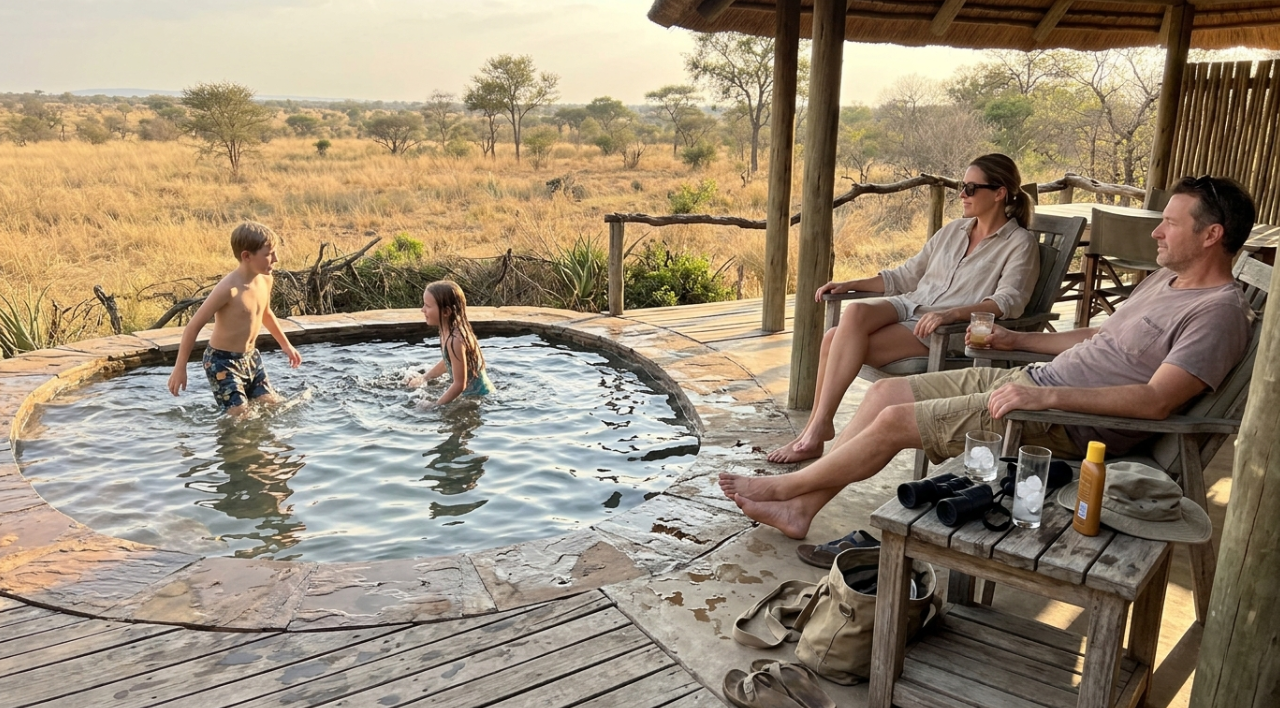
A day with no scheduled game drive, usually spent at the lodge. Children swim, play, join junior ranger programs, or simply decompress. Building one rest day into every four or five safari days keeps energy levels sustainable, especially for children under ten.
Beach Extension
Adding Zanzibar, the Swahili Coast, or another coastal destination after the safari. For a first family safari in Africa that lasts ten days or more, a beach extension provides the transition from intense wildlife days to relaxed vacation mode. Most families do two to four nights.
Multi-Country Safari
An itinerary that spans two or more countries (for example, Tanzania safari plus Uganda gorilla trekking, or Kenya’s Masai Mara plus Tanzania’s Serengeti). Multi-country trips add complexity, flights, and border crossings but allow families to combine experiences that no single country offers alone. A good starting framework for a first trip: stick to one country and save multi-country planning for trip two.
For families with many members across different age groups, our guide to planning safaris for large families covers the logistics of coordinating vehicles, rooms, and activities.
How to Choose a Safari Operator for Your First Family Trip
Private Safari Operator
A company that designs and runs your safari rather than selling a fixed group departure. For families, working with a private operator who specializes in family travel is the strongest recommendation across every planning forum, Reddit thread, and expert guide. A good operator handles park permits, lodge bookings, vehicle assignments, guide selection, domestic flights, airport transfers, and dietary requirements.
What to look for: an operator based in or deeply connected to your destination country, with specific experience handling families with children your kids’ ages. Ask how they handle the youngest-child rule. A qualified operator designs the entire itinerary around your youngest traveler’s needs, then layers in activities for older children and adults.
Duma Explorer is led by Stacy Readal, who has spent 15 years based in Tanzania and speaks fluent Swahili. The company operates locally through Alika Africa, providing direct control over vehicles, guides, and logistics rather than subcontracting to third parties. That continuity matters when a two-year-old needs a schedule change on day three.
Frequently Asked Questions
What is the best age for a first family safari in Africa?
Ages 8 to 12 are widely considered the sweet spot. Children in this range handle long game drives, follow safety instructions reliably, and form lasting memories. But families with younger children (even toddlers) have successful safaris every year, provided they book private vehicles, choose fenced lodges, and plan shorter drive days. Teenagers bring their own advantages: they can do walking safaris, cultural excursions, and (at 15+) gorilla trekking.
How much does a family safari in Africa cost?
A seven-day mid-range safari for a family of four runs $9,000 to $13,500 including accommodation, meals, park fees, vehicle, and guide. Budget options start around $6,700 for five days. Premium trips can exceed $20,000 for a week. The biggest variables are accommodation level, private vs. shared vehicle, number of parks, and whether you add a fly-in transfer or beach extension.
Is Tanzania or Kenya better for a first family safari?
Tanzania offers the highest wildlife density on the Northern Circuit and the option to add Zanzibar as a beach extension. Kenya offers easier international flight connections and shorter transfers to the Masai Mara. Both are excellent. Tanzania tends to edge out Kenya for families wanting a longer trip (10+ days) with varied parks. Kenya wins for families with limited time who want to minimize travel days. Our Tanzania vs. Kenya comparison covers this in depth.
Do children need malaria medication for an Africa safari?
Yes, for East Africa (Tanzania, Kenya, Uganda, Rwanda). All safari parks in these countries fall within malaria transmission zones. The CDC recommends specific antimalarials for children of various ages and weights. South Africa offers malaria-free safari alternatives at reserves like Madikwe and the Eastern Cape, where no prophylaxis is needed.
How far in advance should we book a family safari?
Nine to twelve months before travel for peak season dates (July to October, December to January). Family suites have limited inventory at most camps, and private vehicles must be reserved. Green season trips (November to May) can sometimes be booked four to six months out, but earlier is always safer for multi-room bookings.
Can toddlers go on safari?
Yes, with careful planning. Choose fenced lodges, book a private vehicle, plan short game drives (two hours maximum), and build in generous rest time. South Africa’s malaria-free reserves are the most popular choice for families with toddlers because they remove the prophylaxis concern and tend to have fewer age restrictions.
What should we pack for a first family safari?
Neutral-colored clothing (khaki, olive, brown), layers for cool mornings and warm afternoons, closed-toe shoes for walking, sun hats, high-SPF sunscreen, DEET-based insect repellent, binoculars, and a good camera. For children, bring familiar snacks, entertainment for transfer drives, and a headlamp for nighttime lodge navigation. Our family safari packing list has the complete checklist.
Ready to start planning your family’s first safari?
Build My Family Safari