

Family Safari Itinerary Tanzania 2026: Planning Glossary
TL;DR
A family safari itinerary in Tanzania typically follows the Northern Circuit (Tarangire, Ngorongoro Crater, Serengeti) over 7 to 10 days, using a private vehicle paced to your youngest child. This glossary defines 30+ terms parents encounter when reviewing safari proposals, from park fees and game drive durations to age restrictions, fly-in transfers, and seasonal timing. Use it as a decoder ring for any itinerary quote you receive.
A family safari itinerary for Tanzania looks different from an adults-only trip in almost every detail. The parks may be the same, but the pacing, accommodation choices, transfer methods, activity restrictions, and daily schedule all shift when children are involved. And when you start reading proposals from operators, you hit a wall of unfamiliar terms: concession fees, crater service fees, fly-in transfers, private concessions, green season rates.
This glossary covers the vocabulary of itinerary building, organized by planning category rather than alphabetically. Each term explains what it means and why it matters when you’re traveling with kids. If you’re trying to understand how a private family safari works in Tanzania, that guide covers what “private” actually means. This page focuses on the routing, pacing, scheduling, and fee language you’ll find in any proposal.
What Is the Best Tanzania Family Safari Itinerary? A typical Tanzania family safari itinerary lasts 6 to 8 safari days and follows the Northern Circuit: Tarangire, Ngorongoro Crater and Serengeti. Families should use a private vehicle, limit long transfer days, stay at least two nights where possible, and choose camps based on their children's ages and activity restrictions. Zanzibar can be added for 3 to 5 nights of beach time.
Here’s a quick overview of what’s ahead:
|
Category |
Example Terms |
Key Family Takeaway |
|---|---|---|
|
Route & Destination |
Northern Circuit, Tarangire, Ngorongoro, Serengeti |
The standard family routing framework |
|
Pacing & Structure |
Rest day, lodge move, game drive duration |
Pace to the youngest traveler |
|
Transport |
Fly-in, road safari, private vehicle |
Private vehicle is nearly essential for families |
|
Accommodation |
Family tent, minimum age, exclusive-use |
Check age restrictions before booking |
|
Fees & Costs |
Park entry, concession fee, crater service fee |
Children under 5 free; ages 5 to 15 roughly half-price |
|
Activities |
Walking safari, cultural visit, balloon |
Most have minimum age requirements |
|
Season & Timing |
Dry season, calving, Great Migration |
School holidays overlap with peak season pricing |
Tanzania Family Safari at a Glance
|
Planning Decision |
Practical Starting Point |
|---|---|
|
Best overall route |
Tarangire → Ngorongoro → Serengeti |
|
Typical safari length |
6–8 days |
|
Longer family holiday |
7–10 safari days plus Zanzibar or other activities |
|
Best transport for flexibility |
Private safari vehicle |
|
Younger children |
Shorter drives, more lodge downtime and flexible schedules |
|
Older children/teens |
Longer game drives and a wider range of activities |
|
Lodge changes |
Aim for 2+ nights where practical |
|
Midday strategy |
Return to the lodge when possible |
|
Migration planning |
Choose the Serengeti area based on the month |
|
Zanzibar add-on |
Usually 3–5 nights |
|
Most important booking check |
Confirm each property's minimum age before paying a deposit |
The key principle: build the itinerary around the youngest traveler rather than trying to fit children into an adult safari schedule.
Tanzania Family Safari Itinerary: 7, 8, and 10-Day Options
The best Tanzania family safari itinerary depends on your children's ages, tolerance for long drives, travel season, and whether you want to include Zanzibar. For most first-time families, the Northern Circuit offers the simplest combination of Tarangire, Ngorongoro Crater, and Serengeti, with a private vehicle making it easier to adjust the pace.
7-Day Tanzania Family Safari Itinerary
Best for: Families who want the Northern Circuit highlights without spending too long on safari.
|
Day |
Location |
Family-Friendly Plan |
|---|---|---|
|
Day 1 |
Arusha → Tarangire |
Transfer and afternoon game drive |
|
Day 2 |
Tarangire |
Morning game drive, lodge lunch and afternoon rest |
|
Day 3 |
Tarangire → Ngorongoro |
Game drive or cultural stop en route |
|
Day 4 |
Ngorongoro Crater |
Morning crater game drive and relaxed afternoon |
|
Day 5 |
Ngorongoro → Serengeti |
Scenic transfer with wildlife viewing en route |
|
Day 6 |
Serengeti |
Morning and optional afternoon game drives |
|
Day 7 |
Serengeti → Arusha/Zanzibar |
Fly out of the Serengeti or continue by road depending on the itinerary |
Why it works for families: It covers Tanzania's three headline safari areas without changing accommodation every night. Families with younger children can shorten individual game drives and use the lodge as a midday reset point.
8-Day Tanzania Family Safari Itinerary
Best for: Families who want more breathing room between major destinations.
|
Day |
Location |
Family-Friendly Plan |
|---|---|---|
|
Day 1 |
Arusha → Tarangire |
Arrival and short afternoon game drive |
|
Day 2 |
Tarangire |
Morning game drive and relaxed afternoon |
|
Day 3 |
Tarangire → Ngorongoro |
Transfer with optional cultural experience |
|
Day 4 |
Ngorongoro |
Crater game drive and lodge downtime |
|
Day 5 |
Ngorongoro → Serengeti |
Transfer to the Serengeti with wildlife viewing |
|
Day 6 |
Serengeti |
Full or split game-drive day based on children's energy |
|
Day 7 |
Serengeti |
Second full day with a flexible morning and optional activity |
|
Day 8 |
Serengeti → Arusha/Zanzibar |
Fly to the next destination or return toward Arusha |
Why it works for families: The additional Serengeti night reduces the pressure to see everything in one day. It also gives families more flexibility to stop a game drive early without feeling that they are missing the entire Serengeti experience.
10-Day Tanzania Family Safari + Zanzibar Itinerary
Best for: Families who want safari and beach time rather than 10 consecutive days of game drives.
|
Day |
Location |
Family-Friendly Plan |
|---|---|---|
|
Day 1 |
Arusha |
Arrival, pool time and relaxed evening |
|
Day 2 |
Arusha → Tarangire |
Afternoon game drive |
|
Day 3 |
Tarangire |
Morning game drive and afternoon rest |
|
Day 4 |
Tarangire → Ngorongoro |
Transfer and optional cultural experience |
|
Day 5 |
Ngorongoro |
Crater game drive |
|
Day 6 |
Ngorongoro → Serengeti |
Transfer and wildlife viewing |
|
Day 7 |
Serengeti |
Morning and optional afternoon game drives |
|
Day 8 |
Serengeti |
Flexible safari day |
|
Day 9 |
Serengeti → Zanzibar |
Fly to Zanzibar and settle in |
|
Day 10 |
Zanzibar |
Beach and family activities |
Why it works for families: Adding Zanzibar creates a natural change of pace after several early mornings and vehicle-based days. Families can keep the safari portion focused on wildlife while using the beach portion for swimming, relaxation and lower-intensity activities.
How Many Safari Days Should a Family Plan?
For many families, 6 to 8 days of safari is a practical starting point, while a 10- to 14-day Tanzania holiday can work well when beach time or other non-safari experiences are added. The right length depends more on the youngest child's age and the amount of driving than on a fixed number of days.
A useful rule is:
-
5–6 safari days: Good for younger children or first-time families who want a shorter trip.
-
7–8 safari days: A strong balance for a classic Northern Circuit safari.
-
9–10+ safari days: Better when combining regions, adding more Serengeti time, or including Zanzibar.
-
10–14 total trip days: Often more comfortable for families when several non-safari days are included.
The goal is not to visit the maximum number of parks. It is to create a route that gives children enough wildlife variety without turning every day into a long transfer.
What Is the Minimum Age for a Tanzania Family Safari?
There is no single minimum age that applies to every Tanzania safari. The practical age limit depends on the park, safari operator, accommodation, vehicle arrangement and activities included in the itinerary.
A family with a toddler may be able to take a private game-drive safari, while a particular tented camp, walking safari or other activity may have a higher minimum age.
As a general planning framework:
|
Child's Age |
What to Consider |
|---|---|
|
Under 5 |
Possible with careful planning, but prioritize private transport, shorter drives and family-friendly accommodation |
|
5–7 |
Good age for a flexible private-vehicle safari with shorter game drives and plenty of downtime |
|
8–12 |
Often easier to combine longer drives, multiple parks and selected activities |
|
13–15 |
More itinerary flexibility and a wider range of activities |
|
16+ |
Most age-specific restrictions become less limiting, although individual properties and activities still set their own rules |
These are planning guidelines, not official age requirements. Always confirm the current minimum age directly with the operator and each accommodation before booking.
Tanzania Safari Age Restrictions: What Families Should Check
Age restrictions vary by activity and property, so parents should treat the following as a planning checklist rather than a universal set of Tanzanian rules.
|
Experience |
Typical Family Consideration |
Confirm Before Booking |
|---|---|---|
|
Standard game drive |
Often possible for children of different ages |
Operator and vehicle policy |
|
Tented camp |
Some camps impose minimum ages |
Property's current policy |
|
Walking safari |
Often has a higher minimum age than game drives |
Park, guide and operator |
|
Night game drive |
Rules vary by concession and operator |
Minimum age and concession rules |
|
Hot-air balloon |
Operator-specific age and safety requirements |
Current balloon operator policy |
|
Bush meals |
Usually easier for families |
Whether children are permitted and meal setup |
|
Cultural visit |
Generally flexible |
Community/activity arrangements |
|
Private vehicle |
Best option for adjusting pace |
Vehicle capacity and private-use terms |
|
Family room/tent |
Availability varies by property |
Exact room configuration and age policy |
Important: Do not rely on a generic “family-friendly” label. Ask the operator to confirm the minimum age for every lodge and every activity in your specific itinerary.
Route and Destination Terms
These are the places that appear in nearly every Tanzania family safari itinerary. Understanding what each one offers (and demands) helps you evaluate whether a proposed route makes sense for your children’s ages.
Northern Circuit
The Northern Circuit is a loop of parks and conservation areas within driving distance of Arusha, the gateway city for most Tanzania safaris. A classic Northern Circuit itinerary combines Tarangire National Park, the Ngorongoro Conservation Area, and the Serengeti, sometimes with Lake Manyara or Arusha National Park added. Most family itineraries span 7 to 10 days on this circuit.
The Northern Circuit is well suited to families because it combines several high-value wildlife areas without requiring a separate domestic flight between every destination. However, driving times vary significantly depending on the exact route, lodge location and season. Families should evaluate the actual transfer time on each itinerary, rather than assuming that every park-to-park journey will be short.
For younger children, the most important planning question is not simply how many parks the itinerary includes, but how many hours the family will spend in the vehicle on each transfer day.
Tarangire National Park
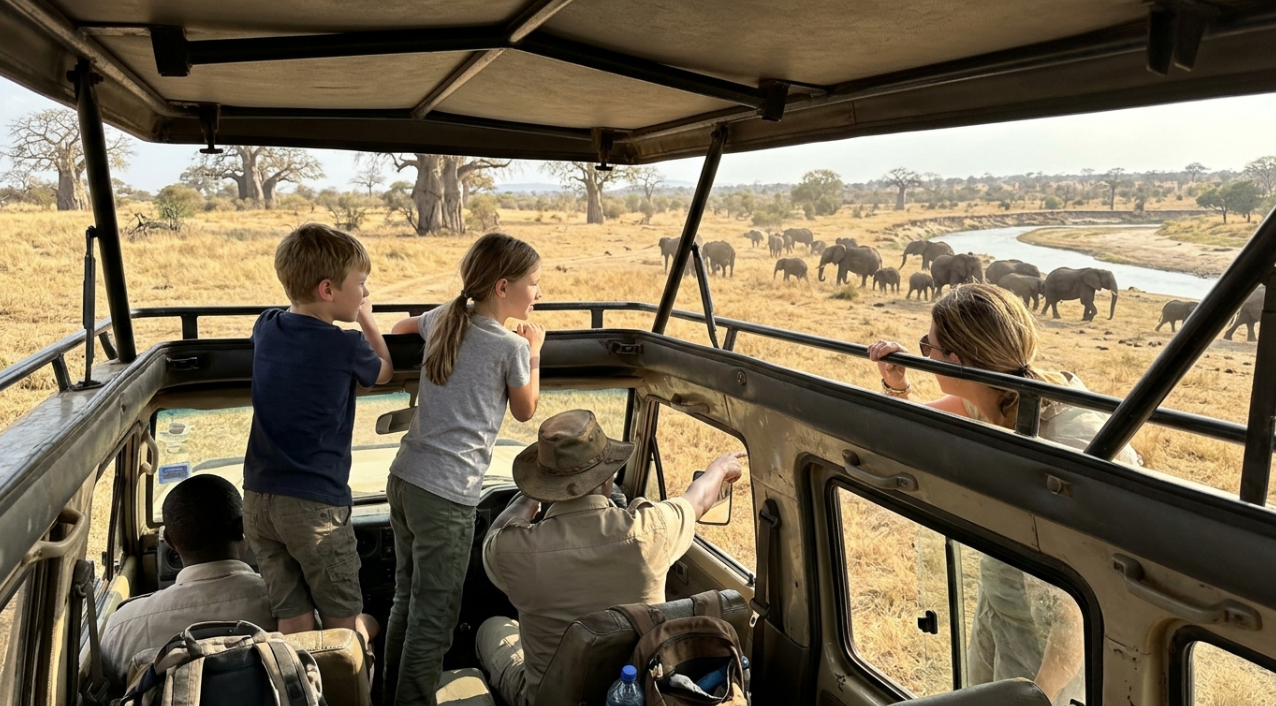
Operators typically place Tarangire at the start of a family safari itinerary, and for good reason. The park delivers immediate wildlife payoffs, particularly massive elephant herds that gather along the Tarangire River. Two nights here lets children settle into the rhythm of game drives before tackling longer days deeper in the circuit. Transfer time from Arusha is only about two hours, so kids aren’t exhausted before they even see their first animal.
For families, Tarangire functions as a confidence builder. Your first game drive at Tarangire sets the tone for the entire trip.
Ngorongoro Crater
A collapsed volcanic caldera roughly 20 kilometers across, with one of the highest wildlife densities in Africa. Game drives within the crater floor are compact, typically 4 to 5 hours, which suits families well. You’re almost guaranteed to see lions, elephants, buffalo, hippos, and sometimes black rhino in a single morning.
The key family detail: the Ngorongoro Crater has its own fee structure. A crater service fee of $295 per vehicle applies for the descent, regardless of how many passengers are inside. That means a family of five in a private vehicle pays the same vehicle fee as a couple. Per-person entry fees are separate (covered in the fees section below). For the full Ngorongoro Crater planning breakdown, that guide covers logistics, timing, and what to expect on the crater floor.
Serengeti National Park
The Serengeti is the centerpiece of most Tanzania safari itineraries and the stage for the Great Migration. It’s vast, which means longer transfer times to reach it, whether by road (roughly 4 to 5 hours from Ngorongoro) or by light aircraft. Operators generally recommend the Serengeti for families with children aged 9 and above because of those longer travel days, though families with younger kids can make it work with careful pacing and fly-in transfers.
The Serengeti rewards patience. A two or three-night stay is the minimum to absorb what the park offers without rushing.
Lake Manyara National Park
A smaller park often used as a half-day stop between Tarangire and Ngorongoro. Lake Manyara is known for tree-climbing lions and huge flamingo flocks along the alkaline lake. Some operators include it as a brief game drive on a transfer day. It’s slightly more flexible on age than other parks, with some lodges allowing children as young as 3.
Arusha National Park
A small park on the outskirts of Arusha that most itineraries skip, but it offers something unusual: walking safaris. For families with children aged 9 and above, a walking safari in Arusha National Park can be transformative. Walking toward giraffe on foot at 20 to 30 meters produces some of the most intense child engagement of any activity on the Northern Circuit. It works well as a first-day or last-day activity.
Zanzibar Extension
Most proposals will offer the option to add Zanzibar after the safari. The reasoning is sound: safari first and beach second gives the best rhythm. Zanzibar becomes the reward, a few days to sleep later, swim, eat seafood, and process the safari experience. For families, this matters because children whose tolerance for back-to-back game drives is finite will be ready for sand and ocean by day six or seven.
A typical extension runs 3 to 5 nights. You’ll see this listed as a separate line item in proposals, sometimes with a domestic flight from the Serengeti or Arusha to Zanzibar included.
Great Migration
The annual movement of roughly 1.5 million wildebeest and hundreds of thousands of zebra through the Serengeti ecosystem. Migration timing affects where you’ll be placed within the Serengeti:
-
January to March: Calving season on the southern plains near Ndutu. By mid-January, roughly 8,000 calves are born each day. More calves attract more predators. This is extraordinary to witness but can be intense for younger children.
-
June to July: Herds move through the Western Corridor in long columns.
-
July to September: River crossings in the northern Serengeti. These are dramatic but unpredictable. Practitioners on TripAdvisor frequently warn families: the migration crossing the Mara River is spectacular, but you sometimes have to sit for hours waiting for a crossing to happen. That calculus changes when kids are in the vehicle.
Which Part of the Serengeti Should Families Visit?
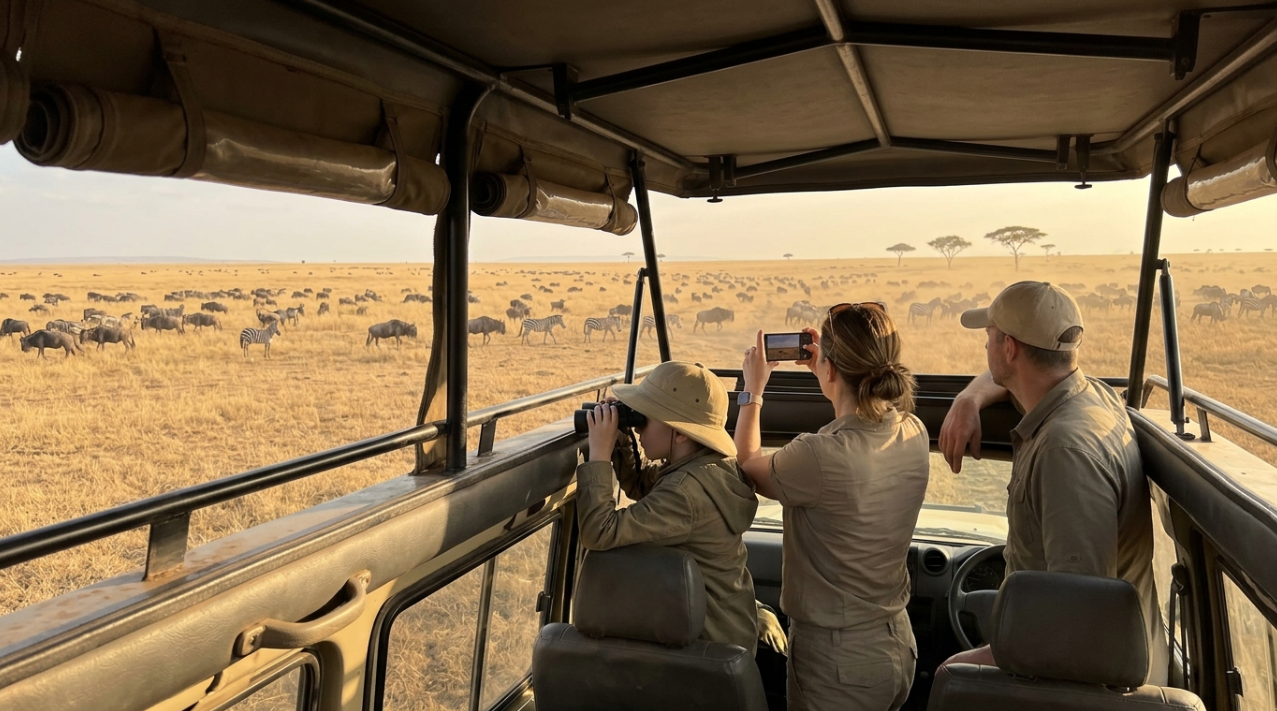
“Serengeti” is not a single wildlife-viewing area. The park is enormous, and the best location for a family itinerary depends on the month, migration movements and how much driving your children can tolerate.
|
Serengeti Area |
Best For |
Family Consideration |
|---|---|---|
|
Central Serengeti |
Year-round wildlife and classic safari viewing |
Often a practical first choice because of strong resident wildlife |
|
Southern Serengeti / Ndutu |
Calving season |
Excellent for migration-focused trips from roughly January to March |
|
Western Corridor |
Seasonal migration viewing |
Can require longer transfers depending on the itinerary |
|
Northern Serengeti |
Migration and possible river-crossing viewing |
Spectacular but crossings are unpredictable and waiting can be lengthy |
The key lesson for families is simple: choose the Serengeti location based on your travel month, not simply because an itinerary says “Serengeti.”
Private Concession
A private concession is an area managed under an arrangement that can provide a more exclusive safari experience than a busy public-road setting. Depending on the location and property's operating rules, guests may have access to experiences such as night drives, off-road driving or walking activities that are restricted or unavailable in national parks.
For families, the attraction is flexibility and variety. However, these experiences are not automatically available at every concession, and each activity can have its own minimum-age and safety requirements. Confirm exactly what is included before booking.
Ndutu / Southern Serengeti
Ndutu is an area in the southern Serengeti/Ngorongoro Conservation Area that becomes the calving grounds from December through March. You’ll see “Ndutu” appear in family safari itineraries targeting calving season. Mobile tented camps in Ndutu follow the herds, so the accommodation is seasonal and the experience is raw. Best for families with older kids who can handle rustic conditions and early mornings.
Which Tanzania Safari Route Works Best by Child's Age?
There is no single family safari route that works for every child. The younger the traveler, the more important short drives, flexible game-drive times and family-friendly accommodation become.
|
Children's Age |
Suggested Route Approach |
Priorities |
|---|---|---|
|
Under 5 |
Tarangire + selected Northern Circuit highlights |
Private vehicle, short drives, flexible lodge time |
|
5–7 |
Tarangire + Ngorongoro + limited Serengeti |
Wildlife variety without excessive transfer time |
|
8–12 |
Tarangire + Ngorongoro + 2–3 Serengeti nights |
More game-drive flexibility and selected activities |
|
13–15 |
Full Northern Circuit |
Longer drives and more activity options |
|
16+ |
Northern Circuit or more adventurous route |
Walking and other age-dependent activities where permitted |
These are starting points rather than fixed rules. A child's personality, travel experience and tolerance for long drives can matter as much as age.
The best itinerary is the one that matches the youngest traveler's stamina to the route—not simply the itinerary that visits the most famous parks.
Itinerary Structure and Pacing Terms
Pacing is where family safari itineraries diverge most from adult trips. These terms describe how days are structured and why it matters.
Pacing
The deliberate calibration of driving time, game drive duration, rest days, and transfer methods to suit everyone in the group. In practice, pacing means designing the itinerary around the person who needs the most accommodation, whether that’s a grandparent with limited mobility or a four-year-old who hits a wall after two hours in a vehicle.
When reviewing a proposal, check the pacing by counting total driving hours per day. If you see a day with a 5-hour transfer followed by an afternoon game drive, that’s a 7 to 8 hour vehicle day. Fine for adults. Brutal for a six-year-old.
Rest Day (Down Day)
A day built into the itinerary with no scheduled transfers or obligations. A rest day at a Serengeti lodge lets grandparents sleep in and read on the veranda while teenagers swim and parents do an optional early morning game drive. Everyone recharges. The trip doesn’t become a forced march from park to park.
Families traveling with three generations should consider a multigenerational safari planning approach that builds rest days into the framework from the start.
Lodge Move / Transfer Day
The day you pack up, leave one lodge, and drive (or fly) to the next. This is where family itineraries most often go wrong. Forum users and operators consistently advise: do not change lodges every night unless the route truly requires it. Constant packing makes the trip feel rushed, children lose their sense of place, and everyone arrives frazzled.
A successful family safari itinerary embraces the “fewer lodge moves” principle. Staying at least two nights per location is far easier than packing up daily. Three nights at a Serengeti camp gives children time to learn the sounds, recognize the staff, and feel at home.
Game Drive Duration by Age
This is the single most actionable reference for parents building a Tanzania family safari itinerary. No two children are alike, but experienced operators and guides converge on consistent recommendations:
|
Child Age |
Recommended Game Drive Length |
Notes |
|---|---|---|
|
3 to 4 years |
2 to 3 hours, morning only |
Short attention spans; bring activities for the vehicle |
|
5 to 7 years |
3 to 4 hours, morning preferred |
A breakfast stop in the bush helps break up the drive |
|
8 to 11 years |
4 to 5 hours with a bush breakfast stop |
Can handle split drives (morning + afternoon) |
|
12 to 16 years |
Standard full-day drives manageable |
Most teenagers match adult endurance by this age |
These are guidelines, not rules. Your child might surprise you. But when evaluating a proposed itinerary, check whether the scheduled game drive times align with your youngest traveler’s realistic attention span.
Morning Game Drive
Typically runs from 6:30 a.m. to around 10:00 a.m. This is the best window for wildlife activity: predators are still active from the night, herbivores are grazing, and the light is beautiful. Kids are usually fresh in the morning if they got to bed early the night before. Most family safaris prioritize this drive above all others.
Afternoon Game Drive
Usually 4:00 p.m. to 6:30 p.m. Shorter than the morning drive, often featuring the best lighting for photography and renewed predator activity as temperatures cool. Not every family itinerary day needs an afternoon drive. Some days, pool time wins.
Midday Break / Lodge Lunch
The hours between approximately 11:00 a.m. and 3:30 p.m. when most families return to the lodge. This is critical. Children need pool time, tree-climbing time, drawing time. Don’t skip this for a “we’re paying for this, let’s maximize game drives” mindset. Practitioners on safari forums warn that you’ll regret it by day three.
A typical family safari day follows this structure:
|
Time |
Activity |
|---|---|
|
6:00 to 6:30 a.m. |
Wake up, light breakfast |
|
6:30 to 10:00 a.m. |
Morning game drive (bush breakfast stop possible) |
|
10:30 a.m. to 3:30 p.m. |
Return to lodge, lunch, rest, pool, free time |
|
4:00 to 6:30 p.m. |
Afternoon game drive (optional) |
|
7:00 p.m. |
Dinner |
Packed Lunch vs. Hot Lunch
Proposals may specify whether your midday meal is a packed lunch eaten in the vehicle during a full-day game drive or a hot lunch back at the lodge. Forum users consistently flag this for families: make sure some days include a hot lunch at the lodge instead of packed lunch every day. Kids tire of cold boxed meals quickly, and a hot lunch means real downtime at camp.
Optimal Trip Length
Operators recommend 6 to 8 days on safari for families with children under 12. After day six, kid-fatigue sets in fast. The vehicle that was thrilling on day one becomes confining. You can extend the total trip beyond 8 days by adding Zanzibar or other non-safari experiences, but the game-drive portion has a natural ceiling for younger travelers.
If you’re building a full Tanzania safari itinerary with costs, that guide covers how trip length affects the total budget.
Transport Terms
How you move between parks shapes the entire family experience. These terms appear in every proposal.
Fly-In Safari
An itinerary that uses light aircraft to transfer between parks, landing at bush airstrips rather than driving for hours on unpaved roads. Fly-in safaris save enormous amounts of time and avoid exhausting transfer days. The trade-offs: higher cost, strict luggage limits (soft-sided bags only, typically 15 to 20 kg per person), and fixed flight schedules.
Family consideration: light aircraft transfers are fast and practical for adults but significantly less comfortable for babies and young children. The planes are unpressurized and can experience noticeable turbulence. Most families with children under 5 find road transfers less stressful, even though they take longer.
Road Safari (Drive-In)
An itinerary using road transfers between parks in a safari vehicle. Lower cost, more scenery along the way, no luggage restrictions, and flexible scheduling. The downside: long, bumpy transfer days can drain young children. For families with kids under 8, limit driving days to 3 to 4 hours when possible.
Fly-in vs. road for families:
|
Factor |
Fly-In |
Road Transfer |
|---|---|---|
|
Travel time between parks |
30 to 90 minutes |
3 to 6 hours |
|
Cost |
Higher |
Lower |
|
Luggage |
15 to 20 kg soft bags only |
Flexible |
|
Comfort for young children |
Turbulence risk, noise |
Long but controllable with stops |
|
Scheduling flexibility |
Fixed departure times |
Leave when ready |
|
Best for ages |
7+ |
All ages with proper pacing |
Pop-Top Safari Vehicle
The standard game drive vehicle in Tanzania is a modified 4x4 Land Cruiser with a roof that pops up, allowing passengers to stand and view (and photograph) wildlife from an elevated position while remaining safely inside the vehicle. Children love it. The pop-top is one of the reasons kids engage so intensely on game drives. For more on safari vehicle types and features, that guide covers the differences in detail.
Private Vehicle and Private Guide
These terms cause real confusion. “Private vehicle” means your family rides alone in a 4x4 rather than sharing with strangers. “Private guide” means one guide is dedicated to your family. “Private itinerary” means the route is designed around your dates, ages, and pace.
A family of four can sometimes make private vehicle costs more efficient per person than a couple, because the vehicle and guide cost is shared across more travelers. Private does not always mean more expensive per head, and it definitely does not mean “luxury.” The confusion between “private” and “luxury” leads many families to either overspend or assume private safaris are out of reach.
For families, a private vehicle is almost essential. It lets you cut a game drive short if a child melts down, stop for unscheduled bathroom breaks, and go at your own pace. On a shared vehicle with other travelers, none of that flexibility exists.
Duma Explorer designs custom family itineraries with private vehicles and guides across the Northern Circuit. If you’re comparing proposals and want to understand what “private” should include, explore private family safari planning for the full breakdown.
Bush Airstrip
A small, unpaved landing strip in or near a national park, used by light aircraft for fly-in transfers. There’s no terminal building, just a cleared strip of grass or dirt. Your guide meets you on the tarmac. It sounds adventurous because it is.
Accommodation Terms
Where you sleep matters more on a family safari than almost any other trip. These terms help you decode what’s being offered.
Family Tent / Family Room
Interconnecting or adjacent rooms configured for parents and children. In tented camps, this might mean two canvas tents joined by a short walkway. In lodges, it could be adjoining rooms with a shared door. Confirm the exact configuration before booking, especially in unfenced camps where children shouldn’t walk between rooms alone at night. For a detailed guide to family-friendly safari lodges in Tanzania, that resource covers what to look for by property type.
Exclusive-Use Villa / Safari House
A standalone property booked entirely for your group. Exclusive-use properties offer schedule flexibility that standard lodges can’t match: meal times shift to suit your family, game drives start when you want them to, and kids can make noise without worrying about other guests. These are typically the most expensive accommodation option but can be cost-effective for larger families or multi-family groups.
Lodge Age Restrictions / Minimum Age
This is the single most common surprise for families planning a Tanzania trip. Most tented camps and safari lodges enforce minimum age policies, typically requiring children to be at least 8 to 12 years old. The restrictions exist for safety reasons (unfenced camps, wild animals) and guest experience (other travelers may not want children at dinner).
General ranges by property type:
|
Property Type |
Typical Minimum Age |
|---|---|
|
Luxury tented camp (unfenced) |
8 to 12 years |
|
Mid-range tented camp |
6 to 8 years |
|
Permanent safari lodge |
4 to 6 years |
|
Family-specific lodge |
No minimum or 3+ years |
|
Private concession camp |
Often negotiable with private booking |
|
Exclusive-use villa |
No minimum |
Always confirm age policies before falling in love with a property.
Child Rate (Accommodation)
Many safari camps offer discounted or complimentary rates for children sharing their parents’ room. The age cutoffs vary wildly by property. Some extend child rates to age 16, others to age 21. A few offer free stays for children under 5. This is not standardized, so check each property individually. Proposals should specify which child rate applies.
Fees and Cost Terms
Tanzania’s park fee system is straightforward once you understand the layers. These terms appear on every invoice.
Park Entry Fee (Conservation Fee)
The per-person, per-day fee charged by TANAPA (Tanzania National Parks Authority) to enter a national park. Child rates apply to children aged 5 to 15. Children under 5 enter free.
Current rates for the Northern Circuit parks families visit most:
|
Park |
Adult (16+) |
Child (5-15) |
Under 5 |
|---|---|---|---|
|
Serengeti |
$82.60 |
$23.60 |
Free |
|
Ngorongoro Conservation Area |
$82.60 |
$23.60 |
Free |
|
Tarangire |
$59.00 |
$17.70 |
Free |
|
Lake Manyara |
$59.00 |
$17.70 |
Free |
|
Arusha National Park |
$59.00 |
$17.70 |
Free |
These fees are charged per 24-hour period. A two-night stay means two days of park fees. They add up quickly for families. Good operators include all park fees in the quoted price so there are no surprises.
Concession Fee
An additional per-person fee for staying overnight inside a national park (as opposed to staying at a lodge outside park boundaries). Currently $70.80 per person per 24 hours in the Serengeti. This fee is on top of the park entry fee. Proposals should clearly state whether concession fees are included or extra.
Crater Service Fee
The specific fee for descending into the Ngorongoro Crater floor. This includes a $295 per-vehicle charge plus individual entry fees ($70.80 per adult, $23.60 per child). The vehicle fee is flat regardless of passenger count, so families sharing a private vehicle get better value per person than couples.
Vehicle Fee
Some parks charge a separate fee for the safari vehicle itself, independent of passenger fees. This appears as a line item in detailed invoices. Not all proposals break it out separately.
Activity Terms with Age Restrictions
Family safari itineraries in Tanzania typically include activities beyond standard game drives. Each one has its own age and logistics considerations.
Walking Safari
A guided walk through the bush on foot, accompanied by an armed ranger. The minimum age for walking safari in Tanzania is usually 12 to 16 years, depending on the park and operator. Arusha National Park is one of the few places where a walking safari is available for children as young as 9 (with parental consent and guide approval).
Walking safaris are short (1 to 3 hours) and fundamentally different from a game drive. The sensory intensity of approaching wildlife on foot, hearing every twig snap, produces a reaction in children that vehicle-based viewing rarely matches.
Cultural Visit / Maasai Village
A visit to a local Maasai community, usually lasting 1 to 2 hours. Children of all ages can participate, and families consistently rate these visits as trip highlights. One Duma Explorer traveler described their experience at Mysigio Camp, where the family stayed “right next to a Maasai village and experience 1st hand their homes and unique culture.” Cultural visits provide a welcome change of pace between game drives and give children something to process beyond wildlife.
Hot-Air Balloon Safari
A sunrise balloon flight over the Serengeti, typically lasting about an hour, followed by a bush breakfast. The minimum age is 7 to 8 years (a government regulation, not an operator preference). The flight launches before dawn, so children need to be comfortable with a very early wake-up. The cost is significant, usually $500 to $600 per person.
Night Game Drive
Only available in private concessions, not in national parks. Night drives use spotlights to find nocturnal species (bush babies, aardvarks, leopards hunting) that are impossible to see during the day. Most concessions set their own minimum age, typically 6 to 10 years. If your proposal includes a private concession stay, ask whether night drives are included and what the age limit is.
Bush Breakfast / Bush Lunch
A meal set up outdoors during a game drive, often under an acacia tree with wildlife visible in the distance. Bush breakfasts are a common feature of morning game drives and give children a reason to look forward to the drive. The food is usually simple (eggs, sausages, toast, fruit, coffee, juice) but the setting is unforgettable.
Sundowner
An evening drink served at a scenic viewpoint as the sun sets, often during or after an afternoon game drive. Some lodges make this a formal affair with cocktails and canapes. With children, it’s more likely juice boxes and crackers with a view, but the experience of watching an African sunset together is the point.
Season and Timing Terms
When you travel determines which wildlife you see, how crowded the parks are, and how much you pay. These terms appear in every timing discussion.
Dry Season / Peak Season
June through October. Vegetation is sparse, making wildlife easier to spot. Water sources are limited, concentrating animals around rivers and waterholes. This is peak season: highest prices, most visitors, and the most competition for top lodges. It also overlaps with Northern Hemisphere summer school holidays, which is why so many families end up traveling during this window.
Green Season / Shoulder Season
November through March (with short rains typically in November and December). Fewer crowds, lower prices, and lusher landscapes. The southern Serengeti comes alive with the calving season from January through March. The trade-off: some roads can be muddy, and afternoon thunderstorms are common. For families willing to travel during winter or spring school breaks, the green season offers outstanding value.
For a month-by-month breakdown of the best time to visit Tanzania, that guide covers how each season affects the safari experience.
Calving Season
January through March on the southern Serengeti plains. By mid-January, roughly 8,000 wildebeest calves are born each day. The concentration of newborns attracts predators, creating some of the most dramatic wildlife interactions of the year. Ndutu is the epicenter. For families, calving season offers incredible viewing without the crowds of peak dry season, but the predator action can be graphic. Parents of younger children should consider whether witnessing a lion kill is something their child is ready for.
River Crossing Season
July through September in the northern Serengeti, when migrating herds cross the Mara River. These crossings are the most photographed events in African wildlife, but they’re unpredictable. You might wait hours at a crossing point with nothing happening. Practitioners on safari forums consistently note that this waiting game is difficult with children in the vehicle. If river crossings are a priority, consider whether your children can handle long, uncertain waits.
Short Rains and Long Rains
The short rains (November to mid-December) bring brief afternoon showers that green up the landscape but rarely disrupt game drives. The long rains (late March through May) are heavier and more sustained. Most operators advise against family travel during the long rains due to muddy roads and reduced wildlife visibility. Some lodges close entirely during April.
How to Read a Family Safari Proposal
When you receive an itinerary proposal from an operator, here’s what to look for and what questions to ask.
What Should Be Included
A complete family safari proposal should specify:
-
Day-by-day routing with named parks and accommodation
-
Transfer method and estimated driving time for each move
-
Which meals are included at each stop
-
Park fees (stated as included or listed separately)
-
Whether the vehicle and guide are private
-
Age restrictions for each property
-
Child rates clearly broken out
-
Activity options with age minimums noted
-
Domestic flight details if fly-in segments are included
-
Zanzibar extension pricing if applicable
Red Flags if Missing
|
Missing Element |
Why It Matters |
|---|---|
|
No driving times listed |
You can’t evaluate pacing without knowing transit hours |
|
“Park fees extra” with no estimate |
Fees can add $100+ per person per day, budget impact is significant |
|
No mention of vehicle type (shared vs. private) |
You may be on a shared vehicle with non-family travelers |
|
No age restrictions noted |
You might book a camp that won’t accept your children |
|
Lodge names listed as “or similar” |
You can’t verify age policies or family room availability |
|
No child rate breakdown |
You’re guessing at the real cost |
Questions to Ask
-
What is the maximum driving time on the longest transfer day?
-
Are park fees, concession fees, and crater service fees included in the quoted price?
-
What is the minimum age at each property?
-
Is the vehicle private to our family?
-
Can game drive times be adjusted for our children’s ages?
-
What happens if our child gets sick or needs to return to the lodge early?
-
Are there rest days built in, or is every day a transfer or full game drive day?
Frequently Asked Questions
What is the best age for a Tanzania family safari?
Children aged 6 and above can handle the Northern Circuit comfortably with proper pacing. Ages 8 to 12 tend to be the sweet spot: old enough to appreciate wildlife, young enough to be genuinely amazed. Children under 6 can absolutely go on safari, but accommodation options narrow significantly due to age restrictions at many camps. For the best safari experiences for kids in Tanzania, that guide covers age-specific recommendations.
How many days should a family safari in Tanzania be?
Six to eight days on safari is the recommended range for families with children under 12. You can extend the total trip to 10 to 14 days by adding Zanzibar or other non-game-drive experiences. After about six days of game drives, most children are ready for something different.
Do children pay park fees in Tanzania?
Children under 5 enter all national parks free. Children aged 5 to 15 pay reduced rates (roughly 30% of the adult fee). Children 16 and older pay adult rates. These fees are charged per 24-hour period at each park.
Is a private vehicle necessary for a family safari?
Not technically required, but strongly recommended. A private vehicle lets you adjust game drive length on the fly, take bathroom breaks without inconveniencing other travelers, and move at your family’s pace. The cost is shared across all passengers, so a family of four often pays less per person than a couple would for the same vehicle.
Can toddlers go on safari in Tanzania?
Yes, but with significant constraints. Many camps have minimum ages of 6 to 12 years. Permanent lodges and exclusive-use properties are more flexible. Game drives should be limited to 2 to 3 hours. Fly-in transfers in unpressurized light aircraft are uncomfortable for very young children. It’s doable, but requires careful lodge selection and realistic expectations about daily schedules.
Should families fly or drive between parks in Tanzania?
It depends on your children’s ages and your budget. Flying saves hours and eliminates exhausting road transfers, but costs more and imposes strict luggage limits. Driving is cheaper and more flexible, but long bumpy roads wear children down. Many families use a hybrid approach: drive the shorter legs (Arusha to Tarangire, Tarangire to Ngorongoro) and fly the longer ones (Ngorongoro to Serengeti, Serengeti to Zanzibar).
Is the Zanzibar extension worth adding after a family safari?
Almost always yes. Children need decompression time after days of early mornings and vehicle-based activity. Zanzibar provides exactly that: beaches, swimming, snorkeling, and a completely different pace. Three to four nights is plenty. The domestic flight from the Serengeti to Zanzibar takes about 90 minutes, saving a full day of backtracking to Arusha.
When you’re ready to turn these terms into an actual plan, Duma Explorer builds custom family safari itineraries around your children’s ages, your travel dates, and your priorities across the Northern Circuit.
Share your travel dates, children’s ages, preferred trip length, accommodation style, and whether you’re interested in a Zanzibar extension. That’s enough to start designing a route that works for your whole family.