

Best Safari for Kids in Tanzania: 2026 Family Guide
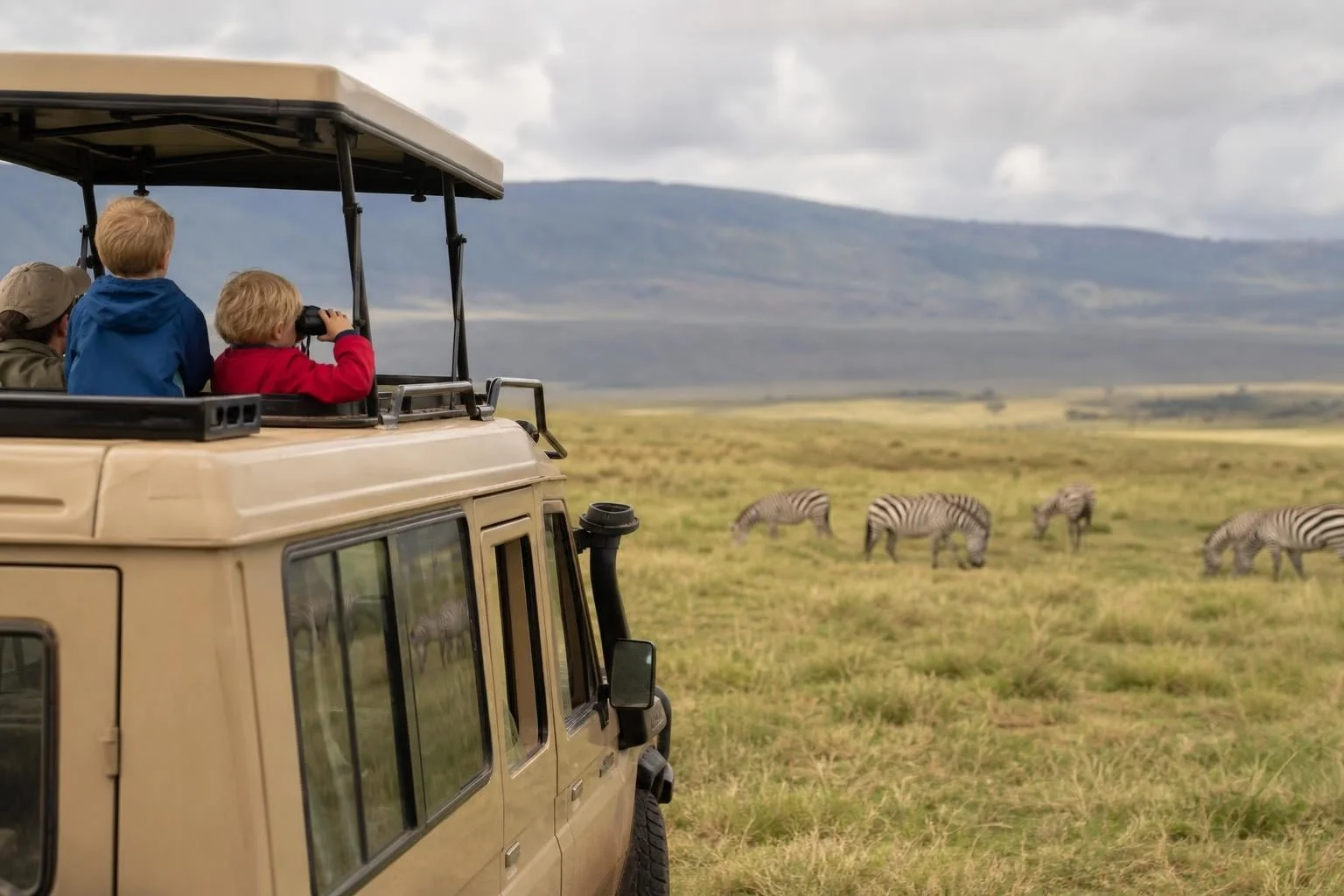
Planning a Tanzania safari with kids is less about finding one “best” park and more about matching the destination, vehicle, accommodation, activities, and safari pace to your children's ages. For most families, the Northern Circuit offers the strongest combination of wildlife, family-friendly lodges, flexible private safaris, and relatively easy access from Arusha.
Answer Capsule: The best safari setup for kids in Tanzania usually combines a private 4x4, shorter game drives, family-friendly accommodation, and parks that minimize long transfer times. Tarangire and Ngorongoro are particularly practical for younger children, while Serengeti becomes more attractive for older children who can handle longer drives. The best timing depends on whether your priority is easier driving conditions, wildlife concentrations, lower prices, or the Great Migration.
Quick takeaway: For a first family safari, focus on five decisions in this order:
-
Your children's ages — age affects activities, accommodation rules, and how much driving they can comfortably handle.
-
Your safari vehicle — a private vehicle gives families much more control over stops, drive length, and daily timing.
-
Your park combination — Tarangire, Ngorongoro, Serengeti, and Lake Manyara each suit different family priorities.
-
Your itinerary pace — fewer parks with more time in each can be easier for children than constantly changing camps.
-
Your accommodation — pools, family rooms, kids' programs, and flexible meal arrangements can make a major difference.
The guide below explains which Tanzania safari options work best for different ages, budgets, activity preferences, and trip lengths.
Best Safari Parks in Tanzania for Kids
There is no single best Tanzania national park for every family. The right choice depends on your children's ages, tolerance for long drives, wildlife priorities, and how much time you have.
|
Park |
Best For |
Why Families Like It |
Main Consideration |
|---|---|---|---|
|
Tarangire |
Younger children and first-time safari families |
Shorter drives, elephants, baobabs, strong wildlife viewing |
Usually visited for 1–2 days |
|
Ngorongoro Crater |
Families wanting concentrated wildlife |
High wildlife density in a compact area |
Crater descent and road conditions can make the day tiring |
|
Serengeti |
Older children and wildlife-focused families |
Predators, huge landscapes, Great Migration |
Longer transfers unless you fly |
|
Lake Manyara |
Shorter safari days |
Compact park, varied scenery, birdlife, short game drives |
Wildlife experience is less extensive than Serengeti |
|
Arusha National Park |
Active families and teenagers |
Walking opportunities, varied landscapes, close to Arusha |
Not a substitute for the major wildlife parks |
Which Tanzania park should you choose?
For younger children: Tarangire is often easier to combine with a relaxed family itinerary because driving distances can be shorter.
For concentrated wildlife viewing: Ngorongoro Crater can provide a high-density game-viewing experience without requiring a full day of searching across a huge landscape.
For older children and teenagers: Serengeti is especially appealing when the family is comfortable with longer drives or bush flights.
For a shorter safari: Tarangire and Lake Manyara can fit more easily into a compact itinerary.
For active teenagers: Arusha National Park can add a walking component before or after a traditional game-drive safari.
Quick-Reference: What’s Available by Age
|
Age Bracket |
Game Drives |
Walking Safari |
Balloon Safari |
Gorilla Trekking |
Key Considerations |
|---|---|---|---|---|---|
|
Under 4 |
Possible (private vehicle only) |
No |
No |
No |
Strongly discouraged by most operators; long drives and dust are hard on toddlers |
|
4 to 5 |
Yes (private vehicle recommended) |
No |
No |
No |
Shorter drives, lodge with pool and childcare, flexible schedule needed |
|
6 to 9 |
Yes |
No (minimum age 12+) |
Yes (age 7+) |
No |
Sweet spot for younger families; kids remember the trip and handle 3 to 4 hours in a vehicle |
|
10 to 12 |
Yes |
Some operators allow 12+ |
Yes |
No |
Can handle longer Serengeti distances; most camp age restrictions lift |
|
13 to 15 |
Yes |
Yes |
Yes |
Yes (age 15+) |
Full access to nearly every activity; ideal for active, engaged teenagers |
|
16+ |
Yes |
Yes |
Yes |
Yes |
Charged adult park fees; treated as adults by lodges |
For a broader overview of family safari planning across multiple African countries, the parent glossary covers terms that apply continent-wide.
Age and Access Terms
Child Rate
How lodges, camps, and Tanzania’s park authorities define pricing for children. The term means different things depending on who’s charging:
TANAPA (national parks): Children under 5 enter free. Ages 5 to 15 pay approximately 50% of the adult conservation fee. Children 16 and older pay the full adult rate. See the official TANAPA tariff page for current numbers.
Lodges and camps: Children aged 0 to 2 are almost universally free. Ages 3 to 11 typically pay 50% to 75% of the adult rate. Children 12 and over are usually charged the full adult rate at most luxury properties.
Why it matters for families: the gap between “child” definitions at park level versus lodge level catches many parents off guard. A 14-year-old pays reduced park fees but full price at most camps.
Minimum Age
Most Tanzania safari lodges and tented camps set their own minimum age for guests, typically somewhere between 8 and 12 years old. There is no government-mandated minimum age for game drives in Tanzania’s national parks.
The distinction matters because most age restrictions apply to shared game drives, where a crying infant or restless toddler genuinely disrupts other guests. On a private vehicle, many properties will accommodate children below their standard minimum if the operator negotiates in advance.
Parents on travel forums consistently report discovering camp age limits as a surprise during the booking process. Clarify this before you fall in love with a particular property.
Age Restriction (Activity-Specific)
Different activities carry different hard limits:
|
Activity |
Minimum Age |
Notes |
|---|---|---|
|
Game drive (national parks) |
No official limit |
Lodge/camp policies apply; private vehicle recommended for under-6 |
|
Walking safari |
12 to 16 years |
Varies by park and operator; most common minimum is 12 |
|
Hot air balloon safari |
7 years |
Serengeti Balloon Safaris sets this limit; cost ranges from $600 to $799 per person in 2026 |
|
Night drive |
Varies |
Only available in private conservancies, not national parks |
|
Gorilla trekking (Uganda/Rwanda) |
15 years |
Strict, non-negotiable; see the gorilla trekking age limit guide |
What Is the Best Tanzania Safari for Different Child Ages?
|
Child's Age |
Safari Style to Consider |
What to Prioritize |
What to Watch |
|---|---|---|---|
|
Under 4 |
Short, flexible private safari |
Private vehicle, short drives, lodge facilities |
Long transfers, dust, early starts |
|
4–5 |
Relaxed Northern Circuit |
Tarangire, Ngorongoro, pool, flexible schedule |
Camp age restrictions |
|
6–9 |
Classic family safari |
Private vehicle, wildlife variety, manageable drives |
Too many long transfer days |
|
10–12 |
Broader Northern Circuit |
Serengeti, selected activities, longer game drives |
Activity-specific minimum ages |
|
13–15 |
More active safari |
Walking where permitted, Serengeti, cultural activities |
Operator-specific restrictions |
|
16+ |
Nearly full adult itinerary |
Longer drives, broader activity choices |
Adult pricing at many properties |
Age is only one factor. A child's patience with long drives, interest in wildlife, swimming ability, sleep schedule, and previous travel experience can be just as important when designing the itinerary.
Junior Ranger Program / Kids’ Club
On-site supervised activity programs designed for younger guests. Activities typically include animal track identification, bush craft, archery, stargazing, bird spotting, and cooking. Some properties, like those running the andBeyond WILDChild Programme, give every child a welcome bag with a logbook, crayons, age-appropriate toys, and a personalized note.
Not every camp offers one. If your children are under 10, confirming the availability of a kids’ program or babysitting service should happen before you book, not after.
Private Vehicle
A dedicated 4x4 safari vehicle for your family only, with your own driver-guide. This is the single most important booking decision for families with kids under 10.
A private vehicle means you control drive duration, bathroom stops, early returns to the lodge, and the pace of every sighting. One parent’s frustration, shared on a popular travel forum, captures the stakes perfectly: “If my kids cannot go on a game drive then either me or my husband are going to be stuck on the property.” With a private vehicle, that problem disappears.
Families weighing accommodation styles and vehicle options against their children’s ages can explore Tanzania family safari options for a deeper look at how these decisions connect.
Private vs. Shared Safari Vehicle for Families
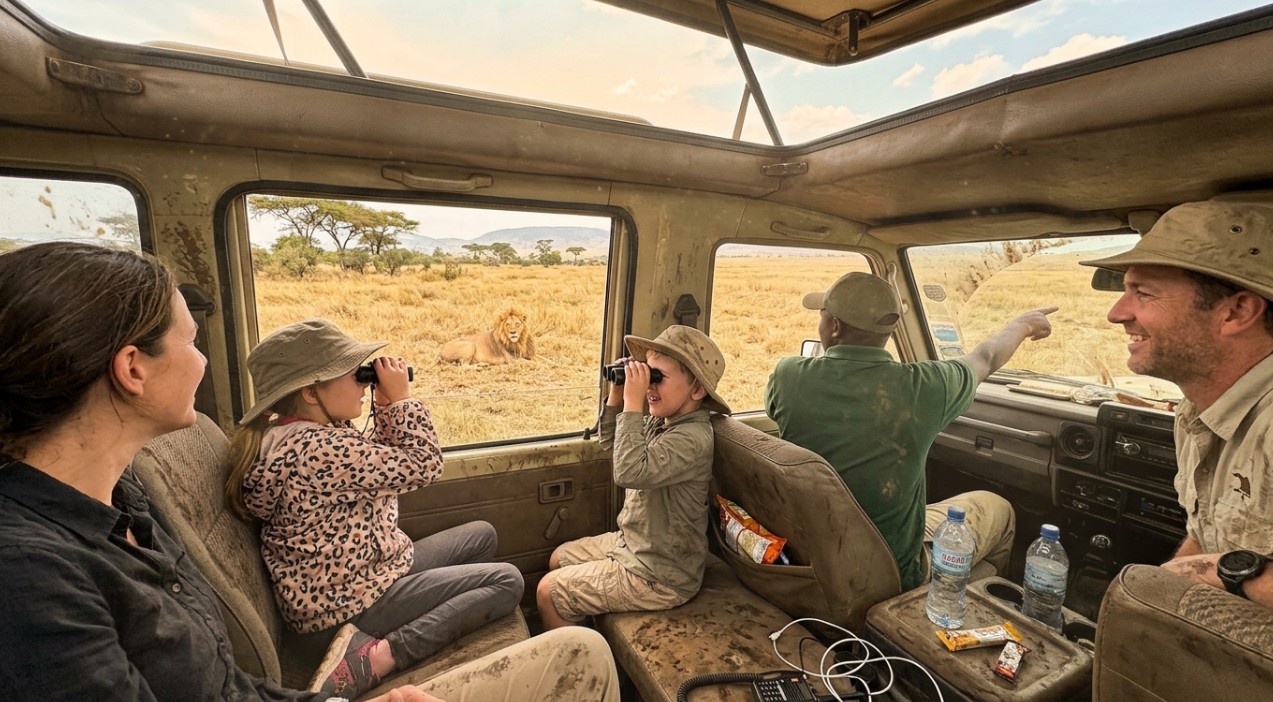
For families traveling with children, the choice between a private and shared safari vehicle can affect the entire rhythm of the trip. A private vehicle costs more, but it gives the family control over when to start, stop, return to camp, and adjust the day's schedule.
|
Feature |
Private Vehicle |
Shared Vehicle |
|---|---|---|
|
Departure time |
Flexible |
Usually fixed |
|
Bathroom stops |
Flexible |
Depends on group |
|
Ending a game drive early |
Easy |
Must consider other guests |
|
Child naps |
Easier to accommodate |
Less predictable |
|
Family conversation |
Private |
Shared with other guests |
|
Cost |
Higher |
Lower |
|
Best for |
Families with young children or specific needs |
Older children and budget-conscious families |
When is a private safari vehicle worth the cost?
A private vehicle is particularly useful when children are young, naps and bathroom breaks are unpredictable, or parents want the flexibility to shorten a game drive. It can also make it easier to customize the day around swimming, meals, and other activities.
A shared vehicle can work well for older children who are comfortable following a fixed schedule and for families trying to reduce the overall safari budget.
The key question is not simply whether a private vehicle is “better.” It is whether the additional flexibility is valuable enough for your family's ages, schedule, and budget.
Park and Route Terms
Northern Circuit
Tanzania’s most popular safari route, connecting four major wildlife areas: Tarangire, Lake Manyara, Ngorongoro Crater, and Serengeti. All are accessible from the gateway city of Arusha. This is the default family safari route because it offers the highest wildlife density, the widest range of family-friendly lodges, and well-maintained roads between parks.
A detailed Northern Circuit guide breaks down distances, timing, and routing options.
Tarangire National Park
Often called the perfect first park for kids. Tarangire delivers large elephant herds, distinctive baobab trees, and compact driving circuits that keep vehicle time short. Several family-friendly lodges near or inside the park feature swimming pools, which, as any parent knows, can matter as much as the wildlife for keeping younger children happy.
The short distance from Arusha (roughly two hours) means less time in transit and more time watching elephants. For families with children under six, Tarangire is the strongest starting point. A full breakdown of what to expect lives in the Tarangire safari glossary.
Serengeti National Park
Tanzania’s most famous park and the stage for the Great Migration. The Serengeti is bigger, wilder, and requires longer drives (or bush flights) to reach. That makes it best suited for children aged six and older who can handle three to four hours in a vehicle without melting down.
The payoff is enormous. No park in Africa matches the Serengeti for predator sightings, open plains, and sheer drama. Families with teenagers often call it the highlight of their trip. For a comprehensive planning resource, see the Serengeti safari guide.
Ngorongoro Crater
A collapsed volcanic caldera roughly 20 kilometers across, home to an extraordinary concentration of wildlife in a compact space. The steep descent into the crater takes about 30 minutes, and once on the floor, game drives are relatively short because animals are everywhere.
High wildlife density in a small area makes the Crater excellent for families. Children don’t need to endure hours of searching. The Ngorongoro Crater planning guide covers logistics and seasonal considerations.
Lake Manyara National Park
A smaller park about three hours from Arusha, known for tree-climbing lions, flamingos, and a canopy walkway. The driving circuit is short enough for a half-day visit, making it ideal for families with very young children who need an afternoon at the lodge.
Lake Manyara works well as a first-day or last-day park, easing the family into or out of the safari experience.
Arusha National Park
A small park on the outskirts of Arusha that offers one thing most Northern Circuit parks don’t: walking safaris in a relatively low-risk environment. Families with older teenagers sometimes start here with a guided walk before heading into the bigger parks. One Duma Explorer client family of four with two teenagers did exactly this, beginning their nine-night private safari with a walking safari in Arusha National Park before moving through Western Serengeti, Central Serengeti, Ngorongoro, and Tarangire.
Concession
A private conservation area within or adjacent to a national park, managed by a lodge or camp operator. Concessions typically allow activities that national parks prohibit, including night drives, off-road driving, and walking safaris for younger ages. They also tend to limit visitor numbers, meaning fewer vehicles at sightings.
For families, concessions offer more flexibility and a more exclusive feel, though they come at a higher price.
Best Tanzania Safari Itineraries for Families
The best family safari itinerary is usually the one that leaves enough time for wildlife viewing without turning every day into a long transfer. Children often enjoy the safari more when there are fewer accommodation changes and enough downtime between game drives.
|
Trip Length |
Example Route |
Best For |
|---|---|---|
|
4–5 days |
Arusha → Tarangire → Ngorongoro → Arusha |
First safari with younger children |
|
6–7 days |
Arusha → Tarangire → Ngorongoro → Serengeti → Arusha |
Classic first Tanzania safari |
|
8–10 days |
Northern Circuit + Zanzibar |
Families wanting safari and beach time |
|
10–14 days |
Tarangire → Ngorongoro → Serengeti → additional park → Zanzibar |
Older children and teenagers |
4–5 Day Family Safari
Keep the route compact. Tarangire and Ngorongoro can provide a strong introduction to Tanzania without requiring the family to spend several consecutive days on long road transfers.
6–7 Day Family Safari
Add the Serengeti if wildlife is a major priority and the children can comfortably handle longer travel days. Consider a bush flight if the budget allows and reducing road-transfer time is important.
8–10 Day Safari and Zanzibar
A safari followed by several days in Zanzibar gives children a change of pace. After several days of early starts and game drives, swimming, beaches, and less structured activities can provide useful downtime.
10–14 Day Family Safari
Longer trips allow families to slow down rather than simply add more destinations. Older children and teenagers can also handle a broader mix of activities, including selected walking experiences and cultural visits where permitted.
Activity Terms
Game Drive
The core safari activity. You ride in a modified Land Cruiser (or similar 4x4) with a pop-up roof hatch that lets passengers stand for better wildlife viewing and photography.
Game drives run in two sessions: an early morning departure before sunrise, returning mid-morning, and a late afternoon departure around 3:30 or 4 PM, returning after sunset. The midday break gives kids time to swim, rest, or do kids’ club activities. For a deeper look at safari vehicle types, including what a pop-up roof actually looks like, there’s a dedicated glossary.
Walking Safari
A guided walk through the bush on foot, led by an armed ranger and a certified walking guide. The minimum age in Tanzania is usually 12 to 16 years, depending on the park and operator. Walking safaris focus on tracking, smaller wildlife, and the sensory experience of being in the bush without a vehicle between you and the animals.
Not for young children. Period.
Night Drive
A game drive conducted after dark using spotlights or infrared light to find nocturnal animals like aardvarks, bush babies, and hunting predators. Night drives are only permitted in private conservancies, not in Tanzania’s national parks. If your itinerary includes a concession stay, ask whether night drives are offered and whether children can participate.
Bush Walk
A shorter, less intensive version of a walking safari, typically conducted near the lodge boundary. Some properties allow children younger than 12 on bush walks because the environment is more controlled. These are more about teaching kids to read animal tracks and identify plants than about encountering large wildlife.
Balloon Safari
A one-hour hot air balloon flight over the Serengeti at dawn, followed by a champagne bush breakfast on landing. The minimum age is seven years old. Prices for the 2026 season range from $600 to $799 per person. Children are charged the same rate as adults.
The experience is spectacular but expensive for a family. Some parents choose to send only the adults while kids do a morning game drive with the guide.
Cultural Visit / Maasai Boma
A guided visit to a Maasai village (boma) to learn about traditional housing, livestock herding, and daily life. Children consistently enjoy these visits because they’re interactive: jumping dances, fire-making demonstrations, and meeting Maasai children their own age.
One Duma Explorer client family noted: “We especially enjoyed the Mysigio camp where we were able to stay right next to a Maasai village and experience 1st hand their homes and unique culture.” Cultural visits break up the rhythm of game drives and give kids a human connection to the places they’re visiting.
Bush Breakfast / Bush Dinner
A meal set up outdoors in the wilderness, often under a tree or overlooking a river. Bush breakfasts typically follow a morning game drive, while bush dinners happen at sunset. These are special-occasion meals arranged by the lodge, and kids tend to love the novelty of eating outside surrounded by nature.
Spice Tour
A Zanzibar-specific activity where a guide walks you through a spice farm, explaining the cultivation of cloves, vanilla, cinnamon, nutmeg, and other spices. Good for older kids (8+) who can engage with the smells and tastes. Younger children may lose interest quickly. A full overview lives in the Zanzibar spice tour glossary.
Accommodation Terms
Family Tent
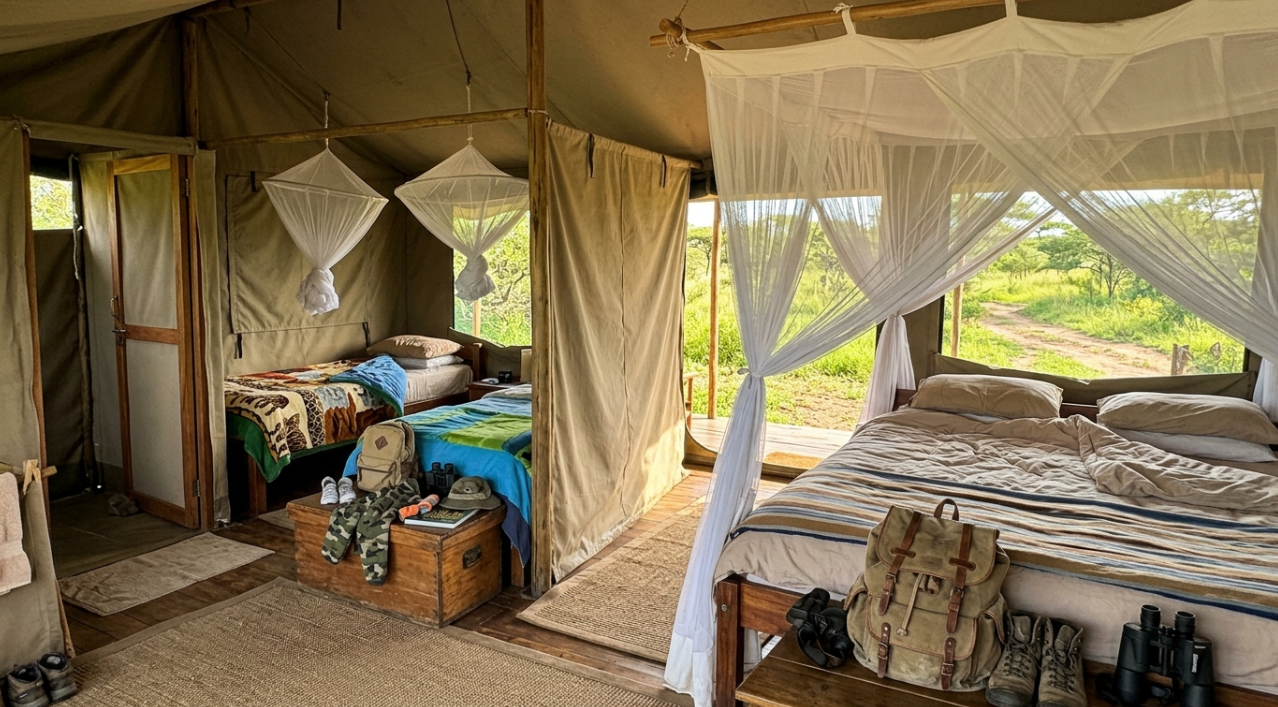
Don’t let the word “tent” mislead you. A family tent on safari is typically a large canvas structure with proper beds, an en-suite bathroom (often with a flush toilet and hot shower), and sometimes a private plunge pool or deck. “Tent” refers to the canvas walls, not to camping gear you’d buy at a sporting goods store.
Interconnecting Room
Two separate rooms joined by an internal door. This is the standard family configuration at safari lodges. Parents get their own space; kids get theirs; everyone can check on each other without going outside. When booking, confirm whether the interconnecting door locks from both sides.
Lodge
A permanent structure built from brick, stone, or timber. Lodges are typically more child-friendly than tented camps because they offer more stability: solid walls, swimming pools, larger common areas, and often more staff on hand. For families with children under six, a lodge with a pool is close to non-negotiable. Practitioners on travel forums overwhelmingly identify pools as the single most important lodge amenity for kids on safari.
Tented Camp
Semi-permanent canvas structures that range from extremely basic to ultra-luxurious. A high-end tented camp can be as comfortable as any hotel, with king beds, freestanding bathtubs, and private butlers. The key variable for families is whether the camp is fenced.
Mobile Camp
A camp that physically moves two to three times per year to follow wildlife patterns, most notably the Great Migration. Mobile camps offer incredible wildlife access but typically have fewer family amenities (no pool, simpler structures). Best for families with older kids who are fully invested in the wildlife experience.
Exclusive-Use Villa
A private house within a camp or lodge property, booked exclusively by one group. Villas typically include multiple bedrooms, a private kitchen or chef, a plunge pool, and a dedicated safari vehicle. This is the ideal setup for multigenerational family safaris.
One Duma Explorer client, Linda, traveled with 13 family members ranging in age from 11 to 62. She noted that the operator “planned the perfect safari with the right amount of days at each park and listened to what type of accommodations we needed.” Exclusive-use villas make trips like this possible without splitting the family across multiple rooms in different parts of a property. For multigenerational safari planning specifics, there’s a dedicated guide.
Fenced vs. Unfenced Camp
Fenced camps have a physical barrier (electric fence, thorn fence, or wall) between the accommodation and the surrounding bush. Unfenced camps sit directly in the wilderness, meaning animals can walk through the property.
For families with young children, fenced camps or lodges provide peace of mind. Unfenced camps are perfectly safe when you follow rules (don’t walk alone at night, always use an escort), but they require a level of vigilance that can add stress when you’re also managing children.
Kids’ Club
A supervised on-site program offering age-appropriate activities during morning and afternoon game drive windows. Activities range from archery and animal-track identification to cooking lessons and stargazing. Not every camp has one, and quality varies widely. Ask for specifics before booking.
Planning and Cost Terms
PPPD (Per Person Per Day)
The standard pricing unit for safari accommodation. A rate of “$600 PPPD” means each person pays $600 per day. For a family of four staying three nights, that’s $600 x 4 x 3 = $7,200 for accommodation alone.
PPPD rates at safari camps usually include accommodation, all meals, some or all drinks, two game drives per day, laundry, and sometimes park fees. They typically exclude tips, balloon safaris, premium alcohol, and spa treatments. Always ask what’s included.
Budget-level family safaris run roughly $400 to $500 PPPD. Mid-range (lodges with pools, reliable vehicles) runs $500 to $700 PPPD. Luxury and fly-in options start at $700 and can exceed $1,500 PPPD. A detailed Tanzania safari cost breakdown helps families understand what drives these numbers.
Park Fee / Conservation Fee
A daily fee charged by the government for entering a national park. This is separate from what you pay your safari operator for vehicles, guides, and accommodation. The adult conservation fee for most Northern Circuit parks is $60 per person per day. Children aged 5 to 15 pay approximately half the adult rate. Children under 5 are free.
These fees add up fast for families. A family of four (two adults, one 8-year-old, one 3-year-old) visiting Serengeti for three days would pay approximately: (2 x $60 x 3) + (1 x $30 x 3) + $0 = $450 in park fees alone.
TANAPA
Tanzania National Parks Authority. The government body that manages all national parks in Tanzania, sets conservation fees, and establishes rules for activities inside parks (including walking safari age limits and night drive prohibitions).
NCAA
Ngorongoro Conservation Area Authority. A separate body from TANAPA that manages the Ngorongoro Conservation Area. The fee structure differs slightly: there’s a conservation fee per person plus a vehicle entry fee (currently $40 per vehicle for the crater descent).
All-Inclusive
A pricing structure where meals, drinks, activities, and sometimes park fees are bundled into one rate. “All-inclusive” sounds comprehensive but often excludes tips, balloon safaris, premium wines and spirits, spa treatments, and laundry at some properties. Read the fine print.
Full Board
All three meals (breakfast, lunch, dinner) are included in the rate. Drinks may or may not be. “Full board plus” or “full board with house drinks” means non-premium alcoholic and soft drinks are also covered. For families, full board is the norm on safari since there are no nearby restaurants.
Soft Bag
A flexible, collapsible duffel bag required for bush plane flights. Hard-sided suitcases cannot fit in the small luggage compartments of light aircraft. Weight limits are strict: usually 15 to 20 kg per person, including the bag itself. If your family itinerary includes any fly-in transfers, pack in soft bags from the start.
Logistics Terms
Fly-In Safari
A safari that uses small bush planes (typically Cessna Caravans) to move between parks or camps. Fly-in safaris save hours of driving, which matters enormously for families with young kids. The trade-offs: higher cost, strict luggage limits (soft bags only, 15 to 20 kg), and fixed flight schedules that reduce flexibility.
For families with children under eight, the time savings of a fly-in safari can be the difference between a smooth trip and daily meltdowns during long road transfers.
Driving Safari
A road-based safari where your guide drives you between parks in a 4x4. Lower cost, more scenic stops, easier luggage handling, and the flexibility to stop whenever a child needs a bathroom break. But transfer days between parks (especially from Arusha to Serengeti, roughly 8 hours) can drain young children.
Families planning a first Tanzania safari can ask Duma Explorer to compare driving and fly-in routes for the same itinerary, so you see exact time and cost trade-offs.
Bush Plane
The small propeller aircraft used for fly-in safaris. Typically 12 to 14 seats, unpressurized, flying at lower altitudes. The views are fantastic. The luggage rules are not: soft bags only, 15 to 20 kg per person. Children count as full passengers for luggage limits.
Transfer Day
A day spent primarily driving between parks rather than game viewing. On a Northern Circuit driving safari, you’ll typically have one or two transfer days. These are the hardest days for kids. Experienced operators break them up with stops at viewpoints, picnic lunches, and brief village visits.
Pop-Up Roof
The hinged roof section of a safari vehicle that lifts up, allowing passengers to stand inside the vehicle for better wildlife viewing and photography. Children love this feature. Make sure your guide shows kids how the hinge works and establishes safety rules (no leaning out, sit down when the vehicle moves) before the first game drive.
Season and Wildlife Terms
Dry Season (June to October)
The best overall period for a kids’ safari in Tanzania. Less mud, cooler temperatures, concentrated wildlife around water sources, and dramatically reduced mosquito activity. The dry season also aligns with Northern Hemisphere summer holidays, making it the most popular (and most expensive) time for family travel.
For details on how timing affects every aspect of a trip, see the best time for a Tanzania safari.
Green Season / Wet Season (November to May)
Lower prices, lush scenery, and fewer tourists, but also rain, muddy roads, and higher malaria risk. The “short rains” (November to December) are manageable, while the “long rains” (March to May) can make some roads impassable. Not ideal for a first family safari unless budget is the primary driver.
Calving Season (January to March)
The period when roughly 500,000 wildebeest calves are born on the southern Serengeti plains near Ndutu. Baby animals everywhere. Predators hunting in broad daylight. For kids, this is arguably the most exciting time to visit the Serengeti because the action is constant and visible, not hidden in tall grass. The trade-off: January to March falls in the warmer, wetter part of the year.
Great Migration
The continuous, circular movement of approximately 1.5 million wildebeest, plus hundreds of thousands of zebra and gazelle, across the Serengeti-Mara ecosystem. The timing of the migration varies by month, and “seeing the migration” means different things at different times of year: calving in January to March, river crossings from July to October, and general herd movement year-round.
Big Five
Lion, leopard, elephant, buffalo, and rhinoceros. Originally a hunting term (the five most dangerous animals to hunt on foot), now the most famous wildlife checklist for safari visitors. Kids often keep a tally. The Northern Circuit offers realistic chances at all five, though rhino sightings depend on location and luck.
Safety and Health Terms
Malaria Prophylaxis
Preventive medication taken before, during, and after travel to a malaria zone. Malaria is present across all Northern Circuit parks. Pediatric formulations are available for children, but dosages and drug choices depend on your child’s age and weight. Visit a travel clinic four to six weeks before departure to get the right prescription.
For malaria prevention specifics in the broader region, the Zanzibar malaria guide covers prophylaxis options in detail.
Travel Clinic
A medical facility specializing in travel health. This is where you’ll get childhood vaccinations (yellow fever, hepatitis A, typhoid) and malaria prescriptions tailored to Tanzania. Four to six weeks of lead time is standard because some vaccines require multiple doses.
AMREF Flying Doctors
East Africa’s primary air ambulance service. Most reputable safari operators include AMREF coverage in their packages or offer it as an add-on. In the unlikely event of a medical emergency in a remote park, AMREF can evacuate patients to hospitals in Arusha or Nairobi. Confirm this coverage is included in your safari quote.
Zanzibar Extension Terms
Bush and Beach
The classic Tanzania combination: a Northern Circuit safari followed by a beach stay on Zanzibar. For families, this isn’t a luxury add-on; it’s close to a necessity. By day five or six of back-to-back game drives, most children are ready for sand and water.
Practitioners on travel forums consistently describe the beach days as “essential, not optional” for family trips. One experienced parent put it bluntly: the four days of beach decompression are “the difference between coming home rested and coming home shattered.” A recommended total trip length is 7 to 10 days.
For itinerary ideas that combine both, the 14-day Tanzania and Zanzibar guide maps out pacing and logistics.
Spice Island
Zanzibar’s nickname, earned from its centuries-long role in the global spice trade. Cloves, nutmeg, cinnamon, black pepper, and vanilla are all grown here. A spice tour is one of the island’s signature family activities.
Stone Town
The historic old town of Zanzibar City, a UNESCO World Heritage Site. Narrow alleyways, carved wooden doors, rooftop restaurants, and a busy waterfront. Older kids find it fascinating. Toddlers find it hot and confusing. Best suited for families with children eight and up.
Dhow Cruise
A trip on a traditional Swahili sailing boat (dhow), typically at sunset or as part of a snorkeling excursion. Kid-friendly and photogenic. Ask about life jackets for children before booking. For a full list of activities on the island, see the Zanzibar excursions guide.
What to Pack: Key Terms for Kids on Safari
Junior binoculars: Lightweight, kid-sized binoculars with 8x magnification. Worth the investment. They keep children engaged during slow sighting moments.
Wildlife bingo cards: Printable or laminated cards listing animals to spot. Many operators provide these, but bringing your own ensures you have them from day one.
Soft bag: Required for any bush plane transfer. Even if your itinerary is driving-only, a soft duffel is easier to load into a safari vehicle than a hard suitcase.
Neutral-colored clothing: Khaki, olive, tan, brown. Bright colors can disturb wildlife and attract insects. No camouflage patterns, which are restricted in some East African countries.
Sun protection: High-SPF sunscreen, wide-brimmed hats, and UV-protective clothing. The equatorial sun at altitude is significantly stronger than most families expect.
Closed-toe shoes: Required for any walking activity. Safari boots or sturdy sneakers work fine for kids.
Park Fees for Children: Quick-Reference Table
|
Park / Area |
Adult Fee (per day) |
Child Fee (ages 5-15, per day) |
Under 5 |
Notes |
|---|---|---|---|---|
|
Serengeti |
$60 |
~$30 |
Free |
Largest park; multi-day visits common |
|
Ngorongoro Crater |
$60 + $40 vehicle fee |
~$30 + vehicle fee shared |
Free |
Vehicle fee is per vehicle, not per person |
|
Tarangire |
$60 |
~$30 |
Free |
Usually 1-2 day visits |
|
Lake Manyara |
$60 |
~$30 |
Free |
Half-day visits common |
|
Arusha National Park |
$60 |
~$30 |
Free |
Walking safari option for teens |
Fees shown are approximate and based on published TANAPA rates. Confirm current rates with your operator or at tanzaniaparks.go.tz.
Frequently Asked Questions
What is the best age for a kids’ safari in Tanzania?
Ages 6 to 9 are the sweet spot for younger families. Children in this range are old enough to be genuinely interested in wildlife, can handle three to four hours in a vehicle, and will remember the trip for the rest of their lives. Ages 10 to 15 open up even more activities, including walking safaris (12+) and balloon flights (7+). Children under 4 can technically go on safari, but most operators and experienced families discourage it.
Do children pay full park fees in Tanzania?
No. Children under 5 enter all TANAPA parks free of charge. Children aged 5 to 15 pay approximately half the adult conservation fee. At age 16, the full adult rate applies.
Can toddlers go on safari in Tanzania?
Technically yes, but it requires significant accommodation: a private vehicle, shorter game drives, a lodge with childcare, and realistic expectations. Long drives, extreme dust, strict timing, and the genuine risk of an unhappy child disrupting an entire lodge at 5 AM affect everyone’s experience. Most operators recommend waiting until at least age 4, preferably 6.
Is a private vehicle necessary for a family safari in Tanzania?
For families with children under 10, it is close to essential. A private vehicle lets you leave a sighting early, take unscheduled bathroom breaks, and return to the lodge when your kids hit their limit. On a shared vehicle, one restless child affects every other guest. The cost increase is meaningful, but the flexibility is worth it.
How many days should a family safari in Tanzania be?
Seven to ten days is the recommended range for a “bush and beach” trip combining a Northern Circuit safari (4 to 6 days) with a Zanzibar beach extension (3 to 4 days). A safari-only trip of 5 to 7 days works if beach time isn’t in the plan, though most families with children benefit from the decompression days.
Is Zanzibar worth adding after a safari with kids?
Yes. By the fifth or sixth day of game drives, most children are ready for swimming, snorkeling, and unstructured time. Zanzibar provides exactly that. The flight from Serengeti or Arusha to Zanzibar is short (60 to 90 minutes), and the island offers family-friendly beaches, spice tours, dolphin trips, and Stone Town exploration.
What should kids pack for a Tanzania safari?
Junior binoculars, a wildlife checklist or bingo cards, neutral-colored clothing (no bright colors or camouflage), a wide-brimmed hat, high-SPF sunscreen, closed-toe shoes for any walking activity, and a soft duffel bag if bush plane flights are part of the itinerary. Most lodges handle laundry daily, so you can pack lighter than you think.
Start Planning Your Family Safari
The best safari for kids in Tanzania isn’t a single lodge or park. It’s the right combination of parks, accommodation, vehicle type, and pacing matched to your children’s ages and your family’s travel style.
Tell Duma Explorer your children’s ages, your travel dates, and how many days you have. The team will design the right route.