Gorilla Trekking Bwindi Sectors: 2026 Guide to All 4
TL;DR
Bwindi Impenetrable National Park is divided into four trekking sectors: Buhoma, Ruhija, Rushaga, and Nkuringo. Each sector has different gorilla families, terrain difficulty, accommodation options, and access routes. Your permit locks you into one sector, so choosing the right one matters. This guide breaks down every sector, defines key terms, and covers the critical 2026 UWA rule changes that affect how you book.
Quick Answer: Which Bwindi Sector Is Best? If you're wondering which Bwindi gorilla trekking sector is best, the answer depends on your travel style rather than one "winner."
|
Traveler Type |
Best Sector |
Why |
|---|---|---|
|
First-time visitors |
Buhoma |
Easier terrain, excellent lodges, established infrastructure |
|
Best permit availability |
Rushaga |
Most habituated gorilla families and daily permits |
|
Birdwatchers |
Ruhija |
Highest concentration of Albertine Rift endemic birds |
|
Challenging hikes |
Nkuringo |
Steepest terrain and spectacular scenery |
|
Gorilla Habituation Experience |
Rushaga |
Only sector offering the four-hour habituation trek |
|
Luxury travelers |
Buhoma or Rushaga |
Largest selection of upscale lodges |
|
Shortest drive from Kigali |
Rushaga |
Approximately 4–5 hours via Cyanika Border |
Bottom line: There is no universally "best" Bwindi sector. The right choice depends on your fitness, preferred accommodation, permit availability, and overall Uganda itinerary.
Why the Sector System Matters
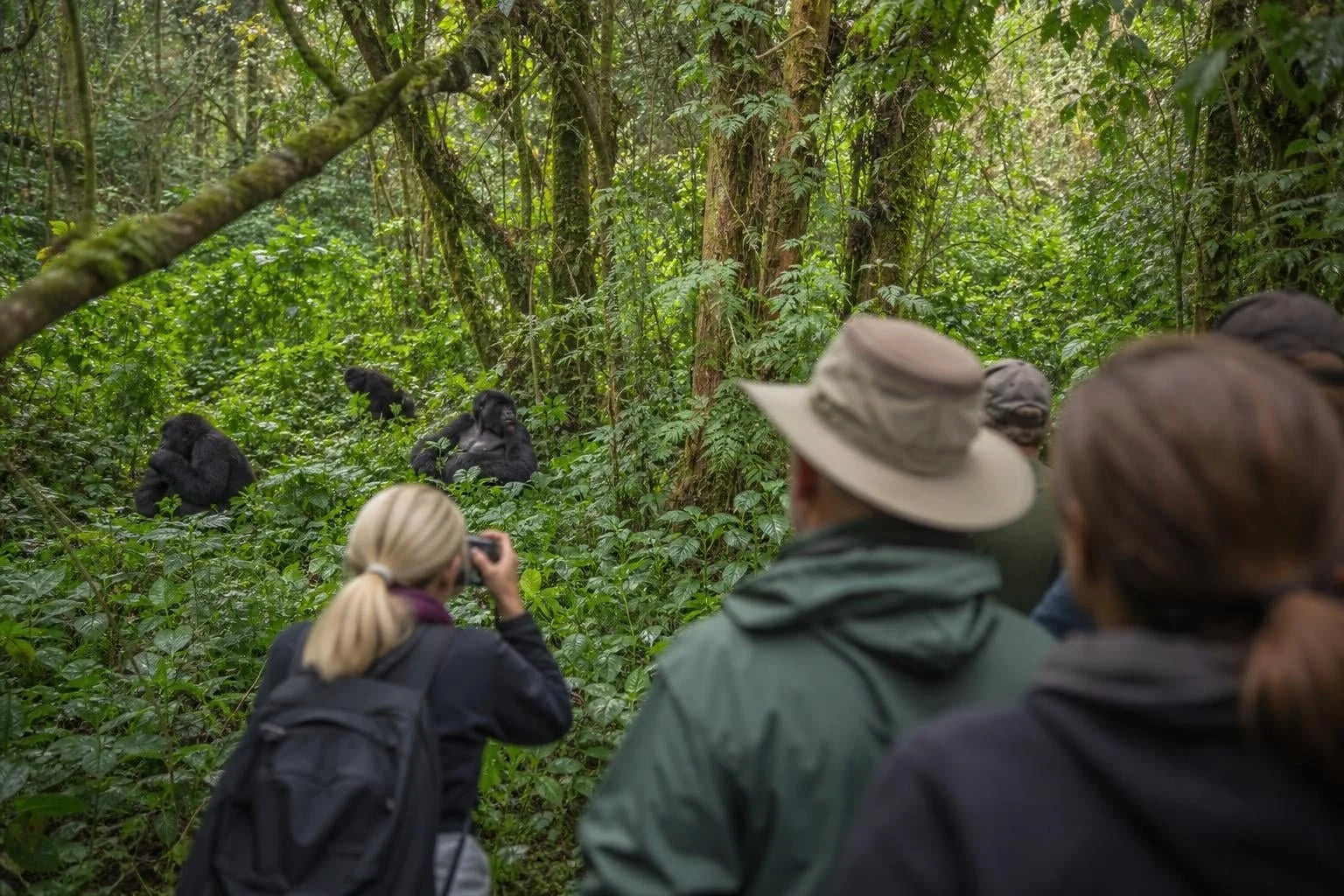
Bwindi Impenetrable National Park covers roughly 321 square kilometers of steep, tangled forest in southwestern Uganda. It sits between 1,160 and 2,607 metres in elevation and holds a UNESCO World Heritage designation. The 2018 Bwindi-Sarambwe census counted 459 gorillas in 36 social groups, and a new census is underway through 2025 to update those numbers. Combined with the Virunga Massif population of 604, the global mountain gorilla population stands at approximately 1,063.
The park is split into four gorilla trekking Bwindi sectors, each functioning almost as its own mini-park with a separate briefing point, ranger team, gorilla families, and set of nearby lodges. The sectors are hours apart by road, and your permit assigns you to one specific sector and one specific gorilla family. You cannot show up at Buhoma with a Rushaga permit.
This means sector choice is one of the most consequential decisions in your trip planning, affecting everything from how hard you hike to whether you can combine the trek with other parks.
Planning a Uganda gorilla trek? See our gorilla safari pricing to understand what full trip packages look like.
Bwindi Sector Map Explained
Many first-time visitors assume the four Bwindi sectors are connected by short walking trails. They are not.
Although all four sectors belong to the same national park, they function almost like separate parks with their own:
-
UWA briefing centers
-
ranger teams
-
gorilla families
-
lodge clusters
-
access roads
Driving between sectors can take anywhere from one to four hours depending on the route, making it impractical to stay in one sector while trekking in another.
This is why choosing the correct lodge after your permit is confirmed is just as important as selecting the correct trekking sector.
The Four Bwindi Gorilla Trekking Sectors Defined
Buhoma Sector (North)
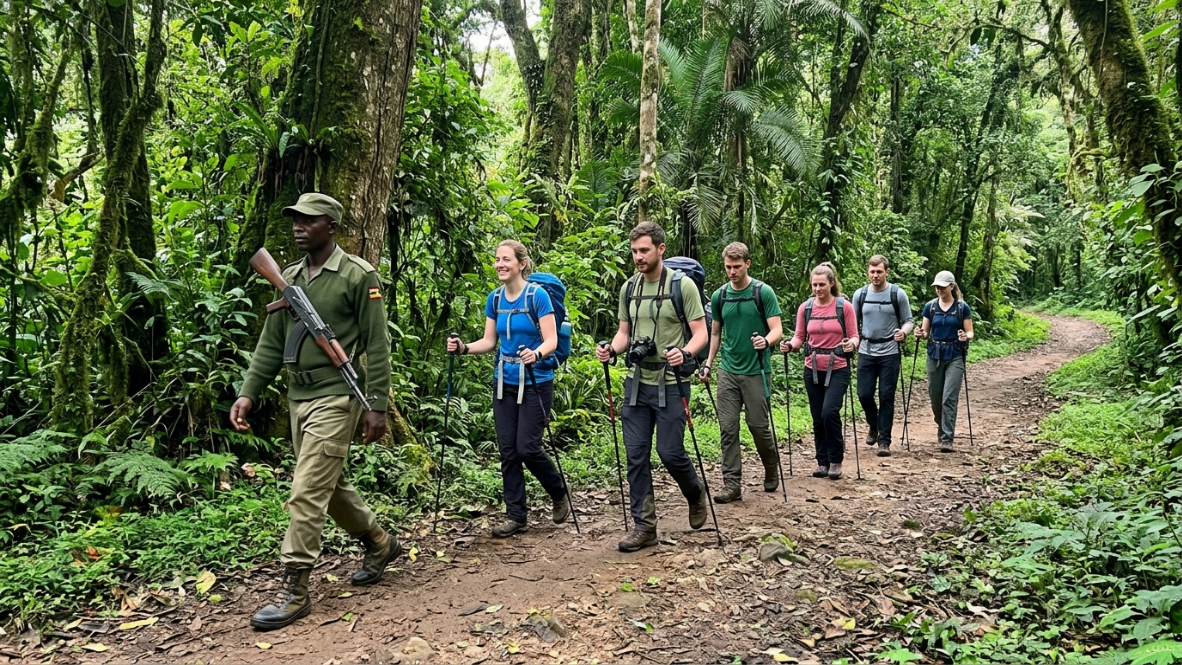
Buhoma is the original sector, opened to gorilla tourism in 1993, and it remains the most established. The Bwindi National Park headquarters sit here, which makes logistics straightforward. Check-in, briefing, and ranger coordination all happen at the same hub.
Gorilla families: Mubare (the first family ever habituated in Bwindi), Habinyanja, Rushegura, Katwe, and others. The exact count fluctuates as groups split and merge, but expect roughly 3 to 5 trackable families at any given time.
Terrain and difficulty: Varied but not punishing. Buhoma is widely considered the most forgiving sector for first-time trekkers. Several operators note that treks here sometimes finish by 11:00 AM, with total hiking time as short as 3 to 4 hours depending on where the gorillas slept the night before.
Accommodation: The most developed lodging scene in Bwindi, skewing toward mid-range and luxury. Buhoma Lodge sits inside the park gate itself, a genuinely unusual arrangement.
Access: About 8 to 10 hours by road from Entebbe, or roughly 2 hours by chartered flight to Kihihi Airstrip followed by a 1-hour drive. From Kigali, the Katuna (Gatuna) border crossing works best for reaching Buhoma.
Best for: First-time trekkers, older travelers, families with teenagers meeting the age minimum, and anyone combining Bwindi with Queen Elizabeth National Park, Kibale Forest, or Murchison Falls.
Ruhija Sector (East)
Ruhija is Bwindi’s highest sector, perched at around 2,350 metres. The altitude makes it noticeably cooler than the other sectors, and the terrain is challenging partly because of the elevation itself. If you have concerns about fitness requirements for gorilla trekking, factor in the thin air.
Gorilla families: Bitukura, Oruzogo, Mukiza, and Kyaguliro (roughly 4 families). Bitukura is considered one of the easiest families to trek to in Ruhija and a favorite among photographers because of the group’s relatively relaxed behavior around humans.
Birding and wildlife: For birders, Ruhija is the standout sector, with numerous Albertine Rift endemics present. It is also the only Bwindi sector where elephants and antelopes are regularly spotted.
Accommodation: Limited. Ruhija lacks the luxury lodge options found in Buhoma or Rushaga, and the access roads are rough, requiring a proper 4WD vehicle. One important logistics tip from practitioners: operators at Realm Africa Safaris recommend staying overnight in Ruhija itself rather than sleeping in Buhoma and waking up at 6:00 AM for the one-hour drive, or worse, staying in Kabale and waking at 5:00 AM for a two-hour drive in the dark. This is a common mistake.
Unique feature: Ruhija is the only sector offering a hike to Rwamunyonyi Peak, which rises to 2,607 metres, the highest point in Bwindi.
Access: Same border crossing as Buhoma (Katuna/Gatuna from Kigali), but add extra drive time from the border.
Best for: Birders, photographers targeting the Bitukura family, and trekkers who want fewer crowds and don’t mind basic accommodation.
Rushaga Sector (South)
Rushaga has the largest number of habituated gorilla families of any Bwindi sector, which means more permits are released here daily. During peak season, this is often the easiest sector for securing availability. Most tour operators point to Rushaga as the default recommendation for exactly this reason.
Gorilla families: Nshongi, Busingye, Kahungye, Mishaya, Bweza, Rwigi, Bikingi, Mucunguzi, and others. The count sits at roughly 7 to 9 families, though this shifts as groups split. Across all four Bwindi gorilla trekking sectors combined, the total is approximately 20 to 25 habituated families as of 2026.
Why do published counts vary so much? Because gorilla groups are not static. A family led by a young silverback may split from a larger group, creating a new trackable unit. Less frequently, small groups merge. Any source claiming a fixed, precise number is oversimplifying.
Habituation experience exclusivity: Rushaga is the only sector in Bwindi offering the Gorilla Habituation Experience (more on this below), where you spend up to four hours with a semi-habituated family instead of the standard one hour.
Terrain: Variable. Some treks are moderate, others steep. The range of families means rangers can often match your fitness level to an appropriate group.
Access: Approximately 4 to 5 hours by road from Kigali International Airport via the Cyanika border crossing, making Rushaga the most convenient sector for travelers coming from Rwanda.
Best for: Travelers prioritizing permit availability, those wanting the habituation experience, and anyone routing through Kigali. For a full comparison of the Rwanda vs. Uganda gorilla trekking decision, that’s a separate but important planning step.
Nkuringo Sector (South)
Nkuringo is the least visited and most physically demanding of the four gorilla trekking Bwindi sectors. The trailhead sits high on a ridge, but the gorillas often range in the valleys below. Treks frequently begin with a steep descent through dense forest and end with a punishing climb back up. This is not a sector you pick lightly.
Gorilla families: Nkuringo, Christmas, and Bushaho (roughly 3 families). Fewer families means fewer daily permits.
Scenery: Nkuringo offers dramatic views of the Nyamuragira and Nyiragongo volcanic peaks across the border in the DRC. The ridge-top setting is genuinely stunning.
Accommodation: Fewer options than Buhoma or Rushaga, though a handful of quality lodges exist on the ridge above the park.
Access: Like Rushaga, the Cyanika border crossing from Kigali is the best route.
Best for: Fit, experienced hikers seeking a challenging trek with fewer tourists. An expert guide summarized it well in a Horizon Guides interview: “I recommend Buhoma for easier-going treks and Nkuringo for longer and more challenging treks.”
Quick-Reference Sector Comparison Table
|
Buhoma |
Ruhija |
Rushaga |
Nkuringo |
|
|---|---|---|---|---|
|
Location |
North |
East |
South |
South |
|
Gorilla Families |
~3–5 |
~4 |
~7–9 |
~3 |
|
Difficulty |
Easy to moderate |
Moderate to hard (altitude) |
Variable |
Hard |
|
Habituation Experience? |
No |
No |
Yes |
No |
|
Accommodation Range |
Wide (budget to luxury) |
Limited |
Growing (mid to luxury) |
Limited |
|
Nearest Airstrip |
Kihihi (~1 hr drive) |
Kihihi (~2+ hrs) |
Kisoro (~1 hr) |
Kisoro (~1 hr) |
|
Best Border from Kigali |
Katuna/Gatuna |
Katuna/Gatuna |
Cyanika |
Cyanika |
|
Best For |
First-timers, multi-park trips |
Birders, photographers |
Permit availability, GHEX |
Fit hikers, solitude |
Which Sector Fits Your Priorities?
|
If your priority is... |
Best Sector |
|---|---|
|
Shortest hikes |
Buhoma |
|
Highest success booking permits |
Rushaga |
|
Best photography |
Ruhija |
|
Luxury accommodation |
Buhoma |
|
Closest to Kigali |
Rushaga |
|
Fewest tourists |
Nkuringo |
|
Gorilla Habituation Experience |
Rushaga |
|
Multi-park safari |
Buhoma |
How UWA Assigns Gorilla Families
Many travelers think they choose their gorilla family after buying a permit. In reality, your permit guarantees only your trekking sector.
On the morning of your trek, Uganda Wildlife Authority (UWA) rangers assign each visitor to a specific habituated gorilla family based on several factors, including:
-
age
-
fitness level
-
medical considerations
-
group size
-
current gorilla locations
This helps distribute visitors across multiple gorilla families while matching easier hikes to travelers who may need them.
Permit and Booking Terms
Gorilla Trekking Permit
The standard gorilla trekking permit for Bwindi costs $800 USD per person for foreign non-residents as of 2026. This covers one trek with one habituated gorilla family, limited to one hour of viewing time once the group is found. Each family allows a maximum of eight visitors per day.
The permit is sector-specific and family-specific. You don’t get to choose which family within a sector, but UWA rangers consider your fitness level during the morning briefing when making assignments. For a complete breakdown of booking procedures, read our Uganda gorilla permits guide.
Gorilla Habituation Experience (GHEX)
A unique alternative available only in the Rushaga sector. For $1,500 USD per person, you spend up to four hours with a gorilla family that is still being accustomed to human presence. Only four visitors are allowed per session, compared to eight for standard trekking.
Here’s an important nuance that most guides skip: a traveler on TripAdvisor who did both the standard trek and the habituation experience reported that the semi-habituated group was far less relaxed, while the fully habituated families were more likely to behave naturally, giving a truer sense of gorilla life. The habituation experience offers more time, but the “always better” framing some operators use isn’t quite right. It depends on what you value more: duration or calm, close interaction.
Note: some sources indicate the GHEX price may rise to $1,800 from mid-2026 or early 2027. Confirm current pricing with your operator.
Low-Season Permit Discount
Starting in February 2026, UWA introduced an official low-season discount. During April, May, and November, the standard permit drops to $600 USD per person for foreign non-residents. This represents a 25% savings. Those months overlap with Uganda’s rainy seasons, so trails are muddier and drives slower, but the gorillas are there year-round. For broader timing advice, see this best time to visit East Africa guide.
Soft Hold (Abolished March 2026)
Previously, tour operators could reserve a gorilla permit for up to seven days without payment, a “soft hold” that let them confirm client details before committing funds. As of March 1, 2026, this is gone. Full payment is now required immediately to secure a permit. This means booking decisions need to happen faster, and last-minute itinerary changes are harder to accommodate.
Licensed Operator Requirement (2026)
Also effective March 1, 2026: individual foreign travelers can no longer purchase gorilla trekking permits directly through UWA. All bookings must go through a licensed Ugandan tour operator. This is a significant change. If you’ve seen older blog posts advising you to email UWA directly, that advice is outdated.
This rule change is one reason working with an established operator matters more now than it did even a year ago. The wrong operator can mean a lost booking window. The right one handles sector selection, permit procurement in the correct sector, and lodge matching near your assigned briefing point, all of which are tightly linked.
Uganda Wildlife Authority (UWA)
The government body that manages all national parks in Uganda, issues gorilla trekking permits, sets pricing, and enforces park rules. UWA rangers lead every gorilla trek.
Peak Season and Dry Season
Uganda’s dry seasons run roughly June through September and December through February. These are the peak months for gorilla trekking across all Bwindi sectors because trails are drier and road access is easier. Permits sell out faster. If you’re targeting peak season, book at least 3 to 6 months in advance.
On-the-Ground Terms
Morning Briefing
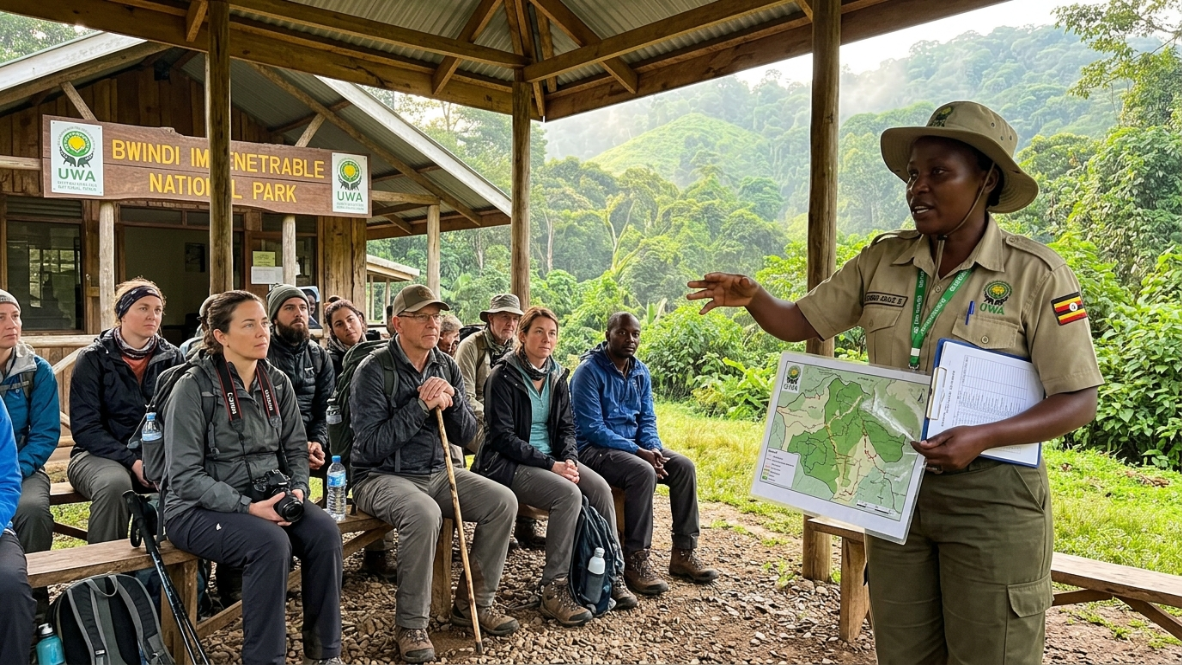
Every gorilla trekking day begins with a briefing at your sector’s headquarters, typically between 7:00 and 7:30 AM. Rangers explain the rules, assign trekking groups to specific gorilla families based on fitness levels, and introduce your guides. This is mandatory. Being late is not an option.
Gorilla Family / Group
A social unit of mountain gorillas, typically ranging from 8 to 25 members, led by a dominant silverback. Each habituated family has a name and a known home range, though gorillas move daily. Tracker teams head out at 5:00 AM to locate the family before trekkers even arrive at the briefing point. This advance tracking is why the trek success rate exceeds 98% in 2026.
Silverback
The dominant adult male in a gorilla family, recognizable by the silver-grey hair across his back. The silverback makes all major decisions for the group: where to feed, when to move, and how to respond to threats. During your trek, the silverback is usually the most visually striking individual you’ll encounter, and the one whose body language the rangers watch most closely.
Habituation Process
The multi-year process of gradually accustoming a wild gorilla group to the presence of humans. It typically takes 2 to 3 years of daily visits by trained rangers before a family is calm enough to receive tourists. Groups in the habituation process are the ones visited during the GHEX in Rushaga.
Porter
A local community member you can hire to carry your daypack and help you navigate difficult terrain. The cost is $15 to $25 per day, and the money goes directly to the porter. As one travel blogger put it: “For just $20 to $25 USD it makes the trek easier and directly supports the local community.” In the steeper sectors like Nkuringo and Ruhija, a porter is not a luxury. It’s a practical decision.
Need to know what to bring in that daypack? Here’s a gorilla trekking packing list.
Sedan Chair (“African Helicopter”)
For travelers with mobility limitations who still want to trek, four porters carry you through the forest in a specialized chair. This service costs between $300 and $500 and must be arranged in advance. It’s a real option, used regularly, and it opens gorilla trekking Bwindi sectors to people who might otherwise rule it out.
7-Meter / 10-Meter Rule
The minimum distance trekkers must maintain from gorillas. Historically set at 7 meters, UWA has tightened this to 10 meters in 2026 to reduce disease transmission risk. Rangers enforce this strictly. If a gorilla approaches you (which happens), you’re instructed to slowly back away. Flash photography is also prohibited. For the full breakdown of gorilla trekking safety rules, read our dedicated guide.
Tracker / Ranger
Two distinct roles. Trackers are the team that heads out before dawn to locate the gorilla family and radio back coordinates. Rangers are the armed UWA guides who accompany your trekking group, navigate the forest, and enforce park rules. You’ll typically have two rangers per group of eight trekkers.
Trekking Certificate
Issued after your trek as a souvenir. It names the gorilla family you visited, the date, and the sector. Not officially required for anything, but a nice memento.
Logistics and Planning Terms
Kihihi Airstrip
The nearest airstrip to the Buhoma sector, about one hour’s drive away. Charter flights from Entebbe or Kajjansi take roughly two hours. This is the most common air route for travelers skipping the 8 to 10 hour road journey from Entebbe.
Kisoro Airstrip
The nearest airstrip to Rushaga and Nkuringo, about one hour’s drive from either sector. Flights here are less frequent and more weather-dependent than Kihihi, so build buffer time into your schedule.
Cyanika Border
The preferred Uganda-Rwanda border crossing for reaching Rushaga and Nkuringo from Kigali. The drive from Kigali to Rushaga via Cyanika takes approximately 4 to 5 hours.
Katuna / Gatuna Border
The busiest Uganda-Rwanda crossing, best for reaching Buhoma and Ruhija from Kigali. Processing is generally smooth but can back up during holidays.
East Africa Tourist Visa (EATV)
A single $100 visa covering Uganda, Rwanda, and Kenya for 90 days. Essential for travelers combining gorilla trekking in Bwindi with safari time in Kenya or beach time at a Rwandan lodge. The application process and current rules are covered in our East Africa visa guide.
Time Zone Difference (Rwanda vs. Uganda)
One of the most common mistakes on the Kigali-to-Bwindi route: forgetting the time difference. Rwanda runs on Central Africa Time (CAT). Uganda runs on East Africa Time (EAT). Uganda is one hour ahead. If your morning briefing is at 7:00 AM Uganda time and you’re crossing from Rwanda, your phone may still show Rwandan time. Set an alarm. Missing the briefing means missing your trek.
Conservation Terms
Revenue Sharing
Twenty percent of gorilla permit fees go directly to communities surrounding Bwindi. This is not a vague promise. It’s a structured UWA program that funds schools, health clinics, and infrastructure in villages adjacent to the park. Revenue sharing is one of the core reasons local communities support conservation rather than resenting the park’s boundaries.
Bwindi-Sarambwe Ecosystem
Bwindi Impenetrable National Park in Uganda and the adjacent Sarambwe Nature Reserve in the DRC together form a contiguous gorilla habitat. Gorillas cross the border freely. Conservation management requires coordination between both countries.
Mountain Gorilla Census
Conducted every 5 to 10 years across the Bwindi-Sarambwe ecosystem and the Virunga Massif. The most recent completed census (2018) counted 1,063 mountain gorillas globally. A new Bwindi-Sarambwe census began in 2025, using two sweeps to reduce the chance of missing any individuals. Results will update the population figures used for all four gorilla trekking Bwindi sectors.
Batwa Community Experience
The Batwa are the indigenous forest-dwelling people who were relocated when Bwindi became a national park. Cultural tourism programs in the Buhoma and Nkuringo sectors offer guided visits where Batwa community members share their history, traditional practices, and relationship with the forest. It’s a meaningful add-on, especially in sectors where you might have a free afternoon.
Minimum Trekker Age
You must be at least 15 years old to participate in gorilla trekking in Bwindi. No exceptions. This applies across all four sectors and to both standard treks and the habituation experience. For families with younger children, the age rule is the first thing to check. Full details are in our gorilla trekking age limits article.
Choosing a Sector by Traveler Profile
Rather than declaring one “best” sector (a question every competitor tries to answer with a single name), the smarter approach is matching the sector to your specific situation.
You’re a first-time trekker over 50: Buhoma. The terrain is manageable, the infrastructure is proven, and treks often wrap up by late morning.
You’re a serious birder or wildlife photographer: Ruhija. The Albertine Rift endemics and the Bitukura family’s photogenic calm are hard to beat. Pack warm layers for the altitude.
You want the best odds of getting a permit in peak season: Rushaga. More families means more daily permits. It’s also the shortest drive from Kigali.
You want the habituation experience: Rushaga. It’s the only option.
You’re fit, experienced, and want solitude: Nkuringo. The ridge-to-valley treks are demanding, but you’ll share the forest with far fewer people.
You’re combining Bwindi with other Uganda parks: Buhoma. Its proximity to Queen Elizabeth and Kibale makes multi-park itineraries practical without excessive driving.
Ready to start building your itinerary? Explore Uganda gorilla safari trips with full pricing and sector-matched logistics.
Common Mistakes When Choosing a Bwindi Sector
Many first-time visitors accidentally choose the wrong sector because they focus only on gorilla numbers.
Avoid these common mistakes:
Booking accommodation before securing permits
Always confirm your trekking sector first. Lodges are often several hours apart.
Assuming every sector is equally easy
Nkuringo and Ruhija generally require more climbing than Buhoma.
Underestimating road travel
Driving between northern and southern sectors can take several hours on mountain roads.
Ignoring the Kigali route
If flying into Kigali, Rushaga and Nkuringo usually offer the shortest transfers.
Waiting too long during peak season
Permits for popular travel months often sell out several months in advance.
Frequently Asked Questions
Can I choose which gorilla trekking Bwindi sector my permit is for?
Yes, but availability varies by sector and season. Your operator requests a specific sector when booking your permit, and UWA confirms based on availability. Rushaga has the most daily permits, so it’s easiest to secure. Nkuringo, with only three families, is the tightest.
How far apart are the Bwindi sectors from each other?
Buhoma to Ruhija is roughly a one-hour drive. Buhoma to Rushaga or Nkuringo takes 3 to 4 hours by road. The southern sectors (Rushaga and Nkuringo) are close to each other but distant from the northern ones. You cannot realistically trek in one sector and sleep in another unless you’re prepared for a very early or very late drive.
Is the gorilla habituation experience worth the extra cost?
It depends on what matters to you. You get up to four hours instead of one, and the group is limited to four people instead of eight. But the semi-habituated gorillas may be more skittish. If calm, close encounters matter most, the standard trek with a fully habituated family can actually be more rewarding for some travelers.
Can I still book a gorilla permit directly with UWA as a foreign traveler?
No. As of March 1, 2026, all foreign travelers must book through a licensed Ugandan tour operator. Direct individual bookings with UWA are no longer accepted.
What happens if I’m not fit enough for the sector I’m assigned?
Rangers assess fitness during the morning briefing and assign gorilla families accordingly. Within a given sector, some families range closer to the trailhead than others. In Rushaga, for example, the wide selection of families gives rangers more flexibility. If you have serious mobility concerns, the sedan chair service ($300 to $500) is available with advance booking.
Which Bwindi sector is closest to Kigali, Rwanda?
Rushaga, at roughly 4 to 5 hours via the Cyanika border crossing. Remember the one-hour time zone difference when crossing from Rwanda into Uganda.
When is the cheapest time to go gorilla trekking in Bwindi?
April, May, and November, when the low-season permit discount drops the price from $800 to $600. Trails are wetter and drives take longer, but permit availability is better and lodges are less crowded.
Do I need a specific visa to visit multiple countries on my gorilla trek?
The East Africa Tourist Visa ($100) covers Uganda, Rwanda, and Kenya on a single 90-day permit. It’s the most practical option if you’re crossing borders.