

TL;DR
Groups need more lead time than couples or solo travelers. A group safari booking timeline is the structured sequence of planning milestones, from initial inquiry through departure, that a group follows to secure lodges, vehicles, permits, and flights for a shared safari. A group of 8 needing 4 rooms at a 10-tent camp immediately limits availability in ways that don’t apply to a couple booking one room. Add vehicle allocation, permit coordination, and the reality of aligning schedules across 6 to 20 people, and you can see why the timeline stretches.
Groups of 6 to 10 should start planning at least 6 to 9 months before travel. Groups of 12 or more need 9 to 12 months, sometimes longer for peak season or exclusive-use camps. The pre-booking phase (aligning dates, budget, and trip style within the group) can consume 1 to 3 months before an operator even gets involved. Start earlier than you think.
How Far in Advance Should You Book a Group Safari? A group safari in Tanzania should generally be booked 6–9 months before departure for groups of 6–10 people and 9–12 months ahead for groups of 12 or more. Groups traveling during peak season (June–October), visiting popular Great Migration camps, or requiring exclusive-use lodges should ideally start 12–18 months in advance. Smaller groups traveling during the green season may find suitable options with 2–5 months of planning.
The exact booking window depends on four factors:
-
Group size: More travelers require more rooms, vehicles, and coordinated reservations.
-
Travel season: Peak migration months and school holidays have higher accommodation demand.
-
Accommodation type: Small luxury camps and exclusive-use properties have limited inventory.
-
Special permits: Gorilla trekking and other limited-capacity activities may require earlier reservations.
Planning rule: Start discussing your safari with an operator before everyone has finalized their commitment. You can refine the itinerary and secure availability while the group completes its internal arrangements.
What Should You Book First for a Group Safari?
When organizing a group safari in Tanzania, prioritize the reservations that have the most limited availability. Accommodation, specialist camps, gorilla permits, and private safari vehicles should be addressed before less restrictive travel arrangements.
Booking in the correct order reduces the risk of confirming international flights before the safari itinerary is secured.
Recommended Booking Priority
|
Priority |
What to arrange |
Why it matters |
|---|---|---|
|
1 |
Travel dates and group size |
Establishes the basic requirements for the itinerary |
|
2 |
Safari operator and itinerary |
Determines routes, accommodation, transport, and overall cost |
|
3 |
Lodges and tented camps |
Small properties have limited room inventory |
|
4 |
Gorilla permits and special activities |
Limited daily allocations can restrict travel dates |
|
5 |
Safari vehicles and guides |
Larger groups may need multiple dedicated vehicles |
|
6 |
Domestic and regional flights |
Seat availability and luggage restrictions affect group logistics |
|
7 |
International flights |
Book once the ground itinerary and key reservations are confirmed |
|
8 |
Insurance, visas, and final preparations |
Complete individual travel requirements before departure |
Why Accommodation Should Be a Priority
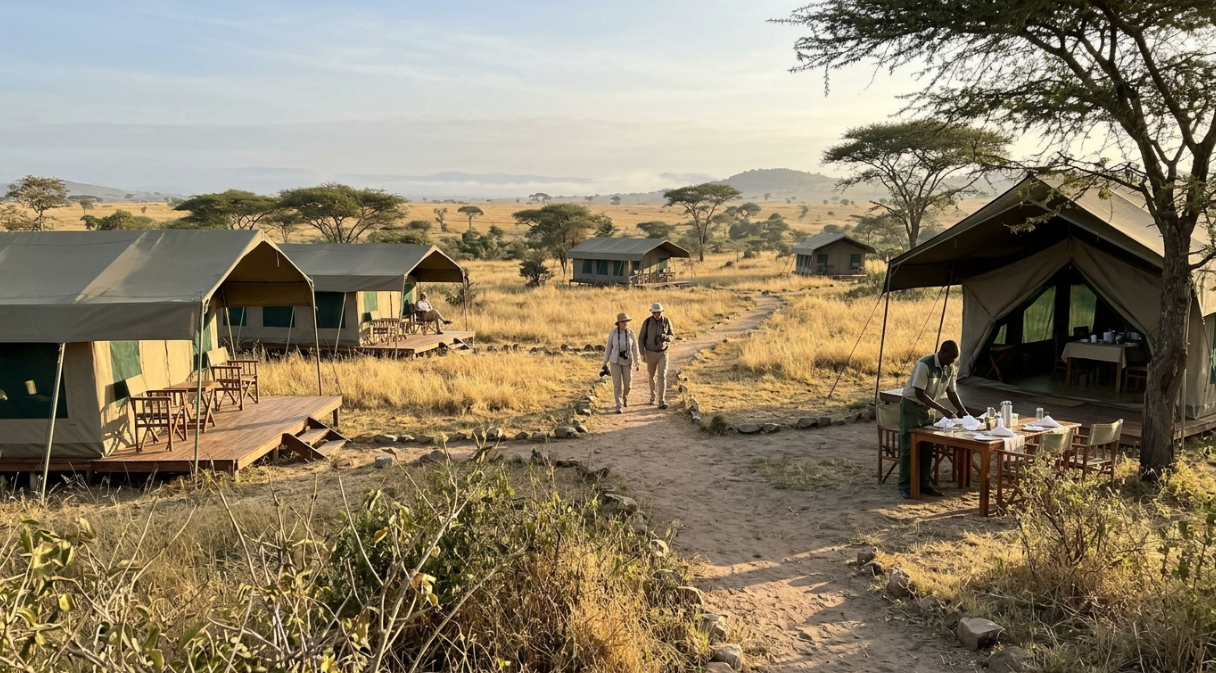
A group of eight travelers might require four double rooms at one property. If a camp has only ten tents, that single reservation occupies a substantial portion of its inventory.
This becomes particularly important in the northern Serengeti during Great Migration river-crossing season, when demand concentrates around a limited number of camps.
Why Special Permits Should Be Secured Early
Gorilla trekking permits and other limited-capacity activities can dictate the dates of an entire itinerary. If your group needs several permits on the same day, availability should be checked before committing to non-refundable flights.
Planning tip: Ask your safari operator to check accommodation and permit availability together rather than booking each component independently.
Group Safari Booking Timeline: Recommended Lead Times by Group Size
The ideal booking window for a Tanzania group safari depends on the number of travelers, travel season, and accommodation requirements. Larger groups should start earlier because they need more rooms, vehicles, and coordinated reservations.
|
Group size |
Green season (Apr–May, Nov) |
Shoulder season |
Peak season (Jun–Oct, Dec–Feb) |
|---|---|---|---|
|
4–6 travelers |
2–4 months |
4–6 months |
6–9 months |
|
6–10 travelers |
3–5 months |
6–8 months |
9–12 months |
|
12–20 travelers |
4–6 months |
6–9 months |
9–12 months |
|
20+ travelers |
6–9 months |
9–12 months |
12–18 months |
|
Exclusive camp buyout |
6–9 months |
9–12 months |
12–18 months |
These are recommended planning windows, not guaranteed availability deadlines. Specific camps, migration locations, room configurations, and group requirements can require earlier booking.
Additional planning considerations:
-
Great Migration river-crossing camps in the northern Serengeti may require 12–18 months of advance planning.
-
Groups needing multiple family suites or interconnected rooms should start earlier.
-
Gorilla trekking permits should ideally be secured 6–12 months ahead during popular travel periods.
-
Groups with flexible dates and accommodation preferences may find options with shorter lead times.
If you’re organizing a friends trip, the Tanzania group safari planning guide covers logistics beyond just the timeline.
What Is a Group Safari Booking Timeline?
A group safari booking timeline maps every milestone between “we should do this” and wheels-up at Kilimanjaro International Airport. It covers the pre-booking alignment phase (agreeing on dates and budget), operator engagement, deposit collection, permit applications, flight bookings, balance payments, and final confirmations.
The reason this timeline matters more for groups than for couples comes down to four compounding constraints:
Lodge capacity. Small camps in prime wildlife areas often have fewer than a dozen rooms. A group of 8 needing 4 rooms at a 10-room camp absorbs nearly half the property’s inventory on those dates. Practitioners on TripAdvisor report that popular camps in northern Serengeti sell out 12 to 18 months ahead for peak crossing dates.
How Group Size Affects Safari Vehicle Allocation
Safari vehicle allocation directly affects the cost, comfort, and logistics of a private group safari.
Most traditional Tanzania safari Land Cruisers are configured for up to six passengers, generally providing each traveler with a window seat. Larger groups therefore need multiple vehicles, each with its own driver-guide.
|
Group size |
Typical vehicle requirement |
Main consideration |
|---|---|---|
|
2–6 travelers |
1 vehicle |
One dedicated safari vehicle |
|
7–12 travelers |
2 vehicles |
Coordinated departures and guide communication |
|
13–18 travelers |
3 vehicles |
Multiple driver-guides and vehicle coordination |
|
19–24 travelers |
4 vehicles |
Larger accommodation and transport requirements |
Vehicle capacity depends on the operator's vehicle configuration, passenger luggage, and applicable seating arrangements.
Why Vehicles Should Be Confirmed Early
A group that requires three or four vehicles cannot always be accommodated by an operator at short notice.
The operator needs to coordinate:
-
Vehicle availability for the entire travel period.
-
Experienced driver-guides.
-
Park entry and vehicle logistics.
-
Airport and lodge transfers.
-
Communication between vehicles during game drives.
For larger groups, ask whether the vehicles will travel together throughout the itinerary or operate as separate subgroups.
Vehicle allocation. Private groups need dedicated 4x4 safari vehicles, typically seating a maximum of 6 passengers each. A 12-person group requires two or three vehicles, all with experienced driver-guides. These must be committed and crewed well in advance.
Permit bottlenecks. Gorilla trekking permits are limited to 8 per gorilla family per day. A solo traveler can sometimes find a last-minute permit. A group of 8 needing permits on the same date faces much tighter supply. Learn more about gorilla trekking permits and booking rules.
Payment coordination. Collecting deposits and balance payments from multiple people, each with different financial situations and timelines, is one of the most underestimated friction points in group travel.
Recommended Lead Times by Group Size
4 to 6 Travelers
This is the easiest group size to accommodate. You’ll need one or two vehicles and two to three lodge rooms. For green season travel, 3 to 5 months is often enough. For peak dry season (June through October) or festive holiday periods, aim for 6 to 9 months.
6 to 10 Travelers
The sweet spot for group safaris, but also where lodge constraints start to bite. A 6-month lead time is a reasonable minimum for travel in any season. For peak season, 9 months is safer. One TripAdvisor user shared that they contacted operators in January for August travel and found most accommodations were already full, forcing them to plan for the following year instead.
For groups of 10, the cost and vehicle planning guide for safaris of this size breaks down what to expect.
12 to 20 Travelers
Groups of 12 or more should target 9 to 12 months of lead time. At this size, you’re looking at three or four vehicles, potentially the entire inventory of a small camp, and complex logistics around internal flights (bush planes have weight and seat limits). Private camp buyouts, most common with groups of 12 to 20 people, typically require booking 9 to 12 months in advance.
This size range suits family reunions and large family safaris where multiple households are coordinating.
20+ Travelers (Corporate and Incentive Groups)
Corporate safari experiences should be booked 12 to 18 months in advance for optimal lodge availability and competitive pricing, especially for groups exceeding 15 participants or traveling during peak season. The logistics here go beyond just rooms and vehicles: you’re coordinating conference spaces, team-building activities, and often split-group itineraries where subgroups visit different parks on different days.
For corporate and incentive planners, the incentive travel planning guide covers the additional considerations unique to business groups.
How Season Affects the Group Safari Booking Timeline
Season is the single biggest modifier of how far ahead your group needs to act. Best Time to Book a Tanzania Group Safari by Travel Season
Different safari seasons create different accommodation and availability challenges. Groups should consider both wildlife conditions and booking demand when selecting departure dates.
|
Travel period |
Main safari considerations |
Group booking recommendation |
|---|---|---|
|
January–March |
Southern Serengeti calving season and high demand around Ndutu |
Start 9–12 months ahead |
|
April–May |
Long rainy season and generally lower visitor demand |
Start 2–6 months ahead |
|
June–October |
Dry season and Great Migration river-crossing demand |
Start 9–18 months ahead |
|
November |
Short rainy season and generally lower visitor demand |
Start 2–5 months ahead |
|
December |
Festive travel demand and holiday availability |
Start 9–12 months ahead |
These are general planning recommendations. Actual availability varies by destination, accommodation category, and specific departure dates.
One important editorial point: your current article groups December through February together as a peak period. I would distinguish December holiday demand from January–March calving-season demand because the reasons for high accommodation demand are different.
Also, March should not automatically be treated as equivalent to January and February. Rainfall and lodge availability can vary considerably during this transition.
Peak Dry Season (June to October)
This is the highest-demand window. Excellent wildlife viewing, minimal rain, and the Great Migration crossings in northern Serengeti all converge. Northern Serengeti camps at marquee crossing locations need 12 to 18 months for group bookings. Even standard Serengeti and Ngorongoro properties fill 9 to 12 months out for groups.
Calving Season (January to March)
Southern Serengeti camps near Ndutu, where wildebeest herds give birth and predators concentrate, run at high occupancy. Groups should plan 9 to 12 months ahead.
School Holidays and Festive Periods (December to February, July to August)
Family demand concentrates during these windows, and planning around school holidays requires 9 to 12 months for groups, particularly at family-friendly lodges with limited room configurations.
Green Season (April to May, November)
Fewer visitors, lower rates, and lush landscapes. The green season can often be booked with shorter lead times, sometimes 2 to 5 months even for mid-sized groups. This is the window where groups on tighter timelines still have realistic options.
Can You Book a Group Safari at the Last Minute?
Yes, it is possible to book a group safari in Tanzania with only a few months of preparation, but availability and itinerary flexibility become more important.
The shorter the booking window, the more likely your group will need to compromise on accommodation, travel dates, or safari routes.
Booking a Group Safari 6 Months Before Departure
Six months is a reasonable planning window for smaller groups and some mid-sized groups, particularly during the green season.
You may still find suitable accommodation in Tarangire, Lake Manyara, or other less heavily booked areas. However, popular northern Serengeti camps may already have limited availability during peak migration periods.
Booking a Group Safari 3 Months Before Departure
Three months is more challenging for private groups of six or more.
Your operator may need to:
-
Check alternative lodges and tented camps.
-
Adjust travel dates by several days.
-
Consider different Serengeti accommodation locations.
-
Use available vehicles rather than requesting specific configurations.
-
Rework the itinerary around confirmed accommodation.
Booking a Group Safari Less Than 30 Days Before Departure
Last-minute group safaris are possible when accommodation, vehicles, and guides are available.
However, groups should expect limited choices, particularly during peak season. Special activities involving limited permits may also be difficult to arrange.
Last-Minute Booking: What Can You Compromise On?
|
Requirement |
Flexibility recommendation |
|---|---|
|
Travel dates |
Consider shifting departure by 3–7 days |
|
Accommodation |
Accept alternative camps or lodges |
|
Safari route |
Consider less crowded destinations |
|
Room arrangements |
Be flexible with room configurations |
|
Vehicle arrangements |
Accept available vehicle allocations |
|
Special permits |
Check availability before confirming travel |
Important: Do not pay for non-refundable international flights until your operator has confirmed the essential ground arrangements and any limited-capacity activities.
Group Safari Booking Checklist: 18 Months to Departure
A successful group safari requires several planning milestones to happen in the correct order. Use this checklist to track reservations, payments, and travel preparations from the first group discussion to departure.
|
Timeline |
Planning task |
Completion goal |
|---|---|---|
|
18–15 months |
Agree on approximate dates, group size, and budget |
Establish the initial travel requirements |
|
15–12 months |
Contact safari operators and compare itineraries |
Select an operator and preferred route |
|
12–9 months |
Secure lodges, camps, vehicles, and special permits |
Confirm the main safari arrangements |
|
9–6 months |
Pay scheduled deposits and book international flights |
Confirm participation and transportation |
|
6–3 months |
Complete travel insurance, visa preparations, and health planning |
Prepare individual travelers |
|
3–2 months |
Pay outstanding balances and reconfirm reservations |
Finalize the financial arrangements |
|
2–1 months |
Collect passport details, distribute packing lists, and confirm transfers |
Complete group coordination |
|
1–2 weeks |
Review departure instructions, luggage limits, and emergency contacts |
Ensure everyone is ready |
|
Departure week |
Confirm airport transfers, flight details, and group communication |
Begin the safari |
Group Organizer's Pre-Departure Checklist
Before departure, the group coordinator should confirm:
-
Every traveler has a valid passport and required travel documents.
-
All accommodation reservations are confirmed.
-
Safari vehicles and driver-guides are allocated.
-
Special permits and activity reservations are secured.
-
International and domestic flights are confirmed.
-
Every traveler has appropriate travel insurance.
-
Outstanding balances have been paid.
-
Dietary requirements and accessibility needs have been communicated.
-
Emergency contacts and travel information have been distributed.
-
Everyone has received the final itinerary and packing instructions.
How Permits and Multi-Country Add-Ons Extend the Timeline
Adding gorilla trekking, a Kilimanjaro climb, or a Kenya extension to a group safari doesn’t just add days to the trip. It adds months to the planning timeline.
Gorilla Trekking Permits
Uganda charges $800 per permit; Rwanda charges $1,500. Only 8 permits are issued per gorilla family per day. For a group of 8, you need an entire family’s allocation for one day. During peak season (June to September, December to February), permits should be secured 6 to 12 months ahead. In practice, groups often need to apply at the very start of the planning process.
Kilimanjaro Group Climbs
Fixed-date group departures on popular routes fill months in advance. If your safari group includes a Kilimanjaro climb, the climb dates often anchor the entire trip timeline, with the safari built around them.
Kenya Extensions (Maasai Mara)
Adding a Maasai Mara extension to a Tanzania safari requires cross-border logistics, separate vehicle and guide arrangements, and additional flight bookings. This adds 2 to 4 weeks of coordination and should be finalized at the 9 to 12 month mark alongside the main safari itinerary.
Deposits, Payments, and Group-Specific Challenges
Industry Deposit Norms
Deposits across Tanzania-based safari operators range from 10% to 50% of the total trip cost. The most common range for private group safaris is 25% to 30%. Balance payments are typically due 28 to 90 days before departure, with 60 days being the most standard cutoff.
Group Safari Payment Timeline: When Is Each Payment Due?
Group safari payments are usually divided into an initial deposit and one or more subsequent payments before departure. The exact schedule depends on the safari operator, accommodation providers, and booking conditions.
|
Payment stage |
Typical timing |
Purpose |
|---|---|---|
|
Initial deposit |
At booking confirmation |
Secures the itinerary and reservations |
|
Intermediate payment |
According to the operator's payment schedule |
Covers accommodation and transport commitments |
|
Final balance |
Commonly 30–90 days before departure |
Settles the remaining safari cost |
|
Optional extras |
Before or during the safari |
Covers additional activities and personal expenses |
Why Group Deposits Should Be Collected Early
The group organizer should establish payment deadlines before confirming reservations.
A useful approach is to collect individual deposits before making a financial commitment to the safari operator.
This reduces the risk of one or two participants withdrawing after the group has already secured accommodation and vehicles.
For groups with multiple households, consider using a shared payment tracker showing:
-
Traveler's name.
-
Agreed trip cost.
-
Deposit amount.
-
Outstanding balance.
-
Payment deadline.
-
Confirmation status.
Important: Always communicate the operator's actual payment terms and cancellation policy to every participant before collecting deposits. Do not present one cancellation schedule as universal across all Tanzania safari operators.
Typical Cancellation Structure
Cancellation fees in the safari industry follow a sliding scale. A representative structure:
|
Cancellation Window |
Fee |
|---|---|
|
61+ days before departure |
Loss of deposit |
|
60 to 45 days |
25% of total cost |
|
44 to 29 days |
60% of total cost |
|
28 to 7 days |
90% of total cost |
|
Less than 7 days |
100% of total cost |
These percentages are per person, which matters for groups. If one member drops out at 30 days, that person may owe 90% of their share, and the remaining group may face vehicle or room reconfiguration costs.
Collecting Payments from Multiple People
This is the friction point that no glossy safari brochure mentions but every group organizer lives through. Practitioners in group travel communities recommend three specific tactics:
-
Set firm payment deadlines before collecting expressions of interest. People who know they’ll lose a deposit by a specific date make decisions faster.
-
Use deposits to confirm commitment. A paid deposit separates “I’d love to go” from “I’m going.”
-
Offer installment payments rather than one large lump sum. Spreading the cost over 3 to 4 payments between booking and departure reduces payment anxiety.
For a detailed look at managing group payments, the group safari payment planning guide walks through the process.
How to Choose a Safari Operator for a Large Group
Choosing the right safari operator is particularly important when organizing a private group safari. The operator must coordinate accommodation, vehicles, guides, payments, and travel arrangements for multiple participants without compromising the overall experience.
Before confirming a booking, compare operators using the following criteria.
|
Selection criteria |
What to look for |
|---|---|
|
Group experience |
Previous experience organizing groups of similar size |
|
Vehicle availability |
Enough dedicated 4x4 vehicles for the entire group |
|
Accommodation access |
Ability to secure multiple rooms at suitable lodges |
|
Itinerary planning |
Experience coordinating multi-park itineraries |
|
Payment arrangements |
Clear deposit schedules and payment deadlines |
|
Cancellation policies |
Written terms covering individual cancellations |
|
Communication |
One dedicated group coordinator |
|
Emergency support |
Clear procedures for delays, medical emergencies, and itinerary changes |
Questions to Ask Before Booking
Before paying a deposit, ask your safari operator:
-
Have you organized safaris for groups of our size before?
-
Can you confirm all required rooms at the same lodges?
-
How many travelers will share each safari vehicle?
-
Will each vehicle have a dedicated driver-guide?
-
What happens if one participant cancels?
-
Are the quoted prices fixed or subject to changes?
-
What is included in the initial deposit?
-
What happens if a lodge or internal flight becomes unavailable?
-
Who will be our main point of contact?
-
What emergency assistance is available during the safari?
A reliable operator should be able to explain these arrangements before the group commits financially.
Planning tip: Request one consolidated proposal covering the itinerary, accommodation, vehicle allocation, payment schedule, and cancellation conditions. This makes it easier for everyone in the group to compare options and make a decision.
Common Group Booking Mistakes
Five mistakes surface repeatedly in forums and operator feedback:
Booking international flights before the safari is confirmed. Cheap fares don’t help if the camps are full on those dates. Always confirm the ground itinerary first, then book flights.
Waiting for 100% group commitment before engaging an operator. The internal alignment phase can eat months while lodge availability evaporates. Contact an operator once you have a core group of committed travelers. Others can be added later if space permits.
Not naming a single group coordinator. Multiple people emailing an operator creates confusion, conflicting requests, and delays. Designate one person to handle all operator communication.
Underestimating the pre-booking phase. The 1 to 3 months spent deciding dates, budget, and trip style within the group is real time that counts against your booking window. Factor it in.
Assuming availability exists because “Africa has many lodges.” The safari properties worth visiting in prime locations are small by design. A camp with 10 tents in the northern Serengeti during August migration season is not the same as a 200-room hotel in a major city.
Group Joining Safari vs. Private Group Safari: Timeline Differences
These two trip types have fundamentally different booking timelines.
|
Factor |
Group Joining Safari |
Private Group Safari |
|---|---|---|
|
What it is |
Join strangers on a fixed-date, fixed-route departure |
Your group exclusively; custom itinerary, private vehicles |
|
Typical group size |
4 to 12 (mixed travelers) |
Your group only |
|
Booking lead time |
Weeks to 3 months |
6 to 18 months |
|
Deposit |
Often 10% to 15% |
Usually 25% to 30% |
|
Flexibility |
Low: fixed dates, routes, accommodations |
High: everything customizable |
|
Best for |
Budget travelers, solo travelers, last-minute plans |
Friends, families, celebrations, corporate groups |
|
Balance due |
30 to 45 days before departure |
60 to 90 days before departure |
Group joining safaris can be booked on much shorter notice because the operator has already committed to the vehicles, guides, and lodges. You’re filling a seat, not commissioning a trip.
For a deeper comparison, see the private vs. group safari guide.
When Are Lodge Rates Released for the Following Year?
This question comes up frequently on TripAdvisor, where one poster noted that some operators said they could book from 8 months out while others said 12 months, and a few said they could accept a deposit at any point.
The confusion is real but explainable. Most East African lodges release rates for the following calendar year between June and October. Some premium properties release rates as early as May. Operators with strong lodge relationships can often place provisional holds before rates are formally published, which is one reason to engage an experienced operator early rather than waiting for everything to be neatly priced out.
For groups, this means that if you’re planning travel in the second half of next year, reaching out to an operator 12 to 15 months ahead may mean initial conversations happen before rates are released. A good operator will scope the itinerary and place holds, then confirm pricing once rates publish.
FAQs
How far in advance should a group of 10 book a Tanzania safari?
For peak season (June through October), aim for 9 months minimum. For green season, 4 to 6 months may be sufficient. The biggest variable is your target camps: popular migration-area properties fill faster than parks like Tarangire or Ruaha.
Can we book a group safari 3 months before travel?
For a budget group joining safari or green season travel with flexible dates, sometimes yes. For a private group safari during peak season at specific lodges, almost certainly not. Three months is typically too late for groups of 6 or more during high-demand periods.
What happens if someone in our group cancels?
Cancellation fees apply per person according to the operator’s cancellation schedule. If the cancellation changes the vehicle or room configuration, there may be additional cost adjustments for the remaining group. Travel insurance that covers trip cancellation is strongly recommended for every group member.
Do we need a group coordinator?
Absolutely. One person should handle all communication with the operator, collect payments and passport details, distribute pre-trip information, and make decisions when the group can’t reach consensus. Without a coordinator, response times stretch, details fall through cracks, and operators spend time managing group dynamics instead of trip logistics.
Should we book gorilla permits before or after confirming the safari?
Ideally, simultaneously. Gorilla permit availability (especially for groups needing multiple permits on the same date) can be the bottleneck that dictates your travel dates. Confirm the safari itinerary and apply for permits at the same time, rather than sequencing them.
How does a multigenerational group affect the timeline?
Multigenerational groups often need more time because of differing comfort levels, activity interests, and mobility requirements. Room configurations at family-friendly lodges are more limited than standard rooms. Plan to start the process 9 to 12 months out regardless of season. The multigenerational safari planning guide covers how to align everyone’s expectations.
If your group is forming and you want to understand what’s realistic for your dates, group size, and budget, Duma Explorer designs private group itineraries with the kind of consultative process that handles multi-room logistics, vehicle planning, and permit coordination from the start.