

Multigenerational Safari Tanzania 2026: 35 Key Terms
TL;DR
A multigenerational safari in Tanzania brings three or more generations together (grandparents, parents, and children) across the Northern Circuit parks. Planning one well requires understanding about 35 specific terms, from age-bracket park fees and vehicle splits to pacing strategies and lodge age restrictions. This glossary defines every concept you’ll encounter between your first search and final booking, with the practical context needed to make confident decisions for travelers ranging from toddlers to grandparents.
A multigenerational safari involves three or more generations of a family, typically grandparents, parents, and children, traveling together to experience wildlife in Africa. It is not the same as a “family safari,” which usually means two generations. The wider age spread changes everything: lodge selection, daily pacing, vehicle configuration, activity choices, and budgeting all become more complex.
Tanzania is one of the strongest destinations for this trip type. The Northern Circuit’s game-drive format keeps everyone seated in a vehicle during wildlife viewing, which works for a five-year-old and a seventy-year-old equally well. The parks cluster within reasonable driving distances of each other. And the accommodation range, from exclusive-use villas to interconnecting family tents, gives groups the shared time and private space that three generations need.
This glossary covers the 35+ terms you’ll encounter while planning. Rather than alphabetical order, the terms are grouped by planning stage so you can read straight through as a decision-making guide or jump to the category that matters most right now.
For a broader look at family trip options across East Africa, see the family safari planning guide.
What Is a Multigenerational Safari in Tanzania? A multigenerational safari in Tanzania is a private or small-group wildlife trip designed for three or more generations, usually grandparents, parents, and children. The itinerary should account for different ages, mobility levels, activity interests, accommodation requirements, and travel tolerances. Key planning decisions include private vehicles, lodge age restrictions, daily driving time, internal flights, rest days, park fees, and child-friendly activities. For most families, a slower private itinerary through Tarangire, Ngorongoro, and the Serengeti provides more flexibility than a fixed group safari.
What Makes a Multigenerational Safari Different?
A multigenerational Tanzania safari has to accommodate more variation in age, physical ability, sleep schedules, interests, and comfort levels than a typical family safari. The goal is not simply to find child-friendly accommodation. The entire itinerary needs to work for grandparents, parents, and children at the same time.
|
Planning Factor |
Typical Family Safari |
Multigenerational Safari |
|---|---|---|
|
Ages |
Usually parents and children |
Often grandparents, parents, and children |
|
Pacing |
Can follow a standard itinerary |
Usually benefits from slower pacing |
|
Vehicle |
One vehicle may be sufficient |
Larger groups may require multiple vehicles |
|
Accommodation |
Family room may work |
Multiple rooms or private-use properties may be preferable |
|
Activities |
Primarily child-focused |
Needs options for different generations |
|
Mobility |
Usually fewer accessibility concerns |
Vehicle access, walking distances, and room location matter more |
|
Rest |
Fewer dedicated recovery periods |
Rest days can be valuable |
|
Transfers |
Road transfers may be acceptable |
Flights can reduce fatigue on long routes |
|
Planning |
Standard family itinerary may work |
Custom planning is often more practical |
The biggest difference is flexibility. A three-generation group may need to split activities temporarily, shorten a game drive, change meal times, or use different transportation without disrupting the rest of the trip.
How to Plan a Multigenerational Tanzania Safari
Start with the people rather than the parks. Before choosing an itinerary, determine the ages, mobility requirements, preferred activity levels, accommodation needs, and tolerance for long road transfers.
Use this sequence:
-
List every traveler and age. Age affects park fees, lodge restrictions, activity eligibility, and sometimes accommodation.
-
Identify mobility requirements. Note walking limitations, stairs, vehicle-access concerns, and preferred room locations.
-
Set the group's pace. Decide how many early mornings, long drives, and full-day game drives everyone can comfortably handle.
-
Choose the vehicle configuration. Larger groups may need two or more vehicles.
-
Check accommodation age policies. Confirm minimum-age requirements before selecting camps.
-
Decide where flying makes sense. Consider internal flights when road transfers would create excessive fatigue.
-
Build in recovery time. A rest day can make a longer safari more manageable.
-
Choose activities by age. Game drives can involve the whole family, while walking safaris and other activities may have age restrictions.
-
Calculate the full cost. Include accommodation, park fees, vehicles, flights, activities, and applicable child rates.
-
Confirm current rules before booking. Park fees, visa requirements, lodge policies, and activity age limits can change.
35 Multigenerational Tanzania Safari Terms at a Glance
|
Category |
Term |
Why It Matters |
|---|---|---|
|
People |
Multigenerational safari |
Trip involving three or more generations |
|
People |
Trip organizer |
Person responsible for collecting family requirements |
|
People |
Private guide |
Dedicated driver-guide who can adapt the itinerary |
|
People |
Vehicle split |
Determines how larger families divide vehicle costs |
|
Accommodation |
Family tent |
Connected or shared accommodation designed for families |
|
Accommodation |
Family suite |
Multiple sleeping areas within a lodge or suite |
|
Accommodation |
Exclusive-use villa |
Private property reserved for one family group |
|
Accommodation |
Age restriction |
Determines whether children can stay at a specific camp |
|
Accommodation |
Child rate |
Discounted accommodation pricing based on age |
|
Accommodation |
Triple or extra bed |
Determines whether rooms can accommodate larger families |
|
Activities |
Kids' program |
Structured activities designed for younger travelers |
|
Costs |
PPPD |
Per-person-per-day pricing used by safari operators |
|
Costs |
Park conservation fee |
Entry or conservation charge associated with park visits |
|
Costs |
Child park fee bracket |
Age-based park pricing for children |
|
Costs |
Crater descent fee |
Vehicle-related fee associated with Ngorongoro Crater |
|
Costs |
Concession fee |
Additional charge associated with camps in protected areas |
|
Transport |
Internal flight |
Light-aircraft transfer between safari destinations |
|
Itinerary |
Northern Circuit |
Route connecting Tanzania's major northern safari areas |
|
Itinerary |
Pacing |
Matching travel speed to the family's needs |
|
Itinerary |
Rest day |
Scheduled recovery day without a major transfer |
|
Itinerary |
Drive time |
Time spent traveling between destinations |
|
Itinerary |
Game-drive time |
Time spent actively viewing wildlife |
|
Itinerary |
Fly-in safari |
Safari reached partly by light aircraft |
|
Extension |
Zanzibar extension |
Beach portion added after the safari |
|
Planning |
Recommended trip duration |
Helps determine how many parks can realistically fit |
|
Wildlife |
Game drive |
Vehicle-based wildlife viewing |
|
Wildlife |
Walking safari |
Guided wildlife experience on foot |
|
Wildlife |
Hot-air balloon safari |
Dawn balloon experience over the Serengeti |
|
Wildlife |
Cultural visit |
Visit focused on local communities and culture |
|
Wildlife |
Great Migration |
Seasonal movement of large herbivore herds |
|
Wildlife |
Big Five |
Lion, leopard, elephant, rhinoceros, and Cape buffalo |
|
Safety |
Malaria prophylaxis |
Preventive medication planning for malaria risk |
|
Safety |
Altitude |
Important consideration around the Ngorongoro highlands |
|
Accessibility |
Vehicle access |
Getting safely into and out of safari vehicles |
|
Logistics |
Comfort stops |
Planning restroom breaks during drives |
|
Booking |
Custom safari |
Itinerary designed around the family's requirements |
|
Booking |
Local ground team |
Tanzania-based staff supporting the trip |
|
Booking |
Private vs. group safari |
Determines flexibility, privacy, and pricing structure |
|
Documents |
Tanzania e-Visa |
Entry documentation that travelers may need |
|
Insurance |
Travel insurance |
Coverage consideration for multiple age groups |
People and Group Structure
Multigenerational Safari
Three or more generations traveling together on a wildlife safari. The defining characteristic is the age spread. When your group includes a six-year-old and a sixty-two-year-old (as one Duma Explorer trip did for a family of 13 members), the planning can’t follow a standard template. Every decision, from which parks to visit to how long you spend in the vehicle each day, must account for the youngest child’s attention span, the grandparents’ mobility, and the parents’ desire to actually see wildlife rather than manage logistics.
The key distinction from a two-generation family safari: you’re balancing three different sets of physical capabilities, interests, and comfort thresholds simultaneously.
Trip Organizer
The family member who takes point on planning. This is usually a parent or an adult child of the grandparents. The trip organizer’s job is to collect critical information from every generation before contacting an operator: mobility limitations, dietary requirements, medication schedules, passport expiration dates, activity interests, and budget expectations.
A practical tip: create a shared document where each household fills in their details. This prevents the trip organizer from becoming a bottleneck and ensures the safari designer has accurate information from the start.
Private Guide (Driver-Guide)
A guide dedicated exclusively to your family group for the duration of the safari. This person drives the vehicle, interprets wildlife behavior, manages timing, and adapts the day’s plan based on how the group is feeling. For a multigenerational Tanzania safari, a private guide is not a luxury upgrade but a planning necessity. When a grandparent needs an earlier return to the lodge, or a child is restless after two hours, the guide can adjust without affecting anyone outside the family.
The quality of guiding varies enormously across operators. Advanced training programs like FGASA certification and EcoTraining produce guides who do more than point at animals. They read animal behavior, manage group energy, and know when to push forward versus when to call it a day.
Vehicle Split
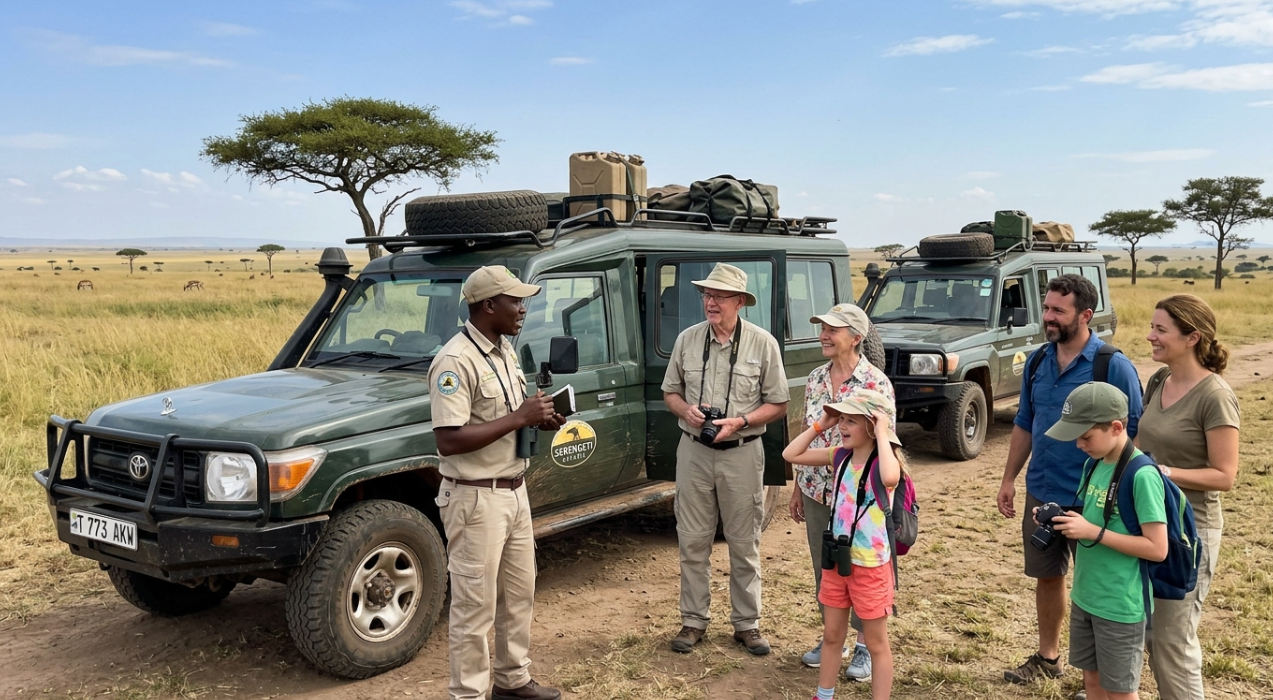
Modified Land Cruisers used on Tanzania safaris accommodate a maximum of 6 to 7 passengers. When a multigenerational group exceeds this, a second vehicle is required. This changes the cost structure significantly.
Here’s the math that matters: a private vehicle costing $200-$300 per day works out to $33-$50 per person when six passengers share it. The same vehicle with only two passengers costs $100-$150 per person. Larger multigenerational groups actually benefit from economies of scale, but they need to account for the second vehicle’s cost.
Beyond cost, two vehicles offer a practical advantage. Grandparents who want a shorter game drive can return to the lodge while parents and older children continue. Different generations can pursue different activities on the same morning. For more on safari vehicle types and configurations, see the dedicated guide.
Accommodation Terms
Family Tent and Family Suite
A family tent is a semi-permanent canvas structure with interconnected sleeping areas, typically accommodating up to four adults and two children. A family suite is the hard-walled equivalent inside a lodge building. Both give parents and children proximity without sharing one room.
The practical difference: family tents feel more “safari” (canvas walls, sounds of the bush at night, closer to nature), while family suites offer more insulation, usually better climate control, and sturdier bathroom fixtures. For multigenerational groups, the choice often depends on how adventurous the grandparents are.
Exclusive-Use Villa (Safari House)
An entire property, complete with its own guide, chef, and vehicle, booked for one family group. This is the gold standard for multigenerational Tanzania safaris with 8 or more travelers. The family gets shared meals and communal spaces for togetherness, plus separate bedrooms and living areas for each generation’s privacy.
Exclusive-use properties also offer schedule flexibility that standard lodges can’t match. Meal times shift to suit your group. Game drives start when you want them to. A grandmother who needs a late morning can have breakfast at her own pace while the teenagers head out at dawn.
Age Restriction (Minimum Age)
Most tented camps and safari lodges enforce minimum age policies, typically requiring children to be at least 8 to 12 years old. This is the single most common surprise for families planning a multigenerational trip with young grandchildren.
Some properties waive age restrictions when booked on an exclusive-use basis, since the only guests affected are your own family. Always confirm age policies before booking. A beautiful lodge that won’t accept your four-year-old is worthless to the itinerary.
If your group spans toddlers to grandparents, matching lodge policies to everyone’s ages is genuinely complex.
Duma Explorer’s trip designers can cross-reference your family’s ages against current lodge availability and build a route that works for everyone. Explore family safari packages to start the process.
Child Rate (Accommodation)
Many safari camps offer discounted or complimentary rates for children sharing their parents’ room. The age cutoffs vary by property. Some extend child rates up to age 16, others up to 21. These discounts can meaningfully reduce the overall cost of a multigenerational trip, but the policies differ from lodge to lodge, which makes comparison shopping without an operator’s help quite tedious.
Triple or Extra Bed
Not every safari tent or suite can physically accommodate a third bed. For multigenerational groups, room configuration is a puzzle that needs solving early. A family of five sharing two rooms requires confirmation that one room can take an extra bed. A group of three grandparents needs clarity on whether triple-occupancy rooms exist at the chosen camps.
Kids’ Program (Junior Ranger)
Structured children’s activities offered by some lodges, including guided nature walks, animal-tracking exercises, bug collecting, bark rubbing, and age-appropriate educational content. Some programs provide each child with a backpack of activities.
These programs serve a dual purpose: they give children a safari experience designed for their attention span, and they give parents and grandparents time for adult activities like a guided bush walk or simply a quiet cup of coffee on the veranda.
What Determines the Cost of a Multigenerational Tanzania Safari?
The cost of a multigenerational Tanzania safari depends on the number of travelers, accommodation level, season, itinerary length, vehicle configuration, park fees, domestic flights, and optional activities. A per-person quote can also become misleading for larger families because some expenses, such as vehicles and guides, are shared across travelers.
|
Cost Factor |
Why It Matters |
|---|---|
|
Number of travelers |
Shared vehicle and guide costs can change the per-person price |
|
Number of rooms |
Three generations may require several rooms or a private-use property |
|
Accommodation level |
Luxury camps and exclusive-use properties can substantially increase the budget |
|
Safari length |
More days increase accommodation, park, guide, and transport costs |
|
Season |
Rates can vary depending on travel dates and demand |
|
Vehicle configuration |
Larger families may require more than one vehicle |
|
Internal flights |
Flying can reduce road-transfer time but adds transportation costs |
|
Park fees |
Charges can vary by park, traveler age, residency status, and current regulations |
|
Optional activities |
Balloon flights, walking safaris, and cultural experiences may add to the total |
|
Zanzibar extension |
Adding a beach stay increases both accommodation and transportation costs |
Treat published prices as planning ranges rather than guaranteed rates. Always confirm the current operator quote and applicable park, accommodation, and activity fees for your exact dates and traveler ages.
PPPD (Per Person Per Day)
The standard pricing unit across the safari industry. When an operator quotes $450 PPPD, that means $450 per person for each day of the safari. For a family of six on a seven-day trip at $450 PPPD, the math is $450 × 6 × 7 = $18,900. Group size is the single biggest variable in PPPD calculations, which is why multigenerational groups that fill vehicles and rooms efficiently can achieve better per-person value than couples traveling alone.
Typical ranges for Tanzania: group safaris run $150-$350 PPPD, while private tailor-made safaris start around $350-$600 PPPD. For a detailed breakdown, see the Tanzania safari cost guide.
Park Conservation Fee
A fixed daily charge paid to Tanzania National Parks Authority (TANAPA) for each visitor entering a national park. For most Northern Circuit parks, the adult conservation fee is approximately $60 per person per day. This fee applies regardless of whether you’re on a group or private safari. It’s built into most operators’ quoted prices but worth understanding because it’s a non-negotiable cost that scales linearly with group size and trip length.
Child Park Fee Bracket
Tanzania’s national parks use a tiered fee structure based on age:
|
Age Range |
Fee Status |
|---|---|
|
Under 5 |
Free of charge |
|
5 to 15 |
Approximately 50% of adult rate |
|
16 and older |
Full adult rate |
In the Serengeti specifically, the non-resident adult entry fee is approximately $83 per 24 hours during peak season, while children aged 5-15 pay around $24. These brackets matter for multigenerational budgeting. A group with three children under five saves hundreds of dollars in park fees alone over a week-long safari.
Crater Descent Fee
A per-vehicle charge of approximately $295 to enter the Ngorongoro Crater floor. This is not a per-person fee, which makes it another cost where multigenerational groups benefit from traveling together. For a vehicle carrying six passengers, the descent fee works out to roughly $49 per person. For a couple in their own vehicle, it’s about $148 per person.
More on planning a crater visit in the Ngorongoro Crater safari guide.
Concession Fee
A nightly charge for lodges and camps located inside national park boundaries, paid to the park authority on top of the lodge’s own rates. This fee is usually incorporated into the accommodation price you’re quoted, but it’s worth knowing about because it explains why camps inside parks cost more than those on the periphery. The trade-off: camps inside the park put you closer to wildlife and eliminate early-morning gate queues.
Internal (Domestic) Flight
A charter or scheduled light-aircraft flight between parks or between Arusha and a remote park. The most common use in multigenerational itineraries is flying one direction between Arusha and the Serengeti. The drive takes 7-8 hours over rough roads. A flight takes about 90 minutes.
Flying in one direction helps reduce travel fatigue, which is especially valuable for elderly travelers. The trade-off is cost: internal flights add meaningfully to the budget. But for a grandparent with back problems or a toddler who can’t sit still for eight hours on a bumpy road, the flight can be the difference between enjoying the trip and enduring it.
Itinerary and Pacing Terms
Northern Circuit
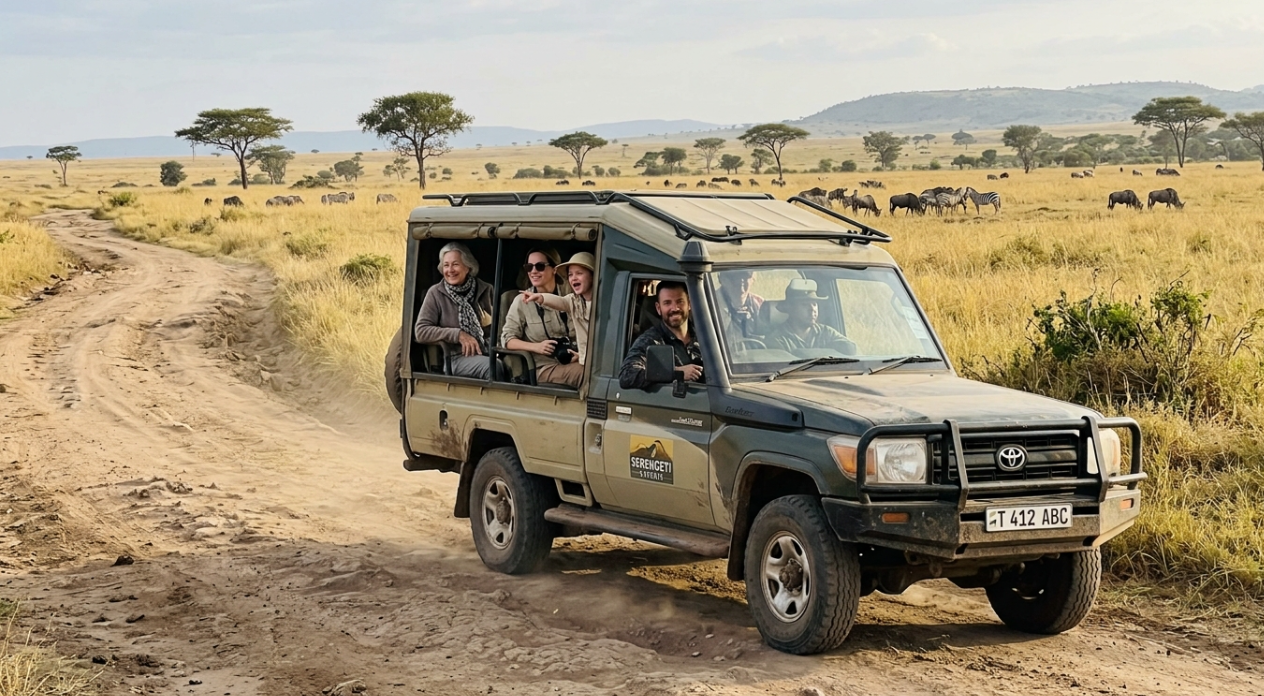
Tanzania’s most popular safari route, connecting a cluster of parks accessible from Arusha: Tarangire, Lake Manyara, Ngorongoro Crater, and the Serengeti. Most multigenerational Tanzania safaris follow some version of this circuit because the parks offer distinct ecosystems within manageable driving distances.
Typical driving times: Arusha to Tarangire is about 2.5 hours. Tarangire to Ngorongoro is roughly 3-4 hours. Ngorongoro to the Serengeti is about 3-4 hours depending on which part of the Serengeti you’re heading to. For a full route overview, see the Tanzania safari itinerary planning guide.
For first-time safari families, Tarangire makes an excellent starting park because its enormous elephant herds and baobab-studded landscape deliver immediate visual impact with a relatively short drive from Arusha.
Which Tanzania Parks Work Well for Multigenerational Safaris?
Different parks solve different planning problems. For a multigenerational trip, the best itinerary is usually the combination that balances wildlife variety with manageable transfers and an appropriate pace.
|
Destination |
Why Families Consider It |
Planning Consideration |
|---|---|---|
|
Tarangire |
Elephants, varied landscapes, relatively accessible from Arusha |
Useful for beginning a safari without an immediate long transfer |
|
Ngorongoro |
High-density wildlife and dramatic scenery |
High elevation around the crater rim can matter for some travelers |
|
Serengeti |
Extensive wildlife viewing and Great Migration opportunities |
Distance from Arusha makes the road transfer longer |
|
Lake Manyara |
Compact park with varied habitats |
Can work as a shorter stop depending on current conditions and itinerary |
|
Northern Serengeti |
Migration and river-crossing opportunities during the appropriate season |
Longer routing and seasonal planning are important |
Rather than choosing parks solely by reputation, compare each destination against the group's ages, mobility, desired wildlife experiences, travel dates, and tolerance for long transfers.
Pacing
The deliberate calibration of driving time, game-drive duration, rest days, and transfer method to suit the needs of everyone in the group. In practice, pacing means designing the itinerary around the person who needs the most accommodation, whether that’s a grandparent with limited mobility or a four-year-old who hits a wall after two hours in a vehicle.
One reviewer of a Duma Explorer multigenerational trip noted that the trip designer “planned the perfect safari with the right amount of days at each park and listened to what type of accommodations we needed (not so high end that we didn’t feel like we were on a safari and not so basic that the kids wouldn’t want to return to Africa when they got older).” That’s pacing in action: it’s not just about speed but about matching every element to the family’s real composition.
The goal is not to fit every famous park into one trip. It is to build a safari that grandparents, parents, and children can all enjoy without fatigue.
Rest Day (Down Day)
A non-driving day built into the itinerary, usually at a lodge with a pool, spa, or on-site wildlife viewing. Standard safari itineraries rarely include rest days because they’re designed for fit adults trying to maximize park time. Multigenerational itineraries need them.
A rest day at a Serengeti lodge, for example, lets grandparents sleep in and read on the veranda while teenagers swim and parents do an early-morning game drive. Everyone recharges. The trip doesn’t become a forced march from park to park.
Drive Time vs. Game-Drive Time
Two very different things. Drive time is the transit between locations (Arusha to Tarangire, for example). This is functional travel over sometimes rough roads, and it’s the part that tires people out. Game-drive time is the slow, meandering, stop-when-you-see-something wildlife viewing inside the park. This is the purpose of the trip.
Good multigenerational itinerary design minimizes drive time and protects game-drive time. Bad design packs so many parks into a week that half the trip is spent on transit roads.
Fly-In Safari
Reaching a park (especially the Serengeti) by light aircraft instead of driving. For multigenerational groups with elderly travelers, a fly-in can eliminate the most physically demanding segment of the trip. Practitioners on Reddit who’ve planned Tanzania safaris for elderly parents specifically recommend considering charter flights between rougher transfer sections, noting that the added cost is worth the comfort.
Zanzibar Extension
A beach add-on after the safari portion, typically three to five days on Zanzibar’s coast. For multigenerational groups, this serves as a decompression phase: a softer finish after the intensity of early mornings and long game drives. Children can swim and play on the beach. Grandparents can rest. Parents can exhale.
Families wanting to combine Serengeti time with a Zanzibar wind-down can ask Duma Explorer to map the routing, internal flights, and rest days around their group’s age range and pace. See how a safari and Zanzibar extension works.
How Many Days Do You Need for a Multigenerational Tanzania Safari?
A practical multigenerational Tanzania safari often needs enough time to visit two or three destinations without turning every day into a transfer day. The right duration depends on the group's ages, tolerance for road travel, and whether Zanzibar or another extension is included.
|
Safari Length |
Best Use |
|---|---|
|
3–4 days |
Short introduction focused on one or two nearby destinations |
|
5–6 days |
Compact Northern Circuit itinerary |
|
7–9 days |
More relaxed itinerary with multiple safari areas |
|
10+ days |
Extended safari with additional parks, more rest, or a Zanzibar extension |
For three-generation groups, adding days can sometimes improve the experience more than adding destinations. Extra time can be used for a rest day, shorter game-drive days, or a slower transfer schedule rather than simply adding another park.
Wildlife and Activity Terms
Game Drive
Vehicle-based wildlife viewing and the core activity of any Tanzania safari. Passengers sit in a modified 4x4 with a pop-up roof for photography and viewing. Game drives suit all ages and mobility levels because everyone remains seated. Morning drives typically leave at 6:00-6:30 AM and return by noon. Afternoon drives run from about 3:30 PM to sunset.
For multigenerational groups, the private guide’s role during game drives is critical. A good guide reads the group, knows when children are getting restless, and can turn a long search for a leopard into an impromptu lesson about dung beetles when attention spans are fading.
Walking Safari
A guided, on-foot wildlife walk, usually 2-3 hours long. Walking safaris typically require participants to be at least 12 years old. They’re excellent for tweens and teenagers who need to burn off energy and experience the bush at ground level. They are not suitable for young children or travelers with significant mobility limitations.
A Duma Explorer family with two teenagers incorporated a walking safari at Arusha National Park as their first activity before heading to the Serengeti, a smart way to get the kids engaged physically before days of vehicle-based viewing.
Hot-Air Balloon Safari
An early-morning flight over the Serengeti, launching at dawn and drifting over the plains for approximately one hour. This is often the single most memorable activity for a multigenerational group, something everyone talks about for years. The minimum age is typically 7 years old. Cost runs approximately $500-$600 per person. Not every family member needs to participate; grandparents who aren’t comfortable with the balloon can do a morning game drive and meet the rest of the family for the champagne bush breakfast that follows the flight.
Cultural Visit (Maasai Village, Mto wa Mbu)
A guided visit to a local community, often a Maasai village near the Northern Circuit parks or the multicultural town of Mto wa Mbu near Lake Manyara. Cultural visits are engaging for every age group and provide a break from vehicle time. Children are fascinated by Maasai jumping dances. Grandparents appreciate the human connection. Parents value the context it gives to the landscape.
Great Migration
The annual movement of approximately 1.5 million wildebeest and over 400,000 zebra across the Serengeti-Mara ecosystem. The migration follows rain patterns, meaning the herds are in different locations depending on the month. River crossings in the northern Serengeti (typically July through October) are the most dramatic spectacles. One Duma Explorer family saw a wildebeest crossing of the Mara River on the very first afternoon of their safari.
Calving season in the southern Serengeti (January through March) offers a different but equally compelling experience: hundreds of thousands of newborn calves, with predators in high concentration. For detailed monthly timing, consult the best time for Tanzania safari guide.
Big Five
Lion, leopard, elephant, rhinoceros, and Cape buffalo. The classic wildlife checklist, dating to the colonial hunting era but now used for photographic safari goals. Tanzania’s Northern Circuit covers all five species. The Ngorongoro Crater is particularly reliable for Big Five sightings in a single day due to its enclosed ecosystem.
Safety, Health, and Logistics Terms
Malaria Prophylaxis
Tanzania sits within Africa’s malaria belt, making antimalarial medication a planning essential for every family member. This is especially important in multigenerational groups because the right prophylaxis depends on age, weight, existing medications, and health conditions. A drug that works well for a healthy parent may be contraindicated for a grandparent on blood thinners or inappropriate for a young child. Consult a travel medicine specialist at least six weeks before departure. The CDC’s Tanzania traveler health page provides current recommendations.
Some operators don’t recommend traveling with children under 6 specifically because of malaria risk. This is a legitimate concern worth discussing with both your doctor and your safari operator.
Altitude (Ngorongoro Crater Rim)
The Ngorongoro Crater rim sits at over 2,200 metres (7,200 feet). Lodges on the rim can feel surprisingly cold in the mornings and evenings, which catches many travelers off guard after warm days on the Serengeti plains. More importantly, the altitude matters for elderly travelers with cardiovascular or respiratory conditions. Mild altitude effects (shortness of breath, headache, disrupted sleep) are possible, especially on the first night. Families with at-risk members should discuss the Ngorongoro portion of their itinerary with their doctor.
Step Stool and Vehicle Access
For less-mobile guests, the biggest practical challenge is getting in and out of the high 4x4 safari vehicle. A steady arm from the guide, level ground for parking, enough time (no rushing), and a step stool all help. A Reddit thread about planning a Tanzania safari with elderly parents recommended requesting front or middle-row seats for grandparents, confirming a step stool is available, and avoiding the rougher rear seats entirely. Walk-in showers, flat pathways, and ground-floor rooms at lodges are equally important details to confirm.
An operator who proactively addresses these details, before you ask, signals that they understand what a multigenerational trip with senior travelers actually requires.
Comfort Stops
Restroom availability along game-drive and transit routes. Comfort stops are not a luxury detail. For many older travelers, restroom timing determines whether a game drive feels relaxed or stressful. Inside national parks, restroom facilities are limited to designated picnic sites and park gates. Ask your operator about restroom availability on the specific routes planned for your itinerary. A good private guide knows every restroom between Arusha and the Serengeti and plans accordingly.
Travel Insurance (Multigenerational)
Every traveler needs coverage, but multigenerational groups face a specific challenge: policies must cover all age ranges in the party. Elderly travelers may need enhanced medical evacuation coverage. Pre-existing conditions must be declared. Some insurers impose age limits or surcharges for travelers over 70 or 75. Purchasing separate, age-appropriate policies for each generation is sometimes more practical than trying to find a single family plan.
E-Visa and Tanzania Visa
All visitors to Tanzania require a visa, obtainable online through the Tanzania Immigration e-visa portal. Passports must be valid for at least six months beyond the travel date. For families with children, note that children’s passports typically require renewal every five years, so check expiration dates early. Processing times vary, so apply well in advance. More details in the Tanzania visa requirements guide.
Booking and Operator Terms
Custom (Tailor-Made) Safari
An itinerary designed specifically for your family’s ages, interests, dates, and budget. This is the standard format for multigenerational travel because off-the-shelf packages almost never accommodate the age-range diversity of a three-generation group. A custom itinerary accounts for lodge age restrictions, vehicle configuration, pacing, internal flights, rest days, and activity age minimums simultaneously.
A seven-day mid-range safari for a family of four typically costs between $9,000 and $13,500. Larger multigenerational groups of 8-12 can see better per-person economics due to shared vehicle and guide costs, though they’ll need multiple rooms and possibly multiple vehicles.
Operator With Local Ground Team
An operator with offices and staff physically based in Tanzania, not a booking agent working from another country. This distinction matters for multigenerational trips because things change: a grandparent might need a different room configuration on arrival, a child might get sick, weather might force a route change. An operator with a local ground team can handle these situations in real time.
Private vs. Group Safari
A quick cost comparison for context:
|
Format |
Typical PPPD Range |
Multigenerational Fit |
|---|---|---|
|
Group (shared) safari |
$150-$350 |
Poor. Fixed schedule, mixed strangers, no pace flexibility |
|
Private tailor-made safari |
$350-$600+ |
Strong. Family sets the pace, guide adapts to the group |
|
Exclusive-use property |
Varies widely |
Best for large multigenerational groups (8+) |
For multigenerational groups, private safaris are worth the premium. You set when to stop, linger, and rest, with no group timetable to follow. The cost difference narrows as group size increases because vehicle and guide costs are split among more people.
Frequently Asked Questions
What age range works for a multigenerational Tanzania safari?
There is no single minimum or maximum. Duma Explorer has organized trips for groups spanning ages 11 to 62 (a party of 13 family members). Children under 5 can go on game drives, and their park entry is free. The practical challenges increase with younger children: lodge age restrictions limit options, malaria risk is higher for small children, and long drive days aren’t feasible. The ideal age for children is generally 6 and above, with ages 11+ able to handle full-day drives and walking safaris. Elderly travelers of any age can participate if the itinerary is paced correctly and vehicle access is managed.
How many vehicles does a group of 8-12 need?
Two vehicles minimum. Modified Land Cruisers seat 6-7 passengers maximum. A group of 8 needs two vehicles; a group of 12 needs two or three, depending on how many seats each vehicle has and whether the family wants elbow room. Two vehicles also provide flexibility: one can return to the lodge early while the other continues.
How much does a multigenerational Tanzania safari cost?
Private tailor-made safaris in Tanzania typically start at $350-$500 per person per day. A 7-day private safari for a family of four runs roughly $9,000-$13,500 total. Larger multigenerational groups benefit from shared vehicle costs: a daily vehicle charge of $250 divided among six passengers is about $42 per person, versus $125 per person for a couple. Children under 5 enter parks free, and children 5-15 pay roughly half the adult park fee. Internal flights, balloon safaris, and exclusive-use properties push the total higher.
Should we fly or drive between parks?
It depends on who’s in the group. The drive from Arusha to the Serengeti takes 7-8 hours and covers rough roads. Healthy adults and older teenagers handle it fine, especially with stops at viewpoints along the way. For grandparents with back problems, young children who can’t tolerate long drives, or anyone with mobility limitations, flying one direction (usually into the Serengeti) eliminates the hardest transfer segment. The flight adds cost but can transform the trip experience for vulnerable travelers.
Can toddlers under 5 go on a multigenerational Tanzania safari?
Yes, but with significant caveats. Park entry is free for children under 5. However, many tented camps enforce minimum age restrictions of 8-12 years, which limits lodge choices. Malaria prophylaxis options for very young children are limited. Long game drives aren’t realistic with toddlers. And the trip organizer takes on substantially more logistical complexity. It’s possible with careful planning and realistic expectations, but most operators recommend age 6 as the practical threshold.
When is the best time for a multigenerational Tanzania safari?
The dry season (June through October) offers the best wildlife viewing because animals concentrate around water sources and vegetation thins out, making them easier to spot. This period also coincides with Northern Hemisphere summer holidays, making it practical for families with school-age children. January through March (calving season in the southern Serengeti) is another strong window, aligning with some school breaks. The shoulder months of June and October tend to have lower crowds and sometimes better pricing.
What information should the trip organizer collect before contacting an operator?
Travel dates (or a range), number of travelers with each person’s age, any mobility limitations or health conditions, passport expiration dates, approximate budget per person or total, preferred accommodation level, must-see parks or experiences, interest in extensions (Zanzibar, Kilimanjaro, gorilla trekking), and any dietary requirements. Having this ready makes the initial planning conversation dramatically more productive.
Ready to start planning? Share your travel dates, the ages of everyone in the group, your trip duration, budget range, and any mobility considerations. Duma Explorer’s team will design a multigenerational Tanzania safari route that works for every generation.