

Kilimanjaro Tipping Guide 2026: How Much, When & How
TL;DR
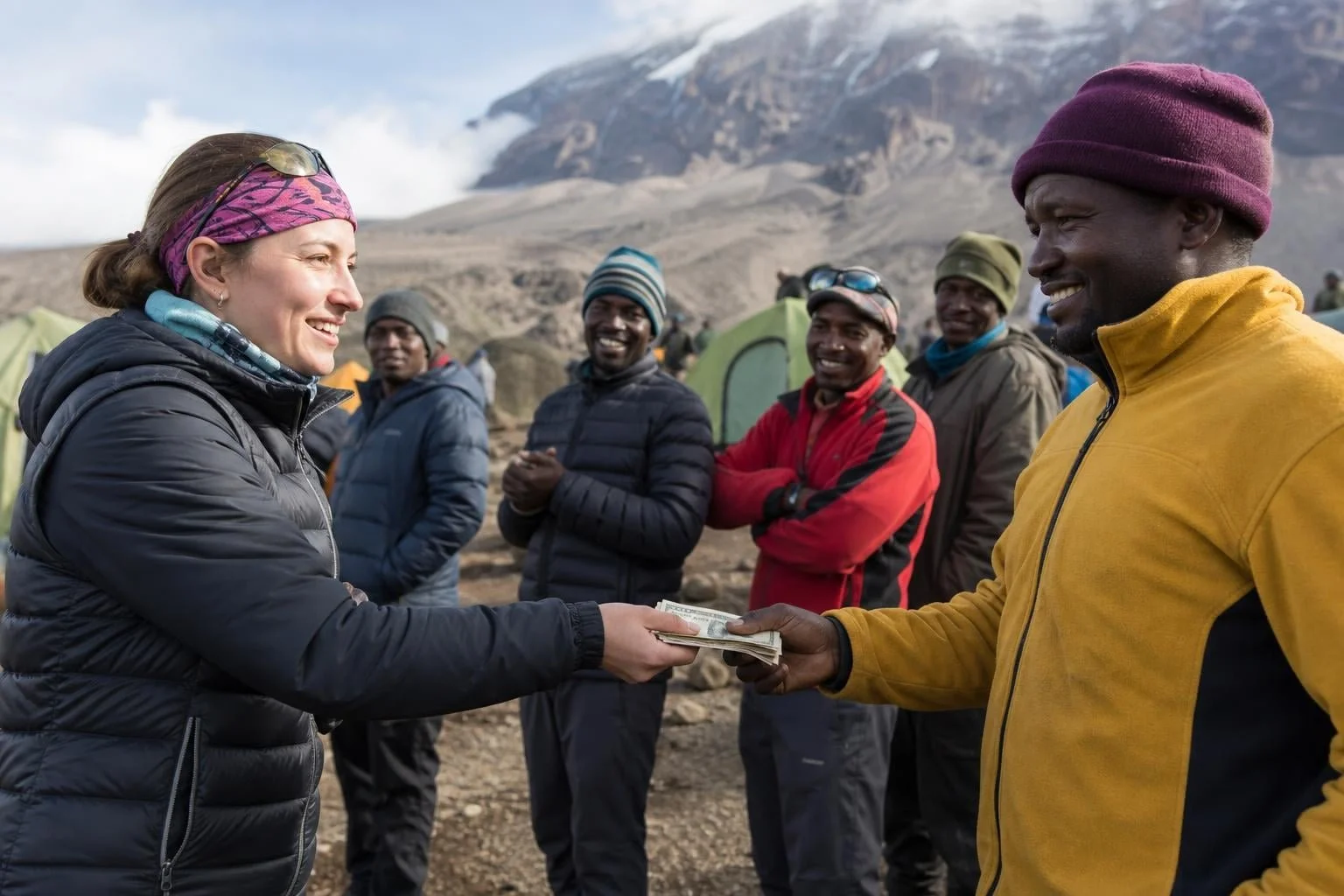
Budget roughly $20/day for your lead guide, $12/day for assistant guides and cooks, and $6/day per porter, all per group, not per person. For a 7-day trek with two climbers, expect a total tip of about $1,000 ($500 each). Bring crisp US dollar bills dated 2009 or newer, and tip each crew member individually during the tipping ceremony on your final night on the mountain. Solo climbers pay more per person because the crew-to-climber ratio is higher.
Tipping on Kilimanjaro is not optional in any practical sense. It is deeply expected, and for many crew members, tips represent the largest portion of their income. Yet the whole subject generates enormous confusion. Practitioners on Reddit’s r/Kilimanjaro forum regularly post conflicting numbers, misunderstand whether rates are per person or per group, and worry about the social dynamics of handing out cash at altitude after an exhausting summit push.
This guide cuts through that confusion. It covers every role, every rate, every term you need to know, and the exact cash preparation steps that will save you stress on the mountain.
Planning a Kilimanjaro climb? See how route choice affects success and crew size before budgeting your tips.
Direct Answer If you're climbing Kilimanjaro, budget around 10–15% of your trek cost for tips. Current KPAP recommendations are approximately $20–25 per day for the lead guide, $10–15 for assistant guides and cooks, $5–10 per porter, and $7–12 for specialty porters, with all amounts calculated per group rather than per climber. For most 7-day climbs, expect to budget roughly $450–550 per person in a two-person group, while solo climbers typically pay more because they require nearly the same support crew. Key Takeaways - Tips are expected on every Kilimanjaro climb. - Rates are per group, not per climber. - Bring clean US dollars printed in 2009 or later. - Tip crew members individually. - Budget about 10–15% of your total trip price. - KPAP-certified operators follow transparent tipping practices.
Quick-Answer Kilimanjaro Tipping Table
These daily rates align with recommendations from the Kilimanjaro Porters Assistance Project (KPAP), the independent organization that sets fair-treatment standards for mountain crews.
|
Crew Role |
Daily Tip (Per Group) |
|---|---|
|
Lead Guide |
$20–$25 |
|
Assistant Guide |
$10–$15 |
|
Cook |
$10–$15 |
|
Porter |
$5–$10 |
|
Specialty Porter (waiter, toilet porter, summit porter) |
$7–$12 |
The single most important thing to understand: these amounts are per group of climbers, not per climber. This distinction trips up almost everyone. If you’re climbing as a pair and your lead guide’s recommended tip is $20/day, you and your partner split that $20 between you, each contributing $10/day.
A reasonable rule of thumb is to budget 10–15% of your total trek cost for Kilimanjaro tipping.
If you’re also adding a safari to your trip, tipping norms differ. The Tanzania safari tipping guide covers those separately.
Kilimanjaro Tipping Calculator (Quick Estimate)
Many travelers simply want to know approximately how much cash they should bring. Use this quick guide before reading the detailed explanations.
|
Group Size |
Trek Length |
Suggested Cash to Bring |
|---|---|---|
|
Solo |
6 days |
$350–450 |
|
2 people |
7 days |
$900–1,100 total |
|
4 people |
7 days |
$1,250–1,500 total |
|
6+ people |
7–8 days |
$1,700–2,300 total |
Always bring around 10–15% extra in small bills in case your final crew is larger than expected.
Total Per-Climber Budget by Group Size
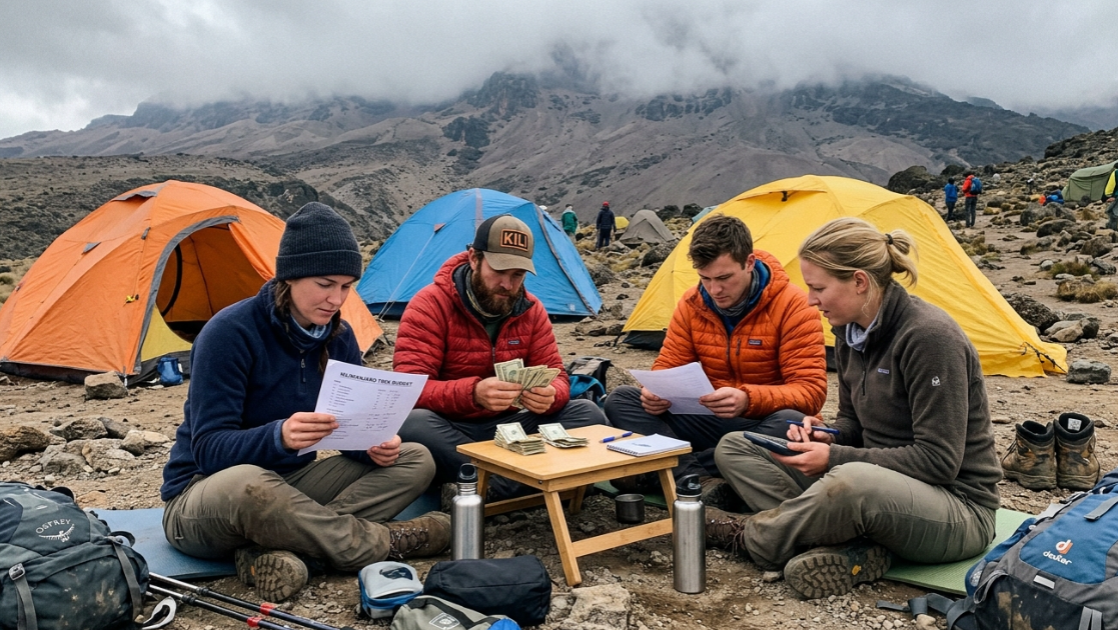
The number of people in your group changes your per-person tipping cost dramatically, because crew sizes don’t scale down proportionally.
|
Scenario |
Trek Length |
Typical Crew Size |
Estimated Total Tips |
Per-Climber Cost |
|---|---|---|---|---|
|
Solo climber |
6 days |
1 guide, 1 assistant, 1 cook, 4 porters |
$330–$420 |
$330–$420 |
|
Pair |
7 days |
1 guide, 1 assistant, 1 cook, 6–7 porters |
$900–$1,100 |
$450–$550 |
|
Group of 4 |
7 days |
1 guide, 2 assistants, 1 cook, 10–12 porters |
$1,200–$1,500 |
$300–$375 |
|
Group of 8 |
7 days |
1 guide, 3–4 assistants, 1–2 cooks, 18–22 porters |
$2,000–$2,500 |
$250–$315 |
Solo climbers always pay the most per person. The crew-to-climber ratio is highest when you climb alone, since you still need a guide, cook, and several porters regardless. Understanding these private vs. group cost dynamics helps you budget realistically.
How Total Tips Change by Route
Different routes mean different trek lengths, and longer treks mean more days of tipping. Crew sizes also vary slightly based on the route’s logistical demands.
|
Route |
Typical Days |
Typical Crew (for 2 climbers) |
Estimated Total Group Tip |
|---|---|---|---|
|
Marangu |
5–6 |
1 guide, 1 assistant, 1 cook, 5–6 porters |
$650–$850 |
|
Machame |
6–7 |
1 guide, 1 assistant, 1 cook, 6–7 porters |
$850–$1,100 |
|
Lemosho |
7–8 |
1 guide, 1 assistant, 1 cook, 7–8 porters |
$1,000–$1,250 |
|
Northern Circuit |
8–9 |
1 guide, 1–2 assistants, 1 cook, 7–8 porters |
$1,100–$1,400 |
The Northern Circuit, being the longest route, carries the highest tipping total. But it also has the highest success rates, so many climbers find the extra cost worthwhile.
Glossary of Key Kilimanjaro Tipping Terms
Assistant Guide
The second-in-command on your climb. Assistant guides walk with slower climbers, help manage gear logistics, and provide backup safety coverage. Operators typically assign one assistant guide per every two climbers. Recommended tip: $10–$15 per day (per group).
On summit night, having strong assistant guides matters enormously. Look for operators whose guides hold Wilderness First Responder certifications to ensure qualified support at high altitude.
Cook (Mountain Cook)
The person responsible for preparing all meals at camp, often producing surprisingly elaborate food under tough conditions at altitude. A good cook transforms your climb experience. Recommended tip: $10–$15 per day (per group).
To get a sense of what mountain cooks actually prepare, the Kilimanjaro food guide breaks down typical menus from day one through summit day.
Crew Manifest
A document listing every crew member assigned to your climb by name and role. The manifest is your primary protection against kirunje (see below). Before the tipping ceremony, a reputable operator will share the manifest so you can verify that everyone present actually worked on your expedition.
Helping Porter
An informal term for any porter who takes on duties beyond carrying loads. This includes waiter porters, toilet porters, camp crew, and summit porters. Because they perform extra work, they should receive higher tips than standard porters. An additional $1–$3 per day above the base porter rate is appropriate.
Kilimanjaro Porters Assistance Project (KPAP)
The independent nonprofit that monitors porter treatment on Kilimanjaro. KPAP partner companies must meet strict standards: minimum daily wages (20,000 TZS for porters, 30,000 TZS for assistant guides and cooks, 40,000 TZS for lead guides), transparent tipping procedures, proper clothing and shelter, and load limits of 20 kg per porter.
Partners must score at least 85% on KPAP’s Guidelines for Proper Porter Treatment Scorecard and are monitored every season. About 70% of Kilimanjaro expeditions don’t comply with KPAP standards, which makes choosing a certified partner one of the most impactful decisions you can make as a climber.
Kirunje
A Swahili term for the practice of unauthorized porters showing up at the tipping ceremony who did not actually work on your climb. They appear hoping to collect a share of the tips. This is one of the least discussed but most important Kilimanjaro tipping problems.
Ethical operators prevent kirunje by maintaining crew manifests and requiring each crew member to sign a tip distribution report after receiving their share. If your operator cannot produce a manifest before the ceremony, that is a red flag.
Lead Guide (Chief Guide)
Your primary guide and expedition leader. The lead guide manages route decisions, monitors climbers for altitude sickness symptoms, coordinates with park rangers, and leads the summit push. On summit night, the lead guide typically walks with the main group and makes the critical call on whether to continue or turn back.
Recommended tip: $20–$25 per day (per group). The lead guide receives the highest tip because they carry the greatest responsibility.
Porter
The backbone of every Kilimanjaro expedition. Porters carry food, camping equipment, personal bags, and everything else needed for days on the mountain. They hike ahead of climbers to set up camp, then break it down and carry it to the next site. A typical expedition uses three to four porters per climber.
KPAP limits each porter’s load to 20 kg (about 44 lbs). Recommended tip: $5–$10 per day per porter (per group).
Summit Porter
A specialty porter who carries supplemental oxygen, medical supplies, or emergency equipment on summit night. This is physically demanding work at extreme altitude, done in darkness and bitter cold. Tip a summit porter at the higher end of the porter range, or add $2–$3 per day above the base porter rate.
Tip Distribution Report
A signed document confirming that each crew member received their individual share of the tips. After the tipping ceremony, every crew member signs this report. Responsible operators review these reports after every climb to verify fair distribution.
This safeguard exists because of a real and documented problem: when tips are given as a lump sum to the lead guide, the money does not always reach every crew member. Practitioners on Reddit and Tripadvisor consistently warn against handing all tips to one person.
Tipping Ceremony
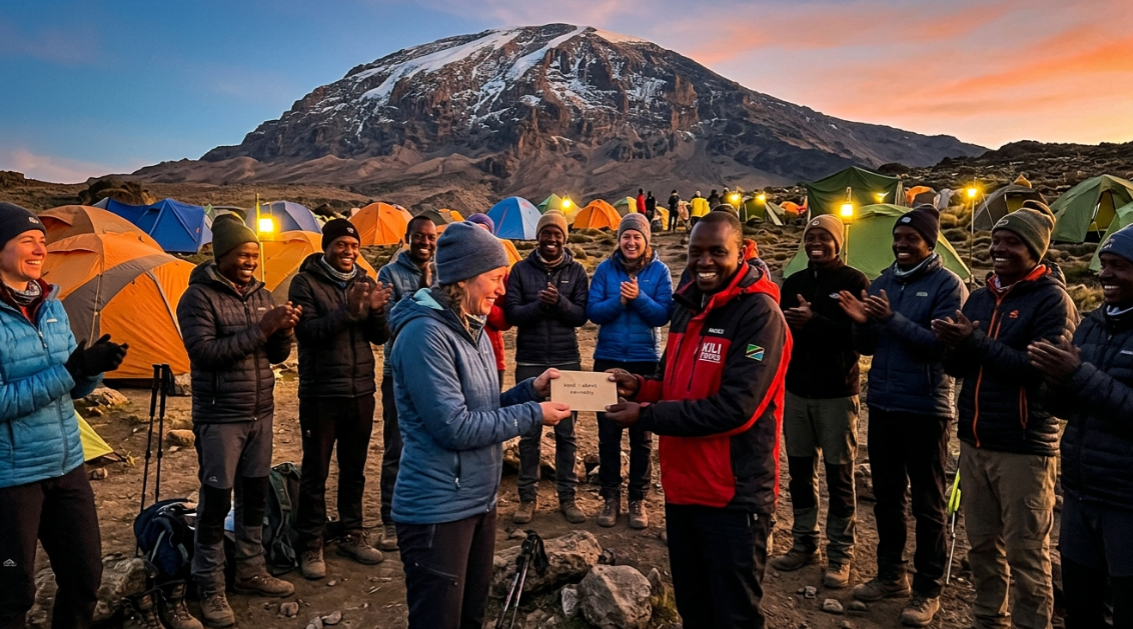
The formal event, usually held on the last evening on the mountain (after the summit attempt), where climbers present tips to each crew member. The ceremony typically involves the crew gathering together, singing, and clapping before each person steps forward.
One travel blogger described the experience honestly: “The first time you see it, it can feel a bit awkward. Everyone stands around, you’re tired, and then the crew starts clapping and singing. But this moment means a lot to them.” That awkwardness is normal. The crew has spent days carrying your gear, cooking your food, and keeping you safe. The ceremony is their moment of recognition.
Toilet Porter
A porter specifically assigned to manage the portable toilet at camp, carrying it between sites, setting it up, and maintaining sanitation. This is one of the least glamorous jobs on the mountain and deserves recognition through a higher tip.
Waiter Porter
A porter who doubles as the camp server, setting up the dining tent, serving meals, and cleaning up afterward. Like other specialty roles, waiter porters should receive tips above the base porter rate.
Why Tips Matter: Porter Wages in Context
Understanding crew wages makes the importance of Kilimanjaro tipping impossible to ignore.
As of 2024, KPAP partner companies pay porters a minimum of 20,000 Tanzanian Shillings per day, roughly $8.70. The Mount Kilimanjaro Porters Society negotiated increases effective January 2025, raising minimum daily wages to approximately $15 for porters. These are the rates at certified, ethical companies.
Non-certified operators often pay far less. One self-identified porter shared on a Tripadvisor forum that “many companies pay porter salary of 10,000 TZS per day, equivalent to less than $4… porters depend on tip.”
For many crew members, tips genuinely double or triple their take-home pay for a climb. This is why the tipping norms exist, and why following them matters.
Why Does Kilimanjaro Require So Many Crew Members?
One of the biggest surprises for first-time climbers is the size of the expedition team. Unlike many trekking destinations, Kilimanjaro climbs are fully supported expeditions.
A typical climb includes:
-
Lead guide
-
Assistant guide(s)
-
Mountain cook
-
Camp crew
-
Waiter porter
-
Toilet porter (optional)
-
Equipment porters
-
Summit porter (sometimes)
Several factors influence crew size:
-
Route length
-
Number of climbers
-
Camping versus hut routes
-
Total food and equipment
-
Safety requirements
-
National park regulations
Because every expedition relies on a large support team, tipping represents an important part of responsible travel on Kilimanjaro.
Does Route Choice Affect Tipping?
Yes.
Longer routes generally require:
-
More climbing days
-
More food
-
More fuel
-
Additional porter loads
-
Sometimes additional guides
That increases the overall tip pool even though the daily recommended tip rates remain the same.
|
Route |
Tipping Cost |
|---|---|
|
Marangu |
Lowest |
|
Machame |
Moderate |
|
Rongai |
Moderate |
|
Lemosho |
Higher |
|
Northern Circuit |
Highest |
Currency and Cash Preparation
Getting cash wrong is one of the most common Kilimanjaro tipping mistakes. You cannot fix a currency problem once you’re on the mountain.
US Dollar Requirements
-
Bills must be dated 2009 or later. Banks and recipients in Tanzania routinely reject older bills.
-
Bills must be crisp and undamaged. No tears, no ink marks, no heavy folds.
-
Tips can also be given in Euros, Swiss Francs, or Tanzanian Shillings, but US Dollars are the most universally accepted and preferred.
Denomination Strategy
Bring a mix of small and large bills:
-
$1, $5, and $10 bills work best for tipping individual crew members. You will need many of these.
-
$50 and $100 bills get better exchange rates if crew members convert to shillings, so including some larger denominations is thoughtful.
-
Plan your total, then add 10–15% extra for unexpected situations (an extra porter, a particularly helpful crew member, small purchases in Moshi or Arusha).
Where to Get Cash
Order new bills from your bank at least two weeks before departure. Airport exchange counters rarely stock the crisp, post-2009 bills you need. ATMs in Arusha and Moshi dispense Tanzanian Shillings, not dollars, so do not count on withdrawing tip money in Tanzania.
For a full breakdown of what else to budget beyond tips, the Tanzania safari cost guide covers park fees, accommodations, and other expenses that shape your total trip spend.
How Tipping Works on the Mountain
The Timeline
-
Pre-trek briefing: Your operator should provide a crew manifest listing every person assigned to your climb, along with their role.
-
During the climb: Pay attention to who is working on your expedition. Note standout performers.
-
After summit day: The tipping ceremony takes place on the last evening, usually at the final camp before descending to the gate.
-
The ceremony itself: Crew members gather, often singing and clapping. You present tips individually, with each person stepping forward.
-
Distribution report: Each crew member signs a document confirming receipt of their tip amount.
The Envelope Method
The most practical approach is to prepare individual envelopes before the ceremony. Label each one with the crew member’s name and role using the manifest. This keeps the ceremony organized and ensures every person receives their intended amount.
KPAP strongly recommends tipping each crew member directly. Do not hand a lump sum to the lead guide for distribution. Multiple sources, from travel forums to operator blogs, report cases where guides kept a disproportionate share when given control of all tip money.
The Emotional Reality
Climbing Kilimanjaro is physically exhausting. By the time you reach the tipping ceremony, you have just completed (or attempted) a summit push that likely started around midnight, followed by a long descent. You are tired, possibly emotional, and standing in front of a group of people who made the whole thing possible.
The singing, the clapping, the formality of it can feel overwhelming or awkward if you’re not prepared. That is completely normal. Experienced climbers on forums and YouTube walkthroughs consistently say the same thing: it feels strange for about thirty seconds, then it becomes one of the most meaningful moments of the entire trip.
The “40% of Trek Cost” Problem
A recurring anxiety on social media involves climbers whose operators quoted tipping expectations amounting to 30–40% of the trek price. One Facebook post that ranked in Google’s top results described a $510 tip demand on a budget trek, which sparked dozens of alarmed responses.
Here is the context that post was missing: budget operators often set artificially low trek prices and then compensate by pressuring climbers to tip enormous amounts. The operator looks cheap on paper, but the real cost (trek price plus expected tips) is comparable to or higher than a reputable operator that pays fair wages from the start.
When an operator pays KPAP-compliant wages, the tipping expectations remain reasonable, typically 10–15% of the total trek cost. When an operator pays porters $4/day and expects climbers to make up the difference, tipping can balloon to uncomfortable levels. This is one of many costly booking mistakes that travelers make when choosing the cheapest option.
Gear Donations as Supplementary Tips
Beyond cash, consider donating clothing and equipment to your crew. Mountain staff climb Kilimanjaro dozens of times per year and go through gear quickly. Warm jackets, fleece layers, gloves, hiking boots, and thermal underwear are all valuable.
Two important rules for gear donations:
-
Give directly to the intended person. Do not hand a pile of gear to the lead guide and assume it will be distributed fairly. The same transparency concerns that apply to cash tips apply here.
-
Don’t substitute donations for tips. Gear is a welcome supplement, not a replacement. Your crew needs cash to pay rent, school fees, and daily expenses that a fleece jacket cannot cover.
Common Mistakes
Confusing “per group” with “per person.” This is the most widespread error. Forum threads on Reddit are full of climbers who budgeted $20/day per person for their lead guide instead of $20/day for the whole group. Read the KPAP guidelines carefully and do the math before you leave home.
Handing a lump sum to the lead guide. It is faster and less awkward, which is exactly why people do it. But it removes transparency. Always tip individually.
Bringing old or damaged bills. A $20 bill from 2006, no matter how crisp, will be rejected. This catches American travelers off guard more than anyone because US dollars “look the same” across decades. Check the date on every single bill.
Tipping less because you didn’t summit. Whether you reach Uhuru Peak or turn back at Stella Point, the crew provided the same service. Tip for the quality of care you received, not for the outcome of the climb.
Not accounting for specialty porters. Your total crew may include a waiter, a toilet porter, and a summit porter who all deserve slightly higher tips than base porters. If you budget only for generic “porter” rates, you will come up short.
Biggest Myth About Kilimanjaro Tipping
The biggest misconception is that operators are "asking for too much."
In reality, there are two very different situations:
Ethical operators
-
Pay fair wages
-
Use KPAP standards
-
Tips reward excellent service
Budget operators
-
Advertise unusually cheap climbs
-
Pay lower wages
-
Depend on climbers to make up the difference through larger tips
Looking only at trek price can therefore be misleading. Always compare the total expected trip cost rather than the advertised package price.
How Much Cash Should You Bring to Tanzania?
Many travelers underestimate how much physical cash they need.
Besides tips, you'll likely use cash for:
-
Airport snacks
-
Drinks
-
Souvenirs
-
Hotel gratuities
-
Safari tipping
-
Visa fees (where applicable)
-
Emergency expenses
A good rule is to carry your expected tip amount plus another $150–300 in small bills for incidental expenses.
Frequently Asked Questions
Is Kilimanjaro tipping mandatory?
Tipping is not legally required, but it is a deeply entrenched custom and a critical part of crew compensation. Choosing not to tip would be a serious breach of mountain etiquette and would directly harm people who depend on that income.
How do I find out my exact crew size before the climb?
A responsible operator will provide a crew manifest during your pre-trek briefing. If your operator cannot or will not share this, ask directly. You need the number to calculate your total Kilimanjaro tipping budget.
Can I tip in Tanzanian Shillings instead of US Dollars?
Yes. Crew members accept Tanzanian Shillings, Euros, and Swiss Francs in addition to US Dollars. However, dollars are the most commonly expected currency and simplify the math since all published guidelines use dollar figures.
What if I’m climbing during peak season? Should I tip more?
Peak season (June through October and late December through February) does not change the standard tipping rates. However, during the best months to climb Kilimanjaro, crews work more frequently and may appreciate the recognition of particularly strong service with a modest bump above the minimum.
Do tips differ between routes like Lemosho and Marangu?
The daily per-role rates stay the same. What changes is the number of tipping days (Marangu is typically 5–6 days, Lemosho is 7–8) and sometimes the crew size. See the route-specific table above for estimated totals.
What happens if extra people show up at the tipping ceremony?
This is kirunje, the practice of unauthorized porters appearing to claim a share of tips. Use the crew manifest to verify who should be present. If you notice unfamiliar faces, raise the issue with your lead guide before distributing tips.
Should I combine my Kilimanjaro and safari tips into one budget?
No. Mountain tipping and safari tipping follow different conventions with different crew roles and rates. Budget them separately. For safari-specific guidance, the Africa-wide tipping etiquette guide covers drivers, lodge staff, and other roles.
I’m still in the training phase. Is it too early to think about tipping?
It is never too early to understand the financial picture. Knowing your tipping budget helps you choose the right route and group size. If you’re still building fitness, the Kilimanjaro training glossary covers the physical preparation side.
Kilimanjaro tipping is not complicated once you understand the structure. Know your crew, know your rates, bring the right cash, and tip each person directly. The people who carry your gear, cook your food, and guide you to the roof of Africa deserve fair compensation, and now you know exactly how to provide it.
Ready to start planning your climb with a KPAP founding partner? Compare routes, crew standards, and Kilimanjaro climb costs to find the right fit.