

Kilimanjaro Guides: 8 Keys to Choosing the Best (2026)
TL;DR
Every climber on Kilimanjaro is required by law to hire a licensed guide. The average summit success rate across all operators is roughly 65%, but that number jumps to 85–95% with experienced guides on longer routes. The difference comes down to guide certifications (look for Wilderness First Responder training, not just basic first aid), ethical porter treatment (verified by KPAP), and summit-night support ratios. Budget between $2,000 and $5,000 per person for a quality climb, and set aside $250–$400 in cash tips for your mountain crew.
Quick Answer: How Do You Choose the Best Kilimanjaro Guide? The best Kilimanjaro guide is one who combines safety training, mountain experience, and ethical operating standards. Look for companies whose lead guides are Wilderness First Responder (WFR) certified, participate in the Kilimanjaro Porters Assistance Project (KPAP), maintain a 1:1 guide-to-climber ratio on summit night, recommend 7- to 9-day routes for better acclimatization, and clearly publish guide experience, pricing, and safety equipment. Avoid operators that compete mainly on the lowest price. Key Takeaways - Hiring a licensed guide is mandatory on every Kilimanjaro climb. - WFR certification is one of the strongest indicators of guide quality. - KPAP membership independently verifies porter welfare. - Longer routes (7–9 days) dramatically improve summit success. - The cheapest operators often cut costs through lower crew wages and reduced safety standards. - Summit-night guide ratios matter more than overall group size. - Expect to spend approximately $2,000–$5,000 for a reputable operator. - Experienced guides can improve summit success rates by more than 20 percentage points.
At-a-Glance: How to Compare Kilimanjaro Guide Companies
|
Evaluation Dimension |
What to Look For |
Red Flag |
|---|---|---|
|
Guide Certification |
WFR-certified lead guides |
Only basic KINAPA first aid |
|
Porter Welfare |
KPAP partner (independently audited) |
No KPAP mention; vague ethics claims |
|
Summit-Night Support |
1:1 guide-to-climber ratio |
1 guide for 6+ climbers |
|
Route Duration |
7+ day routes recommended |
Pushing 5-day itineraries |
|
Pricing |
$2,000–$5,000 pp with clear inclusions |
Under $1,500 all-in (corners being cut) |
|
Reviews |
Consistent 4.5+ across TripAdvisor, Google, Facebook |
Reviews only on operator’s own website |
|
Safety Equipment |
Pulse oximeters, supplemental O₂, radios |
No mention of medical equipment |
|
Experience Level |
Lead guides with 50–100+ summits |
No stated guide experience |
This table is the skeleton of every decision covered below. The rest of this article puts muscle on it.
Do You Need a Guide on Kilimanjaro? (Yes, It’s the Law)
TANAPA (the Tanzania National Parks Authority) enforces a nationwide policy requiring all trekkers on Mount Kilimanjaro to be accompanied by a licensed, certified guide. No exceptions for any route, any season, or any experience level. Solo “self-guided” Kilimanjaro climbs do not exist legally.
The regulation serves three purposes. First, safety: altitude sickness kills people every year, and a trained guide catches warning signs before they become emergencies. Second, environmental protection: guides enforce park rules around waste, fire, and trail use. Third, local employment: the mountain supports thousands of Tanzanian families through guiding, portering, and cooking.
If you’re not ready for a multi-day expedition but still want to experience Kilimanjaro’s lower slopes, there are day hike options that offer a taste of the mountain with less commitment.
For a full summit attempt, the question is never whether to hire a guide. It’s which guide.
What Kilimanjaro Guides Actually Do (Day by Day)
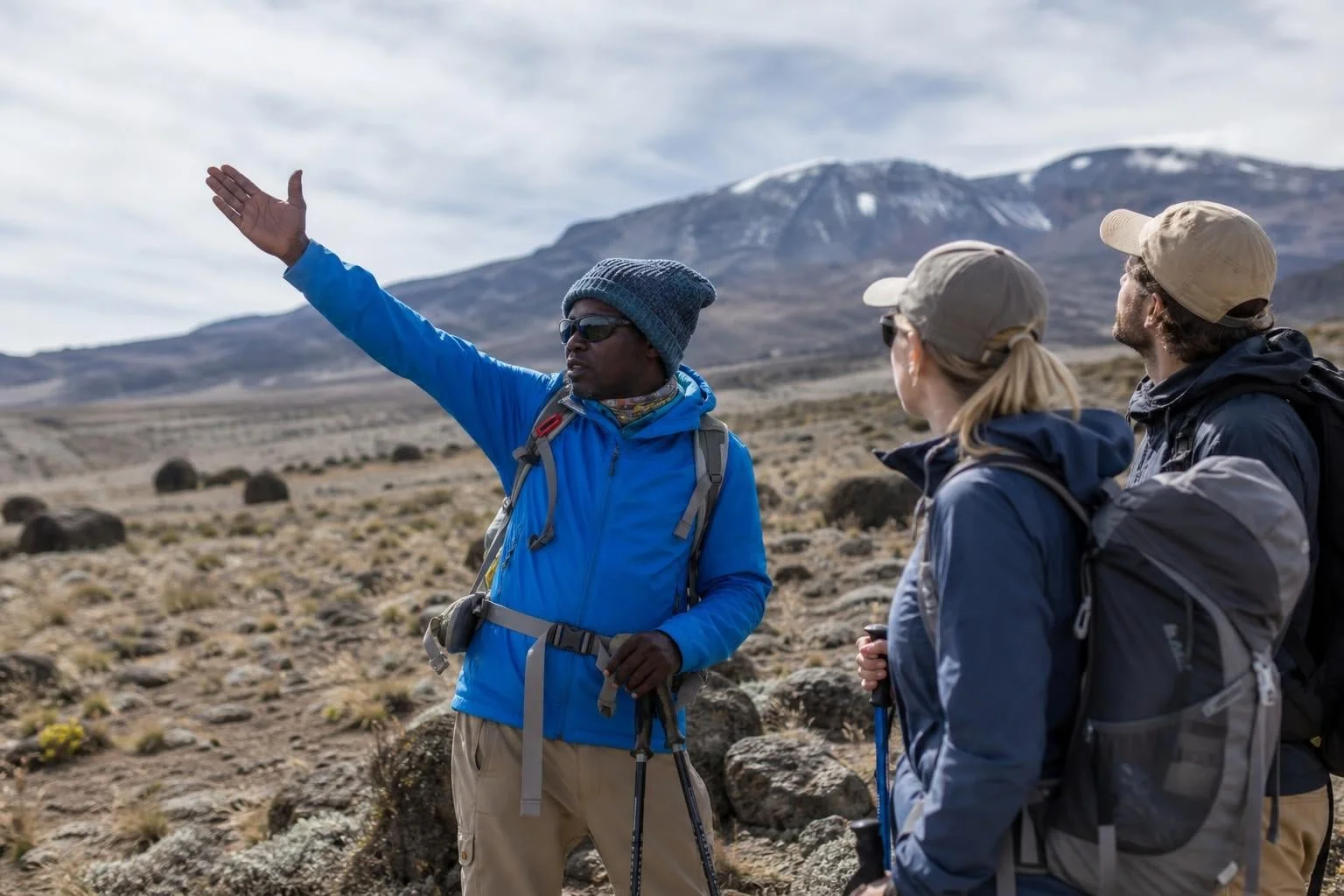
Most people picture a guide as someone who walks in front of you and points at things. On Kilimanjaro, the guide’s real work is mostly invisible.
Pre-Climb Briefing
The day before your climb, your lead guide meets with you in Moshi or Arusha for a gear check, route overview, and health assessment. Good guides ask pointed questions about your training history, any medications you’re taking, and your previous altitude experience. They’re building a baseline they’ll compare against every day on the mountain.
Daily Health Monitoring
Each morning and evening, guides check pulse oximetry (blood oxygen saturation) and ask about sleep quality, appetite, headaches, and energy levels. This data tells them whether your body is acclimatizing on schedule.
A Wilderness First Responder guide goes further. As one climbing forum contributor put it, “the best guides notice you didn’t finish dinner before you notice it yourself.” That kind of observation, probing why you’re not eating, catching a downward SpO₂ trend before you feel symptoms, is what separates a WFR-trained guide from one who simply walks beside you.
Pacing and Acclimatization Decisions
“Pole pole” (slowly, slowly) is the Swahili mantra on Kilimanjaro, but great guides do more than just walk slowly. They adjust pace dynamically based on how the group is responding. They decide when to add extra rest stops, when to extend time at a camp for better acclimatization, and when to push forward. These micro-decisions compound over a week-long climb and directly affect your summit success rate.
Summit Night: The Critical 8–12 Hours
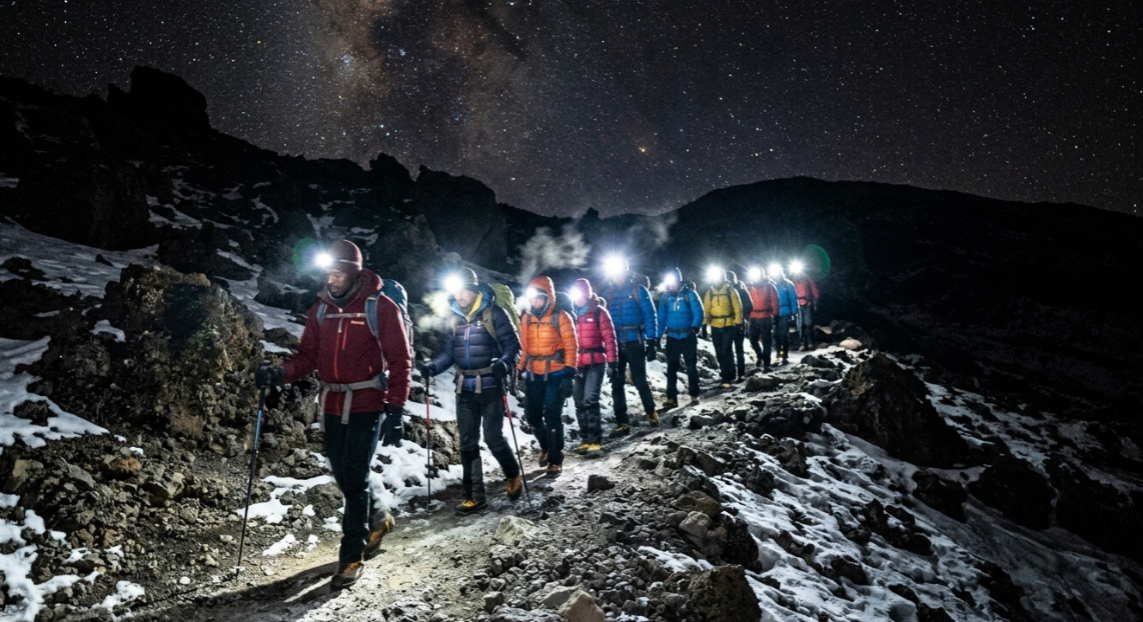
Summit night is where guides earn their keep. You start around midnight, climbing in darkness at temperatures around -20°C, pushing through the thin air above 5,000 meters. This is when acute altitude sickness risk peaks.
Some operators provide a 1:1 guide-to-climber ratio specifically for summit night, which means if one climber needs to turn back or be evacuated, every other climber still has a dedicated guide. Duma Explorer is one operator that maintains this 1:1 summit-day ratio, and it’s a structural advantage worth asking about when comparing companies.
Emergency Response
When things go wrong at altitude, they go wrong fast. Guides trained in wilderness medicine carry pulse oximeters, supplemental oxygen, comprehensive first aid kits, and VHF radios. Some top operators also carry Gamow bags (portable hyperbaric chambers that simulate lower altitude). Helicopter evacuation is available using Airbus AS 350 B3 helicopters that can land at altitudes up to 4,700 meters, but getting a climber down to that altitude often depends entirely on the guide’s quick decision-making.
Understanding what you’ll eat on Kilimanjaro matters here too, because the cook is a critical member of the mountain crew. Good nutrition at altitude isn’t a luxury; it’s part of the safety system.
Why Your Guide Matters More Than Your Fitness
Many first-time climbers assume physical fitness is the biggest predictor of reaching Uhuru Peak. While preparation certainly helps, research and operator data consistently show that acclimatization strategy and guide decisions often have a greater influence on summit success.
A professional guide controls pacing, hydration reminders, altitude monitoring, meal timing, rest breaks, and evacuation decisions. Even very fit climbers can develop Acute Mountain Sickness (AMS), while moderately fit hikers frequently reach the summit because their guides manage the climb conservatively.
Think of fitness as your engine and your guide as the driver. A powerful engine with poor navigation still ends up in the wrong place.
Guide Certifications That Matter
Not all Kilimanjaro guide credentials are equal. Here’s what each one actually means for your safety.
KINAPA/TANAPA License (Mandatory Baseline)
A licensed Kilimanjaro guide is one who has been officially registered with KINAPA (Kilimanjaro National Park Authority). To obtain this license, guides typically undergo training covering park regulations, basic ecology, basic first aid, and client management. Every legal guide on the mountain has this. It’s the floor, not the ceiling.
The critical gap: Tanzania’s national park regulations only require lead guides to hold a basic first aid certificate, with no requirement for wilderness-specific training. A standard first aider is trained to manage emergencies for 10–20 minutes until professional help arrives. On Kilimanjaro, professional help can be hours or even a full day away.
Wilderness First Responder (The Real Differentiator)
The most important voluntary certification for any Kilimanjaro guide is Wilderness First Responder (WFR). This internationally recognized 80-hour course prepares guides to manage medical emergencies in remote, high-altitude environments for 24 hours or longer in isolation.
WFR is not legally required. The fact that some operators invest in it anyway tells you something important about their priorities. When evaluating companies, don’t just ask “Are your guides WFR-certified?” Ask “Are ALL your lead guides WFR-certified, or just some?”
KPAP Partner Status (Ethics Verification)
The Kilimanjaro Porters Assistance Project, established in 2003, is a legally registered Tanzanian NGO that monitors porter working conditions. Here’s the part most articles skip: KPAP assigns an undercover porter on each hike to evaluate treatment standards from the inside. After every climb, KPAP assesses the crew’s conditions and assigns a score. To remain a partner, operators must maintain a score of 85% or above.
This secret-shopper system is genuinely rigorous. A company claiming to be a “KPAP partner” can be independently verified, unlike vague claims about “treating our porters well.”
Red Flags to Watch For
-
No mention of any certification beyond KINAPA
-
Claims of “trained guides” with no specifics
-
No KPAP affiliation or porter welfare policy
-
No physical office in Moshi or Arusha (makes accountability difficult)
-
Reviews only on the operator’s own website
For a broader understanding of staying safe during East Africa travel, see this safety guide.
WFR vs Basic First Aid: What's the Difference?
|
Skill |
Basic First Aid |
Wilderness First Responder |
|---|---|---|
|
Training Length |
Usually 1–2 days |
Approximately 80 hours |
|
Remote Medicine |
Limited |
Extensive |
|
High Altitude Emergencies |
Minimal |
Comprehensive |
|
Patient Care Duration |
Minutes |
Up to 24+ hours |
|
Evacuation Planning |
Basic |
Advanced |
|
Medical Decision Making |
Limited |
Extensive |
For Kilimanjaro, WFR certification provides substantially better preparation for managing altitude-related emergencies where professional medical care may be many hours away.
The Guide Career Ladder: Porter to Summit Leader
Understanding how Kilimanjaro guides build their careers helps you appreciate what you’re paying for and ask better questions when evaluating companies.
Most guides are Tanzanian locals who start as mountain porters, carrying gear up and down the slopes for years. From there, they may advance to personal porter (assigned to a single climber), then assistant guide, sometimes cook, and eventually pursue their KINAPA guiding certification. At companies like Thomson Safaris, guides like James have documented this full progression from porter to head guide over the course of a decade or more.
This matters because a guide with 15+ years of experience and 100+ successful summits has encountered nearly every combination of weather, altitude sickness, group dynamics, and equipment failure that the mountain can produce. Experience compounds on Kilimanjaro. Each climb is different, and the edge cases (a sudden weather shift at Barafu Camp, a climber who hid symptoms for two days) are what separate a veteran guide from a competent but inexperienced one.
When comparing operators, look for stated guide experience levels. The strongest companies will tell you their lead guides have 50–100+ summits each. Senior guides at top operators often exceed 200.
The industry is also professionalizing rapidly. In 2026, TATO (the Tanzania Association of Tour Operators) launched a national capacity-building initiative that brought together over 2,428 registered driver guides and more than 1,159 mountain porters for updated training on international service standards. This is fresh context that signals the industry is raising its baseline, which makes choosing operators who’ve been above that baseline all along even more valuable.
How to Evaluate a Kilimanjaro Guide Company
Here’s an 8-point checklist you can use before committing money to any operator. Print it out or save it on your phone.
1. KINAPA/TANAPA License
Confirm the company is registered and licensed. This is table stakes, but some operators working through informal middlemen may not hold direct licenses.
2. WFR Certification for Lead Guides
Ask specifically: “How many of your lead guides hold active WFR certification?” The answer should be all of them, not “some” or “our senior guides.”
3. KPAP Partner (Verified)
Check the KPAP website for the operator’s name. Self-claimed ethical treatment is marketing. KPAP verification is accountability. Duma Explorer is a founding partner of KPAP, which signals something stronger than mere compliance.
4. Published Guide-to-Climber Ratios
This should be stated on the operator’s website, especially for summit night. A 1:1 ratio on summit night is the gold standard. If the company won’t publish their ratios, that tells you something.
5. Transparent Pricing
The company should clearly list what’s included and excluded. Park fees, crew wages, meals, camping equipment, rescue fees, airport transfers: all of it should be spelled out. More on pricing below.
6. Minimum 7-Day Routes Recommended
Each additional day above six days on the mountain increases summit success rates by 8–10%. An operator that eagerly sells 5-day climbs is prioritizing volume over your safety.
Considering a Kilimanjaro climb? Compare routes, durations, and success rates to understand which itineraries give you the best chance of reaching the summit.
7. Physical Office in Moshi or Arusha
A local office means local accountability. It means the operator can be found if something goes wrong. Practitioners on Reddit consistently recommend booking with Tanzania-based operators for this reason, noting that local presence translates to faster problem resolution and more control over crew quality.
8. Review Consistency Across Multiple Platforms
Check TripAdvisor, Google, SafariBookings, and Facebook groups. An operator with glowing reviews on their own website but no presence on independent platforms is a warning sign. Look for consistent 4.5+ ratings across at least two or three platforms.
Common Mistakes People Make When Choosing a Guide
Many first-time climbers focus almost entirely on price. Unfortunately, this often leads to compromises that aren't obvious until they're already on the mountain.
Common mistakes include:
-
Choosing the cheapest operator available
-
Booking a 5-day itinerary to save money
-
Ignoring guide certifications
-
Not asking about summit-night support
-
Assuming online reviews tell the whole story
-
Forgetting to verify KPAP partnership
-
Comparing only total price instead of inclusions
Avoiding these mistakes greatly improves both safety and summit success.
What Kilimanjaro Guides Cost (Full Pricing Breakdown)
The pricing question is more nuanced than most articles acknowledge. Here’s how the money actually breaks down.
The Fixed Chunk: Park Fees
Park fees set by TANAPA usually make up 50–60% of the total payment. For a typical 7-day climb, park fees alone range between $900 and $1,300. Every operator pays these, and no one gets a discount. This means that when you see wildly different prices between operators, the difference lives in the remaining 40–50%.
The Variable Chunk: Where Guide Quality Lives
That remaining portion covers crew wages, food quality, camping equipment, safety gear, WFR training, transportation, and the operator’s margin. This is where guide quality, porter welfare, and safety equipment are funded.
A quality trek typically falls in the $2,000 to $6,000 range, with budget options starting around $1,400 and luxury climbs exceeding $7,000. For most climbers, the realistic cost of a safe, well-organized expedition sits between $3,000 and $5,000 per person.
For a deeper look at where every dollar goes, see this Kilimanjaro cost breakdown.
Why Cheap Climbs Have a Hidden Cost
When an operator charges under $1,500 all-in, something is being cut. Usually it’s crew wages. KPAP’s minimum wage standards require porters to earn at least 20,000 TZS/day, cooks and assistant guides 30,000 TZS/day, and lead guides 40,000 TZS/day. Budget operators frequently fail to meet these minimums.
As KPAP has documented, the lower the cost of a climb, the higher the probability that an operator is not providing proper treatment standards, such as minimum salary and food. Well-meaning climbers inadvertently become part of the exploitation when they book on price alone.
The price question isn’t just about personal value. It’s an ethics question.
Group vs. Private Pricing
Group climbs spread fixed costs across more people, bringing per-person prices down. For example, Duma Explorer’s group departures run from roughly $2,399 per person for a 7-day Machame climb to around $2,999 per person for an 8-day Lemosho, with maximum group sizes capped to maintain quality. Private climbs on similar routes start from approximately $1,999 (Machame) to $3,499 (Lemosho via Crater Camp) per person but offer more flexibility in dates and pacing.
For context on how these costs fit into a broader Tanzania trip budget, safari and beach extensions add their own layer of planning.
What Is Included in Most Kilimanjaro Guided Climbs?
|
Usually Included |
Often Extra |
|---|---|
|
Park fees |
Flights |
|
Camping equipment |
Travel insurance |
|
Guides |
Visas |
|
Porters |
Tips |
|
Cook |
Personal gear rental |
|
Meals |
Hotel upgrades |
|
Transfers |
Alcoholic drinks |
How Much to Tip Your Kilimanjaro Guide
Tipping is expected on Kilimanjaro and represents a significant portion of your crew’s income. KPAP recommends the following daily rates:
|
Role |
Recommended Tip Per Day |
|---|---|
|
Lead guide |
$20 |
|
Assistant guide |
$12 |
|
Cook |
$12 |
|
Porter |
$6 |
For a typical 6–8 day climb, the recommended total tip per climber is $250–$400 for the entire mountain crew. A common rule of thumb: budget 10–15% of your total trip cost for tipping.
How the Tipping Ceremony Works
On the final day of your descent, your guide will organize a tipping ceremony at the last camp or at the park gate. Your crew gathers, there’s usually some singing and dancing, and you present the tips. Bring cash in U.S. dollars, ideally in small denominations ($1, $5, $10, $20). ATMs in Moshi and Arusha are not always reliable, so get your cash sorted before arriving.
For broader context on tipping customs across East African adventures, this safari tipping guide covers amounts and etiquette for different types of trips.
Crew Composition: Who’s on the Mountain With You
Your “guide” is actually a full mountain team. For a climb with two people over seven days, a normal crew comprises one lead guide, one assistant guide, one cook, and six to seven porters. The general ratio is two to three porters per climber, plus one guide per two to three clients.
Each porter is limited to carrying 20 kg of client gear (a TANAPA regulation), which is why you need multiple porters. They carry your camping equipment, food, water, cooking gear, and safety equipment. Each porter’s load is weighed at the gate to enforce the limit.
The cook deserves special mention. At altitude, appetite drops and nausea increases. A skilled mountain cook who can prepare appealing, calorie-dense meals in a camp kitchen at 4,000+ meters is genuinely contributing to your summit chances.
Who Makes Up a Typical Kilimanjaro Crew?
|
Crew Member |
Primary Responsibility |
|---|---|
|
Lead Guide |
Navigation, safety, medical decisions |
|
Assistant Guide |
Client support and pacing |
|
Cook |
Meals and hydration |
|
Porters |
Carry camping equipment and luggage |
|
Waiter (some operators) |
Meal service and camp support |
Many climbers are surprised to learn that a group of two guests may be supported by eight to ten crew members.
Route-Specific Guide Strategies
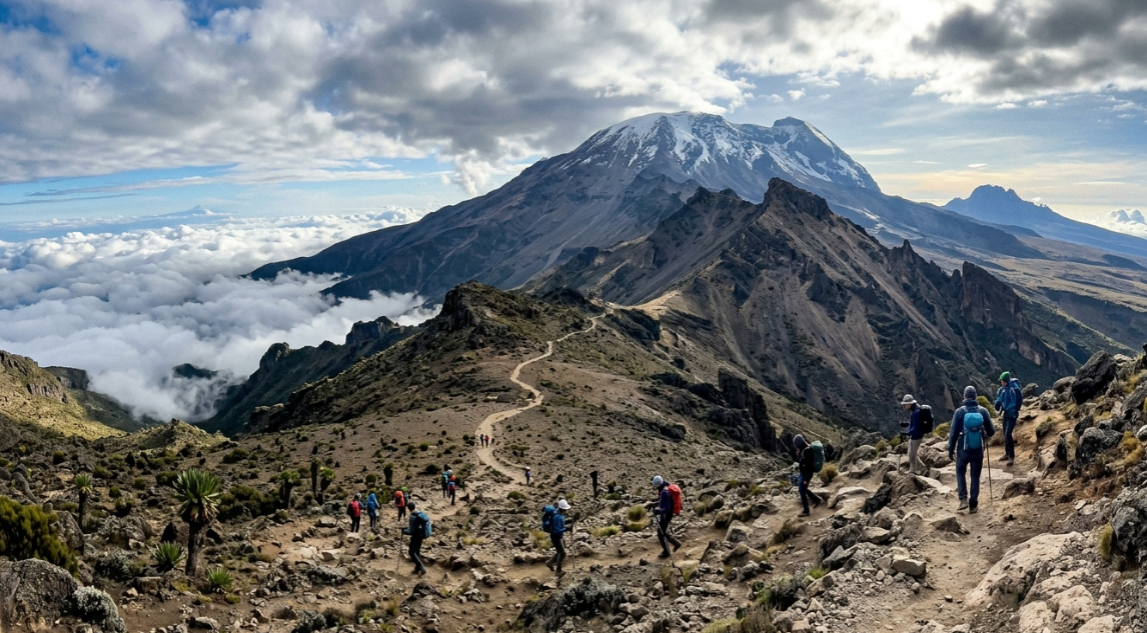
How a guide manages your climb changes significantly based on which route you’re on. Here’s what to know.
Machame Route (7 Days)
The most popular route, with an approximately 85% success rate on a 7-day itinerary. Guides manage the “climb high, sleep low” profile carefully, especially on the descent from Lava Tower to Barranco Camp. The Barranco Wall scramble on Day 4 is where guide experience with nervous climbers matters most. Read the full Machame route breakdown for day-by-day details.
Lemosho Route (8 Days)
Around 90% success rate with an 8-day itinerary. The longer duration gives guides more acclimatization flexibility. Lemosho approaches from the west and joins the Machame route at Lava Tower, giving guides two extra days to monitor your body’s response before the critical push.
Northern Circuit (9 Days)
The highest success rate at roughly 95%. This is the longest route, circumnavigating the mountain and offering the most gradual acclimatization. Guides use the extra days to fine-tune pacing. Two groups on the same 9-day Northern Circuit can still have meaningfully different outcomes depending on operator quality, because how guides respond to altitude symptoms on Day 6 determines whether you summit on Day 8.
Marangu Route (5–6 Days)
The only route with hut accommodations instead of tents, and it has the lowest success rate at approximately 70%. Guides face a tougher challenge here because the shorter itinerary compresses acclimatization. A great guide will recommend the 6-day option over the 5-day one, even though it costs more.
Rongai Route (7 Days)
The only northern approach, with less traffic and drier conditions. Guides familiar with Rongai know that its gentler gradient can create a false sense of security. Climbers feel good for days, then hit the altitude wall suddenly. Experienced Rongai guides front-load their symptom monitoring for this reason.
Seasonal weather patterns also shape guide strategy significantly. See the Kilimanjaro weather by zone guide for month-by-month conditions across the mountain’s five climate zones.
Which Route Gives You the Best Chance of Reaching the Summit?
|
Route |
Days |
Approx. Success Rate |
Difficulty |
|---|---|---|---|
|
Northern Circuit |
9 |
95% |
Moderate |
|
Lemosho |
8 |
90% |
Moderate |
|
Machame |
7 |
85% |
Moderate |
|
Rongai |
7 |
80–85% |
Moderate |
|
Marangu |
5–6 |
65–70% |
Moderate to Challenging |
If maximizing summit success is your priority, choose a longer itinerary rather than a shorter one. Extra acclimatization days generally produce a larger improvement in success rates than most differences between routes.
Questions to Ask Your Operator Before Booking
Use this checklist in your first conversation with any Kilimanjaro operator. Their answers (or lack of answers) will tell you a lot.
-
Are all your lead guides WFR-certified? When was their certification last renewed?
-
What is your guide-to-climber ratio on summit night specifically?
-
Are you a verified KPAP partner? What was your most recent score?
-
What medical equipment do your guides carry? (Pulse oximeter, supplemental oxygen, Gamow bag, radio?)
-
How many successful summits has your most experienced lead guide completed?
-
What is your protocol if a climber needs to descend mid-climb?
-
Can you provide a full cost breakdown showing park fees, crew costs, and inclusions separately?
-
What is your minimum recommended route duration, and why?
Operators who answer these confidently and specifically are the ones investing in their guides. Operators who deflect or give vague responses are worth crossing off your list.
Ready to start planning? Explore Kilimanjaro route options and costs to find the right itinerary for your fitness level and schedule.
Frequently Asked Questions
Can I choose my specific guide?
Most operators assign guides based on availability and route expertise. However, if you’ve researched a specific guide (some have their own following on social media), ask the operator. Repeat clients and referrals often can request a particular lead guide, especially with smaller companies.
How many guides will be with me?
The standard is one lead guide and one assistant guide for groups of two to four climbers. Larger groups add additional assistants. On summit night, the best operators increase this to a 1:1 ratio so that every climber has dedicated support during the most dangerous phase of the climb.
What happens if I need to turn back?
Your guide will assess the situation and may recommend descent. If you’re in a group with a 1:1 summit-night ratio, an assistant guide will escort you down while the rest of the group continues with their own guides. With lower ratios, one climber’s evacuation can compromise the entire group’s support.
Do guides summit every time?
No. Lead guides summit hundreds of times over their careers, and most are acclimatized to the altitude through sheer repetition. But they don’t summit on every single climb. If a client needs to descend, the lead guide often accompanies them. Some guides also rotate to manage fatigue over back-to-back climbs.
What language do guides speak?
Swahili is the first language for most Tanzanian guides, and English is the standard working language on the mountain. Communication is rarely a problem. Some operators also have guides who speak French, German, or Spanish, but you need to request this in advance.
What gear should I bring?
Your operator provides camping and cooking equipment. You’re responsible for personal gear: clothing layers, boots, sleeping bag (often available for rent), headlamp, water bottles, and snacks. A complete packing list for East Africa covers everything in detail, and if you want Kilimanjaro-specific gear guidance, check the Kilimanjaro training glossary to understand terms like “layering system” and “gaiters.”
Is there a minimum experience level I should look for in a guide?
Look for a lead guide with at least 50–100 successful summits. Senior guides at top operators have well over 100 each, and some exceed 200. Experience on your specific route matters too, so don’t hesitate to ask.
Do I need travel insurance for Kilimanjaro?
Yes, absolutely. Make sure your policy covers high-altitude trekking up to at least 6,000 meters and includes helicopter evacuation. Many standard travel insurance policies exclude altitude activities above 4,000 or 5,000 meters. Check the fine print before you book.
Your guide is not a nice-to-have on Kilimanjaro. Your guide is the single biggest variable between standing on Uhuru Peak and turning around at Stella Point. Choose accordingly.
Start your Kilimanjaro planning: See all climbing routes, pricing, and dates offered by Duma Explorer, with WFR-certified guides, 1:1 summit-day support, and KPAP founding partner status.