

Luxury Tanzania Honeymoon Glossary 2026: 30+ Terms
TL;DR
When planning a luxury Tanzania honeymoon, you’ll encounter terms like “bush and beach,” “fly-in safari,” “barefoot luxury,” and “PPPPN” across operator quotes and websites. None of them get explained. This glossary defines the 30+ terms couples encounter most often, organized by category: trip structure, accommodation types, romantic experiences, wildlife and seasons, pricing, and key destinations. Understanding these terms before requesting quotes can save you thousands and help you book exactly the right trip.
When you start comparing quotes for a luxury Tanzania honeymoon, the language shifts fast. One operator mentions a “fly-in safari with a bush-and-beach structure.” Another lists a “mobile tented camp on a private concession” followed by “barefoot luxury on Mnemba.” A third quotes you “PPPPN, all-inclusive, excluding conservation fees.”
These terms rarely get defined. Every top-ranking honeymoon page assumes you already know what they mean, which creates a real problem when the difference between “all-inclusive” and “full board” can shift your budget by over a thousand dollars.
This glossary covers the terms you’ll actually encounter while planning, organized by category so you can jump to what you need. If you want to see how these pieces fit into a real itinerary, the Zanzibar honeymoon safari guide walks through the full trip structure.
Quick Answer: What Terms Matter Most on a Luxury Tanzania Honeymoon? A luxury Tanzania honeymoon combines safari and beach travel, often using terms such as fly-in safari, bush and beach, private concession, luxury tented camp, PPPPN, full board, all-inclusive, sundowner, and Great Migration. The most important terms to understand are those affecting your route, accommodation, inclusions, wildlife timing, and total trip cost.
15 Luxury Tanzania Honeymoon Terms to Know Before Booking
|
Term |
Category |
Why It Matters |
|---|---|---|
|
Bush and Beach |
Trip structure |
Combines a Tanzania safari with a Zanzibar or island stay |
|
Fly-in Safari |
Logistics |
Replaces long road transfers with small-aircraft flights |
|
Private Safari |
Logistics |
Gives your couple a dedicated vehicle and guide |
|
Luxury Tented Camp |
Accommodation |
Offers hotel-level comfort in a wilderness setting |
|
Mobile Tented Camp |
Accommodation |
Moves seasonally to follow wildlife and migration patterns |
|
Private Concession |
Safari access |
Can provide fewer vehicles and activities unavailable in national parks |
|
Barefoot Luxury |
Beach accommodation |
Describes informal, highly personalized luxury |
|
All-Inclusive |
Pricing |
Defines which meals, drinks, activities, and services are included |
|
Full Board |
Pricing |
Usually means breakfast, lunch, and dinner, with drinks treated separately |
|
PPPPN |
Pricing |
Means price per person per night |
|
Conservation Fee |
Pricing |
A separate charge that may support conservation or protected areas |
|
Sundowner |
Experience |
Sunset drinks served during a safari outing |
|
Balloon Safari |
Experience |
Sunrise hot-air-balloon flight over the Serengeti |
|
Great Migration |
Wildlife |
The annual movement of wildebeest, zebra, and other grazing animals |
|
Green Season |
Seasonality |
A wetter period that can offer lower rates, lush scenery, and fewer visitors |
Trip Structure and Logistics
These terms describe how a luxury Tanzania honeymoon is organized, the routes it follows, and how you move between destinations.
Bush and Beach Honeymoon
The dominant format for a Tanzania honeymoon. You start with safari (the “bush” half, typically in the Serengeti or Ngorongoro area), then fly to Zanzibar for white-sand beaches. The contrast between the two is part of what makes it feel so complete: adventure first, then ease.
Most couples spend 4 to 5 days on safari and 5 to 7 days on the beach, totaling 10 to 14 days. The 14-day Tanzania itinerary guide shows how this structure works day by day.
Northern Circuit
The most famous Tanzania safari route, encompassing the Serengeti, Ngorongoro Crater, Tarangire, and Lake Manyara. Virtually all luxury Tanzania honeymoons follow some version of this circuit, though not every trip includes all four parks. The Serengeti and Ngorongoro are near-universal; Tarangire is the common third choice for its elephant herds and baobab-studded landscapes.
Fly-in Safari
Uses light aircraft (typically Cessna Caravans operated by airlines like Coastal Aviation and Auric Air) to travel between destinations. Instead of spending five or six hours on a bumpy road between Arusha and the central Serengeti, you fly in roughly 90 minutes, with aerial views of the plains as a bonus.
For honeymooners, fly-in safaris mean more time together at camps and less time in transit. They also unlock access to remote luxury camps that are simply impractical to reach by road.
The flight from the Serengeti to Zanzibar takes about two hours, making the bush-to-beach transition seamless. If you’re weighing the tradeoffs between driving and flying, a private vs. group safari comparison covers how vehicle and flight choices affect cost and experience.
Bush Flight
The actual light-aircraft flights between safari airstrips and islands. These are small planes, often seating 6 to 12 passengers. The critical logistics detail for honeymooners: baggage limits are usually 15 kg per person in a soft-sided bag. No hard-shell suitcases. If you’re packing evening wear for Zanzibar dinners, plan accordingly. The Tanzania packing list has specific guidance on what to bring and how to pack light.
Domestic Flight Hops
Your bush flight will likely make one or two interim stops at small airstrips to drop off or pick up other passengers before reaching your destination. This is completely normal, not a sign of a budget product. These “hops” add 15 to 30 minutes to your journey and are standard practice across all East African safari airlines.
Private Vehicle and Private Guide
A dedicated 4x4 safari vehicle and driver-guide exclusive to your couple. At the luxury tier, this is standard. You set the schedule. If a leopard appears and you want to watch for an hour, nobody else is itching to move on. If you want to sleep in and start your game drive late, that’s fine. The flexibility alone makes it worth the premium, and your guide becomes the single biggest factor in the quality of your safari experience.
Private Safari
A safari where the vehicle and guide are reserved exclusively for your couple or travel party. Unlike a shared safari, you generally have more control over departure times, how long you spend at wildlife sightings, and the pace of the day. Private safaris are particularly popular for honeymoons because they provide greater flexibility and privacy.
Shared Safari
A safari in which you share a vehicle with other travelers. Shared safaris generally cost less than private safaris but offer less control over the daily schedule. For honeymooners, the main tradeoff is price versus privacy and flexibility.
Safari Circuit
A sequence of parks, reserves, or safari regions visited during one trip. A Northern Tanzania itinerary might combine Tarangire, Ngorongoro, and Serengeti before continuing to Zanzibar. The more destinations you add, the more transfers and travel time your honeymoon requires.
Airstrip
A small landing area used by safari aircraft to connect remote camps and lodges. Safari airstrips are often located close to camps, reducing the need for long road transfers. Your itinerary may list an airstrip rather than the name of the camp as the destination for a bush flight.
Game Drive
A guided wildlife-viewing excursion, usually conducted in a 4x4 safari vehicle. Game drives are typically scheduled in the early morning and late afternoon, when wildlife activity and temperatures are often more favorable.
What These Safari Terms Mean for Your Honeymoon
The terminology matters because each choice changes the balance between privacy, travel time, wildlife viewing, comfort, and cost.
|
If you see this in a quote |
It usually means |
Ask the operator |
|---|---|---|
|
Private safari |
Dedicated vehicle and guide |
Is the vehicle exclusive for the entire safari? |
|
Fly-in safari |
Small-aircraft transfers |
How many flight legs and stops are included? |
|
Private concession |
Restricted-access safari area |
Are night drives and off-road driving permitted? |
|
Mobile camp |
Seasonal or temporary camp |
Where will the camp be located on our dates? |
|
All-inclusive |
Multiple meals, drinks, and services included |
Can you provide the complete inclusions and exclusions? |
|
Full board |
Breakfast, lunch, and dinner |
Are drinks, game drives, and transfers extra? |
|
PPPPN |
Per person, per night |
Does the rate include taxes and conservation fees? |
|
Bush and beach |
Safari followed by the coast |
Which flights connect the safari and beach portions? |
|
Green season |
Wetter travel period |
Which properties remain open and what activities operate? |
|
Conservation fee |
Additional conservation-related charge |
Is this already included in the quoted rate? |
Accommodation Types
Safari accommodation terminology is genuinely confusing. A “tent” might have a king bed, freestanding bathtub, and private plunge pool. A “lodge” might be a concrete building or an open-air treehouse. Here’s what each term actually means.
Luxury Tented Camp
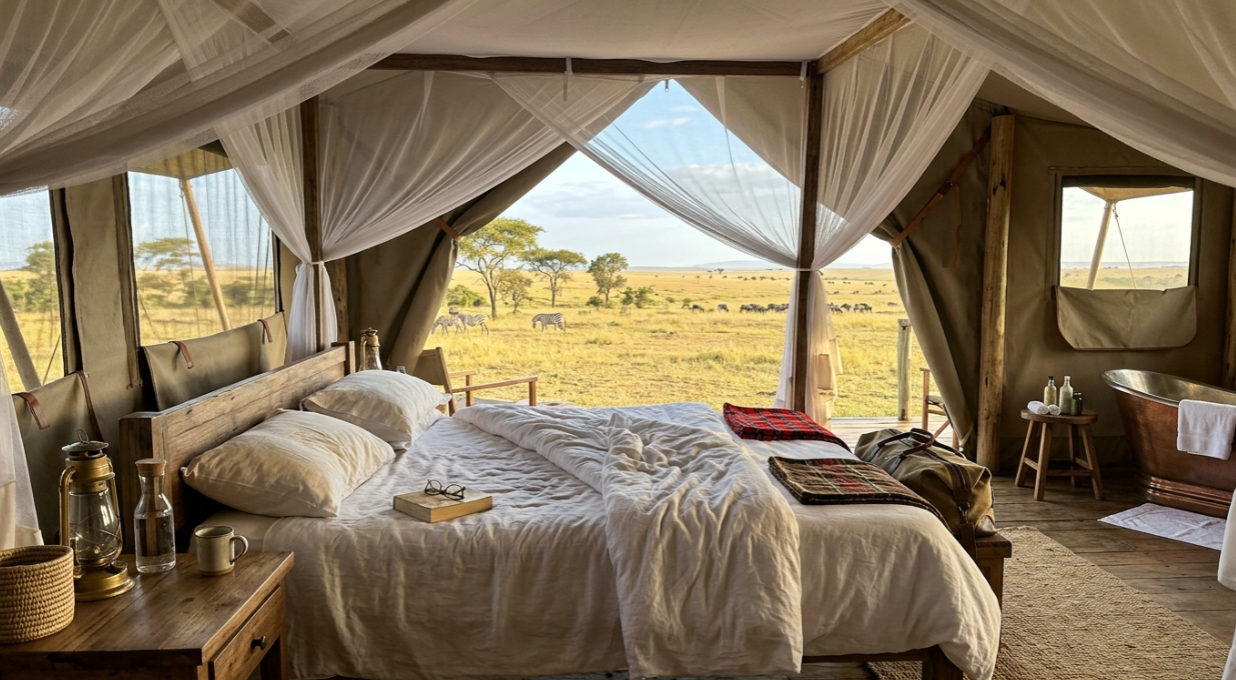
Don’t let the word “tent” fool you. These accommodations often feel more like boutique hotels in the wilderness. A typical luxury tent includes a spacious bedroom with fine linens, en-suite bathroom with hot-water shower (sometimes a freestanding tub), a private veranda overlooking the bush, and in some cases a personal plunge pool.
The “tent” part refers to the canvas walls and roof, which give the space an immersive feel: you hear the wildlife at night, catch the morning breeze, and feel connected to the landscape in a way that concrete walls don’t allow.
Mobile Tented Camp
A tented camp designed to operate seasonally from temporary or semi-permanent locations rather than remaining in one fixed structure year-round. Some mobile camps relocate to position guests near seasonal wildlife movements, including the Great Migration, while others move according to the operator's planned safari circuit. Always check where the camp will be located during your travel dates.
Permanent Lodge
A fixed-structure property with traditional hotel amenities: swimming pools, spas, restaurants, multiple room categories. Permanent lodges offer the most “resort-like” safari experience. They tend to have more guests than tented camps but also more facilities.
Banda
A standalone beach cottage or hut, common on Zanzibar and its surrounding islands. Bandas range from simple to spectacular. Mnemba Island, the pinnacle of private-island honeymoons in Tanzania, has just 12 secluded bandas hidden among palms beside pristine beach. Each one is its own private retreat.
Barefoot Luxury
A term describing properties where the experience is the height of luxury and exclusivity, combined with understated simplicity. No dress code, no shoes required, yet the service, food, and quality are exceptional. Mnemba Island Lodge is the textbook example, offering dedicated butlers and world-class diving while maintaining a deliberately relaxed atmosphere.
The concept works because it strips away formality without stripping away quality. For honeymooners, this translates to spending days in swimwear and bare feet while still eating beautifully prepared meals and sleeping in extraordinary comfort.
Star Bed / Sleep-Out
Open-air sleeping platforms, sometimes elevated on wooden decks or built into treehouses, positioned so you sleep directly under the stars. Many luxury camps offer these as a one-night add-on experience. You’re sleeping out in the bush in extraordinarily comfortable beds with mosquito netting, often with a campfire nearby and a guide within earshot for safety. The sounds of the African night become the experience itself.
Fly Camping
An overnight adventure away from your main lodge, inspired by old-school safari, when hunters would go out into the wild for days sleeping under a simple “fly sheet.” Modern fly camping is a sanitized version of that: you hike or drive to a remote spot, sleep in a basic but comfortable camp, and return the next morning.
It works best in Tanzania’s most remote parks like Ruaha, Katavi, and the Mahale Mountains. For adventurous honeymoon couples, it’s a night that feels like stepping back in time.
Suite / Villa
A larger or more private accommodation category than a standard room or tent. At luxury safari camps and beach resorts, suites and villas may include separate living areas, private decks, plunge pools, outdoor showers, or dedicated service. Always check the actual room layout rather than assuming every “suite” includes a private pool.
Private Pool
A swimming pool reserved exclusively for your accommodation. Private plunge pools are common at high-end safari camps and villas and can add privacy without requiring a full-size resort pool. If a quote describes a “private pool villa,” confirm whether the pool is genuinely exclusive or shared with another accommodation.
Romantic Experiences and Add-Ons
These are the terms you’ll see listed as optional upgrades or included touches in luxury honeymoon quotes.
Balloon Safari
A hot air balloon flight over the Serengeti at dawn, drifting silently above herds of wildebeest, zebra, and the golden plains. Typically followed by a champagne bush breakfast after landing. Multiple Duma Explorer reviewers, including honeymooners and anniversary travelers, describe this as the single standout experience of their trip.
Balloon safaris cost approximately $500 to $600 per person and must be booked in advance during peak season. They operate from several launch points across the Serengeti, with the central and northern zones being most popular.
Bush Dinner
A private dinner set up in the wilderness: lantern light, no other guests, and a sky that has no competition. Staff from your camp arrange a table in a scenic location (often under an acacia tree or on a kopje), prepare a multi-course meal, and leave you alone to eat by firelight.
This is the kind of evening that a luxury Tanzania honeymoon can deliver, and Arusha-based safari planners note that bush dinners are among the details couples remember most clearly despite costing relatively little on top of the overall trip price.
Sundowner
Sunset drinks served in a scenic bush or lakeside location during or after an afternoon game drive. Your guide will find a beautiful spot, pull out a cooler with gin and tonics or cold beer, and you watch the African sun go down. A standard inclusion at luxury camps and one of those rituals that defines the safari experience.
One Duma Explorer client celebrating their 25th wedding anniversary described the overall experience as “absolutely magical,” with sundowner moments frequently singled out in reviews.
Champagne Breakfast
A fully catered breakfast served outdoors after a morning activity (typically a balloon flight or early game drive), often with sparkling wine. It’s essentially a picnic, but with white tablecloths, proper silverware, and a chef who prepared everything in a mobile kitchen nearby.
Dhow Cruise
Sailing in a dhow, the traditional wooden sailing boat of Zanzibar, along the coast or to a sandbar. Sailing in the late evening to watch the sun set is the best time of day and is wonderfully romantic. Most luxury beach properties offer this as a complimentary or low-cost add-on. The Zanzibar excursions guide covers dhow cruises and other coastal activities in more detail.
Spice Tour
A guided tour of Zanzibar’s spice plantations, where you see, smell, and taste the cloves, vanilla, cinnamon, cardamom, and nutmeg that earned the island its “Spice Island” nickname. It adds cultural depth beyond beach days and pairs well with a night in Stone Town. The Zanzibar spice tour glossary explains what to expect.
Private Concession
A leased area adjacent to or within a national park where a single operator has exclusive game-drive rights. This means fewer vehicles on the road (sometimes yours is the only one), more intimate wildlife sightings, and the ability to do off-road driving and night game drives that aren’t permitted in public park areas.
For honeymooners, a private concession offers a level of solitude that public parks can’t match during high season.
Wildlife and Seasonal Terms
Understanding these terms helps you time your luxury Tanzania honeymoon to match the wildlife experiences you care about most.
Great Migration
The largest mass movement of land mammals on Earth: more than a million wildebeest along with hundreds of thousands of zebra and gazelle circling through the Serengeti and Kenya’s Masai Mara in a continuous loop. There is no single “migration season.” The herds are always somewhere in the Serengeti ecosystem. Your timing determines what you see.
Duma Explorer reviewers consistently rank the Migration as the single most-mentioned honeymoon highlight. For a deeper look at timing and locations, the Serengeti safari guide covers the full annual cycle.
Migration Timing Is Regional, Not a Single Date
The Great Migration does not follow a fixed annual timetable. Herd locations change from year to year based on rainfall and grazing conditions. Instead of asking an operator simply for “migration season,” ask where the herds are most likely to be during your exact travel dates and which safari area gives you the best chance of seeing the behavior you want.
For example, couples interested in calving should look at the southern Serengeti and Ndutu area during the relevant seasonal window, while couples hoping to see river crossings should focus on northern Serengeti positioning and allow multiple days for an unpredictable event.
Calving Season
January and February in the southern Serengeti and Ndutu region, where hundreds of thousands of wildebeest gather to give birth. Roughly 8,000 calves are born daily during the peak. Newborn animals also attract predators, creating unusually active wildlife viewing with hunts and chases happening regularly.
Calving season is an excellent honeymoon window. It combines dramatic wildlife with warm weather, green landscapes, and generally fewer crowds than the June-through-October peak.
Mara River Crossing
The dramatic river crossings in the northern Serengeti (typically July through September) where wildebeest plunge into the crocodile-filled Mara River. One Duma Explorer traveler described it as the “most memorable experience of my life.” Crossings are unpredictable, so staying multiple nights near the river increases your chances of witnessing one.
Big Five
Lion, leopard, elephant, Cape buffalo, and black rhinoceros. Tanzania’s national parks feature all Big Five. Ngorongoro Crater is widely considered the best single location to see them, as the crater walls create a natural enclosure with high wildlife density.
Kopje
Pronounced “copy.” Granite rock outcroppings scattered across the Serengeti plains. Lions love resting on them for the vantage point and the warmth of sun-heated rock. Kopjes make for dramatic photographs and are a regular feature of game drives. Your guide will likely stop at several.
Pricing and Booking Terms
This section covers the terms that appear in quotes and invoices. Understanding them before you compare proposals can prevent expensive misunderstandings.
PPPPN (Per Person Per Night)
The standard safari pricing unit. When a lodge quotes $800 PPPPN, that means $800 per person, per night. A couple staying three nights would pay $800 x 2 people x 3 nights = $4,800. Luxury safari is priced per person, per night, and is almost always all-inclusive at the top tier.
All-Inclusive
At luxury safari camps, “all-inclusive” typically covers: accommodation, all meals, house wines and spirits, soft drinks, laundry, scheduled game drives, and park fees. What it does NOT usually cover: premium experiences like balloon safaris, spa treatments, diving, charter flights between camps, and gratuities.
Always ask for the specific inclusions list. The gap between what you assume is included and what actually is can be the difference between a $10,000 and $13,000 trip.
Full Board
Accommodation plus three meals daily (breakfast, lunch, dinner). Drinks may or may not be included. Full board is common at mid-range properties and some luxury lodges. If drinks aren’t included, expect to pay $5 to $15 per alcoholic drink in the bush. The Tanzania safari cost guide breaks down how different board types affect your total spend.
Conservation Fee
Some properties add a separate nightly conservation fee on top of their quoted rate. Mnemba Island, for example, charges approximately $1,650 per person per night all-inclusive, plus a $100 per person per night conservation fee. This fee typically supports the marine reserve or wildlife area surrounding the property. Always check whether the quoted price includes or excludes conservation fees.
Peak / High Season
June through October is the long dry season and the peak of the safari calendar. Wildlife concentrates around water sources, making game viewing excellent. Vegetation is shorter and thinner, improving visibility. This is also when prices hit their maximum and popular camps sell out months in advance.
Green / Shoulder Season
March through May (the “long rains”) and November (the “short rains”). The same lodge that costs $1,200 PPPPN in August might drop to $600 to $800 in April. The landscape turns gorgeously lush, birdlife peaks, and parks are dramatically less crowded. The tradeoff: some roads become muddy, occasional heavy afternoon rain can limit game drives, and a few camps close entirely.
For honeymooners on a budget, green season can be 30 to 50% cheaper for the very same lodge. The best time for Tanzania safari covers how each month compares.
Key Honeymoon Destinations
These are the places that appear in virtually every luxury Tanzania honeymoon itinerary, along with alternatives that offer more privacy or a different character.
Serengeti National Park
The centerpiece of most Tanzania honeymoon safaris. Named World’s Leading National Park at the 2025 World Travel Awards, surpassing Kruger and Yellowstone. Covering 14,763 square kilometers, the Serengeti is vast enough to support dozens of luxury camps without feeling crowded, especially if you fly into remote areas or stay on private concessions.
Ngorongoro Crater
A collapsed volcanic caldera about 20 kilometers across, with walls rising 600 meters above the floor. The crater contains one of the densest concentrations of wildlife in Africa. Game drives here feel different from the Serengeti because the enclosed geography keeps animals within a relatively small area. You’re almost guaranteed to see the Big Five in a single visit.
Planning note: andBeyond Ngorongoro Crater Lodge, one of the most famous luxury properties overlooking the crater, is closed for refurbishment until January 2027. If that lodge was on your shortlist, alternatives exist but should be booked early. The Ngorongoro Crater planning guide covers current options.
Tarangire National Park
Known for its enormous elephant herds (some of the largest in East Africa), ancient baobab trees, and a quieter atmosphere than the Serengeti. Tarangire is often added as a first or last safari stop on the Northern Circuit. For couples who value intimacy over fame, Tarangire delivers excellent game viewing with significantly fewer vehicles.
Zanzibar
The beach half of the bush-and-beach formula. Key areas for honeymooners:
-
Northeast coast (Nungwi, Kendwa): Reliable swimming beaches with minimal tidal variation, vibrant restaurant scenes, and sunset views over the water.
-
Southeast coast (Michamvi, Pingwe): Dramatic tidal flats, quieter properties, and a more remote feel.
-
Stone Town: Zanzibar’s historic center, a UNESCO World Heritage Site with spice-scented markets and centuries of layered history. Most couples spend one night here, either at the start or end of their beach stay.
Experienced planners suggest upgrading accommodations as the itinerary progresses, a “gradual upward trend” that builds toward the most relaxing property at the end. Start with the adventure of safari, end with the finest beach resort.
Pemba Island and Mafia Island
For an even more intimate experience, you could spend a few days on Pemba or Mafia Islands, two secluded havens forming part of the Zanzibar Archipelago. Both offer world-class diving and snorkeling with almost no tourist infrastructure. Privacy seekers and serious divers should consider these as alternatives to Zanzibar proper. The Pangani and Saadani guide covers another lesser-known beach-and-bush alternative on the mainland.
Mnemba Island
A private island off Zanzibar’s northeast coast with only 12 bandas, offering what is widely described as the ultimate barefoot luxury experience. Dedicated butlers, world-class diving on the house reef, and absolute seclusion. At approximately $1,700 per person per night (plus conservation fees), Mnemba sits at the top of the Tanzania honeymoon price scale, and couples who choose it consistently describe it as worth every dollar.
Pricing Terms That Can Change Your Final Honeymoon Cost
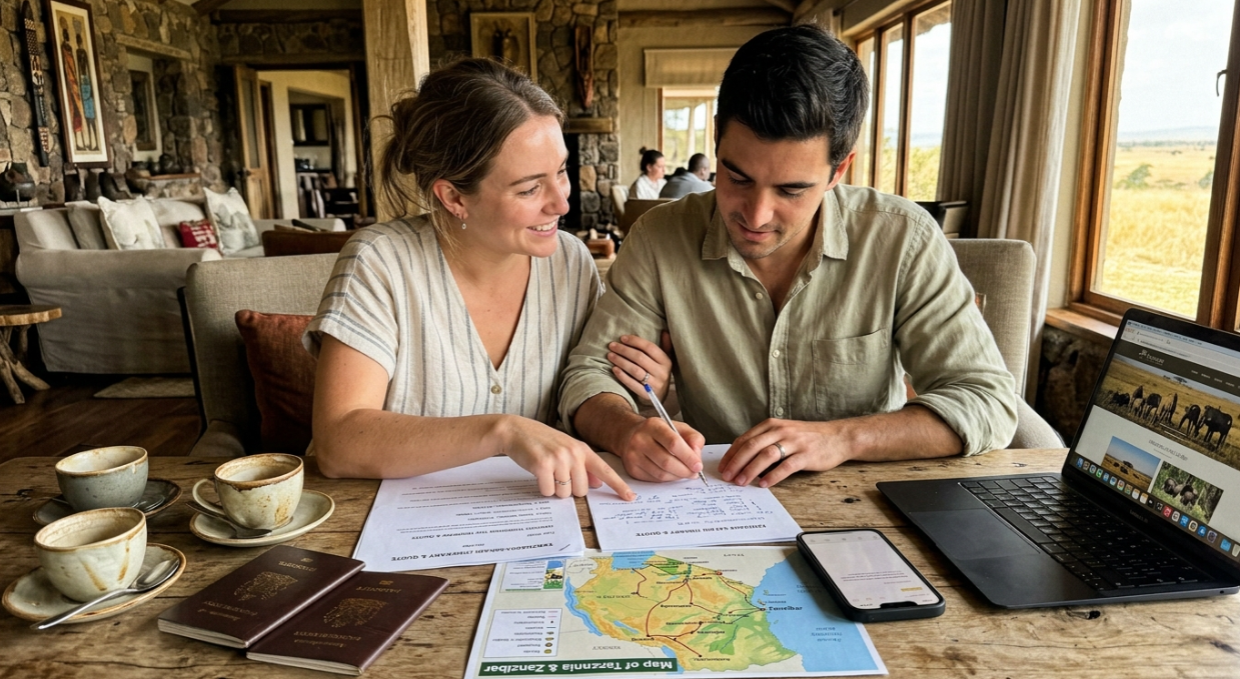
The headline nightly rate is not always the final price. When comparing Tanzania honeymoon quotes, check whether each proposal treats the following items as included, excluded, or optional.
|
Cost item |
Why it matters |
|---|---|
|
Accommodation |
Usually the largest fixed component |
|
Meals |
May be included under full board or all-inclusive rates |
|
Drinks |
House drinks may be included while premium beverages cost extra |
|
Park fees |
Can be included in safari rates or listed separately |
|
Conservation fees |
May appear as a separate charge |
|
Domestic flights |
Often essential for fly-in itineraries |
|
Balloon safari |
Usually an optional premium experience |
|
Private vehicle |
Can materially increase the safari rate |
|
Spa treatments |
Normally additional |
|
Diving and marine excursions |
Often separate from accommodation |
|
Tips |
Usually paid separately |
|
International flights |
Normally outside the safari package |
|
Travel insurance |
Normally paid separately |
|
Visa costs |
Normally paid separately |
What a Luxury Tanzania Honeymoon Actually Costs
Pricing varies dramatically based on season, accommodation tier, trip length, and how you choose to move between destinations. Here are realistic ranges based on 2026 operator data:
|
Trip Type |
Duration |
Approximate Cost Per Person |
|---|---|---|
|
Safari only (luxury tier) |
5-7 nights |
From ~$4,500 |
|
Bush + short beach |
7-9 nights |
From ~$6,500 |
|
Full bush and beach |
9-12 nights |
From ~$8,000 |
|
Ultra-luxury, fully private |
10-14 days |
From ~$12,000 |
These figures typically include accommodation, meals, game drives, park fees, and domestic flights. International flights, visas, travel insurance, tips, and premium add-ons (balloon safaris, spa, diving) are usually extra.
One cost insight worth noting: booking directly with a Tanzania-based operator instead of an overseas agency can reduce the total price by 25% to 40%, because you eliminate the intermediary markup. The operator on the ground is doing the actual work regardless of who sells the trip.
The “Slow Safari” Approach to Honeymoon Pacing
The most consistent advice from couples who have done it: fewer lodges, longer stays. Rushing between camps turns romance into logistics. Staying three nights somewhere instead of two changes the whole feeling.
This “slow safari” philosophy is gaining traction among modern couples. Instead of rushing to see everything, the goal is to see better. Spend a full morning watching a lion pride without checking your watch. Have a long breakfast on your veranda. Skip the afternoon game drive to swim in the pool together.
An Arusha-based honeymoon specialist with over 10 years of experience noted that romantic touches like in-room flower petal turndowns, private sunrise breakfasts on your lodge deck, guided nature walks, and private sunset dhow cruises are all inexpensive relative to the overall trip cost, and they’re the details couples remember most clearly.
For most couples, the best months for a Tanzania honeymoon are June through October (dry conditions, excellent Zanzibar weather) or January through February (calving season, warm beaches, fewer peak-season crowds).
If you’re comparing quotes and want help decoding what’s included, or if you want a bush-and-beach honeymoon built around your specific dates and priorities, Duma Explorer designs custom Tanzania honeymoon safaris with private vehicles, hand-picked camps, and the kind of small details that turn a trip into the trip.
Frequently Asked Questions
How long should a luxury Tanzania honeymoon be?
Ten to fourteen days is the standard range. This gives you 4 to 5 days on safari and 5 to 7 days on Zanzibar or a private island. Shorter trips (7 to 9 days) work but require tighter logistics and less beach time. Longer trips allow for additions like Tarangire, a spice tour, or a night in Stone Town.
What does a fly-in safari include that a road safari doesn’t?
Fly-in safaris include light-aircraft transfers between destinations instead of long 4x4 drives. You gain time (hours instead of a full day), access to remote camps, and aerial views of the landscape. The tradeoff is cost (flights add $200 to $500 per leg) and the 15 kg soft-bag luggage limit.
Is green season worth considering for a honeymoon?
Yes, especially for couples who want privacy and lower prices. Green season (March through May) can cut lodge costs by 30 to 50%. Parks are emptier, landscapes are lush, and birdlife is exceptional. The risk is rain and occasionally impassable roads. November’s “short rains” are a milder compromise: some discounts, less disruption.
What’s typically NOT included in “all-inclusive” safari pricing?
Balloon safaris ($500 to $600 per person), spa treatments, premium wines or champagne beyond house selection, diving excursions, laundry at some properties, charter flights between camps, travel insurance, international flights, visa fees, and gratuities for guides and camp staff.
What’s the luggage limit on bush flights, and how do honeymooners manage it?
Fifteen kilograms per person in a soft-sided duffel, no hard suitcases. Pack lightweight, quick-dry safari clothing and one set of nicer evening wear for Zanzibar. Most Zanzibar resorts offer laundry service, so you don’t need as many outfits as you’d think. Some couples ship a separate bag ahead to their beach hotel.
When should we start planning a luxury Tanzania honeymoon?
Six to twelve months in advance, especially for peak season (June through October) or if specific properties like Mnemba Island are on your list. Popular camps have limited capacity, often fewer than 20 guests, and sell out early. Calving season (January and February) is slightly easier to book with shorter lead times but still benefits from early planning.