

Tanzania Safari Packing List 2026: What to Pack & Why
TL;DR
Packing for a Tanzania safari involves country-specific rules that most generic lists ignore: a strict 15 kg luggage limit on bush planes (soft-sided duffels only), a nationwide ban on plastic bags since 2019, clothing colors dictated by tsetse fly science, and a camouflage ban rooted in military law. This glossary explains every term and item you’ll encounter in pre-trip emails, along with the reasoning behind each one.
Every safari operator sends a packing list. Most travelers glance at it, nod, and then spend three days stress-packing anyway. The problem isn’t a lack of lists. It’s a lack of explanation. Why a soft-sided duffel specifically? Why not dark blue? What exactly is a Type G plug, and will it fry a hair dryer?
This guide takes a different approach. Instead of another flat checklist, it defines and explains the terms, rules, and gear categories that show up in pre-trip documents, organized so you understand not just what to pack but why it matters in Tanzania specifically. These recommendations come from years of guiding on the northern circuit, where conditions vary from the dusty plains of Tarangire to the chilly rim of Ngorongoro Crater.
If you’re still in the planning stages, start with our guide to private Tanzania safari options to match your route and lodging preferences before you start packing.
Quick Answer: What Do You Pack for a Tanzania Safari? A Tanzania safari packing list should focus on lightweight, neutral-colored clothing, a soft-sided duffel bag under 15–20 kg, and essential travel gear for bush flights and remote lodges. Key items include layered clothing for temperature swings, a Type G adapter, malaria protection, insect repellent (DEET + permethrin-treated clothing), binoculars, a reusable water bottle, and a buff for dust protection. Hard-shell suitcases and plastic bags are not allowed on most safari routes, and camouflage clothing is prohibited by law.
Tanzania Safari Packing Checklist (At a Glance)
|
Category |
Must-Pack Items |
Why It Matters |
|---|---|---|
|
Luggage |
Soft duffel (<15 kg), daypack |
Required for bush flights |
|
Clothing |
Neutral layers, fleece, shell jacket |
Extreme temperature swings |
|
Footwear |
Closed shoes + sandals |
Terrain + lodge comfort |
|
Health |
Malaria meds, DEET, sunscreen |
High-risk equatorial zone |
|
Electronics |
Type G adapter, power bank |
Limited electricity in camps |
|
Documents |
Passport, yellow fever card |
Strict border enforcement |
|
Safari Gear |
Binoculars, camera lens |
Long-distance wildlife viewing |
|
Safety |
Travel insurance |
Remote medical evacuation costs |
Tanzania Safari Regions That Affect What You Pack
Different parks in Tanzania require slightly different packing priorities:
-
Serengeti National Park → Dust protection, binoculars, telephoto lens
-
Tarangire National Park → Tsetse fly protection, long sleeves
-
Ngorongoro Conservation Area → Cold-weather layering, fleece jacket
-
Lake Manyara National Park → Mixed terrain, insect repellent
Luggage and Transport Terms
Soft-Sided Duffel
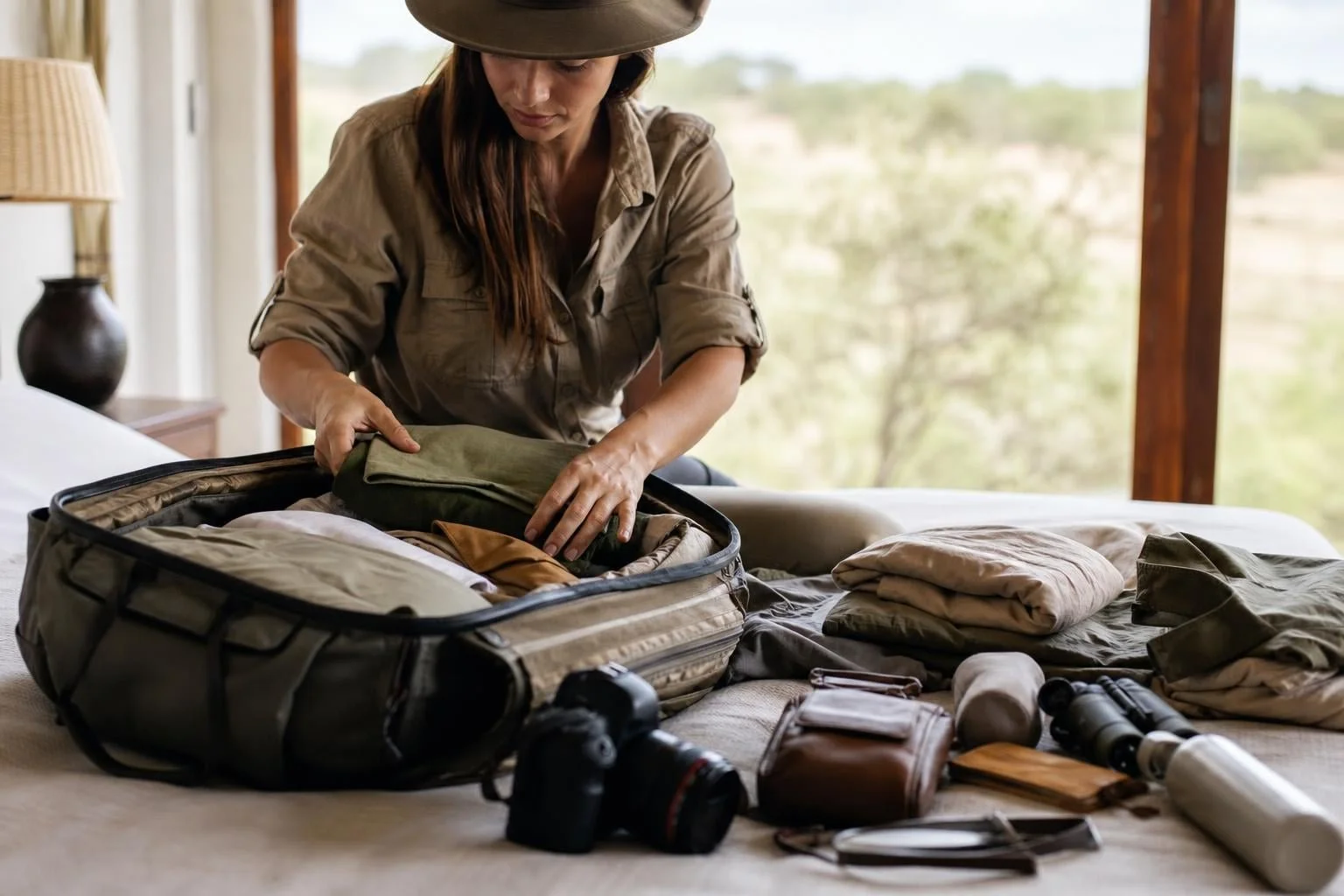
A soft-sided duffel is a bag made without rigid frames, hard shells, or internal spines. On a Tanzania safari, this isn’t a suggestion. It’s a requirement for anyone taking domestic bush flights between parks. The cargo holds on light aircraft (Cessna Caravans and similar) are small, oddly shaped compartments. Ground crews need to compress and manipulate your bag to fit it in alongside other passengers’ luggage. A hard-shell suitcase simply won’t work.
Look for a duffel between 50 and 80 liters with minimal internal structure. One flat reinforced side is usually acceptable. Avoid bags with large built-in wheels, though small inline wheels are sometimes tolerated.
Practical tip: Pack your duffel inside a larger suitcase for the international flight, then leave the suitcase at your Arusha hotel. Most hotels store luggage for free.
Bush Plane Weight Limit (The 15 kg Rule)
This is the single most misunderstood packing constraint for Tanzania safaris. Domestic bush flights enforce strict per-person luggage limits that include everything: your duffel and your day pack combined.
The specifics vary by airline. Coastal Aviation typically allows 15 kg (33 lbs) per person, with maximum bag dimensions of 76 cm x 48 cm x 29 cm. Air Excel is slightly more generous at 20 kg (44 lbs) per person. Both require soft bags. Your operator should confirm which airline you’re flying, but planning around the 15 kg limit is the safest approach.
Practitioners on Reddit and TripAdvisor report that excess baggage charges are steep, and in some cases, bags are simply left behind for the next flight. Weigh your packed duffel at home. Then weigh it again.
Day Pack
A small backpack (20 to 30 liters) that goes with you into the safari vehicle for each game drive. It should hold your camera, extra lens, binoculars, sunscreen, water bottle, snacks, and a light jacket. On bush flights, this counts toward your total weight allowance, so keep it under 3 to 4 kg.
Packing Cubes
Compression packing cubes are especially useful inside soft duffels, which lack the structure and compartments of a suitcase. They keep clothing organized and allow you to compress items to maximize space. Color-coded cubes (one for clean clothes, one for worn items) make it easy to stay organized across multiple lodge stops.
Laundry Service at Lodges
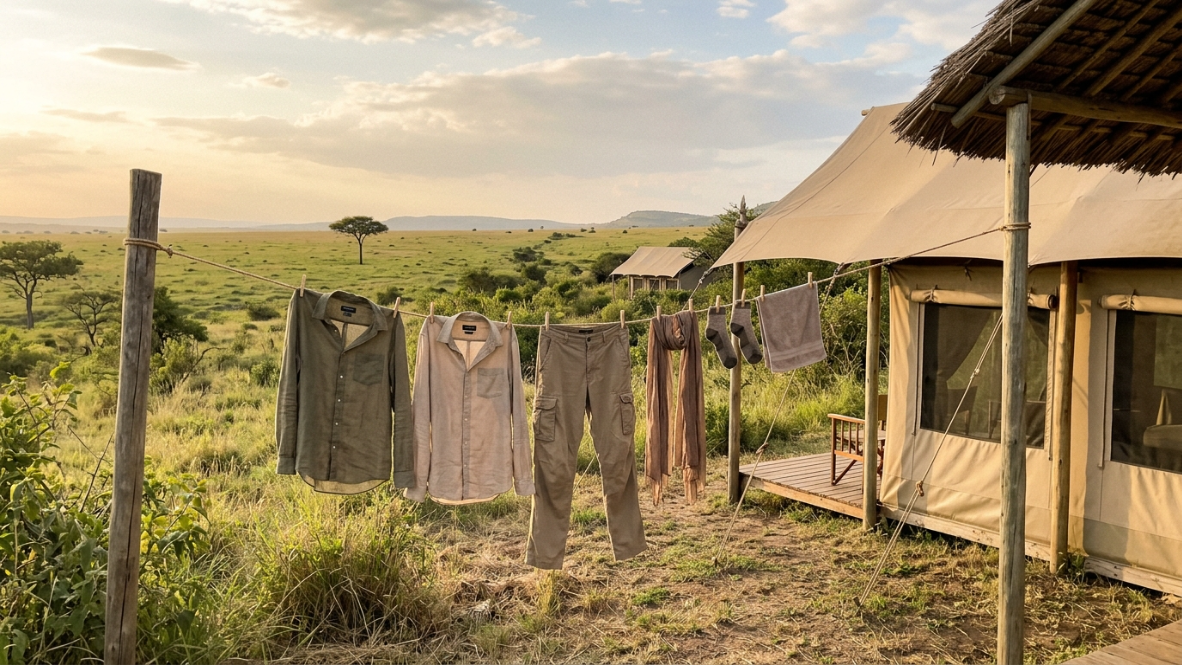
Most safari lodges and tented camps in Tanzania offer same-day or next-day laundry service, often included in the room rate. This means you can pack significantly fewer clothes than you’d think. Three to four sets of safari clothing is enough for a two-week trip if you rotate through laundry cycles.
One important note: laundry is typically hand-washed and line-dried, so delicate fabrics may not fare well. Pack clothes that can handle some rough treatment.
For travelers choosing higher-end accommodations, luxury safari lodges typically provide toiletries, robes, and other amenities that further reduce what you need to bring.
Clothing and Fabric Terms
Neutral and Earth-Tone Clothing
Khaki, olive, beige, tan, and muted brown are the standard colors for a Tanzania safari packing list. There are three reasons.
First, animals are less startled by colors that blend with the environment. Second, lighter earth tones stay cooler than dark fabrics under equatorial sun. Third, the red-brown dust of the Serengeti and Tarangire will stain everything anyway, and it shows far less on earth-tone clothing than on white or bright colors.
Avoid bright white (reflects light harshly, shows every speck of dust) and very dark colors like black and navy (attract heat and certain biting insects).
Tsetse Fly Colors
This deserves its own entry because it’s one of the most frequently discussed and least understood topics in Tanzania safari packing.
Tsetse flies have color vision. Research published in PLOS Neglected Tropical Diseases found that blue and black are the strongest attractors, followed by red. The study tested 37 different colored fabric squares on tsetse populations near Lake Victoria and measured landing rates.
This isn’t trivial. Tsetse bites are painful, can penetrate denim, and in rare cases transmit sleeping sickness. One experienced safari-goer on TripAdvisor noted that “lathering your body in DEET doesn’t deter the tsetse fly from biting.” DEET works for mosquitoes, not tsetse.
Which parks are worst? Tsetse flies prefer woodlands, especially scrub trees near water. On Tanzania’s northern circuit, Tarangire National Park is the most common encounter zone, followed by the wooded areas of the western Serengeti and parts of Lake Manyara. The open grasslands of the Serengeti plains and the Ngorongoro Crater floor tend to have far fewer. Practitioners on travel forums consistently confirm this park-by-park pattern.
What to wear: Light-colored, loose-fitting, mid-weight fabrics. Tsetse can bite through thin or tightly fitted clothing like leggings, thin cotton, or athletic wear. Looser, slightly heavier material makes it much harder for them to penetrate.
Camouflage Ban
In many East African countries, camouflage patterns are reserved strictly for the military and police. Wearing camouflage in Tanzania is prohibited for citizens and strongly discouraged for visitors. In neighboring countries like Zimbabwe and Uganda, it’s outright illegal for anyone and can result in fines or clothing confiscation at the airport.
Leave camo jackets, pants, hats, and bags at home. If you’re combining a Tanzania safari with gorilla trekking in Uganda or Rwanda, this rule applies there too.
Layering System
This is the most important clothing concept for a Tanzania safari packing list, and many first-time visitors get it wrong.
The northern circuit (Tarangire, Lake Manyara, Serengeti, Ngorongoro) sits at elevations ranging from 900 to 2,300 meters above sea level. Morning game drives start before sunrise, when temperatures in open-topped vehicles can drop below 10°C (50°F). By midday, the same location might reach 30°C (86°F). The temperature swing can be 20 degrees within a few hours.
The solution is a three-layer system:
-
Base layer: A breathable, moisture-wicking long-sleeve shirt. Synthetic or merino wool, not cotton.
-
Mid layer: A mid-weight fleece or softshell jacket. This is your workhorse for early morning and evening drives.
-
Outer layer: A lightweight, windproof, and ideally water-resistant shell jacket. Even during the dry season, unexpected rain happens.
Travelers who pack only t-shirts and shorts end up shivering before sunrise. Those who bring heavy winter coats carry unnecessary weight. Layering solves both problems.
Your packing needs will also shift based on when you’re visiting, since June through August mornings are notably colder than December visits.
UPF Clothing
UPF (Ultraviolet Protection Factor) is the fabric equivalent of SPF for sunscreen. A UPF 50 shirt blocks roughly 98% of UV radiation. This matters on safari because you’re spending six to eight hours per day outdoors, often in open vehicles at equatorial latitudes where UV intensity is extreme.
Several outdoor brands sell lightweight, long-sleeve safari shirts with UPF 50+ ratings. They dry quickly, breathe well, and eliminate the need to constantly reapply sunscreen to your arms and torso.
Buff / Neck Gaiter
A stretchy tube of fabric that you wear around your neck and pull up over your nose and mouth when driving through dusty sections. This is the most underrated item on any Tanzania safari packing list. It also works as sun protection for your neck, a headband, and extra warmth on cold mornings.
The red laterite dust in parks like Tarangire and the Serengeti gets everywhere. Into your camera bag, your nostrils, between your teeth. A buff weighs nothing, takes up zero space, and makes dust encounters far more comfortable. Experienced safari guides consider it essential gear.
Permethrin Treatment
Permethrin is an insecticide that can be applied to clothing, where it remains effective for multiple weeks (or through several wash cycles, depending on the product). Unlike DEET, which you apply to skin and which mosquitoes simply avoid, permethrin kills or disables insects on contact with the treated fabric.
Treating your safari shirts, pants, and socks with permethrin before your trip provides passive protection against both mosquitoes and tsetse flies. You can buy pre-treated clothing or apply a spray-on treatment at home. It’s odorless once dry and safe for skin contact through the fabric.
Practical tip: Treat your clothes at least 24 hours before packing to allow full drying.
Compression Socks
These are graduated-pressure socks designed to improve blood circulation during long periods of sitting. The flight to East Africa is typically 15 to 20 hours of travel time, and deep vein thrombosis (DVT) risk increases on long-haul flights. Compression socks are a simple, inexpensive preventive measure.
What NOT to Pack for a Tanzania Safari
Many first-time safari travelers overpack items that are unnecessary or even restricted. Avoiding these will save luggage space and prevent issues at customs or airstrips.
Do NOT bring:
-
Hard-shell suitcases (not accepted on bush flights)
-
Plastic shopping bags (banned in Tanzania since 2019)
-
Camouflage clothing (restricted by law in East Africa)
-
Heavy jeans or thick cotton clothing (too hot + slow drying)
-
High heels or formal shoes (not suitable for safari terrain)
-
Excess toiletries (most lodges provide basics)
-
Single-use plastics (encouraged to eliminate entirely)
Health, Safety, and Documents
Malaria Prophylaxis
Malaria is transmitted by Anopheles mosquitoes, which are active primarily at dawn and dusk. The northern safari circuit is a malaria zone, and travel clinics strongly recommend prophylactic medication. Common options include Malarone (atovaquone-proguazone), doxycycline, and mefloquine. Each has different side effect profiles, dosing schedules, and costs.
Consult a travel medicine clinic at least four to six weeks before departure. Do not skip this. For more on staying safe in East Africa, including health precautions, our safety guide covers the full picture.
Yellow Fever Certificate
Tanzania requires proof of yellow fever vaccination for travelers arriving from or transiting through countries with yellow fever transmission risk. This includes common routing countries like Ethiopia (Addis Ababa is a major transit hub for East Africa flights). The vaccination is administered as a single dose that provides lifelong immunity, and you’ll receive an International Certificate of Vaccination (the “yellow card”).
Even if your travel route doesn’t technically require it, some operators and immigration officers may request it. Getting vaccinated eliminates any ambiguity at the border. For full entry requirements, see the Tanzania visa and entry guide.
DEET Repellent
DEET (N,N-Diethyl-meta-toluamide) is the gold standard active ingredient in insect repellents. A concentration of 25 to 30% provides effective protection against mosquitoes for several hours.
Important timing note: you primarily need repellent at dawn and dusk, when mosquitoes are active. During the midday heat, mosquitoes are largely dormant. Most reputable lodges also provide repellent in guest rooms, so one small personal bottle is enough.
Cream or roll-on formulations are better than aerosol sprays for safari use. Sprays create a fine mist that can drift into vehicle cabins, affect other passengers, and damage camera lens coatings. Stick or cream gives you precise application where you need it.
Coastal extension note: If you’re adding Zanzibar or the Swahili Coast after your safari, pack repellent for that portion too. Many travelers assume the beach is low-risk, but mosquito exposure is actually higher in coastal areas. Check our Zanzibar packing list for beach-specific guidance.
Travel Insurance
Travel insurance for a Tanzania safari should include two critical coverages: trip cancellation/interruption and emergency medical evacuation. Evacuation from a remote bush camp to a hospital in Nairobi or Dar es Salaam can cost $50,000 or more out of pocket. Standard health insurance policies from most countries do not cover this.
Look for policies that specifically cover “adventure travel” or “safari” activities and confirm that helicopter/air ambulance evacuation is included. Some credit card travel benefits have altitude or activity exclusions that would apply to Kilimanjaro but not safari.
Passport (6-Month Validity Rule)
To enter Tanzania, your passport must have at least six months of validity remaining from your date of arrival and at least one blank page for the visa stamp. This is strictly enforced. Airlines may deny boarding if your passport doesn’t meet this requirement.
US Dollars (Small Bills) for Tipping
Cash in US dollars is the preferred tipping currency in Tanzania. Safari guides, drivers, lodge staff, and camp crews all rely on tips as a significant portion of their income. The general guideline is $10 to $20 per person, per day for your driver-guide, plus an additional $10 to $20 daily distributed among various lodge and camp staff.
Bring small denominations: $1, $5, $10, and $20 bills. Larger bills are hard to break. Also ensure your bills are recent (post-2006 series) and in good condition, as older or damaged US currency is often refused in East Africa. For a complete breakdown of what safaris cost beyond tips, the Tanzania safari cost glossary covers park fees, vehicle costs, and more.
Note that Tanzanian ATMs typically limit withdrawals to 400,000 to 600,000 Tsh per transaction (roughly $140 to $220 USD), so don’t count on getting all your tip cash locally.
First-Aid Kit Essentials
Your operator and guide will carry a more comprehensive medical kit, but a small personal kit should include: basic painkillers (ibuprofen, paracetamol), antihistamines for allergic reactions, anti-diarrheal medication (loperamide), oral rehydration salts, adhesive bandages, antiseptic wipes, and any personal prescription medications.
One tip that surfaces repeatedly on Reddit travel forums: bring activated charcoal tablets for stomach issues. Multiple travelers report it as the single most useful item for dealing with mild food-related discomfort during the first day or two of adjusting to different cuisine and water.
Tanzania Safari Packing by Season (Dry vs Wet Season)
Your packing list should change slightly depending on when you travel.
Dry Season (June–October)
-
Cold mornings (as low as 5–10°C in Ngorongoro)
-
Dust-heavy conditions in Serengeti and Tarangire
-
Minimal rain gear required
Add:
-
Extra fleece layer
-
Buff for dust protection
-
Lip balm + moisturizer (dry air)
Wet Season (November–May)
-
Afternoon rain showers common
-
Higher humidity and mosquito activity
-
Greener landscapes and thicker vegetation
Add:
-
Lightweight waterproof jacket
-
Quick-dry clothing
-
Extra insect repellent (higher mosquito exposure)
Gear and Electronics
Type G Plug (UK-Style Adapter)
Tanzania uses the Type G plug, the same three-rectangular-pin configuration used in the United Kingdom. The country’s electrical standard is 230V at 50Hz.
You’ll need a travel adapter if your devices use a different plug type. However, many newer Tanzanian hotels and lodges have installed universal outlets that accept multiple plug types. Don’t count on this at every stop, though. Bring at least one Type G adapter.
Adapter vs. Converter
This distinction confuses many travelers. An adapter changes the physical shape of your plug to fit a foreign outlet. A converter changes the voltage.
Here’s the good news: most modern electronics (laptops, phone chargers, camera chargers, tablets) are dual-voltage. Check the fine print on your charger. If it says “INPUT: 100-240V, 50/60Hz,” you only need an adapter. A converter is unnecessary. This covers the vast majority of devices travelers carry.
The exception is devices with heating elements or motors: hair dryers, curling irons, electric shavers. These are often single-voltage (110V only for US devices) and would need a converter, or better yet, just leave them at home. Most lodges provide hair dryers.
Power Bank / Portable Charger
In bush camps and mobile tented camps, electricity may only be available during certain hours (typically evening generator time) or from solar systems with limited capacity. A portable charger with at least 10,000 mAh ensures you can keep your phone and camera batteries topped up between charges.
Bring your charging cables and start each day with a full power bank. Some photographers carry two power banks and rotate them.
Binoculars
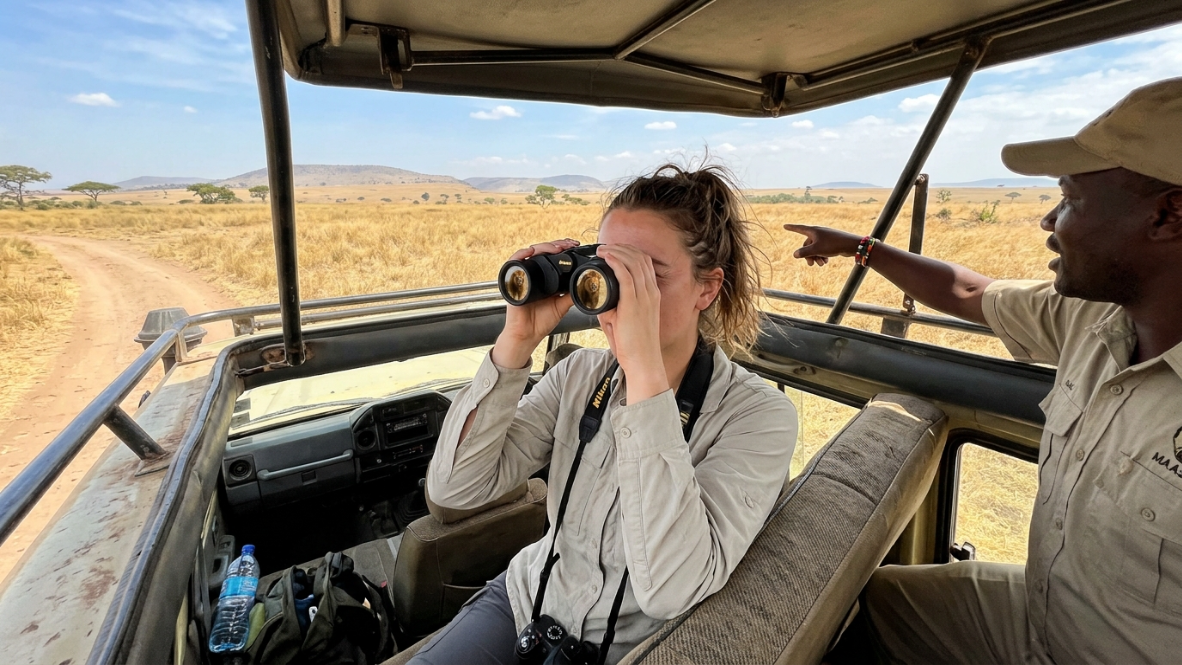
A pair of binoculars is arguably more important than a camera for overall safari enjoyment. Not everything is close. A cheetah on a distant ridge, a martial eagle in a treetop, a leopard draped over a branch 200 meters away. Binoculars make these moments vivid in ways a phone screen never will.
Look for 8x42 or 10x42 specifications. The first number is magnification, the second is the objective lens diameter in millimeters. Larger objective lenses gather more light, which matters for early morning and late evening viewing.
Telephoto Lens (200-600mm Range)
For serious wildlife photography, a telephoto zoom in the 100-500mm or 200-600mm range is the primary safari lens. Experienced safari photographers recommend bringing this on a dedicated camera body, with a second body fitted with a 24-105mm lens for wider environmental shots.
The reason for two bodies: you do not want to change lenses during a game drive. The fine red dust that’s everywhere in Tanzania’s parks will settle on your sensor the moment you expose it. Dust spots on every subsequent image are the result.
For a deeper look at photography gear for wildlife settings, the gorilla trekking photography guide covers gear selection and camera settings in challenging light.
Dust Covers and Dry Bags
Bring rain/dust covers for cameras and lenses. Even in the dry season, afternoon showers happen, and dust is a constant companion. A simple plastic rain sleeve that fits over your camera and lens costs a few dollars and saves thousands in sensor cleaning or repairs.
A small dry bag or waterproof stuff sack is also worth carrying for your phone, passport, and other documents. It protects against both rain and the dust that works its way into every zipper and pocket.
Bean Bag (Camera Support)
A bean bag is a small, fabric pouch that you fill with rice or beans and drape over the vehicle’s window frame or roof hatch edge. It creates a stable, vibration-dampening platform for your telephoto lens, far more effective than trying to handhold a heavy lens from a moving vehicle.
You can buy one specifically designed for photography or simply bring an empty fabric bag and fill it with dry rice or beans from a market in Arusha. Some photographers bring them pre-filled; others fill on arrival to save weight (remember that 15 kg limit).
Memory Cards and Storage
Bring more memory cards than you think you’ll need. A single game drive can produce 500 to 1,000 images if you’re shooting wildlife action. Two to three 128 GB cards is a reasonable minimum for a week-long safari. A portable hard drive or laptop for nightly backups adds security.
Sensor Cleaning Kit
If you’re carrying interchangeable-lens cameras, a basic sensor cleaning kit (rocket blower, sensor swabs, cleaning solution) can save a trip. Despite best efforts, dust finds its way in. A rocket blower handles most particles; sensor swabs handle the stubborn ones.
Headlamp / Torch
Many tented camps and bush lodges have limited lighting on pathways between your tent and the dining area. A small headlamp lets you navigate safely at night while keeping both hands free. Red-light mode is ideal because it preserves your night vision and is less likely to disturb wildlife.
Tanzania-Specific Rules and Conditions
Plastic Bag Ban (June 2019)
Since June 1, 2019, Tanzania has enforced a strict ban on single-use plastic bags. This applies to bags brought into the country in carry-on and checked luggage. Customs officers screen for prohibited items at points of entry, and non-compliance can result in confiscation, delays, or fines.
The practical reality, according to multiple travel practitioners, is that enforcement is courteous and focused on education rather than punishment. Still, the simplest approach is to not bring any disposable plastic bags.
The ziplock exception: Clear resealable bags (ziplocks) for toiletries are permitted, but with a condition. You must keep them with you for the entire trip and take them home. They cannot be disposed of in Tanzania.
Practical tip: Repack toiletries into reusable silicone bags before departure. Use cloth or mesh bags for organizing items inside your duffel instead of plastic shopping bags.
Safari Dust (Red Earth)
The laterite soil across much of Tanzania’s safari circuit is a fine, iron-rich red dust that coats everything. Cameras, clothing, skin, the inside of your bag. It’s not a problem to solve, just a reality to plan for.
Choose clothing in colors that won’t show dust stains prominently (another point for earth tones over white). Bring lens wipes for cameras and binoculars. Keep electronics in protective cases or dry bags when not in use. Accept that your beige safari shirt will be a warm terracotta by day three.
Reusable Water Bottle
Most lodges, tented camps, and safari vehicles offer filtered or purified water refill stations. A 750 ml to 1 liter reusable bottle is enough. This reduces plastic waste (important given the bag ban ethos) and ensures you stay hydrated during long game drives. Insulated bottles keep water cool in the midday heat.
Quick-Reference: The Complete Tanzania Safari Packing List
Luggage: Soft-sided duffel (under 15 kg packed), day pack, packing cubes
Clothing: 3 to 4 neutral-toned long-sleeve shirts (UPF rated), 2 to 3 pairs of safari pants (zip-off convertible work well), mid-weight fleece, windproof shell jacket, wide-brimmed hat, buff/neck gaiter, underwear and socks for 4 days, one set of casual evening clothes, sturdy closed-toe walking shoes, sandals for lodges
Health and toiletries: Malaria prophylaxis, DEET cream/roll-on, sunscreen (SPF 50+), lip balm with SPF, hand sanitizer, personal first-aid kit, prescription medications, activated charcoal tablets
Documents: Passport (6+ months validity), yellow fever certificate, printed travel insurance policy, photocopies of all documents (stored separately), visa confirmation, US dollars in small bills
Electronics: Type G adapter, power bank (10,000+ mAh), charging cables, headlamp with extra batteries
Photography (optional): Camera body with telephoto lens (200-600mm), second body with wide zoom, dust covers, bean bag, extra memory cards, sensor cleaning kit, portable hard drive
Miscellaneous: Binoculars, reusable water bottle, sunglasses (polarized), compression socks for flights, small dry bag
Frequently Asked Questions
Can I bring a hard-shell suitcase on a Tanzania safari?
Only if your entire trip is by road vehicle. If your itinerary includes any domestic bush flights (which most Serengeti itineraries do), hard-shell suitcases are not accepted. Soft-sided duffels are mandatory due to the small, irregularly shaped cargo holds on light aircraft. Check with your operator about your specific transfers.
How strictly is the 15 kg luggage limit enforced?
Very strictly. Bags are weighed at the airstrip before boarding, and excess weight results in surcharges or your bag being held for a later flight. The 15 kg limit applies to Coastal Aviation and includes your day pack. Air Excel allows 20 kg. Plan for the lower limit unless your operator confirms otherwise.
What happens if I accidentally bring plastic bags into Tanzania?
Customs officers will likely confiscate them at the airport. Enforcement tends to be polite and educational rather than punitive, but bringing prohibited items can cause delays during entry processing. The safest approach is simply to leave all single-use plastic bags at home and use cloth, mesh, or reusable silicone alternatives.
Do I really need malaria medication for a northern circuit safari?
Travel medicine professionals consistently recommend prophylaxis for the northern circuit, which includes Tarangire, Serengeti, and Ngorongoro. The risk is moderate, and the consequences of contracting malaria are serious. Combine medication with physical prevention: DEET at dawn/dusk, permethrin-treated clothing, and long sleeves during active mosquito hours.
Is a telephoto lens necessary, or can I use my smartphone?
A smartphone will capture wide scenic shots and closer animals (elephants at your vehicle, for example). But for most wildlife photography, the subjects are too far away for phone cameras to produce satisfying results. A 200-600mm telephoto lens is the workhorse range for safari photography. If you’re not a photographer, consider renting a lens rather than buying one.
What colors should I absolutely avoid wearing on safari?
Dark blue and black attract tsetse flies, which are common in wooded areas of Tarangire and the Serengeti. Bright white shows dust and can startle animals. Camouflage patterns are prohibited in Tanzania and several neighboring countries. Stick to khaki, olive, beige, and muted earth tones.
How much cash should I bring for tipping?
Budget $20 to $40 per person, per day total: $10 to $20 for your driver-guide and roughly the same distributed among lodge and camp staff. For a seven-day safari, that’s approximately $140 to $280 per person in small US bills ($1, $5, $10, $20). Bring bills printed after 2006 in good condition.
Do lodges really do laundry, and is it included?
Most safari lodges and tented camps offer laundry service, often included or for a small fee. Clothes are hand-washed and line-dried, usually returned within 24 hours. This means three to four outfits can carry you through a trip of any length. Don’t overpack.
What is the most important item for a Tanzania safari?
A soft-sided duffel bag under the airline weight limit is the most critical item, as bush flights strictly prohibit hard-shell suitcases.
Can I wear jeans on safari?
You can, but they are not recommended. Jeans are heavy, slow to dry, and uncomfortable in hot daytime temperatures.
Do I need special clothing for game drives?
Yes. Lightweight, neutral-colored layered clothing is best for temperature changes and wildlife visibility conditions.
Is laundry available on safari?
Yes. Most lodges in Tanzania offer same-day laundry service, reducing the need to overpack.
Can I bring a drone to Tanzania?
In most cases, drones require government permits and are restricted in national parks. Always check regulations before travel.
A thorough packing list removes one of the biggest sources of pre-trip anxiety. But the right operator removes the rest, from route planning and permit logistics to guide quality and vehicle reliability. If you’re still designing your Tanzania trip, explore safari itineraries, routes, and costs or learn about common safari booking mistakes before you finalize plans.