

Tanzania Safari Locations: Guide to Parks & Circuits 2026
TL;DR
Tanzania has more than 22 national parks and reserves spread across three main safari circuits: Northern, Southern, and Western. The Northern Circuit (Serengeti, Ngorongoro, Tarangire, Lake Manyara) draws the most visitors, but the Southern and Western circuits offer larger parks, fewer crowds, and unique experiences like boat safaris and chimpanzee trekking. Where you go depends on what you want to see, how much time you have, and whether you prioritize the Great Migration, Big Five density, or genuine wilderness solitude.
Tanzania protects roughly 44% of its land as wildlife areas. That’s a staggering amount of wilderness, and it means the list of Tanzania safari locations stretches far beyond the Serengeti and Ngorongoro Crater that dominate most travel brochures. There are remote western parks where fewer than 2,000 international visitors show up per year, a coastal park where elephants wander within sight of the Indian Ocean, and a southern reserve larger than Belgium that receives less than 1% of the country’s tourists.
This guide covers every major safari destination in Tanzania, organized by circuit. Each entry explains what makes the location distinct, what wildlife to expect, how to get there, and when to visit. Whether you’re comparing parks for a first trip or building a multi-stop itinerary, every section is designed to help you make decisions faster.
Planning your route? Our East Africa safari itineraries guide breaks down the most popular multi-park routes with timing and cost context.
Quick Answer: Which Tanzania Safari Location Is Best? If you're planning your first safari, the Northern Circuit is the best overall choice because it combines the Serengeti, Ngorongoro Crater, Tarangire, and Lake Manyara into one easy itinerary with the highest wildlife density.
Choose a different circuit if your priorities differ:
|
If you want... |
Go here |
|---|---|
|
First safari |
Northern Circuit |
|
Great Migration |
Serengeti |
|
Big Five in one day |
Ngorongoro Crater |
|
Elephant herds |
Tarangire |
|
Boat safaris |
Nyerere |
|
Wild dogs |
Ruaha |
|
Chimpanzees |
Mahale or Gombe |
|
Very few tourists |
Katavi |
|
Safari + beach |
Saadani + Zanzibar |
|
Budget safari |
Mikumi |
|
Luxury fly-in safari |
Southern Circuit |
Safari Circuits Explained
Tanzania’s safari locations are organized into three geographic circuits. Think of these as regional clusters. Parks within the same circuit sit close enough together to combine into a single trip without exhausting travel days.
Northern Safari Circuit
The Northern Circuit is the most popular Tanzania safari route. It includes the Serengeti, Ngorongoro Conservation Area, Tarangire, Lake Manyara, and Arusha National Park. The gateway city is Arusha, which has an international airport and sits within a few hours’ drive of every park in the circuit.
Most first-time visitors to Tanzania choose the Northern Circuit, and for good reason. It concentrates the Big Five, the Great Migration, and some of Africa’s most iconic scenery into a compact area. A typical Northern Circuit safari runs 4 to 7 days, which keeps costs manageable relative to the remoter circuits.
The trade-off: popularity means higher visitor density, especially at Ngorongoro Crater and central Serengeti between July and October.
Southern Safari Circuit
The Southern Circuit is larger, less visited, more remote, and offers different wildlife experiences. It includes Nyerere National Park (formerly Selous Game Reserve), Ruaha National Park, Mikumi, and the Udzungwa Mountains. The gateway is Dar es Salaam rather than Arusha.
What sets the south apart? Boat safaris on the Rufiji River, walking safaris through genuine wilderness, and some of Africa’s best wild dog sightings. Tanzania’s southern parks are larger than the entire Serengeti ecosystem combined, yet they receive a fraction of the visitors.
The trade-off is higher cost and logistics complexity. Light aircraft flights are usually necessary, and most 7-day southern trips run $4,500 to $9,000 per person. For a deeper look at what these trips involve, see our remote Tanzania safaris guide.
Western Safari Circuit
The Western Circuit covers Mahale Mountains, Katavi, and Gombe Stream, all clustered around Lake Tanganyika in far western Tanzania. These parks are the hardest to reach and the least visited, but they offer something no other circuit can: wild chimpanzee trekking in pristine mountain forest.
Access is by small aircraft and, in Mahale’s case, by boat only. Visitors who make the effort are rewarded with near-total solitude and some of Africa’s most dramatic scenery, where jungle-cloaked mountains plunge straight into the continent’s deepest lake.
Which Tanzania Safari Circuit Should You Choose?
Most travelers only have enough time to visit one safari circuit. The best choice depends on your priorities.
Choose the Northern Circuit if...
-
It's your first safari
-
You want the Great Migration
-
Seeing the Big Five matters most
-
You're driving instead of flying
-
You have under a week
Choose the Southern Circuit if...
-
You've already visited Serengeti
-
You dislike crowds
-
You want walking safaris
-
Boat safaris interest you
-
You want luxury fly-in camps
Choose the Western Circuit if...
-
Chimpanzees are your priority
-
You enjoy remote travel
-
You have a larger budget
-
You want one of Africa's least-visited safari experiences
This captures many long-tail searches like:
-
best safari circuit Tanzania
-
northern vs southern safari
-
which Tanzania safari should I choose
Tanzania Safari Locations at a Glance
|
Location |
Best Known For |
Days Needed |
Crowd Level |
First-Time Friendly |
|---|---|---|---|---|
|
Serengeti |
Great Migration |
3-5 |
High |
Yes |
|
Ngorongoro |
Big Five |
1 |
High |
Yes |
|
Tarangire |
Elephants |
1-2 |
Medium |
Yes |
|
Lake Manyara |
Birding |
0.5-1 |
Medium |
Yes |
|
Arusha |
Walking safari |
0.5-1 |
Low |
Yes |
|
Nyerere |
Boat safari |
3-4 |
Low |
No |
|
Ruaha |
Lions & wild dogs |
3-4 |
Very Low |
No |
|
Katavi |
Wilderness |
3-4 |
Extremely Low |
No |
|
Mahale |
Chimp trekking |
3-5 |
Extremely Low |
No |
|
Gombe |
Jane Goodall |
2-3 |
Very Low |
No |
|
Saadani |
Bush & beach |
2-3 |
Low |
Yes |
Northern Circuit Locations
Arusha National Park
It always surprises repeat safari visitors how few people bother with Arusha National Park. Sitting just 25 kilometers from Arusha city, this compact park gets skipped by travelers rushing to the Serengeti. That’s a mistake.
Arusha NP sits at the foot of Mount Meru (Tanzania’s second-highest peak at 4,566 meters) and packs diverse habitats into a small footprint: montane forest, crater lakes, and open grassland. It’s one of the few Northern Circuit parks that offers walking safaris, and its Momela Lakes attract flamingos and over 400 bird species. Black-and-white colobus monkeys are common in the forest sections, and buffalo, giraffe, and waterbuck roam the meadows.
Best for: Half-day or full-day safaris on arrival day, walking safaris, Mount Meru acclimatization hikes, birding.
Access: 45-minute drive from Arusha or Kilimanjaro International Airport. No flight needed.
Crowd level: Low. Most tour vehicles pass through without stopping.
Lake Manyara National Park
Covering just 33,000 hectares, Lake Manyara National Park is a compact sanctuary of remarkable biodiversity. The park sits at the base of the Great Rift Valley escarpment, and its alkaline lake can host millions of flamingos during the right season.
Lake Manyara is famous for two things: tree-climbing lions and exceptional birding. Over 500 bird species have been recorded here. The park also supports buffalo, hippo, giraffe, elephant, and leopard in a condensed area that makes for productive half-day game drives.
Best for: Birding, tree-climbing lions, a shorter game drive between Arusha and the Serengeti or Ngorongoro.
Access: 2-hour drive from Arusha. Often combined as a stopover en route to Ngorongoro.
Crowd level: Moderate. The small size means vehicles cluster, but drives are typically half-day.
Ngorongoro Conservation Area and Crater
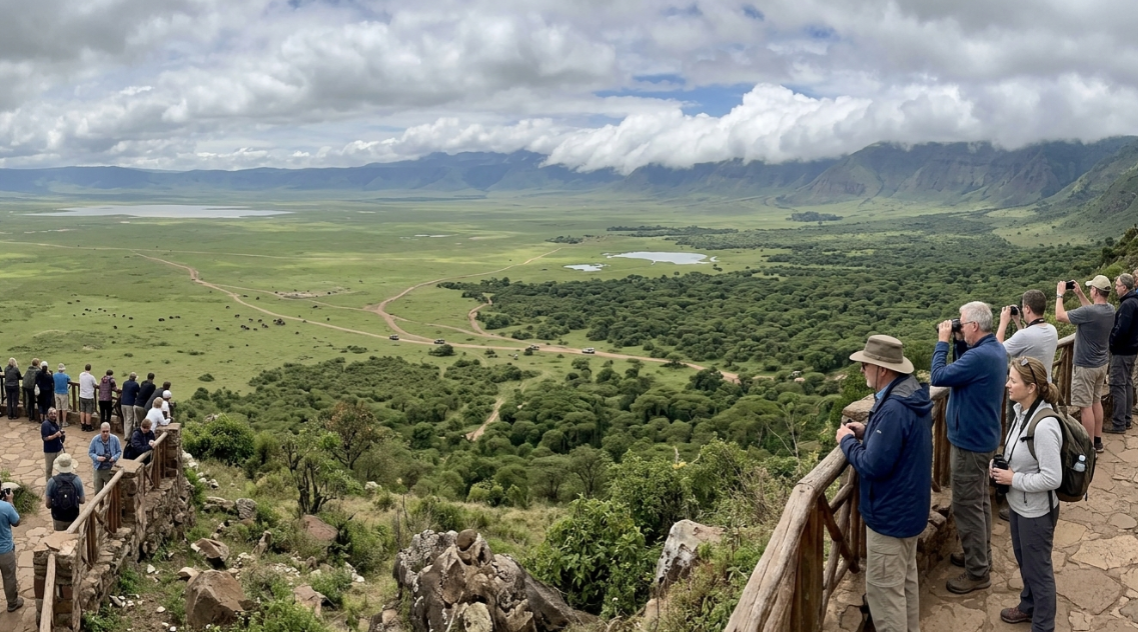
Ngorongoro is not a national park. It’s a conservation area managed by a separate authority (the Ngorongoro Conservation Area Authority, not TANAPA), where Maasai pastoralists co-exist with wildlife. This distinction matters for two reasons: the management and fee structures differ from parks, and the Maasai cultural presence adds a dimension you won’t find elsewhere.
The centerpiece is the Ngorongoro Crater, the world’s largest intact volcanic caldera. Its walls rise 600 meters above a floor measuring approximately 260 square kilometers, creating a natural enclosure that holds between 26,000 and 28,000 individual large animals. The crater offers the highest chance to see the critically endangered black rhinoceros anywhere in Africa. All Big Five species are present within this single caldera.
One notable absence inside the crater: giraffe. The steep walls apparently discourage them from descending to the floor.
Ngorongoro received 752,232 tourists in 2023, making it one of Tanzania’s most visited wildlife areas. It’s been a UNESCO World Heritage Site since 1979.
Best for: Big Five in a single day, black rhino sightings, Maasai cultural encounters.
Access: 3-hour drive from Arusha to the crater rim. Most visitors stay at rim lodges and descend for a full-day game drive.
Crowd level: High, especially between July and October. Early morning crater descents help, but expect other vehicles.
Serengeti National Park
The Serengeti is the anchor of Tanzania safari locations and arguably the most famous wildlife destination on Earth. Its name comes from the Maasai word “siringet,” meaning “endless plains,” and the park extends across 14,763 square kilometers of grassland, woodland, and kopje-dotted terrain.
The Serengeti hosts over 70 species of large mammals and 500 species of birds. It is home to the most varied collection of terrestrial wildlife on the planet, and it’s the stage for the Great Migration (more on that below).
Park fees: USD 83 per adult per 24 hours for foreign non-residents. Staying at a hotel inside the park during peak season adds a USD 60 concession fee plus 18% VAT, bringing the per-person daily total to roughly USD 160. For a full breakdown of what Tanzania safari costs actually look like, see our safari cost and fee guide.
Best for: Great Migration, Big Five, big cat concentrations, classic African savanna scenery.
Access: 8-hour drive from Arusha via Ngorongoro, or a 1.5-hour flight to one of several airstrips.
Crowd level: Varies dramatically by zone and season. Central Serengeti gets busy. Northern and western corridors are much quieter.
Tarangire National Park
Tarangire covers approximately 2,850 square kilometers and sits southeast of Lake Manyara. During the dry season (June to October), up to 3,000 elephants converge on the Tarangire River, joined by buffalo, wildebeest, and zebra. It has the greatest concentration of wildlife outside the Serengeti ecosystem.
Two features set Tarangire apart from other Tanzania safari locations. First, the ancient baobab trees. Some are over a thousand years old, and they give the park a visual character unlike anything in the Serengeti. Second, the dry-country antelope: gerenuk and oryx appear here in numbers you simply won’t see in other Northern Circuit parks.
Birders should pay attention. More than 550 species have been recorded, making Tarangire one of Tanzania’s best birding parks.
Best for: Elephants, baobab scenery, birding, dry-country antelope species.
Access: 2-hour drive from Arusha. Often the first park visited on a Northern Circuit safari.
Crowd level: Moderate in dry season, low in green season (November to May).
Mkomazi National Park
Mkomazi sits on the Kenyan border near Kilimanjaro and is one of the least-known Northern Circuit parks. It’s home to a rhino sanctuary and wild dog breeding program, set against a backdrop of the Usambara and Pare mountain ranges. Practitioners on travel forums describe it as “the Tsavo of Tanzania” because of the dry, scrubby landscape and sparse visitor numbers. Check our dedicated Mkomazi National Park guide for details on what to expect.
Best for: Rhino sanctuary visits, wild dogs, off-the-beaten-path experience.
Access: 3 to 4 hours from Arusha by road, or combine with a Kilimanjaro climb.
Crowd level: Very low.
Key Serengeti Sub-Regions
Where you stay in the Serengeti determines what you see. This is a nuance that confuses first-time planners, because the park functions less like a single destination and more like four distinct zones.
Central Serengeti (Seronera)
The area around Seronera Valley is the Serengeti’s year-round game viewing heartland. Resident populations of lion, leopard, cheetah, and hyena remain here regardless of migration patterns. The kopjes (rocky outcrops scattered across the plains) are famous leopard resting spots. Most camps and lodges are concentrated here, which means Seronera is also the busiest zone.
Best for: Big cat sightings year-round, accessible game drives for shorter trips.
Ndutu (Southern Plains)
Ndutu sits on the southern edge of the Serengeti, straddling the border with the Ngorongoro Conservation Area. From January through March, this is where the Great Migration calving season unfolds. An estimated 500,000 wildebeest calves are born during a two-to-three-week window in February, attracting predators from across the ecosystem. The wildebeest migration guide maps these movements in detail.
Best for: Calving season (January to March), predator action around newborns, green-season photography.
Grumeti Reserve and the Western Corridor
The Western Corridor stretches toward Lake Victoria and includes the Grumeti River, where dramatic river crossings occur in May and June as the migration herds push northwest. The Grumeti reserves are private concession areas with exclusive-use camps, meaning fewer vehicles and more flexibility (night drives, walking safaris, off-road driving).
Best for: June river crossings, exclusive concession experiences, lower visitor density.
Kogatende (Northern Serengeti)
Kogatende is the epicenter of the Mara River crossings that define the Great Migration’s most dramatic chapter. From roughly July through October, hundreds of thousands of wildebeest and zebra attempt the crocodile-infested river, creating the wildlife spectacle that fills every nature documentary. This is also where Tanzania and Kenya’s safari ecosystems connect, as the herds move between the Serengeti and Kenya’s Masai Mara.
Best for: Mara River crossings (July to October), high-drama predator-prey action.
Serengeti vs Ngorongoro: Which Is Better?
Many travelers wonder whether to prioritize the Serengeti or Ngorongoro Crater if time is limited.
|
Feature |
Serengeti |
Ngorongoro |
|---|---|---|
|
Size |
Huge |
Compact |
|
Great Migration |
Yes |
No |
|
Big Five |
Usually 4 of 5 |
All Big Five |
|
Rhino |
Rare |
Excellent |
|
Lions |
Excellent |
Excellent |
|
Leopards |
Excellent |
Good |
|
Crowds |
Moderate |
Heavy |
|
Minimum stay |
2-4 days |
1 day |
Southern Circuit Locations
Mikumi National Park
Mikumi is the most accessible Southern Circuit park, sitting just four hours by road from Dar es Salaam. Its open grasslands (often compared to the Serengeti in miniature) support lion, elephant, buffalo, zebra, wildebeest, and giraffe. For travelers with limited time who want a southern Tanzania safari without the cost of fly-in logistics, Mikumi is the practical choice.
Best for: Weekend or short safaris from Dar es Salaam, budget-friendly Southern Circuit option.
Access: 4-hour drive from Dar. Road-accessible (no flight required).
Crowd level: Low to moderate.
Nyerere National Park (formerly Selous Game Reserve)
Nyerere is the largest national park in Tanzania and the biggest in East Africa, covering a staggering 30,893 square kilometers. To put that in perspective: it’s roughly twice the size of the Serengeti. Yet less than 1% of Tanzania’s tourists reach it.
The park centers on the Rufiji River, which enables something many Tanzanian parks don’t offer: boat safaris. Gliding past hippo pods and crocodiles while watching African fish eagles overhead is a fundamentally different experience from a standard game drive. Nyerere is also one of the best places in Africa to see the endangered African wild dog, with healthy pack numbers across the reserve.
Best for: Boat safaris, wild dog sightings, walking safaris, genuine solitude.
Access: Fly-in from Dar es Salaam (45-minute flight). Some lodges accessible by road during dry season.
Crowd level: Very low. You can go hours without seeing another vehicle.
Ruaha National Park
At 20,226 square kilometers, Ruaha is Tanzania’s largest national park proper (Nyerere is larger but was reclassified from a game reserve). Ruaha is home to an estimated 10 to 15% of the world’s lion population and the third largest wild dog population in all of Africa.
What really distinguishes Ruaha from northern parks is the antelope diversity. Sable antelope, roan antelope, and greater kudu, species the Northern Circuit rarely produces, are present in good numbers. The park sits at the convergence of East and Southern African ecosystems, creating unusual biodiversity overlaps.
Ruaha’s vastness combined with very few camps make for an unparalleled experience. It truly feels as if you have this diverse wilderness to yourself.
Best for: Lions, wild dogs, rare antelope species, crowd-free game viewing.
Access: Fly-in from Dar es Salaam (approximately 2 hours) or Arusha.
Crowd level: Very low. Ruaha received far fewer visitors than Serengeti or Ngorongoro.
Udzungwa Mountains National Park
Udzungwa breaks the standard safari mold entirely. There are no game drives here. Instead, this is a hiking and trekking park, home to six primate species (two found nowhere else on Earth) and some of East Africa’s most impressive waterfalls. Scientists have nicknamed it “the Galapagos of Africa” for its level of endemism.
Best for: Hiking, endemic primates, waterfalls, botanists and serious nature enthusiasts.
Access: Road from Dar es Salaam (5 to 6 hours) or combine with Mikumi.
Crowd level: Very low.
Western Circuit Locations
Gombe Stream National Park
Gombe Stream is famous for one reason: Jane Goodall. This tiny park on the shores of Lake Tanganyika is where Goodall began studying chimpanzees in 1960. The habituated Kasakela community has been studied continuously since then, making them the most researched wild chimpanzees in the world.
Gombe is Tanzania’s smallest national park, but what it lacks in size it makes up for in primatological significance. Chimp trekking here typically involves hiking through steep forest terrain for 1 to 4 hours before spending an hour observing a habituated group.
Best for: Chimpanzee trekking with a research-site backdrop, primatology enthusiasts.
Access: Fly to Kigoma, then boat transfer (1 to 2 hours along the lakeshore).
Crowd level: Very low. Visitor permits are limited.
Katavi National Park
If you’re seeking a truly untamed safari, Katavi is your destination. Located in western Tanzania between Lake Tanganyika and Lake Rukwa, Katavi received just 1,557 international visitors in 2022. For context, the Serengeti handles that number every few days.
During the dry season (August to October), Katavi’s floodplains shrink into a few remaining pools that concentrate enormous herds. Buffalo congregate in groups of several thousand, and hippo pools become so packed that animals literally pile on top of each other. Huge lion prides patrol the periphery.
Best for: Raw, unvisited wilderness, massive buffalo and hippo concentrations, big lion prides.
Access: Fly-in from Dar es Salaam or Arusha (with a stop). No realistic road access for tourists.
Crowd level: Among the lowest of any safari destination in Africa.
Mahale Mountains National Park
Mahale is home to one of Africa’s largest chimpanzee populations, estimated at around 800 individuals. The park occupies a chain of mountains that rise sharply from the eastern shore of Lake Tanganyika, with peaks reaching over 2,400 meters. The pristine environment, accessible only by boat or small aircraft, makes it a secluded gem.
Chimp trekking in Mahale is considered by many safari veterans to be the more rewarding experience compared to Gombe, thanks to larger habituated groups and a more dramatic forest setting. After trekking, visitors can swim in the crystal-clear lake, an experience that has no equivalent at any other Tanzania safari location.
Best for: Chimpanzee trekking, Lake Tanganyika swimming and kayaking, ultimate remoteness.
Access: Fly to a nearby airstrip, then transfer by boat. No roads.
Crowd level: Extremely low.
Coastal and Island Locations
Saadani National Park
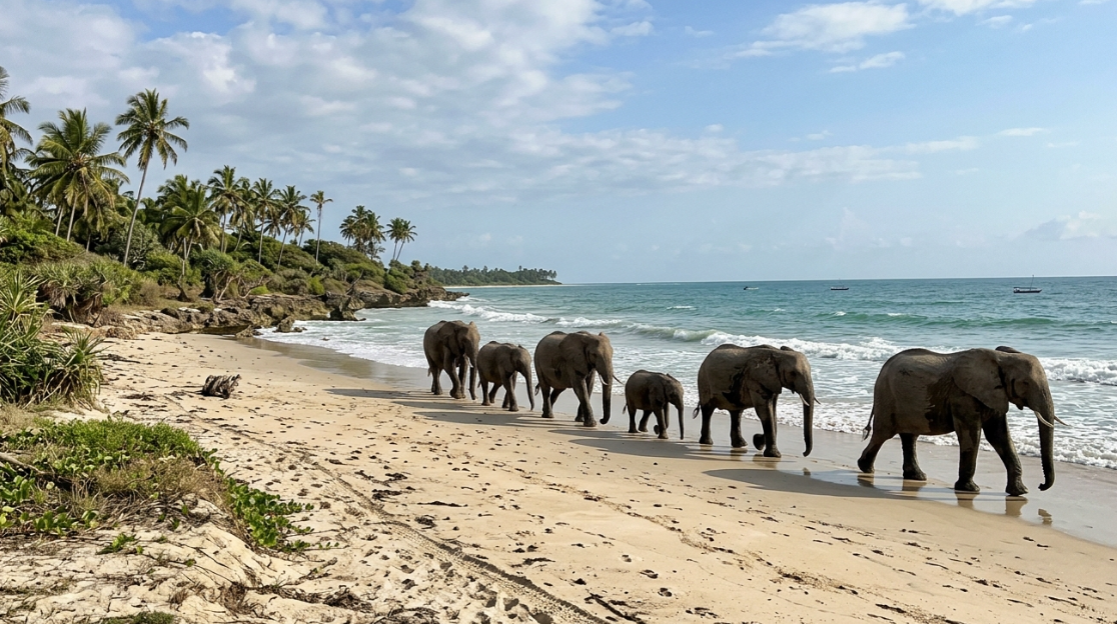
Saadani is the only Tanzanian park where the bush meets the Indian Ocean. Elephants, buffalo, and lions roam within earshot of breaking waves, and green turtles nest on the beaches between May and September. The Wami River provides boat safari opportunities with hippo, crocodile, and mangrove-dwelling birdlife.
This park is a blind spot in most Tanzania safari guides, which is puzzling given how unique it is. It sits north of Dar es Salaam and combines well with Zanzibar for a beach-and-bush itinerary.
For the full picture of what this park offers, see our Saadani National Park guide.
Best for: Beach-and-bush combination, green turtle nesting season, boat safaris, Swahili Coast culture.
Access: 5 to 6 hours by road from Dar, or short charter flight. Can also be reached from Pangani.
Crowd level: Very low.
Zanzibar
Zanzibar isn’t a safari destination in the traditional sense, but it’s the most common extension after a Tanzania safari. The archipelago offers Stone Town’s UNESCO-listed historic center, spice plantations, white-sand beaches, and some of the Indian Ocean’s best snorkeling and diving.
Most travelers spend 3 to 5 days on Zanzibar after their mainland safari. The combination of wildlife and tropical beach is one of the main reasons Tanzania safari locations attract visitors over competing destinations in Southern Africa.
Best for: Post-safari beach relaxation, cultural exploration, snorkeling, diving.
Access: Short flight from Arusha, Serengeti, or Dar es Salaam. Also reachable by ferry from Dar.
Mafia Island and Pemba
For divers and travelers seeking something less commercialized than Zanzibar, Mafia Island and Pemba are worth considering. Mafia Island Marine Park protects whale shark feeding grounds (October to March), and Pemba’s drop-offs offer some of East Africa’s best wall diving. Both islands are quiet, with limited accommodation and a genuinely remote feel.
Best for: Serious diving and snorkeling, whale shark encounters (Mafia), off-grid island stays.
Access: Short flights from Dar es Salaam or Zanzibar.
The Great Migration: Where and When
The Great Migration is the largest mass movement of land mammals on Earth. More than a million wildebeest, along with hundreds of thousands of zebra and gazelle, circle through the Serengeti-Mara ecosystem in a continuous, year-round loop. There are no defined start or end points, but the herds follow a broadly predictable seasonal pattern.
Here’s the month-by-location breakdown:
-
January to March: Ndutu and the southern Serengeti plains. Calving season. Approximately 500,000 calves are born in a concentrated February window.
-
April: Herds begin moving northwest through the southwestern Serengeti.
-
May to June: Western Corridor and Grumeti area. River crossings at the Grumeti.
-
July to October: Northern Serengeti around Kogatende. Mara River crossings, the migration’s most dramatic spectacle.
-
November to December: Herds drift south again toward the Ndutu plains as the short rains green up the grasslands.
Because the migration is a fluid, year-round movement of about two million animals, no single month guarantees a specific sighting. Timing your visit to the right Serengeti zone matters more than picking the “right month.” Our seasonal guide for East Africa maps these patterns across the entire region.
Essential Safari Planning Terms
Big Five
Lion, leopard, elephant, Cape buffalo, and black rhinoceros. In Tanzania, the best single-day Big Five location is Ngorongoro Crater. The Serengeti reliably produces four of the five (rhino sightings are rare there). Southern parks like Ruaha offer strong lion and buffalo but no rhino.
Concession Area
A concession is a privately managed wildlife area adjacent to or within a national park. Operators like Grumeti Reserves in the western Serengeti hold exclusive rights to a defined area, which means fewer vehicles, off-road driving permissions, night drives, and walking safaris. The trade-off is higher nightly rates. For a look at what premium camps in these areas cost, see our luxury Tanzania safari guide.
Fly-in Safari
A safari where you travel between parks by light aircraft (typically Cessna Caravans carrying 12 to 14 passengers) rather than driving. Fly-in safaris are standard for the Southern and Western circuits, where road distances are impractical. The 15-kilogram soft-bag luggage limit is strictly enforced on most bush flights.
Game Drive
The standard safari activity: a guided drive in an open-sided or pop-top 4x4 vehicle, typically departing at dawn (around 6:00 AM) and again in the afternoon (around 3:30 PM). In national parks, vehicles must stay on marked tracks. In concession areas, off-road driving is often permitted.
Mobile Tented Camp
Camps that physically relocate two to four times per year to follow the Great Migration or seasonal game concentrations. They offer a genuine bush experience (canvas tents, bush showers, lantern lighting) while staying close to the action. Mobile camps are most common in the Serengeti, tracking the migration from Ndutu in January to Kogatende by July.
Walking Safari
A guided, on-foot experience in the bush, typically lasting 2 to 4 hours. Walking safaris are available in specific parks: Arusha NP, Tarangire (on certain conservancies), Lake Manyara, and most Southern Circuit parks. They are not permitted in the Serengeti’s main park area or inside Ngorongoro Crater.
Choosing Your Circuit: A Quick Comparison
|
Factor |
Northern Circuit |
Southern Circuit |
Western Circuit |
|---|---|---|---|
|
Gateway city |
Arusha |
Dar es Salaam |
Kigoma / Dar |
|
Typical trip length |
4 to 7 days |
7 to 10 days |
5 to 8 days |
|
Access |
Road from Arusha |
Mostly fly-in |
Fly-in + boat |
|
Crowd level |
Moderate to high |
Low to very low |
Extremely low |
|
Key wildlife |
Great Migration, Big Five, big cats |
Wild dogs, boat safaris, rare antelope |
Chimpanzees, buffalo, hippo |
|
Budget range |
$2,000 to $6,000+ pp |
$4,500 to $9,000+ pp |
$5,000 to $10,000+ pp |
|
Best for |
First-timers, migration seekers |
Repeat visitors, solitude seekers |
Primate enthusiasts, adventurers |
The Northern Circuit is the obvious choice for a first Tanzania safari. It offers the greatest variety of experiences per day of travel, the most accommodation options across price ranges, and the easiest logistics.
But if you’ve done the Northern Circuit already (or you simply don’t want crowds), the Southern Circuit deserves serious consideration. Ruaha and Nyerere deliver a quality of wilderness immersion that the Serengeti’s popular zones can’t match.
Ready to plan a custom itinerary? Our private Tanzania safari options page walks through routes, costs, and what to expect from a tailored trip.
Frequently Asked Questions
What are the best Tanzania safari locations for first-time visitors?
The Northern Circuit is the standard recommendation: Serengeti, Ngorongoro Crater, and Tarangire make a strong 5 to 7 day combination. You’ll see Big Five species, experience the Serengeti’s scale, and encounter Tarangire’s elephants and baobabs. Adding Lake Manyara as a half-day stop rounds out the route without adding significant cost.
When is the best time to visit Tanzania for safari?
It depends on which location you’re targeting. The dry season (June to October) is generally considered peak safari season across all circuits, with the best game viewing as animals concentrate around water sources. But the Great Migration calving season in Ndutu (January to March) is spectacular, and the green season (November to May) brings lower prices, fewer crowds, and lush scenery. Our best time to visit guide maps optimal timing across every major park.
How much does a Tanzania safari cost?
Northern Circuit safaris start around $2,000 per person for a 5-day budget trip and scale up significantly for luxury lodges and private concession camps. Southern Circuit trips typically run $4,500 to $9,000 per person for 7 days due to fly-in logistics and higher-end camp options. Park fees alone in the Serengeti run $83 per adult per 24 hours before accommodation and concession fees.
Can you combine Northern and Southern Circuit parks in one trip?
Yes, but it requires internal flights. There’s no practical way to drive between circuits without losing multiple days. A common approach is 4 to 5 days on the Northern Circuit followed by a flight to Ruaha or Nyerere for 3 to 4 days. Expect 10 to 14 day total trip lengths for multi-circuit itineraries.
Which Tanzania safari locations are best for seeing wild dogs?
Nyerere National Park and Ruaha National Park, both on the Southern Circuit, are the top wild dog destinations. Ruaha holds Africa’s third-largest wild dog population. Northern Circuit parks occasionally produce wild dog sightings, but they’re unreliable.
Is the Serengeti worth the hype?
Yes. Practitioners on Reddit and travel forums sometimes debate whether it’s “overrated,” but the consensus from people who’ve actually been is overwhelmingly positive. The scale of wildlife, particularly during migration season, is genuinely unmatched. The key is choosing the right zone for your travel dates rather than defaulting to central Serengeti.
What’s the difference between Ngorongoro and a national park?
Ngorongoro is a Conservation Area, not a national park. It’s managed by its own authority (NCAA) rather than TANAPA. The critical difference: Maasai communities live inside the conservation area and graze their cattle alongside wildlife. This coexistence creates a cultural layer that national parks don’t have, but it also means different rules, fees, and management priorities.
Are Western Circuit parks worth the extra cost and effort?
For primate enthusiasts, absolutely. Mahale and Gombe offer chimpanzee trekking experiences that can’t be replicated anywhere in East Africa. Katavi’s dry-season wildlife concentrations rival anything on the continent. But these parks require more time, more budget, and more flexibility. They reward travelers who prioritize depth over breadth.