

Safari With Toddlers Tanzania: 2026 Rules, Parks & Safety
TL;DR
Yes, you can take a toddler to Tanzania for a vehicle-based safari. There is no universal government minimum age for a standard safari, but individual lodges, camps, operators, and activities can set their own age restrictions. TANAPA states that children under 5 enter its national parks free, while children aged 5–15 pay child rates.
For toddlers, the best approach is usually a private safari vehicle, short and flexible game drives, fewer hotel changes, and family-friendly accommodation. Tarangire, Lake Manyara, and Ngorongoro are among the easiest Northern Circuit destinations to build into a shorter family itinerary, although the right choice depends on your child's age, tolerance for driving, and the season.
Health planning is particularly important. Tanzania has malaria transmission in areas below 1,800 metres, so parents should discuss malaria prevention and age- and weight-appropriate medication with a travel-health professional before departure.
The key distinction is this: Tanzania does not have one universal “toddler safari rule.” Park regulations, lodge policies, activity restrictions, vehicle arrangements, and medical considerations all need to be checked separately.
Can You Take a Toddler on Safari in Tanzania? Yes, toddlers can go on a vehicle-based safari in Tanzania. There is no single nationwide minimum age for a standard vehicle game drive, but individual lodges, camps, operators, and safari activities can impose their own restrictions. TANAPA states that children under 5 enter its national parks free of charge. For children under five, the most practical setup is a private vehicle, shorter game drives, a flexible itinerary, and accommodation that explicitly accepts young children. Parents should also plan malaria prevention, insect protection, appropriate travel insurance, and access to medical evacuation before travelling. In short: the question isn't whether a toddler is legally allowed on safari; it's whether the itinerary, accommodation, health preparation, and daily pace are appropriate for that child.
Tanzania Safari With Toddlers: Quick Facts
|
Factor |
What parents should know |
|---|---|
|
Minimum age for vehicle safari |
No single nationwide minimum age; park, operator and accommodation policies can differ |
|
Children under 5 |
TANAPA national parks list children under 5 as free of charge |
|
Lodge minimum age |
Varies by property; some camps accept young children while others set minimum ages |
|
Best vehicle setup |
A private safari vehicle is strongly recommended for flexibility |
|
Game-drive length |
Plan shorter drives around your child's age, energy and nap schedule rather than treating 2–3 hours as a legal limit |
|
Malaria prevention |
Tanzania has malaria transmission below 1,800 m; discuss medication and mosquito protection with a travel-health professional |
|
Best Northern Circuit options |
Tarangire, Lake Manyara and Ngorongoro can work well for shorter family itineraries |
|
Trip length |
A shorter itinerary with fewer hotel changes is usually easier for toddlers |
|
Key booking question |
Confirm the lodge's minimum age policy before paying a deposit |
If you’re already confident a Tanzania safari with toddlers is right for your family, a private family safari is the starting point for building an itinerary around nap schedules, short drives, and the right lodges.
Tanzania Safari Age Rules at a Glance
There is no single age rule that applies to every Tanzania safari. Parents need to check four separate layers: national park rules, accommodation policies, safari activities, and the operator's own requirements.
|
Safari element |
Toddler-friendly? |
What to check |
|---|---|---|
|
Vehicle game drive |
Usually yes |
Operator and lodge policy |
|
Private safari vehicle |
Yes |
Vehicle configuration and child-restraint arrangements |
|
Shared game drive |
Less suitable |
Operator's minimum age and schedule |
|
Walking safari |
Generally no for toddlers |
Minimum age varies by regulation, park and operator |
|
Hot-air balloon safari |
No |
Operator minimum age, height and safety requirements |
|
Night game drive |
Often restricted |
Lodge and operator age policy |
|
Lodge or tented camp |
Property-specific |
Minimum age before booking |
|
Cultural activities |
Often possible |
Activity-specific rules and child suitability |
Important: A child can be permitted to enter a national park but still be refused by a particular lodge or activity. Always confirm the specific property's written child policy before booking.
Age and Access Terms
Understanding who sets the rules (and at which level) is the single most important step. Parents frequently assume “safari” has one set of age restrictions. It doesn’t. Parks, lodges, and specific activities each have their own policies, set by different authorities.
TANAPA (Tanzania National Parks Authority)
The government body that manages all Tanzanian national parks, including Serengeti, Tarangire, Lake Manyara, and Arusha National Park. TANAPA sets park entry fees, vehicle regulations, and activity rules. Critically for families: TANAPA imposes no minimum age for vehicle-based game drives. Your six-month-old can legally ride in a safari vehicle through any national park.
Minimum Age Policy (Lodge or Camp)
This is where most parents hit a wall. Individual lodges and tented camps set their own age restrictions, typically requiring children to be at least 8 to 12 years old. These policies exist because properties sharing common dining areas and game-viewing decks with other guests don’t want a screaming toddler disrupting the experience. The restriction is a hospitality decision, not a safety regulation.
Some properties are more flexible. Lake Manyara lodges, for example, sometimes allow children as young as three, thanks to shorter drive distances and calmer surroundings. The key: always confirm the age policy before booking. Families traveling with toddlers alongside grandparents should also review our multigenerational safari planning guide, since mixed-age groups face layered restrictions.
Exclusive-Use Booking
Renting an entire camp or lodge so your family is the only group on the property. When you book exclusive use, age restrictions effectively disappear because the only guests affected are your own family. This is the most reliable workaround for parents with children under five who want access to premium tented camps. It costs more, sometimes significantly, but it removes the biggest accommodation obstacle for a safari with toddlers in Tanzania.
Walking Safari Age Restriction
Walking safaris have much stricter age requirements than vehicle game drives because guests are outside the vehicle in wildlife areas. Minimum ages vary by the specific park, walking activity, operator and applicable regulations.
For toddlers, the practical answer is simple: do not plan a walking safari as part of the itinerary. If an older child wants to participate, confirm the minimum age directly with the operator and park authority before booking.
Balloon Safari Age Restriction
Hot-air balloon safaris are generally not suitable for toddlers. Operators commonly impose minimum-age and/or height requirements, with many using an age around seven as a starting point, but policies vary.
For a toddler itinerary, treat a balloon safari as an older-child activity and check the specific operator's current age, height and safety requirements before booking.
Child (TANAPA Fee Definition)
For park fee purposes, TANAPA defines a “child” as aged 5 to 15. Children in this bracket pay reduced rates (roughly 50% of the adult fee at most parks). This matters because it’s different from the infant/toddler category below.
Infant or Toddler (Under 5)
Children under five years old are exempt from all TANAPA park entry fees. They also enter the Ngorongoro Conservation Area free of charge, including concession fees. This exemption applies to every national park and the NCAA-governed Ngorongoro area. No ticket, no fee, no paperwork.
Health and Safety Terms
Health preparation is the section that causes the most anxiety for parents planning a safari with toddlers in Tanzania. Rightly so. But the risks are well understood and manageable with proper preparation.
Malaria Prophylaxis
Malaria prevention should be part of every family's Tanzania trip planning. CDC lists malaria transmission in Tanzanian areas below 1,800 metres and recommends discussing an appropriate chemoprophylaxis option with a healthcare professional.
Atovaquone-proguanil (Malarone) is one option and can be used for children weighing 5 kg or more, with dosing based on body weight. CDC notes that prophylactic use below 11 kg is considered off-label in the United States, so parents should not choose or dose the medication without medical advice.
For a toddler safari, malaria prevention should combine any prescribed medication with mosquito-bite prevention: long sleeves and trousers, appropriate insect repellent, screened or air-conditioned sleeping areas, bed nets where necessary, and permethrin-treated clothing or gear where appropriate.
Do not use the child's weight alone to decide whether malaria medication is appropriate. A travel-health professional should consider the child's age, weight, medical history, itinerary and destination before prescribing.
DEET
The gold-standard insect repellent recommended by the CDC. A concentration of 20-30% is effective and safe for children over 2 months old. The one precaution specific to toddlers: don’t apply it to their hands, since young children rub their eyes and put fingers in their mouths. Apply to clothing and exposed skin on arms and legs instead.
Picaridin
An odorless alternative to DEET that some parents prefer for toddlers. Effective against mosquitoes at 20% concentration. Less greasy, doesn’t damage plastics or fabrics. Either picaridin or DEET works; the important thing is using one of them consistently at dusk and dawn. For broader context on malaria prevention, our Zanzibar malaria guide covers the same prophylaxis framework.
AMREF Flying Doctors
An emergency air evacuation service that operates across East Africa. AMREF Flying Doctors maintain aircraft with medical staff on standby 24 hours a day. Coverage costs approximately $29 per person for up to 14 days (standard safari radius from Nairobi) or $45 per person for extended regional coverage up to 1,000 km. For families with toddlers, this is an essential safety layer. If your child develops a high fever or needs hospital care during a remote safari, AMREF can evacuate to a Nairobi hospital far faster than any ground transfer.
That said, practitioners on travel forums emphasize treating AMREF as one layer of protection, not the whole plan. Pair it with comprehensive Tanzania travel insurance that covers medical evacuation, trip interruption, and pediatric care.
Travel Clinic
A specialized medical practice that provides destination-specific vaccinations and prescriptions. Visit one 4-6 weeks before departure. For a toddler safari in Tanzania, the travel clinic will prescribe malaria prophylaxis, review routine vaccinations (measles, polio boosters), and advise on any required certificates.
Yellow Fever Certificate
Required if you’re transiting through a yellow fever endemic country on the way to Tanzania (common with connections through Addis Ababa, Nairobi, or other hubs). The vaccine is not routinely given to children under 9 months. If your routing requires a transit that triggers this requirement, discuss alternatives with your travel clinic and airline.
Rehydration Sachets
Oral rehydration salts mixed with clean water. Essential for toddler bush travel. Stomach upsets, mild dehydration from heat, or changes in diet can all affect young children more quickly than adults. Pack at least one sachet per day of travel.
Is Tanzania Safe With a Toddler?
A Tanzania safari can be suitable for a toddler when the trip is designed around the child's age and the realities of travelling in a wildlife environment. The biggest planning considerations are usually malaria and other mosquito-borne illnesses, heat and dehydration, vehicle safety, wildlife proximity, food and water hygiene, and access to medical care.
The safest approach is to:
-
Use a private safari vehicle so you can stop, return to the lodge or change the schedule when your child needs it.
-
Follow your guide's instructions about when it is safe to leave the vehicle.
-
Never allow a toddler to approach or feed wildlife.
-
Keep children away from unfenced areas unless a guide or lodge staff member has specifically confirmed that it is safe.
-
Use appropriate mosquito protection throughout the trip.
-
Carry sufficient drinking water, snacks and child-specific medication.
-
Confirm where the nearest clinic or hospital is at each stage of the itinerary.
-
Purchase travel insurance that explicitly covers medical treatment and evacuation.
-
Confirm the lodge's child policy before booking.
The goal is not to eliminate every risk. It is to remove avoidable risks and build enough flexibility into the itinerary that parents are not forced to choose between a child's needs and a fixed safari schedule.
Vehicle and Logistics Terms
The vehicle situation on a Tanzania toddler safari is straightforward in principle but has practical nuances most guides skip.
Private Safari Vehicle
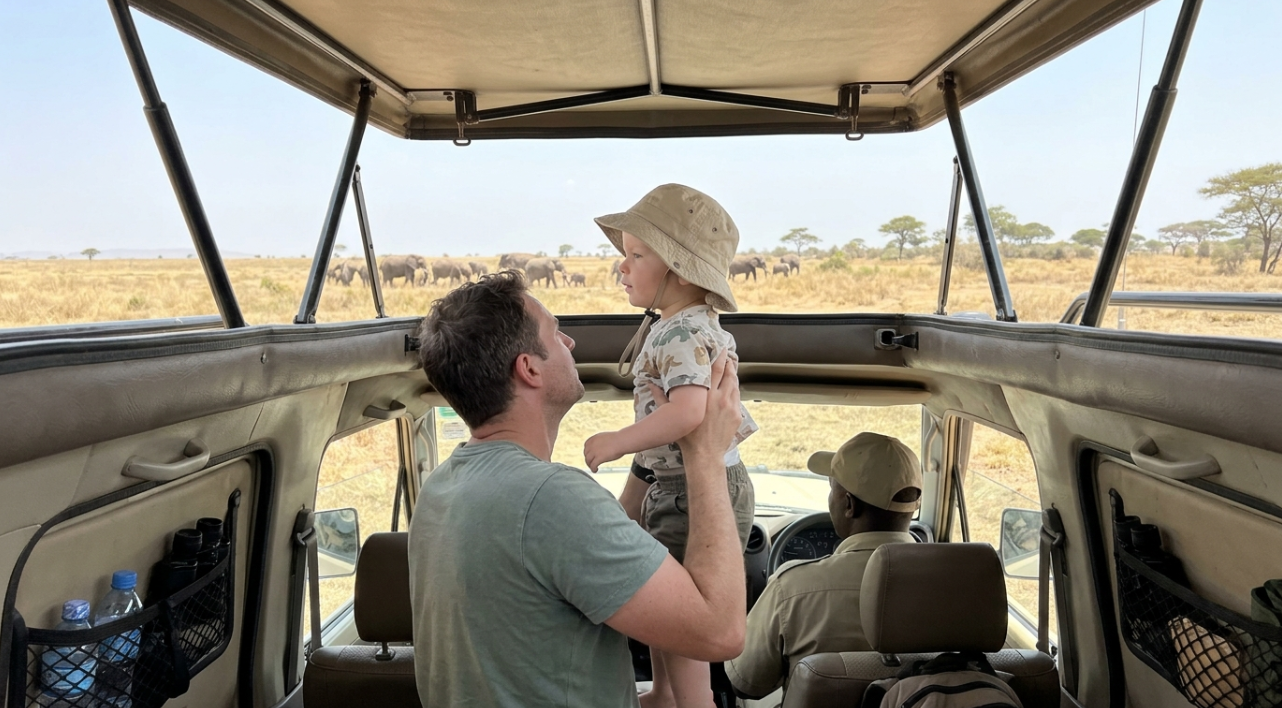
A dedicated Toyota Land Cruiser with a driver-guide assigned exclusively to your family. This is non-negotiable with a toddler. Shared vehicle game drives, where you’re grouped with 4-6 other guests, simply don’t work when a child needs a diaper change, a snack break, or a nap return to the lodge.
A private vehicle means you set the pace, duration, and stops. One family travel blogger put it clearly: choosing an operator that offers private game drivers is key when traveling with a toddler, because flexibility is essential even though it costs more. For details on vehicle types and features, see the safari vehicles glossary.
Pop-Up Roof (Roof Hatch)
The raised section of a safari Land Cruiser that allows passengers to stand and view wildlife above the roofline. With a toddler, this requires active supervision. The opening is large enough for a small child to lean too far, and sudden vehicle movements on rough terrain can cause a fall. Some parents keep toddlers seated and use the windows instead. Others hold children while standing. Either way, never leave a toddler unsupervised at the roof hatch.
Car Seat / Child Restraint
Tanzania does not have mandatory car seat regulations. Safari vehicles are not designed with ISOFIX points or standard seatbelt configurations. Some operators can arrange booster seats or basic child restraints on request, and a few equip vehicles with fridges for milk storage. But the reality is that most families either bring a lightweight travel car seat from home or hold their toddler on their lap. Raising this with your operator before the trip is critical, not something to sort out on arrival day.
Soft Bag
A flexible duffel bag required for bush flights on light aircraft (Cessna Caravans and similar). Rigid suitcases do not fit in the cargo holds. If your Tanzania itinerary includes a fly-in segment (common for Serengeti transfers), pack everything in soft bags. Weight limits are typically 15-20 kg per person, including carry-on. With toddler gear (diapers, extra clothes, snacks), this requires disciplined packing.
If you’re planning a family safari with a toddler and want an itinerary designed around nap schedules, short drives, and the right lodges, Duma Explorer builds custom private safaris around exactly these logistics.
Park and Destination Terms
Not every park in Tanzania works equally well with a toddler. The consensus across operators, travel bloggers, and parent communities is clear: three parks stand out, and a fourth works for families based near Arusha.
Best Tanzania Parks for Toddlers
|
Park |
Why it can work with toddlers |
Main drawback |
Best for |
|---|---|---|---|
|
Tarangire |
Relatively accessible from Arusha and strong wildlife viewing |
Can be hot during parts of the year |
A first short safari |
|
Lake Manyara |
Compact park that can work well for a shorter game drive |
Wildlife experience varies by season |
Half-day or short itineraries |
|
Ngorongoro Crater |
Very concentrated wildlife viewing |
Steep roads, early starts and a different elevation environment |
Families wanting high wildlife density |
|
Serengeti |
Exceptional wildlife and the option of longer stays |
Longer transfers depending on itinerary |
Families whose toddlers tolerate more travel |
|
Arusha National Park |
Close to Arusha and useful for a gentle introduction |
Lower large-game density than the headline safari parks |
A short add-on near Arusha |
The easiest combination for many toddler trips
For a short Northern Circuit safari, Tarangire + Ngorongoro or Tarangire + Lake Manyara can create a simpler itinerary than trying to cover every major park.
There is no single “best” park for every toddler. The right choice depends on the child's age, tolerance for driving, travel season, accommodation availability and how much time the family has.
Northern Circuit
The standard Tanzania safari route connecting Tarangire, Lake Manyara, Ngorongoro, and Serengeti. Most adult safaris cover all four over 7-10 days. With a toddler, you’ll likely visit two or three of these parks over 3-5 days. The full circuit involves too much driving and too many lodge changes for children under five.
Tarangire National Park
The best starter park for a toddler safari. It’s a short drive from Arusha (about 2 hours), has enormous elephant herds that hold a toddler’s attention, and offers high wildlife density without requiring patience for long waits. The terrain is gentle, and game drives can be kept short while still seeing plenty of animals. Families who want deeper detail can explore the Tarangire safari glossary.
Ngorongoro Crater
A collapsed volcanic caldera with an incredibly concentrated animal population on its floor. The crater is ideal for toddlers because you see multiple species quickly, sometimes within the first 30 minutes of descending. There’s no need for the patience that Serengeti or remote parks demand. The drive down and back up takes time, but the game viewing itself can be condensed into 2-3 productive hours. For planning specifics, the Ngorongoro Crater safari guide covers access, fees, and timing.
Ngorongoro Conservation Area Authority (NCAA)
The separate governing body for the Ngorongoro Conservation Area, which is distinct from TANAPA-managed parks. This matters for fees: NCAA sets its own tariff structure. As of 2026, concession fees at Ngorongoro are $71 per person per night for foreign non-residents, while children aged 5-15 pay $12 per night. Children under five are exempt entirely.
Lake Manyara National Park
A small, easy park perfect for a half-day drive. Known for tree-climbing lions and large flocks of flamingos at the lake’s edge. The compact circuit means you can do a meaningful game drive in 2-3 hours and return to your lodge for lunch and nap time. Several Lake Manyara lodges accept children as young as three, making it one of the more accommodating destinations for families with toddlers.
Arusha National Park
The closest national park to Arusha town, with short circuits through forest and around lakes. Good for a gentle introduction to safari for very young children, though wildlife density is lower than Tarangire or Ngorongoro. The park offers canopy walkways and easy nature walks for older children, though walking safari age restrictions still apply.
Accommodation Terms
Lodge and camp selection can make or break a safari with toddlers in Tanzania. The wrong property turns a family adventure into a stressful negotiation with management about noise and meal times.
Family Tent / Family Suite
Larger accommodation units designed for families, typically featuring connected rooms or an extra bed in a spacious tent. Some properties offer two-bedroom suites with a shared living area. These are worth seeking out because they give parents a separate sleeping space from the toddler and a place to retreat during midday downtime. For families needing guidance on which specific lodges welcome young children, the family safari lodges guide is the most useful next step.
Age Restriction (Lodge)
The single most common surprise for parents planning a family safari. Many camps across Tanzania don’t allow children under five, and some set the minimum at eight or even twelve. This isn’t arbitrary cruelty. Open-sided tented camps near wildlife present genuine risks, and shared dining/lounge areas create friction between families and couples seeking a quiet bush experience. Always confirm the property’s specific policy before booking. Condé Nast Traveler has explicitly noted that “many camps don’t allow kids under five,” reinforcing the need to verify.
Babysitting / Childcare
Some family-focused lodges offer babysitting services, either through dedicated children’s programs or individual staff supervision. Quality varies significantly. At high-end properties, this might mean a trained guide takes older children on a nature walk while parents do a longer game drive. For toddlers, it typically means a staff member watches your child at the lodge. Ask specific questions: What’s the caregiver-to-child ratio? Is the person trained in first aid? Will your child be indoors or outdoors?
Swimming Pool
Often the deciding factor for toddler comfort between game drives. A pool gives children a way to burn energy, cool down in afternoon heat, and maintain some sense of routine. Properties without pools rely on the room and surrounding grounds for downtime, which can feel confining for active toddlers. When comparing lodges, pool access should be weighted heavily for any child under five.
Kitchenette / Fridge
Useful for bottle-feeding families, toddler meal preparation, and snack storage. Not all safari lodges offer in-room kitchen facilities, but many family-oriented properties provide a small fridge at minimum. If your toddler has specific dietary needs, confirm this before booking. Some operators can equip the safari vehicle with a portable fridge for milk and snacks during game drives.
Itinerary and Pacing Terms
Pacing is where most families get the planning wrong. An adult safari rewards long drives, dawn-to-dusk activity, and park-hopping. A toddler safari rewards the opposite.
Short Game Drive
A game drive lasting 2-3 hours, either in the early morning (roughly 6-9 AM) or late afternoon (4-6:30 PM). These windows align naturally with toddler wake schedules and avoid the peak midday heat when wildlife is least active anyway. Two short drives per day, with a long break at the lodge between them, is the rhythm that works.
One family travel blogger with direct experience captured it well: for 2-3 year old kids, half-day game drives and wildlife viewing at waterholes work well, but don’t take a two-year-old on a three-day safari experience with nothing else on the program besides wildlife viewing.
Nap-First Scheduling
Structuring game drives around the child’s sleep schedule rather than forcing the child to adapt. This sounds obvious, but it requires an operator willing to build flexibility into the itinerary. A private vehicle makes nap-first scheduling possible because you’re not bound to a shared vehicle’s departure time.
Rest Day
A full day with no game drives, spent at the lodge with pool time, short walks, or cultural visits. For toddlers, rest days are productive, not wasted. They reset energy levels, reduce overstimulation, and give parents a break from vehicle logistics. A 5-day toddler safari should include at least one rest day.
Single-Park Focus
Staying two to three nights in one location rather than moving to a new park every day. This is the structural change that matters most for toddlers. Children in this age range don’t benefit from variety. They benefit from routine, familiar faces, and reduced transit time. A two-night stay at Tarangire followed by two nights at Ngorongoro is better than a four-park sprint, and it still covers excellent wildlife territory.
For help choosing the right season for this kind of paced itinerary, the best time for Tanzania safari guide covers how weather affects comfort and wildlife viewing.
Zanzibar Extension
A beach stay added after the safari portion, typically 3-5 nights. For families with toddlers, a private villa with a pool on Zanzibar is the toddler-friendly format, not a shared resort beach. The combination of bush and beach gives the trip a natural arc: structured wildlife viewing followed by unstructured relaxation. It also breaks up long return flights with a decompression period.
Cost and Fee Terms
Understanding fees for a Tanzania safari with toddlers requires knowing which authority charges what, and where the under-five exemption applies.
Conservation Fee
The per-person, per-day park entry fee charged by TANAPA. Following the July 2025 increase, the headline rate for most Northern Circuit parks is $82.60 per adult per day. Children under five: free. Children aged 5-15 pay roughly half.
Concession Fee
A per-person, per-night charge for staying inside a national park or conservation area, separate from the daily entry fee. At Ngorongoro Conservation Area, concession fees are currently $71 per person per night for foreign non-residents, while children 5-15 pay $12 per night. Under fives are exempt.
Vehicle Fee
A per-vehicle, per-day charge ranging from $25 to $40 depending on the park. This is charged regardless of how many passengers are in the vehicle. With a private vehicle for your family, you pay this once per day.
Child Rate
The discounted park fee for children aged 5-15 at TANAPA parks, typically around 50% of the adult rate. Important to note: this only kicks in at age five. Below that, the child is free.
Private Vehicle Supplement
The additional cost for a dedicated vehicle and driver-guide versus a seat on a shared vehicle. This varies by operator and season but is typically $150-300 per day above the shared rate. For a toddler safari, this isn’t a luxury upgrade. It’s a necessity. If you’re weighing this decision more broadly, private vs. group safari costs breaks down the comparison in detail.
Packing Terms for a Toddler Safari
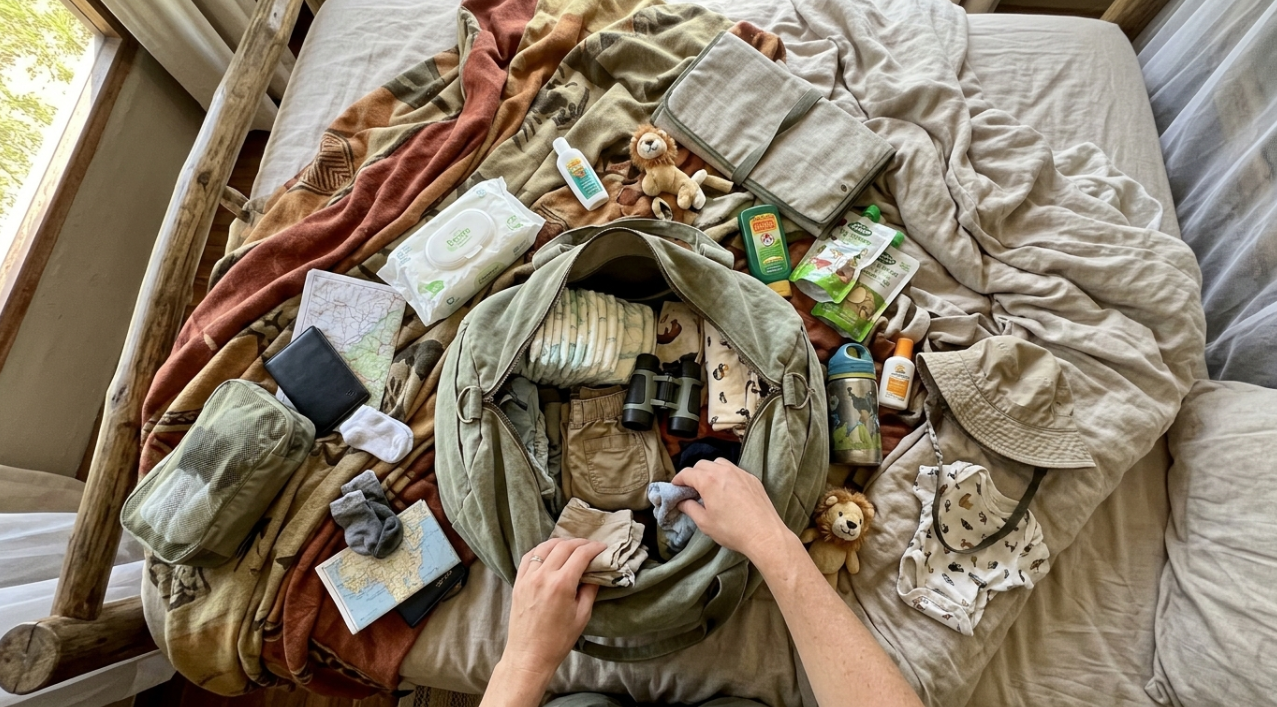
Standard safari packing lists don’t account for children under five. These are the toddler-specific items and concepts that matter.
Pediatric Malarone
Weight-dosed antimalarial tablets specifically for children. Your travel clinic will prescribe the correct dosage based on your child’s weight (minimum 11 kg). Tablets can be crushed and mixed into food for toddlers who can’t swallow pills. Start the course 1-2 days before entering a malaria zone and continue for 7 days after leaving.
Insect-Repellent Clothing
Long-sleeved shirts and pants treated with permethrin, worn particularly at dusk when mosquitoes are most active. Treating clothing is more effective and less messy than relying solely on skin-applied repellent for a squirming toddler. You can buy pre-treated clothing or apply permethrin spray to regular clothes before the trip.
Portable Changing Kit
A compact changing pad, wipes, diapers, and disposal bags for diaper changes at remote stops. Bush stops don’t have restrooms. Your guide will pull over in a safe, open area with good visibility (no tall grass, no predators in sight), and you’ll change the diaper on the vehicle seat or a mat on the ground.
Bush Bathroom Stop
When someone in the vehicle needs a restroom break in the bush, the guide stops in a flat, open area and checks for wildlife before anyone exits. With a diapered toddler, these stops are actually simpler than with older children. The guide handles safety; you handle the diaper.
Entertainment Pack
Audiobooks, sticker books, a few favorite small toys, and, for children aged three and up, a pair of real binoculars (not toy ones). Practitioners on family travel forums consistently recommend binoculars as the single best item for keeping kids engaged during drives. One experienced safari parent shared that binoculars are better than any toy because safari involves lots of driving and lots of patience, and having something to look through turns waiting into a game.
A full family safari packing list covers both adult and child gear in one checklist.
Frequently Asked Questions
Can a 2-year-old go on safari in Tanzania?
Yes. TANAPA sets no minimum age for vehicle-based game drives. A two-year-old can ride in a private safari vehicle through any national park. The constraints are practical, not legal: shorter drives, nap-based scheduling, private vehicle, and careful lodge selection. For children aged 0-2, a recommended safari duration is 3-4 days maximum, with key considerations being health precautions and limited activity options.
Do toddlers need malaria tablets for Tanzania?
Toddlers weighing at least 11 kg (about 24 lbs) can take Malarone (atovaquone/proguanil), which is the CDC-recommended option for pediatric use in Tanzania. For infants under 11 kg, malaria prophylaxis options are very limited. Consult a travel clinic 4-6 weeks before departure.
Which Tanzania parks are best for toddlers?
Tarangire (close to Arusha, high elephant density, short drives), Ngorongoro Crater (compact area, animals visible quickly), and Lake Manyara (small park, half-day circuit). These three parks offer high wildlife concentration without requiring the patience or long transit times that Serengeti demands.
Do children under 5 pay park fees in Tanzania?
No. Children under five enter all TANAPA national parks and the Ngorongoro Conservation Area free of charge. This includes entry fees, camping fees, and concession fees.
Are car seats available in Tanzania safari vehicles?
Not guaranteed. Tanzania has no mandatory car seat regulations, and standard safari Land Cruisers aren’t designed for them. Some operators can arrange booster seats on request, and some can equip vehicles with a fridge for milk. Bring a lightweight travel car seat if this is a priority, and confirm with your operator well before arrival.
How long should game drives be with a toddler?
Two to three hours maximum per drive, with two drives per day. Early morning (6-9 AM) and late afternoon (4-6:30 PM) are the best windows. They align with toddler energy levels and coincide with peak wildlife activity.
What happens if my child needs medical attention on safari?
AMREF Flying Doctors provides emergency air evacuation across Tanzania with medical staff on standby 24 hours a day. Coverage starts at about $29 per person for 14 days. Pair this with comprehensive travel insurance that covers pediatric medical care and evacuation. Your safari guide will also carry a first aid kit and have radio communication with the nearest clinic or hospital.
Build Your Toddler Safari
A Tanzania safari with toddlers takes more planning than a standard trip, but the reward is watching your child see an elephant for the first time from ten meters away. The planning complexity is exactly why families with young children benefit from an operator who understands the logistics at a granular level: which lodges actually welcome toddlers, which parks deliver wildlife without long drives, and how to structure days around a child’s rhythm rather than fighting it.
Duma Explorer designs private family safaris in Tanzania built around your family’s specific ages, pace, and priorities.