

Private Honeymoon Safari Tanzania: Complete Guide 2026
TL;DR
A private Tanzania honeymoon safari typically combines a dedicated safari vehicle and guide with carefully selected lodges or tented camps, often followed by a Zanzibar beach extension. A 7- to 10-night private safari can range from roughly $4,500 to $12,000+ per person depending on accommodation level, season, route, flights, and how much of the trip is exclusive. For couples, the key planning decisions are whether to drive or fly between parks, whether to stay in private concessions, which season fits the trip, and whether Zanzibar should be included. This guide explains the terminology, costs, accommodation options, safari routes, wildlife seasons, and booking considerations you need to compare Tanzania honeymoon safari proposals.
A private honeymoon safari in Tanzania sounds straightforward until you start reading proposals. Suddenly you’re comparing “fly-in” against “road-led,” weighing “full board” versus “fully inclusive,” and wondering whether a “private concession” is worth the premium over a national park.
Most couples hit this wall during their first week of research. The terminology is specific to the East African safari industry, and operators assume you already know it. This glossary closes that gap. It defines every term you’re likely to encounter while planning a private Tanzania honeymoon safari, organized by theme so you can find what you need quickly and evaluate proposals on equal footing.
If you want to see how these terms come together in an actual trip structure, explore Tanzania honeymoon itineraries with route-by-route breakdowns.
What Is a Private Tanzania Honeymoon Safari? A private Tanzania honeymoon safari is a customized safari for a couple that typically includes a dedicated 4x4 vehicle and guide, private accommodation, scheduled game drives, park or conservation fees, and transfers between destinations. Couples can choose a road-led safari, fly between camps, or combine both. A typical private honeymoon route covers Tarangire, Ngorongoro and the Serengeti, often followed by several nights in Zanzibar. The main factors that determine the price are accommodation level, number of safari days, travel season, private vehicle arrangements, domestic flights, conservation or park fees, and optional experiences such as hot-air ballooning or exclusive-use accommodation.
Tanzania Honeymoon Safari at a Glance
|
Planning Factor |
Typical Choice |
What It Means |
|---|---|---|
|
Ideal safari length |
6–8 nights |
Enough time for several Northern Circuit destinations without rushing |
|
Classic route |
Tarangire → Ngorongoro → Serengeti |
Combines different landscapes and wildlife areas |
|
Privacy level |
Private vehicle + guide |
Your game drives are not shared with other travelers |
|
Travel style |
Road-led or hybrid |
Drive between nearby parks and fly longer distances when useful |
|
Best wildlife period |
June–October |
Generally drier conditions and strong wildlife viewing |
|
Calving period |
January–February |
Southern Serengeti focuses on newborn wildebeest and predator activity |
|
Beach extension |
3–5 Zanzibar nights |
Adds relaxation after the safari |
|
Main cost drivers |
Lodging, season, vehicle, flights |
These can substantially change the final quotation |
|
Booking lead time |
Several months ahead |
Especially important for popular camps and peak travel periods |
What Does “Private” Mean on a Tanzania Honeymoon Safari?
This is the single most misunderstood word in honeymoon safari planning. “Private” is not one thing. It’s a spectrum, and where your trip falls on that spectrum changes both the cost and the experience.
|
Privacy Level |
What You Get |
Typical Use Case |
|---|---|---|
|
Private vehicle and guide |
Your own 4x4 and dedicated guide during safari drives |
Couples wanting control over timing and stops |
|
Private game drives at a camp |
A vehicle reserved for your couple rather than shared with camp guests |
Fly-in couples who still want private drives |
|
Private concession |
Accommodation in a privately managed wildlife area with access to activities that may not be available in national parks |
Couples prioritizing seclusion and flexible wildlife activities |
|
Exclusive-use property |
An entire villa, camp or house reserved for your party |
Couples seeking maximum privacy |
Practitioners on TripAdvisor forums frequently note that fly-in safaris, despite feeling “private” because of their exclusivity, often run game drives on a shared basis with other camp guests. You share the vehicle unless you specifically pay for a private one. This distinction matters, and most operator websites don’t make it clear.
For two travelers, private guiding and vehicle costs cannot be split across a larger group. This is why a private honeymoon safari in Tanzania typically costs more per person than the same trip for four friends traveling together. Worth it for the intimacy, but good to understand upfront.
To dig deeper into the cost and experience tradeoffs, compare private versus group safari options.
Private vs. Shared Tanzania Safari
The biggest difference between a private and shared safari is control. On a private safari, the couple normally has a dedicated vehicle and guide, allowing them to choose how long to stay at wildlife sightings and when to start or finish a game drive. On a shared safari, game drives are conducted with other guests, so the group follows a shared schedule and has to accommodate other travelers' preferences.
|
Feature |
Private Safari |
Shared Safari |
|---|---|---|
|
Vehicle |
Dedicated to your party |
Shared with other guests |
|
Schedule |
More flexible |
Shared schedule |
|
Wildlife sightings |
Stay longer if desired |
Group decides when to move |
|
Cost per person |
Higher |
Lower |
|
Honeymoon privacy |
Higher |
Lower |
|
Best for |
Couples prioritizing flexibility |
Travelers prioritizing value |
For honeymooners, the most important question is not simply whether an itinerary is advertised as "private." Confirm whether the vehicle, guide, game drives, accommodation and transfers are private or shared.
Safari Logistics and Trip Structure
Arusha
The gateway city for Tanzania’s Northern Circuit. Nearly every private honeymoon safari starting in northern Tanzania begins with a night in Arusha before heading out to the parks. The city sits at 1,400 meters elevation with views of Mount Meru and, on clear days, Kilimanjaro.
Bush Flight / Domestic Flight
A light-aircraft hop between parks or from the bush to Zanzibar. These small planes (typically Cessna Caravans carrying 12 to 14 passengers) use grass airstrips inside or near national parks. The flight from the Serengeti to Zanzibar takes roughly 90 minutes and eliminates what would otherwise be a full day of driving plus a commercial flight connection. Expect strict luggage limits, usually 15 kg in a soft-sided bag.
Drive-In / Road-Led Safari
An overland itinerary where your private 4x4 stays with you from park to park. On the Northern Circuit, this typically means driving from Arusha through Tarangire, up to the Ngorongoro Crater, and into the Serengeti over several days. The scenery changes gradually, and you stop wherever your guide spots something interesting.
One practical detail that rarely appears in brochures: vehicles used for road-led safaris must travel on public highways between parks, so they’re required to have full sides with windows that often don’t open very far. Inside the parks, some operators switch to open-sided vehicles, but many don’t. If wildlife photography matters to you, ask your operator about vehicle types and window configurations before booking.
Fly-In Safari
An itinerary where you fly between camps on light aircraft. Game drives are handled by the camp’s resident guides rather than a single guide who travels with you. The advantage is that camp-based guides drive the same area daily and know exactly where the resident leopard was last seen or where a pride is denning. The trade-off is less flexibility: you’re on the camp’s schedule for drive times and meal times.
Northern Circuit
The Tarangire, Ngorongoro, Serengeti routing that forms the backbone of most Tanzania honeymoon safaris. This is the most popular circuit for good reason: it packs three distinct ecosystems (woodland, crater, open plains) into a logical geographic sequence. For detailed park-by-park breakdowns, the Northern Circuit safari guide covers routing and timing.
Southern Circuit
Nyerere (formerly Selous Game Reserve) and Ruaha National Park. Far fewer visitors, more remote, and typically accessed by fly-in. A strong option for couples who’ve done the Northern Circuit before or want maximum seclusion.
Transfer
Any movement between airport, lodge, park, or island. Can be a road drive, bush flight, or boat. Always clarify whether transfers are included in your quoted price.
Accommodation Types
Lodge
A permanent structure with en-suite rooms, often a pool, restaurant, and bar. Lodges range from functional mid-range properties to architect-designed luxury buildings. In the Serengeti and Ngorongoro, lodges tend to be larger (40+ rooms) and positioned on crater rims or kopjes with panoramic views.
Luxury Tented Camp
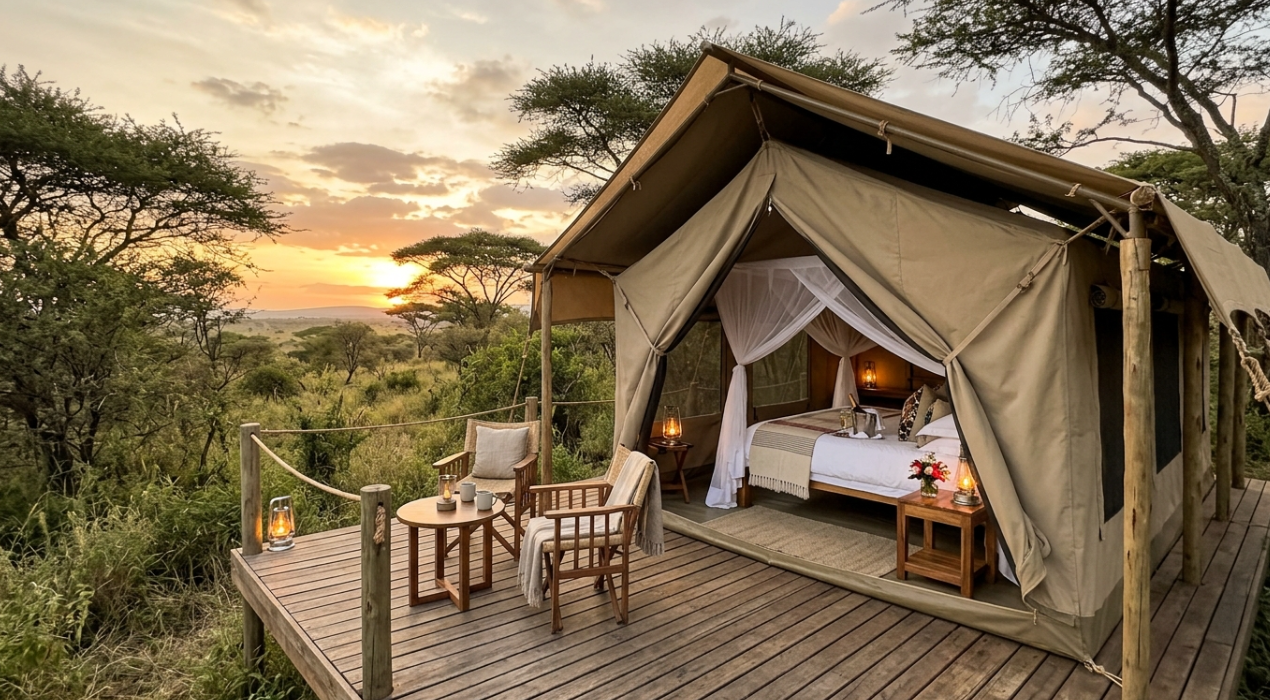
Canvas walls, permanent beds, private bathroom with running water, and a veranda. This is not “camping” in any backpacking sense. Honeymoon-friendly tented camps feature king beds, outdoor showers, and sometimes private plunge pools. The canvas walls mean you hear the bush at night, which is the entire point.
For couples comparing specific properties, romantic safari lodges in Tanzania breaks down what to look for by park and budget.
Mobile Camp
A temporary tented setup that moves with wildlife, particularly the Great Migration herds. Mobile camps offer an immersive experience because they’re positioned based on current animal movements rather than fixed geography.
Fly-Camp
A minimal-infrastructure bush overnight, usually guided and set up at a remote location away from the main camp. Think a comfortable cot under mosquito netting with a bush toilet. More adventure than luxury, but undeniably romantic for the right couple.
Star Bed / Sleep-Out
An open-air sleeping platform (raised, with mosquito netting) positioned away from the main camp. You fall asleep watching the Milky Way and wake to whatever sounds the bush offers. Several camps in the Serengeti and Tarangire offer these as a one-night add-on.
Exclusive-Use
Booking an entire camp, villa, or house for your party only. For honeymooners this means no other guests at meals, on game drives, or at the pool. Pricing reflects that you’re covering the cost of rooms that would otherwise be sold to other travelers.
Board Basis
How meals and drinks are included in your nightly rate:
|
Code |
Meaning |
What’s Included |
|---|---|---|
|
FB (Full Board) |
Three meals daily |
Breakfast, lunch, dinner. Drinks usually excluded or limited to water/tea/coffee. |
|
HB (Half Board) |
Two meals daily |
Typically breakfast and dinner. Common at beach resorts. |
|
AI (All-Inclusive) |
Meals plus house drinks |
Three meals, house wines, beers, spirits, soft drinks. |
|
FI (Fully Inclusive) |
Everything |
Meals, premium drinks, selected activities (game drives, walks), laundry, sometimes park fees. |
On safari, most camps and lodges operate on FB or FI. On Zanzibar, HB and AI are more common. Always confirm whether premium drinks and activities are in or out.
Honeymoon Upgrade
Many luxury lodges in Tanzania offer complimentary honeymoon upgrades: champagne on arrival, a room upgrade if available, a private bush dinner, or a cake. The catch is that these perks are not automatic. You have to mention you’re honeymooning when booking. This is free and valuable, so always tell your operator and the lodge.
Wildlife and Seasons
Understanding seasonal terms is essential because they directly affect what you’ll see, what you’ll pay, and how crowded the parks will be. The best time for a Tanzania honeymoon maps these seasons against romance and value tradeoffs month by month.
|
Period |
Typical Conditions |
Wildlife Focus |
Honeymoon Consideration |
|---|---|---|---|
|
January–February |
Generally warm with green landscapes |
Southern Serengeti calving season |
Strong choice for couples interested in newborn wildlife |
|
March–May |
Long rains |
Lush landscapes and fewer visitors |
Potentially lower rates, but wetter conditions |
|
June–October |
Drier conditions |
Strong general wildlife viewing and northern Migration activity |
High demand and peak pricing in many properties |
|
November–early December |
Short rains |
Green landscapes and changing Migration patterns |
Shoulder-season option |
|
Late December |
Holiday demand |
Variable by location |
Popular travel period; book early |
Big Five
Lion, leopard, elephant, Cape buffalo, and rhinoceros. The term originated with colonial hunting but now refers to the five most sought-after species for wildlife viewing. Tanzania’s Northern Circuit offers reliable Big Five sightings, particularly in the Ngorongoro Crater (one of the few places where black rhinos are seen regularly) and the Serengeti.
Great Migration
A year-round, continuous movement of approximately 1.5 million wildebeest accompanied by around 300,000 zebra and 150,000 gazelle across the Serengeti-Mara ecosystem. The herds follow rainfall patterns in a roughly clockwise loop. “Migration” is misleading if you picture a single event. It’s happening every day of the year, just in different locations.
Calving Season
Late January through February in the southern Serengeti (the Ndutu area). Around 8,000 calves are born daily during the peak. Predator activity is intense, which makes for dramatic wildlife viewing. This is one of the best windows for a private honeymoon safari in Tanzania if you want action without the peak-season crowds of July and August.
River Crossing
The dramatic moments when wildebeest and zebra plunge into the Mara River (and occasionally the Grumeti River) during the northern phase of the Migration, typically July through October. Crocodiles wait in the water. Not every day produces a crossing, and timing depends on herd movements and water levels. The Migration guide covers the timing in detail.
Dry Season (June to October)
The best overall period for wildlife viewing. Vegetation thins out, animals congregate around water sources, and the skies are clear. This is also peak pricing territory. Lodges book up months in advance, especially in July and August.
Green Season (March to May)
The long rains. Lower rates, lush green landscapes, dramatic skies for photography, and far fewer tourists. The trade-off is occasional heavy rain and some roads becoming difficult to pass. For budget-conscious couples who don’t mind brief afternoon showers, green season is the honeymoon value play.
Shoulder Season
The transitional months (November, early December, and June) that sit between peak and green seasons. These offer a solid balance of conditions, wildlife, and pricing. November is particularly attractive for honeymooners: the short rains are usually brief, the Serengeti is green but accessible, and rates haven’t hit peak levels yet.
Peak Season
July through October and late December through February. Highest demand, highest pricing, and the need to book 6 to 12 months ahead for popular properties.
Game Drive
Vehicle-based wildlife viewing, the core activity of any safari. Standard itineraries include a morning drive (departing before dawn, returning for brunch) and an afternoon drive (departing around 3:30pm, returning at sunset). Some camps offer full-day drives with a packed lunch, which gives you flexibility to stay out with an active sighting.
Night Drive
After-dark wildlife viewing using spotlights to find nocturnal species (aardvarks, genets, bush babies, hunting leopards). Night drives are prohibited inside Tanzania’s national parks. They’re only available in private concessions and conservancies.
Walking Safari / Bush Walk
Guided on-foot viewing focused on tracks, insects, plants, birding, and the overall sensory experience of being in the bush without a vehicle. Walking safaris are not available inside Tanzania’s national parks but are offered in concessions and conservancies. A walking safari followed by a sundowner is one of the best honeymoon moments you can plan.
Parks and Protected Areas
Serengeti National Park
Tanzania’s most famous park at 14,750 square kilometers. The Serengeti planning guide covers zones, timing, and where to stay. Park fees are approximately $60 per person per 24 hours (fees are reviewed annually in July by TANAPA).
Ngorongoro Crater
A collapsed volcanic caldera roughly 20 kilometers across with an extraordinarily dense concentration of wildlife on the crater floor. One of the few reliable locations for black rhino sightings. Entry fees are approximately $60 per person plus a vehicle fee, administered by the Ngorongoro Conservation Area Authority. For a deeper look, the Ngorongoro Crater planning guide covers logistics and timing.
Tarangire National Park
Known for massive elephant herds, ancient baobab trees, and excellent dry-season wildlife viewing. Less crowded than the Serengeti, and often the first or last park on a Northern Circuit honeymoon. Entry fees are approximately $53 per person per day.
Private Concession
A specific area within or adjacent to a national park that is leased to a safari operator for private use and managed independently from the park itself. Concessions typically limit the number of beds (and therefore visitors), offer activities prohibited in national parks (night drives, walking safaris, off-road driving), and charge premium rates that include conservation fees. Key Serengeti concessions include Grumeti and Lamai.
Private Concession vs. National Park Safari
A private concession and a national park provide different safari environments and activity options. Neither automatically means a better wildlife experience; the right choice depends on what the couple wants to do.
|
Feature |
National Park |
Private Concession |
|---|---|---|
|
Access |
Publicly managed protected area |
Privately or jointly managed area, depending on location |
|
Visitor controls |
Park regulations and visitor rules |
Often more limited vehicle or guest numbers |
|
Off-road driving |
Restricted by park regulations |
May be permitted under concession rules |
|
Night drives |
Generally restricted |
Often available where permitted |
|
Walking |
Subject to park regulations |
Often available with qualified guides |
|
Privacy |
Depends on location and season |
Often fewer vehicles |
|
Cost |
Park fees apply |
Accommodation may include conservation/concession fees |
Conservancy
Community or privately managed wildlife land adjacent to a national park. Functionally similar to a concession but often involves direct community ownership and revenue-sharing arrangements. Conservancies allow the same exclusive activities as concessions: off-road driving, night drives, and walking safaris.
Park Fees / Conservation Fees
Per-person, per-24-hour entry fees set by TANAPA (for national parks) or the NCAA (for Ngorongoro). A typical 7-day Northern Circuit honeymoon safari visiting Serengeti (4 days), Ngorongoro (1 day), and Tarangire (1 day) accumulates park fees of approximately $760 for two adults. Good operators include these in your quoted price. If a quote seems unusually low, check whether park fees are listed as an exclusion.
For a full breakdown of how fees stack up across a trip, the Tanzania safari cost guide explains each layer.
Honeymoon Experiences and Add-Ons
Bush Dinner
A private open-air dinner set up in the bush, away from the main camp, typically lit with lanterns and candles. Staff prepare the site while you’re on your afternoon game drive, and you arrive to a fully set table in the middle of nowhere. Many camps include one complimentary bush dinner for honeymooners.
Sundowner
Evening drinks at a scenic spot (hilltop, riverbank, kopje) timed to sunset. Your guide drives you out, sets up a small bar, and you watch the sky change color with a gin and tonic. Simple, free at most camps, and consistently cited as a honeymoon highlight.
Champagne Breakfast
A bush-set morning meal, often paired with a hot air balloon landing. Can also be arranged independently at many camps. Picture a white-cloth table under an acacia tree after a sunrise game drive.
Hot Air Balloon Safari
A dawn flight over the Serengeti lasting 50 to 70 minutes, followed by a champagne breakfast after landing. The standard rate is US $599 per person, which includes the TANAPA ballooning fee of $40, a transfer from your lodge to the launch site, the flight, and breakfast. You share the balloon basket with up to 16 passengers. For couples wanting a fully private experience, private balloon charters are available in the Grumeti Reserve, though at a significantly higher cost.
Multiple honeymoon travelers highlight the balloon flight as the standout moment of their trip. Duma Explorer travelers have specifically called out the hot air balloon over the Serengeti as a honeymoon highlight across numerous reviews.
Couple’s Spa / Massage
Available at many premium lodges and nearly all Zanzibar beach resorts. Bush spa treatments (massage under a tree, outdoor bath) are offered at some of the higher-end Serengeti and Tarangire properties.
Dhow Cruise
A trip on a traditional wooden sailing boat, most commonly offered along the Zanzibar coast. Sunset dhow cruises with snacks and drinks are a classic honeymoon activity.
Spice Tour
A guided walk through Zanzibar’s spice farms to see vanilla, cloves, cinnamon, and cardamom growing. The Zanzibar spice tour glossary explains what to expect and what it costs.
How Many Days Do You Need for a Tanzania Honeymoon Safari?
For most couples, the right length depends on whether the trip includes only safari or combines safari with Zanzibar.
-
5–6 nights: Short safari focused on two or three destinations.
-
7–8 nights: More comfortable Northern Circuit safari.
-
9–10 nights: Safari plus a short Zanzibar extension.
-
12–14 nights: A slower honeymoon with more time for wildlife, relaxation or additional destinations.
Avoid changing camps every night simply to add more locations. Fewer destinations with longer stays can create a more relaxed honeymoon and reduce time spent packing and transferring.
Zanzibar and the Beach Extension
Bush-to-Beach
A common Tanzania honeymoon structure is safari first and beach second. The arrangement lets couples finish the more active safari portion before moving to a slower beach stay.
Safari-first is not mandatory, however. Couples who prefer to start with several quiet beach days can reverse the order. The more important consideration is the number of travel days created by changing locations and whether the final itinerary feels relaxed rather than rushed.
Zanzibar
A semi-autonomous archipelago 35 kilometers off Tanzania’s coast. The main island, Unguja, is what most people mean when they say “Zanzibar.” Accessible from the Serengeti by a 90-minute bush flight or from Dar es Salaam by a short flight or ferry.
For couples weighing how a Zanzibar extension fits into the overall honeymoon, the safari and Zanzibar honeymoon guide maps out the logistics.
Stone Town
The UNESCO-listed historic center of Zanzibar City. Narrow streets, carved wooden doors, rooftop restaurants, and a waterfront market. Worth a night or two for cultural immersion before heading to the beach.
Nungwi / Kendwa / Michamvi
Popular beach areas on Zanzibar. Nungwi (north tip) has the most consistent swimming tides and a lively atmosphere. Kendwa is slightly quieter. Michamvi (southeast) is more secluded. Your choice depends on whether you want nightlife options or pure isolation.
Mnemba Island
A private island off Zanzibar’s northeast coast with a single ultra-exclusive lodge (currently operated by andBeyond). Maximum 24 guests on the entire island. It’s the ultimate honeymoon splurge for couples who want world-class snorkeling and zero other people on their beach.
Booking and Cost Vocabulary
Per Person Sharing (pps)
The standard pricing unit in the safari industry. Prices are quoted per person, assuming two people share one room or tent. When you see “$600 pps,” that means the room costs $1,200 total per night for the couple.
Single Supplement
An extra charge applied when one person occupies a double room alone. Not relevant for most honeymooners but worth understanding when reading price lists.
Rack Rate vs. Operator Rate
The rack rate is the published price a lodge charges if you book directly. Tour operators negotiate lower rates based on volume and relationships, then build their margin into your package price. This is why booking through a specialist operator often costs the same or less than going direct, while adding planning expertise and logistical support.
Inclusions
Everything covered in your quoted price. A complete Tanzania honeymoon safari quotation usually brings together the private vehicle, guide services, accommodation, meals according to the stated board basis, park fees, and any domestic flights written into the route. Always confirm inclusions line by line.
Exclusions
Items not covered. Typically: international flights, visa fees (approximately $50 for most nationalities, per the Tanzania Immigration Services Agency), travel insurance, tips, premium drinks, spa treatments, and balloon safaris.
Tipping
Customary and expected for safari guides, drivers, camp staff, and any activity providers. Budget a separate cash amount. The Tanzania safari tipping guide covers recommended amounts by role.
Deposit and Final Payment
Most operators require a 25% deposit to secure your booking, with the balance due 60 to 90 days before your travel date. Lodge allocations are held provisionally until the deposit clears, so delays can mean losing a room at a popular property during peak season.
Cancellation Policy
Terms vary by operator and by how close to the travel date you cancel. Policies are typically tiered: more flexible 90+ days out, stricter within 60 days, and non-refundable within 30 days. Read the fine print.
Travel Insurance
Strongly recommended for any private honeymoon safari in Tanzania. Your policy should cover trip cancellation, medical expenses, and medical evacuation (bush airstrips to Nairobi or Dar es Salaam hospitals). The safari travel insurance guide explains what coverage to look for.
How to Compare Private Tanzania Honeymoon Safari Quotes
Two safari proposals can look similar while including very different services. Compare quotations line by line rather than comparing the headline price alone.
|
Quote Item |
What to Check |
|---|---|
|
Accommodation |
Room or tent category, number of nights and board basis |
|
Safari vehicle |
Private or shared, vehicle type and whether it stays with you |
|
Guide |
Dedicated guide or camp-based guide |
|
Park fees |
Which parks are included and how many entry days are covered |
|
Conservation fees |
Whether concession or conservation charges are included |
|
Domestic flights |
Route, baggage allowance and flight costs |
|
Airport transfers |
Arrival and departure transfers |
|
Game drives |
Private or shared, half-day or full-day |
|
Activities |
Walking, night drives, balloon safari and other activities |
|
Meals |
Full board, all-inclusive or fully inclusive |
|
Drinks |
House drinks only or premium beverages included |
|
Zanzibar |
Hotel, transfers, meals and activities |
|
Taxes and fees |
Whether quoted prices include applicable taxes |
|
Tips |
Usually paid separately unless specifically included |
|
Travel insurance |
Usually excluded |
Questions to Ask Before Paying a Deposit
Ask the operator:
-
Is the safari vehicle completely private for the two of us?
-
Will the same guide stay with us throughout the road portion?
-
Are game drives private at every camp?
-
Which park, conservation and concession fees are included?
-
Are domestic flights included?
-
What baggage allowance applies to bush flights?
-
Which meals and drinks are included?
-
What happens if a flight is delayed or cancelled?
-
What are the cancellation and refund terms?
-
Which honeymoon extras are confirmed rather than subject to availability?
What Determines the Cost of a Private Tanzania Honeymoon Safari?
The final price is usually driven by six variables: accommodation level, number of safari nights, travel season, private vehicle arrangements, domestic flights and optional experiences.
|
Cost Driver |
Lower-Cost Choice |
Higher-Cost Choice |
|---|---|---|
|
Accommodation |
Comfortable lodge or tented camp |
Luxury or ultra-luxury camp |
|
Transport |
Road-led itinerary |
Multiple bush flights |
|
Privacy |
Shared game drives |
Dedicated vehicle and guide |
|
Location |
Standard park accommodation |
Private concession or exclusive-use property |
|
Season |
Green or shoulder season |
Peak wildlife season |
|
Activities |
Standard game drives |
Balloon flight, private dining, walking and other add-ons |
|
Beach extension |
Standard Zanzibar hotel |
Exclusive island or luxury beach property |
When comparing prices, calculate the total trip cost for two people, not only the advertised per-person rate. Also check whether park fees, domestic flights, transfers and activities are already included.
Tanzania Honeymoon Safari Cost Benchmarks
Realistic pricing depends on accommodation tier, number of parks, whether you fly or drive, and whether Zanzibar is included.
|
Trip Style |
Typical Duration |
Approximate Starting Point |
|---|---|---|
|
Mid-range safari |
5–7 nights |
From about $4,500 per person |
|
Safari + short Zanzibar extension |
7–9 nights |
From about $6,500 per person |
|
Extended bush-and-beach honeymoon |
9–12 nights |
From about $8,000 per person |
|
Luxury private honeymoon |
10–14 nights |
From about $12,000 per person |
These are planning benchmarks rather than fixed market prices. Actual quotations can vary substantially by travel month, camp category, private vehicle arrangements, domestic flights, park and conservation fees, and the number of premium experiences included.
Mid-range honeymoon safaris are achievable in the $500 to $700 per person per day bracket according to industry practitioners. Adding a Zanzibar extension at a mid-range beach resort brings the total trip cost to approximately $10,000 to $14,000 all-in for two, including domestic flights.
Luxury and ultra-luxury experiences (private fly-camps, butler service, camps with private plunge pools) can start at around $1,000 per person per day and reach $2,500 or more.
The most popular private honeymoon safari Tanzania itinerary is 10 days: a private safari on the Northern Circuit, a bush flight from the Serengeti to Zanzibar, and four beach nights. Expect to pay between $5,800 and $20,000+ per couple depending on the tier.
For a detailed breakdown of what drives these numbers, the Tanzania honeymoon cost guide walks through each cost layer.
Private Tanzania Honeymoon Safari Itinerary Ideas
The ideal route depends on how much time you have and whether your priority is wildlife, privacy, photography, or a safari-and-beach combination.
|
Trip Length |
Example Route |
Best For |
|---|---|---|
|
5–6 nights |
Tarangire → Ngorongoro → Serengeti |
Couples with limited time |
|
7–8 nights |
Tarangire → Ngorongoro → Serengeti |
Classic Northern Circuit honeymoon |
|
9–10 nights |
Tarangire → Ngorongoro → Serengeti → Zanzibar |
Safari plus beach |
|
12–14 nights |
Northern Circuit → additional safari area → Zanzibar |
Slower-paced honeymoon |
|
10+ nights |
Northern or Southern Circuit → Zanzibar |
Couples prioritizing seclusion |
Classic 7-Night Private Safari
A common Northern Circuit structure is:
Night 1: Arusha
Nights 2–3: Tarangire area
Night 4: Ngorongoro
Nights 5–7: Serengeti
After safari: Optional flight to Zanzibar
The exact number of nights in each destination should depend on seasonal wildlife movements, accommodation availability and the couple's priorities rather than following a fixed template.
Safari + Zanzibar Honeymoon
For couples with 9–12 nights, a common structure is approximately 5–7 safari nights followed by 3–5 nights in Zanzibar. This allows the safari portion to remain focused on wildlife while the final days provide time for beaches, swimming, spa treatments and slower-paced activities.
Guide and Safety Terms
FGASA
Field Guides Association of Southern Africa. A tiered qualification system for safari guides, starting at Level 1 (NQF2) and progressing to advanced tracking and trails certifications. FGASA-trained guides understand animal behavior, ecology, and how to interpret what you’re seeing in the field. Duma Explorer’s safari guides complete EcoTraining programs and are enrolled in FGASA Level 1 certification.
WFR (Wilderness First Responder)
An emergency medical certification for guides operating in remote areas. WFR-trained guides can stabilize injuries, manage altitude sickness, and make evacuation decisions. Duma Explorer’s Kilimanjaro guides hold WFR certification.
KPAP
The Kilimanjaro Porters Assistance Project, which sets standards for porter wages, equipment, and treatment on Kilimanjaro climbs. Duma Explorer is a KPAP founding partner.
Travelife Certified
An international sustainability certification for tour operators covering environmental practices, fair labor, and community engagement. Duma Explorer holds Travelife Certification, one of a small number of Tanzania-based operators with this credential.
How to Choose a Private Tanzania Safari Operator
Before comparing operators by price, compare what each proposal actually includes. A lower headline price may exclude park fees, domestic flights, private vehicle charges or activities that another quotation includes.
Look for:
-
Clear itemized inclusions and exclusions
-
Transparent cancellation terms
-
Private vehicle and guide arrangements stated in writing
-
Experience operating the parks on your route
-
Emergency and evacuation procedures
-
Current insurance and licensing information
-
Clear accommodation names and room categories
-
Domestic-flight baggage requirements
-
A realistic daily driving and activity schedule
-
Reviews that are recent and specific to the type of safari you are booking
Ask for the final itinerary and inclusions in writing before paying a deposit.
Swahili Safari Terms You’ll Hear
|
Term |
Meaning |
|---|---|
|
Safari |
Journey (yes, the word itself is Swahili) |
|
Pole pole |
Slowly, slowly (the pace mantra on Kilimanjaro, but also good honeymoon advice) |
|
Boma |
A traditional enclosure or gathering area; at lodges, often the campfire circle |
|
Kopje |
A rocky outcrop on the Serengeti plains, often home to lions and hyraxes (from Afrikaans, but universally used) |
|
Duma |
Cheetah |
|
Simba |
Lion |
|
Hakuna matata |
No worries (you will hear this constantly, and it never gets old) |
|
Jambo / Mambo |
Hello (formal / informal) |
|
Asante sana |
Thank you very much |
What a Well-Planned Private Honeymoon Safari Delivers
When the terminology makes sense and the operator executes well, the result speaks for itself. One couple who traveled on a 2025 honeymoon safari described it simply: “It exceeded our expectations in every way.” Another pair celebrating their 25th wedding anniversary said the experience was “absolutely magical.” These outcomes don’t happen by accident. They happen because the couple understood what they were booking, communicated their priorities clearly, and worked with an operator who could translate those priorities into a real itinerary.
Duma Explorer designs custom private honeymoon safaris across Tanzania’s Northern Circuit with Zanzibar extensions, from route and timing to lodge selection and romantic add-ons. Owner-led trip design by Stacy Readal, who has spent 15 years based in Tanzania, means your itinerary is built by someone who knows the camps, the guides, and the seasonal patterns firsthand.
Plan My Tanzania Honeymoon →
Frequently Asked Questions
How much does a private honeymoon safari in Tanzania cost?
A mid-range private safari without a beach extension starts around $4,500 per person for 5 to 7 nights. The most popular 10-day bush-to-beach combination runs $5,800 to $20,000+ per couple depending on accommodation tier and whether you fly between parks. Ultra-luxury experiences with exclusive-use camps and private everything start around $12,000 per person.
Is a private safari vehicle worth it for just two people?
Yes, for honeymoons especially. A private vehicle means you control the pace, linger at sightings as long as you want, and don’t share space with strangers. You pay a per-person premium because the vehicle cost isn’t split across more travelers, but the flexibility and intimacy justify it for most couples.
What’s the best time of year for a Tanzania honeymoon safari?
June through October offers the best wildlife viewing and driest weather but comes with peak pricing. Late January through February is excellent for calving season in the southern Serengeti (predator action, fewer crowds). November and early December are shoulder months that balance conditions and cost. The Tanzania honeymoon timing guide breaks this down month by month.
Should we do a road safari or fly-in for our honeymoon?
Road-led safaris offer the best flexibility-to-value ratio on the Northern Circuit. Your vehicle stays with you, you set the schedule, and you don’t share game drives. Fly-in works better for time-pressed couples, those combining northern and southern parks, or anyone who wants to skip long drives between destinations. Many honeymoon itineraries use a hybrid approach: drive between Tarangire, Ngorongoro, and Serengeti, then fly from the Serengeti to Zanzibar.
How many days do we need for a Tanzania honeymoon safari?
Seven days is the minimum to cover two or three parks meaningfully. Ten days is the sweet spot for a safari plus Zanzibar combination (6 nights safari, 4 nights beach). Twelve to fourteen days allows a more relaxed pace and a third beach destination or additional park.
Can we combine safari with Zanzibar on the same trip?
Absolutely, and most honeymoon couples do. The standard format is safari first, beach second. A bush flight from the Serengeti to Zanzibar takes about 90 minutes and eliminates backtracking through Arusha. The Zanzibar honeymoon extension guide covers logistics, costs, and where to stay.
Do lodges really give free honeymoon perks?
Many do, but only if you tell them. Champagne on arrival, room upgrades when available, a complimentary bush dinner or cake, and even spa discounts are common at mid-range and luxury properties. Always mention that you’re honeymooning at the time of booking, not at check-in.