

Best Kilimanjaro Route (2026): Lemosho vs Northern Circuit
Climbing Mount Kilimanjaro is a life changing adventure, but the first big decision you’ll make is choosing a path to the summit. With seven official routes, picking the right one can feel overwhelming. The truth is, the best Kilimanjaro route isn’t a one size fits all answer. It depends entirely on your priorities: Are you seeking stunning scenery, the highest chance of success, or a quiet trail with more solitude?
This guide breaks down everything you need to know to find the perfect route for your climb. We’ll explore the pros and cons of each trail, dive into critical factors like acclimatization and safety, and give you the honest details to help you make an informed choice. For a side‑by‑side overview, see our complete guide to Kilimanjaro climbing routes.
| Route | Recommended Days | Success Rate | Crowds | Best For |
|---|---|---|---|---|
| Lemosho | 8 Days | ~90% | Medium | Scenery & Balance |
| Northern Circuit | 9 Days | ~95%+ | Very Low | Safety & Solitude |
| Machame | 7 Days | ~85% | High | Social Experience |
| Rongai | 7 Days | ~80% | Low | Rainy Season |
| Marangu | 6 Days | ~60% | High | Hut Lovers |
| Umbwe | 6 Days | ~60% | Very Low | Experienced Climbers |
Finding the Best Kilimanjaro Route for You
Let’s get straight to the point. While every route leads to the same magnificent summit, they offer vastly different experiences. Here’s a quick rundown of the top contenders based on what climbers value most.
The Best Overall Kilimanjaro Route: Lemosho
For its incredible balance of beautiful scenery, high success rates, and manageable crowds, the Lemosho Route is widely considered the best Kilimanjaro route overall. Typically climbed over 8 days, it offers a gentle start through a remote rainforest, crosses the vast Shira Plateau with 360 degree views, and tackles the famous Barranco Wall. This longer itinerary provides excellent acclimatization, leading to summit success rates of around 90%.
The Best Route for Acclimatization: Northern Circuit
If maximizing your chances of standing on Uhuru Peak safely is your top priority, the Northern Circuit is your answer. As the longest route (spanning 9 days), it provides the most gradual ascent profile on the mountain. This slow and steady approach is ideal for acclimatization, allowing your body the maximum time to adjust to the altitude. It is without a doubt the safest option.
Kilimanjaro Success Rates by Route (2026 Data)
Success on Kilimanjaro is a math problem: Time = Oxygen. Statistics from 2025 and 2026 show a massive disparity based on itinerary length:
5-Day Routes: ~27% Success Rate
6-Day Routes: ~44% Success Rate
7-Day Routes: ~64% Success Rate
8+ Day Routes:85%–95% Success Rate
The Northern Circuit (9 days) remains the gold standard for success because it utilizes the "climb high, sleep low" principle more effectively than any other path.
The Most Scenic Route: Lemosho
While beauty is subjective, most guides and experienced climbers agree that the Lemosho Route is the most picturesque. It takes you through all five of Kilimanjaro’s ecological zones, from lush rainforest (where you might spot colobus monkeys) and expansive moorland to alpine desert and the arctic summit zone. The views are constantly changing and consistently breathtaking, making it a photographer’s dream.
The Quietest (Least Crowded) Route: Northern Circuit
If you dream of having Kilimanjaro almost to yourself, the Northern Circuit is the undisputed champion of solitude. As the newest and longest route, it attracts very few trekking groups. You will circle the remote northern slopes of the mountain, enjoying quiet trails and campsites where your group might be the only one around. It’s a true wilderness experience.
The Most Challenging Route: Umbwe
For seasoned mountaineers looking for a serious physical test, the Umbwe Route is the most difficult. It is the shortest, steepest, and most direct path to the summit. With its rapid elevation gain, it offers very little time for acclimatization, making it risky and physically grueling. Consequently, it has a very low success rate and is only recommended for extremely fit climbers with prior high altitude experience.
Lemosho vs. Northern Circuit: Which One Should You Choose?
While both routes start on the western side of the mountain and offer superior acclimatization, they cater to different types of adventurers:
Choose Lemosho if: You want the most "iconic" Kilimanjaro experience. It features the famous Barranco Wall and merges with the southern circuit, giving you a mix of remote trails and a vibrant summit night atmosphere.
Choose Northern Circuit if: You want to avoid the "traffic jams." By circling the northern face, you see views of Kenya and the remote wilderness that 90% of climbers never see. It is the ultimate "safety-first" route.
Key Factors for Choosing Your Route
Beyond just picking a name off a map, understanding a few key concepts will help you choose the best Kilimanjaro route for your personal needs.
The Critical Role of Acclimatization
Acclimatization is your body’s process of adjusting to lower oxygen levels at high altitude, and it is the single most important factor for a safe and successful climb. Uhuru Peak stands at 5,895 meters (19,341 feet), where the oxygen is roughly half that at sea level. Ascending too quickly can lead to Acute Mountain Sickness (AMS) or worse. Routes that are longer and feature a “climb high and sleep low” profile (where you hike to a higher elevation during the day and descend to a lower altitude to sleep) dramatically improve your body’s ability to adapt. For practical tips, see our guide to dealing with altitude sickness on Kilimanjaro.
Accommodation: Camping vs. Huts
Your accommodation on the mountain depends entirely on your chosen route.
Mountain Huts: The Marangu Route is the only trail that offers accommodation in large, dormitory style A frame huts. You get a bunk bed and a mattress, which provides great shelter from the elements.
Tented Camping: All other routes (Lemosho, Machame, Northern Circuit, etc.) are camping routes. Your porters carry and set up high quality mountain tents for you at each campsite. While it means sleeping outdoors, camping offers a more authentic wilderness experience and allows for more flexibility with campsite locations.
The Reality of Summit Night
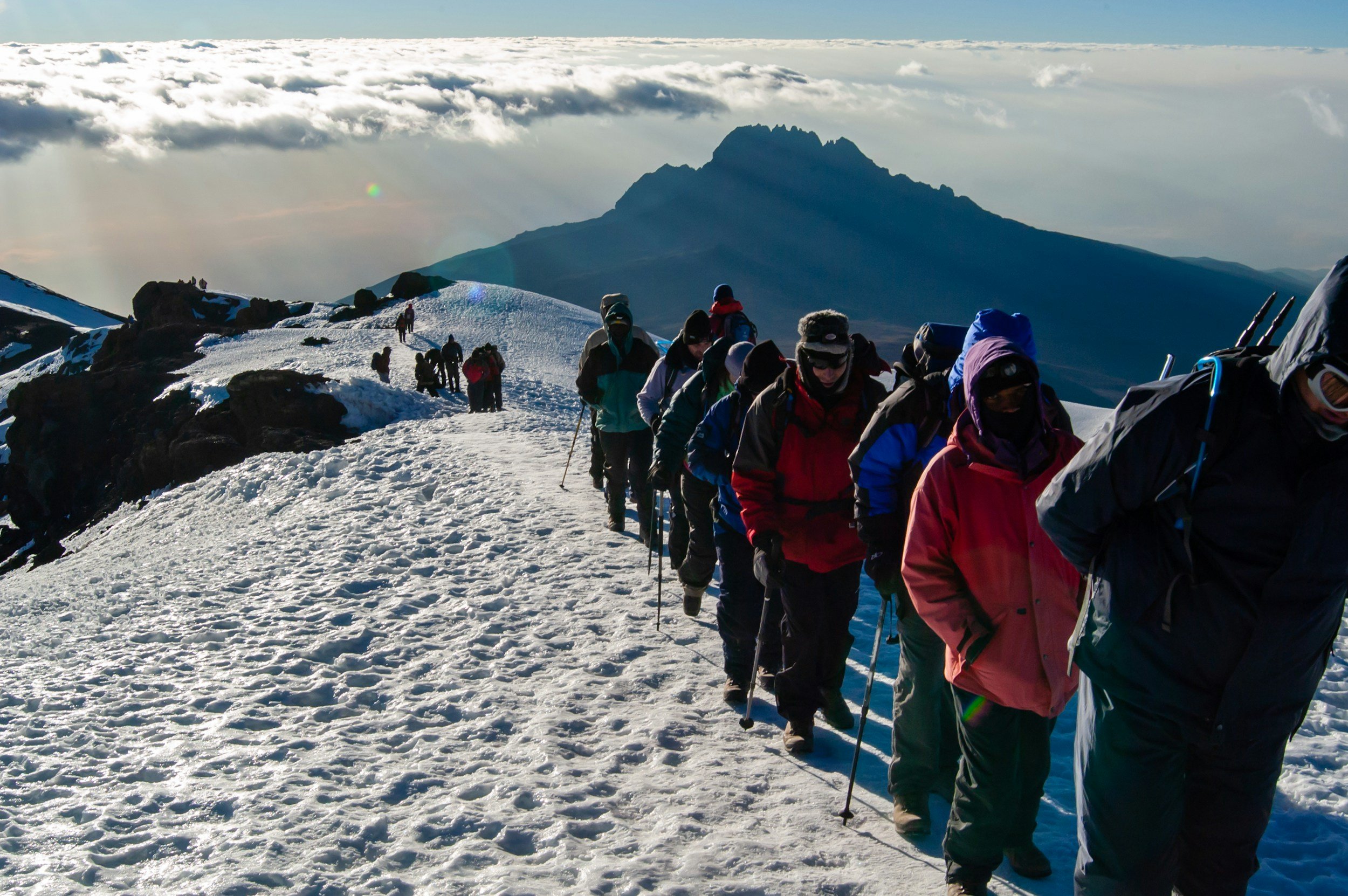
No matter which route you take, the final push to the summit is the hardest part of the journey. Summit night is a grueling test of physical and mental endurance. Climbers typically start their ascent around midnight from a high camp like Barafu (4,673m). You’ll hike for 6 to 8 hours in the freezing dark, slowly gaining over 1,200 vertical meters to reach the top around sunrise. In total, the day involves 13 to 16 hours of trekking at extreme altitude. It’s an exhausting but incredibly rewarding experience.
Safety Considerations on the Mountain
Kilimanjaro is a non technical trek, but it is a serious high altitude mountain that should not be underestimated. Altitude sickness is the primary risk, and it can affect anyone regardless of age or fitness. An estimated 10 to 50 fatalities occur on the mountain each year, usually from altitude related complications.
Choosing a reputable operator is paramount. Experienced guides, like the Wilderness First Responder certified guides at Duma Explorer, conduct daily health checks and carry emergency oxygen. They are trained to spot early signs of altitude sickness and make the right call to ensure your safety. If a serious issue arises, here’s what to know about helicopter evacuation on Kilimanjaro.
A Detailed Look at Each Kilimanjaro Route
Lemosho Route (Pros & Cons)
Often called the best Kilimanjaro route for its perfect blend of features, Lemosho is a top recommendation for most climbers.
Pros: Extremely scenic, low crowds for the first few days, excellent acclimatization profile on the 8 day itinerary, and a very high success rate (around 90%). It offers a true wilderness feel before joining the popular southern circuit.
Cons: It’s a longer and therefore more expensive option. The starting gate requires a longer drive from town.
Machame Route (Pros & Cons)
Nicknamed the “Whiskey Route,” the Machame Route is the most popular route on the mountain for good reason.
Pros: Offers fantastic and varied scenery, including the Shira Plateau and the dramatic Barranco Wall. The 7 day itinerary has a great acclimatization profile and a high success rate (around 85%).
Cons: Its popularity means it is the most crowded route. If you are seeking solitude, this might not be the best choice for you.
Northern Circuit Route (Pros & Cons)
The ultimate choice for those who want to maximize success and avoid crowds.
Pros: The highest success rate on the mountain (over 95%). It is the quietest and least trafficked route, offering a unique and remote wilderness experience with 360 degree views.
Cons: It is the longest and most expensive route, requiring a significant time commitment (9 days).
Rongai Route (Pros & Cons)
The only route approaching from the drier, northern side of the mountain. If you’re planning around rain or peak seasons, see our month‑by‑month advice on the best time to climb Kilimanjaro.
Pros: A great option during the rainy season as the northern slopes receive less precipitation. It’s a quieter trail with a gentle, steady ascent. You get to see both sides of the mountain, as you descend via the Marangu route.
Cons: Some consider it less scenic than the southern routes. It lacks a natural “climb high and sleep low” profile in the early days.
Marangu Route (Pros & Cons)
Known as the “Coca Cola Route,” the Marangu Route is the oldest trail and the only one with hut accommodations.
Pros: Offers the comfort of sleeping in huts instead of tents. The trail has a gradual, steady incline. It is often the cheapest option.
Cons: The standard 5 day itinerary provides poor acclimatization and has the lowest success rate (as low as 27%). It can be very crowded, and the scenery is less varied since you ascend and descend on the same path.
Shira Route (Pros & Cons)
A western approach that starts at a much higher altitude.
Pros: Skips the lower rainforest sections, starting directly on the scenic Shira Plateau. It is a quiet route in the beginning.
Cons: The high starting elevation (around 3,500m) can be jarring and increases the risk of altitude sickness from day one. For this reason, it’s now less popular than the similar but more gradual Lemosho route.
Umbwe Route (Pros & Cons)
The shortest, steepest, and most direct route up Kilimanjaro.
Pros: Offers a tough challenge and almost complete solitude for those who seek it. It’s the fastest way to gain altitude.
Cons: Extremely strenuous with a dangerously rapid ascent. It has a very low success rate due to poor acclimatization and is not recommended by most reputable operators due to the higher risk.
Kilimanjaro Routes at a Glance
Choosing the best Kilimanjaro route often comes down to how many days you can spend on the mountain. Here is a quick comparison of the typical duration and distance for each.
Northern Circuit: 9 days, approx. 90 km
Lemosho Route: 8 days, approx. 70 km
Machame Route: 7 days, approx. 62 km
Rongai Route: 7 days, approx. 73 km
Marangu Route: 6 days (recommended), approx. 72 km
Shira Route: 7 days, similar to Lemosho
Umbwe Route: 6 days (minimum), approx. 37 km
Remember, the distance is less important than the number of days. More days allow for a slower pace and better acclimatization, which is the key to reaching the summit.
The Final Word: What is the Best Kilimanjaro Route?
For first time climbers, the 8 day Lemosho Route is an outstanding choice. It provides the best combination of stunning scenery, excellent acclimatization, and high success rates, giving you a fantastic and enjoyable experience. The 7 day Machame Route is another excellent and very popular alternative for fit beginners.
Ultimately, the journey is just as important as the destination. Choosing the best Kilimanjaro route ensures you can safely enjoy every step of your adventure. If you’re still unsure, talking to an expert can provide clarity. If you’re comparing outfitters, start with our guide to choosing the best Kilimanjaro operator in Moshi. Companies like Duma Explorer, with over 20 years of local Tanzanian experience, offer personalized advice to match you with the ideal route for your goals and fitness level. Their small group climbs and commitment to safety make them a trusted choice for this once in a lifetime trek.
Frequently Asked Questions
What is the easiest route to climb Kilimanjaro?
The Marangu route is often considered the easiest in terms of terrain due to its gradual slope. However, its short 5 day itinerary makes it very difficult for acclimatization, leading to the lowest success rate. A longer route like the 8 day Lemosho or 9 day Northern Circuit is physically easier on the body and gives you a much higher chance of success.
Which is the best Kilimanjaro route for a beginner?
The 8 day Lemosho route is highly recommended for beginners. It has a very high success rate, beautiful scenery, and an excellent acclimatization schedule that allows your body to adjust to the altitude gradually.
How many days do you need to climb Kilimanjaro?
To maximize your chances of success and enjoyment, you should plan for at least 7 days on the mountain. Routes of 8 or 9 days, like Lemosho and the Northern Circuit, have the highest success rates (approaching 90 to 95%) because they allow for optimal acclimatization.
Can you climb Kilimanjaro without a guide?
No, it is a legal requirement set by the Tanzanian government and Kilimanjaro National Park that all trekkers must be accompanied by a licensed guide. This is for your safety and to support the local economy.
Which route has the best views on Kilimanjaro?
The Lemosho route is widely considered the most scenic, as it traverses nearly every ecosystem on the mountain, from lush rainforest to the arctic summit. The Northern Circuit also offers unique and spectacular views of Kibo’s northern face that very few climbers get to see.
