

Family Safari Lodges Tanzania: 2026 Parents' Guide
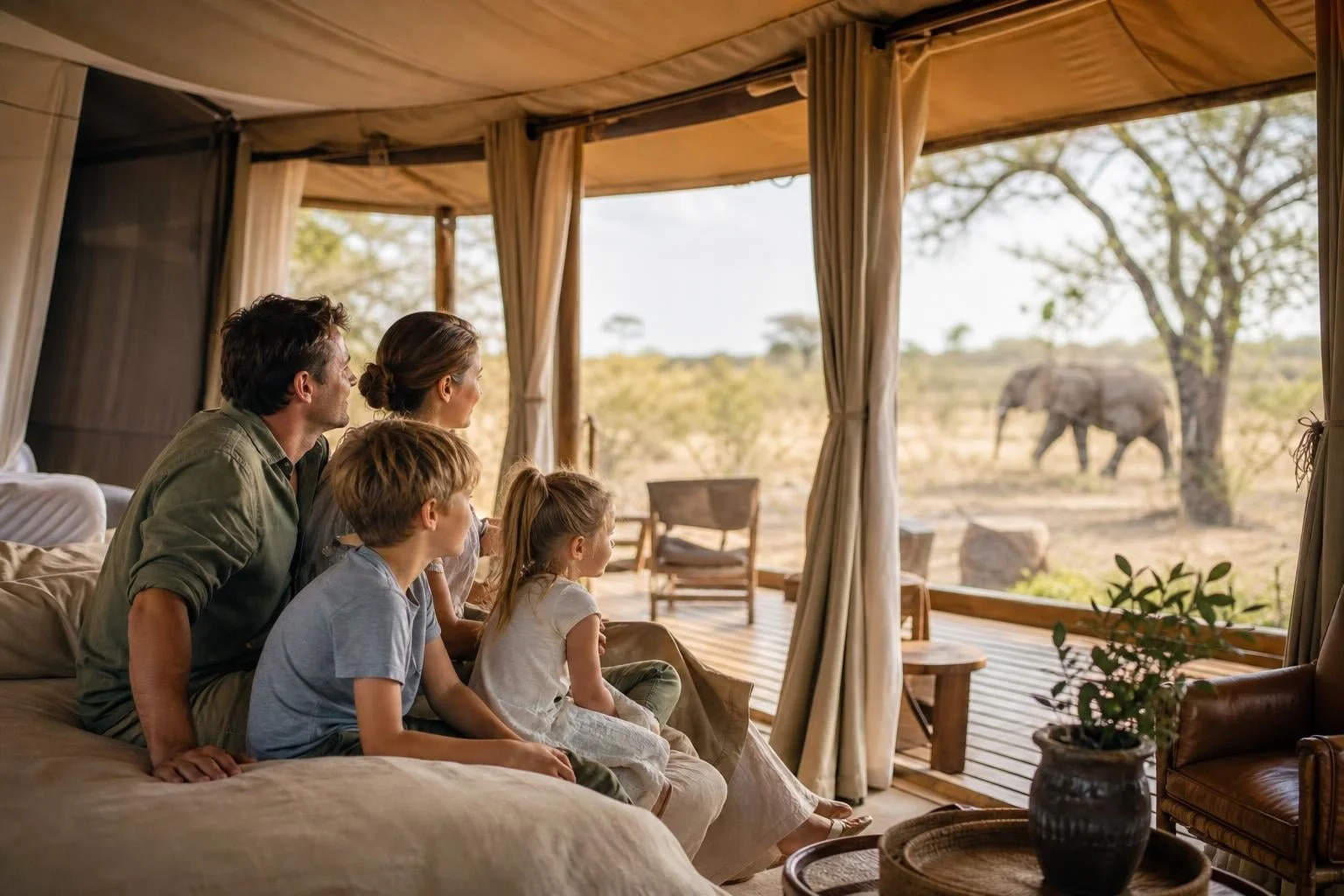
Planning a family safari in Tanzania is less about finding the most luxurious lodge and more about matching the property to your children’s ages, rooming needs, safety rules, vehicle setup, and tolerance for long drives. A lodge that works perfectly for teenagers may be a poor fit for a family with a four-year-old.
The best family safari lodges in Tanzania are those that match your children’s ages, room configuration, safety requirements, daily pace, and access to private game drives. For younger children, prioritize a private vehicle, family or interconnecting rooms, a pool or reliable downtime, flexible meals, and shorter transfers. For older children and teenagers, tented or mobile camps can offer more immersive wildlife experiences. Always confirm child policies, age-restricted activities, fencing, night escorts, and room layouts before booking.
Quick takeaway: For most families, the most important lodge features are the right room configuration, a private vehicle, manageable transfer times, appropriate camp safety procedures, and enough downtime for children. A higher room category does not automatically create a better family safari.
If you want help comparing family safari packages across Tanzania’s parks, Duma Explorer designs private itineraries matched to children’s ages, rooming needs, and daily pace.
Which Tanzania Safari Lodge Setup Is Best for Your Family?
The right lodge setup depends heavily on your children’s ages, how much driving they can tolerate, and how much flexibility you want during game drives.
|
Family situation |
Lodge setup to consider |
Vehicle |
What to prioritize |
|---|---|---|---|
|
Children under 5 |
Permanent lodge, farm lodge, or family-friendly property with strong infrastructure |
Private vehicle |
Short drives, pool, flexible meals, easy room access |
|
Children 6–9 |
Permanent lodge or family tent with a pool |
Private vehicle strongly recommended |
Family room, downtime, shorter game drives |
|
Children 10–12 |
Lodge or tented camp with family accommodation |
Private vehicle still valuable |
Activity variety, comfortable rooming, flexible schedule |
|
Teenagers |
Tented or mobile camp, private villa, or more remote lodge |
Private or shared depending on family preference |
Walking, boating, photography, longer drives |
|
Family of 5+ |
Family tent, private house, villa, or multiple interconnecting rooms |
Private vehicle usually preferred |
Confirm exact bed and bathroom configuration |
|
Multigenerational family |
Private house, villa, or clustered rooms |
One or more private vehicles |
Flexible schedules, easy access, varied activities |
The key principle: Choose the lodge around the family’s constraints first, then choose the luxury level. A beautifully designed lodge cannot compensate for unsuitable rooming, excessive transfer time, or an activity policy that excludes your children.
Family Safari Lodge Terms at a Glance
|
Term |
What it means |
Why it matters for families |
Best for |
|---|---|---|---|
|
Family tent |
A tent or unit with separate sleeping areas for parents and children |
Keeps everyone under one roof with bush immersion |
Families with children 6+ |
|
Interconnecting rooms |
Two rooms with an internal connecting door |
Parents can check on younger children without going outside |
Families with children under 10 |
|
Private vehicle |
A 4x4 used only by your family |
Control timing, snack stops, early returns |
All families, essential for younger kids |
|
Unfenced camp |
A camp where wildlife can walk through the property |
Requires supervision and maturity; magical for older kids |
Families with teens or children 10+ |
|
Permanent lodge |
A fixed property with solid infrastructure |
Pools, reliable power, larger rooms, more predictable amenities |
First-time safari families, younger children |
|
Mobile camp |
A camp that moves seasonally, often following the migration |
Atmospheric but fewer resort amenities |
Older children, wildlife-focused families |
|
Farm lodge |
A lodge on or near a working farm, often around Karatu |
Space, gardens, food familiarity, non-drive activities |
Younger children, multigenerational groups |
|
Fly-in safari |
Using light aircraft between parks |
Reduces road time but comes with strict baggage limits |
Families with limited time or very young children |
|
Pool break |
Midday rest at camp, usually involving a swimming pool |
Prevents game-drive fatigue in children |
All ages, especially under 12 |
|
Child policy |
A lodge’s rules on minimum ages, pricing, and activity access |
Determines whether your children can stay and what they can do |
Every family; verify before booking |
|
Age-restricted activity |
Activities like walking safaris with minimum age requirements |
Children may be excluded from certain experiences |
Families planning beyond game drives |
What Makes a Tanzania Safari Lodge Family-Friendly?
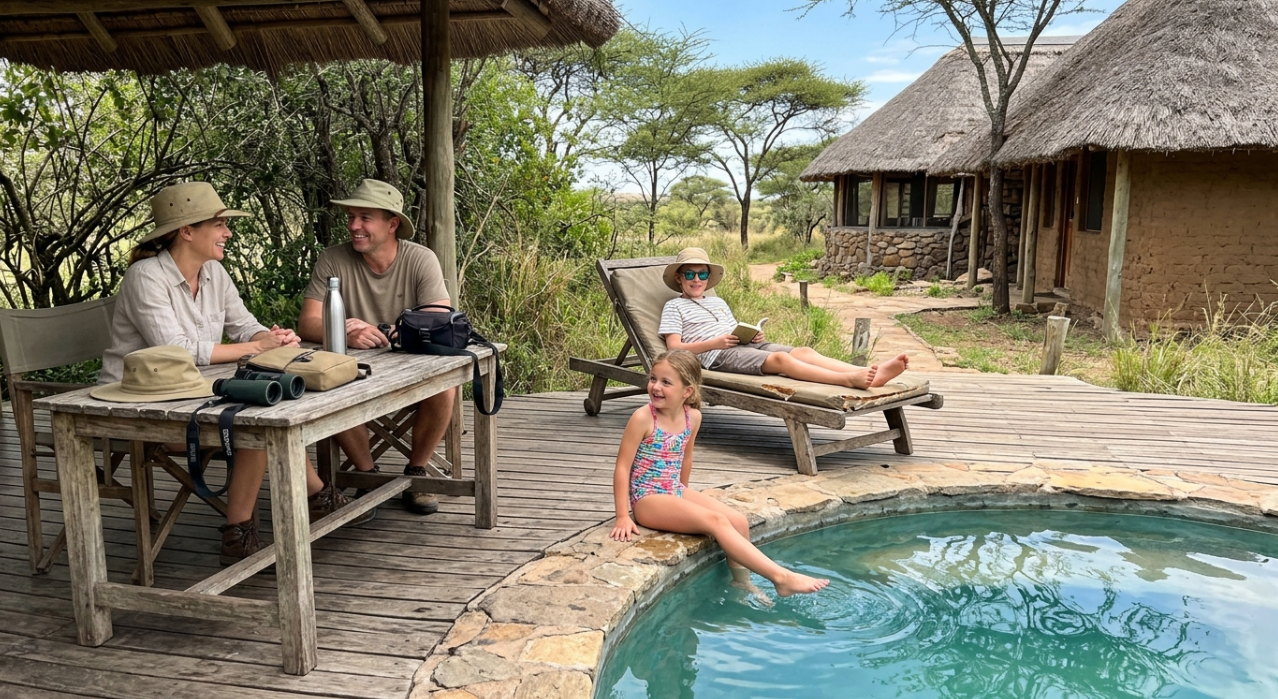
“Family-friendly” on a safari property means something different than it does at a beach resort. It is not just about a kids’ menu or a crib in the room. A genuinely family-friendly Tanzania safari lodge operates in a way that accounts for the unpredictability of traveling with children.
The features that matter most:
-
Room layout that keeps parents and children in the same structure or connected units
-
Private vehicle availability so the family controls the pace of each day
-
Flexible meal times for early dinners, late breakfasts, and snacks between drives
-
Shorter game drives or the option to cut a drive short without disrupting other guests
-
A pool or garden space where children can decompress during the midday heat
-
Guides who engage children with tracking games, bird identification, or storytelling
-
Clear camp safety rules communicated during arrival briefings
-
Lodge location that minimizes transfer time between accommodation and wildlife areas
-
Food flexibility for picky eaters, allergies, or special diets
-
Medical and logistics support including distance to the nearest clinic and emergency procedures
Practitioners on Reddit report that a pool can be a “lifesaver” because children may enjoy game drives but still need downtime after long hours in a vehicle. One parent noted that six or more hours per day in a 4x4 can be too much for young kids. The pool is not a luxury amenity. It is downtime infrastructure.
How to Choose a Family Safari Lodge in Tanzania
A practical way to compare Tanzania safari lodges is to score each property against six family-specific factors: rooming, safety, vehicle flexibility, location, downtime, and child activities.
|
Factor |
What to check |
Why it matters |
|---|---|---|
|
Rooming |
Family tent, interconnecting rooms, number of beds and bathrooms |
Prevents rooming surprises and nighttime inconvenience |
|
Safety |
Fenced or unfenced, night escorts, pool supervision |
Determines how independently children can move around camp |
|
Vehicle |
Private or shared, vehicle capacity, flexible departure times |
Controls the pace of game drives |
|
Location |
Distance from park gates, airstrip, and wildlife areas |
Reduces transfer and commuting time |
|
Downtime |
Pool, gardens, activities, flexible meals |
Gives children a break from long game drives |
|
Activities |
Walking, boating, cultural activities, kids' programs and age limits |
Adds variety and prevents an itinerary from becoming vehicle-heavy |
A simple rule for comparing lodges
Do not compare family lodges on star rating alone. First confirm that the property works for your children's ages, rooming arrangement, safety requirements, activity interests, and daily pace. Then compare comfort, amenities, and price.
A lodge that scores well on all six family factors may be a better fit than a more luxurious property that fails on one critical requirement, such as room configuration or location.
Tanzania Safari Lodge Types for Families: Which Is Right for You?
Permanent Safari Lodge
A permanent lodge is a fixed property built from stone, timber, or concrete. These lodges tend to have more infrastructure than tented camps: swimming pools, larger bathrooms, stronger power systems, more reliable hot water, and sometimes Wi-Fi.
Best for: Younger children, first-time safari families, multigenerational groups, and families who value predictability.
Questions to ask: Does the lodge have a pool? Is the property fenced? How far is the nearest game-drive area from the lodge? Are family rooms or suites available?
Tented Camp
A tented camp uses canvas accommodation with proper beds, en-suite bathrooms, and often a veranda. The word “tent” can be misleading. Many safari tents are spacious, comfortable, and beautifully furnished. But the camp may be unfenced, and guests may need escorts after dark.
Best for: Families with children mature enough to follow camp rules. Parents who want a more immersive bush experience without sacrificing comfort.
Questions to ask: Is the camp fenced or unfenced? Are night escorts provided? Does the family tent have one bathroom or two? How far is the tent from the main dining area?
Mobile Migration Camp
A mobile camp packs up and moves seasonally, often to follow the Great Wildebeest Migration across the Serengeti. These camps offer a thrilling sense of being in the middle of the action, but they typically have fewer resort-style amenities.
Best for: Older children, wildlife-obsessed families, and trips timed to the migration.
Questions to ask: What is the minimum age? Is the camp unfenced? What bathroom facilities are available? How many nights does the camp stay in one location?
For families considering a migration-focused trip, understanding Serengeti safari regions before choosing a camp location is important.
Farm Lodge
A farm lodge sits on or near a working farm or garden property, most commonly around Karatu in the Ngorongoro highlands. Farm lodges can offer gardens, farm animals, coffee tours, and a softer daily rhythm than a full bush camp.
Gibb’s Farm in Karatu, for example, publishes a family fact sheet noting that children of all ages are welcome, ages 0 to 6 stay free when sharing with parents, and the property offers cottages and family houses plus activities like garden walks, harvesting, egg collection, coffee roasting, and cow milking.
Best for: Younger children who need non-drive activities. Families who want a quieter base between Tarangire and Ngorongoro.
Private House or Exclusive-Use Villa
A self-contained property reserved for one family or group, often with a private guide, vehicle, chef, and dedicated staff. Some Serengeti lodges offer villa configurations. Four Seasons Safari Lodge Serengeti, for instance, lists villas that can accommodate configurations such as two adults and three children in a two-bedroom villa.
Best for: Multigenerational families, high-budget trips, families who value privacy and fully flexible schedules.
Beach Lodge (Zanzibar Extension)
The beach component after safari. Families often add Zanzibar for swimming, snorkeling, slower mornings, and recovery from early safari wake-ups.
Best for: Families who want a balanced bush-and-beach trip.
Watch out: Domestic flight timing and Zanzibar weather and tides matter for choosing the right beach area.
Tanzania Family Safari Room Options: Family Tents, Suites & Interconnecting Rooms
Room configuration is one of the biggest stress points for families booking safari lodges in Tanzania. Getting this wrong means sleepless nights, safety concerns, or an unpleasant surprise on arrival.
Family Tent
A tent or unit designed for parents and children, typically with two bedrooms or a main bedroom plus a children’s sleeping area. Some family tents have two bathrooms; others share one. The difference matters at 5:30 a.m. when everyone is getting ready for a game drive.
What to confirm: Number of bedrooms. Number of bathrooms. Whether rooms connect internally. Whether children sleep in the same canvas structure as parents.
Interconnecting Rooms
Two separate rooms with an internal connecting door. This layout lets parents check on younger children without walking outside, which is especially important at unfenced camps where night escorts are required.
Adjacent Rooms
Rooms near each other but not internally connected. This may work for families with teenagers but creates problems at unfenced camps where young children cannot walk between rooms alone after dark.
Family Suite
A larger suite with separate sleeping areas. Ask for the bed count, bathroom count, and whether children’s beds are real beds, sofa beds, or rollaways.
Triple Room
A room set up for three guests. Solves the problem of one child sharing with parents but usually does not work for a family of four or five.
The Family-of-Five Problem
Travelers on Tripadvisor have noted that few Tanzania lodges or tented camps accommodate five guests in one unit, and where family tents exist, a property may have only one. For families of five or larger multigenerational groups, this means booking early is not optional. It is the difference between staying together and being split across the camp.
Practical advice: Book as early as possible for June through October and school-holiday periods. Ask for a room map or written confirmation of bed layout, bathroom count, and whether children are in the same tent, an adjoining tent, or a separate tent nearby.
Cot or Extra Bed
Do not assume availability. Confirm in writing before you arrive.
Child-Sharing Rate
A child price based on sharing with adults. TANAPA states that children under 5 enter Tanzania national parks free and child rates apply for ages 5 to 15. Lodges may have their own separate child policies and pricing. Your operator should explain how children’s ages affect the total quote.
Family Tent vs. Interconnecting Rooms
Both options can work well for families, but they solve different problems.
|
Option |
Main advantage |
Potential drawback |
Usually best for |
|---|---|---|---|
|
Family tent |
Keeps the family together in one accommodation unit |
Layouts vary significantly between properties |
Families wanting one shared base |
|
Interconnecting rooms |
Parents and children have separate rooms with internal access |
Not available at every lodge |
Families wanting more privacy |
|
Adjacent rooms |
More availability at some properties |
Children may need to go outside to reach parents |
Older children or teenagers |
|
Private villa/house |
Maximum privacy and flexibility |
Usually higher cost |
Multigenerational or larger families |
Before booking, ask for the exact room configuration in writing. Confirm the number of bedrooms, bathrooms, beds, internal doors, and whether children sleep in the same building as their parents. “Family room” does not necessarily mean the same thing at every safari lodge.
Private vs. Shared Safari Vehicles for Families
For families with younger children, a private vehicle is usually more important than upgrading to a more expensive lodge. For many families with younger children, a private vehicle can be one of the most useful upgrades because it gives parents control over timing and pacing.
A private safari vehicle means:
Private vs. Shared Safari Vehicle for Families
|
Consideration |
Private vehicle |
Shared vehicle |
|---|---|---|
|
Departure time |
Family controls timing |
Follows group schedule |
|
Early return |
Easy to arrange |
Depends on other guests |
|
Snack and bathroom stops |
Flexible |
Must accommodate the group |
|
Child attention span |
Guide can adapt to the children |
Pace may suit the group rather than one family |
|
Cost |
Higher |
Usually lower |
|
Best for |
Younger children, multigenerational families, families wanting maximum flexibility |
Older children, budget-conscious families, families comfortable with group schedules |
For families with young children, compare the cost of a private vehicle before paying for a higher room category. The flexibility can affect the entire daily safari experience, not just the accommodation.
One parent on Reddit described booking a private safari car as the top tip for traveling with kids, because it lets the family set the pace and return to camp without disrupting others. Another family planning thread echoed that private vehicles prevent the friction that comes from sharing a vehicle with adults on a different schedule.
Duma Explorer’s private safari model pairs families with a dedicated 4x4 and driver-guide for the full trip. This setup naturally solves the pacing problem that shared vehicles create.
For more detail on vehicle types and features, see this safari vehicle comparison guide.
Fenced vs. Unfenced Safari Camps: What Parents Need to Know
Unfenced Camp
An unfenced camp is a safari property where no barrier separates the camp from the surrounding bush. Animals, including elephants, buffalo, and sometimes predators, can walk through or near the property.
This does not automatically mean unsafe. Reputable unfenced camps have procedures: night escorts walk guests between tents and the main area after dark, arrival briefings explain rules, and staff monitor animal movement around camp.
But unfenced camps require maturity and supervision. One Reddit discussion about Tanzania with kids warned that tented camps can be stressful after dark if children need escorts for every walk between tents or bathroom trips. For very young children, this creates logistical friction that compounds over several nights.
Practical questions to ask:
-
Is the camp fenced or unfenced?
-
Are escorts required after dark?
-
Can children walk alone between their tent and the dining area?
-
Is the family tent close to the main area?
-
Is there a pool, and is it fenced or supervised?
-
What is the nearest medical support?
For a deeper look at camp safety procedures and what to expect, read this Tanzania safari safety guide.
Camp Briefing
The arrival safety talk. For families, this is not a formality. Make sure children understand the rules, especially at unfenced properties. Ask the camp manager to explain rules directly to children in age-appropriate language.
Night Escort
A staff member who walks guests between rooms and the main area after dark. At unfenced camps, this is standard. For families, it means every nighttime trip (bathroom, water, checking on children in a separate tent) involves calling for an escort and waiting.
Best Tanzania Safari Regions for Families
|
Region |
Best family fit |
Lodge style to consider |
Watch-outs |
|---|---|---|---|
|
Arusha |
First night after international flights; reset before safari |
Hotel, garden lodge, pool property |
Not a wildlife destination; use for recovery |
|
Tarangire |
Strong first real safari stop; elephants and baobabs |
Permanent lodge or tented camp with pool |
Some camps unfenced; check night-drive/walking age rules |
|
Lake Manyara / Karatu |
Softer base between Tarangire and Ngorongoro |
Farm lodge, family-friendly lodge with gardens |
Manyara is compact; Karatu is better for non-drive activities |
|
Ngorongoro |
Dense wildlife in the crater; iconic day trip |
Crater-rim lodge or Karatu base |
Crater days require early starts; rim lodges can be cold and expensive |
|
Serengeti |
Big wildlife, migration, multi-day stays |
Permanent lodge, tented camp, mobile camp, private villa |
“Serengeti” is too vague; ask for exact location and airstrip |
|
Nyerere (southern) |
Activity variety: boats, walks, game drives |
Fly-in lodge or tented camp |
Some activities have age restrictions; remote for toddlers |
|
Ruaha |
Quieter, wilder, less crowded |
Remote tented camp or hilltop lodge |
Best for older children and repeat safari families |
|
Zanzibar |
Beach recovery after safari |
Beach resort or family villa |
Choose beach area based on tides and children’s swimming ability |
Arusha: The Overlooked First Night
The best family safari lodge decision might be the first night, not the Serengeti camp. A calm arrival lodge with a pool, flexible meals, and laundry service prevents the first game-drive day from being ruined by jet lag and overtired children.
Tarangire: Elephants and Big First Impressions
TANAPA describes Tarangire as a year-round wildlife destination famous for elephants and baobabs, with one of Africa’s highest concentrations of elephants. For families, Tarangire often works well as a first real safari stop because the wildlife is large, obvious, and impressive enough to hook children immediately.
Families preparing for their first Tarangire game drive will benefit from understanding what to expect before arriving.
Ngorongoro and Karatu: Dense Wildlife, Flexible Basing
The Ngorongoro Conservation Area is a UNESCO World Heritage property known for the density of wildlife in and around the crater, including globally threatened species like black rhino. For families, a Ngorongoro crater day can deliver concentrated wildlife viewing in a compact timeframe.
Karatu, the agricultural town in the highlands between Tarangire and the crater, often serves as a more flexible and affordable base. Farm lodges here give children space, gardens, and farm activities that break up vehicle-heavy days. For more on planning a crater visit with children, see this Ngorongoro Crater planning guide.
Serengeti: Ask for the Exact Location
UNESCO describes the Serengeti as 1.5 million hectares of savannah where two million wildebeest plus hundreds of thousands of gazelles and zebras migrate seasonally, followed by predators. It is the centerpiece of most Tanzania family safari itineraries.
But “Serengeti” is not specific enough for lodge planning. Northern Serengeti, Central Serengeti, the Western Corridor, and the Ndutu area serve different seasons and offer different experiences. A Reddit planning comment warned travelers to ask for the exact camp location rather than accepting a vague description, and to understand how much of the itinerary is game-drive time versus transfer time between camps.
In Duma Explorer’s own traveler feedback, families have specifically praised Nyumbani Camp in Central Serengeti for its food and 24-hour hot water, and Lion’s Paw as a standout property. These are the kinds of operational details that matter to families: will the shower be warm at 5 a.m. when you are getting three children ready for a sunrise drive?
Southern Tanzania: Nyerere and Ruaha for Older Kids
TANAPA describes Nyerere as protecting miombo woodlands, floodplains, and Rufiji River channels, with boat safaris, guided walking safaris, and African wild dog potential. For families with older children and teenagers, the activity variety here (boats, walks, game drives) can break up the monotony that younger kids sometimes feel after several days of vehicle-only safaris.
Ruaha is quieter, more remote, and suited to families who want something wilder. It works best for teens, photographers, and families who have already done the northern circuit.
If you are trying to balance Serengeti wildlife with Ngorongoro, Tarangire, and Zanzibar without exhausting children on transfers, Duma Explorer can compare road-based and fly-in routes before lodges are confirmed.
Which Family Safari Lodge Features Are Worth Paying For?
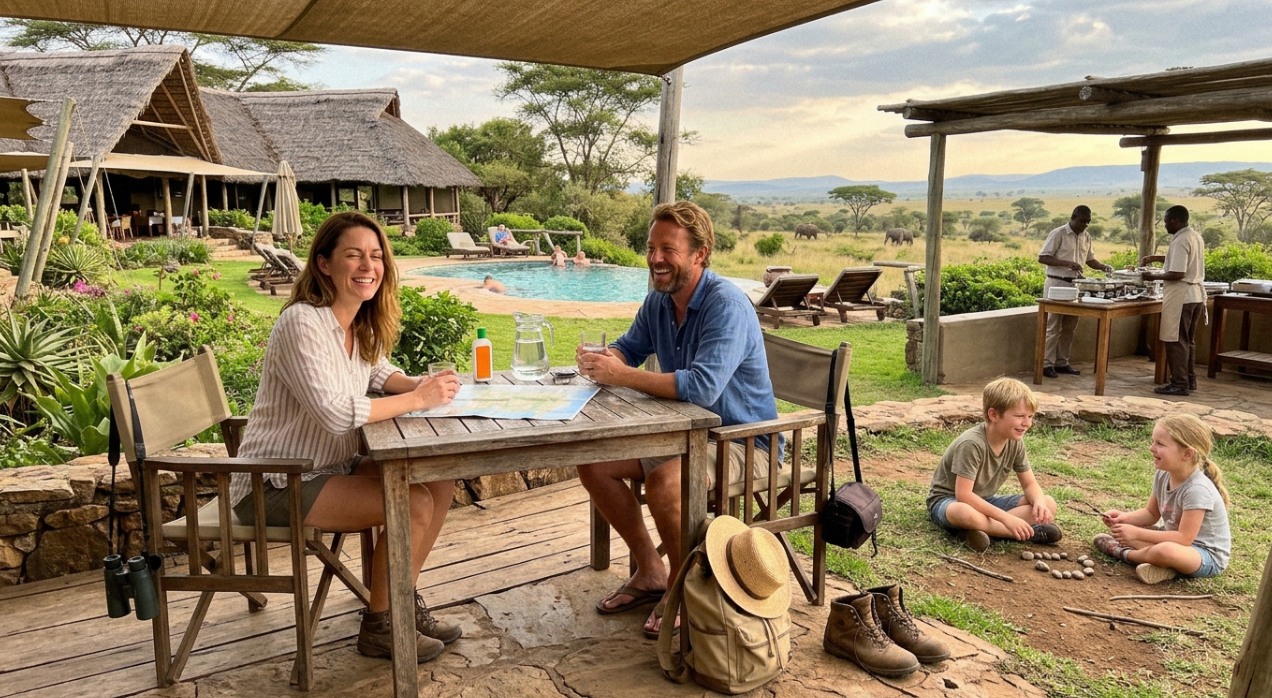
Not every upgrade matters equally for families. These are the features that consistently make or break a family safari experience:
-
Private vehicle. The single highest-value upgrade for families with younger children.
-
Correct room configuration. Family tent, interconnecting rooms, or adjacent units that match your family size.
-
Location that reduces transfer time. Inside-the-park lodging or lodging near a park gate saves driving hours that children feel acutely.
-
Pool or downtime space. Not optional for multi-day safaris with children under 12.
-
Good guide who engages children. A guide who can read children’s attention spans and turn a game drive into a treasure hunt.
-
Flexible meals. Early dinners, packed snacks, food for picky eaters.
-
Reliable power and hot water. At 5 a.m. with a cranky seven-year-old, hot water is not a luxury.
-
Fly-in option. If road transfers between parks exceed four hours, light aircraft can save the day.
-
Laundry. Keeps luggage light, especially with bush-flight baggage limits.
-
Strong operator support. Lodge quality and management change. Duma Explorer’s team has proactively switched a camp after recent client feedback suggested it was no longer the right fit. An operator who monitors current conditions protects your trip in ways a booking platform cannot.
Family-Friendly Lodge vs. Luxury Lodge: What Is the Difference?
A luxury safari lodge is not automatically a family-friendly safari lodge. Luxury usually describes the level of accommodation, service, design, food, and amenities. Family-friendly design describes how well the property works for children and parents.
|
Feature |
Luxury lodge |
Family-friendly lodge |
|---|---|---|
|
Accommodation |
High-end finishes and service |
Appropriate room configuration for children |
|
Food |
Premium dining |
Flexible meal times and child-friendly options |
|
Activities |
Wide range of experiences |
Activities appropriate for children's ages |
|
Vehicle |
May be shared or private |
Private vehicle options are especially valuable |
|
Safety |
Professional camp procedures |
Clear procedures that work for families and children |
|
Downtime |
Pool or spa may be available |
Pool, garden, or activities that children can use |
|
Location |
May prioritize scenery or exclusivity |
Often prioritizes manageable transfers and access |
|
Rooming |
May focus on couples |
Family tents, villas, or interconnecting rooms |
Bottom line: When traveling with children, evaluate a lodge for family suitability first and luxury level second. A lower-category property with the right room, location, vehicle, and downtime can fit a family better than a higher-category lodge designed primarily for adults.
Which Safari Lodge Features Do Families Often Overvalue?
Some features sound important but do not always justify the cost or the tradeoffs.
The highest star rating. A five-star lodge in the wrong location means longer drives, which can ruin the day for young children. A well-located mid-range lodge with a pool and family tent often delivers a better experience.
A kids’ club. Useful at beach resorts, but on safari, children are usually with their parents all day. A great guide and a private vehicle replace most of what a kids’ club offers.
Visiting too many parks. Chasing a fourth or fifth park means more transfer time and less wildlife time. Families who spend three nights per camp and visit fewer parks consistently report better experiences. Moving lodges every night is exhausting for adults and worse for children.
Migration proximity at the wrong time. The Great Migration is seasonal. If your travel dates do not align with the migration’s location, paying a premium for a “migration camp” produces disappointment, not wildebeest.
Remote tented camps for young children. A remote, unfenced tented camp in Ruaha can be magical for teenagers. For a five-year-old, the same camp may mean stressful nights, limited food options, and no pool.
Tanzania Safari Activities for Children: Age Limits & Options
Walking Safari
A guided on-foot safari experience. TANAPA states that walking safaris must be on designated trails and accompanied by an armed ranger. Most parks and lodges set minimum ages, typically 12 or 16, for walking activities.
Age-Restricted Activity
Activities such as walking safaris, canoeing, hot-air ballooning, chimp trekking, and horseback riding may have minimum ages set by parks, lodges, or operators. TANAPA states children under 15 are not permitted for chimp trekking. Always verify age rules before choosing a lodge based on its activity list.
Junior Ranger or Kids’ Program
Structured children’s activities offered by some lodges. Four Seasons Safari Lodge Serengeti, for example, runs a Kids For All Seasons program and notes guests must be age 2 or older. These programs vary widely in quality and scope. Some are full guided nature activities; others are basic childcare.
Cultural Visit
A visit to a Maasai, Hadzabe, Datoga, or local community. These should be handled respectfully and not treated as entertainment. They can be powerful experiences for older children who are ready to engage with different ways of life.
Bush Meal or Picnic Lunch
Meals served during a longer game-drive day, usually in a scenic spot in the bush or beside a river. Important for children’s energy levels and for making full-day drives feel like an adventure rather than an endurance test.
Tanzania Family Safari Logistics: Flights, Luggage, Transfers & Park Fees
Bush Flight
A light aircraft flight between parks or between destinations like Serengeti, Arusha, and Zanzibar. Bush flights reduce road time dramatically, which matters for families with limited days or very young children.
Soft-Sided Luggage
Duffel-style bags that fit into small aircraft cargo holds and safari vehicle storage. Hard-shell suitcases do not work on bush flights and take up too much space in 4x4s.
Bush-Flight Baggage Limit
This is where family logistics get tricky. Coastal Aviation allows 15 kg (33 lb) per person including carry-on and strongly recommends soft bags. Auric Air lists 20 kg (44 lb) per passenger inclusive of hand luggage, cameras, and personal items. For families carrying camera gear, medical kits, children’s comfort items, or car seats, these limits require advance planning. Raise luggage needs during itinerary design, not at the airstrip.
Inside-the-Park vs. Outside-the-Park Lodge
Lodges inside national parks or conservation areas usually offer better access to early and late game drives with less commuting. They tend to cost more and may be more remote. Outside-the-park lodges can offer better value, more space, and more non-drive activities, but they add gate logistics and drive time.
Park Fees and Child Rates
TANAPA uses age bands for park entry: children under 5 enter free, and child rates apply for ages 5 to 15. Conservation fees are valid for 24 hours from entry. Your operator should explain how child ages affect the total quote and when additional day fees apply.
For a full breakdown of how these fees affect your budget, see this Tanzania safari cost guide.
Malaria-Zone Planning
The CDC states that malaria transmission occurs in Tanzania in all areas below 1,800 m (5,900 ft) and recommends prescription malaria medicine for travelers. The CDC’s child travel guidance says children going to malaria areas should take prevention medicine and that families should see a healthcare professional or travel medicine specialist at least one month before departure. Lodge choice does not eliminate the need for professional medical advice. Every family traveling to Tanzania should consult their doctor.
Best Tanzania Safari Lodge Setup by Children’s Age
|
Children’s ages |
Best lodge style |
Vehicle advice |
Pacing advice |
Avoid |
|---|---|---|---|---|
|
Under 5 |
Permanent lodge, resort-style base, or farm lodge |
Private vehicle essential |
Very short drives, lots of downtime, pool |
Adult-style itineraries, long transfers, unfenced remote camps |
|
6 to 9 |
Permanent lodge, farm lodge, family tent with pool |
Private vehicle strongly recommended |
Split morning and afternoon drives, pool breaks |
Changing lodge every night, drives over 3 hours |
|
10 to 12 |
Tented camps or lodges with family units |
Private vehicle still valuable |
Longer drives possible, add non-drive activities |
Too much transit between parks |
|
Teenagers |
Mobile camps, tented camps, Nyerere or Ruaha options |
Depends on family style |
Add walking safaris, boat safaris, photography, cultural visits where age-allowed |
Too little activity variety, too much downtime |
|
Multigenerational |
Private house, villa, or clustered rooms |
Private vehicle(s) often best |
Flexible split activities, consider fly-in to reduce road stress |
One-size-fits-all schedule forced on all generations |
One parent planning with a six-year-old on Reddit wanted to keep the safari portion to seven days because of fatigue concerns. The right lodge cannot fix an itinerary built for adults. Pacing, camp count, and transfer distance matter as much as which property you choose.
For families considering a multigenerational safari, rooming and pace flexibility become even more important.
Questions to Ask Before Booking a Tanzania Family Safari Lodge
Rooming
-
Is there a true family unit with parents and children under one roof?
-
Are rooms interconnecting or just adjacent?
-
How many bathrooms does the family unit have?
-
Are cots or rollaways available? Confirm in writing.
-
How far is the family room from the main dining area?
Safety
-
Is the camp fenced or unfenced?
-
Are escorts required after dark?
-
Are children allowed to walk alone between their room and the main area?
-
Is the pool fenced or supervised?
-
What is the nearest medical support, and how long does it take to reach?
Activities
-
What is the minimum age for game drives at this property?
-
What is the minimum age for walking safaris, if offered?
-
Are ballooning, canoeing, or horseback riding available, and what are the age rules?
-
Can game drives be shortened without penalty?
-
Are private vehicles available, and what is the cost difference?
Food
-
Can the kitchen accommodate picky eaters?
-
Are early dinners available for young children?
-
Are packed snacks provided for game drives?
-
Can the lodge handle food allergies or special diets?
Logistics
-
What are the drive times between this lodge and the previous and next lodge?
-
Which airstrip does the lodge use for fly-in guests?
-
What is the baggage limit on the flights used?
-
Is laundry available?
-
What happens if the lodge’s recent quality feedback is poor? Will the operator switch properties?
Because lodge quality and management can change season to season, Duma Explorer treats lodge selection as part of ongoing trip design rather than a fixed list. The team has changed a camp proactively when recent client feedback suggested it was no longer the right fit.
How Duma Explorer Helps Families Choose Safari Lodges
Duma Explorer (operating locally as Alika Africa in Tanzania) designs private, custom safaris where lodge choice, guide fit, rooming, and pacing are matched to each family’s specifics. Owner-led trip design by Stacy Readal, with extensive Tanzania experience and Swahili fluency, supports the kind of high-touch lodge selection that families need.
What this means in practice:
-
Lodge vetting based on current conditions, not just historical reputation. Properties are monitored through ongoing traveler feedback.
-
Private 4x4 and dedicated driver-guide for the full trip, solving the pacing and flexibility problems shared vehicles create.
-
Route design around children’s ages, so a family with a six-year-old gets a different itinerary than a family with teenagers.
-
On-the-ground operations in Tanzania through Alika Africa for airport transfers, domestic flights, permits, and lodge troubleshooting if something goes wrong.
-
Guide quality investment. Duma’s safari guides have advanced training including EcoTraining and FGASA Level 1 certification, which translates to better wildlife interpretation and a better experience for curious children.
Request a Custom Family Safari Itinerary
Tanzania Family Safari Lodge FAQs
What is the best age for a family safari in Tanzania?
Many families find Tanzania works best once children can enjoy several hours in a vehicle, follow safety instructions, and handle early mornings. Ages 6 and up are generally easier than preschool ages, but the right answer depends on the child, the route, the lodge, and whether the family has a private vehicle. The CDC recommends families see a healthcare professional at least one month before travel to discuss malaria prevention and child-specific health planning.
Are tented camps safe for children?
Many tented camps host families successfully, but parents should confirm whether the camp is fenced, whether night escorts are required, how far the family tent is from the main area, and whether children sleep in the same unit. Unfenced camps can be excellent for older children but may create stress for families with children under six.
Do families need a private safari vehicle in Tanzania?
A private vehicle is strongly recommended for families with younger children because it allows shorter drives, snack stops, flexible returns, and child-paced wildlife viewing. For families with teenagers who are comfortable with group dynamics, shared vehicles can work. But for most family configurations, a private vehicle is the highest-value upgrade available.
Which Tanzania parks are best for a first family safari?
A classic first family safari often combines Arusha (for jet-lag recovery), Tarangire (for elephants and a strong first impression), Karatu or Ngorongoro (for crater wildlife and farm-lodge downtime), and Serengeti (for the big wilderness experience). For help comparing routes and parks, see this Tanzania safari locations guide.
Is Zanzibar worth adding after a family safari?
Yes, for most families. After early mornings and dusty game drives, Zanzibar adds beach time, swimming, snorkeling, and slower days. Plan the route so domestic flights and baggage limits do not create stress. Choose beach areas based on tides, swimming conditions, and children’s ages. A 14-day Tanzania itinerary can show how safari and beach fit together.
How early should families book Tanzania safari lodges?
Earlier than couples. Family tents and interconnecting rooms are limited at most properties, and some camps have only one family unit. For travel during June through October or over Christmas and New Year, booking 9 to 12 months ahead is common. For school-holiday dates with a family of five or more, even earlier is better.
What should families pack for a fly-in safari?
Soft-sided duffel bags are essential. Hard suitcases will not fit in light aircraft cargo holds. Bush-flight baggage limits range from 15 to 20 kg per person depending on the airline, and that includes carry-on items, cameras, and personal belongings. Pack light, use lodge laundry services, and raise any special luggage needs (car seats, medical equipment, heavy camera gear) during trip planning, not at the airstrip.