

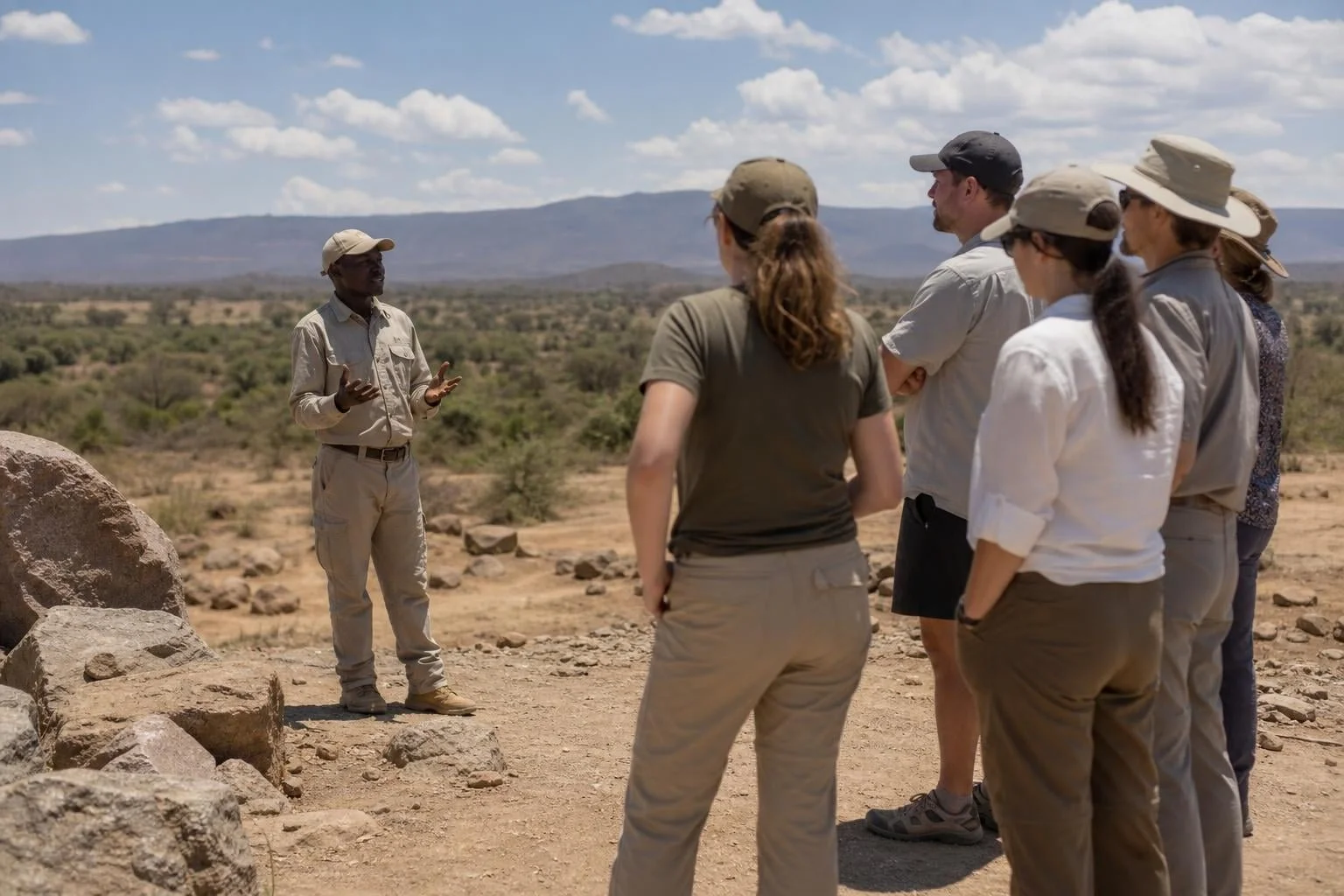
An educational safari in Tanzania goes beyond watching animals from a vehicle. It means traveling with qualified guides who interpret ecology in real time, visiting communities whose cultures stretch back millennia, and standing at archaeological sites where human history began. Tanzania’s Northern Circuit concentrates all of these elements within a compact geography, making it one of the best places on earth for learning through travel.
This glossary defines every term, concept, activity, and destination you’ll encounter when planning an educational safari in Tanzania. Whether you’re a parent building a trip around your children’s curiosity, a teacher organizing a school group, or an adult who simply wants to understand the Serengeti at a deeper level, this is your reference.
TL;DR: An educational safari in Tanzania combines wildlife ecology, cultural immersion with communities like the Maasai and Hadzabe, visits to archaeological sites like Olduvai Gorge, and guided interpretation from certified naturalists. Tanzania’s Northern Circuit parks (Serengeti, Ngorongoro, Tarangire, Arusha, Lake Manyara) cluster these experiences within a few hours of each other, making multi-dimensional learning trips practical and efficient.
Best Places for an Educational Safari in Tanzania
The best destination for an educational safari in Tanzania depends on what travelers want to learn. Serengeti National Park is ideal for studying migration and predator-prey relationships, while Olduvai Gorge focuses on human evolution. Lake Eyasi offers opportunities for learning about Hadzabe and Datoga communities, and Arusha National Park combines birdwatching, forest ecology, and selected guided outdoor activities.
|
Destination |
Main Learning Focus |
Suitable Activities |
Best For |
|---|---|---|---|
|
Serengeti National Park |
Wildlife ecology, migration, predator-prey relationships |
Guided game drives, wildlife observation, birdwatching |
Families, students, wildlife enthusiasts |
|
Ngorongoro Conservation Area |
Geology, biodiversity, conservation and land use |
Crater game drives, geological interpretation, conservation discussions |
Families, school groups, nature enthusiasts |
|
Olduvai Gorge |
Human evolution, archaeology, fossil discoveries |
Museum visit, guided interpretation of the archaeological landscape |
Students, history enthusiasts, families with older children |
|
Tarangire National Park |
Elephant ecology, baobabs, seasonal water availability |
Guided game drives, birdwatching, habitat observation |
Wildlife enthusiasts, school groups |
|
Arusha National Park |
Forest ecology, bird diversity, mountain landscapes |
Guided game drives, permitted walking activities, canoeing where available |
Families, students, first-time visitors |
|
Lake Manyara National Park |
Habitat diversity, birdlife, forest and lakeshore ecology |
Guided game drives, birdwatching, habitat comparisons |
Families, students, nature enthusiasts |
|
Lake Eyasi |
Anthropology, cultural diversity, traditional livelihoods |
Community-led visits arranged with local hosts |
Travelers interested in cultural learning |
|
Mto wa Mbu |
Local livelihoods, food systems, agriculture and cultural diversity |
Guided village walks, market visits, local food experiences |
Families, students, cultural travelers |
|
Zanzibar and Stone Town |
Swahili history, maritime trade, architecture and marine ecology |
Historical walking tours, heritage visits, responsible marine excursions |
History students, families, cultural travelers |
Availability, access rules, seasonal conditions, and age restrictions vary by activity. Confirm arrangements with the relevant park authority and local hosts before finalizing an itinerary.
What Makes a Safari “Educational”?
A standard game drive becomes educational when a trained guide explains why a herd of elephants is moving in a particular direction, or when a cultural visit lets you sit with Hadzabe hunters and learn about a way of life essentially unchanged since the Stone Age. The distinction is interpretation, not itinerary length.
Educational safaris in Tanzania generally draw from six pillars:
|
Educational Pillar |
Examples in Tanzania |
|---|---|
|
Wildlife ecology |
Guided game drives, Great Migration observation, birdwatching |
|
Cultural learning |
Community-led Maasai visits, Hadzabe and Datoga experiences, Mto wa Mbu village walks |
|
Archaeology and human history |
Olduvai Gorge Museum, interpretation of human evolution and fossil discoveries |
|
Conservation education |
Discussions about habitat protection, wildlife corridors, and human-wildlife conflict |
|
Active learning |
Permitted walking safaris, canoe activities where available, field journals, and wildlife tracking demonstrations |
|
Expert interpretation |
Guide-led explanations of animal behavior, local flora, geology, and ecological relationships |
A well-designed educational safari combines several of these pillars. The right mix depends on travelers' ages, interests, available time, and the activities permitted at each destination.
A trip that touches three or more of these pillars delivers genuine educational depth. Most Northern Circuit itineraries can incorporate all six.
If you’re considering a family safari itinerary with educational goals, the key is selecting the right combination of parks, cultural stops, and guide quality rather than booking a trip labeled “educational.”
What Can You Learn on an Educational Safari in Tanzania?
An educational safari in Tanzania can teach travelers about animal behavior, ecosystems, biodiversity, human evolution, cultural traditions, and conservation. The strongest learning experiences connect what travelers observe in the field with explanations from knowledgeable guides and respectful conversations with local hosts.
Wildlife Ecology and Animal Behavior
Game drives can help travelers understand how animals find food, respond to seasonal rainfall, defend their young, and interact with predators. In the Serengeti, the Great Migration provides a practical example of how grazing, rainfall, reproduction, and predator-prey relationships influence an ecosystem.
Example learning question: How does seasonal rainfall affect where wildebeest and other grazing animals move?
Conservation and Biodiversity
Tanzania's protected areas provide opportunities to explore habitat protection, wildlife corridors, human-wildlife conflict, and the relationship between tourism and conservation funding.
Example learning question: What challenges arise when wildlife habitats overlap with land used by nearby communities?
Archaeology and Human Evolution
A visit to Olduvai Gorge introduces travelers to fossil evidence, stone tools, geological layers, and scientific research into human evolution. The experience can help students understand how researchers use physical evidence to develop and test explanations about the past.
Example learning question: How can fossils and stone tools help scientists reconstruct the lives of early hominins?
Cultural Anthropology and Local Livelihoods
Community-led experiences near Lake Eyasi and Mto wa Mbu can introduce travelers to different livelihoods, food systems, craft traditions, and relationships with the natural environment.
Example learning question: How do local livelihoods, changing economic conditions, and environmental pressures influence daily life?
Cultural learning should be guided by local hosts and should respect community consent, privacy, and the right to decline photography or participation.
Geography and Earth Science
The Ngorongoro landscape, the Great Rift Valley, volcanic features, and the alkaline lakes of northern Tanzania provide real-world examples of geological processes and the influence of physical geography on habitats.
Example learning question: How do elevation, water availability, and landforms influence the plants and animals found in different habitats?
Observation, Research, and Critical Thinking
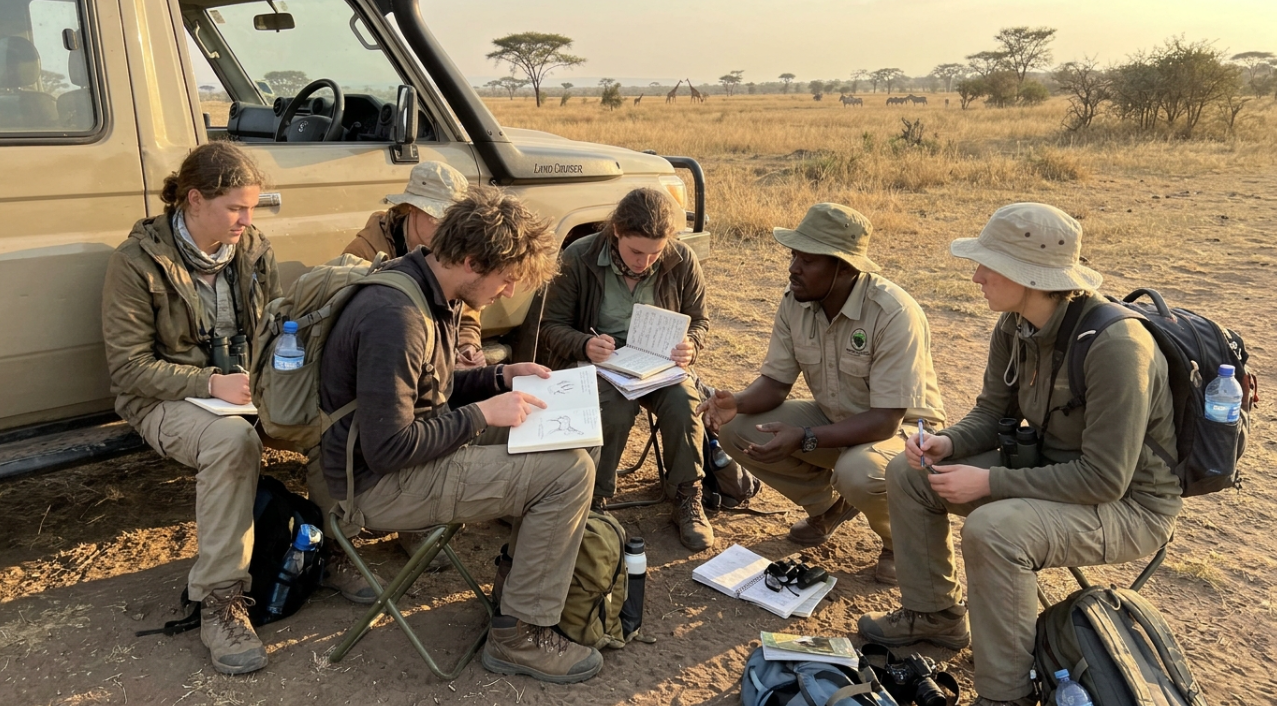
Travelers can keep a field journal, record bird sightings, compare habitats, sketch animal tracks, or discuss conservation questions with their guide. These activities encourage careful observation rather than treating wildlife sightings as a checklist.
Example learning question: What evidence supports a conclusion about an animal's behavior, and what remains uncertain?
Wildlife and Ecology Terms
Big Five
The Big Five refers to lion, leopard, elephant, Cape buffalo, and black rhinoceros. The term originated from colonial hunting, ranking the five most dangerous animals to hunt on foot. Today it serves as a conservation benchmark. Visiting protected areas such as Serengeti National Park and the Ngorongoro Conservation Area allows travelers to understand why national parks are essential for biodiversity, since all five species depend on large, interconnected habitats to survive.
Seeing the Big Five is common on a well-planned Northern Circuit safari, but the educational value lies in understanding each animal’s role in the ecosystem rather than simply checking them off a list.
Great Migration
Every year, over 1.5 million wildebeest, along with roughly 300,000 zebras and 200,000 gazelles, undertake a continuous circular journey through the Serengeti-Mara ecosystem in search of fresh grazing. The migration is driven by rainfall patterns, not a calendar.
Key phases:
-
Calving season (January to March): The southern Serengeti, particularly the Ndutu region, becomes the birthing ground for thousands of wildebeest calves. Large numbers are born within a short window, attracting predators and creating dramatic predator-prey dynamics.
-
Western corridor crossings (June to July): Herds move toward the Grumeti River, facing crocodile-filled crossings.
-
Mara River crossings (July to October): The most filmed phase, as herds cross between the Serengeti and Kenya’s Maasai Mara.
-
Return south (November to December): Short rains pull the herds back toward the Ndutu plains.
The Great Migration acts as a natural cycle of renewal. Grazing prevents grassland overgrowth, animal waste fertilizes soil, and the enormous biomass supports predator populations across the entire ecosystem. For a deeper dive into timing and locations, see our Great Migration safari guide.
Predator-Prey Dynamics
This is what you actually observe on an educational game drive. Elephants protecting calves in a tight formation. Lions coordinating a hunt across open grassland. Giraffes feeding selectively from tall acacia trees while scanning for threats. These real-time encounters illustrate food chains, migration triggers, and the balance that keeps ecosystems functional.
The educational value depends almost entirely on your guide’s ability to explain what is happening and why. A qualified guide will narrate the behavior, place it in ecological context, and connect it to broader conservation challenges.
Biodiversity
Biodiversity measures the variety of life forms in a given area. Tanzania demonstrates this concept vividly. The Ngorongoro Crater floor, covering roughly 260 square kilometers, contains an extraordinary concentration of species in a relatively small space, including the endangered black rhino. It functions as a natural classroom for understanding how geography shapes species density.
Habitat
A habitat is the natural environment where an organism lives and finds the resources it needs to survive and reproduce. Tanzania's Northern Circuit includes grasslands, woodlands, forests, wetlands, lakeshores, and other habitats that support different species.
Comparing habitats during a safari helps travelers understand why certain animals are common in one environment but less frequently observed in another.
Food Web
A food web describes how organisms are connected through feeding relationships in an ecosystem. Plants and grasses support herbivores, which may be prey for carnivores, while decomposers recycle nutrients from dead organic matter.
During a guided game drive, travelers can look for evidence of these relationships, from grazing patterns to scavenging and predator behavior.
Wildlife Corridor
A wildlife corridor is an area that connects habitats and allows animals to move between them. Corridors can be important for seasonal migration, access to water and food, and the movement of individuals between populations.
A guide can explain how roads, settlements, fences, and changes in land use may affect connectivity across the wider landscape.
Carrying Capacity
Carrying capacity describes the population size or level of use that an environment can support under particular conditions. It depends on factors such as food, water, habitat, competition, and environmental change.
It is not a fixed number for every species or season. Observing seasonal changes in water availability and grazing can help travelers understand why ecological conditions change over time.
Field Observation
Field observation is the systematic recording of what can be seen or heard in a natural environment. On an educational safari, travelers might record bird sightings, habitat characteristics, animal behavior, weather, or signs of wildlife activity.
Keeping a field journal helps turn a game drive into an active learning exercise rather than a series of isolated sightings.
Ecosystem
An ecosystem is the community of living organisms interacting with their physical environment. The Serengeti ecosystem is one of the best examples on the planet. The formal borders of Serengeti National Park enclose approximately 14,750 square kilometers, but the broader contiguous ecosystem, including the Ngorongoro Conservation Area, smaller reserves, and Kenya’s Maasai Mara, expands to nearly 30,000 square kilometers. The migration cannot be understood without grasping this interconnected scale.
Birding Safari
A safari structured specifically around birdwatching. Tanzania hosts over 1,100 bird species. Arusha National Park alone contains more than 400 species within its compact 552 square kilometers, making it one of the best birding classrooms in East Africa. The Serengeti and Ngorongoro corridors add raptors, flamingos, and seasonal migrants. For travelers who want birding built into their itinerary, our birding safari guide covers the best parks and seasons.
Responsible Cultural Tourism in Tanzania
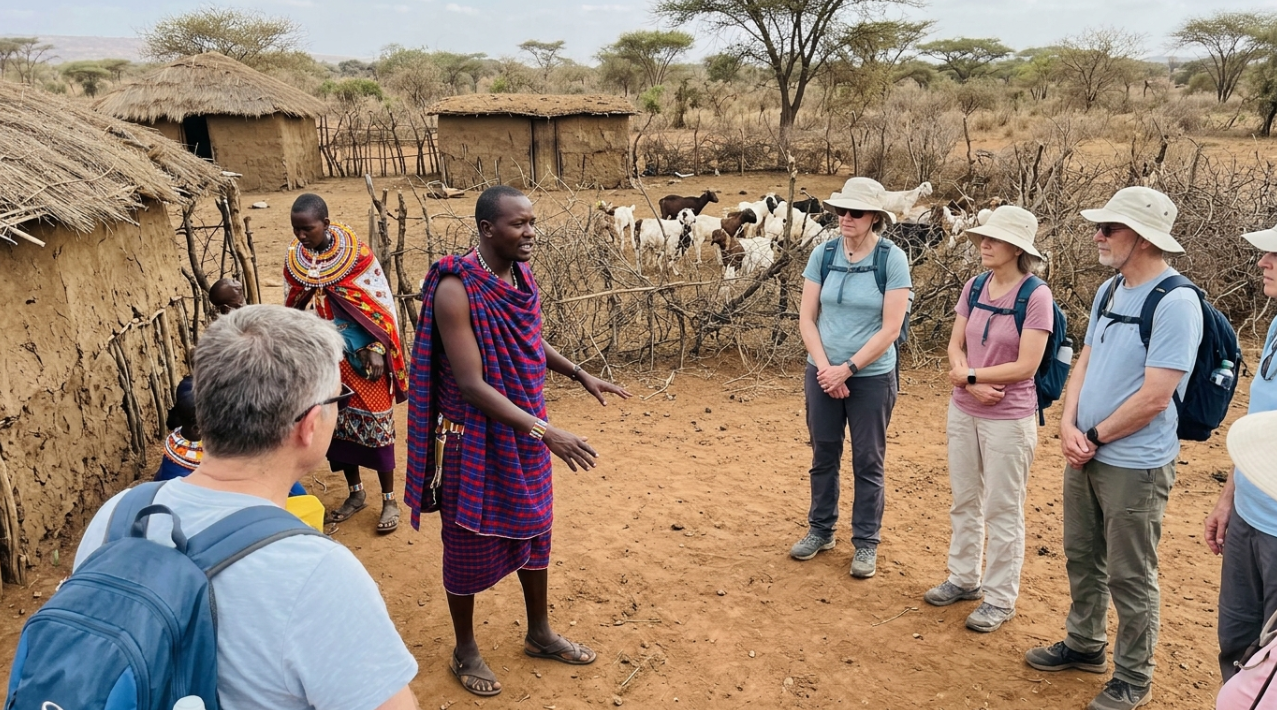
Responsible cultural tourism creates opportunities to learn from local communities while respecting their autonomy, privacy, and contemporary lives. Maasai, Hadzabe, and Datoga communities have distinct histories and traditions, and their livelihoods and circumstances continue to evolve.
A community visit should be more than an opportunity to take photographs. Travelers should understand who is hosting the experience, how participation has been agreed upon, and how the visit benefits the people involved.
How to Choose a Respectful Community Visit
-
Choose locally hosted experiences: Ask whether community members help design or lead the visit.
-
Respect consent: Ask permission before taking photographs, recording conversations, or entering private spaces.
-
Avoid treating traditions as performances: A demonstration or cultural presentation should be understood in the context provided by the hosts, rather than as a complete representation of a community.
-
Recognize contemporary life: Ask about education, livelihoods, environmental pressures, and changing economic conditions where hosts are comfortable discussing them.
-
Clarify how fees are distributed: Ask the operator how community payments are arranged and whether local hosts receive direct compensation.
-
Follow local guidance: Respect requests about clothing, access, photography, and participation in activities.
Cultural experiences are most educational when visitors approach them with curiosity and humility, and when community members retain control over how their knowledge, traditions, and lives are shared.
Cultural and Community Terms
Maasai Boma Visit
A boma is the circular thorn-fence enclosure that defines a traditional Maasai homestead. A typical visit includes a welcome song and dance by warriors, a tour of the boma, a visit inside a traditional Maasai house (built from mud, sticks, and cow dung), a demonstration of fire-making, and the chance to buy beadwork directly from the women who made it.
The educational takeaway is understanding pastoralist life: how the Maasai manage cattle in harmony with wildlife, their social structures, and the pressures of modernization on their traditions. Client reviewers consistently describe these visits as among the most memorable parts of their safaris.
Hadzabe Tribe Visit
The Hadzabe are one of the last remaining hunter-gatherer communities on earth. A visit is not a tourist performance. These are real people living a real life. You join them on their morning hunt, watch how they make fire from two sticks, try shooting a bow and arrow, listen to their songs, and spend time with a community whose way of life has barely changed since the Stone Age.
Hadzabe visits take place near Lake Eyasi, typically combined with a visit to the neighboring Datoga community. Visit fees are modest (roughly $20 to $50 per person), and the experience provides unmatched context for understanding human evolution alongside the archaeological sites nearby.
Datoga Blacksmiths
The Datoga are a pastoralist group known for their metalworking tradition. Visiting a Datoga village means watching blacksmiths hammer arrowheads and jewelry from scrap metal using techniques passed through generations. You’ll see the inside of a Datoga homestead, learn about their warrior traditions, and observe the beadwork and leather clothing decorated with metal ornaments that Datoga women create.
Mto wa Mbu
Mto wa Mbu (Swahili for “Mosquito River”) is a small town at the base of the Great Rift Valley escarpment, sitting in the heart of the Northern Safari Circuit. Around 120 different ethnic groups reside in the village, making it a cross-cultural melting pot with probably the most exotic mix of languages and customs found anywhere in Tanzania. Walking tours through Mto wa Mbu include visits to banana beer breweries, rice paddies, local markets, and art cooperatives.
Cultural Tourism
Unlike conventional tourism that focuses on landmarks and scenery, cultural tourism allows travelers to connect with people, history, and heritage on a personal level. In the context of an educational safari, cultural tourism means scheduled interactions with local communities that go beyond photo opportunities. These visits create understanding that game drives alone cannot provide.
Duma Explorer designs custom itineraries that integrate cultural experiences with wildlife viewing. If you want Hadzabe and Maasai visits woven into your route, it’s worth discussing this during the trip planning stage rather than adding them as afterthoughts.
Archaeological and Historical Terms
Olduvai Gorge
Olduvai Gorge (sometimes written Oldupai) is one of the most important paleoanthropological sites in the world. Located in the Great Rift Valley between the Ngorongoro Crater and Serengeti National Park, its exposed geological strata reveal a remarkable record of animal and human evolution spanning roughly 2 million to 15,000 years ago.
Among the significant finds are various stone tool types, thousands of animal fossils, and fossil bones of hominids and early Homo sapiens. The gorge gained international recognition through groundbreaking discoveries made by Louis Leakey and Mary Leakey, who uncovered evidence that reshaped understanding of early human life.
The on-site museum (the largest natural history and scientific research facility in East Africa following its renovation) makes this an accessible educational stop. Since Olduvai sits directly on the road between Ngorongoro and the Serengeti, including it in an itinerary costs nothing more than a couple of hours.
Cradle of Mankind
A term used broadly for East Africa’s Great Rift Valley, where the oldest known evidence of human ancestors has been found. Olduvai Gorge is the most famous site, but the designation reflects the entire region’s role in human evolutionary history. Standing at Olduvai and understanding that this is where humanity began gives an educational safari in Tanzania a dimension no other destination can match.
Laetoli Footprints
Discovered near Olduvai Gorge, the Laetoli footprints are fossilized hominin tracks dating to approximately 3.6 million years ago. They represent some of the earliest direct evidence of bipedal walking in human ancestors. The site is not always open to visitors, but when accessible, it provides a visceral connection to deep human history that no textbook can replicate.
Ngorongoro Conservation Area (NCA)
Unlike a conventional national park, the Ngorongoro Conservation Area has a long history of balancing wildlife conservation with the lives and traditions of local pastoral communities, primarily the Maasai. This dual management approach, where wildlife protection and human habitation coexist, is itself an educational concept. It raises questions about land use, indigenous rights, and conservation philosophy that make for rich discussion during a safari.
The NCA holds UNESCO World Heritage status, recognized for both its natural and cultural significance.
Safari Activity Types
Game Drive
The primary safari activity: guided wildlife viewing from a modified 4x4 vehicle with a pop-up roof. Game drives typically last three to four hours, though full-day drives with a packed lunch are common in the Serengeti.
The quality of the guide has a tremendous impact. Expert guides dramatically enhance wildlife sighting rates through communication networks with other guides, reading animal signs invisible to untrained eyes, and positioning vehicles optimally. More importantly for educational purposes, they provide ecological background, interpret animal behavior, and discuss conservation challenges in real time.
One reviewer described their guide as someone who “seemed able to spot any creature and even stopped the vehicle once to point out a millipede in the road.” That micro-level attention to the entire ecosystem, not just big cats, is what separates an educational game drive from a standard one.
Walking Safari
A walking safari puts you on foot in the bush with an armed ranger and a trained guide. Guides explain animal tracks and footprints, medicinal and traditional plants, insect life and ecological relationships, and conservation efforts in the park.
There are very few places in Tanzania’s national parks where walking is permitted. Arusha National Park is the primary option, thanks to its low number of large predators. The minimum age for walking safaris in Arusha National Park is 12 years. Practitioners on review sites consistently praise walking safaris in Arusha as one of the most educational activities available on a Tanzania trip.
Night Drive
Evening game drives allow observation of nocturnal species: bush babies, aardvarks, civets, genets, and predators on the hunt. Night drives are typically offered in specific conservancies and Wildlife Management Areas rather than within national park boundaries, where they are generally prohibited.
Canoe Safari
Available at Momella Lakes in Arusha National Park, canoe safaris let you paddle across colorful alkaline lakes with views of Mount Meru, an active volcano and the second-highest peak in Tanzania at 4,566 meters. The lakes vary in color due to different algae concentrations, which itself makes for a good ecology lesson. Hippos and flamingos are common sightings.
For gear and photography tips on any of these activity types, our safari photography guide covers what to bring.
Educational Safaris in Tanzania for Schools and Students
An educational safari for schools or university students should connect field experiences to clear learning objectives. Rather than simply visiting several parks, educators can build a program around wildlife ecology, biodiversity, conservation, archaeology, geography, or cultural anthropology.
How to Structure a Student Safari
Before the trip: Introduce the destination, review relevant background material, discuss field safety, and prepare observation questions.
During the trip: Ask students to keep field journals, record wildlife observations, compare habitats, and discuss questions with guides. Arrange cultural visits through local hosts who have agreed to participate.
After the trip: Have students organize their observations, compare evidence, write reflections, or prepare presentations about conservation and environmental change.
Example Educational Activities
|
Learning Objective |
Field Activity |
Student Output |
|---|---|---|
|
Understand ecosystems |
Observe grazing animals, predators, and vegetation on a guided game drive |
Food-web diagram or field notes |
|
Study biodiversity |
Record birds and compare different habitats |
Species observation log |
|
Explore human evolution |
Visit Olduvai Gorge and learn about archaeological evidence |
Short research report |
|
Understand conservation |
Discuss habitat protection and human-wildlife conflict with a knowledgeable guide |
Conservation case study |
|
Explore cultural diversity |
Participate in a locally hosted cultural experience |
Reflection based on the host's explanations |
|
Study physical geography |
Compare landscapes, elevation, water sources, and vegetation |
Annotated landscape observations |
What Educators Should Confirm Before Booking
-
Whether the itinerary matches the curriculum or learning objectives.
-
Whether guides have relevant subject knowledge and experience with student groups.
-
Age limits, safety arrangements, supervision requirements, and accessibility.
-
Permission requirements, activity availability, and arrangements for community visits.
-
Total travel time, accommodation, meals, insurance, and emergency procedures.
School and university groups should confirm current park fees, educational concessions, and group policies directly with the relevant authorities or tour operator. Do not assume that educational groups automatically qualify for discounted entry.
Guide Qualifications and Training
Guide quality is the single biggest factor that determines whether a safari feels educational or merely scenic. Understanding the certification system helps travelers ask the right questions when choosing an operator.
How to Choose a Guide for an Educational Safari in Tanzania
The best guide for an educational safari combines wildlife knowledge, clear communication, field experience, and an ability to adapt explanations to the group. A certificate can provide evidence of training, but travelers should also ask how the guide will support their specific learning goals.
Questions to Ask a Safari Operator
|
Question |
What a Good Answer Should Explain |
|---|---|
|
What guide qualifications do your guides hold? |
The exact certification, issuing organization, training level, and relevance to the planned activities |
|
Can the guide explain ecology and animal behavior? |
How wildlife sightings will be connected to habitats, feeding behavior, migration, and conservation |
|
Can the experience be adapted for children or students? |
How explanations, activities, and observation tasks will suit different ages and knowledge levels |
|
How are cultural visits arranged? |
Who hosts the visit, whether participation is voluntary, and how community consent and photography are handled |
|
Can you provide a sample educational itinerary? |
Which learning themes, destinations, and activities are included on each day |
|
What safety procedures apply? |
Activity-specific age restrictions, ranger arrangements, emergency communication, and medical plans |
|
Are sustainability claims independently verified? |
The name of the certifying organization, the certification's current status, and its scope |
Are Guide Certifications the Same Across Africa?
No. Guide training and licensing arrangements vary by country, protected area, and activity. FGASA is associated with professional field-guide training in Southern Africa, while Tanzania has its own park and tourism regulatory frameworks. Do not assume that a qualification issued in one country automatically authorizes a guide to lead every activity in another.
When comparing operators, verify the specific credential, its issuing organization, and whether it is relevant to your planned safari.
FGASA (Field Guides Association of Southern Africa)
FGASA is a professional association founded in 1992, dedicated to setting standards for field guides across Africa. Training progresses through levels: Level 1 is the minimum required qualification to work as a guide in a vehicle, covering mammal identification, ecology basics, and guest safety. Qualifications go up to Level 3 and branch into specialist fields like birding and tracking.
FGASA certification is rare among Tanzania-based operators. Duma Explorer is rolling out FGASA Level 1 (NQF2) 55-day certification for its safari guides, a significant investment in guide quality that directly benefits travelers seeking educational depth.
EcoTraining
EcoTraining is a FGASA-endorsed and accredited training provider that delivers field guide courses across Africa. Courses range from short wilderness experiences to full professional guide certifications. Duma Explorer sends its guides through EcoTraining refresher courses to keep their ecological knowledge current.
TANAPA Certificate
TANAPA (Tanzania National Parks Authority) offers its own guide certification through a 28-day course. Training covers survival strategies, ecology, botany, conservation management, and Tanzanian culture. This is the standard certification for guides operating within Tanzania’s national park system.
Wilderness First Responder (WFR)
A medical certification relevant primarily to mountain guides on Kilimanjaro. WFR training prepares guides to handle medical emergencies in remote wilderness settings. Duma Explorer’s Kilimanjaro guides hold WFR certification, which reflects a safety-first approach.
For a full breakdown of what these qualifications mean in practice, see the safari guide qualifications glossary.
Conservation and Responsible Tourism Terms
TANAPA (Tanzania National Parks Authority)
TANAPA is responsible for the management and conservation of all national parks in Tanzania, safeguarding over 99,000 square kilometers of wilderness, roughly 10 to 15 percent of the country’s land across 22 national parks. Beyond park management, TANAPA works with communities to teach sustainable environmental management, providing study materials, teacher training, and conservation education in Swahili. Schools and community groups are offered free visits to parks.
A practical detail worth noting: TANAPA offers group discounts for educational institutions that apply in advance. This is relevant for school groups and university programs planning educational safaris in Tanzania.
UNESCO World Heritage Site
A designation from the United Nations Educational, Scientific and Cultural Organization recognizing sites of outstanding universal value. In Tanzania, both the Serengeti and Kilimanjaro National Park hold this status. Kilimanjaro was designated in 1987. The Serengeti’s designation reflects its role as one of the most significant wildlife spectacles on earth.
Community Conservation
The principle that local communities must benefit from conservation for it to be sustainable. Tourism provides revenue used to support conservation work, wildlife research, and the education and livelihood of local communities living near parks. Conservation experts and safari guides emphasize that quality matters more than quantity in sustainable tourism: keeping a 25-meter distance from animals, diversifying attractions beyond the most popular parks, and providing fair community benefits.
How to Evaluate a Responsible Educational Safari
A responsible educational safari should provide meaningful learning opportunities while minimizing harm to wildlife, respecting local communities, and supporting credible conservation practices. Travelers should look beyond broad sustainability claims and ask for specific evidence.
|
Area |
What to Look For |
Questions to Ask |
|---|---|---|
|
Wildlife welfare |
Compliance with park rules and appropriate distances from animals |
How do guides prevent unsafe or intrusive wildlife encounters? |
|
Community benefits |
Locally hosted experiences and transparent arrangements with community partners |
Who receives payment for community visits? |
|
Conservation education |
Accurate explanations of habitats, wildlife pressures, and conservation work |
How does the guide explain local conservation challenges? |
|
Environmental practices |
Practical waste, water, energy, and resource-management measures |
What steps does the operator take to reduce environmental impacts? |
|
Ethical employment |
Clear commitments to fair working conditions and worker welfare |
How does the operator verify working conditions for its staff and guides? |
|
Independent verification |
Current certifications or independently assessed practices, where applicable |
Who issued the certification, and what exactly does it cover? |
No single certification proves that every aspect of a safari is sustainable. Evaluate the specific practices, evidence, and scope of each claim, and confirm that any certification is current.
KPAP (Kilimanjaro Porters Assistance Project)
An organization focused on fair treatment of mountain porters on Kilimanjaro, including proper wages, adequate food, appropriate gear, and weight limits. Duma Explorer is a KPAP founding partner, which means its climbing operations are regularly audited for porter welfare standards.
Travelife Certified
A sustainability certification for tour operators covering environmental practices, social responsibility, and ethical business operations. Duma Explorer is one of six Travelife-certified operators in Tanzania, a distinction that signals verified (not self-reported) responsible tourism practices.
Carbon Offset
The practice of compensating for greenhouse gas emissions by funding projects that reduce carbon elsewhere. Duma Explorer offsets emissions through Carbon Tanzania, which supports forest conservation projects that also protect wildlife corridors.
Friends of Serengeti
A non-profit organization that facilitates traveler support of conservation, education, and community development within and around the Serengeti ecosystem. Their STEP program (Serengeti Teachers Environmental Program) provides Tanzanian teachers with training on environmental issues, creates conservation-focused curricula, and encourages students to participate in outreach. This is a concrete example of how safari tourism funds educational outcomes for local communities.
Key Destinations and Their Educational Significance
Serengeti National Park
The centerpiece of the Serengeti ecosystem at approximately 14,750 square kilometers. Educational value centers on the Great Migration, predator-prey dynamics, and large-scale conservation management. The Serengeti is where most travelers first grasp what a functioning ecosystem looks like at continental scale. Our Serengeti safari guide covers logistics and planning in detail.
Ngorongoro Crater
A caldera formed by a collapsed volcano, home to a dense concentration of wildlife including the endangered black rhino. The crater’s rich geological history and its role in conservation provide insights into both natural history and the challenges of protecting species in a confined area. The NCA’s dual management model (wildlife plus Maasai pastoral communities) adds a layer of social and political education.
Tarangire National Park
Renowned for its large elephant herds and ancient baobab trees, Tarangire is ideal for studying wildlife migration patterns, the impact of seasonal water availability on animal behavior, and the ecological role of elephants. The park receives less traffic than the Serengeti, which often means longer, more uninterrupted observation time. For first-time visitors, the Tarangire glossary breaks down what to expect.
Arusha National Park
At 552 square kilometers with over 400 bird species and Mount Meru as its backdrop, Arusha National Park is the most activity-diverse park in northern Tanzania. Walking safaris, canoe trips on the Momella Lakes, and forest hikes are all possible here. The park’s proximity to Arusha (about 40 minutes) makes it a practical first or last stop on any educational safari itinerary.
A University of Delaware study-abroad group built their Tanzania program around observations in Arusha National Park, Serengeti, and Tarangire, with their professor preparing students on what to look for and safety protocols before each outing. This illustrates that educational safaris serve university-level depth, not just families.
Lake Manyara National Park
With its alkaline lake and lush groundwater forest, Lake Manyara is famous for tree-climbing lions and diverse birdlife. The park’s varied habitats, from dense forest to open savanna to lakeshore, make it an excellent single-day destination for studying ecological diversity and how different species adapt to different environments within a small area.
Lake Eyasi
The location for Hadzabe and Datoga cultural immersion. Lake Eyasi sits in a semi-arid basin below the Ngorongoro highlands. The educational value here is almost entirely cultural and anthropological rather than wildlife-focused.
Zanzibar and Stone Town
An educational safari in Tanzania can extend to the coast. Stone Town delivers history through the spice trade, the slave trade, Swahili architecture, and centuries of cultural exchange between Africa, Arabia, India, and Europe. Marine ecology lessons come through coral reef snorkeling and mangrove tours. A few days on Zanzibar after a mainland safari creates a natural transition from wildlife and archaeology to maritime history and cultural studies.
Frequently Asked Questions
What age is best for an educational safari in Tanzania?
Children aged 9 to 12 are often an excellent starting point. They can absorb concepts like food chains and conservation while still feeling the raw excitement of seeing wild animals. Walking safaris in Arusha National Park require a minimum age of 12. For younger children, game drives and cultural visits work well. For a more detailed age breakdown, see the best age for safari guide.
Do you need a specialist “educational tour” or can a private safari be educational?
Guide quality matters far more than trip branding. A private safari with a FGASA-certified or TANAPA-certified guide who actively teaches ecology, identifies bird species, and explains conservation dynamics will be more educational than a group tour marketed as “educational” but staffed with an average driver-guide. When planning, ask your operator specifically about guide training and certifications.
What cultural visits can be added to a Tanzania safari?
The main options on the Northern Circuit are Maasai boma visits (available near most parks), Hadzabe and Datoga community visits at Lake Eyasi, and walking tours of Mto wa Mbu. School groups sometimes also visit local schools near Arusha or Karatu. One school group reported participating in boma smearing (a mix of fresh cow manure, soil, ash, and sand) as part of their cultural immersion, describing it as “a very humbling experience.”
Is Olduvai Gorge worth visiting on safari?
Absolutely. Olduvai Gorge sits directly on the road between Ngorongoro Crater and the Serengeti, so it requires minimal detour. The museum is well-curated, and standing at the gorge itself while understanding that this is where critical discoveries about human origins were made gives the trip a dimension that no amount of wildlife viewing can replicate. Budget about two hours for the stop.
What is the educational value of the Great Migration?
The Migration is ecology in motion. It demonstrates how rainfall drives animal movement, how river crossings create predator-prey bottlenecks, how calving season concentrates birth and death in a single landscape, and how grazing patterns maintain grassland health across an ecosystem of nearly 30,000 square kilometers. A knowledgeable guide turns a river crossing from dramatic spectacle into a lesson about energy transfer, population dynamics, and evolutionary pressure.
How does safari tourism support conservation education in Tanzania?
Tourism revenue funds park management, anti-poaching operations, wildlife research, and community education programs. TANAPA’s outreach includes teacher training, conservation videos in Swahili for village screenings, and free park visits for schools. Organizations like Friends of Serengeti run the STEP program, which trains Tanzanian teachers on environmental curriculum. When you pay park fees and book through responsible operators, you’re directly funding this system.
What guide certifications should travelers ask about?
For safari guides: FGASA certification (Levels 1 through 3) and TANAPA certification are the main credentials. EcoTraining courses indicate ongoing professional development. For Kilimanjaro guides: Wilderness First Responder certification signals serious safety training. Not all operators invest in these qualifications, so asking directly is worthwhile.
Planning an educational safari in Tanzania means selecting the right parks, cultural experiences, and guide quality for your group’s interests and ages. If you want these elements woven into a single itinerary rather than pieced together ad hoc, Duma Explorer’s team in Arusha can build a custom route around your goals.