

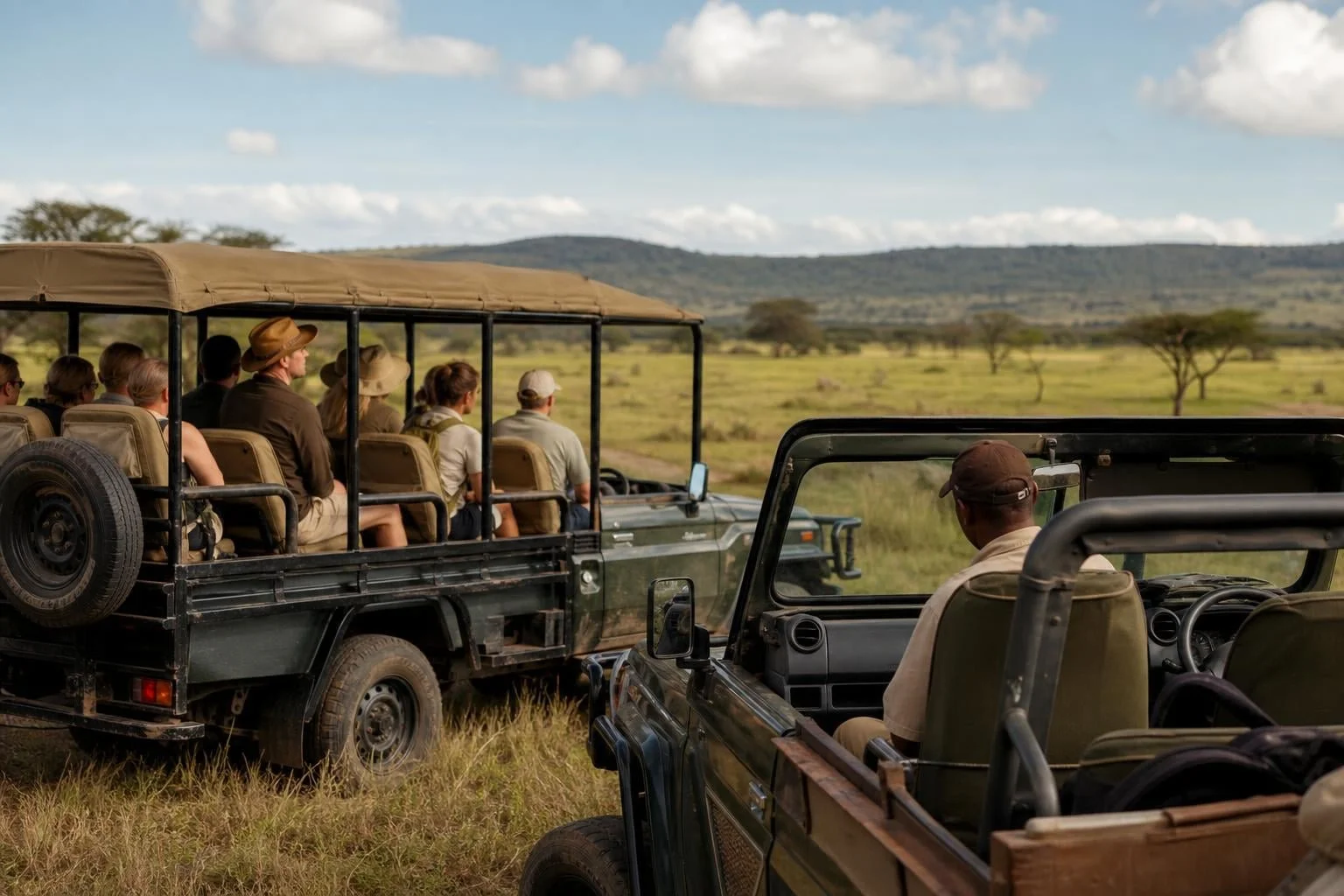
Group safari vehicle planning starts with one fundamental question: should you join a shared group safari or book a private vehicle? The answer depends on your budget, flexibility needs, group size, and how much control you want over daily game drives. This guide walks through that core decision, explains the vehicle types and terms you'll encounter in safari quotes, and shows how vehicle allocation drives both cost and experience quality. It also covers three topics most planning guides miss: passenger comfort and onboard amenities, accessibility and special requirements, and how seasonal crowding changes the vehicle equation.
Whether you're a couple weighing options, a family of 12 splitting across multiple Land Cruisers, or a traveler with mobility concerns, the vehicle decision shapes everything.
Quick Answer: Should You Choose a Group Safari or Private Safari?
Group safari vehicle planning means deciding whether to share a safari vehicle with other travelers or reserve one exclusively for your own group. A shared safari is generally cheaper per person and works best for solo travelers and budget conscious couples. A private safari provides greater flexibility, control over game drive schedules, and more personalized wildlife viewing.
For Tanzania safaris, a private Toyota Land Cruiser with four to six passengers is a common arrangement. Groups of four to six can often achieve a good balance between vehicle cost and flexibility, while larger groups may need multiple vehicles. Four passengers per vehicle can provide more comfortable viewing and photography space, although the ideal arrangement depends on the vehicle configuration and operator.
Get a custom vehicle plan for your group →
The Real Decision Behind Every Safari Quote
When people search for group safari vehicle planning, most aren't managing a 20 person corporate retreat. They're trying to figure out one thing: is it worth paying more for a private vehicle, or should I save money by joining a group?
This is the decision that shapes your entire safari. It determines whether you can linger at a cheetah sighting or move on because three strangers in your vehicle want to find elephants. It controls whether you start game drives at dawn or wait for everyone in the shared vehicle to finish breakfast. And it affects your per person cost by hundreds, sometimes thousands, of dollars.
The vehicle itself stays roughly the same either way: a pop top Toyota Land Cruiser with a driver guide. What changes is who's sitting in it, how many of them there are, and who gets to make decisions about where it goes.
Group Safari vs. Private Safari: The Comparison That Matters Most
Joining a Group Safari (Shared Vehicle)
A "joining" or shared safari means you book a seat on a vehicle alongside other travelers who signed up independently. The operator fills the vehicle (typically four to six passengers) from separate bookings, and everyone follows the same fixed itinerary.
What you get:
- Lower per person cost, often 30% to 50% less than a private vehicle
- A set itinerary with predetermined parks, lodges, and daily schedules
- A guide whose attention is split among all passengers
- No ability to customize stops, timing, or route
What you give up:
- Flexibility to change plans mid drive
- Control over how long you stay at sightings
- Say over the group's pace (early starts vs. sleeping in)
- Privacy for couples, honeymooners, or families with young kids
Joining safaris work well for solo travelers, budget conscious couples, and anyone comfortable adapting to a group dynamic. Practitioners on Reddit report that the social aspect can actually be a highlight: sharing a leopard sighting with fellow travelers creates memorable moments. But others note the frustration of wanting to spend 30 minutes watching a pride of lions while the rest of the vehicle is ready to move on after five.
Private Safari Vehicle
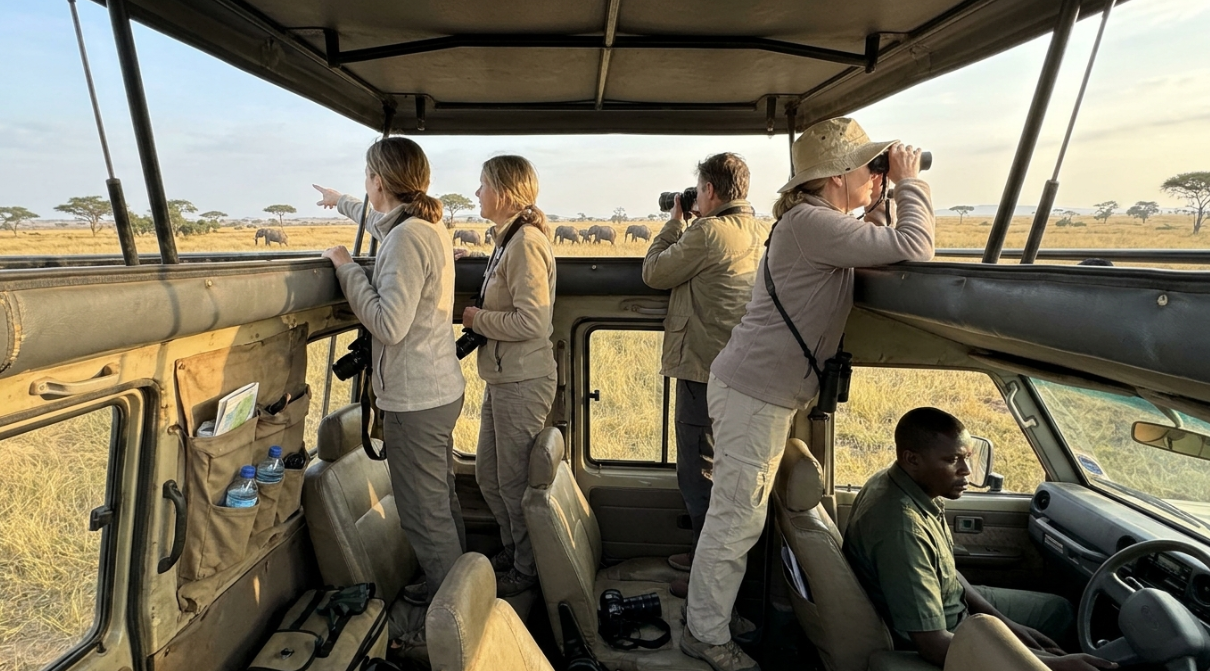
A private vehicle means your group (even if that "group" is just two people) has the entire Land Cruiser and guide to yourselves. You set the schedule, control the pace, and decide every stop.
What you get:
- Complete flexibility over daily timing and route
- A guide focused entirely on your interests
- Window seats for everyone without competition
- Freedom to return to the lodge early or extend a game drive
- Ability to accommodate mixed ages, energy levels, and interests
What you pay:
- Higher per person cost, since the fixed vehicle expenses (hire, fuel, guide salary) are split among fewer people
- Full responsibility for the Ngorongoro Crater descent fee ($295 per vehicle, not per person), which a couple absorbs at $148 each rather than the $49 to $74 per person that a larger group pays
A Fodors forum traveler noted that their private vehicle didn't cost much more than a shared group safari and made an enormous difference: having the vehicle to themselves meant everyone always had a prime view.
For groups of four, the math starts to shift. At four people sharing one private vehicle, the per person vehicle cost drops close to what you'd pay on a joining safari, but with none of the constraints. This is the sweet spot that experienced operators consistently recommend. For a full breakdown, the private group safari cost guide covers the details.
Group Safari vs. Private Safari: Cost Comparison by Group Size
The cost difference between a joining safari and a private safari depends largely on how many people share the vehicle. A private vehicle has fixed operating expenses, including vehicle hire, fuel, and the driver guide. These expenses are divided among the passengers traveling together.
| Travel Arrangement | Passengers | Vehicle Allocation | Cost Sharing Effect | Flexibility |
|---|---|---|---|---|
| Joining safari | 1 | Shared vehicle | Lowest individual vehicle expense | Limited |
| Joining safari | 2 | Shared vehicle | Low individual vehicle expense | Limited |
| Private safari | 2 | 1 vehicle | Highest vehicle expense per person | High |
| Private safari | 4 | 1 vehicle | Vehicle costs divided among four | High |
| Private safari | 6 | 1 vehicle | Vehicle costs divided among six | High |
| Private safari | 8 | 2 vehicles | Vehicle expenses divided across eight | High |
| Private safari | 12 | 2 to 3 vehicles | Depends on passenger allocation | High |
Example: How Private Vehicle Costs Are Shared
Assume a safari vehicle costs $240 per day to operate. This is an illustrative vehicle cost assumption, not a complete safari quotation.
| Passengers | Vehicles | Total Daily Vehicle Cost | Vehicle Cost Per Person |
|---|---|---|---|
| 2 | 1 | $240 | $120 |
| 4 | 1 | $240 | $60 |
| 6 | 1 | $240 | $40 |
| 8 | 2 | $480 | $60 |
| 12 | 2 | $480 | $40 |
These figures exclude accommodation, meals, park fees, taxes, and other safari expenses.
The main takeaway is that private safaris become more economical per person as more travelers share the same vehicle. However, adding another vehicle increases the total operating cost. The best arrangement balances the savings from sharing transportation with passenger comfort and flexibility.
If your group is weighing this decision, the safari for large families guide breaks down cost and experience differences in detail.
Passenger Comfort and Onboard Amenities
Vehicle choice is not just about cost and flexibility. How comfortable passengers feel during eight or more hours on rough roads directly affects whether a safari feels like an adventure or an ordeal. This is a part of group safari vehicle planning that too many travelers overlook until they're already on the road.
What "Comfort" Actually Means in a Safari Vehicle
A standard Tanzania safari Land Cruiser is not a luxury SUV. The suspension is stiff, designed for off road durability rather than smooth riding. Seats have basic foam cushions, and roads in parks like the Serengeti and Tarangire range from packed dirt to deeply rutted tracks during and after the rains. Knowing this upfront prevents disappointment.
That said, comfort varies significantly by operator and vehicle condition. Key factors include:
- Seat padding and condition: Newer vehicles generally have better cushioning. Older Land Cruisers (pre 2010) often have compressed foam that provides little shock absorption over rough terrain.
- Legroom: With six passengers across three rows, legroom in the rear is tight, especially for taller travelers. At four passengers, everyone can stretch.
- Pop top roof access: Standing through the roof hatch distributes body weight differently and relieves pressure on the lower back. With fewer passengers, everyone can stand simultaneously without crowding.
- Dust and ventilation: Vehicles in the convoy's rear catch significantly more dust. Some operators fit better seals around windows and the roof hatch. Others don't.
Amenities Worth Asking About
Not all safari vehicles are equal, even when they're the same model. Travelers on Reddit and safari forums consistently highlight a few amenities that make a real difference over multi day drives:
- Charging ports: USB ports or 12V outlets to keep cameras, phones, and binoculars charged. Many newer vehicles include them, but older ones may not. Ask before assuming.
- Cooler box: A built in or portable cooler for water and drinks during game drives. On full day drives in the Serengeti (where you leave at 6 AM and return at 6 PM), cold water matters more than you'd expect.
- Roof hatch design: Full length pop tops allow everyone in the vehicle to stand. Smaller hatches limit standing room to two or three passengers. This becomes a sore point when a leopard appears and half the group can't get a clear view.
- Beanbag or camera supports: Some operators provide window mounted beanbags for stabilizing cameras. Others expect you to bring your own. Photography focused travelers should confirm this in advance. For more on what to bring, the safari photography gear guide covers equipment specifics.
The Comfort Case for Fewer Passengers
Four passengers per vehicle is not just a viewing quality recommendation. It is a comfort decision. With four people, the middle row acts as a buffer (or gets used for gear), everyone has space to shift position, and nobody is pinned against a door for six hours straight.
One traveler in a YouTube safari review described a six person vehicle on the drive from Arusha to the Serengeti (roughly six to eight hours) as "like being packed into a car with distant relatives for Thanksgiving, except the road is worse." The same distance with four people was described by another reviewer as perfectly manageable.
Accessibility and Special Requirements
Safari vehicles were not designed with accessibility in mind. They sit high off the ground, require climbing a metal step to enter, and have narrow doorways. For travelers with mobility limitations, joint problems, or other physical considerations, this aspect of group safari vehicle planning requires extra attention well before departure.
Common Accessibility Challenges
- Vehicle entry and exit: Standard Land Cruisers require stepping up roughly 50 to 60 cm from the ground. Some vehicles have a fixed step, but it can be narrow and unstable on uneven terrain.
- Seating position: The rear row in most Land Cruisers is the hardest to access and the least comfortable. Travelers with hip or knee issues should be assigned the front passenger seat or first row behind the driver.
- Standing through the roof hatch: This requires pushing up from the seat and standing on the bench. Travelers with balance issues or upper body limitations may find this difficult.
- Terrain and vibration: Extended drives over unpaved roads cause continuous vibration that can aggravate back conditions, joint pain, or recent surgeries.
What Operators Can Arrange
Good operators have dealt with accessibility needs before, but they need advance notice. The accessible tours for seniors guide covers this in depth, though the principles apply to anyone with mobility concerns, not just older travelers.
Reasonable accommodations include:
- Vehicle selection: Some Land Cruiser configurations have wider doors or lower entry points. Operators with their own fleets (rather than subcontracted vehicles) have more control over which vehicle gets assigned.
- Seat assignment: Guaranteeing the front passenger seat for the entire safari, rather than rotating, is a simple accommodation that most operators will agree to.
- Modified step stools: A portable step placed at the vehicle door can reduce the step up height. Ask if the operator provides one.
- Shorter game drives: Instead of full day drives, breaking the day into two shorter sessions (morning and late afternoon) reduces fatigue without sacrificing wildlife viewing quality. The best sightings happen in early morning and late afternoon anyway.
- Private vehicle requirement: Travelers with accessibility needs should almost always book a private vehicle. On a joining safari, there is no guarantee of a preferred seat, no ability to stop for rest breaks, and no flexibility to cut a drive short.
Traveling with Wheelchair Users
Full wheelchair accessibility on a Tanzania game drive safari is extremely limited. Standard safari vehicles cannot accommodate wheelchairs. Some specialist operators in southern Africa offer modified vehicles with ramps and wheelchair locks, but these are uncommon in Tanzania's Northern Circuit parks. Travelers who use wheelchairs should discuss specific requirements directly with the operator well before booking to understand what is and isn't possible.
Medical Equipment and Medications
Travelers requiring CPAP machines, supplemental oxygen, or refrigerated medications should confirm power availability in the vehicle and at lodges. Most safari lodges run generators on set schedules (not 24 hours), which affects charging and device operation. The vehicle's 12V system can power some medical devices, but confirm wattage compatibility with the operator in advance.
Tanzania travel insurance is essential for any traveler with pre existing conditions, and coverage should include emergency evacuation from remote park locations.
How Many People Per Vehicle? The Quality Standard
Whether you're joining a group or booking a private vehicle, the number of passengers per vehicle is the single biggest quality lever on your safari. Four passengers per vehicle is the standard that experienced operators recommend.
How Many Safari Vehicles Does Your Group Need?
The number of safari vehicles required depends on passenger capacity, luggage requirements, and the level of comfort your group expects. A typical Tanzania safari Land Cruiser can be configured for up to six passengers, excluding the driver guide, while smaller passenger allocations provide more personal space.
The following table compares vehicle requirements when planning for a maximum of six versus four passengers per vehicle.
| Group Size | Vehicles at 6 Passengers | Vehicles at 4 Passengers |
|---|---|---|
| 2 to 4 | 1 | 1 |
| 5 to 6 | 1 | 2 |
| 7 to 8 | 2 | 2 |
| 9 to 12 | 2 | 3 |
| 13 to 16 | 3 | 4 |
| 17 to 20 | 4 | 5 |
| 21 to 24 | 4 | 6 |
Example: Planning Vehicles for a Group of 12
A group of 12 travelers has two main options:
- Two vehicles with six passengers each: Lower transportation costs and fewer vehicles to coordinate.
- Three vehicles with four passengers each: More personal space, easier photography, and potentially better access to viewing positions.
The best arrangement depends on the group's budget, luggage volume, ages, photography requirements, and preference for personal space.
Four passengers per vehicle is a comfort oriented recommendation, not a universal vehicle capacity regulation. Confirm the actual seating configuration and permitted passenger capacity with your safari operator before booking.
If you're organizing a trip for 10 or more travelers, planning for a group of 10 gets into the specifics of cost, logistics, and how to split people across vehicles.
Safari Vehicle Seating Arrangements: Where Should Passengers Sit?
Safari vehicle seating arrangements affect visibility, photography opportunities, comfort, and access to the pop up roof. Although configurations vary by vehicle model and operator, most Tanzania safari Land Cruisers have three passenger rows behind the driver and front passenger seat.
A typical configuration accommodates up to six passengers, with two seats per row.
What to consider when choosing seats:
- Front passenger seat: Offers a forward facing view and close interaction with the driver guide, although it may not have the same photography access as the rear passenger rows.
- Middle row: Provides convenient access to the viewing area and can be comfortable for travelers who want a balance between visibility and accessibility.
- Rear row: Offers additional seating but may have different viewing angles and less convenient access to equipment, depending on the vehicle design.
Why seat rotation matters
For groups sharing a vehicle, agree on a seat rotation schedule before the first game drive. This prevents the same passengers from occupying the preferred positions throughout the safari.
A simple rotation system can work as follows:
| Game Drive | Seating Arrangement |
|---|---|
| Day 1 morning | Original seating allocation |
| Day 1 afternoon | Rotate one position |
| Day 2 morning | Rotate again |
| Day 2 afternoon | Continue rotation |
For photography focused groups, discuss window access, camera support, and roof access with the operator before departure. The photography group safari guide covers vehicle setup for serious photographers in detail.
The most important consideration is not simply getting a particular seat. It is ensuring that every passenger has a comfortable and unobstructed wildlife viewing position throughout the safari.
Safari Vehicle Types You'll See in Quotes
Pop Top Land Cruiser
The standard safari vehicle in Tanzania and most of East Africa. A Toyota Land Cruiser 70/76 Series with four wheel drive, low range gearing for rough terrain, and a hinged roof panel that opens fully so passengers can stand for wildlife viewing and photography. Typical configurations seat six passengers across three rows of two.
Park regulations across Tanzania's national parks require enclosed vehicles with pop up roofs rather than fully open vehicles. This isn't an operator preference; it's a legal requirement in the Serengeti, Ngorongoro, Tarangire, and most other Northern Circuit parks.
Whether you're on a joining safari or a private booking, this is almost certainly the vehicle you'll be in. The key variable isn't the vehicle type but how many people sit inside it.
Safari Vehicle Luggage Capacity: How Much Space Does Your Group Need?
Passenger capacity and luggage capacity are two different things. A safari Land Cruiser may accommodate six passengers, but carrying six travelers with large suitcases and photography equipment can significantly reduce available storage space.
This becomes especially important for groups traveling between Arusha, Tarangire, Serengeti, and Ngorongoro, where vehicles may carry passengers and luggage over long distances.
Before booking, consider:
- Number of passengers: More travelers mean less available space for personal belongings.
- Luggage size: Large hard shell suitcases can be difficult to accommodate alongside other passengers' bags.
- Photography equipment: Camera bodies, telephoto lenses, tripods, and camera bags require additional storage.
- Children's equipment: Strollers, child seats, and extra clothing can increase luggage requirements.
- Fly in connections: Light aircraft generally impose stricter baggage limits than road safaris. The luxury safari luggage guide covers weight limits and packing strategies.
Example: Luggage Planning by Vehicle Allocation
| Group Arrangement | Main Consideration |
|---|---|
| 2 passengers, 1 vehicle | Usually more flexibility for luggage |
| 4 passengers, 1 vehicle | More room for personal equipment |
| 6 passengers, 1 vehicle | Storage needs careful planning |
| 8 passengers, 2 vehicles | Luggage can be distributed |
| 12 passengers, 3 vehicles | More room to separate equipment and personal bags |
These are planning considerations, not guaranteed luggage capacities. Actual storage depends on the vehicle's design, roof rack, seating configuration, and equipment.
What to ask your operator
Ask how many bags each vehicle can carry, whether roof storage is available, whether luggage is secured during travel, and whether camera equipment can remain accessible during game drives.
If your group is traveling with substantial luggage, two vehicles with fewer passengers may be more practical than filling one vehicle to its maximum passenger capacity.
Safari Minivan
A budget alternative to the Land Cruiser. Usually a Toyota Hiace or Nissan Caravan, seating six to eight passengers. Minivans are cheaper to hire and adequate on good roads, but they struggle on muddy tracks during the rainy season. The roof hatch is typically smaller than a Land Cruiser's full pop top, limiting how many people can stand and photograph simultaneously.
If an operator quotes a surprisingly low vehicle cost, ask whether they're using minivans. For anyone serious about wildlife viewing, the Land Cruiser is worth the extra cost.
Open Sided Game Viewer
The classic safari vehicle from Botswana and South Africa photos: open sides, tiered seating, no roof or a canvas canopy. These are rarely available in Tanzania except at certain fly in camps and private concessions. They're not permitted in most Tanzanian national parks.
Photography Vehicle
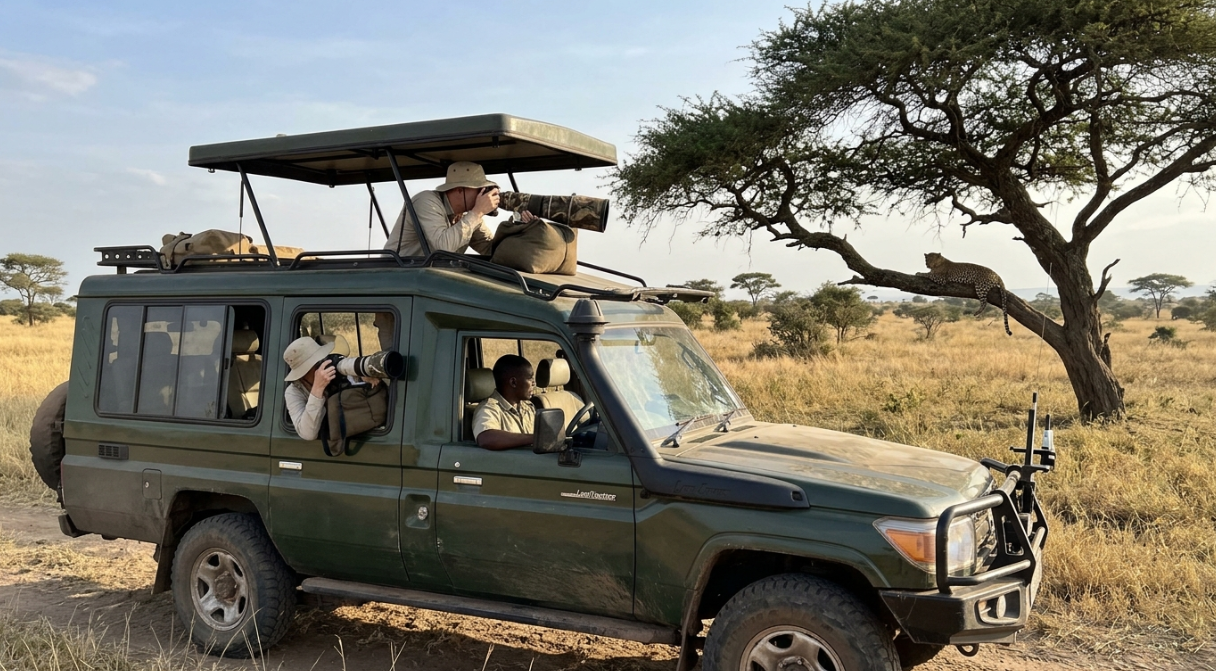
A modified Land Cruiser designed for serious photographers. Features typically include camera mounts or beanbag supports on window frames, lower side panels for ground level shots, and a maximum of four passengers to ensure unobstructed shooting angles.
If your group includes dedicated photographers alongside casual viewers, putting photographers in a separate vehicle with a photography focused guide prevents the frustration of one sub group wanting to spend 45 minutes at a sighting while the other is ready to move on after five.
Vehicle Costs, Park Fees, and How They Affect Your Budget
Understanding how costs work helps you compare group and private quotes accurately. This financial side of group safari vehicle planning is where most travelers either save or overspend.
Vehicle Cost Sharing
The fixed costs of a safari vehicle (hire, fuel, guide salary) don't change whether there are two passengers or six. These costs are split across however many people are in the vehicle. This is where group size delivers genuine savings, and it's the primary reason joining safaris cost less per person.
A group of eight in two private vehicles pays half the per person vehicle cost of a couple in one private vehicle. A solo traveler on a joining safari splits costs with five strangers and pays even less per person, but with zero control over the itinerary.
Tanzania Safari Vehicle Entry Fees: What Groups Should Budget For
Tanzania safari vehicle fees are separate from passenger conservation fees and accommodation expenses. The amount depends on the park authority, vehicle registration category, vehicle weight, and applicable tariff.
For international travelers, vehicle entry charges can be particularly important when planning a multi vehicle safari because each vehicle may incur its own applicable charges.
Before comparing quotes, distinguish between these cost categories:
| Cost Category | How It Is Charged | Impact on Group Budget |
|---|---|---|
| Vehicle hire | Usually per vehicle or per day | Shared among passengers |
| Fuel | Based on distance and itinerary | Depends on route and number of vehicles |
| Driver guide | Included or separately itemized | May increase with additional vehicles |
| Vehicle park entry | Per vehicle, subject to park tariff | More vehicles can mean higher charges |
| Passenger conservation fees | Per person | Increases with group size |
| Accommodation | Per person or room | Depends on room allocation |
| Crater service fee | Per vehicle and descent | Shared among passengers in that vehicle |
Why vehicle weight matters
Tanzania's published vehicle tariffs use vehicle weight categories. Therefore, two safari vehicles may not necessarily attract the same entry charge.
When requesting a quotation, ask the operator to identify the applicable vehicle entry fees rather than assuming that every Land Cruiser attracts one flat rate.
For current charges, consult the Tanzania National Parks Authority tariff information and the Ngorongoro Conservation Area Authority tariff portal.
Park charges and government tariffs can change. Confirm the applicable rates for your travel dates before paying a deposit.
Ngorongoro Crater Descent Fee: Why Vehicle Allocation Matters
The Ngorongoro Crater service fee is charged per vehicle for each descent into the crater, rather than being divided into a standard per person charge. This makes vehicle allocation an important part of safari budgeting.
For example, a group sharing one vehicle divides the applicable vehicle fee among its passengers, while a couple traveling privately carries a larger share of that expense.
Using an illustrative total fee of $295 per vehicle:
| Passengers | Vehicles | Total Crater Fee | Cost Per Person |
|---|---|---|---|
| 2 | 1 | $295 | $147.50 |
| 4 | 1 | $295 | $73.75 |
| 6 | 1 | $295 | $49.17 |
| 8 | 2 | $590 | $73.75 |
| 12 | 2 | $590 | $49.17 |
These calculations assume every vehicle makes one descent and the $295 amount is the applicable final charge, including relevant taxes.
The practical lesson is that adding passengers to a vehicle can reduce the crater fee per person, provided the vehicle remains within its permitted passenger capacity.
When comparing safari quotations, ask:
- Is the crater service fee included?
- Is the quoted amount inclusive of VAT?
- Is the fee charged for each vehicle or each descent?
- Will every vehicle in the group descend into the crater?
- Are any additional vehicle permits or charges applicable?
Always confirm the current applicable rate with your safari operator or the Ngorongoro Conservation Area Authority before booking.
For a deeper look at how park fees and vehicle costs add up, Tanzania safari cost per person provides a full breakdown.
Per Person Per Day (PPPD)
The standard pricing unit in safari quotes. Vehicle and guide costs decrease on a PPPD basis as group size increases. Park fees and accommodation don't; those are fixed per person. Understanding this distinction helps you compare a joining safari quote against a private vehicle quote accurately. The vehicle savings on a joining safari come entirely from splitting fixed costs more ways.
Seasonal Vehicle Crowding: When Timing Changes the Vehicle Equation
Group safari vehicle planning doesn't happen in a vacuum. The time of year you travel dramatically affects how crowded parks feel, how many vehicles cluster at sightings, and whether a shared safari feels sociable or claustrophobic.
Peak Season Realities (June through October, December through February)
Tanzania's dry seasons coincide with European and North American school holidays, creating peak demand. During July and August in the Serengeti, it's common to find 15 to 20 vehicles at a single lion sighting. The Ngorongoro Crater floor, which has limited space to begin with, can feel like a parking lot during peak weeks.
This matters for vehicle planning in several ways:
- Joining safaris fill faster during peak months, which means less control over who your vehicle mates are. During low season, operators sometimes struggle to fill vehicles, and a joining safari might effectively become semi private with only two or three passengers.
- Vehicle positioning becomes competitive. At popular sightings, your guide's ability to get a good angle depends partly on how early you arrive. Private vehicles have an advantage because they can leave camp earlier without waiting for a full vehicle to assemble.
- Park vehicle limits at sightings are enforced more strictly during peak months. If your multi vehicle group arrives together, three of your four vehicles might count against the five vehicle cap, leaving less room for maneuvering.
Green Season Advantages (March through May, November)
The "long rains" of March through May and "short rains" of November represent low season. Fewer tourists, lower prices, and dramatically less vehicle congestion. A game drive in April might encounter two or three vehicles at a sighting rather than twenty.
For group safari vehicle planning, green season offers some specific benefits:
- Private vehicle pricing drops. Operators discount vehicle rates during low season, narrowing the price gap between joining and private safaris. A couple that couldn't justify a private vehicle in July might find it affordable in April.
- Fewer passengers on joining safaris. With lower demand, joining safari vehicles often run with three or four passengers rather than the maximum six. This means more space without paying the private vehicle premium.
- Less pressure on seat rotation. When every sighting has only your vehicle present, the distinction between front row and back row matters less. Everyone gets an unobstructed view regardless of position.
The trade off is that some roads become difficult or impassable during heavy rains. Minivans are particularly vulnerable to getting stuck in mud. Land Cruisers handle wet conditions far better, but even they can bog down on certain Serengeti tracks. This is another reason the vehicle type matters. For timing your trip, the best time for Tanzania safari guide covers wildlife patterns month by month.
How Crowding Affects Multi Vehicle Groups
Large groups face a specific challenge during peak season. A family reunion with four vehicles arriving at a leopard sighting effectively overwhelms the viewing area. Good operators plan for this by having vehicles split routes in the morning and share sightings via radio rather than traveling as a convoy.
Practitioners on safari forums consistently warn against "caravan style" driving during peak months. One guide shared in a YouTube walkthrough that the worst thing a multi vehicle group can do is follow each other bumper to bumper across the Serengeti. It guarantees that every vehicle arrives at the same time, creates its own traffic jam, and misses the sightings the other vehicles would have found on a different route.
The smart approach: assign vehicles to different sectors of the park each morning, share significant finds by radio, and reconvene at a designated lunch spot.
When Groups Get Bigger: Multi Vehicle Coordination
For families, friend groups, or any party large enough to need two or more vehicles, group safari vehicle planning shifts from the group vs private question to a coordination challenge.
Best Safari Vehicle Arrangement for Different Group Types
The ideal vehicle allocation depends on more than the number of travelers. Age differences, photography equipment, mobility requirements, and individual interests can influence whether a group should share one vehicle or divide into smaller groups.
| Group Type | Recommended Arrangement | Main Consideration |
|---|---|---|
| Solo travelers | Joining safari | Lower individual cost and social experience |
| Couples | Private vehicle or joining safari | Privacy versus budget |
| Families with young children | Private vehicle | Flexible schedules and breaks |
| Multigenerational families | Private vehicles with coordinated guides | Different activity levels and comfort needs |
| Groups of friends | One or more private vehicles | Shared interests and group size |
| Photography groups | Photography focused private vehicles | Window access and equipment space |
| Corporate groups | Multiple coordinated vehicles | Scheduling and group management |
Families with children
Families often benefit from private vehicles because children may need additional breaks, flexible meal times, or shorter game drives. Parents can discuss child seats, vehicle access, and suitable game drive schedules with the operator. The family safari itinerary planner covers how to build a schedule that works for kids without sacrificing wildlife viewing.
Multigenerational groups
Grandparents, parents, and children may have different expectations. Multiple vehicles allow travelers to divide into smaller groups according to their preferred pace, while still following the same overall itinerary.
Photography groups
Wildlife photographers may need longer viewing periods, unobstructed camera positions, and additional room for equipment. A dedicated photography vehicle can help prevent competing priorities during game drives.
Groups of friends
Friends traveling together may prefer to share a private vehicle to reduce individual transportation costs. However, once the group exceeds the comfortable capacity of one vehicle, splitting into two coordinated vehicles may provide a better experience.
The best vehicle arrangement is the one that accommodates the group's actual travel requirements rather than simply filling every available seat.
Vehicle Split
How a group distributes itself across multiple vehicles. This is one of the most consequential decisions in group safari vehicle planning, and the one most organizers make passively rather than actively.
A family of 13, ages 11 to 62, the kind of multigenerational group where energy levels and interests vary enormously, needs at least three vehicles at four per vehicle. Each vehicle gets its own guide, its own pace, and its own route within the day's plan. The grandparents can return to the lodge early while the teenagers push for a sunset drive.
For groups with mixed ages, multigenerational safari planning covers how to structure vehicle splits so everyone gets the trip they want.
Head Guide / Lead Guide
In multi vehicle groups, one guide takes a coordination role: managing radio communication, making decisions about route changes when roads are bad, and serving as the primary contact with lodge staff. Not every operator designates a formal head guide, so it's worth asking.
VHF / Two Way Radio
Guides use dashboard mounted radios to communicate with park officials and other guides. When a leopard appears on a kopje, word travels across radio channels within minutes.
For multi vehicle groups, the radio serves a different function: coordinating between your own vehicles. Your guides can agree to meet at a specific picnic spot, share a sighting one vehicle found, or arrange different routes so the group covers more ground. It's your private intelligence network rather than a shared free for all.
Vehicle Positioning and Sighting Etiquette
Many Tanzanian parks limit the number of vehicles at a single sighting, often to five at a time. For multi vehicle groups, your three or four vehicles might count toward that cap. A good lead guide will coordinate so your vehicles rotate rather than monopolize the sighting.
A skilled guide also knows how to position the vehicle at the optimal angle for viewing: sun behind the passengers, anticipating the animal's movement, rotating as the animal shifts.
Seat Rotation
The practice of rotating passengers to different positions between game drives. The front row beside the guide offers the best view and photography angle; the back row catches more dust. Most guides will suggest a rotation if the group doesn't establish one themselves. Do it between drives, not while the vehicle is moving.
Drive In vs. Fly In: What Changes for Your Vehicle Arrangement
Drive In (Road) Safari
Your group travels overland between parks in its own vehicles with its own guides. For groups of four or more, driving is typically more cost effective than flying, even when factoring in longer travel times. The group keeps its private vehicles and guides throughout, maintains control over stops and pace, and avoids luggage restrictions.
This is where the private vehicle advantage really compounds. The same guide and vehicle that take you through Tarangire accompany you to the Serengeti and Ngorongoro. That continuity with your guide, someone who learns your interests and preferences over several days, is a significant quality factor that joining safaris and fly in itineraries often can't match.
Fly In Safari
The group flies between airstrips on light aircraft, typically Cessna Caravans holding 12 to 14 passengers. Game drives at each destination use vehicles provided by the camp, which are usually shared with other camp guests unless your group pays for exclusive use vehicles.
This is the detail most travelers miss. A fly in safari effectively resets your vehicle arrangement at every stop. Your group of four might share vehicles with strangers at the lodge, losing the private vehicle benefit you'd have on a drive in safari. If maintaining a private vehicle throughout is important, confirm this with the operator before booking fly in segments. The luxury fly in safari guide explains how to secure private vehicles at remote camps.
Empty Leg Charges
When your group flies from one park to the next but the vehicle and driver must return overland to their base, you pay for that "empty" return trip. This cost is built into some quotes and itemized in others. For groups comparing drive in and fly in options, empty leg charges can narrow the price gap.
Luggage Restrictions
Light aircraft in East Africa typically allow 15 kg per person in soft sided bags. Groups with heavy camera gear or families with children's equipment will face real constraints. If your group includes serious photographers with long lenses, this alone might tip the decision toward a drive in safari where luggage capacity is virtually unlimited.
Questions to Ask Your Operator About Vehicles
What Happens If a Safari Vehicle Breaks Down?
Vehicle reliability is an important consideration when organizing a group safari, especially when traveling through remote areas of Tanzania.
A mechanical problem can interrupt a game drive, delay transfers between parks, or affect the schedule of an entire group. The consequences can be more significant when several vehicles are traveling together.
Before booking, understand how your operator handles vehicle maintenance and emergency replacements.
Important questions to ask include:
- Does the operator maintain its own safari vehicles?
- Are vehicles inspected before each safari?
- Is a backup vehicle available in the operating region?
- How quickly can a replacement vehicle reach the group?
- Can passengers be temporarily transferred to another vehicle?
- Does the operator have a communication system for remote areas?
Why this matters for multi vehicle groups
If one vehicle breaks down during a safari involving 12 travelers, the operator needs a plan for the affected passengers without unnecessarily disrupting the entire group.
A well organized operator should explain its contingency arrangements before the trip begins. Ask whether replacement vehicles are included in the quoted service or whether additional charges could apply.
Vehicle reliability is not just a transportation issue. It directly affects the group's safety, schedule, and overall safari experience.
Whether you're comparing joining safaris or pricing a private vehicle, these questions cut straight to the details that matter:
- How many passengers will be in each vehicle? Accept nothing vague. Get a specific number guaranteed in writing.
- Is the vehicle private to my group, or will I share with other travelers? The most important question for couples and small groups.
- What flexibility do I have to change the daily schedule? On a joining safari, usually none. On a private vehicle, plenty, but confirm this.
- What is the vehicle make, model, and approximate year? A 2015 Land Cruiser and a 2005 Land Cruiser offer different reliability and comfort.
- Is the Ngorongoro Crater descent fee included in the quoted price?
- For fly in segments, will my group have private vehicles at the camp? Or will we share with other guests?
- Can vehicles split for different activities? Relevant for families and groups with mixed interests.
- What happens if a vehicle breaks down? Is there a backup vehicle? How quickly can a replacement arrive?
- What onboard amenities does the vehicle include? Charging ports, cooler box, beanbag supports for cameras.
- Can the vehicle accommodate any accessibility or mobility needs in our group? Specify exactly what's required rather than asking generally.
If you want help evaluating vehicle arrangements in an operator's quote, Duma Explorer's team can walk through the details. They operate their own vehicles in Tanzania through their local operation, Alika Africa, and understand exactly how vehicle allocation affects day to day safari quality, whether you're a couple considering a private vehicle or a family of 12 coordinating a convoy.
Request a custom safari itinerary →
How Vehicle Planning Connects to the Bigger Picture
Vehicle decisions don't happen in isolation. Your choice between group and private affects everything from lodge selection to daily scheduling to how much you spend overall. A couple choosing a private vehicle over a joining safari adds cost but gains freedom. A family of eight booking two private vehicles saves per person while maintaining complete flexibility, the best of both worlds.
For travelers starting to map out timing and logistics, the group safari booking timeline explains when to lock in vehicles, guides, and accommodations relative to your travel dates.
For larger groups, the complexity multiplies in ways that deserve separate attention. Corporate safari retreat planning covers how to manage logistics for 20 plus travelers without the trip feeling like a military operation.
FAQ
Should I join a group safari or book a private vehicle?
It depends on your priorities. Joining safaris cost less per person and work well for solo travelers or budget conscious couples comfortable with a fixed itinerary. Private vehicles cost more but give you complete control over pace, stops, and timing. For groups of four or more, private vehicles often approach joining safari pricing while offering far more flexibility.
How many people fit in a Tanzania safari vehicle?
A standard pop top Toyota Land Cruiser seats six to seven passengers across three rows. The comfortable and recommended limit for quality game viewing is four passengers. At four, everyone has a window seat with room for cameras and personal space through the pop top roof.
Is it better to have 4 or 6 passengers per vehicle?
Four is better for the experience. Six is cheaper per person. At four passengers, everyone has unobstructed views, comfortable roof hatch access, and a guide who can cater to fewer preferences. At six, the vehicle is crowded, the back row feels cramped, and photography becomes a competition for position. If budget allows, four per vehicle is the recommendation from nearly every experienced safari operator.
How much does an extra safari vehicle cost for a group?
An additional vehicle adds vehicle hire (typically $150 to $300 per day), fuel, an extra guide's salary, vehicle park entry fees ($20 to $40 per park per day), and the Ngorongoro Crater descent fee ($295 per vehicle) if applicable. Over a 7 day safari, the total incremental cost of one additional vehicle is roughly $1,500 to $3,000, split across the group.
What is the Ngorongoro Crater vehicle fee and how does it affect my cost?
The crater descent fee is $295 per vehicle per descent, not per person. A couple in a private vehicle pays $148 each. A group of 6 on a joining safari pays about $49 each. Most travelers find the cost difference acceptable given the private vehicle's flexibility advantages, but it's worth knowing how the math works when comparing quotes.
Should a group book a fly in or drive in safari?
For groups of four or more, drive in is usually more cost effective and preserves your private vehicle arrangement throughout the trip. Fly in safaris reset your vehicle situation at each camp, often defaulting to shared vehicles with other guests. Fly in makes sense when distances are extreme (southern Tanzania's Ruaha or Selous from Arusha) or when the group values time savings over vehicle continuity.
Do all vehicles in a multi vehicle group follow the same route?
Not necessarily, and often they shouldn't. Splitting routes means your group covers more ground, finds more sightings independently, and avoids the congestion of four of your own vehicles lined up at every stop. Guides coordinate via radio to share significant sightings, and the group reconvenes at lunch or back at the lodge.
Can safari vehicles accommodate travelers with mobility limitations?
Standard Land Cruisers are not built for wheelchair access and require stepping up a significant height to enter. However, operators can make accommodations including guaranteed front seat assignment, portable step stools, shorter game drive sessions, and vehicle selection for wider door configurations. Always communicate specific needs well before booking so the operator can plan appropriately.
What should I prioritize when starting group safari vehicle planning?
Start with the group vs. private decision, then determine how many passengers per vehicle you want (four is the comfort standard), and finally work out the vehicle split if your party needs multiple vehicles. Season matters too: peak season (June through October, December through February) offers the best weather and wildlife viewing but brings significant vehicle crowding at popular sightings. Green season (March through May, November) means fewer tourists, lower vehicle rates, and less competition at sightings, but some roads may become difficult. Groups willing to travel in green season can often upgrade from a joining safari to a private vehicle for similar or lower cost.
Planning the right vehicle arrangement, whether that means choosing between a joining safari and a private booking or coordinating multiple vehicles for a family trip, is the decision that shapes your entire safari experience. Start the vehicle conversation early, before lodges and parks are even on the table.